Market Overview
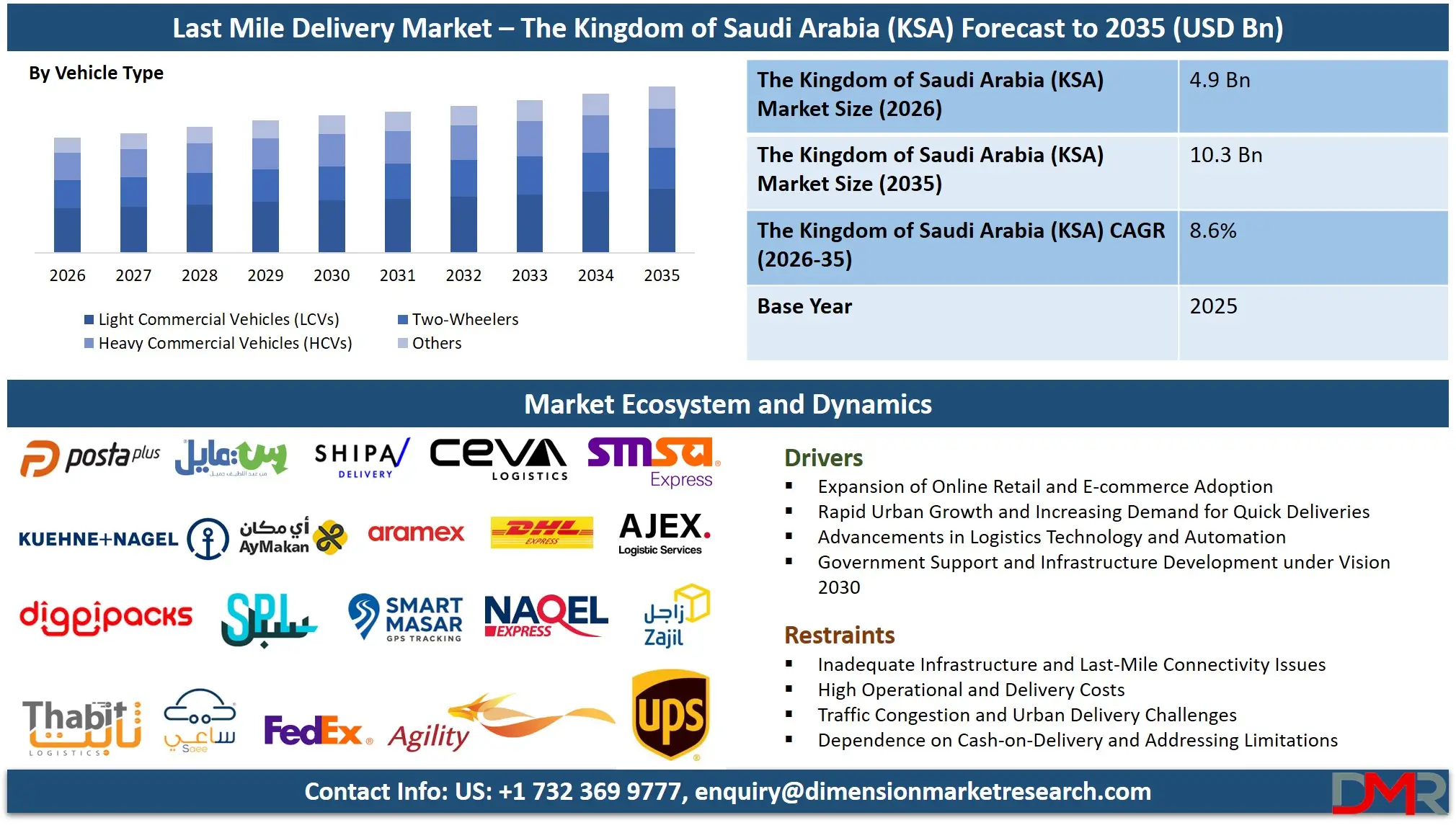
Saudi Arabia last mile delivery market size is expected to reach a value of USD 4.9 billion in 2026, and it is further anticipated to reach a market value of USD 10.3 billion by 2035 at a CAGR of 8.6%.
ℹ
To learn more about this report –
Download Your Free Sample Report Here
The KSA's last-mile delivery market represents one of the fastest-evolving logistics ecosystems in the Middle East, driven by rapid urbanization, digital transformation, and strong government-backed economic diversification initiatives under Vision 2030. Major cities such as Riyadh, Jeddah, and Dammam act as key hubs for last-mile operations, supported by expanding infrastructure and rising consumer demand.
Last-mile delivery in KSA is increasingly integrated into daily life, fueled by a young, tech-savvy population and high smartphone penetration. Consumers expect fast delivery timelines, real-time tracking, and flexible delivery options, prompting logistics providers to innovate continuously. The growing presence of parcel lockers, dark stores, and pickup points is enhancing delivery flexibility across urban areas.
The market has undergone significant transformation due to digitalization and automation. Technologies such as artificial intelligence, IoT-enabled tracking, and predictive analytics are being widely deployed to improve delivery efficiency and accuracy. Additionally, smart city initiatives are enabling the development of intelligent logistics networks.
E-commerce growth remains a primary catalyst, with platforms such as Noon and Amazon Saudi Arabia driving significant parcel volume growth. The pandemic further accelerated online shopping adoption, making Last-Mile delivery a critical component of the retail ecosystem.
ℹ
To learn more about this report –
Download Your Free Sample Report Here
Sustainability is also gaining traction, with logistics providers investing in electric vehicles, alternative fuels, and optimized route planning. Government initiatives supporting green mobility are influencing industry practices.
Despite strong growth, the market faces challenges such as workforce dependency on expatriates, rising operational costs, and complex Last-Mile logistics in rapidly expanding urban environments. Overall, the KSA Last-Mile delivery market is characterized by rapid technological advancement, evolving consumer expectations, and strong economic backing.
The Kingdom of Saudi Arabia (KSA) Last-Mile Delivery Market: Key Takeaways
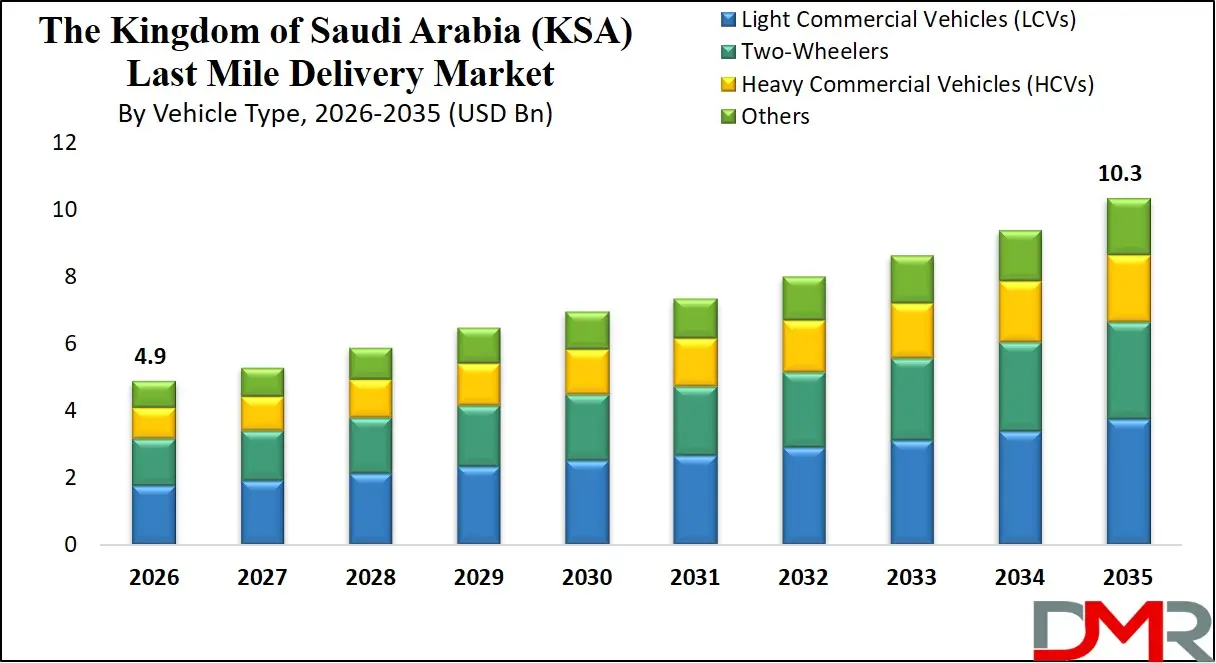
- Market Growth Insights: The market is anticipated to reach approximately USD 4.9 billion in 2026 and is projected to expand to around USD 10.3 billion by 2035, registering a CAGR of 8.6% during the forecast period.
- By Delivery Mode Insights: Ground transportation remains the leading segment, supported by well-developed road infrastructure and its efficiency in managing high parcel volumes across both urban and rural regions.
- By Vehicle Type Insights: Light commercial vehicles, especially compact vans, are predominantly utilized due to their flexibility and suitability for navigating KSA's urban layouts and expanding city environments.
- By Service Type Insights: The B2C segment holds the largest share, driven by the rapid rise of e-commerce and the increasing adoption of direct-to-consumer business models.
- By Delivery Time Frame Insights: Standard and next-day delivery services continue to dominate, while same-day delivery is witnessing increasing demand, particularly in major metropolitan areas.
- By Application Insights: E-commerce and retail applications account for the majority of market share, reflecting the growing reliance on online shopping platforms across KSA.
- By End-User Insights: Large enterprises lead the market, benefiting from strong financial capabilities and the ability to invest in advanced logistics technologies and infrastructure.
- Key Players Insights: Major market participants include Saudi Post (SPL), Aramex, SMSA Express, Noon, Amazon Saudi Arabia, and other key players.
The Kingdom of Saudi Arabia (KSA) Last-Mile Delivery Market: Use Cases
- E-commerce Driven Fulfillment Ecosystem: E-commerce fulfillment represents the most significant and rapidly growing use case in the KSA Last-Mile delivery market. Logistics providers are increasingly adopting advanced technologies such as automated sorting, AI-based demand forecasting, and real-time tracking to streamline delivery operations. The seamless integration between fulfillment centers and Last-Mile networks ensures efficient order processing and timely deliveries.
- Convenience-Led Grocery and Food Delivery Expansion: The grocery and food delivery segment has experienced strong growth, driven by evolving consumer lifestyles and a rising preference for convenience. Companies are investing in cold chain logistics, temperature-controlled systems, and real-time tracking solutions to ensure the safe and efficient delivery of perishable goods.
- Critical Healthcare and Pharmaceutical Distribution: The healthcare logistics segment demands high levels of reliability and security for transporting pharmaceuticals, medical equipment, and diagnostic samples. Logistics providers utilize specialized packaging, temperature monitoring, and tracking systems to maintain product integrity. Digital integration also enhances coordination between healthcare providers and delivery networks.
- Accelerated Urban Retail and Same-Day Delivery Models: Same-day retail delivery is gaining significant momentum in KSA, particularly in urban centers. Retailers are leveraging local stores and micro-fulfillment hubs to accelerate delivery times and remain competitive with major e-commerce platforms. Advanced routing technologies and real-time data analytics play a crucial role in optimizing delivery efficiency.
The Kingdom of Saudi Arabia (KSA) Last-Mile Delivery Market: Stats & Facts
Transport General Authority (TGA), Saudi Arabia
- Over 63 million parcels were delivered in Q1 2025, highlighting rapid growth in Last-Mile logistics demand.
- More than 50 million parcels were delivered in Q2 2025, marking one of the highest quarterly delivery volumes recorded.
- Total delivery service requests, including food and courier services, exceeded 101 million orders in Q2 2025, reflecting strong demand for Last-Mile services.
Saudi Vision 2030 / National Transport and Logistics Strategy (NTLS)
- The government aims to position KSA as a global logistics hub connecting three continents, significantly boosting Last-Mile delivery demand.
- Logistics sector development is a key pillar of economic diversification, driving investments in transportation and delivery infrastructure.
Saudi Post (SPL) / Postal Network Data
- Saudi Post operates around 13,000 postal branches and service points nationwide, supporting extensive Last-Mile connectivity.
- The organization employs over 45,000 personnel, enabling large-scale logistics and delivery operations across the country.
General Authority for Statistics (GASTAT), Saudi Arabia
- E-commerce adoption continues to rise steadily, contributing significantly to increased parcel delivery volumes across urban regions.
- High urban population concentration is accelerating demand for faster and more efficient Last-Mile delivery services.
The Kingdom of Saudi Arabia (KSA) Last-Mile Delivery Market: Market Dynamic
Driving Factors in the Kingdom of Saudi Arabia (KSA) Last-Mile Delivery Market
Rapid E-commerce Expansion
The rapid expansion of e-commerce platforms such as Noon and Amazon Saudi Arabia is significantly increasing parcel volumes across the Kingdom. A growing digital consumer base, high smartphone penetration, and improved online payment systems are accelerating online retail adoption. Consumers increasingly expect faster, more flexible delivery options, prompting logistics providers to enhance their Last-Mile capabilities. Additionally, the rise of direct-to-consumer brands and omnichannel retail strategies is further intensifying delivery demand, requiring efficient, scalable, and technology-driven logistics networks to ensure timely and reliable order fulfillment across both urban and semi-urban regions.
Urbanization and Smart City Development
Rapid urbanization and large-scale smart city initiatives are transforming the logistics landscape in Saudi Arabia. Mega projects such as NEOM are driving infrastructure modernization and enabling advanced logistics ecosystems. Increasing population concentration in cities is generating higher delivery density, requiring more efficient route planning and distribution strategies. Smart infrastructure, including connected transport systems and digital platforms, is supporting real-time logistics optimization. These developments are encouraging the adoption of innovative delivery solutions, improving operational efficiency, and creating a more integrated and technologically advanced Last-Mile delivery environment across the Kingdom.
Restraints in the Kingdom of Saudi Arabia (KSA) Last-Mile Delivery Market
High Operational Expenses
High operational costs remain a significant challenge in the KSA Last-Mile delivery market. Expenses related to fuel, vehicle maintenance, labor, and infrastructure development continue to rise, putting pressure on logistics providers' profit margins. Additionally, investments in advanced technologies such as automation, artificial intelligence, and electric vehicles require substantial capital expenditure. Balancing cost efficiency with service quality is increasingly difficult, especially as consumers expect fast and low-cost delivery services. Companies must continuously optimize routes, improve fleet utilization, and adopt cost-effective technologies to maintain competitiveness while managing rising operational expenditures in a dynamic and demanding market environment.
Urban Delivery Complexity
Urban delivery operations in Saudi Arabia face increasing complexity due to traffic congestion, rapid city expansion, and high delivery density. Navigating densely populated areas, managing delivery time windows, and ensuring efficient parking and access present ongoing challenges. Infrastructure limitations in certain urban zones further complicate operations. Logistics providers must rely on advanced routing systems, real-time traffic data, and optimized scheduling to ensure timely deliveries. Additionally, the need to balance speed, cost, and environmental considerations adds further pressure. These complexities require continuous innovation in logistics planning, vehicle deployment, and Last-Mile strategies to maintain service reliability and efficiency.
Opportunities in the Kingdom of Saudi Arabia (KSA) Last-Mile Delivery Market
Autonomous and Drone Delivery
The adoption of autonomous vehicles and drone delivery presents significant growth opportunities in the KSA Last-Mile delivery market. These technologies have the potential to reduce labor dependency, lower operational costs, and improve delivery efficiency. In remote and less densely populated areas, drones can provide faster and more cost-effective delivery solutions, particularly for essential goods. Autonomous ground vehicles are also being explored for urban logistics to enhance Last-Mile efficiency. Supportive government initiatives and technological advancements are expected to accelerate adoption, enabling logistics providers to expand service coverage, improve delivery speed, and create innovative solutions for evolving consumer demands.
Green Logistics Initiatives
Sustainability is emerging as a key opportunity in the KSA Last-Mile delivery market. Logistics providers are increasingly adopting environmentally friendly practices such as electric vehicle fleets, fuel-efficient transportation, and sustainable packaging solutions. Government policies promoting reduced carbon emissions are encouraging the transition toward greener logistics operations. Route optimization technologies are also being used to minimize fuel consumption and improve efficiency. Additionally, the use of alternative delivery methods such as cargo bikes in urban areas is gaining traction. These initiatives not only reduce environmental impact but also enhance brand reputation and align with global sustainability trends, creating long-term growth opportunities.
Trends in the Kingdom of Saudi Arabia (KSA) Last-Mile Delivery Market
Automation and AI Integration
Automation and artificial intelligence are transforming Last-Mile delivery operations in Saudi Arabia. AI-powered systems are enabling advanced route optimization, predictive analytics, and demand forecasting, allowing logistics providers to improve efficiency and reduce delivery times. Automated warehouses and robotic sorting systems are streamlining order processing and minimizing human error. These technologies also help address labor challenges and enhance scalability in high-demand periods. Real-time data analysis enables better decision-making and resource allocation. As technology adoption increases, automation and AI are becoming essential components of modern logistics strategies, driving innovation and improving overall service quality in the Last-Mile delivery market.
Smart Logistics and Micro-Fulfillment
The rise of smart logistics and micro-fulfillment centers is reshaping Last-Mile delivery in KSA. IoT-enabled systems and cloud-based platforms provide real-time visibility across the supply chain, improving coordination and operational efficiency. Micro-fulfillment centers located close to urban consumers reduce delivery distances and enable faster order processing. These facilities support same-day and next-day delivery services while lowering transportation costs. Retailers and logistics providers are increasingly investing in localized distribution networks to meet growing consumer expectations. This trend is enhancing delivery speed, improving customer satisfaction, and optimizing resource utilization, making logistics operations more agile and responsive.
The Kingdom of Saudi Arabia (KSA) Last-Mile Delivery Market: Research Scope and Analysis
By Delivery Mode Analysis
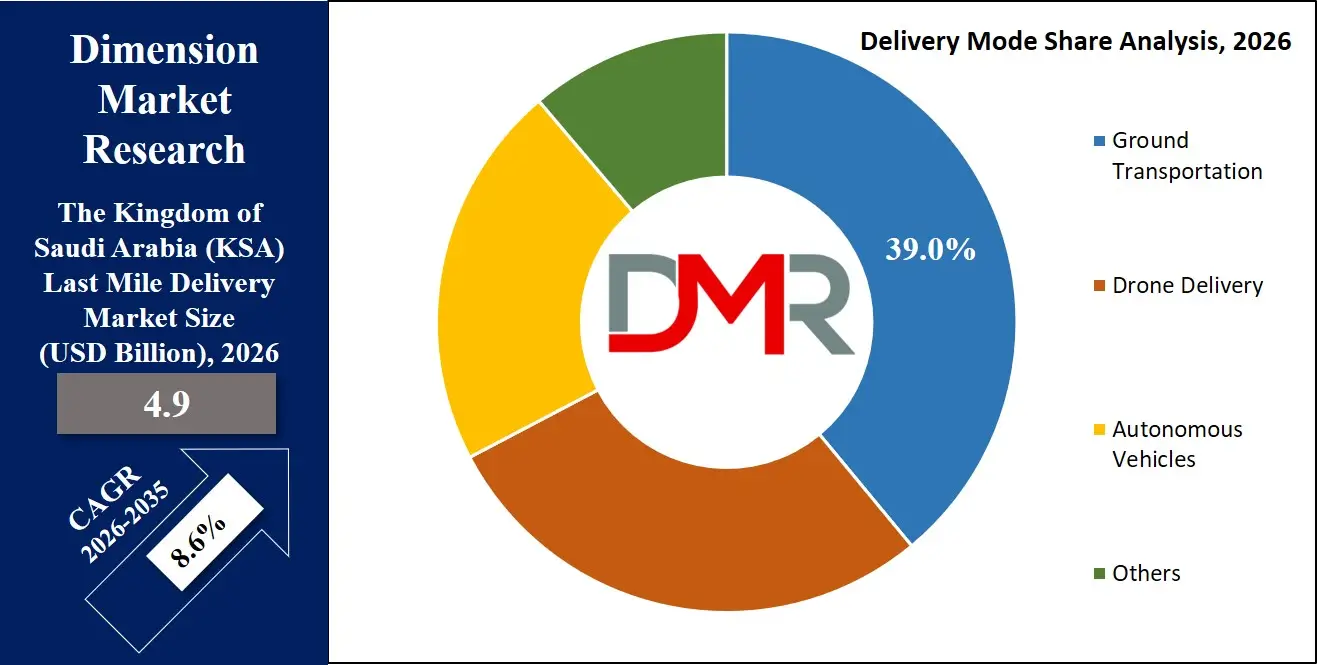
Ground transportation is expected to dominate the KSA Last-Mile delivery market due to its strong road infrastructure, operational flexibility, and ability to efficiently handle high parcel volumes across diverse geographic regions. Saudi Arabia has invested heavily in developing an extensive road network that connects major urban centers such as Riyadh, Jeddah, and Dammam with suburban and rural areas, enabling seamless goods movement. Ground delivery offers unmatched scalability, making it suitable for a wide range of shipments, from small parcels to bulk deliveries.
ℹ
To learn more about this report –
Download Your Free Sample Report Here
Additionally, logistics providers benefit from the flexibility of ground transport in managing dynamic delivery routes and schedules, especially in high-demand urban environments. Real-time tracking, route optimization software, and fleet management systems further enhance operational efficiency. While alternative delivery modes such as drones and autonomous vehicles are gaining attention, their adoption remains limited due to regulatory, technological, and infrastructure constraints. However, pilot programs are being explored, particularly for remote and hard-to-reach areas. Despite emerging innovations, ground transportation remains the backbone of Last-Mile logistics in KSA, supported by continuous investments in infrastructure and digital technologies that ensure reliability, cost-effectiveness, and nationwide coverage.
By Vehicle Type Analysis
Light commercial vehicles (LCVs) are anticipated to dominate the KSA Last-Mile delivery market due to their optimal balance between capacity, cost efficiency, and maneuverability. These vehicles are particularly well-suited for urban and semi-urban environments, where delivery routes often involve frequent stops and varying parcel sizes. LCVs enable logistics providers to efficiently manage high delivery volumes while navigating city streets and expanding residential zones.
In addition to LCVs, two-wheelers and delivery bikes are increasingly being used in densely populated urban areas to improve delivery speed and reduce congestion-related delays. These vehicles offer greater agility, allowing delivery personnel to navigate traffic and access locations that may be difficult for larger vehicles. Their role is especially important in supporting food delivery and small parcel shipments.
Heavy commercial vehicles (HCVs) play a complementary role by transporting goods between warehouses, distribution centers, and regional hubs rather than performing final deliveries. The integration of electric vehicles within LCV and two-wheeler fleets is also gaining traction, driven by sustainability initiatives and government support for green mobility. Advanced telematics and fleet management technologies are further enhancing efficiency across all vehicle types. Overall, the combination of LCV dominance and diversified vehicle usage ensures a balanced and adaptable delivery ecosystem in KSA.
By Service Type Analysis
The B2C (business-to-consumer) segment is poised to dominate the KSA Last-Mile delivery market, primarily driven by the rapid growth of e-commerce platforms such as Noon and Amazon Saudi Arabia. This segment is characterized by high delivery volumes, frequent shipments, and diverse customer expectations, including flexible delivery windows and real-time tracking. The increasing popularity of online shopping and mobile commerce has significantly expanded B2C delivery demand across the Kingdom.
Logistics providers are investing heavily in digital technologies, automated sorting systems, and advanced routing solutions to meet the evolving needs of consumers. B2C deliveries also require efficient handling of returns and reverse logistics, further adding complexity to operations.
The B2B (business-to-business) segment remains an essential part of the market, supporting the movement of goods between retailers, wholesalers, and manufacturers. These deliveries typically involve larger shipment sizes and require high reliability and scheduled logistics operations.
The C2C (consumer-to-consumer) segment, driven by online marketplaces and peer-to-peer transactions, is gradually expanding but remains smaller in comparison. Overall, the dominance of B2C services reflects the increasing digitalization of retail and the growing importance of customer-centric delivery solutions in KSA.
By Delivery Time Frame Analysis
Next-day delivery is projected to become the standard expectation in the KSA Last-Mile delivery market, offering an optimal balance between cost efficiency and service reliability. Logistics providers have developed robust distribution networks and strategically located fulfillment centers to support timely deliveries across major cities and surrounding regions. Standard delivery options, typically ranging from two to five days, remain widely used for non-urgent shipments due to their affordability and operational efficiency.
Same-day delivery, while currently representing a smaller share, is the fastest-growing segment, particularly in urban centers such as Riyadh and Jeddah. This growth is driven by increasing consumer demand for immediacy and convenience, especially in e-commerce, grocery, and food delivery services. To support same-day delivery, companies are investing in micro-fulfillment centers, advanced route optimization technologies, and real-time tracking systems.
However, same-day delivery presents operational challenges, including higher costs, complex route planning, and increased pressure on logistics infrastructure. Despite these challenges, continuous technological advancements and infrastructure improvements are expected to drive its growth. Overall, the delivery time frame landscape in KSA reflects a balance between efficiency, cost, and evolving consumer expectations.
By Application Analysis
E-commerce and retail applications are poised to dominate the KSA Last-Mile delivery market, driven by the rapid expansion of online shopping and changing consumer behavior. Platforms such as Noon and Amazon Saudi Arabia have significantly increased parcel volumes, creating strong demand for efficient and reliable delivery services. Logistics providers play a critical role in ensuring timely deliveries, which directly impact customer satisfaction and brand loyalty.
In addition to e-commerce, grocery and food delivery services are experiencing rapid growth due to rising demand for convenience and on-demand consumption. These services require specialized logistics capabilities, including temperature-controlled transportation and real-time tracking.
Healthcare and pharmaceutical logistics represent another important application, involving the delivery of medical supplies, medicines, and diagnostic samples. This segment requires strict compliance, reliability, and secure handling.
Document and parcel delivery services continue to support both personal and business needs across the Kingdom. The diversity of applications highlights the versatility of Last-Mile delivery systems and their critical role in supporting multiple industries. As digital adoption continues to grow, application-based demand for Last-Mile delivery is expected to expand further.
By End-User Analysis
Large enterprises are expected to dominate the KSA Last-Mile delivery market due to their strong financial resources, advanced technological capabilities, and extensive logistics networks. These organizations invest heavily in infrastructure such as automated warehouses, digital platforms, and optimized distribution systems, enabling them to deliver high-quality and reliable services. Their ability to leverage economies of scale allows them to manage high delivery volumes efficiently while maintaining competitive pricing.
Large enterprises also lead in adopting advanced technologies such as artificial intelligence, robotics, and real-time tracking systems, which enhance operational efficiency and customer experience. Their nationwide presence enables them to serve both urban and rural areas effectively.
Small and medium-sized enterprises (SMEs), while contributing significantly to demand, often rely on third-party logistics providers to manage their delivery operations due to limited resources. This dependency allows SMEs to focus on core business activities while benefiting from established logistics networks.
Despite their smaller scale, SMEs are increasingly adopting digital platforms and logistics solutions, enabling them to compete more effectively. Overall, the dominance of large enterprises reflects the capital-intensive nature of Last-Mile delivery, while SMEs continue to play a vital supporting role in market growth.
The Kingdom of Saudi Arabia (KSA) Last-Mile Delivery Market Report is segmented on the basis of the following:
By Delivery Mode
- Ground Transportation
- Drone Delivery
- Autonomous Vehicles
- Others
By Vehicle Type
- Light Commercial Vehicles (LCVs)
- Two-Wheelers
- Heavy Commercial Vehicles (HCVs)
- Others
By Service Type
By Delivery Time Frame
- Next-day Delivery
- Same-day Delivery
- Standard (2-5 days)
By Application
- E-commerce/Retail
- Grocery & Food Delivery
- Healthcare & Pharmaceuticals
- Documents & Parcels
- Others
By End-User
- Retail Customers
- SMEs
- Large Enterprises
Impact of Artificial Intelligence in the Kingdom of Saudi Arabia (KSA) Last-Mile Delivery Market
- Intelligent Logistics Planning and Dynamic Routing: Artificial intelligence is enabling smarter logistics planning by continuously analyzing real-time data such as traffic flow, delivery density, and road conditions. This allows companies to dynamically adjust routes, reduce transit time, and improve delivery accuracy, ultimately enhancing operational efficiency and lowering transportation costs.
- Smart Automation Across Logistics Operations: AI is driving automation across sorting centers, warehouses, and dispatch systems, reducing manual intervention and improving consistency. Automated processes help logistics providers manage large volumes of parcels efficiently while minimizing human error and increasing overall productivity in Last-Mile operations.
- Improved Delivery Transparency and Customer Engagement: With AI integration, companies can offer precise delivery time estimates, real-time tracking, and proactive notifications. This improves transparency and enhances customer engagement by providing greater control over delivery schedules and increasing trust in logistics services.
- Data-Driven Decision Making and Demand Optimization: AI-powered analytics enable companies to anticipate demand fluctuations, optimize inventory distribution, and allocate resources more effectively. This leads to better planning, reduced delivery delays, and improved service levels, particularly during peak shopping seasons and promotional events.
- Operational Efficiency in Warehousing and Fulfillment: Artificial intelligence enhances warehouse performance through intelligent inventory management, automated picking systems, and optimized storage layouts. These improvements accelerate order processing, reduce errors, and ensure faster movement of goods from fulfillment centers to end customers, supporting efficient Last-Mile delivery.
The Kingdom of Saudi Arabia (KSA) Last-Mile Delivery Market: Competitive Landscape
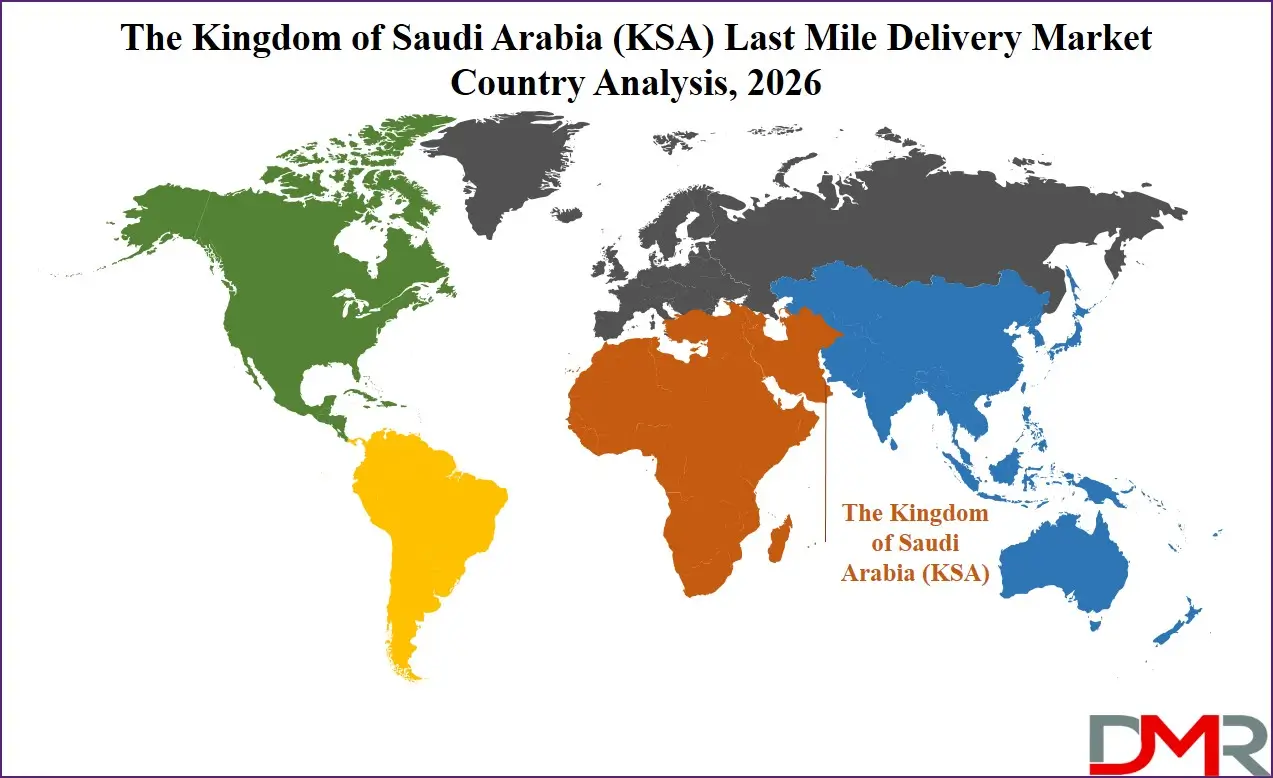
The Kingdom of Saudi Arabia's last-mile delivery market features intense competition between well-established international logistics giants and agile local players, all vying for dominance in a sector rapidly transformed by Vision 2030 and e-commerce growth.
International companies such as DHL Group, FedEx, and UPS hold a significant position, leveraging their global networks, express delivery capabilities, and expertise in complex logistics to serve the business-to-business and high-value parcel segments.
ℹ
To learn more about this report –
Download Your Free Sample Report Here
The market is anchored by powerful local entities. Saudi Post, including Naqel Express, is expanding its logistics capabilities under government-led modernization efforts. Aramex and SMSA Express are also major players with extensive regional networks, while Zajil Express remains a key competitor.
The rise of online retail and rapid delivery has spurred a new wave of competition. E-commerce giants like Amazon and Noon operate their own delivery fleets to control the customer experience. Simultaneously, q-commerce platforms such as Jahez, HungerStation, Mrsool, and Nana are redefining expectations with on-demand delivery models, creating a fiercely contested landscape for quick commerce services.
Some of the prominent players in the Kingdom of Saudi Arabia (KSA) Last-Mile Delivery Market are:
- Aramex
- SMSA Express
- Zajil Express
- Naqel Express
- Saudi Post (SPL)
- Saee
- Ajex
- Aymakan
- Agility
- Shipa Delivery
- DHL International
- FedEx
- UPS Saudi Arabia
- CEVA Logistics
- Abdul Latif Jameel (S:mile)
- Diggipacks
- Masar Tracking
- Thabit Logistics
- Posta Plus
- Kuehne + Nagel
- Other Key Players
Recent Developments in the Kingdom of Saudi Arabia (KSA) Last-Mile Delivery Market
- March 2026: Ajex Logistics announced a strategic partnership with a major international e-commerce platform to expand its same-day delivery capabilities across Riyadh, Jeddah, and Dammam.
- February 2026: Saudi Post (SPL) and Naqel Express unveiled a joint logistics hub in Riyadh, integrating their parcel sorting networks to streamline Last-Mile operations as part of the National Logistics Strategy.
- February 2026: Jahez International acquired a minority stake in a regional q-commerce startup, signaling further consolidation in the on-demand delivery space.
- January 2026: DHL International invested SAR 150 million to expand its electric vehicle fleet for Last-Mile deliveries in major Saudi cities, aligning with the Kingdom's sustainability goals.
- December 2025: The Saudi Logistics Summit was held in Riyadh, featuring dedicated sessions on Last-Mile innovation, autonomous delivery, and cold chain logistics, with participation from Aramex, Agility, and CEVA Logistics.
- November 2025: Amazon Saudi Arabia launched three new delivery stations in Tabuk, Hail, and Najran, increasing its Last-Mile coverage to over 90% of the Kingdom's population.
- October 2025: Agility announced a joint venture with a local investment fund to develop micro-fulfillment centers in urban areas, aiming to reduce Last-Mile delivery times to under two hours in key districts.
- September 2025: FedEx Saudi Arabia introduced a new automated sorting facility at King Khalid International Airport, enhancing its express Last-Mile capabilities for business-to-business shipments.
- September 2025: Aymakan secured SAR 50 million in a Series B funding round led by a regional venture capital firm to scale its tech-enabled delivery platform.
Report Details
| Report Characteristics |
| Market Size (2026) |
USD 4.9 Bn |
| Forecast Value (2035) |
USD 10.3 Bn |
| CAGR (2026–2035) |
8.6% |
| Historical Data |
2021 – 2025 |
| Forecast Data |
2027 – 2035 |
| Base Year |
2025 |
| Estimate Year |
2026 |
| Report Coverage |
Market Revenue Estimation, Market Dynamics, Competitive Landscape, Growth Factors and etc. |
| Segments Covered |
By Component (Solutions and Services), By Size (Small & Medium-sized Enterprises and Large Enterprises), By Industry Vertical (Public Sector, Pharmaceuticals, Media & Entertainment, IT & Telecommunication, BFSI, and Others Industry Verticals), By Delivery Mode (Ground Transportation, Drone Delivery, Autonomous Vehicles, and Others), By Vehicle Type (Light Commercial Vehicles, Two-Wheelers, Heavy Commercial Vehicles, and Others), By Service Type (B2C, B2B, and C2C), By Delivery Time Frame (Next-day Delivery, Same-day Delivery, and Standard [2–5 days]), By Application (E-commerce/Retail, Grocery & Food Delivery, Healthcare & Pharmaceuticals, Documents & Parcels, and Others), and By End-User (Retail Customers, SMEs, and Large Enterprises) |
| Country Coverage |
The Kingdom of Saudi Arabia (KSA) |
| Prominent Players |
Aramex, SMSA Express, Zajil Express, Naqel Express, Saudi Post (SPL), Saee, Ajex, Aymakan, Agility, Shipa Delivery, DHL International, FedEx, UPS Saudi Arabia, CEVA Logistics, Abdul Latif Jameel (S:mile), Diggipacks, Masar Tracking, Thabit Logistics, Posta Plus, Kuehne + Nagel, and Other Key Players |
| Purchase Options |
We have three licenses to opt for: Single User License (Limited to 1 user), Multi-User License (Up to 5 Users) and Corporate Use License (Unlimited User) along with free report customization equivalent to 0 analyst working days, 3 analysts working days and 5 analysts working days respectively. |
Frequently Asked Questions
How big is the Kingdom of Saudi Arabia (KSA) Last-Mile Delivery Market?
▾ The Kingdom of Saudi Arabia (KSA) Last-Mile Delivery Market size is estimated to have a value of USD 4.9 billion in 2026 and is expected to reach USD 10.3 billion by the end of 2035.
Who are the key players in the Kingdom of Saudi Arabia (KSA) Last-Mile Delivery Market?
▾ Some of the major key players in the Kingdom of Saudi Arabia (KSA) Last-Mile Delivery Market are Amazon Logistics, UPS, FedEx, USPS, DHL eCommerce, XPO Logistics, and many others.
What is the growth rate in the Kingdom of Saudi Arabia (KSA) Last-Mile Delivery Market?
▾ The market is growing at a CAGR of 8.6 percent over the forecasted period.