Saudi Arabia Oil Condition Monitoring Market Size
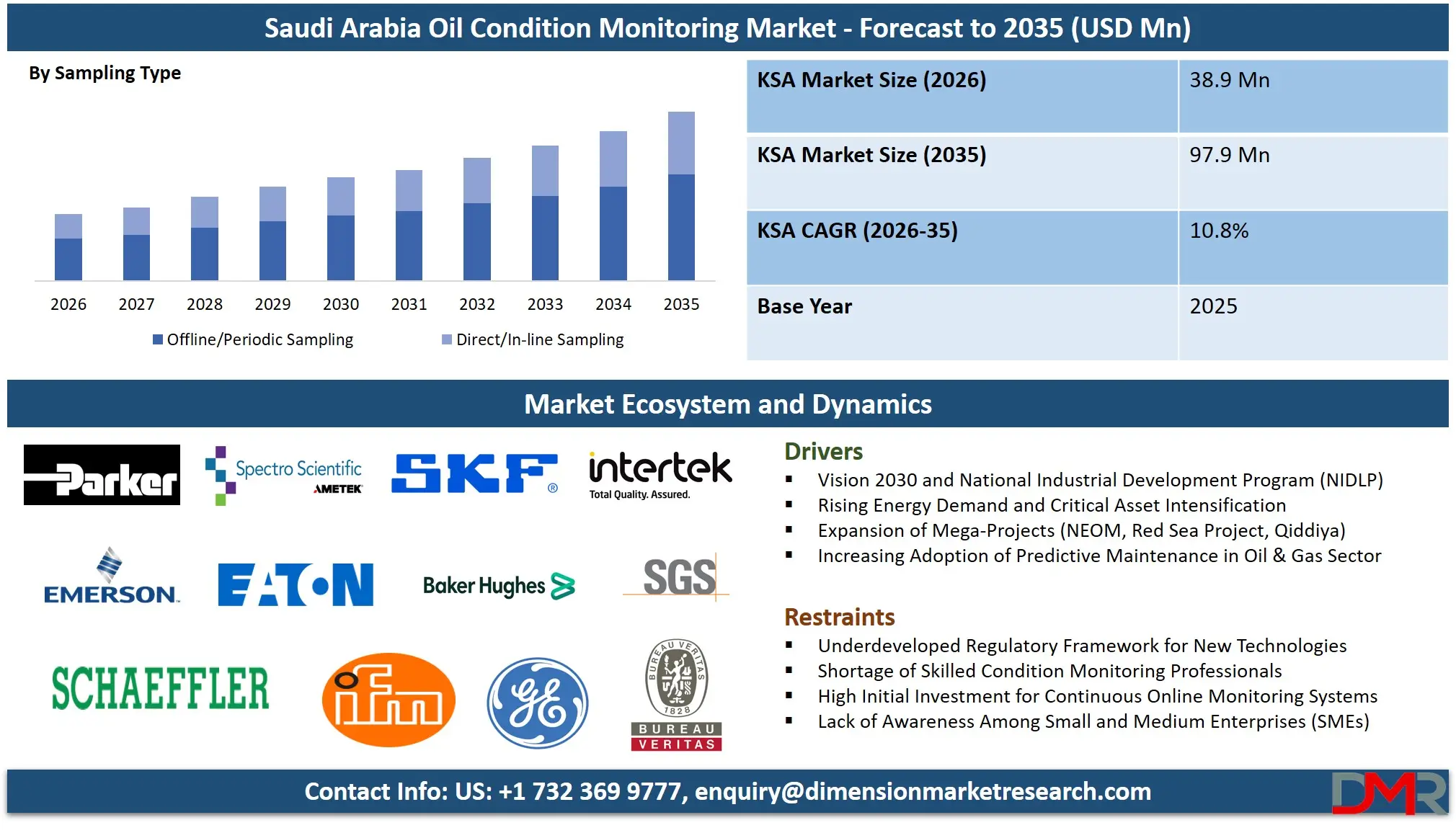
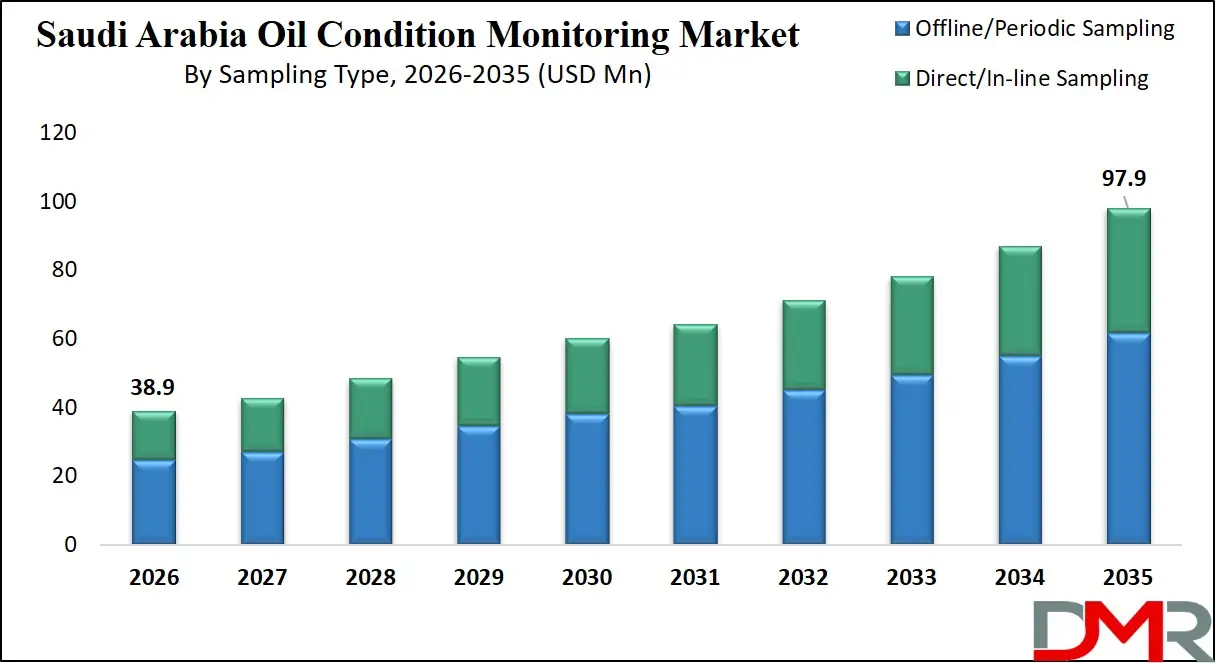
The Saudi Arabia Oil Condition Monitoring Market is estimated to be valued at USD 38.9 million in 2026 and is projected to reach USD 97.9 million by 2035, growing at a CAGR of 10.8% during the forecast period.
ℹ
To learn more about this report –
Download Your Free Sample Report Here
The Saudi Arabia Oil Condition Monitoring Market is expanding rapidly, owing to the implementation of various programs by the government, like NIDLP, which stresses asset integrity and operational efficiency.
Higher emphasis on minimizing unexpected downtimes, alongside increased energy consumption and the dearth of trained manpower for maintenance purposes, is further promoting growth. Various mega projects, like NEOM Industrial City and King Salman Energy Park (SPARK), have generated huge demand for oil analysis solutions both through online and lab-based methods.
ℹ
To learn more about this report –
Download Your Free Sample Report Here
Key Takeaways
- Market Size & Forecast: The Saudi Arabia oil condition monitoring market is projected to reach USD 38.9 million by 2026 and expand to USD 97.9 million by 2035, driven by rising demand for predictive maintenance across industrial sectors.
- Growth Rate & Outlook: Market growth is anticipated to be at a CAGR of 10.8% as a result of Vision 2030 industrial transformation efforts, increasing energy demand, and the rapid adoption of advanced oil analysis technologies.
- Primary Growth Drivers: Growth in this market is attributed to government mandates for asset reliability under Vision 2030 and NIDLP, along with the urgent need for continuous oil analysis for critical rotating equipment.
- Key Market Trends: Some notable trends that show the high potential of this market include integration of oil analysis data into digital factory software, shift from periodic to continuous online analysis, and AI-based spectrometric diagnostics.
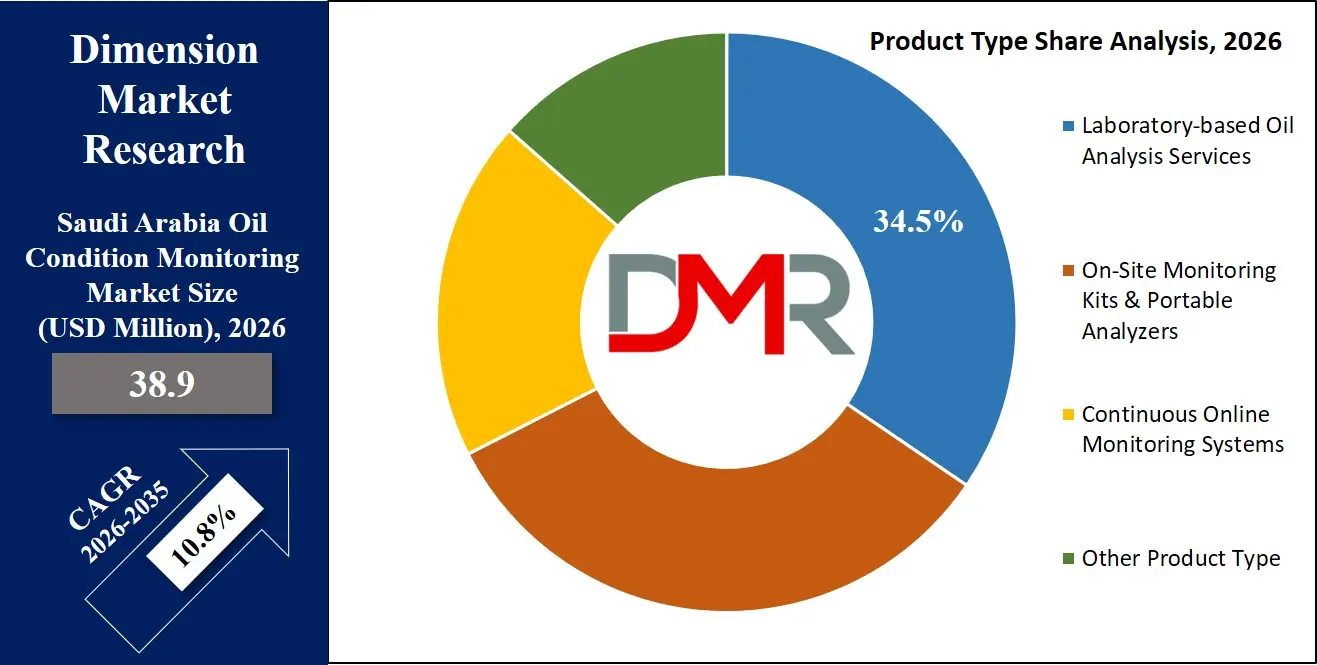
- By Product Type Analysis: Laboratory-based oil analysis services dominate the market with approximately 34.5% market share in 2026 due to high-accuracy spectrometric and additive depletion testing.
- By Sampling Type Analysis: Offline or periodic sampling leads the market with a 52.4% share in 2026, primarily due to its ease of deployment and lower capital requirements.
- By Measurement Type Analysis: Wear and contamination monitoring holds the largest share at approximately 37.8% of the measurement type segment in 2026, driven by critical failure prevention needs.
What is Oil Condition Monitoring?
Oil condition monitoring is the process of analyzing oil lubricants, hydraulic oil, and other industrial coolant oils in order to evaluate the performance and state of the equipment being operated. Oil condition monitoring assists in detecting any wear debris in the oil, contamination of the oil with any substances such as water or fuel, and changes in the properties of the oil, such as acid number or loss of additives.
Use Cases
- Giga-Project Asset Resilience for NEOM & SPARK: Enables continuous monitoring of lubricants used in gas turbines, compressors, and heavy machinery supporting mega-projects such as NEOM and SPARK to avoid catastrophic equipment failures allowing long-term operational assurance.
- Predictive Maintenance Across Oil & Gas Value Chain: Analyzes metals collected from oil upstream drilling rig, midstream pipeline and downstream refinery samples for wear debris and cross contamination reducing impact of unplanned down time while increasing critical asset life.
- Power Generation Reliability for Conventional & Renewable Plants: Monitors oil condition in gas turbines, steam turbines and wind farm gearboxes to optimize predictive maintenance schedules, avoid expensive generator failures and maximize energy output.
- Workforce Safety and Automated Maintenance Operations: Decreases frontline oil sampling risks and repetitive strain injuries of an aging maintenance workforce and enables remote diagnostics and data-driven maintenance decisions across industrial facilities.
How AI Is Transforming the Saudi Arabia Oil Condition Monitoring Market
The Saudi Arabia Oil Condition Monitoring Market is witnessing a revolutionary change with the adoption of artificial intelligence for predictive analytics and automated decision-making. Oil data technology leverages machine learning to review historical oil data, wear debris patterns, and chemical trends to dynamically predict potential equipment failures ahead of time — allowing for preventive solutions rather than reactions after the fact. AI further helps in demand forecasting of lubricants and spare parts, slashing inventory cost and making supply chain efficient. In mega-projects like NEOM, AI models simulate multiple failure scenarios for large-scale assets to optimize their maintenance.
In addition, AI helps ensure the transparency of sourcing and quality assurance of monitoring systems and consumables. There, computer vision and analytics can verify the authenticity of sensors and parts, as well as detect defects or contamination with greater accuracy than manual inspection without human judgment errors. Another prediction made it possible to predict sourcing disruption based on geopolitical and environmental data which is pivotal for Saudi Arabia ensuring that compliance, reliability is in place along with reduced dependence on manual testing and reliance on international suppliers.
Market Dynamics
Driving Factors in Saudi Arabia Oil Condition Monitoring Market
Vision 2030 and National Industrial Development Program (NIDLP)
The most important driving force for the Oil Condition Monitoring Market is the Saudi government's Vision 2030 and NIDLP, which mandate improved asset reliability, worker safety, and localization of predictive maintenance technologies across all industrial sectors. These government initiatives impose quality standards for industrial output and operational efficiency, creating top-down demand for oil condition monitoring systems and performance reporting throughout the industrial economy, from oil refineries to manufacturing plants.
Rising Energy Demand and Critical Asset Intensification
With the accelerated growth in the development of power generation capacity, oil and gas operations, and manufacturing facilities, there is an immediate need for oil analysis to ensure that the critical machinery operates efficiently and effectively without any unforeseen interruptions in the operation process. The increasing interest in gas power generation and renewables in Saudi Arabia calls for effective lubrication systems to prevent unexpected shutdowns.
Restraints in Saudi Arabia Oil Condition Monitoring Market
Underdeveloped Regulatory Framework for New Technologies
There is no fast track to the approval process for high-end oil sensors and analyzers available within Saudi Arabia, unlike the European Union and America, resulting in dependence on logistics chains. Without standards for certification, wireless sensors, and IoT-based analyzers may result in delays in imports, which means that large-scale adoption cannot be achieved without reducing costs.
Shortage of Skilled Condition Monitoring Professionals
There is also a shortage of local engineers trained in the field of wear particles identification, measuring the ferrous density and spectroscopic analysis, thus making it necessary to employ more costly foreign specialists. Employment of foreign specialists results in higher operating expenses and reduced opportunities for transferring knowledge of oil analysis skills into local factories.
Opportunities in Saudi Arabia Oil Condition Monitoring Market
Local Manufacturing of Oil Analysis Equipment and Consumables
The development of local production of sensors, portable analysis machines, and laboratory reagents would be beneficial in decreasing dependency on imports and enable the Kingdom to become self-reliant in industrial predictive maintenance. The presence of local manufacturing facilities, artificial intelligence-driven inventories, and cold-chain logistics for specialized reagents would cater to unique market needs prevalent in the Gulf region.
Value-Based Maintenance Contracting with Uptime Guarantees
As Saudi Arabia embraces value-oriented industrial systems, there is an increasing need for performance management solutions to ensure system availability and compliance with international standards. It is imperative that any production line be assessed for risk and adhere to international safety standards for automation systems, creating a huge market for value-based contracts and uptime guarantees.
Trends in Saudi Arabia Oil Condition Monitoring Market
Integration of Oil Data into Digital Factory Platforms
Oil condition intelligence is being fed into manufacturing execution systems (MES) and remote monitoring dashboards, enabling real-time downtime detection and automatic maintenance scheduling across industrial facilities. System data on viscosity, particle counts, and additive depletion are being transmitted to factory command centers for centralized decision-making and predictive maintenance workflow automation.
Shift from Periodic to Continuous Online Monitoring
Large industrial centers are increasingly adopting real-time sensors over traditional offline sampling to achieve immediate fault detection and reduce the lag between sample collection and laboratory reporting. This trend is particularly strong in critical applications such as gas turbines, high-speed compressors, and wind turbine gearboxes where early failure detection is mission-critical for operational continuity.
Research Scope and Analysis
By Product Type Analysis
The Saudi Arabia market is currently dominated by Laboratory-based Oil Analysis Services, accounting for approximately 34.5% of the market share in 2026, reflecting the country's high-volume diagnostic burden for critical industrial assets. These services offer high-accuracy spectrometric analysis, additive depletion tracking, and full chemical property profiling. Their usage is vital to decrease unexpected machinery failures, maintain production line efficiency, and optimize operational economics.
ℹ
To learn more about this report –
Download Your Free Sample Report Here
The segment with the highest CAGR is Continuous Online Monitoring Systems due to the country's commitment to curbing unplanned downtime and meeting real-time data needs for mega-projects. This segment involves sensor reliability management, data transmission risk mitigation, and proper alarm management protocols. On-Site Monitoring Kits and Portable Analyzers are gaining traction among small and medium enterprises for quick field checks, while Other Product Types, including consumables and calibration services, form a smaller but essential supporting segment.
By Sampling Type Analysis
The most prominent segment is Offline or Periodic Sampling, accounting for approximately 52.4% of the market share in 2026, as it provides foundational operational flexibility upon which other configurations are built. This segment offers ease of deployment, lower capital requirements, and modularity suitable for existing maintenance workflows. The segment with the highest CAGR is Direct or In-line Sampling because of the growing need for real-time data acquisition and better integration with continuous process control systems. Direct or In-line Sampling will become increasingly important for continuous process factories, while Offline Sampling will remain essential for small and medium enterprise production cells and pilot lines requiring lower initial investment. Both sampling types are critical for comprehensive oil condition monitoring strategies across different asset classes and operational environments.
By Measurement Type Analysis
The Wear and Contamination Monitoring segment holds the largest share, representing approximately 37.8% of the market in 2026, as it directly addresses the primary failure modes of rotating machinery including gearboxes, engines, and hydraulic systems. This segment includes wear debris analysis, particle counting, and ferrous density measurement to detect metal particles indicating component degradation. The Chemical Property Analysis segment is growing at the highest CAGR due to increasing regulatory compliance requirements for total acid number (TAN), total base number (TBN), oxidation, nitration, additive depletion, and spectrometric analysis. Physical Properties measurement including viscosity, density, and temperature remains fundamental for assessing fluid health. Fluid Contamination Analysis covering water content, fuel dilution, and soot and insolubles is critical for diesel engines and hydraulic systems. Other Measurement Parameters include specialized tests for specific industrial applications.
By Industry Vertical Analysis
The Oil and Gas sector accounts for the largest share at approximately 54.7% in 2026, driven by Saudi Aramco's massive upstream, midstream, and downstream asset base requiring continuous oil analysis. The highest CAGR segment is Energy and Power Generation, as operators of gas turbines, conventional power plants, and renewable wind assets prioritize efficiency and uptime. Industrial Manufacturing follows, needing oil analysis for heavy machinery, process industries, and food and beverage equipment. Transportation includes automotive, aviation, marine, and railways, each with specific engine and transmission oil requirements. Mining and Construction Equipment operates in harsh environments requiring frequent wear debris analysis. Other verticals include aerospace, defense, and agricultural machinery for specialized applications.
Saudi Arabia Oil Condition Monitoring Market Report is segmented based on the following:
By Product Type
- On-Site Monitoring Kits & Portable Analyzers
- Laboratory-based Oil Analysis Services
- Continuous Online Monitoring Systems
- Other Product Type
By Sampling Type
- Offline/Periodic Sampling
- Direct/In-line Sampling
By Measurement Type
- Physical Properties
- Viscosity
- Density
- Temperature
- Wear & Contamination Monitoring
- Wear Debris Analysis
- Particle Counting
- Ferrous Density Measurement
- Fluid Contamination Analysis
- Water Content
- Fuel Dilution
- Soot & Insolubles
- Chemical Property Analysis
- Total Acid Number (TAN)
- Total Base Number (TBN)
- Oxidation & Nitration
- Additive Depletion
- Spectrometric Analysis
- Other Measurement Parameters
By Industry Vertical
- Transportation
- Automotive (Passenger & Commercial Vehicles)
- Aviation
- Marine
- Railways
- Energy & Power Generation
- Conventional Power (Coal, Gas, Nuclear)
- Renewable Energy (Wind Turbines, Hydropower)
- Industrial Manufacturing
- Heavy Machinery
- Process Industries
- Food & Beverage Equipment
- Mining & Construction Equipment
- Oil & Gas (Upstream, Midstream, Downstream)
- Other Industry Verticals
Competitive Landscape
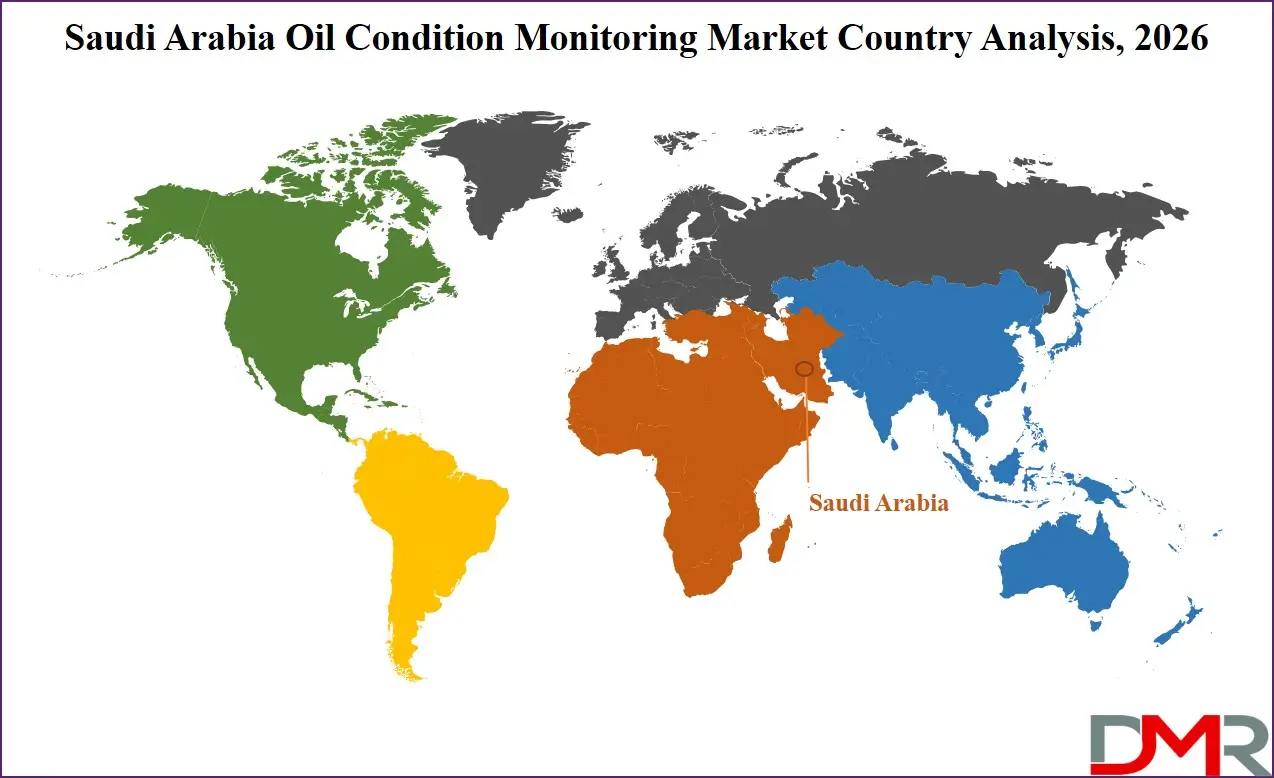
The Saudi Arabia Oil Condition Monitoring Market is characterized by large government-backed industrial zones, international diagnostics manufacturers and local distributors. Competition will focus on supporting Vision 2030 goals through sustainable predictive maintenance solutions. Anchor stakeholders include the Ministry of Industry, Saudi Aramco, NEOM Industrial City and SABIC, in addition to global industry leaders for diagnostic technologies and technical training programs.
ℹ
To learn more about this report –
Download Your Free Sample Report Here
The emerging industrial economy and small-to-medium enterprises are served by local service providers and regional distributors. competition is heating up around AI-driven analytics, uptime guarantees and local manufacturing capabilities. Expect a fragmented market with lots of local startups alongside ongoing international investments in giga-projects and the NIDLP framework.
Some of the prominent players in Saudi Arabia Oil Condition Monitoring Market are:
- Parker-Hannifin Corporation
- Spectro Scientific, Inc.
- SKF AB
- Emerson Electric Co.
- Honeywell International Inc.
- Eaton Corporation plc
- Schaeffler AG
- ifm electronic gmbh
- ABB Ltd.
- General Electric Company
- SGS SA
- Intertek Group plc
- Bureau Veritas SA
- ALS Limited
- Baker Hughes Company
- SLB
- BAFCO Reliability Company
- RICI Company Ltd.
- IRIS Maintenance Technologies Co. Ltd.
- NDT Corrosion Control Services Co. Ltd.
- Other Key Players
Recent Developments
- February 2026: Intertek Group plc launched a real-time corrosion under insulation (CUI) screening solution, enabling advanced inspection, asset integrity monitoring, and predictive maintenance for pipelines and industrial infrastructure.
- January 2026: Baker Hughes Company deployed its Leucipa automated field production solution, enabling AI-driven monitoring and optimization of oil & gas assets, supporting predictive maintenance strategies.
- September 2025: Bureau Veritas SA continued strengthening its testing, inspection, and certification (TIC) services for energy and industrial sectors, supporting asset integrity management and condition monitoring across critical infrastructure.
Report Details
| Report Characteristics |
| Market Size (2026) |
USD 38.9 Mn |
| Forecast Value (2035) |
USD 97.9 Mn |
| CAGR (2026–2035) |
10.8% |
| Historical Period |
2021 – 2025 |
| Forecast Period |
2027 – 2035 |
| Base Year |
2025 |
| Estimate Year |
2026 |
| Segments Covered |
By Product Type (On-Site Monitoring Kits & Portable Analyzers, Laboratory-based Oil Analysis Services, Continuous Online Monitoring Systems, Other Product Types), By Sampling Type (Offline/Periodic Sampling, Direct/In-line Sampling), By Measurement Type (Physical Properties, Wear & Contamination Monitoring, Fluid Contamination Analysis, Chemical Property Analysis, Other Measurement Parameters), By Industry Vertical (Transportation, Energy & Power Generation, Industrial Manufacturing, Mining & Construction Equipment, Oil & Gas, Other Industry Verticals) |
| Country Coverage |
Saudi Arabia |
Frequently Asked Questions
How big is the Saudi Arabia Oil Condition Monitoring Market?
▾ The Saudi Arabia Oil Condition Monitoring Market size is estimated to have a value of USD 38.9 million in 2026 and is expected to reach USD 97.9 million by the end of 2035.
What is the CAGR of the Saudi Arabia Oil Condition Monitoring Market from 2026 to 2035?
▾ The market is growing at a CAGR of 10.8% over the forecasted period.
What factors are driving the growth of the Saudi Arabia Oil Condition Monitoring Market?
▾ The rising energy demand and critical asset intensification requiring continuous oil analysis and Vision 2030 and NIDLP mandating predictive maintenance are the key factors driving the market growth.
What are the major trends in the Saudi Arabia Oil Condition Monitoring Market?
▾ Major trends include integration of oil data into digital factory platforms and a significant shift from periodic sampling to continuous online monitoring systems.
Who are the key players in the Saudi Arabia Oil Condition Monitoring Market?
▾ Some of the major key players in the Saudi Arabia Oil Condition Monitoring Market are Parker-Hannifin Corporation, Spectro Scientific, Inc., SKF AB, Emerson Electric Co., Honeywell International Inc., Eaton Corporation plc., and many others.
How is the Saudi Arabia Oil Condition Monitoring Market segmented?
▾ The market is segmented by Product Type, Sampling Type, Measurement Type, and Industry Vertical.