Market Snapshot
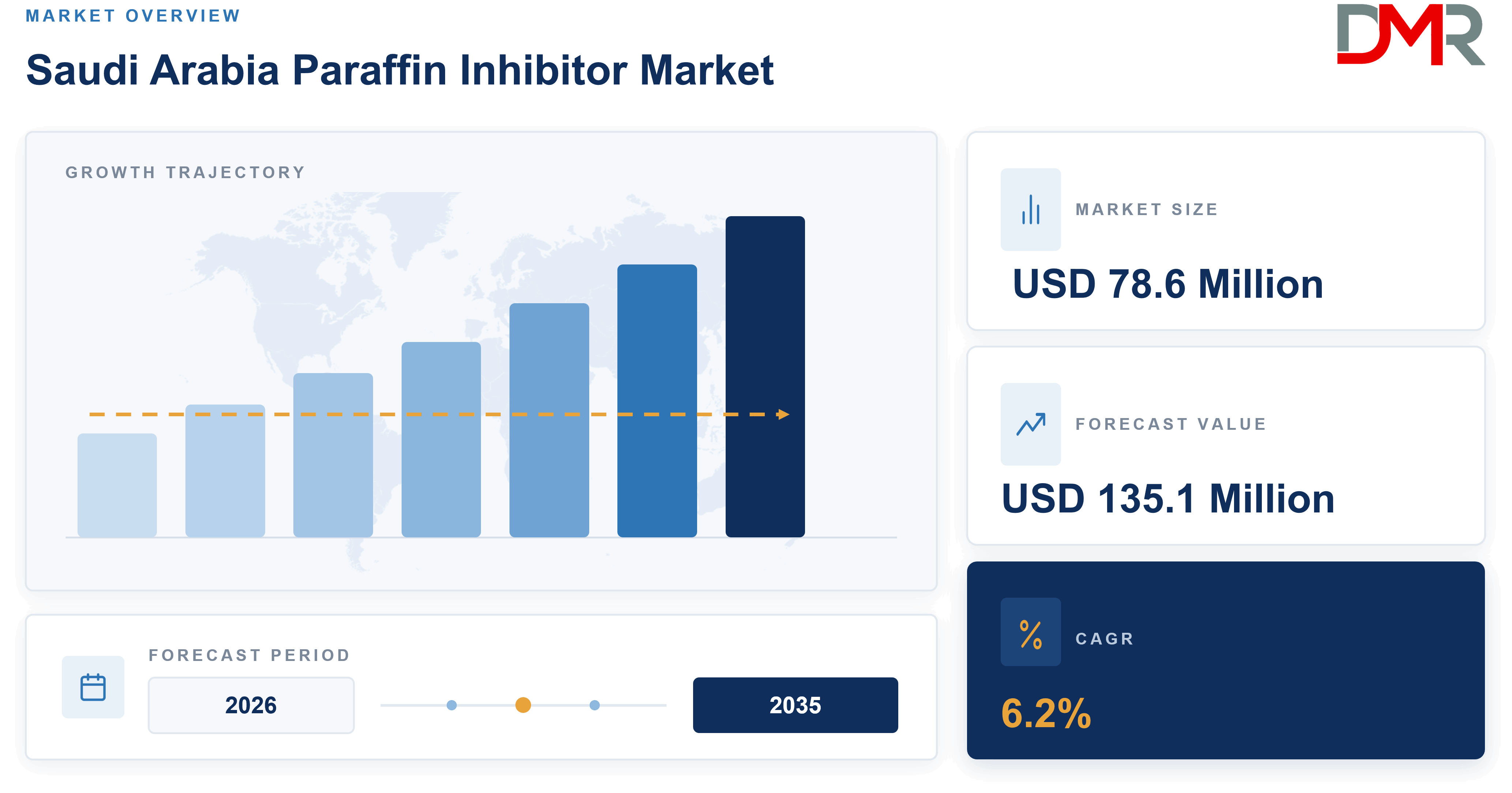
- Market Size (2026): USD 78.6 Mn
- Forecast Value (2035): USD 135.1 Mn
- CAGR (2026-2035): 6.2%
- Leading Type (2026): Crystal Modifiers, approximately 38%
- Leading Chemical Composition (2026): Ethylene Vinyl Acetate Copolymers, around 29%
- Key Players: SLB, Halliburton Company, Baker Hughes Company and others
What is Saudi Arabia Paraffin Inhibitor Market and its Market Size?
The Saudi Arabia Paraffin Inhibitor Market size is estimated to reach USD 78.6 million in 2026 and is further anticipated to reach USD 135.1 million by 2035, at a CAGR of 6.2%. The scope covers paraffin inhibitors, pour-point depressants, dispersants and related preventive wax-control chemistry consumed inside Saudi Arabia for upstream production, pipelines, storage, terminal operations and refinery feed handling. It measures domestic demand rather than global revenue earned by Saudi-based companies.
ℹ
To learn more about this report –
Download Your Free Sample Report Here
Paraffin inhibitors are flow-assurance chemicals designed to alter wax crystal nucleation, growth, shape or adhesion so deposited wax does not restrict production equipment. Crude oils containing heavier normal paraffins can form crystals as temperature and pressure decline during production and transportation. The resulting deposits can reduce internal pipe diameter, raise pressure drop, restrict wells, foul storage equipment and increase intervention frequency.
Saudi demand is linked to the scale of upstream operations and to the need to keep crude moving efficiently from producing assets through gathering, processing, storage and export infrastructure. Inhibitor selection depends on wax appearance temperature, crude composition, fluid temperature, shear, residence time and dosage. This makes laboratory testing and field qualification central to purchasing, with suppliers competing on cost per treated barrel and the duration of effective deposit control.
The market is also being reshaped by local-content procurement and the growth of Saudi blending and service capability. Global production-chemical companies retain strong formulation libraries and field databases, while local suppliers increasingly compete on inventory, response time and customization. The strongest commercial model combines formulation chemistry with laboratory screening, dosage optimization and field support.
Use Cases
- Well and Flowline Wax Control: Upstream operators inject paraffin inhibitors into wax-prone crude streams before temperature and pressure decline trigger crystal growth. The treatment modifies wax formation, helps prevent wall deposition and reduces the frequency of mechanical cleaning or solvent remediation across gathering lines and production tubing.
- Pipeline Flow Assurance: Pipeline operators use polymeric inhibitors and dispersants to keep wax crystals suspended as crude moves through long-distance lines. Better deposit control protects internal diameter, limits pressure build-up and supports steadier transport rates when feed temperature approaches or falls below the crude's wax appearance range.
- Storage and Terminal Management: Terminal operators dose paraffin-control chemistry into storage systems where cooling and long residence times can increase waxy sludge formation. Maintaining fluidity improves tank drainage, transfer efficiency and pump reliability while reducing manual cleanout and the volume of difficult hydrocarbon residue.
- Workover and Remediation Support: Oilfield service companies combine inhibitors with solvent-based dissolvers when production has already been impaired by wax deposition. The program removes existing deposits and then applies preventive chemistry so the restored well or flowline can remain productive for longer between intervention cycles.
Key Takeaways
- Market Size & Share: Saudi Arabia is estimated at USD 78.6 million in 2026, supported by recurring upstream flow-assurance requirements.
- Type Analysis: Crystal Modifiers are projected to hold approximately 38% of 2026 revenue because they directly alter wax crystal behavior before deposition.
- Demand Concentration: National Oil Companies are expected to account for around 61% of 2026 demand.
- Chemistry Shift: Bio-Based and Low-Toxicity Chemistry is forecast to expand at a CAGR of 8.3% from 2026 to 2035.
- Application Growth: Pipeline Flow Assurance is forecast to grow at a CAGR of 7.5% through 2035.
- Localization: In-Kingdom blending, technical service and stockholding are becoming more important as Saudi procurement targets higher local content.
How AI/Gen AI is Transforming the Saudi Arabia Paraffin Inhibitor Market?
AI can improve paraffin-control programs by linking crude properties, wax appearance temperature, dosage, pipeline temperature, pressure and flow rate to deposit risk. Predictive models can identify where conditions are moving toward wax formation and help field teams adjust chemical dosage before production loss occurs. This is especially useful in gathering systems where operating conditions change over time.
Generative AI has a supporting role in formulation knowledge and technical service. Controlled systems can summarize laboratory histories, compare field trials and organize treatment recommendations, while engineers retain responsibility for chemical selection. Near-term value therefore comes from faster troubleshooting and better use of accumulated field data rather than autonomous chemistry design.
- Deposit-Risk Forecasting: machine-learning models can estimate wax deposition risk from temperature, pressure and fluid-property data.
- Dosage Optimization: analytics can adjust inhibitor treatment when production rate or thermal conditions change.
- Field-Test Knowledge Management: LLM systems can organize bottle-test, cold-finger and flow-loop results for faster comparison.
- Inventory Forecasting: demand models can improve local stock planning around field consumption and intervention schedules.
Key Drivers in the Saudi Arabia Paraffin Inhibitor Market
Demand is supported by Saudi Arabia's large crude-production base and by the recurring cost of preventing wax-related flow restrictions.
- Large Upstream Production Base: Crude Oil Production is expected to account for approximately 51% of 2026 application revenue. Paraffin-control chemicals are used where cooling and depressurization cause wax crystals to form in production tubing, flowlines and surface equipment. Because the treatment is often continuous or periodically repeated, consumption persists even when drilling activity slows. The commercial driver is the cost of avoiding lost production, pressure build-up and repeated mechanical or thermal intervention.
- Flow-Assurance Focus Across Gathering and Pipeline Systems: Pipeline Flow Assurance is forecast to expand at a CAGR of 7.5% between 2026 and 2035. Longer transport distances and variable operating temperatures increase the need to keep wax particles from adhering to internal surfaces. Chemical treatment can help preserve hydraulic capacity and reduce pigging or cleaning frequency. The value proposition strengthens when inhibitor dosage costs less than the production disruption and maintenance associated with unmanaged deposition.
Restraints in the Saudi Arabia Paraffin Inhibitor Market
Growth is moderated by crude-specific qualification requirements and by competition from mechanical, thermal and solvent-based remediation methods.
- High Formulation Specificity and Qualification Time: Ethylene Vinyl Acetate Copolymers are projected to account for around 29% of 2026 chemistry revenue, but no single chemistry performs optimally across all waxy crudes. Suppliers must test cloud point, pour point, wax appearance behavior and deposition tendency before field deployment. This makes qualification slower and more expensive than selling a standardized commodity chemical, while poor field performance can quickly disqualify a formulation.
- Alternative Wax-Control Methods: Operators can use pigging, hot-oil treatment, solvent washing or thermal management instead of continuous inhibitor injection in some systems. Liquid formulations are expected to represent nearly 79% of 2026 form revenue, but their recurring cost must still be justified against intervention-based alternatives. Chemical treatment is most attractive when wax risk is frequent and predictable; where deposition is sporadic, buyers may prefer periodic remediation.
Growth Opportunities in the Saudi Arabia Paraffin Inhibitor Market
White space is strongest in local formulation, lower-toxicity chemistry and digitally optimized treatment programs.
- Localized Concentrate Blending: Concentrated Blend products are forecast to grow at a CAGR of 7.6% through 2035. Higher-active formulations reduce freight and storage volume and can be diluted or tailored near the field. This model aligns with Saudi localization goals because value is added through domestic blending, testing, warehousing and technical support rather than importing every finished treatment package.
- Lower-Toxicity Wax-Control Chemistry: Bio-Based and Low-Toxicity Chemistry is forecast to expand at a CAGR of 8.3% from 2026 to 2035. Growth will remain performance-led, but suppliers can gain share when newer carriers or active chemistries reduce solvent exposure without sacrificing crystal modification or dispersion. The opportunity is strongest in formulations that improve handling while keeping dosage economically competitive.
Trends in the Saudi Arabia Paraffin Inhibitor Market
Saudi buyers are shifting from standalone chemical supply toward integrated wax-management programs supported by laboratory testing and data.
- Field-Specific Formulation Design: Crystal Modifiers are expected to retain approximately 38% of 2026 type revenue because their effectiveness can be tuned to the wax distribution of a specific crude. Suppliers increasingly use cold-finger tests, microscopy, rheology and flow-loop work to choose polymer structure and dosage. This makes technical service a larger part of the commercial offering.
- Local Supply Resilience: National Oil Companies are expected to represent around 61% of 2026 end-user demand, giving procurement policy a strong influence on supplier strategy. More vendors are therefore building Saudi inventory, blending capability and field-service teams. Localization reduces lead time and can improve responsiveness when operators need rapid chemistry changes after a shift in crude or temperature profile.
Research Scope and Analysis
Segment performance is assessed across five axes: type, chemical composition, form, application and end user. Each axis identifies where 2026 revenue is concentrated and where growth is moving through 2035, linking wax-control demand to field conditions, formulation technology and localization.
ℹ
To learn more about this report –
Download Your Free Sample Report Here
By Type
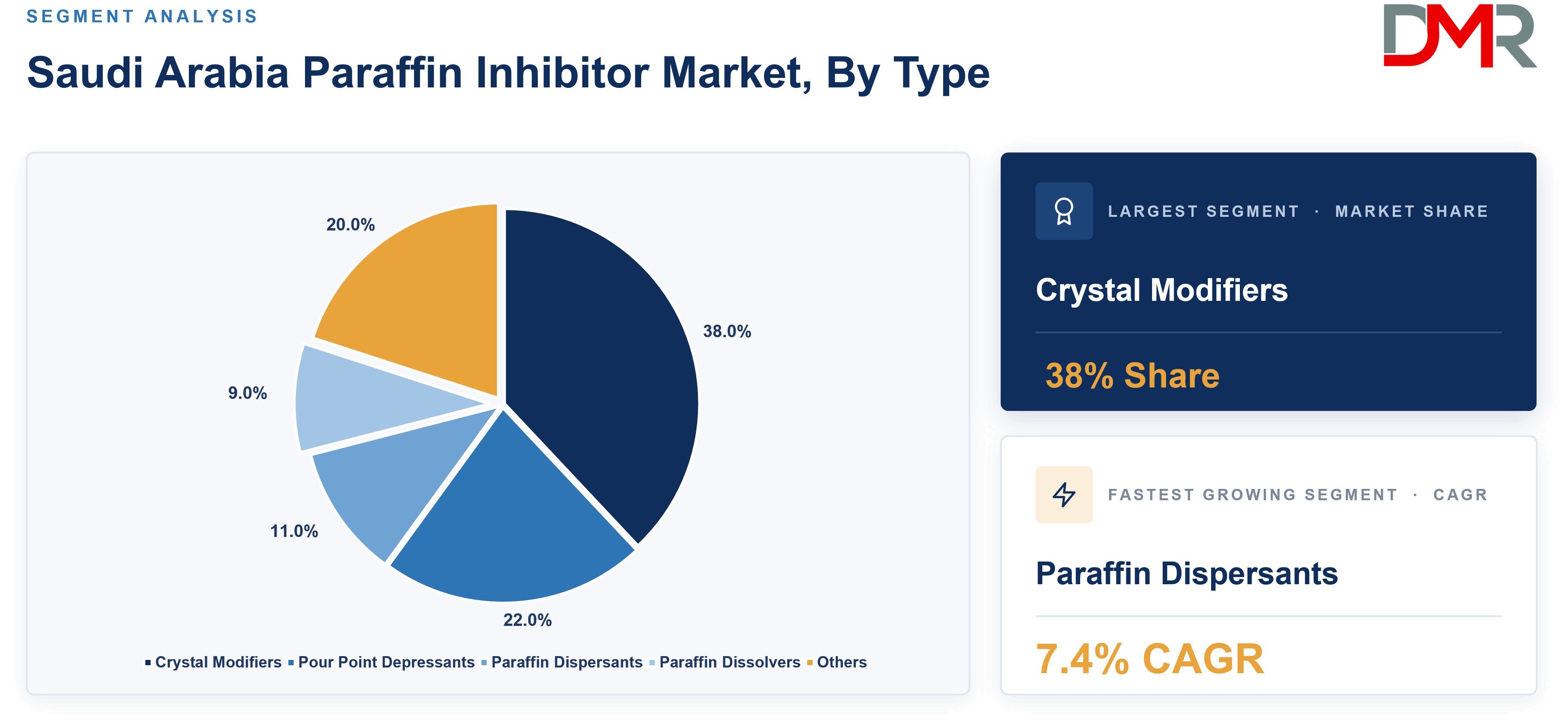
Crystal Modifiers are projected to hold the largest type share in 2026, accounting for approximately 38% of revenue because they directly interfere with wax crystal growth and reduce the tendency of crystals to form strong deposits. Their use is well suited to continuous upstream treatment where preventing deposition is preferable to repeated remediation. Growth, however, is concentrated in Paraffin Dispersants, forecast to expand at a CAGR of 7.4% between 2026 and 2035. Dispersants help keep wax particles suspended and reduce adhesion to production surfaces, making them useful where deposit control must complement existing mechanical or thermal practices.
By Chemical Composition
Ethylene Vinyl Acetate Copolymers are expected to hold the leading chemistry position in 2026 with around 29% of revenue because their polymer architecture can be tuned to interact with paraffin crystals and lower pour-point behavior. They are established ingredients in many wax-management formulations. The faster trajectory sits with Bio-Based and Low-Toxicity Chemistry, expanding at a CAGR of 8.3% through 2035. Adoption is being pulled by solvent-reduction goals, safer handling and interest in lower-impact production chemicals, although performance under Saudi field temperatures and crude conditions remains the first qualification hurdle.
By Form
Liquid products are projected to dominate in 2026 with nearly 79% of revenue because existing chemical injection systems are designed for pumpable formulations that can be dosed continuously and adjusted quickly. Liquids also support rapid mixing with hydrocarbon streams and simplify field handling. Growth, however, is concentrated in Concentrated Blend products, forecast to rise at a CAGR of 7.6% between 2026 and 2035. Concentrates reduce transport and storage requirements and can support local dilution or customization, which fits Saudi localization and supply-resilience objectives.
By Application
Crude Oil Production is expected to lead application demand in 2026 with approximately 51% of revenue because wax-control chemistry is most frequently applied before deposition restricts wells, tubing, separators or flowlines. The treatment protects production continuity and reduces intervention frequency. Growth, however, is concentrated in Pipeline Flow Assurance, forecast to expand at a CAGR of 7.5% through 2035. The combination of long transport distances, changing fluid temperature and the economic cost of reduced hydraulic capacity makes preventive chemical treatment increasingly attractive in wax-prone pipeline systems.
By End User
National Oil Companies are projected to hold around 61% of 2026 demand because Saudi upstream production, gathering and export infrastructure are highly concentrated. Large procurement programs favor qualified suppliers with proven technical support and local availability. Growth, however, is faster among Oilfield Service Companies, which are forecast to expand at a CAGR of 7.2% from 2026 to 2035. Service companies increasingly bundle wax control with production optimization, well intervention and flow-assurance contracts, allowing paraffin inhibitor demand to grow through integrated service packages.
The Saudi Arabia Paraffin Inhibitor Market Report is Segmented Based on the Following
By Type
- Crystal Modifiers
- Pour Point Depressants
- Paraffin Dispersants
- Paraffin Dissolvers
- Others
By Chemical Composition
- Ethylene Vinyl Acetate Copolymers
- Polyacrylates and Methacrylates
- Polyethylene-Based Polymers
- Surfactant-Based Blends
- Bio-Based and Low-Toxicity Chemistry
- Others
By Form
- Liquid
- Concentrated Blend
- Emulsion
- Others
By Application
- Crude Oil Production
- Pipeline Flow Assurance
- Storage and Terminal Operations
- Well Stimulation and Workover
- Refinery Feed Handling
- Others
By End User
- National Oil Companies
- Oilfield Service Companies
- Pipeline and Terminal Operators
- Refineries
- Independent Operators and Contractors
- Others
Competitive Landscape
Competition combines global production-chemical companies, oilfield service majors, specialty formulators, regional distributors and Saudi blending firms. International suppliers retain advantages in polymer chemistry, field databases and proprietary testing methods, while domestic companies compete through local content, shorter lead times and customization. Qualification history creates meaningful switching barriers because wax-control performance depends on crude composition and temperature. Major strategies include local blending, laboratory expansion, integrated flow-assurance services and data-assisted dosage optimization. As Saudi procurement continues to favor local value addition, suppliers with in-Kingdom inventory and technical capability should gain an advantage over import-only competitors.
Some of the Prominent Players in the Saudi Arabia Paraffin Inhibitor Market Are
- SLB
- Halliburton Company
- Baker Hughes Company
- ChampionX Corporation
- Clariant AG
- BASF SE
- The Dow Chemical Company
- Croda International Plc
- Innospec Inc.
- Dorf Ketal Chemicals
- Nouryon
- Evonik Industries AG
- Arkema S.A.
- Solvay SA
- The Lubrizol Corporation
- Stepan Company
- Italmatch Chemicals S.p.A.
- Nalco Water, an Ecolab company
- Weatherford International plc
- SNF Group
- REDA Chemicals
- REDA Energy
- Meta Solutions Company (MetaSol)
- Modern National Chemicals
- Energy Industry Equipment Factory
- KRON Oilfield Service Company
- SUGEST
- Safra Company Limited
- Sama Chemical Product Factory
- Oilfield Production Technologies (OPT)
- Al Moghera Chemical Company
- Brenntag Saudi Arabia
- Azelis Middle East
- Rezayat Trading Company
- Arabian Chemical Company
- Gulf Chemicals and Industrial Oils Company
- Saudi Chemical Company Limited
- Neelam Aqua & Speciality Chem.
- Sipchem
- Saudi Basic Industries Corporation (SABIC)
- Other Key Players
Pricing Analysis
Paraffin inhibitor pricing is shaped by polymer type, active concentration, solvent system, order volume, dosage efficiency and the technical service bundled with the chemical. Buyers typically evaluate the total cost per treated barrel or the cost of avoiding a deposition event rather than comparing product price alone. A premium inhibitor can still be competitive if it works at lower dosage, extends cleaning intervals or preserves production throughput.
Local blending can reduce freight, inventory and emergency-delivery costs, while imported proprietary formulations can command higher prices when qualification history is strong. Price pressure is greatest where several approved products show similar field performance. It is lower in difficult wax systems where switching risk is high and the supplier has proven deposition-control results. Contract value increasingly includes testing, optimization and field support in addition to the chemical itself.
Technology Analysis
Paraffin inhibition technology is centered on crystal modification, pour-point depression and particle dispersion. High-molecular-weight polymers can interfere with wax nucleation and crystal growth, while surfactant-based systems reduce adhesion between wax particles and pipe surfaces. The optimum treatment depends on crude composition and operating temperature, which is why laboratory screening remains central to product selection.
Technology development is moving toward more concentrated polymer packages, lower-toxicity solvents and data-assisted dosage control. Advanced testing combines wax appearance measurements, cold-finger deposition, microscopy, rheology and flow-loop simulation. The strongest suppliers increasingly connect these tools with production data so inhibitor selection and dosage can be adjusted as field conditions change. This turns wax management from a fixed chemical program into an adaptive flow-assurance service.
Recent Developments
- In August 2026, Aramco reported first-half liquids production of 9.1 million barrels per day, underscoring the scale of the domestic production system that supports recurring flow-assurance chemical demand.
- In February 2026, Aramco announced that its iktva program had reached 70% local content and set a new intention to reach 75% by 2030, strengthening the incentive for local production-chemical blending and technical services.
Report Details
| Report Characteristics |
| Market Size (2026) |
USD 78.6 Mn |
| Forecast Value (2035) |
USD 135.1 Mn |
| CAGR (2026-2035) |
6.2% |
| Historical Data |
2021 - 2025 |
| Forecast Data |
2026 - 2035 |
| Base Year |
2025 |
| Segments Covered |
By Type, By Chemical Composition, By Form, By Application and By End User |
| Regional Coverage |
Saudi Arabia |
Frequently Asked Questions
How big is the Saudi Arabia Paraffin Inhibitor Market?
▾ The Saudi Arabia Paraffin Inhibitor Market is estimated at USD 78.6 million in 2026. The figure covers preventive and remedial wax-control chemistry consumed within Saudi Arabia across crude production, pipelines, storage, terminals and refinery feed handling. Demand is supported by the scale of the country's hydrocarbon system and the cost of avoiding wax-related restrictions.
What is the growth rate of the Saudi Arabia Paraffin Inhibitor Market?
▾ The market is forecast to expand at a CAGR of 6.2% from 2026 to 2035. Growth is driven by recurring flow-assurance requirements, longer and more intensively managed transport systems, local blending capacity and greater use of data-assisted dosage optimization. The category remains an established production-chemical niche rather than a frontier technology market.
What is driving demand in the Saudi Arabia Paraffin Inhibitor Market?
▾ Demand is driven by the need to prevent wax crystals from restricting wells, flowlines, pipelines and storage systems as crude cools and depressurizes. Operators value inhibitors when chemical treatment costs less than lost production, pigging, hot-oil treatment or solvent remediation. Saudi localization policies also encourage more domestic inventory, blending and technical support.
Which type leads the Saudi Arabia Paraffin Inhibitor Market?
▾ Crystal Modifiers are expected to lead the market in 2026 with a share of approximately 38%. These polymeric products interfere with wax crystal formation and growth, reducing the tendency of paraffin to create strong deposits. Their position is supported by preventive use in continuous production systems where avoiding deposition is more economical than repeated remediation.
Which chemistry is growing fastest in the Saudi Arabia Paraffin Inhibitor Market?
▾ Bio-Based and Low-Toxicity Chemistry is forecast to grow fastest, at a CAGR of 8.3% from 2026 to 2035. Growth is supported by demand for lower-solvent formulations and safer handling, but adoption remains dependent on field performance. New products must still match conventional chemistry on crystal modification, dispersion and dosage efficiency.
Who are the key players in the Saudi Arabia Paraffin Inhibitor Market?
▾ Key participants include SLB, Halliburton Company, Baker Hughes Company, ChampionX Corporation, Clariant AG, REDA Chemicals and Meta Solutions Company. Competition also includes specialty polymer suppliers, Saudi blenders and regional distributors. Market position depends on field qualification, local inventory, laboratory capability and the ability to optimize dosage under changing production conditions.
What is the outlook for the Saudi Arabia Paraffin Inhibitor Market?
▾ The Saudi Arabia Paraffin Inhibitor Market is expected to remain a steady-growth flow-assurance niche through 2035. The main shifts will be toward concentrated formulations, lower-toxicity solvent systems, local blending and data-assisted treatment programs. Suppliers that combine proven polymer chemistry with strong Saudi technical service should be best positioned to capture incremental demand.