Saudi Arabia Potassium Chloride Market Snapshot
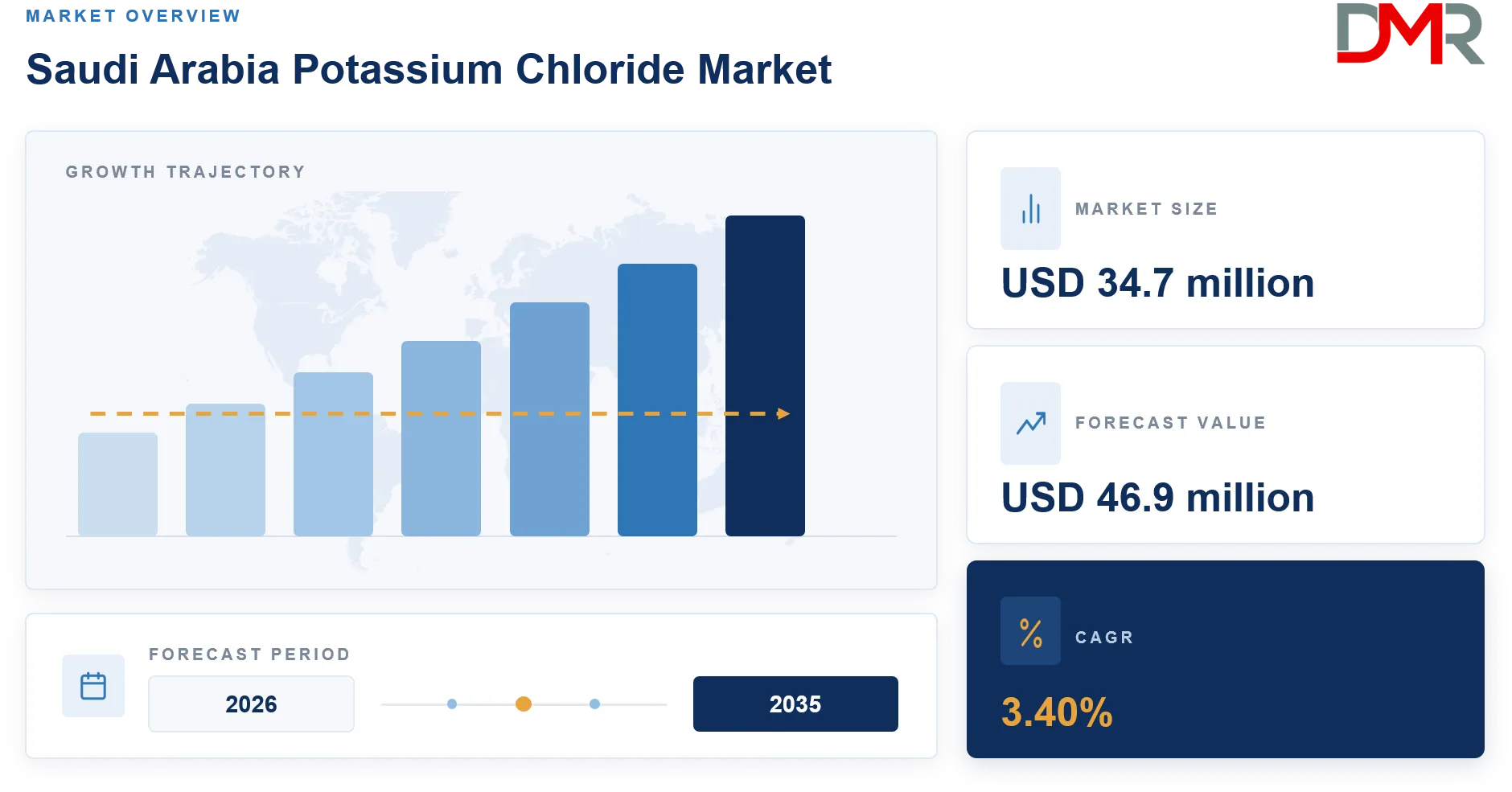
- Market Value: Saudi Arabia potassium chloride market is valued at USD 34.7 million in 2026 and is expected to reach USD 46.9 million by 2035.
- CAGR: Saudi Arabia potassium chloride market is expected to grow at a CAGR of 3.4% from 2026 to 2035.
- By Grade Segment Analysis: Agricultural grade dominated the market with an 83.6% share in 2026.
- By Form Segment Analysis: Granular solid potassium chloride led the form segment with a 51.8% share in 2026.
- By Application Segment Analysis: Fertilizers accounted for the largest application share at 76.9% in 2026.
- By End-User Industry Segment Analysis: Agriculture held the leading share at 75.8% in 2026.
- Major Players: Delmon Group, Nassguard, United Industrial Chemicals, Alchemora Ltd., and Veeransh Chemicals.
What is the Saudi Arabia Potassium Chloride Market and its Market Size?
The Saudi Arabia Potassium Chloride Market size is projected to be valued at USD 34.7 million in 2026 and is projected to reach USD 46.9 million by 2035, expanding at a CAGR of 3.4% during the forecast period. Potassium chloride, commonly called KCl or muriate of potash in fertilizer applications, is an important potassium source used to support crop nutrition as well as chemical, pharmaceutical, food processing, water treatment, and industrial operations.
ℹ
To learn more about this report –
Download Your Free Sample Report Here
The Saudi Arabia potassium chloride market demand is closely connected with the Kingdom's agricultural production, fertilizer distribution network, import channels, greenhouse cultivation, chemical processing capacity, and water management infrastructure. Agricultural grade represents the commercial center of the market because potassium is required for plant water regulation, enzyme activity, fruit development, crop quality, and resistance to environmental stress. Saudi Arabia also depends heavily on external KCl supply. World Bank WITS data show that the country imported approximately USD 23.2 million of potassium chloride under HS 310420 in 2024, with Jordan accounting for the clear majority of reported import value.
Use Cases
- Crop Nutrition and Fertilization: Agricultural potassium chloride is primarily used as a potassium source in fertilizer programs for cereals, vegetables, date palms, fruits, and other crops. It supports nutrient balance, crop development, water regulation, and yield formation. Its high nutrient concentration and established fertilizer distribution channels make agricultural grade KCl the largest commercial use in Saudi Arabia.
- Greenhouse and Protected Agriculture: Potassium inputs are important in intensive vegetable cultivation where growers manage nutrient delivery to achieve consistent output and crop quality. Saudi Arabia produced about 797 thousand tons of greenhouse vegetables in 2024, up 10.6% from 2023, while greenhouse vegetable area reached around 7.8 thousand hectares. This creates a specialized demand base for soluble and controlled nutrient formulations.
- Chemical Manufacturing: Industrial and technical grades of potassium chloride are used as feedstock or process materials in selected potassium compounds and specialty chemical formulations. Demand is concentrated among chemical distributors, compounders, industrial processors, and users requiring controlled purity. Expansion of Saudi Arabia's downstream chemical economy supports opportunities for higher specification KCl beyond commodity fertilizer applications.
- Pharmaceutical and Food Processing: Higher purity potassium chloride is used in pharmaceutical formulations, electrolyte products, food processing, and applications requiring controlled composition and quality. Demand volumes are considerably smaller than fertilizer use, but pharmaceutical and food grades command stricter specifications and potentially higher unit value, creating opportunities for certified suppliers serving regulated manufacturing environments.
- Water and Industrial Processing: Potassium chloride can be used in selected water treatment, ion exchange regeneration, process chemistry, and industrial applications. Saudi Arabia's focus on water efficiency, desalination, wastewater treatment, and industrial water reuse supports demand for reliable chemical supply. Buyers in these applications generally place greater emphasis on consistency, purity, documentation, and dependable delivery than bulk agricultural customers.
How AI/Gen AI is Transforming the Saudi Arabia Potassium Chloride Market?
Digital analytics and machine learning are becoming more relevant to potassium chloride consumption through precision agriculture rather than through changes to the basic chemical itself. Farms, greenhouse operators, fertilizer distributors, and agronomy providers can combine soil measurements, irrigation data, crop stages, weather information, and nutrient records to improve potassium application decisions. More accurate nutrient recommendations can reduce excessive fertilizer use while directing potassium toward crops and growth stages where it produces greater economic value. This development is especially relevant in Saudi Arabia because agricultural expansion must operate alongside strict water efficiency requirements.
Generative systems can also improve commercial planning across potassium chloride procurement and distribution. Importers and industrial buyers can use data models to compare supplier quotations, freight movements, inventory positions, consumption patterns, and contract requirements. Distributors can improve demand forecasting by linking customer orders with cropping calendars and regional agricultural activity. In industrial markets, automated document analysis can help procurement teams review technical specifications, certificates of analysis, and supplier records. These tools may improve purchasing efficiency and inventory management, but actual adoption will depend on data quality, integration with existing enterprise systems, and supplier transparency.
Key Drivers in the Saudi Arabia Potassium Chloride Market
Expansion of High-Value Crop and Greenhouse Production
Growth in protected vegetables, fruit cultivation, and other commercially important crops supports Saudi Arabia potassium chloride demand because potassium plays a major role in crop quality, water regulation, and nutrient balance. Saudi greenhouse vegetable production reached about 797 thousand tons in 2024, while open-field vegetable production reached approximately 2.745 million tons. Increasing production intensity encourages growers and fertilizer suppliers to focus on efficient nutrient programs, supporting demand for agricultural grade and granular potassium chloride.
Food Security and Agricultural Productivity Programs
Saudi agricultural policy increasingly links production growth with resource efficiency and food security. The Ministry of Environment, Water and Agriculture promotes modern irrigation, sustainable resource management, and reduced production of highly water-intensive crops. Within this framework, balanced crop nutrition becomes commercially important because growers need to obtain more output from controlled land and water resources. Potassium chloride benefits from this productivity focus, particularly where soil and crop requirements support chloride-tolerant fertilizer programs.
Restraints in the Saudi Arabia Potassium Chloride Market
Dependence on Imported Potassium Chloride
Saudi Arabia has limited domestic potash supply and therefore relies strongly on international sourcing. This exposes buyers to freight costs, global potash cycles, supplier concentration, shipping disruptions, and contract pricing. In 2024, Saudi potassium chloride imports were valued at about USD 23.2 million, and Jordan represented roughly USD 22.6 million of this amount. Such concentration can reduce procurement flexibility, encouraging larger distributors and fertilizer buyers to maintain diversified sourcing strategies and adequate inventories.
Water Constraints and Crop Selection Policies
Agricultural expansion in Saudi Arabia is shaped by water availability. Government policy encourages modern irrigation and restricts the expansion of water-intensive agricultural practices, which means fertilizer consumption cannot simply rise through unlimited cultivated-area growth. Potassium chloride suppliers therefore need to align products with efficient farming, protected cultivation, fertigation practices, and higher-value crops. Chloride sensitivity in selected crops can also lead growers to consider alternative potassium sources when agronomic conditions require them.
Growth Opportunities in the Saudi Arabia Potassium Chloride Market
Specialized Products for Protected Agriculture
Protected cultivation creates opportunities beyond conventional bulk fertilizer sales. Saudi Arabia had more than 121 thousand greenhouses planted with vegetables in 2024, while protected vegetable output increased 10.6% year over year. Suppliers able to provide consistent particle size, suitable solubility, reliable analysis, technical support, and integration with customized nutrient programs can address higher-value customers. Distribution partnerships with agronomy companies and greenhouse operators can further strengthen market access.
Supply Chain Diversification and Local Distribution
The Saudi potassium chloride supply chain offers room for importers and distributors that can reduce procurement risk through multiple sourcing relationships, regional warehousing, inventory visibility, and reliable last-mile delivery. Historical trade data show material changes in Saudi import value and supplier mix across years, reinforcing the importance of flexible procurement. Companies that combine bulk sourcing with technical, industrial, food, or pharmaceutical grades can capture demand across several end-use segments rather than relying only on fertilizer customers.
Trends in the Saudi Arabia Potassium Chloride Market
Shift Toward Precision Nutrient Management
Saudi agriculture is gradually moving toward controlled irrigation, protected production, soil monitoring, and more precise fertilizer programs. The trend favors nutrient decisions based on crop needs rather than uniform application rates. Potassium chloride remains attractive where agronomic conditions support its use because it provides a concentrated potassium source with an established global supply chain. Suppliers are increasingly differentiated by product consistency, agronomic guidance, delivery reliability, and compatibility with modern fertilizer programs instead of competing on commodity price alone.
Greater Focus on Procurement Security
Potassium chloride buyers are placing greater importance on origin diversity, inventory planning, quality documentation, and logistics resilience. Saudi import data illustrate why this matters. Import value moved from about USD 46.8 million in 2022 to USD 32.5 million in 2023 and USD 23.2 million in 2024, while trade remained strongly linked to Jordan. These movements encourage distributors and large users to evaluate contracts using delivered cost, availability, lead time, quality, and supplier continuity.
Research Scope and Analysis.
The Saudi Arabia Potassium Chloride Market is segmented based on Grade, Form, Application, End-User Industry, and other relevant commercial categories. The study provides an in-depth analysis of key segments and sub-segments, covering their applications, industry adoption, demand patterns, procurement requirements, and contribution to overall market growth.
ℹ
To learn more about this report –
Download Your Free Sample Report Here
By Grade
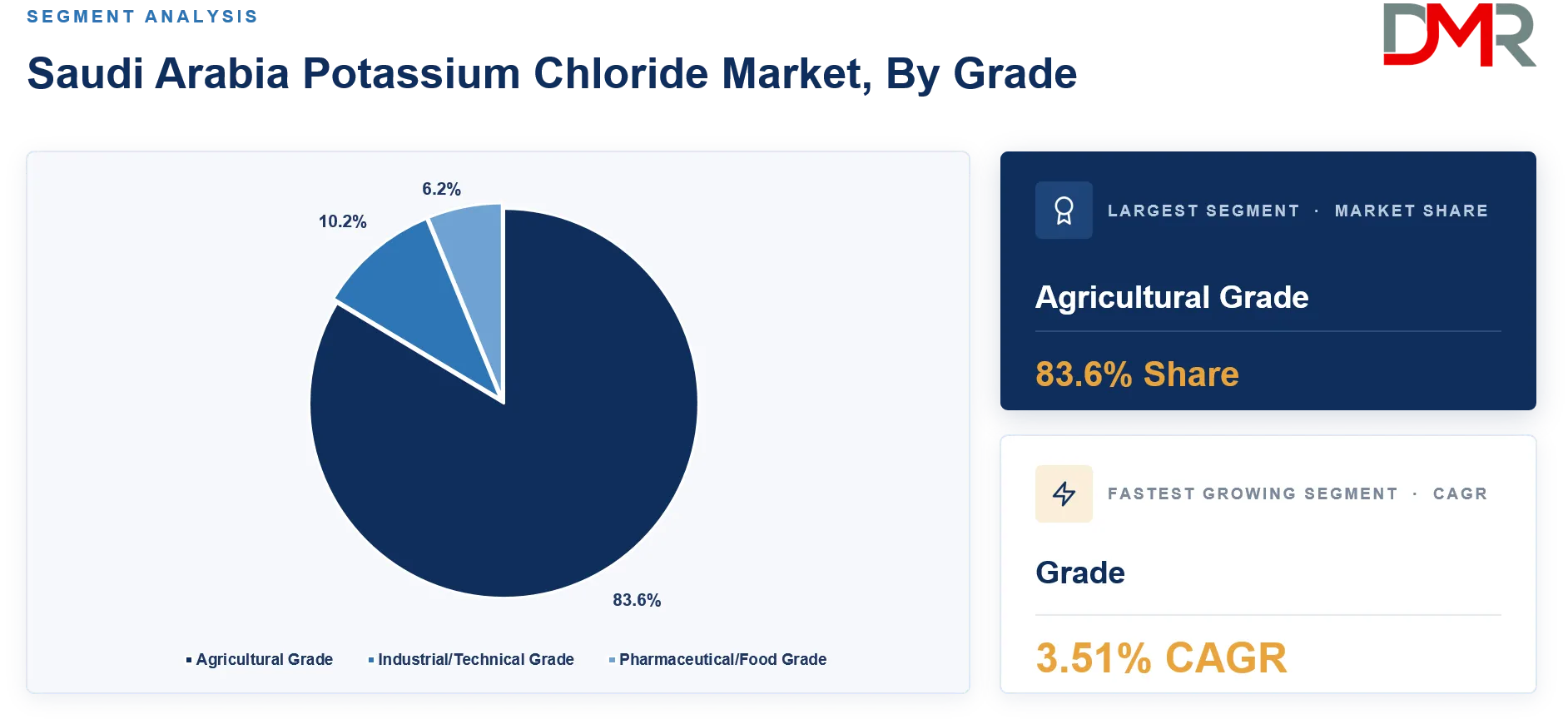
Agricultural grade dominated the Saudi Arabia potassium chloride market with an 83.6% share in 2026. Its leadership reflects the scale of fertilizer consumption compared with industrial, pharmaceutical, and food applications. Potassium chloride provides a concentrated source of potassium for crop nutrition and is widely suited to field fertilizer programs where chloride tolerance is acceptable. Demand is supported by cereals, vegetables, fruits, date palms, and other commercial crops. Saudi Arabia produced around 1.923 million tons of dates and 2.745 million tons of open-field vegetables in 2024, illustrating the crop base served by the fertilizer supply chain. Industrial, technical, pharmaceutical, and food grades represent smaller but higher-specification opportunities.
By Form
Granular solid potassium chloride led the form segment with a 51.8% share in 2026. Granules are commercially important because they offer practical handling, storage, transport, blending, and field application characteristics for bulk fertilizer markets. They can be incorporated into compound fertilizer blends and distributed through established agricultural supply networks. Powder and crystalline forms serve customers requiring different dissolution, processing, or formulation properties, while liquid products address specialized handling or nutrient delivery needs. The continuing dominance of agriculture supports granular demand, although growth in greenhouse production, specialty fertilizers, water treatment, and industrial processing is creating a broader market for soluble and controlled-specification forms.
By Application
Fertilizers held the largest application share at 76.9% in 2026, confirming that crop nutrition is the principal source of potassium chloride market revenue in Saudi Arabia. Fertilizer demand is supported by vegetable production, cereals, date palms, fruit crops, greenhouses, and other commercial agriculture. Chemical manufacturing, pharmaceuticals, industrial processing, food processing, and water treatment form smaller application pools but diversify supplier opportunities. Higher-specification sectors commonly require tighter control of impurities, product consistency, packaging, certificates, and traceability, creating differentiated value compared with bulk fertilizer products.
By End-User Industry
Agriculture accounted for a 75.8% market share in 2026. Cereals, fruits and vegetables, oilseeds, fiber crops, sugar crops, and protected agriculture collectively generate the majority of KCl consumption. The sector's leadership also reflects the comparatively lower volumes required by pharmaceutical, food, chemical, oil and gas, and water treatment users. Future agricultural demand will be shaped by production intensity and nutrient efficiency rather than unrestricted acreage expansion. This creates opportunities for suppliers that can combine potassium chloride distribution with soil testing, crop-specific recommendations, efficient irrigation programs, and reliable regional availability.
The Saudi Arabia Potassium Chloride Market Report is segmented on the basis of the following:
By Grade
- Agricultural Grade
- Industrial/Technical Grade
- Pharmaceutical/Food Grade
By Form
- Solid
- Granular
- Powder
- Crystalline
- Liquid
By Application
- Fertilizers
- Chemical Manufacturing
- Pharmaceuticals & Healthcare
- Industrial Processing
- Food Processing
- Water Treatment
- Others
By End-User Industry
- Agriculture
- Cereals
- Fruits & Vegetables
- Oilseeds
- Fiber & Sugar Crops
- Chemical & Petrochemical
- Pharmaceuticals
- Food & Beverage
- Oil & Gas
- Water Treatment
Competitive Landscape
The Saudi Arabia potassium chloride market has a mixed competitive structure involving fertilizer suppliers, chemical distributors, industrial trading companies, water treatment specialists, pharmaceutical participants, regional importers, and diversified Saudi industrial groups. Competition differs substantially by grade. Agricultural KCl is more sensitive to bulk procurement cost, product availability, particle consistency, logistics, warehousing, and relationships with fertilizer distributors, while technical, pharmaceutical, and food-grade segments place greater weight on purity, certification, documentation, traceability, and packaging.
Import dependence makes supply reliability a major competitive factor. Companies with regional sourcing networks, storage capacity, predictable lead times, technical support, and established relationships with agricultural or industrial users are better positioned to defend market share. Market participants can also differentiate through multi-grade portfolios that address fertilizer, chemical processing, pharmaceutical manufacturing, food processing, and water treatment demand. As procurement becomes more data-driven, buyers are likely to compare suppliers on delivered cost, contract flexibility, quality consistency, source diversification, technical compliance, and supply continuity rather than nominal product price alone.
Some of the prominent players in the Saudi Arabia Potassium Chloride Industry are:
- Delmon Group
- Nassguard
- United Industrial Chemicals
- Alchemora Ltd.
- Veeransh Chemicals
- Chimi S.R.L.
- Petrochem Middle East FZE
- Sipchem Marketing Company
- SABIC
- Advance Treatment for Water Purification Co.
- GDCC
- Crown Towers Chemical Co.
- Al Askar
- Pharmaceutical Solutions Industry
- Al Razi Pharma Industries
- Jamjoom Pharmaceuticals Co. Ltd.
- Spectro Pharma
- Granules Pharmaceuticals Inc.
- Aspire Trading
- Sahara Ma'aden Petrochemicals
- Others
Export-Import Analysis
Saudi Arabia potassium chloride trade is primarily import-driven because domestic demand from agriculture, fertilizer distribution, chemical processing, pharmaceuticals, food manufacturing, and water treatment is supported by overseas supply. Agricultural grade KCl accounts for the largest demand pool, making fertilizer procurement the key influence on import volumes and purchasing cycles. Jordan is an important regional supply source due to its potash resources, geographic proximity, and established logistics links with Saudi buyers. Imports can also originate from global producers and regional trading hubs based on price, grade, availability, freight cost, and contract terms. Export activity from Saudi Arabia remains comparatively limited because potassium chloride is largely procured to serve domestic consumption or downstream processing. This import dependence exposes buyers to international potash prices, freight movements, supplier concentration, currency-linked procurement costs, and logistics disruptions. As a result, Saudi importers are increasingly focused on diversified sourcing, strategic inventories, reliable regional warehousing, quality assurance, and longer-term supplier relationships to protect continuity of supply.
Investment and White Space Analysis
Investment opportunities in the Saudi Arabia potassium chloride market are concentrated in areas where import dependence, agricultural modernization, and specialized industrial requirements create gaps in the existing supply chain. With agriculture accounting for 75.8% of market demand in 2026, opportunities exist in regional fertilizer distribution, granular KCl storage, precision nutrient services, greenhouse fertilizer programs, and crop-specific potassium formulations. White space is also emerging beyond commodity agricultural grade products. Pharmaceutical, food, chemical, industrial processing, and water treatment users require controlled purity, dependable specifications, technical documentation, and consistent delivery, creating room for specialized importers and local formulators. Investors can also target bulk storage, repacking, blending, quality testing, and digital inventory management to reduce lead times for Saudi customers. Partnerships with international potash producers could improve source diversification and procurement security. The strongest opportunities are therefore likely to combine imported KCl with local value-added services rather than relying only on commodity trading and price competition.
Report Details
| Report Characteristics |
| Market Size (2026) |
USD 34.7 Million |
| Forecast Value (2035) |
USD 46.9 Million |
| CAGR (2026–2035) |
3.4% |
| Historical Data |
2021 – 2025 |
| Forecast Data |
2027 – 2035 |
| Base Year |
2025 |
| Estimate Year |
2026 |
| Segments Covered |
By Grade (Agricultural Grade, Industrial/Technical Grade, and Pharmaceutical/Food Grade), By Form (Solid {Granular, Powder, and Crystalline} and Liquid), By Application (Fertilizers, Chemical Manufacturing, Pharmaceuticals & Healthcare, Industrial Processing, Food Processing, Water Treatment, and Others), and By End-User Industry (Agriculture {Cereals, Fruits & Vegetables, Oilseeds, and Fiber & Sugar Crops}, Chemical & Petrochemical, Pharmaceuticals, Food & Beverage, Oil & Gas, and Water Treatment) |
| Regional Coverage |
Saudi Arabia |
Frequently Asked Questions
What is the current size of the Saudi Arabia Potassium Chloride Market?
▾ The Saudi Arabia Potassium Chloride Market is valued at USD 34.7 million in 2026 and will reach USD 46.9 million by 2035.
What is the growth rate of the Saudi Arabia Potassium Chloride Market during?
▾ The Saudi Arabia Potassium Chloride Market is expected to grow at a CAGR of 3.4% during the forecast period 2026-2035.
What factors are driving the growth of the Saudi Arabia Potassium Chloride Market?
▾ Agricultural expansion, greenhouse farming, crop nutrition, and food security drive Saudi Arabia Potassium Chloride Market growth.
What are the major challenges restraining the Saudi Arabia Potassium Chloride Market?
▾ Import dependence, global potash price shifts, water constraints, and supply risks restrain Saudi Arabia Potassium Chloride Market growth.
Which segment holds the largest share of the Saudi Arabia Potassium Chloride Market?
▾ Agricultural grade holds an 83.6% share in 2026, making it the leading Saudi Arabia Potassium Chloride Market grade segment.
Who are the leading companies in the Saudi Arabia Potassium Chloride Market?
▾ Delmon Group, Nassguard, United Industrial Chemicals, Alchemora Ltd., Veeransh Chemicals, Chimi S.R.L., Petrochem Middle East FZE, Sipchem Marketing Company, SABIC, Advance Treatment for Water Purification Co., GDCC, Crown Towers Chemical Co., Al Askar, Pharmaceutical Solutions Industry, Al Razi Pharma Industries, Jamjoom Pharmaceuticals Co. Ltd., Spectro Pharma, Granules Pharmaceuticals Inc., Aspire Trading, and Sahara Ma'aden Petrochemicals are prominent companies in the Saudi Arabia Potassium Chloride Market.
How is AI influencing the Saudi Arabia Potassium Chloride Market?
▾ AI supports precision farming, nutrient planning, demand forecasting, and procurement across the Saudi Arabia Potassium Chloride Market.
What are the future opportunities and trends in the Saudi Arabia Potassium Chloride Market?
▾ Precision farming, greenhouse expansion, supply diversification, and specialty grades offer Saudi Arabia Potassium Chloride Market opportunities.