Market Overview
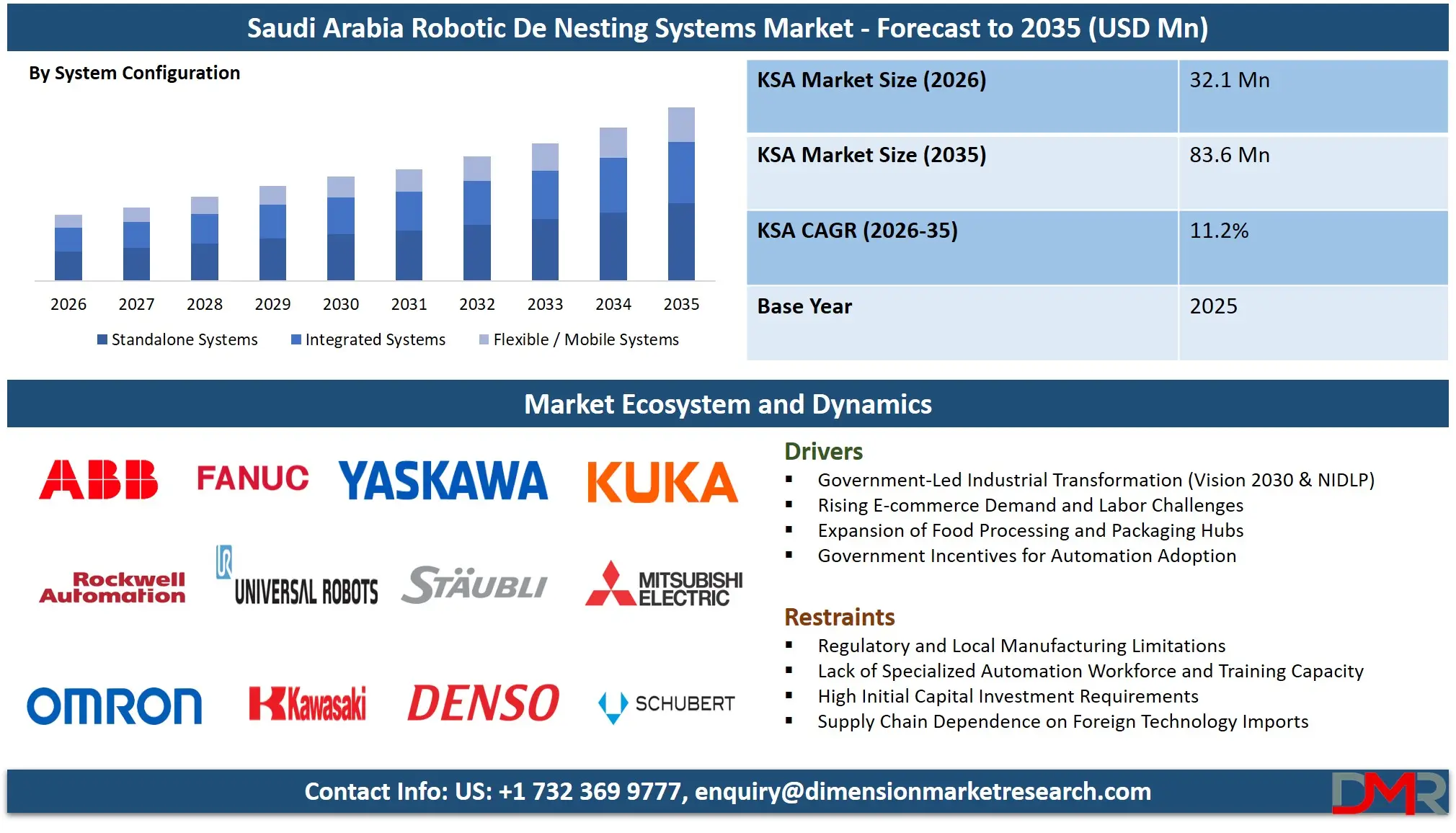
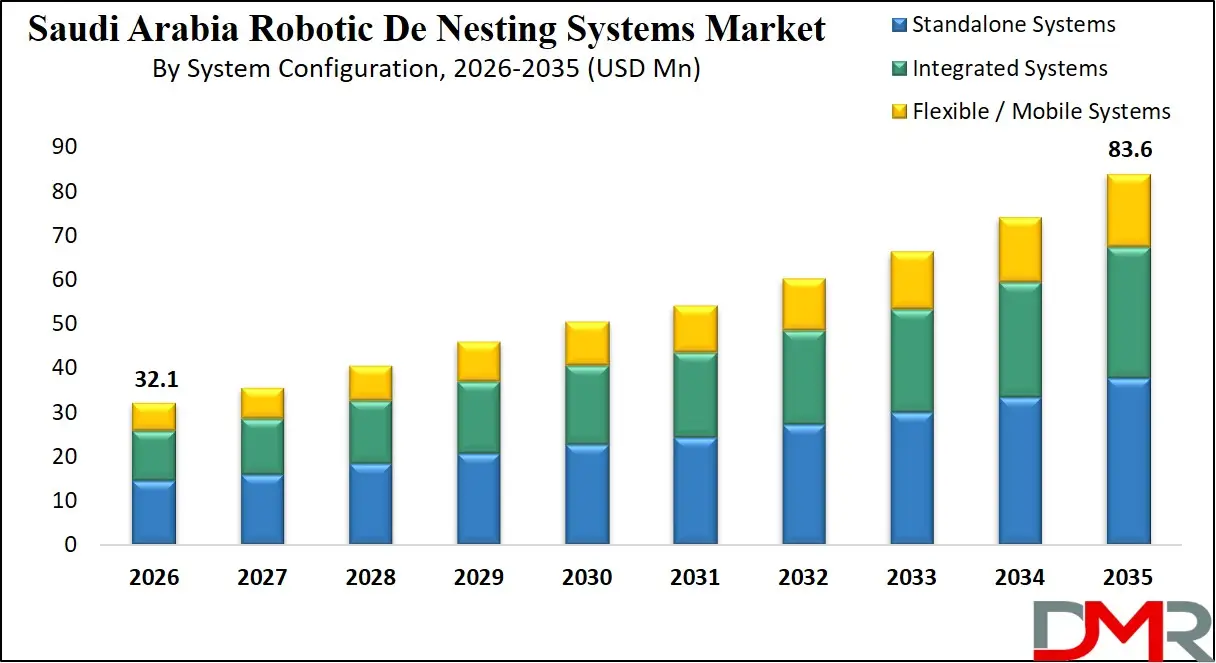
The Saudi Arabia Robotic De-Nesting Systems Market size is expected to reach a value of USD 32.1 million in 2026, and it is further anticipated to reach a market value of USD 83.6 million by 2035 at a CAGR of 11.2%.
ℹ
To learn more about this report –
Download Your Free Sample Report Here
Saudi Arabia Robotic De-Nesting Systems Market is one of the rapidly growing markets in the Middle East because the region has set ambitious industrial transformation objectives that should be reached by integrating the Vision 2030 and the National Industrial Development and Logistics Program (NIDLP). With the increase in automation demand attributed to labor cost optimization, e-commerce growth, and supply chain digitization, the public sector is responding to the need of providing sophisticated material handling and de-nesting solutions, and so, are the individual manufacturing organizations.
The issue of the robotic de-nesting system management in Saudi Arabia is evolving to a higher stage in the form of a national industrial security scenario and economic diversification. The government initiative to localize the production of industrial robotics, and the creation of the mega industrial zones such as the King Salman Energy Park (SPARK) and NEOM Industrial City, is placing a huge demand on robotic de-nesting systems and related automation services.
ℹ
To learn more about this report –
Download Your Free Sample Report Here
Saudi Arabia Robotic De-Nesting Systems Market: Key Takeaways & Other Influencing Factors
- Market Growth Insights: The market is anticipated to reach approximately USD 32.1 million in 2026 and is projected to expand to around USD 83.6 million by 2035, registering a CAGR of 11.2% during the forecast period.
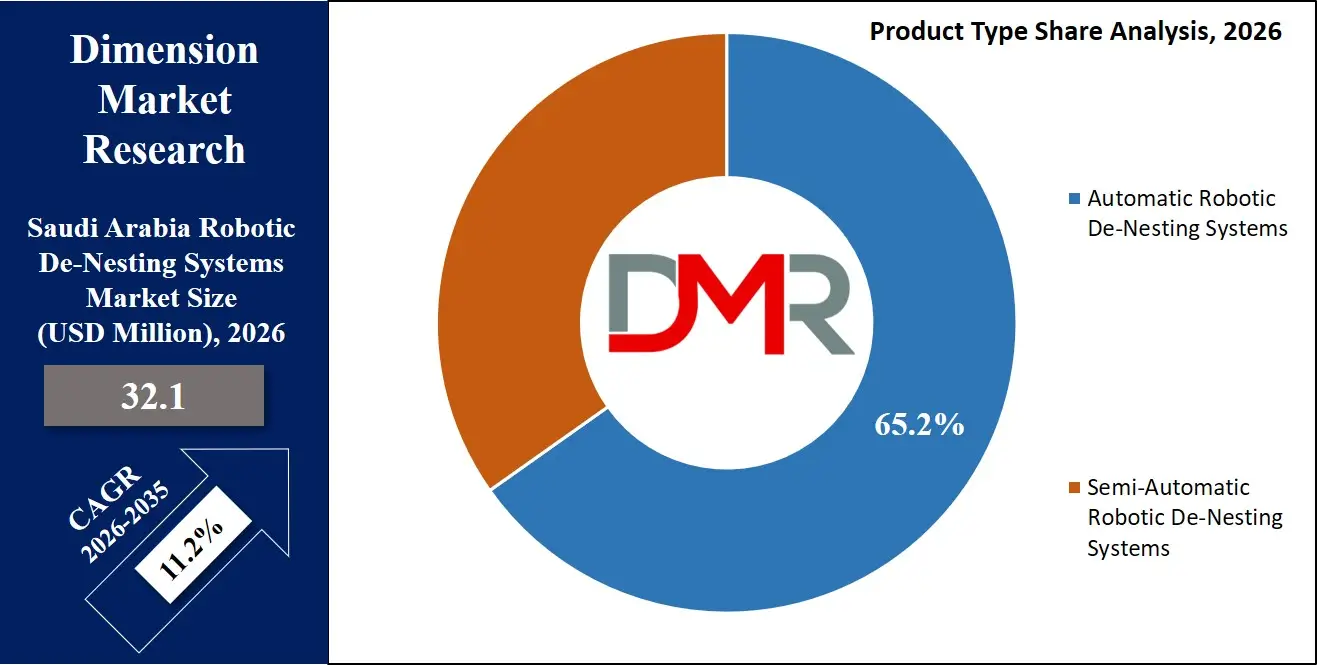
- By Product Type: The leading category includes automatic robotic de-nesters that work at high speed and use vision systems. Semi-automatic de-nesters are rapidly becoming relevant for Saudi Arabia to address its rising demand for de-nesters in SME manufacturing lines.
- By System Configuration Insights: Standalone systems are expected to take over the market due to their ease of deployment and lower capital expenditure. The most rapidly developing segments are the integrated and flexible/mobile systems with the development of fully connected production lines and autonomous mobile robot (AMR) based de-nesting units.
- By End-User Insights: Manufacturing and warehousing facilities are popularized for high-volume de-nesting operations, whereas logistics centers are rapidly increasing because of their need for sortation and mixed-pallet handling with shorter cycle times.
- Saudi National Industrial Development and Logistics Program (NIDLP): The NIDLP is a project to privatize 290 industrial service centers and increase the number of specialized automation hubs across the Kingdom which is a colossal undertaking in terms of access to robotic de-nesting systems and management of risk linked to manual handling injuries.
- Ministry of Industry and Mineral Resources (MIMR), Saudi Arabia: Saudi Arabia has one of the highest rates of logistics and warehousing expansion in the region and over 18.2% of the industrial facilities in the country already use semi-automated processes, so automation risks to the supply chain should be assessed and reduced.
- General Authority for Statistics (GASTAT), Saudi Arabia: It is projected that over 25.0% of the manufacturing workforce in Saudi Arabia would be aged 50 years or above by 2035. This population change worsens the risk factor of repetitive strain injuries and triggers the development of robotic de-nesting solutions for aging industrial infrastructure, housing, and workforce health services.
Impact of the Iran conflict on Saudi Arabia Robotic De-Nesting Systems Market
Iran crisis is a risk that has augmented supply chain and regulatory risks in Robotic De-Nesting Systems Market in Saudi Arabia. The mounting tensions risk disruption of import pathways of robotic arms and end-effectors, and accelerate the necessity to have localized production capacities, which include quality assurance and supply chain resilience. The players (NEOM Industrial, SAUDI ARAMCO (industrial automation division), and local distributors) are making investments in local manufacturing partners, e-commerce solutions, and quality certification solutions. The market is shifting towards vertically-integrated markets with a combination of local sourcing, ISO-certified production, and digital distribution. It will give an opportunity to local producers, logistics companies, and certification organizations across the automation programs in Saudi Arabia.
Saudi Arabia Robotic De-Nesting Systems Market: Use Cases
- Giga-Project Industrial Infrastructure and Resilience: NEOM Industrial City, King Abdullah Economic City, and King Salman Energy Park (SPARK) are being planned with robotic de-nesting system logistics in mind, using advanced modelling to address risks such as supply chain interruptions, robotic recall, and inventory expiry to ensure long-term sustainability and production safety.
- Supply Chain Digitization and Automated Warehousing: The burden of manual depalletizing is a key concern, driving investments in robotic de-nesting risk management through warehouse resilience, real-time monitoring, and remote diagnostics to reduce production downtime and manage equipment-related risks.
- Public-Private Partnership (PPP) to Automation Expansion: With support from the Ministry of Industry and the Private Sector Participation Center (PCP), automation expansion is reducing access risks through investments in hybrid work cells, robotic labs, and uptime-based system procurement aligned with international industrial standards.
- Insurance Sector Risk Stratification and Reimbursement Alignment: The Council of Health Insurance (CHI) and the Saudi Central Bank (SAMA) are implementing value-based industrial safety and robotic outcome guidelines, with insurers and TPAs focusing on operational and financial risk management for high-value robotic systems and workplace safety.
Saudi Arabia Robotic De-Nesting Systems Market: Market Dynamics
Driving Factors in Saudi Arabia Robotic De-Nesting Systems Market
Government-Led Industrial Transformation (Vision 2030 & NIDLP)
The most important driving forces of the robotic de-nesting systems market are the Vision 2030 National Industrial Development and Logistics Program (NIDLP) and the National Transformation Program. These initiatives of the government impose the quality of industrial output and worker safety and localization of automation technologies that give a top-down demand on the purchase of robotic de-nesting systems and the provision of performance reporting and predictive maintenance services throughout the industrial economy.
Rising E-commerce Demand and Labor Challenges
The rising volume of parcel sorting, mixed-SKU palletizing, and just-in-time manufacturing which are caused by consumer demand, supply chain volatility, and labor shortages are major drivers of the market. These are the conditions that require advanced robotic de-nesting interventions and long-term system management plans, which will equip them with the capability to decrease operational costs and sustainability in the long-term.
Restraints in Saudi Arabia Robotic De-Nesting Systems Market
Regulatory and Local Manufacturing Limitations
The system of regulatory accelerated approval of new robotic de-nesting systems, which is built in Saudi Arabia through the Saudi Standards, Metrology and Quality Organization (SASO) is not as developed as in Europe and the US. Lack of rapid ways for collaborative robots and lack of localized production of end-effectors can lead to dependence on supply chain and will not allow the mass adoption and cost-cutting of the market.
Lack of Specialized Automation Workforce and Training Capacity
The local automation engineers and robotics programmers are not sufficient in the special field of complex de-nesting integrations, particularly in such fields as vision-guided picking, and gripper changeover. This reliance on international technical experts can increase costs and slow down the experience of instilling new robotic de-nesting skills into homeland factories.
Opportunities in Saudi Arabia Robotic De-Nesting Systems Market
Development of Local Robotics Manufacturing and Supply Chain Capabilities
The possibility of developing and developing local expertise in the fields of robotic de-nesting systems assembly, vision system calibration, and end-of-arm tooling has a strong chance of growth and development. Localized manufacturing plants, AI-based inventory systems, and cold chain logistics (for food-grade applications), specific to the demands of the Gulf area, can address some of the most important market demands and help the Kingdom become self-sufficient in this important sphere of industrial automation.
Value-Based Operational Contracting and Uptime Guarantees
With Saudi Arabia coming up with a value-based industrial framework, the robotic de-nesting system performance management services have a huge prospect. Demand in both the public industrial zones and the private logistics centers will be high as a result of the necessity to independently verify uptime, risk assess production lines in the system registry, and be compliant with international automation safety guidelines.
Trends in Saudi Arabia Robotic De-Nesting Systems Market
Robotic De-Nesting Data and Digital Factory Platforms Integration
The fact that robotic de-nesting intelligence is being integrated into the basic design and operational model of digital factory platforms in Saudi Arabia is one of the significant trends in this market. System data are being fed into manufacturing execution systems (MES) and remote monitoring applications and into factory command centers to allow real-time downtime detection and automatic maintenance scheduling.
Growing Focus on Vision-Guided and Collaborative De-Nesting Technologies
Taking into account the saliency of long-term equipment complications, the focus on managing the risks associated with the use of robotic systems is one of the trends that should be considered, which also presupposes the introduction of the next-generation systems. Such technologies as 3D vision-guided de-nesting and collaborative robots (cobots) are highly important in terms of investments and their application is becoming the norm in large industrial centers as post-market surveillance of such new systems.
Saudi Arabia Robotic De-Nesting Systems Market: Research Scope and Analysis
By Product Type Analysis
The Saudi Arabia market is currently dominated by Automatic Robotic De-Nesting Systems, accounting for approximately 65.2% of the market share in 2026, which means that the high-volume production burden the kingdom faces on the spot. They are high-speed systems, vision-guided systems, and mixed-case capable systems.
ℹ
To learn more about this report –
Download Your Free Sample Report Here
Evaluation and usage of these systems are vital to the decrease in manual handling injuries, survival of production line efficiency, and operational economics. The segment with the highest CAGR is Semi-Automatic Robotic De-Nesting Systems due to the commitment of the country to curb workplace injuries as well as control SME entry costs. This will involve operator safety risk, risks of system downtime, and improper changeover management.
By System Configuration Analysis
The most prominent segment is Standalone Systems, accounting for approximately 52.4% of the market share in 2026, since it provides the basic operational flexibility on the basis of which all the other configurations work. This is ease of deployment, lower capital requirement, and modularity. The segment with the highest CAGR is Flexible / Mobile Systems because of the need to have multi-line adaptability and better floor space utilization. Flexible/Mobile Systems will still be an important part of multi-line factories and the Standalone Systems will still be needed in SME production cells and pilot lines.
By Application Analysis
This segment is poised to be dominated by Food and Beverage, accounting for approximately 37.8% of the market share in 2026, because it is recommended that least hygienic contamination solutions should serve the high-throughput production line requirements as well as be compatible with the 24/7 factory networks currently being established. The segment with the highest CAGR is Pharmaceuticals due to the increasing regulatory compliance (GMP) and traceability requirements for sterile and validated de-nesting processes. Also important is Automotive, where complex, critical case traceability is of paramount importance due to the complete validation and durability required.
By Distribution Channel Analysis
Direct Sales is the dominating segment, accounting for approximately 58.3% of the market share in 2026, since the majority of high-value system procurements are represented by the large number of industrial clients who have long-term contracts, system integration needs, and after-sales support requirements. Such conditions have the commercial urgency and technical requirement to spend a lot of money on customized de-nesting solutions. The segment with the highest CAGR is Online Sales, largely due to SME digitization and general improvement in e-procurement measures, and is becoming more and more used for standardized and spare part purchases.
By End-User Analysis
Manufacturing accounts for the largest share, representing approximately 54.7% of the market share in 2026, as these are the most optimal location sites and funder of robotic de-nesting system deployments via the MIMR and other governmental bodies. The segment with the highest CAGR is Logistics, as the operators of the new automated distribution hubs must consider the role of efficiency and cost-effectiveness in their approach. The Warehousing sector is also right behind since not only do they have to cope with the e-commerce acute volume, but also the follow-up of system uptime. Others (including academic research labs and military depots), working with complex R&D and critical supply cases, are also another end-user, although a less important one.
Saudi Arabia Robotic De-Nesting Systems Market Report is segmented on the basis of the following:
By Product Type
- Automatic Robotic De-Nesting Systems
- Semi-Automatic Robotic De-Nesting Systems
By System Configuration
- Standalone Systems
- Integrated Systems
- Flexible / Mobile Systems
By Application
- Food and Beverage
- Pharmaceuticals
- Packaging
- Automotive
- Electronics
- Others
By Distribution Channel
- Direct Sales
- Distributors
- Online Sales
- Others
By End-User
- Manufacturing
- Logistics
- Warehousing
- Others
Impact of Artificial Intelligence in Saudi Arabia Robotic De-Nesting Systems Market
The integration of machine learning algorithms enhances AI-powered analytics platforms in the Saudi Arabia Robotic De-Nesting Systems Market. With predictive models, demand forecasting, and inventory optimization, operators can anticipate market changes and align supply chains, reducing inventory levels and improving warehouse efficiency.
The incorporation of AI also assists in sourcing transparency and quality assurance of robotic de-nesting systems. AI-based vision inspection devices and supply chain analytics can verify end-effector materials, identify production flaws or contamination, and forecast sourcing disruptions based on environmental and geopolitical conditions. This is particularly important for industrial plans in Saudi Arabia, including NEOM, where system purity, sterility, and regulatory quality can be ensured with reduced reliance on manual testing.
Saudi Arabia Robotic De-Nesting Systems Market: Competitive Landscape
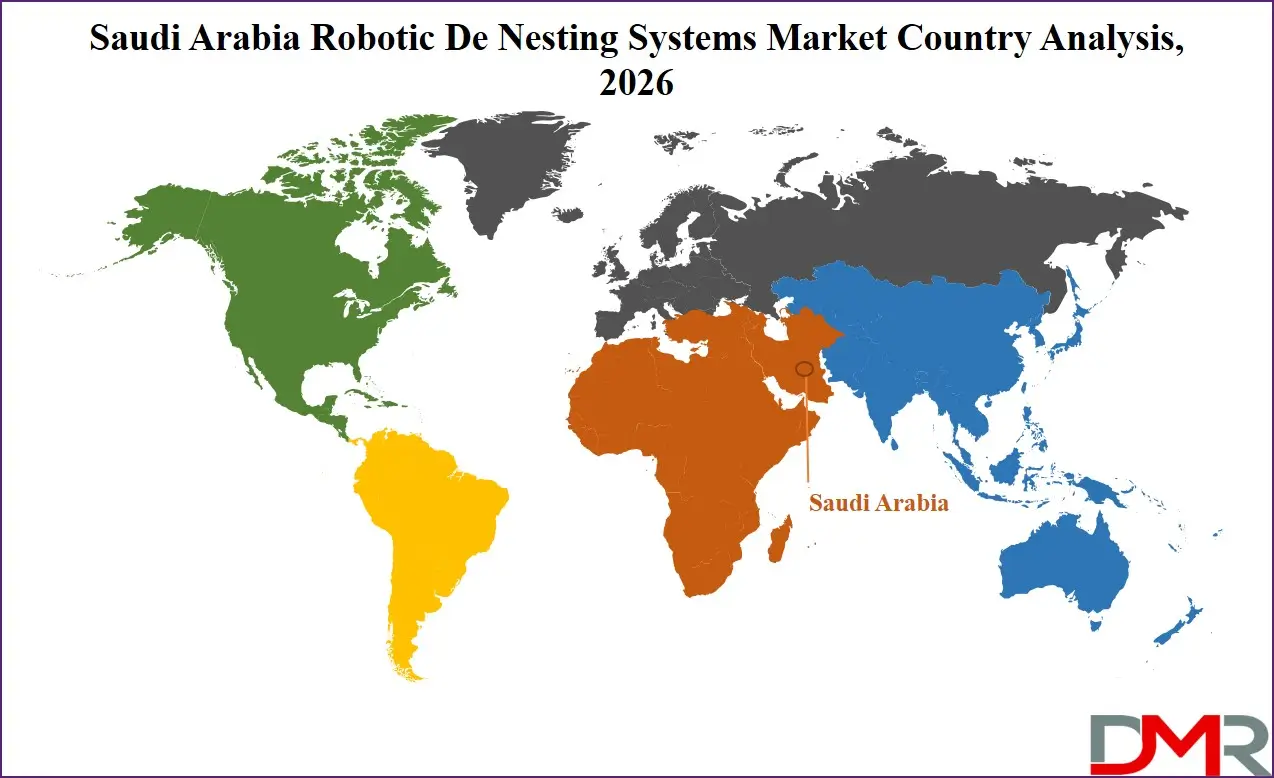
The Saudi Arabia market of robotic de-nesting systems is a dynamic place, with large government-funded industrial zones, top international robotics manufacturers, and an additional ecosystem of local distributors. The focus of competition lies in the realization of the Vision 2030 industrial goals. Anchors, key consumers, and innovators are state-owned industrial networks and project developers, including the Ministry of Industry, Saudi Aramco Industrial Development, NEOM Industrial City, and SABIC.
ℹ
To learn more about this report –
Download Your Free Sample Report Here
They are associated with the largest companies worldwide such as KUKA, ABB, FANUC, Yaskawa, and Siemens on automation technologies and technical training. The developing industrial sector is served by local and regional distributors such as Tamer Group and Al Rushaid Industrial.
Some of the prominent players in Saudi Arabia Robotic De-Nesting Systems Market are:
- ABB Ltd.
- FANUC Corporation
- KUKA AG
- Yaskawa Electric Corporation
- Schneider Electric SE
- Rockwell Automation, Inc.
- Universal Robots A/S
- Stäubli International AG
- Kawasaki Heavy Industries, Ltd.
- Omron Corporation
- Mitsubishi Electric Corporation
- Marel hf.
- BluePrint Automation, Inc.
- JLS Automation
- Brillopak Ltd.
- FlexLink (Coesia Group)
- Schubert Group GmbH
- Scott Automation & Robotics Limited
- DENSO Corporation
- RoboMecs Company
- Other Key Players
Recent Developments in Saudi Arabia Robotic De-Nesting Systems Market
- March 2026: ABB Ltd. partnered with NVIDIA Corporation to enhance industrial robot training using AI-based simulation through NVIDIA Omniverse, improving real-world accuracy and efficiency of robotic systems used in material handling and pick-and-place operations.
- March 2026: NVIDIA Corporation, in collaboration with robotics partners including ABB Ltd. and Universal Robots, supported deployment of AI-powered robotic systems capable of performing adaptive industrial tasks, improving scalability and flexibility in automation.
- March 2026: Yaskawa Electric Corporation expanded its robotics portfolio through continued advancements in industrial automation and strategic initiatives, including equity investments and system-level innovations to strengthen its global robotics capabilities.
- December 2025: Omron Corporation announced a significant expansion of its collaborative robot (cobot) lineup, introducing the TM S Series (TM6S, TM20S, TM30S) designed to enhance flexible automation, material handling, and pick-and-place operations.
Report Details
| Report Characteristics |
| Market Size (2026) |
USD 32.1 Mn |
| Forecast Value (2035) |
USD 83.6 Mn |
| CAGR (2026–2035) |
11.2% |
| Historical Data |
2021 – 2025 |
| Forecast Data |
2027 – 2035 |
| Base Year |
2025 |
| Estimate Year |
2026 |
| Report Coverage |
Market Revenue Estimation, Market Dynamics, Competitive Landscape, Growth Factors and etc. |
| Segments Covered |
By Product Type (Automatic Robotic De-Nesting Systems, Semi-Automatic Robotic De-Nesting Systems), By System Configuration (Standalone Systems, Integrated Systems, Flexible / Mobile Systems), By Application (Food and Beverage, Pharmaceuticals, Packaging, Automotive, Electronics, Others), By Distribution Channel (Direct Sales, Distributors, Online Sales, Others), By End-User (Manufacturing, Logistics, Warehousing, Others) |
| Country Coverage |
The Kingdom of Saudi Arabia (KSA) |
| Prominent Players |
ABB Ltd., FANUC Corporation, KUKA AG, Yaskawa Electric Corporation, Schneider Electric SE, Rockwell Automation, Inc., Universal Robots A/S, Stäubli International AG, Kawasaki Heavy Industries, Ltd., Omron Corporation, Mitsubishi Electric Corporation, Marel hf., BluePrint Automation, Inc., JLS Automation, Brillopak Ltd., FlexLink (Coesia Group), Schubert Group GmbH, Scott Automation & Robotics Limited, DENSO Corporation, RoboMecs Company and Other Key Players |
| Purchase Options |
We have three licenses to opt for: Single User License (Limited to 1 user), Multi-User License (Up to 5 Users), and Corporate Use License (Unlimited User) along with free report customization equivalent to 0 analyst working days, 3 analysts working days and 5 analysts working days respectively. |
Frequently Asked Questions
How big is the Saudi Arabia Robotic De-Nesting Systems Market?
▾ The Saudi Arabia Robotic De-Nesting Systems Market size is estimated to have a value of USD 32.1 million in 2026 and is expected to reach USD 83.6 million by the end of 2035.
What is the growth rate in the Saudi Arabia Robotic De-Nesting Systems Market?
▾ The market is growing at a CAGR of 11.2% over the forecasted period.
Who are the key players in the Saudi Arabia Robotic De-Nesting Systems Market?
▾ Some of the major key players in the Saudi Arabia Robotic De-Nesting Systems Market are FANUC Corporation, ABB Ltd., Yaskawa Electric Corporation, KUKA AG, Kawasaki Heavy Industries, DENSO Corporation, and many others.