Market Snapshot
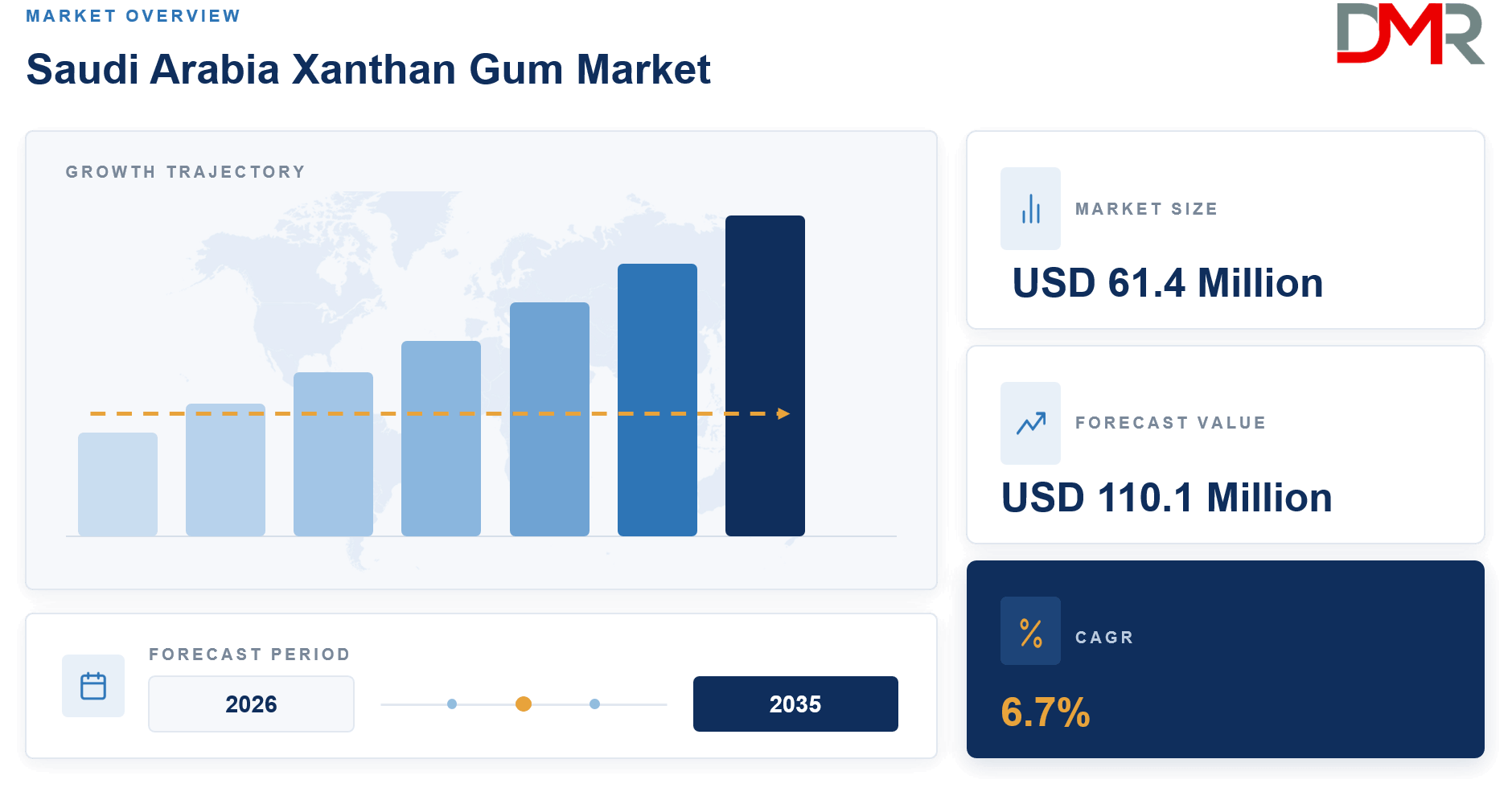
- Market Size (2026): USD 61.4 Mn
- Forecast Value (2035): USD 110.1 Mn
- CAGR (2026-2035): 6.7%
- Leading Grade (2026): Food Grade, approximately 34.5%
- Leading Application (2026): Thickening & Stabilizing, around 40.2%
- Key Players: CP Kelco, Fufeng Group, Brenntag and others
What is Saudi Arabia Xanthan Gum Market and its Market Size?
The Saudi Arabia Xanthan Gum Market size is estimated to reach USD 61.4 Mn in 2026 and is further anticipated to reach USD 110.1 Mn by 2035, at a CAGR of 6.7%. Xanthan gum is a fermentation-derived polysaccharide used where formulators need viscosity, suspension stability, water binding or controlled flow under changing temperature, salt and pH conditions. In Saudi Arabia, commercial demand is split between food processing, oilfield fluids, pharmaceuticals, personal care and a smaller group of industrial applications.
ℹ
To learn more about this report –
Download Your Free Sample Report Here
The scope covers xanthan gum consumed inside Saudi Arabia, including imported material, locally stocked product, locally blended formulations and oilfield grades supplied through domestic chemical and drilling-fluid channels. It does not represent worldwide sales of producers headquartered elsewhere. Demand is concentrated around the Eastern Province for drilling and energy services, Riyadh for national distribution and formulated consumer products, and Jeddah for food manufacturing, warehousing and import-linked ingredient supply.
Oilfield users value xanthan gum because relatively low loading can support viscosity and cuttings suspension in water-based drilling systems, especially when stable rheology is required across variable salinity and shear. Food processors use food-grade material as E415 in sauces, dairy systems, beverages, bakery fillings and convenience foods. Pharmaceutical and personal care formulators employ it as a suspending, stabilizing and texture-control ingredient in oral liquids, topical preparations, toothpaste and cosmetic emulsions.
Structurally, the market is moving from spot import buying toward qualified supply programs that combine specification control, inventory availability and technical support.
Use Cases
- Water-Based Drilling Fluids: Oilfield service companies and drilling-fluid manufacturers deploy xanthan gum to control low-shear viscosity and suspend drilled solids in water-based mud systems. The additive helps maintain transport performance during circulation changes, supporting more predictable hole cleaning and reducing dependence on higher dosages of less efficient thickeners.
- Dairy and Beverage Stabilization: Food manufacturers use food-grade xanthan gum in flavored milk, dairy beverages, fruit preparations and drink systems where solids must remain evenly dispersed. Controlled viscosity improves texture consistency and storage stability, while small inclusion rates help processors meet formulation targets without materially changing taste.
- Sauces and Prepared Foods: Sauce, dressing and convenience-food producers add xanthan gum to manage pour behavior, cling and emulsion stability. It performs across acidic formulations and processing temperature changes, allowing product developers to maintain consumer-facing texture while improving process tolerance during mixing, filling, transport and shelf storage.
- Oral and Topical Formulations: Pharmaceutical and personal care manufacturers use xanthan gum to suspend insoluble ingredients and stabilize structured liquids, gels and creams. The result is better dose uniformity, controlled spreadability and reduced phase separation, especially in products that require a plant-derived or fermentation-based rheology modifier.
Key Takeaways
- Market Size & Share: The sector is projected to expand at a headline CAGR of 6.7% between 2026 and 2035 as industrial and consumer formulation demand broadens.
- Grade Analysis: Food Grade is expected to account for roughly 34.5% of 2026 revenue, supported by a wide application base across processed foods and beverages.
- Demand Concentration: Oil & Gas is projected to hold close to 36.8% of end-use revenue in 2026 because drilling-fluid consumption remains concentrated in the Eastern Province.
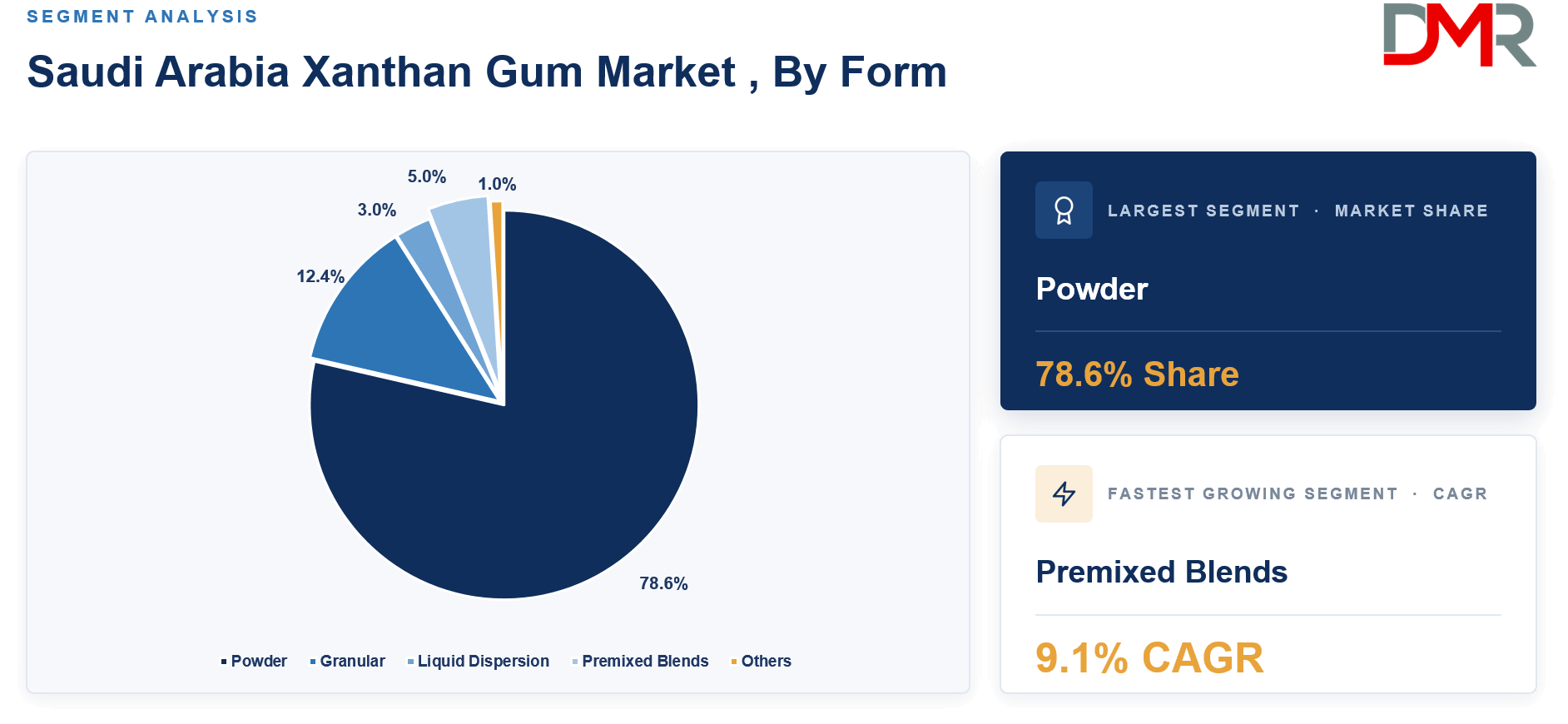
- Form Analysis: Powder is expected to represent nearly 78.6% of demand in 2026 because it is easier to ship, store, meter and blend than prepared dispersions.
- Growth White Space: Premixed Blends are forecast to expand at a CAGR of 9.1% through 2035 as users buy more application-ready stabilizer systems.
- Channel Shift: Distributors & Traders are forecast to grow at 7.6% as customers place greater value on local inventory, documentation and smaller-lot availability.
How AI/Gen AI is Transforming the Saudi Arabia Xanthan Gum Market?
Artificial intelligence has a practical rather than transformational role in this ingredient market. Food and chemical formulators increasingly use machine-learning assisted experimentation to compare viscosity, sensory response, salt tolerance and process stability across xanthan dosages and combinations with guar gum, carrageenan, cellulose derivatives or starch. In oilfield applications, data-driven models can connect mud properties, temperature, salinity, solids loading and circulation conditions with treatment recommendations, helping engineers adjust fluid systems with fewer trial cycles.
Generative AI is more relevant to documentation and formulation workflows. Large language models can organize supplier certificates, safety information, food-additive requirements and customer specifications, while predictive tools can identify specification drift in incoming lots. Digital process models can also help local blenders reduce over-treatment and improve batch consistency, although final release decisions still depend on laboratory testing and qualified technical staff.
- Formulation Screening: Machine learning ranks likely gum combinations and dosage windows before laboratory trials.
- Drilling Fluid Optimization: Predictive models relate rheology measurements to changing well conditions and treatment requirements.
- Quality Control Analytics: Statistical and computer-vision systems flag packaging, moisture and batch-consistency anomalies during receiving and blending.
- Document Processing: LLM tools organize certificates of analysis, specifications and regulatory records for faster supplier qualification.
Key Drivers in the Saudi Arabia Xanthan Gum Market
Demand is being pulled by two structurally different engines, the Kingdom's drilling and energy-services base and the expansion of local food manufacturing. Both favor ingredients that deliver predictable performance at low dosage and can be supported by reliable domestic inventory.
- Persistent Oilfield Fluid Consumption: Oil & Gas is expected to account for approximately 36.8% of end-use demand in 2026, making drilling activity the single largest consumption base. Xanthan gum supports low-shear viscosity, solids suspension and hole-cleaning performance in water-based mud systems, so its value rises where drilling programs require stable rheology under salt, temperature and shear variation. Saudi localization policies also encourage oilfield chemical suppliers to maintain domestic stock, blending and manufacturing capabilities. This increases the probability that xanthan is sourced through qualified local channels rather than as a purely transactional import, supporting steadier consumption and shorter replenishment cycles.
- Expansion of Local Food Processing: Food & Beverage is projected to represent around 34.1% of end-use revenue in 2026 and is modeled as the fastest-growing major industry at a CAGR of 8.0%. Saudi investments in dairy, meat, beverages, bakery, sauces and convenience foods increase the number of formulations requiring stable texture, suspension and emulsion control. Xanthan gum is attractive because processors can achieve noticeable rheological effects at relatively low inclusion levels and across acidic or thermally processed systems. As local factories broaden SKU ranges, demand shifts from commodity thickening toward application-specific stabilizer systems, creating repeat requirements for consistent food-grade material and technical support.
Restraints in the Saudi Arabia Xanthan Gum Market
Growth is moderated by import dependence and by the fact that xanthan competes with several other hydrocolloids and synthetic rheology modifiers. Buyers can switch when price, lead time or formulation performance changes.
- Import Exposure and Price Volatility: Powder is expected to hold nearly 78.6% of 2026 demand, and much of this material reaches the Kingdom through international supply chains. Fermentation economics depend on carbohydrate feedstocks, utilities, plant operating rates and freight, while Saudi buyers also face inventory and working-capital costs associated with imported product. A sudden change in supplier availability can push distributors toward higher safety stocks or alternative origins. For price-sensitive food and industrial formulations, that volatility can delay reformulation projects or encourage partial substitution with guar gum, modified starch, cellulose derivatives or blended stabilizer systems.
- Substitution Across Formulation Systems: Thickening & Stabilizing is projected to account for roughly 40.2% of application demand in 2026, but xanthan does not own this function exclusively. Depending on texture, labeling, temperature, electrolyte level and cost target, formulators can select guar, carrageenan, pectin, locust bean gum, CMC, HPMC or modified starch. Oilfield engineers can also shift polymer packages according to well conditions and fluid design. This limits the ability of suppliers to pass through price increases and means technical service matters as much as availability. Growth therefore depends on demonstrating measurable performance rather than simply expanding distribution.
Growth Opportunities in the Saudi Arabia Xanthan Gum Market
The strongest white spaces sit in value-added grades and service models where suppliers solve a formulation or logistics problem rather than sell a standard bag. Local blending and application support can capture a larger share of customer spend.
- Application-Ready Stabilizer Blends: Premixed Blends are forecast to grow at a CAGR of 9.1% from 2026 to 2035, faster than the overall market. Saudi food manufacturers are adding more differentiated products but do not always want to build hydrocolloid expertise internally. Suppliers can combine xanthan with guar, carrageenan, CMC, starch or emulsifiers to produce systems tuned for dairy drinks, sauces, bakery fillings, meat products and frozen foods. This shifts competition away from price per kilogram toward performance per formulation. Local blending also supports shorter development cycles, smaller minimum order quantities and better adaptation to regional taste, process and storage conditions.
- Localized Oilfield Chemical Manufacturing: Oilfield Grade is projected to expand at a CAGR of 8.2% through 2035 as local drilling-fluid manufacturers deepen Saudi production and inventory. A supplier that qualifies xanthan for API-oriented drilling systems, maintains dependable Eastern Province stock and supports field troubleshooting can participate in higher-value contracts than an importer selling generic material. There is further opportunity to package xanthan with PAC, CMC, starches and other water-based mud additives. Localization reduces lead-time risk for operators and supports procurement programs that increasingly consider domestic value addition alongside price and technical performance.
Trends in the Saudi Arabia Xanthan Gum Market
Buyer behavior is shifting toward documented, application-specific supply and away from undifferentiated ingredient trading. The change is visible in both food formulation and oilfield chemical channels.
- Higher Emphasis on Traceability and Specification Control: Food Grade is expected to carry approximately 34.5% of grade revenue in 2026, and customers increasingly require consistent documentation around identity, microbiology, heavy metals, allergen status, halal suitability and batch performance. Local distributors are responding with tighter supplier qualification, warehousing and certificate management rather than competing only on landed price. This favors producers with stable fermentation quality and distributors with technical personnel who can interpret specification differences. It also raises switching costs once a grade has been approved for a sensitive beverage, dairy or pharmaceutical formulation.
- Shift Toward Local Stock and Technical Distribution: Direct Sales are projected to hold around 55.7% of 2026 channel revenue, but Distributors & Traders are expected to grow faster at 7.6%. Customers with variable production schedules prefer shorter replenishment, smaller lots and local support, especially when imported lead times are uncertain. Distributors are therefore expanding from simple resale into inventory planning, formulation assistance, regulatory documentation and multi-ingredient bundling. For xanthan suppliers, channel capability is becoming an important differentiator because the same customer may buy food ingredients, oilfield polymers or personal-care additives through different technical teams and purchasing cycles.
Research Scope and Analysis
Segment performance is assessed across grade, application, form, end-use industry and distribution channel. Each axis identifies where 2026 revenue is concentrated and which sub-segment is expected to expand fastest through 2035, together with the commercial mechanism behind that position.
ℹ
To learn more about this report –
Download Your Free Sample Report Here
By Grade
Food Grade is projected to hold the largest share by grade in 2026, accounting for approximately 34.5% of revenue because it serves a broad installed base across sauces, dairy, beverages, bakery, meat products and convenience foods. Qualification requirements also create repeat purchasing once a processor approves a specific grade. Growth, however, is concentrated in Oilfield Grade, expanding at a CAGR of 8.2% between 2026 and 2035. Saudi drilling programs require reliable rheology modifiers for water-based fluids, and local chemical manufacturers are increasing their ability to blend and stock drilling additives in the Eastern Province. Oilfield buyers also place a premium on consistent viscosity response, salt tolerance and dependable delivery, which supports value growth above the market average.
By Application
Thickening & Stabilizing is expected to remain the largest application in 2026, representing around 40.2% of revenue because xanthan is widely selected to build viscosity, reduce phase separation and improve texture at low inclusion rates. The steeper trajectory sits with Rheology Modification, which is forecast to grow at a CAGR of 8.4% through 2035. Growth is supported by water-based drilling systems, specialty chemical formulations and higher-performance food products where flow behavior under shear matters as much as static thickness. Suppliers that can provide application data and blend design support are better positioned to capture this faster-growing use.
By Form
Powder is projected to dominate the form mix in 2026 with close to 78.6% of revenue, reflecting its storage stability, shipment efficiency and compatibility with existing dry-ingredient and oilfield blending systems. Saudi importers and distributors can also hold powder inventory for multiple end markets without carrying water weight or short shelf-life constraints. Growth, however, is concentrated in Premixed Blends, forecast to expand at a CAGR of 9.1% between 2026 and 2035. Food processors and specialty formulators increasingly prefer systems that combine xanthan with complementary hydrocolloids or functional additives.
By End Use Industry
Oil & Gas is expected to hold the largest end-use share in 2026 at approximately 36.8%, supported by the scale of Saudi drilling activity and the need for rheology control in water-based mud systems. The Eastern Province also hosts a dense network of drilling-fluid manufacturers, service companies and chemical distributors, reinforcing local consumption. Growth, however, is concentrated in Food & Beverage, which is forecast to expand at a CAGR of 8.0% through 2035. New domestic manufacturing capacity, product localization and broader ranges in dairy, beverages, sauces and prepared foods increase the number of formulations using hydrocolloids.
By Distribution Channel
Direct Sales are projected to hold the largest channel share in 2026, accounting for roughly 55.7% of revenue because large oilfield service companies, food manufacturers and chemical blenders often negotiate directly with qualified producers or major regional principals. Volume commitments and specification control favor these relationships. The faster growth sits with Distributors & Traders, forecast to expand at a CAGR of 7.6% between 2026 and 2035.
The Saudi Arabia Xanthan Gum Market Report is Segmented Based on the Following
By Grade
- Food Grade
- Oilfield Grade
- Pharmaceutical Grade
- Cosmetic Grade
- Technical Grade
- Others
By Application
- Thickening & Stabilizing
- Rheology Modification
- Suspension
- Emulsification
- Binding
- Others
By Form
- Powder
- Granular
- Liquid Dispersion
- Premixed Blends
- Others
By End Use Industry
- Oil & Gas
- Food & Beverage
- Pharmaceuticals
- Personal Care & Cosmetics
- Industrial Processing
- Others
By Distribution Channel
- Direct Sales
- Distributors & Traders
- Specialty & Online Channels
- Others
Competitive Landscape
Competition combines multinational fermentation producers, Chinese volume suppliers, global ingredient distributors, oilfield service companies and Saudi specialty chemical channels. Price matters, but qualification, viscosity consistency, microbiological control, documentation and local availability can be more important in sensitive food or drilling applications. Large users favor approved suppliers that can maintain continuity across batches, while smaller processors rely on distributors for local stock and technical guidance.
Some of the Prominent Players in the Saudi Arabia Xanthan Gum Market Are
- CP Kelco
- Jungbunzlauer Suisse AG
- Fufeng Group
- Deosen Biochemical Ltd.
- Meihua Holdings Group Co., Ltd.
- Cargill, Incorporated
- Ingredion Incorporated
- International Flavors & Fragrances Inc.
- ADM
- Brenntag SE
- IMCD Group
- Azelis
- Barentz
- Univar Solutions Inc.
- Caldic B.V.
- DKSH Holding Ltd.
- Halliburton
- SLB
- Baker Hughes
- Weatherford International plc
- Newpark Resources, Inc.
- Clariant
- BASF SE
- Ashland Inc.
- Lubrizol Corporation
- Nouryon
- Polymers Oil & Gas Factory
- Modern Petrochemicals Co. Ltd.
- KRON Oilfield Service Company
- Sahaa Ingredients
- REDA Chemicals
- Midad Chemicals Company Ltd.
- Black Gold Industrial Co.
- Arabian Minerals & Chemicals Co. Ltd.
- Rezayat Trading Company Ltd.
- Rawabi Oil & Gas
- Abdulla Fouad Group
- Al-Rushaid Petroleum Investment Company
- Gulf Chemicals & Industrial Oils Co.
- Saudi Chemical Company Holding
- Other Key Players
Recent Developments
- In July 2026, Halliburton received multi-year contracts from Aramco covering approximately 285 planned onshore wells, expanding integrated drilling, completion and workover activity in Saudi Arabia and supporting demand for qualified drilling-fluid additives and local chemical supply.
- In January 2026, Saudi authorities reported an 18% increase in licensed factories and warehouses during 2025, including 624 food factories and 5,344 food warehouses, broadening the domestic customer base for stabilizers, thickeners and other formulation ingredients.
- In January 2026, JBS continued expansion of its Jeddah food manufacturing operation with capital investment of about SAR 319 million, strengthening local processed-food capacity and the addressable market for texture, stabilization and formulation ingredients.
Report Details
| Report Characteristics |
| Market Size (2026) |
USD 61.4 Mn |
| Forecast Value (2035) |
USD 110.1 Mn |
| CAGR (2026-2035) |
6.7% |
| Historical Data |
2021 - 2025 |
| Forecast Data |
2026 - 2035 |
| Base Year |
2025 |
| Segments Covered |
By Grade, By Application, By Form, By End Use Industry and By Distribution Channel |
| Regional Coverage |
Saudi Arabia |
Frequently Asked Questions
How big is the Saudi Arabia Xanthan Gum Market?
▾ The Saudi Arabia Xanthan Gum Market is estimated at USD 61.4 Mn in 2026. Demand comes from oilfield drilling fluids, processed food and beverages, pharmaceuticals, personal care and smaller industrial uses.
What is the growth rate of the Saudi Arabia Xanthan Gum Market?
▾ The market is forecast to expand at a CAGR of 6.7% from 2026 to 2035. Growth is supported by continuing drilling-fluid consumption, food manufacturing localization, greater use of formulated stabilizer systems and expanding technical distribution. The pace remains moderate because xanthan faces substitution from other hydrocolloids, cellulose derivatives, starches and alternative oilfield polymers.
What is driving demand in the Saudi Arabia Xanthan Gum Market?
▾ Demand is primarily driven by the Kingdom's large oil and gas services base and growing local food manufacturing. Oilfield users require viscosity and suspension control in water-based drilling fluids, while food processors use xanthan in sauces, dairy products, beverages and prepared foods.
Which grade leads the Saudi Arabia Xanthan Gum Market?
▾ Food Grade is expected to lead by grade in 2026 with approximately 34.5% of revenue. Its position reflects the broad number of applications that require texture and stability control, including dairy, beverages, sauces, bakery products and processed foods. Oilfield Grade remains close behind and is expected to grow faster through the forecast period.
Which end-use industry is expanding fastest?
▾ Food & Beverage is forecast to post the fastest growth among the major end-use industries, with a CAGR of 8.0% from 2026 to 2035. New local manufacturing capacity, product localization and rising formulation complexity increase the requirement for hydrocolloids that can provide repeatable viscosity, suspension, emulsion stability and water binding.
Who are the key players in the Saudi Arabia Xanthan Gum Market?
▾ Key participants include CP Kelco, Fufeng Group, Deosen Biochemical, Brenntag, Halliburton, Polymers Oil & Gas Factory and Sahaa Ingredients. Competition includes international xanthan producers, global chemical distributors, oilfield service companies and domestic Saudi suppliers that provide local inventory, technical support, blending and customer-specific supply programs.
What is the outlook for the Saudi Arabia Xanthan Gum Market through 2035?
▾ The Saudi Arabia Xanthan Gum Market is anticipated to reach USD 110.1 Mn by 2035. The strongest opportunities are expected in oilfield-grade polymers, local food manufacturing, application-ready hydrocolloid blends and technical distribution. Suppliers that combine qualified product, reliable Saudi inventory and formulation support should be better positioned than purely transactional import channels.