What is the Scrum Software Market Size in 2026?
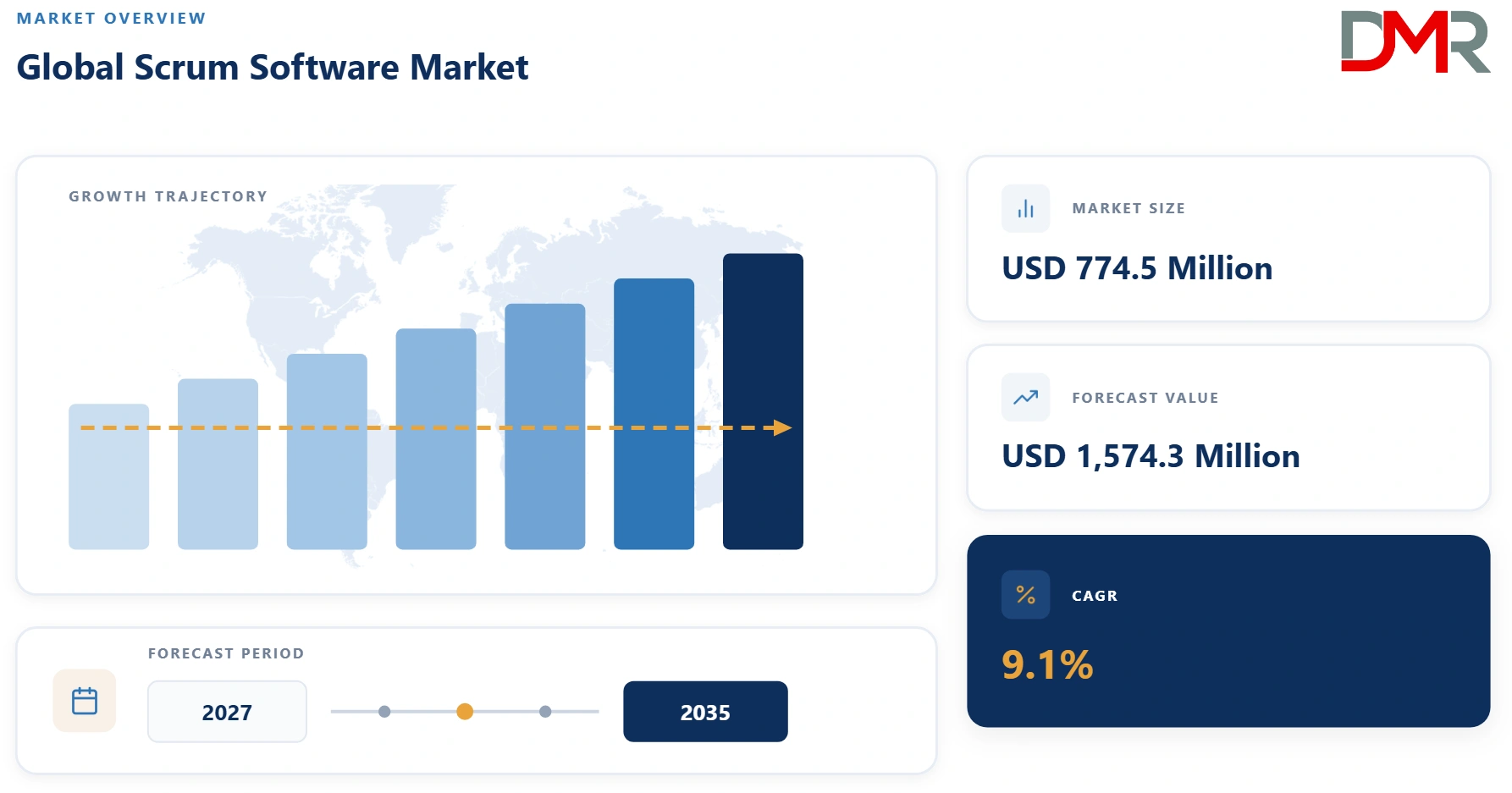
The Global Scrum Software Market is valued at USD 774.5 million in 2026 and is projected to reach USD 1,574.3 million by 2035, growing at a CAGR of 9.1% from 2027 to 2035. Growth is driven by increasing adoption of agile project management methodologies, expanding software development activities, growing demand for collaborative work management platforms, and rising enterprise investments in digital workflow management solutions.
ℹ
To learn more about this report –
Download Your Free Sample Report Here
Scrum software refers to digital tools designed to support project planning, sprint management, backlog organization, task allocation, and progress monitoring within the Scrum framework. These solutions help development teams organize work into manageable iterations, monitor project performance, and coordinate activities across different departments. Scrum software typically includes features such as sprint boards, product backlogs, burndown charts, velocity tracking, and collaborative reporting. Organizations utilize these platforms to improve project transparency, resource allocation, team coordination, and product delivery efficiency.
The Global Scrum Software Market covers software and services supporting Scrum-based project management and agile workflow execution across enterprise environments. Market coverage encompasses cloud-based and on-premises deployment models serving small, medium, and large enterprises. The analysis includes IT & telecom, BFSI, retail & e-commerce, manufacturing, healthcare, government, and education. Revenue assessment considers software subscriptions, licensing, implementation, integration, customization, training, consulting, and technical support services associated with Scrum software adoption.
Scrum Software Market Snapshot
Scrum Software Market Snapshot, 2027-2035
| Metric |
Value |
| Market Size (2026) |
USD 774.5 Million |
| Forecast Value (2035) |
USD 1,574.3 Million |
| CAGR (2027–2035) |
9.1% |
| Largest Region (2026) |
North America, 44.0% share |
| Fastest-Growing Region (2027–2035) |
Asia Pacific, 9.7% CAGR |
| Leading Offering (2026) |
Software, 72.5% share |
| Leading Deployment (2026) |
Cloud-Based, 76.0% share |
| Key Players |
Atlassian Corporation; Microsoft Corporation, Zoho Corporation; ClickUp; monday.com Ltd.; Asana, Inc.; Broadcom Inc.; Digital.ai Software, Inc. |
Scrum Software Market: Key Takeaways
- Market Growth: The market is valued at USD 774.5 million in 2026 and is projected to reach USD 1,574.3 million by 2035, registering a CAGR of 9.1%.
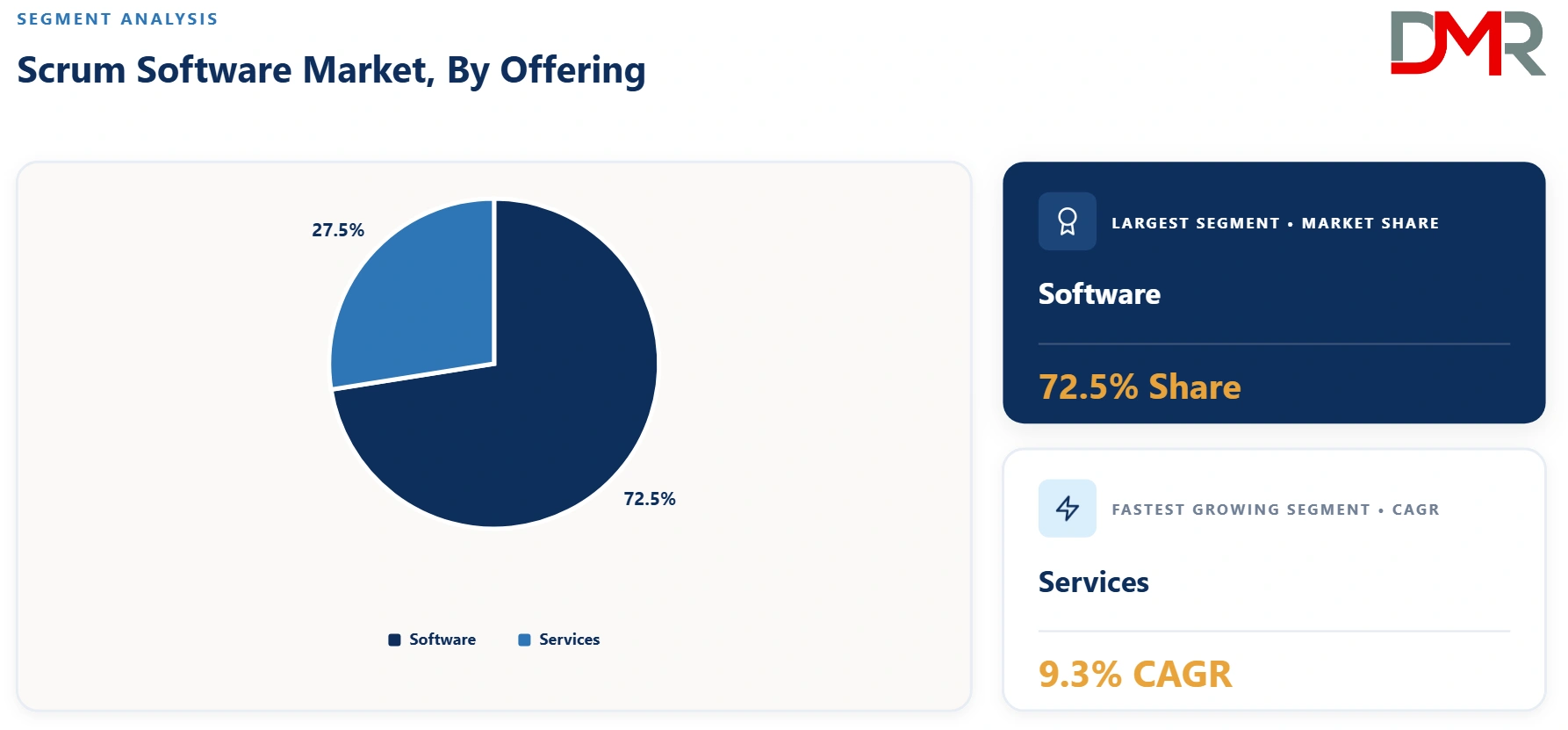
- Offering Leader: Software accounts for 72.5% of market revenue in 2026, supported by extensive adoption of digital sprint planning and agile project management platforms.
- Fastest-Growing Offering: Services are projected to register a CAGR of 9.3%, driven by increasing demand for implementation, integration, customization, and agile transformation consulting.
- Deployment Leader: Cloud-Based deployment accounts for 76.0% of market revenue in 2026, supported by remote accessibility, scalability, and centralized project management capabilities.
- Fastest-Growing Deployment: Cloud-Based deployment is projected to register a CAGR of 9.4%, driven by distributed development teams and increasing adoption of subscription-based software.
- Regional Picture: North America leads with a 44.0% market share in 2026, while Asia Pacific is projected to grow at a CAGR of 9.7%.
What are the Key Use Cases of Scrum Software?
- Sprint Planning and Execution: Supports sprint scheduling, workload estimation, task allocation, and progress monitoring to improve project execution within defined development cycles.
- Product Backlog Management: Organizes product requirements, user stories, feature requests, and development priorities, supporting efficient resource allocation and product development planning.
- Cross-Functional Team Collaboration: Facilitates communication, task coordination, document sharing, and workflow transparency across development teams and business departments.
- Project Performance Monitoring: Provides burndown charts, velocity reports, sprint reviews, and performance dashboards to evaluate development progress and identify operational bottlenecks.
How are Foundation Models and Generative AI Transforming the Scrum Software Market?
Foundation models and generative AI are transforming the Scrum Software Market through advancements in automated sprint planning, backlog refinement, task estimation, and project performance analysis. Large language models enable Scrum platforms to interpret project requirements, generate user stories, summarize team discussions, and recommend task priorities. These capabilities reduce administrative workloads, improve project visibility, and support efficient resource allocation across software development and business operations.
Generative AI also supports historical sprint data analysis, workload forecasting, dependency identification, and early detection of potential project delays. Integrated analytical capabilities help development teams evaluate sprint performance and identify workflow bottlenecks. Natural language interfaces simplify access to project information and reporting functions. Increasing adoption of generative AI encourages investment in intelligent workflow automation, predictive project analytics, collaborative planning, and automated documentation capabilities across enterprise environments.
Scrum Software Market Dynamics at a Glance
Drivers, Restraints, Opportunities and Trends in the Scrum Software Market
| Type |
Factor |
Impact |
| Driver |
Increasing Adoption of Agile Project Management Methodologies |
High |
| Driver |
Growing Demand for Distributed Team Collaboration |
High |
| Restraint |
Challenges Associated with Organizational Transition to Scrum |
High |
| Restraint |
High Implementation and Integration Costs |
Medium |
| Opportunity |
Expanding Adoption of Scrum Across Non-IT Industries |
High |
| Opportunity |
Growing Demand for Enterprise-Scale Scrum Management Solutions |
High |
| Trend |
Increasing Integration with DevOps and Software Development Platforms |
High |
| Trend |
Growing Adoption of Customizable Workflows and Automated Project Reporting |
Medium |
What is Driving the Growth of the Scrum Software Market?
Increasing Adoption of Agile Project Management Methodologies
Increasing adoption of agile project management methodologies is driving demand for Scrum software across enterprise environments. Organizations are replacing rigid project management approaches with iterative development practices that support changing business requirements and continuous product improvement. Scrum software enables teams to organize development activities into defined sprints, prioritize product backlogs, and monitor project progress. Regular sprint reviews and structured feedback processes help organizations identify operational challenges and improve product delivery schedules. Growing requirements for faster software releases, improved customer responsiveness, and efficient resource utilization encourage investment in dedicated Scrum management platforms across industries.
Growing Demand for Distributed Team Collaboration
Growing demand for distributed team collaboration is accelerating the adoption of Scrum software across organizations with geographically dispersed workforces. Remote and hybrid working arrangements require centralized platforms for managing development activities, coordinating responsibilities, and maintaining project visibility. Scrum software provides shared sprint boards, task updates, backlog management, and collaborative reporting capabilities. These functions support communication between product owners, Scrum masters, developers, and other project stakeholders. Organizations increasingly prioritize accessible project management solutions that reduce communication gaps and improve coordination across departments. Continued expansion of distributed development teams and international business operations supports demand for collaborative Scrum software platforms.
What are the Key Restraints in the Scrum Software Market?
Challenges Associated with Organizational Transition to Scrum
Challenges associated with organizational transition to Scrum restrict software adoption across businesses accustomed to traditional project management practices. Successful Scrum implementation requires changes in organizational workflows, employee responsibilities, communication practices, and project evaluation methods. Employees unfamiliar with agile methodologies may encounter difficulties adapting to sprint-based development and collaborative planning. Organizations frequently require specialized training and process restructuring before achieving meaningful productivity improvements. Inadequate understanding of Scrum principles can result in inefficient workflows, inconsistent sprint execution, and limited software utilization. Such organizational challenges can delay implementation decisions and reduce the effectiveness of Scrum software investments.
High Implementation and Integration Costs
High implementation and integration costs present challenges for Scrum software adoption, particularly among organizations operating with limited technology budgets. Enterprise-grade platforms may require expenditure on software subscriptions, system configuration, workflow customization, data migration, and technical support. Additional costs arise from integration with existing development tools, enterprise resource planning systems, and business communication platforms. Organizations managing complex legacy infrastructure frequently encounter compatibility challenges during implementation. Smaller businesses may rely on basic project management tools or freely available alternatives to reduce operational expenditure. These financial considerations restrict adoption of comprehensive Scrum software solutions across cost-sensitive enterprise environments.
What are the Key Opportunities in the Scrum Software Market?
Expanding Adoption of Scrum Across Non-IT Industries
Expanding adoption of Scrum across non-IT industries creates opportunities for software providers serving diverse business environments. Organizations in manufacturing, healthcare, financial services, retail, and education are exploring iterative project management practices to improve operational flexibility and service delivery. Scrum methodologies support product development, marketing campaigns, business process improvement, and organizational transformation initiatives beyond conventional software development. Technology providers can address these requirements through industry-specific templates, configurable workflows, and simplified collaboration features. Growing demand for structured project execution and faster responses to changing customer requirements supports commercial opportunities for Scrum software across traditionally underserved industries.
Growing Demand for Enterprise-Scale Scrum Management Solutions
Growing demand for enterprise-scale Scrum management solutions creates opportunities for providers supporting large organizations with multiple development teams. Complex enterprise projects frequently involve interconnected workstreams, shared resources, and dependencies across departments. Conventional team-level Scrum tools may provide limited visibility into organization-wide project activities. Enterprise-scale solutions offer centralized portfolio management, cross-team dependency tracking, capacity planning, and consolidated performance reporting. These capabilities help organizations align development activities with strategic business objectives. Increasing adoption of large-scale agile transformation programs encourages investment in scalable Scrum software, enterprise integration services, and specialized implementation support.
What are the Latest Trends in the Scrum Software Market?
Increasing Integration with DevOps and Software Development Platforms
Increasing integration with DevOps and software development platforms reflects changing enterprise requirements for connected development workflows. Organizations increasingly seek Scrum software capable of connecting sprint planning and backlog management with source code repositories, testing environments, and deployment pipelines. Integrated platforms enable development teams to monitor project activities alongside software build, testing, and release processes. These capabilities improve coordination between development and operations teams while reducing manual information transfers. Growing demand for continuous software delivery encourages technology providers to strengthen integration capabilities across development environments. Connected project management and development workflows support improved operational efficiency and product release management.
Growing Adoption of Customizable Workflows and Automated Project Reporting
Growing adoption of customizable workflows and automated project reporting reflects increasing enterprise requirements for flexible project management solutions. Organizations operate with different development practices, reporting structures, team configurations, and business objectives. Scrum software providers increasingly offer configurable sprint boards, custom work item categories, automated notifications, and personalized performance dashboards. These capabilities enable organizations to adapt project management platforms to specific operational requirements without extensive software development. Automated reporting reduces manual administrative activities and improves access to project performance information. Increasing emphasis on project transparency, resource utilization, and development efficiency supports demand for flexible Scrum management platforms.
Research Scope and Analysis
The research covers the Global Scrum Software Market across offering, deployment, enterprise size, end-use industry, and region. The analysis evaluates revenue generated through Scrum software subscriptions, licensing, implementation, integration, training, consulting, and associated technical support services. Market assessment incorporates enterprise adoption, technological developments, competitive positioning, software deployment preferences, and commercial growth opportunities across diverse industries and geographic markets.
ℹ
To learn more about this report –
Download Your Free Sample Report Here
By Offering Analysis
Software is projected to dominate the offering segment in the Global Scrum Software Market, accounting for 72.5% of the total market share in 2026. Dominance is supported by extensive enterprise adoption of digital sprint planning, backlog management, and collaborative project management platforms. Services are projected to be the fastest-growing segment, registering a CAGR of 9.3% from 2027 to 2035, driven by increasing demand for software implementation, workflow customization, system integration, and agile transformation consulting.
By Deployment Analysis
Cloud-Based deployment is projected to dominate the deployment segment in the Global Scrum Software Market, accounting for 76.0% of the total market share in 2026. Dominance is supported by remote accessibility, scalability, centralized project administration, and reduced infrastructure requirements. Cloud-Based deployment is also projected to be the fastest-growing segment, registering a CAGR of 9.4% from 2027 to 2035, driven by expanding distributed development teams and increasing adoption of subscription-based project management platforms.
By Enterprise Size Analysis
Large Enterprises are projected to dominate the enterprise size segment in the Global Scrum Software Market, accounting for 58.2% of the total market share in 2026. Dominance is supported by extensive software development activities, complex project management requirements, and substantial investments in enterprise digital transformation. Small & Medium Enterprises (SMEs) are projected to be the fastest-growing segment, registering a CAGR of 9.6% from 2027 to 2035, driven by increasing availability of affordable cloud-based software and growing adoption of agile project management methodologies.
By End-Use Industry Analysis
IT & Telecom is projected to dominate the end-use industry segment in the Global Scrum Software Market, accounting for 32.5% of the total market share in 2026. Dominance is supported by extensive software development activities, frequent product releases, and established adoption of agile development methodologies. Retail & E-Commerce is projected to be the fastest-growing segment, registering a CAGR of 9.8% from 2027 to 2035, driven by expanding digital commerce platforms, increasing demand for rapid application updates, and continuous improvement of customer experience technologies.
How is the Scrum Software Market Segmented?
By Offering
By Deployment
By Enterprise Size
- Small & Medium Enterprises (SMEs)
- Large Enterprises
By End-Use Industry
- IT & Telecom
- BFSI
- Retail & E-Commerce
- Manufacturing
- Healthcare
- Government
- Education
- Others
Which Region Leads the Scrum Software Market?
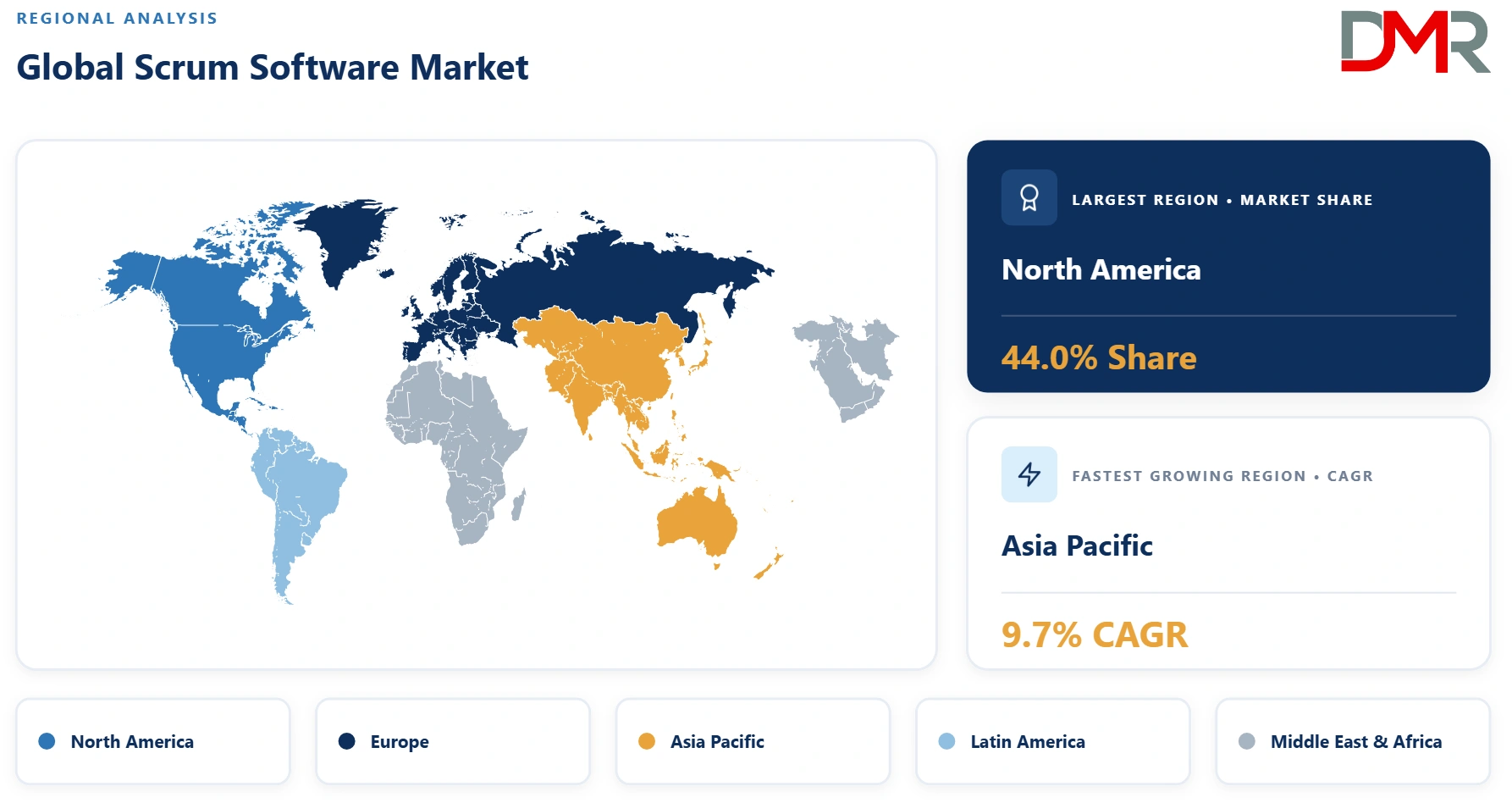
North America leads the Global Scrum Software Market with a market share of 44.0% in 2026, while Asia Pacific is projected to register the highest CAGR of 9.7% from 2027 to 2035.
ℹ
To learn more about this report –
Download Your Free Sample Report Here
Region with the Largest Revenue Share
North America dominates the Global Scrum Software Market, accounting for 44.0% of the total market share in 2026, based on the supplied segmentation figures. Regional dominance is supported by established software development infrastructure, widespread adoption of agile methodologies, and substantial enterprise technology investments. The U.S. and Canada contribute to regional demand through software development activities, cloud adoption, and digital transformation initiatives. The presence of established project management software providers supports product innovation, while increasing demand for collaborative development platforms and enterprise-scale agile management solutions encourages market expansion.
Region with the Highest CAGR
Asia Pacific is projected to register the highest CAGR of 9.7% in the Global Scrum Software Market from 2027 to 2035. Regional growth is supported by expanding software development activities, increasing enterprise digitalization, and growing adoption of cloud-based project management solutions. China, Japan, India, Australia, and South Korea contribute through technology investments, software outsourcing activities, and digital business expansion. Growing demand for affordable Scrum software, collaborative development platforms, and efficient project management capabilities supports market expansion across established and emerging regional economies.
Regional Analysis
Europe Scrum Software Market
The Europe Scrum Software Market is supported by established software development industries, increasing enterprise digital transformation, and growing adoption of agile project management methodologies. Germany, France, the U.K., Italy, and Spain contribute to regional demand through technology investments and business modernization initiatives. Organizations increasingly prioritize Scrum platforms offering secure data management, configurable workflows, and enterprise integration capabilities. Growing requirements for collaborative development, operational efficiency, and regulatory compliance encourage adoption of cloud-based and on-premises Scrum software solutions across regional industries.
Latin America Scrum Software Market
The Latin America Scrum Software Market is supported by expanding software development activities, increasing digital entrepreneurship, and growing adoption of collaborative project management platforms. Mexico and Brazil contribute to regional demand through technology sector development, digital commerce expansion, and software outsourcing activities. Organizations increasingly adopt cloud-based Scrum software to improve project coordination and reduce technology infrastructure costs. Growing demand for affordable subscriptions, localized software interfaces, and agile development capabilities supports commercial opportunities across regional enterprises and emerging technology businesses.
Middle East & Africa Scrum Software Market
The Middle East & Africa Scrum Software Market is supported by national digital transformation initiatives, expanding information technology infrastructure, and increasing adoption of modern project management practices. Saudi Arabia, the UAE, and South Africa contribute through enterprise modernization, software development, and digital government initiatives. Organizations increasingly prioritize collaborative project management solutions to improve operational flexibility and project delivery efficiency. Growing demand for cloud-based Scrum platforms, localized implementation services, and configurable project management tools creates opportunities across established and emerging regional markets.
By Region
North America
Europe
- Germany
- France
- The U.K.
- Italy
- Spain
- Rest of Europe
Asia-Pacific
- China
- Japan
- India
- Australia
- South Korea
- Rest of APAC
Latin America
- Mexico
- Brazil
- Rest of LATAM
Middle East & Africa
- Saudi Arabia
- The UAE
- South Africa
- Rest of MEA
Regulatory Landscape
The regulatory landscape of the Global Scrum Software Market is influenced by data protection regulations, information security standards, software licensing requirements, and industry-specific compliance frameworks. The General Data Protection Regulation (GDPR) and California Consumer Privacy Act (CCPA), as amended, influence personal information handling across relevant jurisdictions. Information security standards such as ISO/IEC 27001 encourage secure software deployment and organizational data management. Enterprises operating in regulated industries require appropriate access controls, audit trails, and project documentation capabilities. These requirements create opportunities for software providers offering secure cloud infrastructure, configurable user permissions, data encryption, and comprehensive project reporting capabilities.
Technology Analysis
Technological advancements in the Global Scrum Software Market focus on cloud computing, workflow automation, real-time collaboration, and advanced project analytics. Modern Scrum platforms incorporate interactive sprint boards, customizable backlogs, resource planning tools, and performance monitoring dashboards. Application programming interfaces facilitate integration with software development environments, source code repositories, testing platforms, and enterprise communication tools. Cloud-based infrastructure supports centralized project administration and scalable software deployment across distributed teams. Increasing demand for efficient project execution encourages investment in automated reporting, dependency tracking, workload management, and configurable workflows, strengthening technological differentiation across Scrum software providers.
Who are the Leading Companies in the Scrum Software Market?
The Global Scrum Software Market is characterized by competition among established project management software providers, specialized agile development platform providers, and enterprise technology companies. Major participants include Atlassian Corporation, Microsoft Corporation, Zoho Corporation, monday.com Ltd., and ClickUp. Competitive differentiation focuses on sprint management capabilities, backlog organization, workflow customization, reporting functionality, software integration, and subscription pricing. Companies strengthen market positioning through product innovation, expanded collaboration capabilities, enterprise partnerships, and integrated software development solutions.
- Atlassian Corporation (Sydney, Australia): Provides Scrum management solutions through Jira, supporting sprint planning, product backlog management, customizable Scrum boards, development progress tracking, and agile performance reporting.
- Microsoft Corporation (Washington, U.S.): Offers Scrum project management capabilities through Azure Boards within Azure DevOps, supporting sprint planning, work item tracking, backlog prioritization, team capacity management, and development workflow integration.
- Zoho Corporation (Chennai, India): Provides Zoho Sprints, supporting agile project planning, backlog organization, sprint scheduling, release management, and project performance reporting across collaborative enterprise environments.
- monday.com Ltd. (Tel Aviv, Israel): Offers agile project management capabilities through monday dev, supporting sprint execution, product roadmaps, backlog management, task coordination, and software development planning.
- ClickUp (California, U.S.): Provides integrated project management solutions supporting sprint management, task organization, development workflows, collaborative documentation, and project progress monitoring across distributed teams.
Some of the prominent players in the Global Scrum Software are:
- Atlassian Corporation
- Microsoft Corporation
- Zoho Corporation
- monday.com Ltd.
- ClickUp
- Asana, Inc.
- Broadcom Inc.
- Digital.ai Software, Inc.
- JetBrains s.r.o.
- IBM Corporation
- Scrumwise ApS
- Vivify Ideas
- OpenProject GmbH
- Kaleidos (Taiga)
- Zenhub
- Linear Orbit, Inc.
- Planview, Inc.
- Apptio (IBM Corporation)
- Aha! Labs Inc.
- Wrike, Inc.
- Smartsheet Inc.
- Kantata, Inc.
- Nutcache Technologies Inc.
- Axosoft, LLC
- GitLab Inc.
- GitHub, Inc.
- Shortcut Software Company
- Codegiant
- Favro AB
- Hygger LLC
- MeisterLabs GmbH
- Quire
- GoodDay Work
- Teamwork.com
- RedmineUP
- Tuleap (Enalean)
- Easy Software Ltd.
- ONES.com
- Plane Software, Inc.
- Other Key Players
Recent Developments
- In November 2026, Atlassian Corporation announced its Jira Autumn 2026 release, introducing performance improvements and enhanced navigation across project management environments. The development supports faster access to Scrum boards, simplified work item management, and improved development team productivity.
- In October 2026, Zoho Corporation announced new enhancements to Zoho Sprints, including expanded search capabilities and configurable release management rules. The development supports more efficient project navigation, release planning, and workflow customization across agile development environments.
- In September 2026, Atlassian Corporation introduced additional sprint completion information within Jira. The development improves visibility into work item completion status, supporting more informed sprint reviews and subsequent development planning.
- In July 2026, Microsoft Corporation introduced enhancements to Azure Boards through its Sprint 277 update, including pull request annotations within board card settings. The development strengthens connectivity between project tracking and software development activities, supporting improved visibility into development progress.
- In April 2026, JetBrains s.r.o. introduced Whiteboards through YouTrack 2026.1. The development provides visual planning and collaboration capabilities, enabling development teams to organize ideas, establish task relationships, and coordinate project activities within an integrated environment.
Report Scope and Research Methodology
Definition: The Scrum Software Market encompasses software and services supporting Scrum-based project management, sprint planning, product backlog organization, task coordination, team collaboration, and project performance assessment across enterprise environments globally. General-purpose project management platforms are included only to the extent that revenue is attributable to Scrum-related functionality and associated services.
Methodology: Dimension Market Research's market estimation methodology combines bottom-up analysis of Scrum software provider revenues, software subscriptions, enterprise licensing, adoption rates, and associated service expenditure with top-down validation against agile project management and enterprise collaborative software spending. Primary interviews with software providers, Scrum masters, project managers, product owners, and enterprise end users support validation of pricing and adoption assumptions. Forecasts incorporate segment-level growth expectations for 2027–2035, alongside assessments of technological advancements, enterprise requirements, competitive developments, and market conditions.
Report Details
| Report Characteristics |
Details |
| Market Size (2026) |
USD 774.5 Million |
| Market Size (2027) |
USD 784.2 Million |
| Forecast Value (2035) |
USD 1,574.3 Million |
| CAGR (2027–2035) |
9.1% |
| Historical Data |
2021–2026 |
| Forecast Data |
2027–2035 |
| Base Year |
2026 |
| Estimate Year |
2027 |
| Regional Coverage |
North America (The US, Canada); Europe (Germany, France, The UK, Italy, Spain, Rest of Europe); Asia Pacific (China, Japan, India, Australia, South Korea, Rest of APAC); Latin America (Mexico, Brazil, Rest of LATAM); Middle East & Africa (Saudi Arabia, The UAE, South Africa, Rest of MEA) |
Frequently Asked Questions
How big is the Scrum Software Market in 2026?
▾ The Global Scrum Software Market is valued at USD 774.5 million in 2026 and is projected to reach USD 1,574.3 million by 2035.
What is the growth rate of the Scrum Software Market?
▾ The Global Scrum Software Market is projected to grow at a CAGR of 9.1% from 2027 to 2035.
Which region leads the Scrum Software Market?
▾ North America dominates the Global Scrum Software Market, accounting for a supplied share of 44.0% in 2026.
Which offering segment dominates the Scrum Software Market?
▾ Software dominates the offering segment, accounting for 72.5% of the total market share in 2026.
Which end-use industry is growing fastest in the Scrum Software Market?
▾ Retail & E-Commerce is projected to be the fastest-growing end-use industry segment, registering a CAGR of 9.8% from 2027 to 2035.
Who are the key players in the Scrum Software Market?
▾ Key players include Atlassian Corporation, Microsoft Corporation, Zoho Corporation, monday.com Ltd., ClickUp, Asana, Inc., Broadcom Inc., and Digital.ai Software, Inc.
What are the main challenges facing the Scrum Software Market?
▾ Challenges associated with organizational transition to Scrum and high implementation and integration costs are the major restraints limiting Scrum software adoption across enterprises.