Market Snapshot
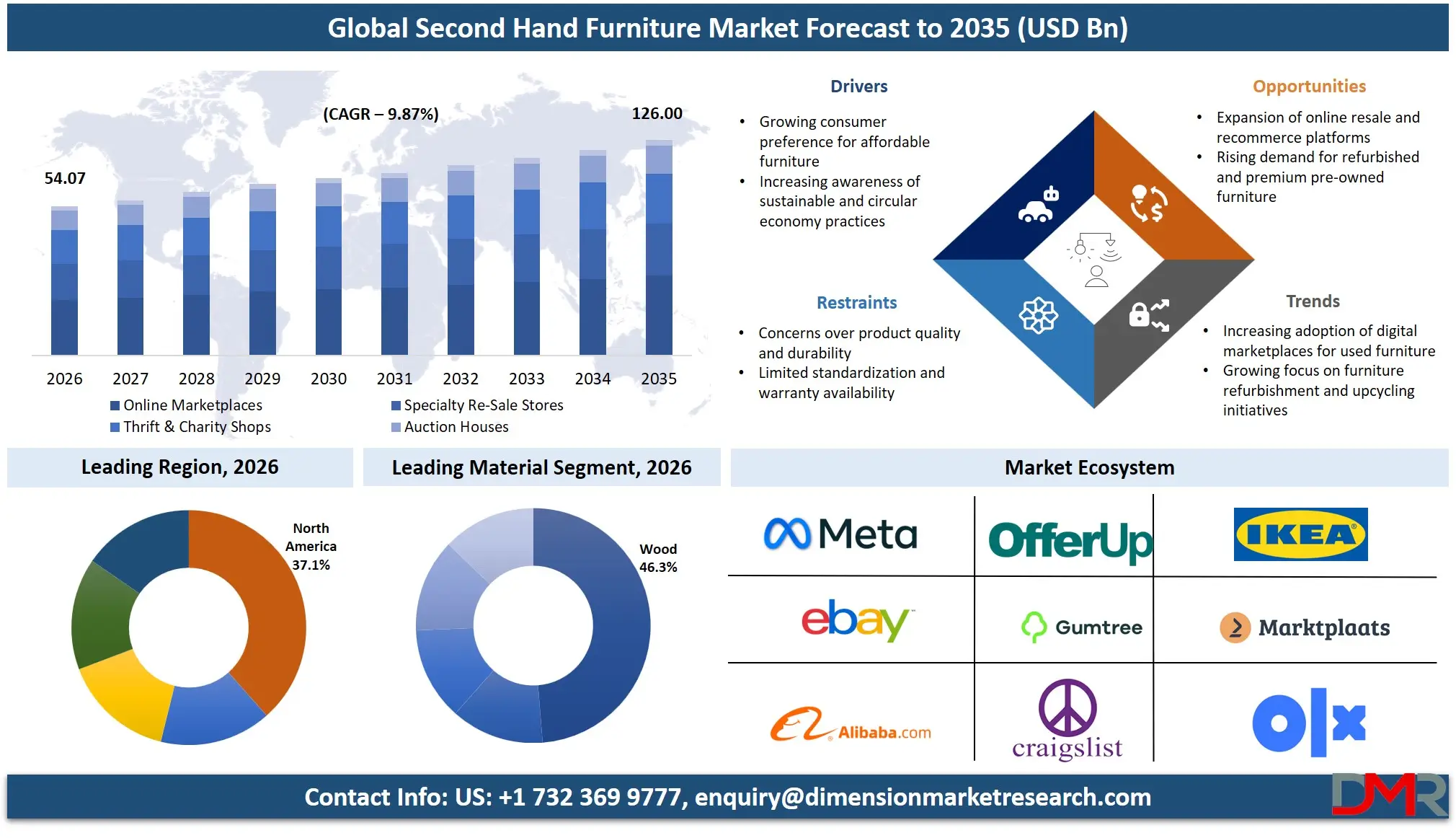
- The second-hand furniture market size is USD 49.21 billion in 2025, reached USD 54.07 billion in 2026, and is projected to hit USD 126.00 billion by 2035 at a CAGR of 9.87%.
- By Product Type: Sofas & Couches led with a 30.14% share in 2026.
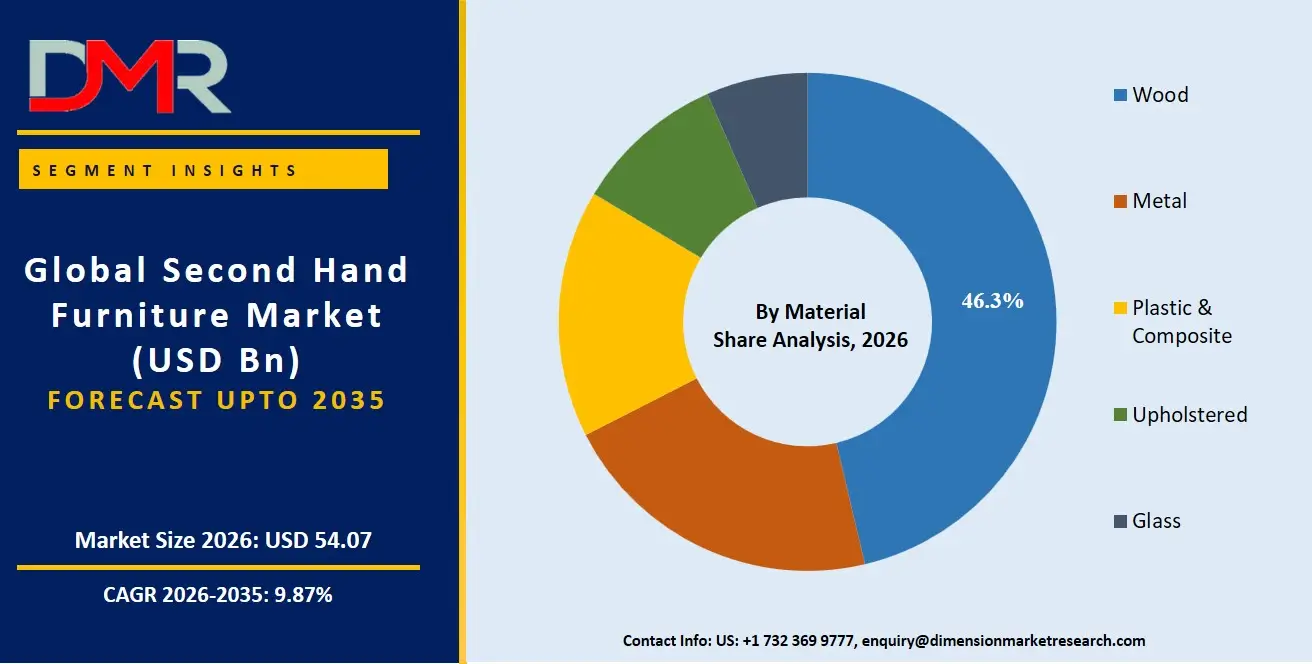
- By Material: Wood led with a 46.27% share in 2026.
- By End-User: Residential led with a 59.28% share in 2026.
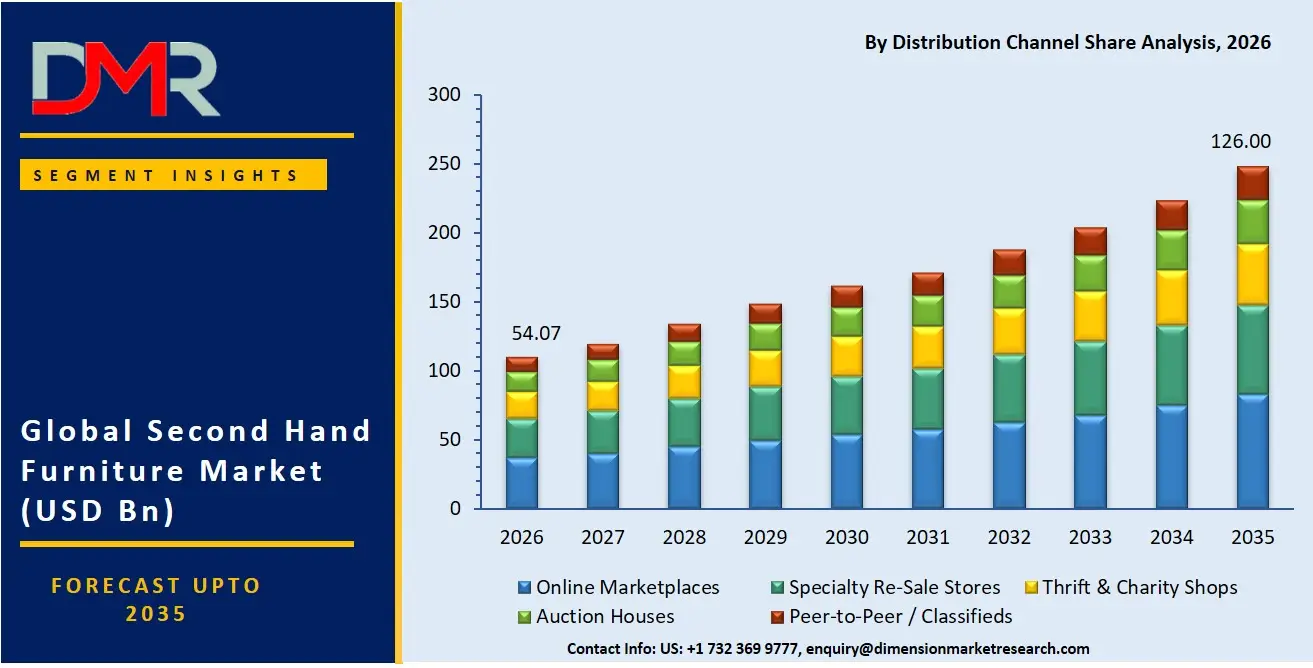
- By Distribution Channel: Online Marketplaces led with a 43.25% share in 2026.
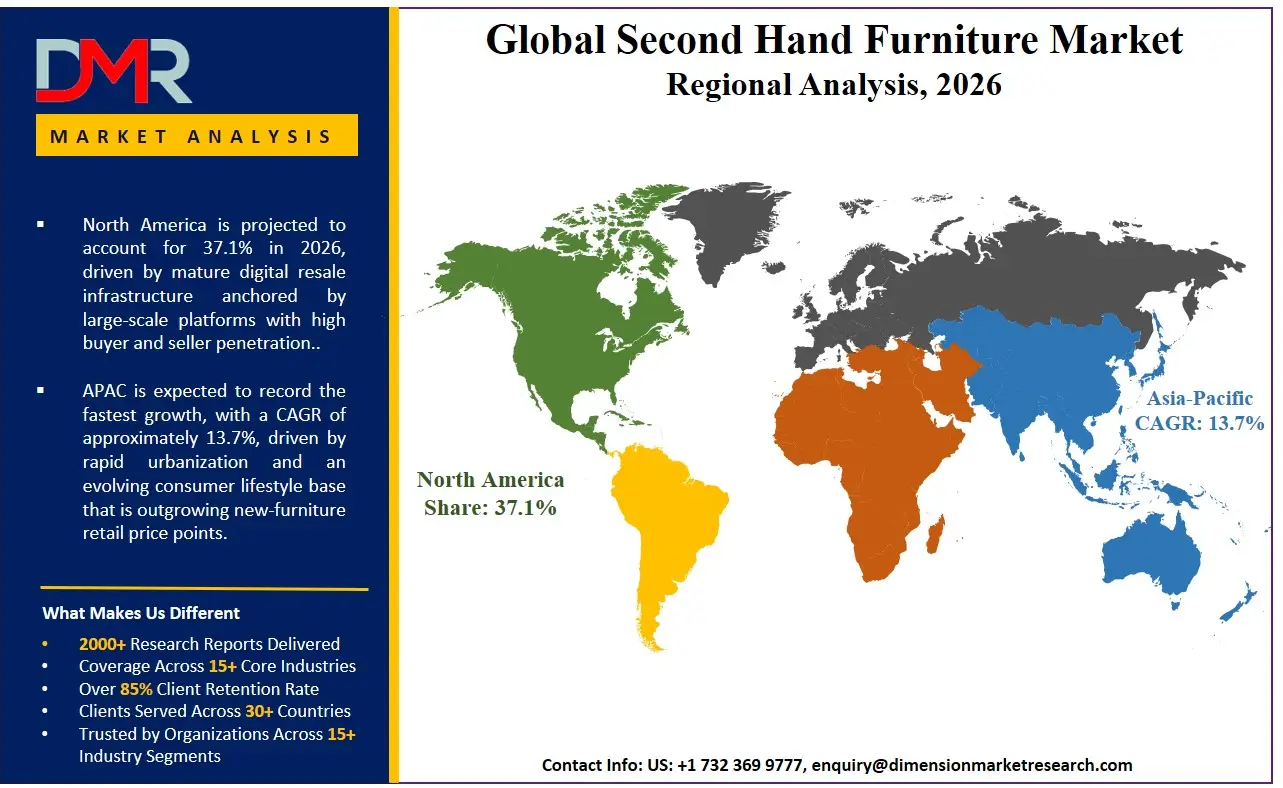
- By Region: North America led with a 37.10% share in 2026.
- Commercial and office furniture resale is expanding at a 9.1% CAGR as businesses optimize fit-out budgets.
Market Overview
The second-hand furniture market covers the resale, redistribution, and peer-to-peer trade of previously owned furniture across residential and commercial end-uses. The market spans sofas, beds, dining sets, office furniture, and outdoor pieces sold through digital platforms, specialty resale stores, thrift shops, auction houses, and classified listings. New-furniture rental and subscription models fall outside this scope, as do furniture component parts traded in industrial recycling channels.
ℹ
To learn more about this report –
Download Your Free Sample Report Here
The EU furniture sector operates at scale: as reported by EU CORDIS, the industry represents a €84 billion market consuming approximately 10.5 million tonnes of furniture annually and employing around 1 million workers. Furniture waste from this system exceeds 4% of total EU municipal solid waste, per EU CORDIS data, creating a structural diversion opportunity that organized resale operators are positioned to capture. The sheer volume of discarded inventory, combined with growing consumer willingness to buy pre-owned, forms the upstream supply base on which Second Hand Furniture Market depends.
Digital platforms reshaped the economics of second-hand furniture trade by collapsing search and transaction costs. Online resale marketplaces now drive over 45% of total purchases, replacing the friction-heavy classifieds model with standardized listings, secure payments, and buyer-protection features. Artificial intelligence is accelerating this shift by enabling automated condition grading, pricing recommendations, and fraud detection, reducing the information asymmetry that historically suppressed buyer confidence in pre-owned goods.
Market Size and Forecast
The Global Second Hand Furniture Market size is estimated at USD 54.07 Billion in 2026 from USD 49.21 Billion in 2025, and is projected to reach USD 126.00 Billion by 2035, exhibiting a CAGR of 9.87% during the forecast period.
The forecast rests on three structural assumptions: continued growth in online resale infrastructure, sustained pressure on consumer purchasing power across developed markets, and accelerating commercial furniture turnover as office occupancy patterns stabilize post-pandemic. Budget-constrained millennials and urban renters have anchored demand by choosing 30–70% price discounts over new-furniture retail, pulling forward adoption timelines. These buyers are not substituting down. They are recalibrating what value means across a furniture purchase cycle.
Institutional capital is validating the growth trajectory. In November 2025, A91 Partners acquired a 25% stake in Spacewood Furnishers for ₹300 crore, funding brand expansion, technology upgrades, and operational strengthening in a market where organized players remain rare. That investment signals that private equity now views second-hand furniture as a platform business rather than a fragmented trade category. Downside risk concentrates in logistics: last-mile delivery costs for bulky items remain a structural ceiling on platform margins and could compress growth below forecast if fuel and labor costs remain elevated.
Product Type Analysis
Sofas & Couches led the Product Type segment with a 30.14% share in 2026.
Sofas and couches dominate because they represent the single highest-value item category in the average household's resale inventory. A sectional sofa retains structural integrity long after aesthetic preferences shift, creating natural resale velocity. Buyers accept pre-owned upholstered seating more readily than other furniture categories because condition assessment is straightforward and transportation options are better developed for large, uniformly shaped pieces.
Beds and headboards rank second in category volume, driven by urban apartment turnover cycles where tenants frequently furnish on short-term horizons. Tables, chairs, and storage furniture together account for the majority of transaction count but not value, since per-unit prices in those categories are lower. Office furniture is the fastest-growing sub-category within Product Type, pulled by the 9.1% CAGR in commercial resale as businesses downsize or reconfigure workspaces. Outdoor furniture remains the smallest category, constrained by weather-related condition concerns that limit buyer confidence in online transactions.
Material Analysis
With a 46.27% share in 2026, Wood outpaced all other Material categories.
ℹ
To learn more about this report –
Download Your Free Sample Report Here
Wood commands its dominant share because solid timber and engineered-wood furniture holds physical integrity over decades, allowing it to change hands multiple times without structural failure. Buyers assign a premium to wooden pieces relative to plastic alternatives, which tends to compress discount expectations and support seller returns. EEB and UEA data indicate that EU domestic furniture consumption runs at €55.8 billion and 8.6 million tonnes annually, with business furniture adding €12.2 billion and 1.9 million tonnes per year. Wood's dominance across both streams means the upstream supply of resalable wooden inventory is consistently large.
Metal furniture holds the second material position, concentrated in office and commercial categories where durability and weight tolerance matter more than aesthetics. Plastic and composite pieces form the lowest-value tier, moving primarily through peer-to-peer classifieds at minimal margins. Upholstered and glass categories occupy specialist niches: upholstered items transact heavily on platforms focused on vintage and designer categories, while glass furniture faces condition-disclosure challenges that limit mainstream resale velocity.
End-User Analysis
Residential accounted for 59.28% of End-User demand in 2026, the highest of any category.
Residential buyers drive the majority of volume because life-event triggers, such as moves, divorces, and first-apartment setups, create cyclical and predictable demand spikes. Urban renters in particular buy and sell furniture on compressed timescales, functioning as a revolving supply-demand engine that feeds platform transaction volume. Budget pressure from inflation-adjusted rent burdens has reinforced residential dominance by widening the value gap between pre-owned and new furniture retail prices.
Commercial offices represent the fastest-growing end-user segment, propelled by the 9.1% CAGR in business furniture resale. Workspace operators are buying used workstations, chairs, and storage units rather than commissioning new fit-outs, redirecting capital toward technology and lease obligations. Hospitality and leisure buyers, while smaller in share, pursue vintage and character-rich pieces for differentiation purposes that new-furniture retail cannot replicate. Educational institutions and healthcare facilities are emerging acquisition channels, often sourcing through specialist resale operators who can certify condition and provide volume discounts.
Distribution Channel Analysis
Online Marketplaces captured 43.25% of the Distribution Channel segment in 2026, ahead of all rivals.
ℹ
To learn more about this report –
Download Your Free Sample Report Here
Online marketplaces lead because they aggregate supply and demand at a scale no physical format can match. A single platform listing reaches buyers nationally or internationally within hours of posting, eliminating the geographic constraint that historically capped secondary furniture trade to a buyer's commutable radius. Peer-to-peer classifieds and online marketplaces together account for over 45% of total second-hand furniture purchases, confirming that digital-first discovery is now the default behavior for pre-owned furniture transactions.
Specialty resale stores hold the second position by anchoring a curated experience that online platforms cannot fully replicate. Buyers willing to pay a premium for physical inspection and personal service drive footfall into stores. Thrift and charity shops serve price-sensitive segments but face inventory quality inconsistency. Auction houses serve the high-value collectible and vintage tier, where price discovery through competitive bidding creates better seller returns than fixed-price listings. Omnichannel models that blend physical storefronts with digital catalogs are becoming the fastest-growing distribution format, as operators recognize that buyers research online and often prefer to inspect before completing a purchase.
Key Market Segments
By Product Type
- Sofas & Couches
- Beds & Headboards
- Tables (Dining, Coffee, Side)
- Chairs & Stools
- Storage Furniture (Wardrobes, Cabinets)
- Office Furniture
- Outdoor Furniture
By Material
- Wood
- Metal
- Plastic & Composite
- Upholstered
- Glass
By End-User
- Residential
- Commercial Offices
- Hospitality & Leisure
- Educational Institutions
- Healthcare
- Public
By Distribution Channel
- Online Marketplaces
- Specialty Re-Sale Stores
- Thrift & Charity Shops
- Auction Houses
- Peer-to-Peer / Classifieds
Regional Analysis
North America led the regional segment with a 37.10% share in 2026, valued at USD 18.25 Billion.
ℹ
To learn more about this report –
Download Your Free Sample Report Here
North America's lead reflects a mature digital resale infrastructure anchored by large-scale platforms with high buyer and seller penetration. The U.S. market alone carried USD 8.5 billion in 2024, supported by a culture of frequent residential mobility and broad consumer acceptance of pre-owned goods. Sustainability motivations have reinforced purchasing behavior: North American buyers increasingly frame furniture reuse as an environmental statement rather than a compromise, widening the addressable audience beyond strictly budget-driven shoppers.
Asia Pacific is the fastest-growing region, propelled by rapid urbanization and an evolving consumer lifestyle base that is outgrowing new-furniture retail price points. India's furniture market is tracking toward USD 61 billion, and organized resale infrastructure in that country remains significantly underpenetrated, creating a first-mover window for platforms capable of building trust and logistics networks simultaneously. Europe follows with a well-established thrift culture and regulatory pressure driving circular-economy adoption, particularly among EU member states where sustainability policy is tightening disposal norms. Latin America and the Middle East and Africa remain early-stage markets, constrained by fragmented logistics but presenting long-run volume potential as urban middle-class populations expand.
Key Regions and Countries
North America
Europe
- Germany
- France
- The UK
- Spain
- Italy
- Rest of Europe
Asia Pacific
- China
- Japan
- South Korea
- India
- Australia
- Rest of APAC
Latin America
- Brazil
- Mexico
- Rest of Latin America
Middle East & Africa
- GCC
- South Africa
- Rest of MEA
Market Dynamics
Driver: Price Discount and Digital Convenience Anchor Buyer Adoption
A 30–70% price discount versus new furniture has made second-hand purchasing the rational default for budget-constrained millennials and urban renters. Price sensitivity alone does not explain the shift. Platform convenience, secure transactions, and verified listings have removed the friction that historically kept buyers in new-furniture retail. Online resale platforms now account for over 45% of total purchases, confirming that a structural channel preference has formed, not merely a cyclical bargain-hunting episode.
U.S. government data provides the upstream supply context: the EPA reports that generation of furniture and furnishings in U.S. municipal solid waste reached 12.1 million tons in 2018, up from 2.2 million tons in 1960, with furniture representing 4.1% of total MSW that year. The supply of resalable furniture feeding into the secondary market is structurally abundant. Sellers face declining barriers to listing, while buyers face declining barriers to discovery. Both forces compound the platform network effect.
Restraint: Quality Inconsistency and Logistics Complexity Suppress Conversion
No standardized quality-assessment framework exists across the second-hand furniture industry. Condition descriptions vary by seller, platform, and geography, producing inconsistent product states that suppress first-time buyer confidence. A buyer burned by a misleading listing rarely returns to the category. Platforms absorbing return costs face margin compression that limits their capacity to invest in trust-building features at the pace the market requires.
High-volume last-mile delivery remains a structurally difficult problem for bulky furniture. EU CORDIS data shows that total annual EU furniture waste reaches 10.78 million tonnes, with commercial sources contributing 18% of generation. The physical scale of discarded furniture volumes illustrates the logistical challenge: moving large, heavy, irregularly shaped pieces through last-mile networks inflates fulfillment costs in ways that erode seller returns and buyer willingness to pay for delivery. Operators that solve the logistics equation at acceptable cost will hold a durable competitive advantage.
Opportunity: Refurbishment, AI Grading, and Emerging Market Expansion
Professional refurbishment and restoration services create a value-capture layer that raw peer-to-peer resale cannot access. Damaged or aesthetically dated inventory, which platforms currently discount or reject, becomes a margin-generating asset when refurbishment is integrated into the supply chain. India's furniture market trajectory toward USD 61 billion opens an underpenetrated organized resale channel, where affordable housing demand generates consistent furniture turnover and where formal resale infrastructure is nearly absent. In November 2025, Circle, a Bengaluru-based marketplace for pre-owned goods, raised ₹3.4 crore in a pre-seed funding round led by Titan Capital to expand its AI-powered resale platform, signaling early institutional conviction in that geography.
AI-powered authentication and condition-grading technology addresses the trust gap that constrains peer-to-peer transactions. Automated grading eliminates the subjective, seller-defined condition descriptions that produce buyer disappointment. As reported by the EPA, 80.1% of U.S. furniture and furnishings was landfilled and 19.5% was combusted for energy recovery in 2018. Those figures quantify the scale of inventory that never enters a resale channel, despite being physically recoverable. EEB and UEA data further show that approximately 10 million tonnes of furniture are discarded in EU Member States annually, the majority sent to landfill or incineration. Platforms capable of intercepting a fraction of that flow through refurbishment and AI-graded resale will find supply-side economics strongly in their favor.
Market Trends
Brand-Led Circular Entry and Omnichannel Convergence Redefine Category Boundaries
IKEA's buy-back and resale program marks the entry of incumbent new-furniture manufacturers into the circular economy, a structural shift that legitimizes resale in the eyes of mainstream consumers. EU online purchase penetration has reached 77%, per reported figures, and 80–90% of EU furniture waste is currently incinerated or landfilled with only approximately 10% recycled, as reported by EU CORDIS. The gap between waste volumes and recycling rates confirms a recovery opportunity that brands, platforms, and refurbishers are now competing to capture. Omnichannel models blending physical storefronts with digital catalogs are emerging as the operational format that converts browsing intent into completed transactions, with the online channel growing faster than any physical format.
Market Competition Overview
The second-hand furniture market is highly fragmented, with no single operator controlling more than a low single-digit share of global transaction volume. Fragmentation is structural: the market operates across geographies with distinct platform cultures, logistics networks, and regulatory environments, making cross-border consolidation capital-intensive and operationally complex. As referenced by the EEB and UEA, furniture reuse accounts for approximately 6% of total EU furniture arising as waste, and the European furniture remanufacturing sector generates roughly €300 million in turnover employing 3,400 workers, less than 0.1% of the total furniture industry by scale. These figures confirm that organized resale and remanufacturing remain nascent relative to the available supply.
Platform operators divide into two strategic archetypes. Horizontal marketplaces aggregate high transaction volume across all furniture categories, competing on supply depth and buyer reach. Vertical specialists target high-value niches such as vintage, designer, or commercial-office furniture, competing on curation, authentication, and buyer trust. Horizontal players hold the volume advantage but face pressure from category specialists who convert more buyers at higher average order values. The fastest share shifts are occurring in the commercial segment, where businesses bypassing new fit-outs are generating a concentrated, high-value buyer pool that specialist resale operators are best positioned to serve.
Company Profiles
eBay Inc. operates as the world's largest horizontal resale marketplace, with second-hand furniture forming a significant and growing category within its broader consumer goods platform. eBay's competitive advantage derives from its global buyer base, established trust infrastructure, and seller tools that reduce listing friction. The platform's open-marketplace model means it competes simultaneously on price, selection, and reach without bearing inventory risk. eBay's breadth is both its asset and its limitation: category specialists consistently outperform it on curation and authentication in the premium furniture segment.
In October 2025, Meta Platforms (Facebook Marketplace) strengthened its position in the peer-to-peer furniture resale space through the TCC Concept acquisition of a 95.18% stake in Pepperfry via a share-swap transaction valued at approximately ₹659.44 crore, reflecting the accelerating consolidation of furniture marketplace activity into platform ecosystems with social graph advantages. Facebook Marketplace's integration within an existing social network gives it a zero-cost distribution channel that standalone resale platforms cannot replicate. Local delivery coordination and trust through social connections reduce the friction that suppresses peer-to-peer furniture transactions on anonymous platforms.
Key Players
- eBay Inc.
- Meta Platforms (Facebook Marketplace)
- Alibaba Group (Xianyu / Idle Fish)
- Adevinta
- OLX Group
- IKEA
- Chairish, Inc.
- 1stDibs.com, Inc.
- AptDeco, Inc.
- Craigslist
- OfferUp
- Gumtree
- Leboncoin
- Marktplaats
- Habitat for Humanity ReStore
- British Heart Foundation (Furniture & Electrical)
- The Salvation Army Family Stores
- CORT Furniture Outlet
- Beverly Hills Chairs
- Rework Office Furniture
- Envirotech Products Company
- Steelcase Inc.
- Pottery Barn
- Second Hand Office Furniture Co.
- Thrift Super Store
- Almost Perfect Furniture
- OneUp Furniture
Supply Chain and Value Chain Analysis
The second-hand furniture value chain begins with supply sourcing: residential owners, commercial offices, hospitality operators, and educational institutions generate outgoing inventory. Aggregators, including platform operators, thrift networks, and specialist resellers, collect or list this inventory. Refurbishers add value at the midpoint by repairing, cleaning, or restoring pieces that cannot be sold in their current condition. Logistics providers manage pickup, transport, storage, and last-mile delivery, which is where cost concentration and margin risk are highest. The final step is buyer acquisition and fulfillment, where platforms capture their fee or margin.
Maximum value is created at the refurbishment and curation stage, where raw salvaged inventory is transformed into retail-grade product commanding a 2–5x markup over unprocessed condition. Maximum risk concentrates at last-mile logistics, where the weight and bulk of furniture drive per-unit delivery costs that can exceed the resale price of lower-value items. Operators who control or tightly integrate the logistics layer hold a structural advantage over pure listing platforms competing on the same inventory.
Regulatory Landscape
EU circular-economy policy is the most consequential regulatory force in Second Hand Furniture Market. The European Commission's Ecodesign for Sustainable Products Regulation and evolving extended producer responsibility frameworks are increasing pressure on new-furniture manufacturers to account for end-of-life disposal costs. Those requirements create a structural tailwind for organized resale operators by raising the effective cost of disposing of furniture and incentivizing diversion into secondary markets. EU member states with mandatory separate collection requirements for bulky waste are generating higher volumes of condition-assessed furniture available for resale at lower acquisition cost.
North American regulation remains less prescriptive than the EU but is tightening in specific jurisdictions. California's extended producer responsibility legislation covering durable goods, including furniture, sets a precedent that other U.S. states may follow. Safety standards for upholstered furniture, particularly flammability regulations, create compliance complexity for resellers who cannot guarantee that pre-owned pieces meet current certification standards. Platforms operating cross-border must navigate divergent safety certification requirements, which limits the scalability of international expansion without dedicated compliance infrastructure.
Investment and White Space Analysis
Investment in the second-hand furniture market is concentrating in three areas: platform technology for AI-powered condition grading and authentication, logistics infrastructure for last-mile bulky-goods delivery, and geographic expansion into underpenetrated markets in South and Southeast Asia. The ₹300 crore investment by A91 Partners in Spacewood Furnishers and the ₹3.4 crore pre-seed funding for Circle in India confirm that institutional capital is moving into organized South Asian furniture resale ahead of broad market formation.
The largest white space sits at the intersection of commercial office furniture and professional refurbishment. Businesses decommissioning large office fit-outs generate high volumes of uniform, condition-assessable inventory that individual-seller platforms cannot process efficiently. An operator building a B2B resale and refurbishment service targeting corporate fit-out cycles would face limited direct competition and could command premium pricing for guaranteed condition grading and volume logistics. European markets also offer white space in brand-affiliated resale programs, where only a small number of manufacturers have followed IKEA's circular-economy lead despite the regulatory and consumer sentiment pressure to do so.
Recent Developments
- August 2025, Auction Technology Group (ATG) acquired Chairish, the online marketplace for vintage furniture, décor, and art, for USD 85 million, expanding its presence in the global resale furniture and collectibles market.
- March 2026, Rentomojo filed its Draft Red Herring Prospectus (DRHP) with SEBI to raise ₹150 crore through an IPO, supporting growth of its furniture-focused e-marketplace business.
Report Details
| Report Characteristics |
| Market Value (2025) |
USD 49.21 Billion |
| Market Value (2026) |
USD 54.07 Billion |
| Forecast Revenue (2035) |
USD 126.00 Billion |
| CAGR (2026 to 2035) |
9.87% |
| Base Year for Estimation |
2025 |
| Historic Period |
2020 to 2024 |
| Forecast Period |
2026 to 2035 |
| Report Coverage |
Revenue Forecast, Market Dynamics, Competitive Landscape, Recent Developments |
| Segments Covered |
By Product Type (Sofas & Couches, Beds & Headboards, Tables, Chairs & Stools, Storage Furniture, Office Furniture, Outdoor Furniture); By Material (Wood, Metal, Plastic & Composite, Upholstered, Glass); By End-User (Residential, Commercial Offices, Hospitality & Leisure, Educational Institutions, Healthcare, Public); By Distribution Channel (Online Marketplaces, Specialty Re-Sale Stores, Thrift & Charity Shops, Auction Houses, Peer-to-Peer / Classifieds) |
| Regional Analysis |
North America (US and Canada), Europe (Germany, France, The UK, Spain, Italy, and Rest of Europe), Asia Pacific (China, Japan, South Korea, India, Australia, and Rest of APAC), Latin America (Brazil, Mexico, and Rest of Latin America), Middle East & Africa (GCC, South Africa, and Rest of MEA) |
| Competitive Landscape |
eBay Inc., Meta Platforms (Facebook Marketplace), Alibaba Group (Xianyu / Idle Fish), Adevinta, OLX Group, IKEA, Chairish Inc., 1stDibs.com Inc., AptDeco Inc., Craigslist, OfferUp, Gumtree, Leboncoin, Marktplaats, Habitat for Humanity ReStore, British Heart Foundation, The Salvation Army Family Stores, CORT Furniture Outlet, Beverly Hills Chairs, Rework Office Furniture, Envirotech Products Company, Steelcase Inc., Pottery Barn, Second Hand Office Furniture Co., Thrift Super Store, Almost Perfect Furniture, OneUp Furniture |
| Customization Scope |
Customization for segments and region or country level will be provided. Additional customization can be done based on requirements. |
| Purchase Options |
Three license options: Single User License, Multi-User License (Up to 5 Users), Corporate Use License (Unlimited Users and Printable PDF) |
Frequently Asked Questions
What is the biggest investment opportunity in Second Hand Furniture Market?
▾ The largest opportunity sits in B2B commercial furniture resale combined with professional refurbishment. Businesses decommissioning office fit-outs generate high volumes of uniform inventory that individual platforms cannot absorb efficiently. India's organized resale infrastructure remains underpenetrated against a furniture market tracking toward USD 61 billion, making South Asian platform entry a high-upside early-stage bet.
Who are the top companies in Second Hand Furniture Market?
▾ eBay Inc. and Meta Platforms (Facebook Marketplace) lead by transaction volume and buyer reach. Alibaba Group's Xianyu platform dominates China's peer-to-peer resale segment. Specialist operators including 1stDibs, Chairish, and AptDeco hold strong positions in the high-value vintage and designer furniture tier.
Which segment is growing fastest in Second Hand Furniture Market and why?
▾ Online Marketplaces within the Distribution Channel segment are growing fastest, accounting for 43.25% of total purchases and expanding at the highest rate of any format. Buyers have shifted discovery behavior permanently online, and platform improvements in trust, logistics coordination, and AI-powered grading are converting more browse sessions into completed transactions.
Which region is growing fastest in Second Hand Furniture Market and why?
▾ Asia Pacific is the fastest-growing region, driven by rapid urbanization, expanding urban middle-class populations, and an evolving consumer culture that is moving toward organized resale. India presents the most concentrated growth opportunity: a furniture market targeting USD 61 billion with virtually no organized secondary resale infrastructure creates a first-mover advantage for platforms that can establish trust and logistics networks ahead of mass adoption.
What is the biggest challenge holding Second Hand Furniture Market back?
▾ The absence of standardized quality-assessment frameworks is the primary structural restraint. Without consistent condition grading, first-time buyers face uncertainty that suppresses conversion rates and damages repeat-purchase behavior. High last-mile delivery costs for bulky furniture compound the problem by eroding platform margins before operators have accumulated the scale needed to negotiate favorable logistics contracts.