What is the Secure Access Service Edge (SASE) Market Size?
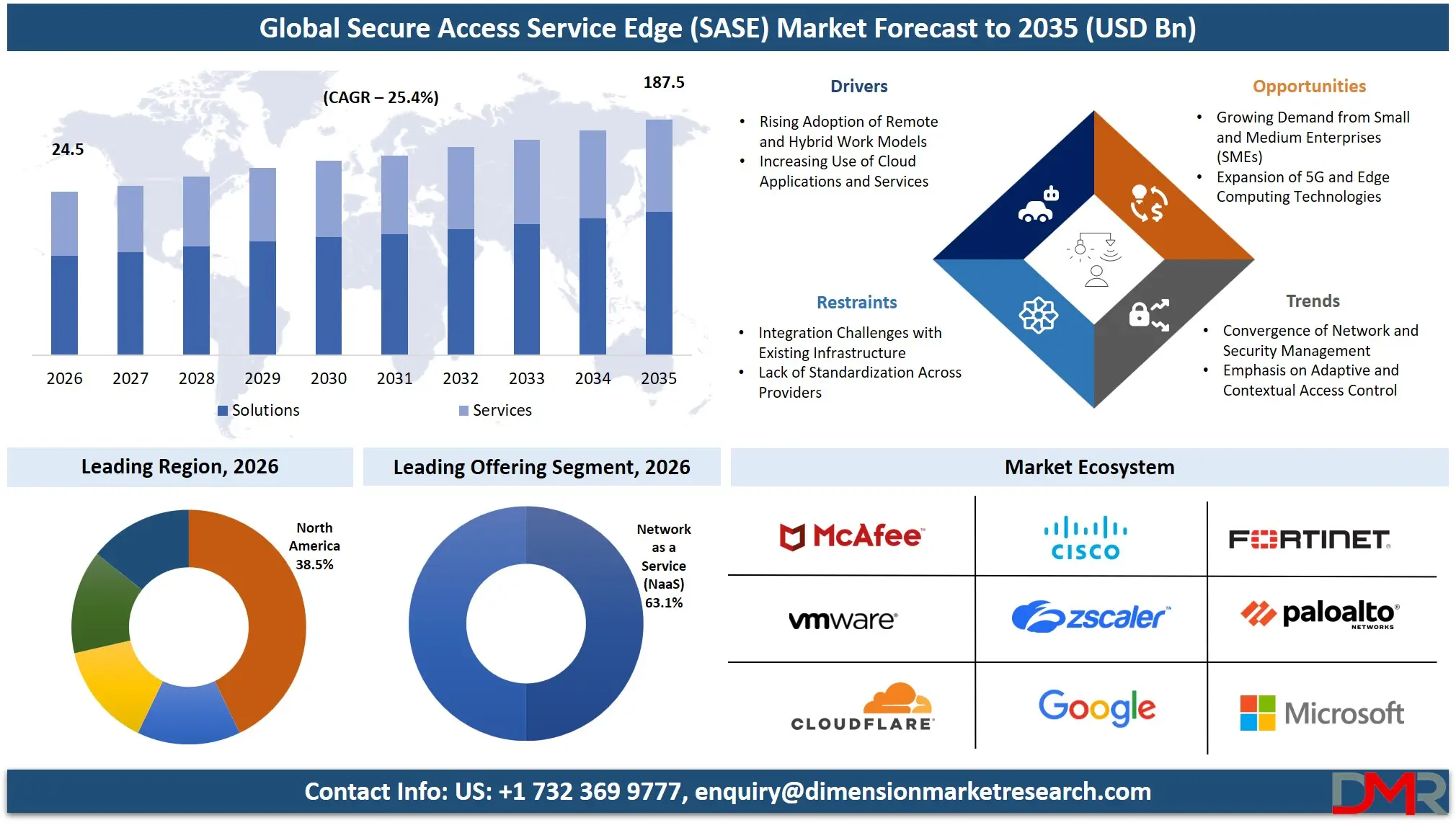
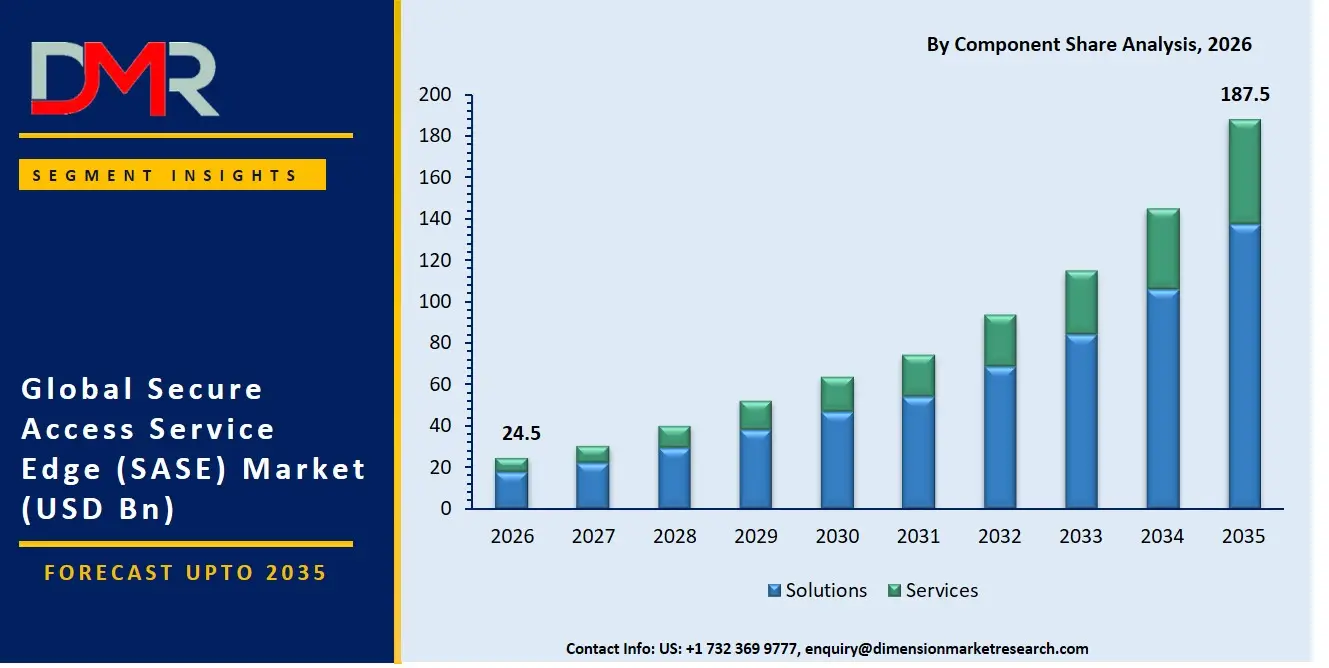
The Global Secure Access Service Edge (SASE) Market is expected to reach a value of USD 24.5 billion in 2026, and it is further anticipated to reach USD 187.5 billion by 2035, growing at a CAGR of 25.4% during the forecast period.
ℹ
To learn more about this report –
Download Your Free Sample Report Here
The SASE market has been growing at an explosive rate as enterprises abandon rigid, data center-centric network perimeters in favor of a cloud-delivered architecture that converges networking and security. The market consists of solutions such as Software-Defined Wide Area Network (SD-WAN), Secure Web Gateway (SWG), Cloud Access Security Broker (CASB), Zero Trust Network Access (ZTNA), and Firewall-as-a-Service (FWaaS), alongside professional and managed services that help organizations design and maintain these converged frameworks.
The increasing demand to securely connect hybrid workforces, branch offices, and edge computing sites directly to cloud applications is driving the necessity of an integrated SASE fabric. Large enterprises are the most frequent adopters, with cloud-based deployment remaining the most popular due to its dynamic scalability and ability to enforce unified policy. The BFSI, IT and Telecom, and Government and Public Sector industries are key players as they require stringent identity-centric security and low-latency connectivity for decentralized applications.
ℹ
To learn more about this report –
Download Your Free Sample Report Here
The US Secure Access Service Edge (SASE) Market
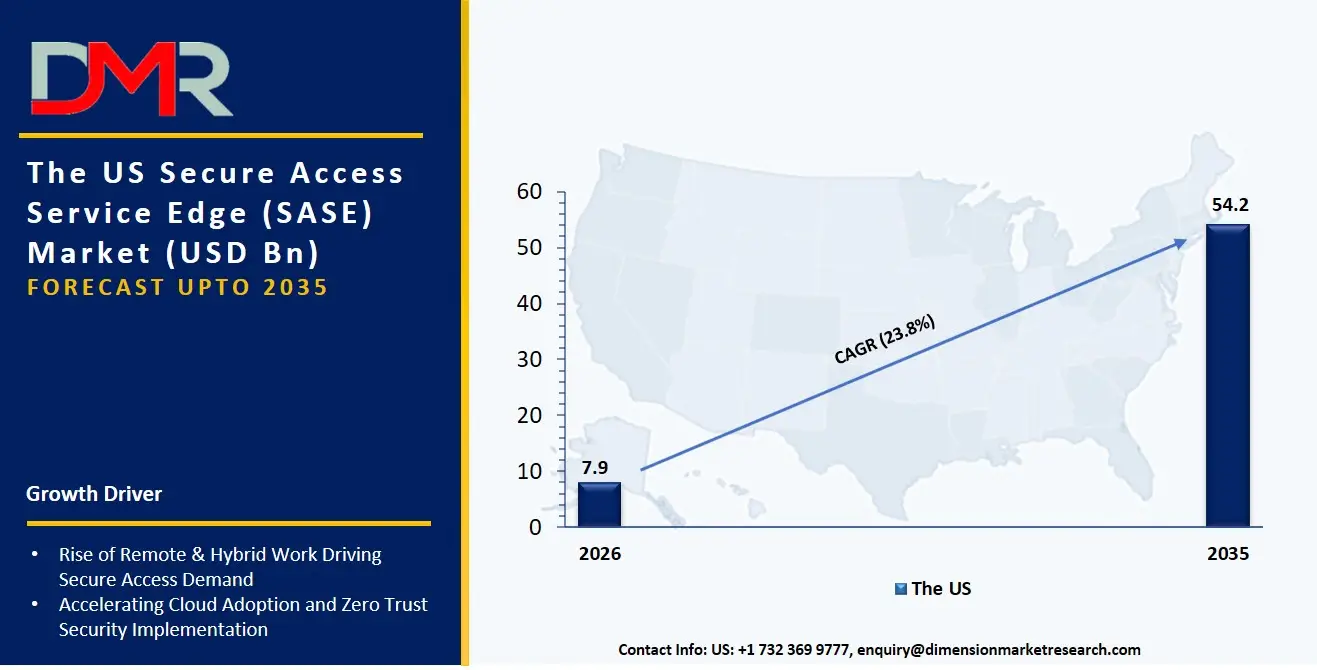
The US Secure Access Service Edge (SASE) Market is projected to reach USD 7.9 billion in 2026 at a compound annual growth rate of 23.8% over its forecast period, which further expected to reach a market value of USD 54.2 billion by 2035.
ℹ
To learn more about this report –
Download Your Free Sample Report Here
The US continues to be the largest and most advanced market for SASE due to the widespread distribution of remote workers and the rapid dissolution of the traditional network perimeter within Fortune 500 companies. The market has been typified by high demand for Zero Trust Network Access (ZTNA) solutions, whereby organizations are retiring legacy VPNs to minimize the lateral movement of ransomware threats. Furthermore, the proliferation of sensitive data across multiple cloud environments is generating a corresponding need for advanced Cloud Access Security Broker (CASB) services to regulate adaptive, identity-aware data loss prevention policies.
The Europe Secure Access Service Edge (SASE) Market
The Europe Secure Access Service Edge (SASE) Market is estimated to be valued at USD 6.9 billion in 2026 and is further anticipated to reach USD 50.7 billion by 2035 at a CAGR of 24.8%. The regulatory frameworks including GDPR and the evolving EU cybersecurity certification schemes have a significant impact on the European market and drive the need for local points of presence (PoPs) and sovereign SASE capabilities. Accelerated growth of cloud-based Secure Web Gateway (SWG) deployment services is also being experienced in the region as manufacturing and energy utilities in Germany and France seek to sanitize operational technology (OT) data streams before they traverse wide-area networks. In addition, initiatives such as GAIA-X are challenging SASE providers to develop dedicated managed services that guarantee data residency and logical isolation within European cloud ecosystems.
The Japan Secure Access Service Edge (SASE) Market
The Japan Secure Access Service Edge (SASE) Market is projected to be valued at USD 2.6 billion in 2026. It is further expected to witness robust growth, holding USD 9.2 billion in 2035 at a CAGR of 28.0%. The Japanese market is unique, with a corporate drive to "Society 5.0" and digital transformation (DX) in response to an aging workforce and the acute need to secure telework environments. Professional Services and cloud-based SD-WAN solutions make up a large part of the spending as large conglomerates migrate from expensive MPLS circuits to agile, secure networking. There is also a strong need for deep local integration to bridge the gaps between legacy on-premise manufacturing execution systems and modern Secure Access Service Edge fabrics, forming a niche for specialized managed services and granular policy orchestration.
Key Takeaways
- Market Size & Forecast: The Global Secure Access Service Edge (SASE) market is projected to reach USD 24.5 billion in 2026, expanding meteorically to USD 187.5 billion by 2035, fueled by the dual drivers of ubiquitous hybrid work and the obsolescence of castle-and-moat network security models.
- Growth Rate & Outlook: Global market growth is expected at a CAGR of 25.4%, driven by the critical shortage of in-house convergence networking and security architects and the escalating complexity of managing disparate point solutions that create visibility gaps.
- Primary Growth Drivers: Key forces include the widespread shift from implicit trust architectures to Zero Trust principles, the need for integrated Security as a Service (SECaaS/SSE) to secure access for unmanaged devices, and the consolidation of branch office infrastructure requiring specialized Professional Services for deployment.
- Key Market Trends: Major trends include the rise of single-vendor SASE platforms over multi-vendor integrations, the use of AI-driven insights within FWaaS to autonomously stop sophisticated Layer 7 attacks, and the shift toward Managed SASE Services as enterprises look to outsource complex 24/7 policy management and monitoring.
- By Deployment Mode Analysis: Cloud-based SASE models are expected to dominate enterprise strategies due to the inherent flexibility of edge-to-cloud connectivity. Hybrid deployments are increasingly critical for organizations in manufacturing and government that must centrally manage tight security policies while maintaining on-premise resiliency for operational continuity.
- By Industry Vertical Analysis: IT and telecom dominate due to heavy reliance on cloud infrastructure, large-scale data traffic, and distributed networks, driving strong adoption of SASE solutions to ensure secure connectivity, performance optimization, and advanced threat protection.
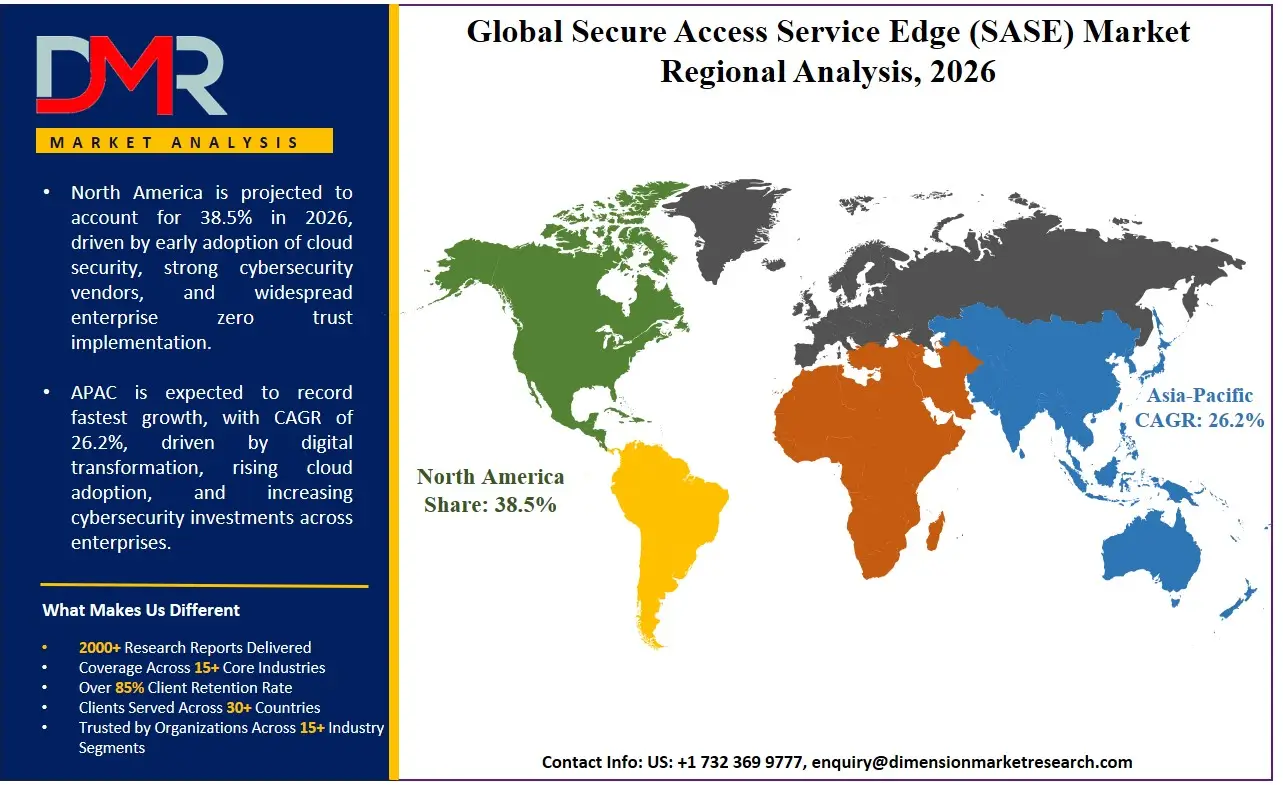
- Regional Leadership: North America is poised to dominate this market with 38.5% of the market share in 2026 due to its mature hyper-scale cloud infrastructure and the presence of major SASE innovation hubs, making it the vanguard of network security convergence.
What is the Secure Access Service Edge (SASE)?
Secure Access Service Edge (SASE) is a cloud-delivered architectural framework that converges comprehensive WAN capabilities with a full stack of network security functions to support the dynamic secure access needs of digital enterprises. These services, unlike siloed network or security stacks, are concerned with the identity-based context of access. This involves Solutions like SD-WAN to intelligently route traffic, ZTNA to replace traditional VPNs, and Security as a Service (SECaaS/SSE) components—SWG, CASB, and FWaaS delivered from a unified global PoP fabric. With over 80% of enterprises adopting a hybrid work model, SASE is essential to enforce granular, session-level security policy that follows the user, not the data center, ensuring digital business agility without compromising on threat prevention.
Use Cases
- Remote Workforce Security: Companies with employees working from home or different locations use SASE to provide secure access to internal systems and cloud apps. It ensures every user is verified before getting access, no matter where they are. This reduces the risk of cyberattacks and data breaches in remote environments.
- Cloud Application Protection: SASE helps businesses safely connect users to cloud-based services like email, storage, or software tools. It checks traffic in real time and blocks suspicious activity. This is useful for organizations that rely heavily on cloud platforms for daily operations.
- Branch Office Connectivity: Businesses with many branch offices use SASE to connect locations directly to cloud services without needing backhaul to a central data center. This improves speed and reduces complexity, while applying the same security policies everywhere.
- Zero Trust Implementation: SASE supports zero trust by verifying users, devices, and applications before allowing access. Even if someone is inside the company network, they must pass strict checks. This limits the chances of insider threats or compromised accounts causing damage.
How AI is Transforming the Secure Access Service Edge (SASE)?
AI is transforming the Secure Access Service Edge market by moving from reactive signature detection to predictive, autonomous threat resolution and network optimization. In the realm of security solutions, AI-powered engines within SWG and CASB components analyze patterns in real-time telemetry to instantly identify anomalous user behavior indicative of credential theft, dynamically adjusting access policies without a human intermediary. Meanwhile, AI-driven features in SD-WAN solutions allow businesses to self-heal network performance by predicting brownout conditions across last-mile circuits and seamlessly steering latency-sensitive unified communications traffic to the most optimal path before degradation is user-perceptible.
Governance and business transformation projects are also revolving around AI. In the area of managed services, intelligent AI co-pilots are continuously used to comb through massive audit logs across FWaaS and ZTNA fabrics, proactively identifying misconfigurations that create security blind spots against frameworks like PCI-DSS and NIST 800-207. Moreover, generative AI assistants are augmenting professional services by translating natural-language corporate access policies into complex technical orchestration logic, reducing the onboarding time for a global Zero Trust posture from months to days.
Market Dynamics
Key Drivers in the Global Secure Access Service Edge (SASE) Market
Rising Adoption of Remote and Hybrid Work Models
One of the key drivers of growth in the SASE market is the global shift toward remote and hybrid work environments. As more employees access corporate systems from outside traditional office networks, companies need to ensure secure and reliable connections from any location or device. Traditional network security setups, which rely on centralized data centers and on-premise firewalls, are no longer efficient in this distributed setup. SASE offers a cloud-native approach that secures both the network and users regardless of where they are. This makes it easier for IT teams to manage access, enforce policies, and protect data. The flexibility, scalability, and cloud-based nature of SASE solutions are especially attractive for businesses supporting hybrid work models. This ongoing trend is expected to continue fueling market demand.
Increasing Use of Cloud Applications and Services
The widespread adoption of cloud platforms for storage, collaboration, and business operations is driving the need for smarter, unified security systems. Organizations are moving away from on-premise infrastructure and relying more on services like SaaS (Software-as-a-Service), which require constant and secure internet connectivity. SASE plays a crucial role here by combining networking and security into one framework that protects cloud-bound traffic. It offers tools like secure web gateways, cloud access security brokers, and data loss prevention, all designed to keep sensitive data safe during cloud access. With cloud environments being more dynamic and complex, traditional security tools often fail to provide full visibility or control. SASE solves this by offering consistent, policy-driven protection across users, apps, and devices, making it an essential solution for cloud-first businesses.
Restraints in the Global Secure Access Service Edge (SASE) Market
Integration Challenges with Existing Infrastructure
One major restraint in the SASE market is the difficulty organizations face in integrating SASE solutions with their existing IT infrastructure. Many businesses still operate with a mix of legacy systems, on-premise hardware, and older security tools that are not easily compatible with cloud-native SASE platforms. Transitioning to SASE often requires significant changes in network architecture, which can be complex and time-consuming. This shift may also demand additional training for IT staff and careful planning to avoid disruptions. Smaller companies with limited technical expertise or budget may find the transition especially challenging. These barriers can slow down adoption rates and make companies hesitant to move away from their current setup, despite the long-term benefits SASE may offer.
Lack of Standardization Across Providers
Another key limitation holding back the SASE market is the lack of standardization across different service providers. Since SASE is a relatively new concept, each vendor offers its version of the solution with varying features, architectures, and integration capabilities. This inconsistency can make it difficult for businesses to compare options or switch providers later on. It also leads to confusion about what a "complete" SASE solution should include. For large enterprises seeking uniform policy enforcement across global operations, such variation in tools and capabilities can lead to gaps in security. Without widely accepted standards, businesses may struggle to find a one-size-fits-all solution, which can delay purchasing decisions and affect long-term adoption.
Growth Opportunities in the Global Secure Access Service Edge (SASE) Market
Growing Demand from Small and Medium Enterprises (SMEs)
An emerging opportunity in the SASE market lies in the growing demand from small and medium-sized enterprises. Traditionally, advanced cybersecurity and network solutions were more common in large organizations due to cost and complexity. However, with SASE offering cloud-based delivery and subscription-based models, it has become more accessible to smaller businesses. SMEs now recognize the need for secure access to cloud applications and remote work tools, just like larger enterprises. As cyber threats become more frequent and targeted, SMEs are actively seeking scalable and easy-to-manage solutions. SASE fits this demand well by combining multiple services into one platform. This rising awareness and affordability create a strong opportunity for vendors to expand their reach into the SME segment.
Expansion of 5G and Edge Computing Technologies
The rollout of 5G networks and the rise of edge computing are opening up new possibilities for the SASE market. As businesses deploy more connected devices and move data processing closer to the user through edge computing, the need for fast, secure, and reliable connectivity increases. SASE solutions can complement these technologies by providing low-latency, real-time security at the edge of the network. This ensures that users and devices remain protected, even in highly distributed environments. The integration of SASE with 5G and edge infrastructure allows enterprises to support smart factories, IoT systems, and mobile workforces more efficiently. This technological convergence is expected to unlock new use cases and drive further demand for cloud-delivered security and networking solutions.
Trends in the Global Secure Access Service Edge (SASE) Market
Convergence of Network and Security Management
A recent trend in the SASE market is the growing convergence of network and security management tools into single dashboards. Vendors are integrating analytics, policy orchestration, and real-time monitoring so IT teams can manage everything from one unified interface. This blends visibility and control across the network edge, cloud access, and user activity. As a result, security operations teams spend less time switching between systems, improving response times, and reducing configuration errors. This streamlined approach helps companies maintain consistent policies and speeds up deployment across different environments.
Emphasis on Adaptive and Contextual Access Control
Another trend gaining momentum is the adoption of adaptive and contextual access control in SASE platforms. Instead of granting access based solely on identity or device, these systems dynamically evaluate risk factors such as location, behavior, device posture, and application sensitivity. Policies are adjusted in real time users may receive elevated authentication prompts or limited permissions depending on the situation. This adaptive method aligns with zero‑trust principles, helping organizations reduce over‑permissioning and respond to unusual activity quickly. It delivers a smarter, more granular approach to secure access, increasing resilience against evolving threats.
Research Scope and Analysis
The Secure Access Service Edge (SASE) market is driven by rising demand for cloud-based security, scalable networking, and zero-trust frameworks. Growing adoption across large enterprises, remote work environments, and IT & telecom sectors continues to accelerate deployment of integrated SASE solutions globally.
ℹ
To learn more about this report –
Download Your Free Sample Report Here
By Component Analysis
The solutions segment is projected to dominate the SASE market, holding a share of 70% in 2025, as organizations prioritize integrated, cloud-delivered security and networking capabilities over standalone services. Within solutions, technologies such as SD-WAN, SWG, CASB, ZTNA, and FWaaS form the core architecture of SASE, enabling secure, scalable, and high-performance connectivity across distributed environments. Enterprises are increasingly adopting these solutions to replace legacy network security systems and support remote workforces and cloud applications. The demand is particularly strong among large enterprises that require centralized visibility, policy enforcement, and threat protection. As businesses move toward zero-trust frameworks, solution-based offerings remain critical, driving their dominance due to their direct role in securing users, applications, and data.
By Offering Analysis
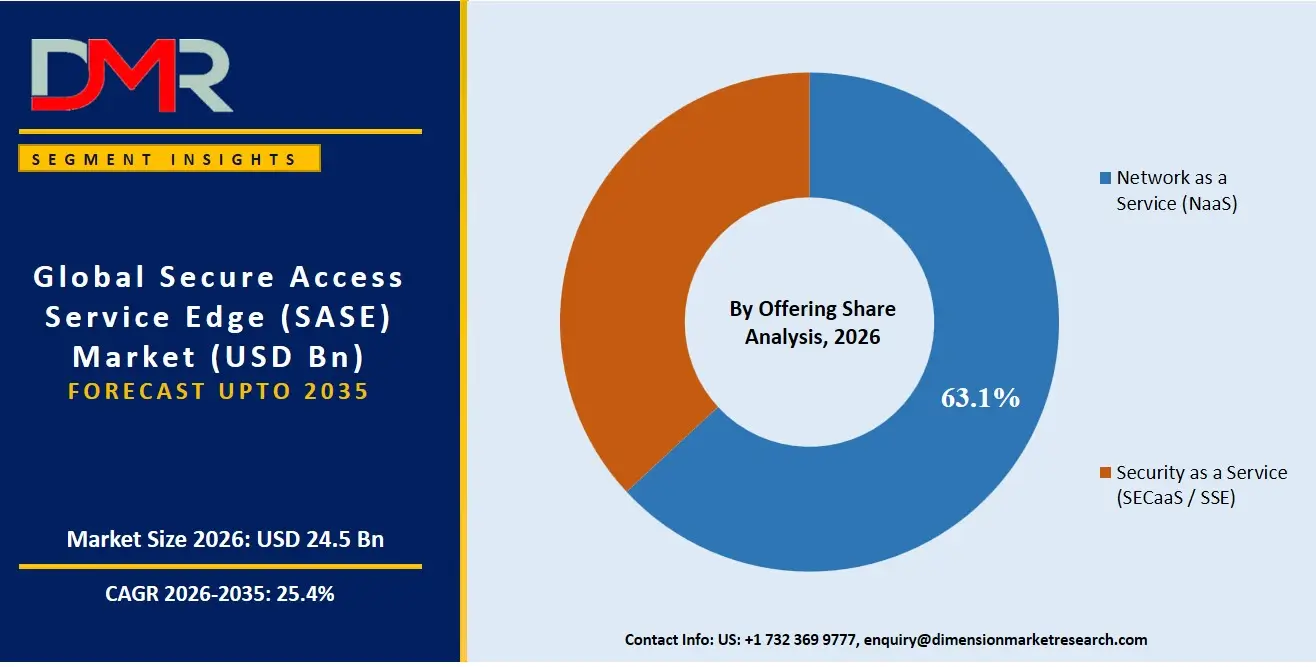
Network as a Service (NaaS) is poised to dominate the offering segment in the SASE market, holding a share of 63.1% in 2025, due to the growing need for flexible, scalable, and high-performance network connectivity across distributed enterprise environments. As organizations increasingly adopt cloud-first strategies and support remote and hybrid workforces, they require seamless and reliable network access without the limitations of traditional infrastructure. NaaS enables enterprises to deploy and manage wide area networks through cloud-based platforms, reducing dependency on costly hardware and simplifying operations. It also enhances application performance, ensures consistent connectivity across branch offices, and supports rapid scalability. Additionally, the integration of NaaS with SD-WAN technologies allows businesses to optimize traffic routing and improve user experience. These benefits collectively drive strong adoption, making NaaS the dominant offering.
By Deployment Mode Analysis
Cloud-based deployment is anticipated to dominate the SASE market with a revenue share of 55.5% in 2025, due to its scalability, flexibility, and alignment with modern IT environments. As enterprises migrate applications and workloads to the cloud, they require security solutions that can operate seamlessly across distributed networks. Cloud-native SASE platforms eliminate the need for complex on-premise hardware and enable real-time policy enforcement regardless of user location. This model supports remote work, branch connectivity, and mobile access more effectively than traditional systems. Additionally, cloud deployment reduces operational costs and simplifies management through centralized control. Organizations prefer this approach for its ability to quickly adapt to changing business needs, making it the leading deployment mode.
By Organization Size Analysis
Large enterprises is projected to dominate the organization size segment, holding a share of 62.3%, due to their complex IT environments, higher cybersecurity budgets, and greater exposure to advanced threats. These organizations operate across multiple locations, with a large remote workforce and heavy reliance on cloud applications, making SASE solutions essential for secure connectivity and centralized management. They are early adopters of advanced technologies such as zero trust architecture and integrated security frameworks. Additionally, large enterprises require comprehensive solutions that combine networking and security functions, which SASE effectively delivers. Their need for regulatory compliance, data protection, and operational efficiency further drives adoption, ensuring their dominant position in this segment.
By Industry Vertical Analysis
The IT and telecom sector is poised to dominates the SASE market, hold a share of 42.3% in 2025, due to its high reliance on digital infrastructure, cloud services, and distributed networks. Companies in this sector manage vast amounts of data and require secure, high-performance connectivity across global operations. With the rapid adoption of cloud computing, 5G networks, and remote work models, IT and telecom firms are among the earliest adopters of SASE solutions. They also play a dual role as both users and providers of SASE technologies, further strengthening their position. The need for continuous network uptime, real-time monitoring, and advanced threat protection makes SASE a critical component in this industry's operations.
The Global Secure Access Service Edge (SASE) Market Report is segmented on the basis of the following:
By Component
- Solutions
- Software-defined Wide Area Network (SD-WAN)
- Secure Web Gateway (SWG)
- Cloud Access Security Broker (CASB)
- Zero Trust Network Access (ZTNA)
- Firewall-as-a-Service (FWaaS)
- Services
- Professional Services
- Managed Services
By Offering
- Network as a Service (NaaS)
- Security as a Service (SECaaS / SSE)
By Deployment Mode
- Cloud-based
- On-premise
- Hybrid
By Organization Size
- Small and Medium-sized Enterprises (SMEs)
- Large Enterprises
By Industry Vertical
- BFSI
- IT and Telecom
- Retail and E-commerce
- Healthcare
- Government and Public Sector
- Manufacturing
- Energy and Utilities
- Education
- Other Industry Vertical
Regional Analysis
Leading Region by Market Share
North America wiil be leading the Secure Access Service Edge (SASE) market in 2026 with an estimated share of 38.5%, driven by the region's strong digital infrastructure and high adoption of cloud-based services. The presence of major technology firms and cybersecurity providers across the US and Canada supports innovation and faster deployment of SASE solutions. With businesses increasingly embracing hybrid work models, there is rising demand for secure, scalable, and unified network and security frameworks. Strict regulatory requirements, a mature enterprise IT ecosystem, and high awareness of cyber threats further encourage the shift toward advanced solutions like SASE. Companies in sectors such as finance, healthcare, and technology are especially active in upgrading to cloud-native security tools. The region also benefits from continuous investments in 5G, edge computing, and AI-powered cybersecurity, which complement the expansion of SASE platforms. All these factors make North America a key contributor to the global SASE market's growth and adoption during the ongoing year.
ℹ
To learn more about this report –
Download Your Free Sample Report Here
Fastest-Growing Regional Market
Asia Pacific is showing significant growth in the Secure Access Service Edge (SASE) market over the forecast period due to rapid digital transformation and increasing cloud adoption across countries like India, China, Japan, and Australia. Organizations are shifting to remote and hybrid work models, which creates strong demand for secure network access and cloud-native security solutions. As businesses move away from traditional network architecture, there is growing interest in zero trust network access, SD-WAN integration, and unified threat protection. The region's expanding internet infrastructure, rise in cyber threats, and increasing investments in IT modernization support the demand for advanced, scalable, and cost-effective SASE platforms across various industries.
By Region
North America
Europe
- Germany
- The U.K.
- France
- Italy
- Russia
- Spain
- Benelux
- Nordic
- Rest of Europe
Asia-Pacific
- China
- Japan
- South Korea
- India
- ANZ
- ASEAN
- Rest of Asia-Pacific
Latin America
- Brazil
- Mexico
- Argentina
- Colombia
- Rest of Latin America
Middle East & Africa
- Saudi Arabia
- UAE
- South Africa
- Israel
- Egypt
- Rest of MEA
Competitive Landscape
The Secure Access Service Edge (SASE) market is highly competitive, with many technology providers working to offer all-in-one solutions that combine both network and security features. Some companies focus on building complete platforms from the ground up, while others expand through partnerships or by buying smaller firms. The competition centers around who can offer the most reliable, fast, and easy-to-manage service that works well across multiple locations and cloud environments. Flexibility, strong data protection, smooth user experience, and quick setup are key selling points. As more businesses move to remote work and cloud-based systems, demand keeps growing, pushing providers to innovate faster. Success in this space depends on constant improvement, strong support, and the ability to adapt to changing business needs.
Some of the prominent players in the Global Secure Access Service Edge (SASE) Market are:
- Cisco
- Cato Networks
- Netskope
- Zscaler
- Palo Alto Networks
- Fortinet
- Cloudflare
- Check Point Software Technologies
- Akamai Technologies
- Versa Networks
- HPE
- Broadcom
- Forcepoint
- iboss
- Aryaka Networks
- Open Systems
- Skyhigh Security
- Lookout
- Netsurion
- Todyl
- Barracuda Networks
- Sophos
- Juniper Networks
- SonicWall
- F5
- Huawei
- Orange Business
- BT Group
- Telefónica
- Deutsche Telekom
- GTT Communications
- Lumen Technologies
- Verizon
- AT&T
- Vodafone
- NTT DATA
- Kyndryl
- Rackspace Technology
- Tata Communications
- Wipro
- Other Key Players
Recent Developments
-
In October 2025, NETGEAR introduced an enterprise security offering for small and midsize businesses and managed service providers, incorporating Exium’s SASE and hybrid firewall solution.
-
In June 2025, Zscaler expanded its partnership with Vectra AI to bring AI-based threat detection and response capabilities to Zscaler Internet Access.
-
In September 2026, Cato Networks introduced SMB FlexPool, a pooled licensing program designed to help managed service providers scale managed SASE services for small and midsize businesses.
-
In September 2025, Netskope raised its planned IPO price range, targeting a valuation of up to USD 7.26 billion as it prepared to enter the public market.
Report Details
| Report Characteristics |
| Market Size (2026) |
USD 24.5 Bn |
| Forecast Value (2035) |
USD 187.5 Bn |
| CAGR (2026–2035) |
25.4% |
| The US Market Size (2026) |
USD 7.9 Bn |
| Historical Data |
2021 – 2025 |
| Forecast Data |
2026 – 2035 |
| Base Year |
2025 |
| Estimate Year |
2026 |
| Segments Covered |
By Component, By Offering, By Deployment Mode, By Organization Size, By Industry Vertical |
| Regional Coverage |
North America – The US and Canada; Europe – Germany, The UK, France, Russia, Spain, Italy, Benelux, Nordic, & Rest of Europe; Asia-Pacific – China, Japan, South Korea, India, ANZ, ASEAN, Rest of APAC; Latin America – Brazil, Mexico, Argentina, Colombia, Rest of Latin America; Middle East & Africa – Saudi Arabia, UAE, South Africa, Turkey, Egypt, Israel, & Rest of MEA |
Frequently Asked Questions
How big is the Global Secure Access Service Edge (SASE) Market?
▾ The Global Secure Access Service Edge (SASE) market is poised to be valued at USD 24.5 billion in 2026 and is projected to reach USD 187.5 billion by 2035, driven by the universal need for a converged platform to secure and connect the hybrid enterprise edge.
Which region held the largest share of the Secure Access Service Edge (SASE) Market in 2026?
▾ North America is poised to dominate this market as it holds 38.5% market share in 2026, driven by a mature hyperscale cloud ecosystem and aggressive investment in Zero Trust Network Access (ZTNA) and SSE capabilities to eliminate legacy attack surfaces.
Which region is expected to grow the fastest in the Secure Access Service Edge (SASE) Market?
▾ The Asia-Pacific region is expected to grow the fastest, fueled by rapid digital transformation and smart manufacturing initiatives in India, China, and Japan, where Professional and Managed SASE Services are critical for transitioning large manufacturing and conglomerate WANs to secure, direct-to-cloud architectures.
Who are the key players in the Global Secure Access Service Edge (SASE) Market?
▾ Key players include Cisco, Cato Networks, Netskope, Zscaler, Palo Alto Networks, Fortinet, Cloudflare, Check Point Software Technologies, Akamai Technologies, Versa Networks, HPE, Broadcom, Forcepoint, iboss, Aryaka Networks, Open Systems, Skyhigh Security, Lookout, Netsurion, Todyl, Barracuda Networks, Sophos, Juniper Networks, SonicWall, F5, Huawei, Orange Business, BT Group, Telefónica, Deutsche Telekom, GTT Communications, alongside the managed SASE divisions of top Global System Integrators.
What is the CAGR of the Global Secure Access Service Edge (SASE) Market from 2026 to 2035?
▾ The market is expected to grow at a CAGR of 25.4% from 2026 to 2035, reflecting the accelerating obsolescence of perimeter-based architectures and the structural shift to identity-centric, cloud-delivered security.
What factors are driving the growth of the Global Secure Access Service Edge (SASE) Market?
▾ Key drivers include the critical convergence skills gap, the imperative to secure a distributed hybrid workforce without latency-inducing VPN backhaul, the operational complexity of integrating disparate point solutions, and the surge in demand for Managed SASE Services amid a shortage of 24/7 security operations center (SOC) talent.
What are the major trends in the Global Secure Access Service Edge (SASE) Market?
▾ Major trends include the consolidation toward single-vendor SASE platforms, the integration of Generative AI copilots into policy management workflows, the rise of "Green Networking" through branch device consolidation, and the focus on extending ZTNA and FWaaS to cover unmanaged OT and IoT endpoints in Manufacturing and Energy sectors.
How is the Global Secure Access Service Edge (SASE) Market segmented?
▾ The market is segmented by By Component, By Offering, By Deployment Mode, By Organization Size, and By Industry Vertical.