What is the Secure File Transfer Market Size?
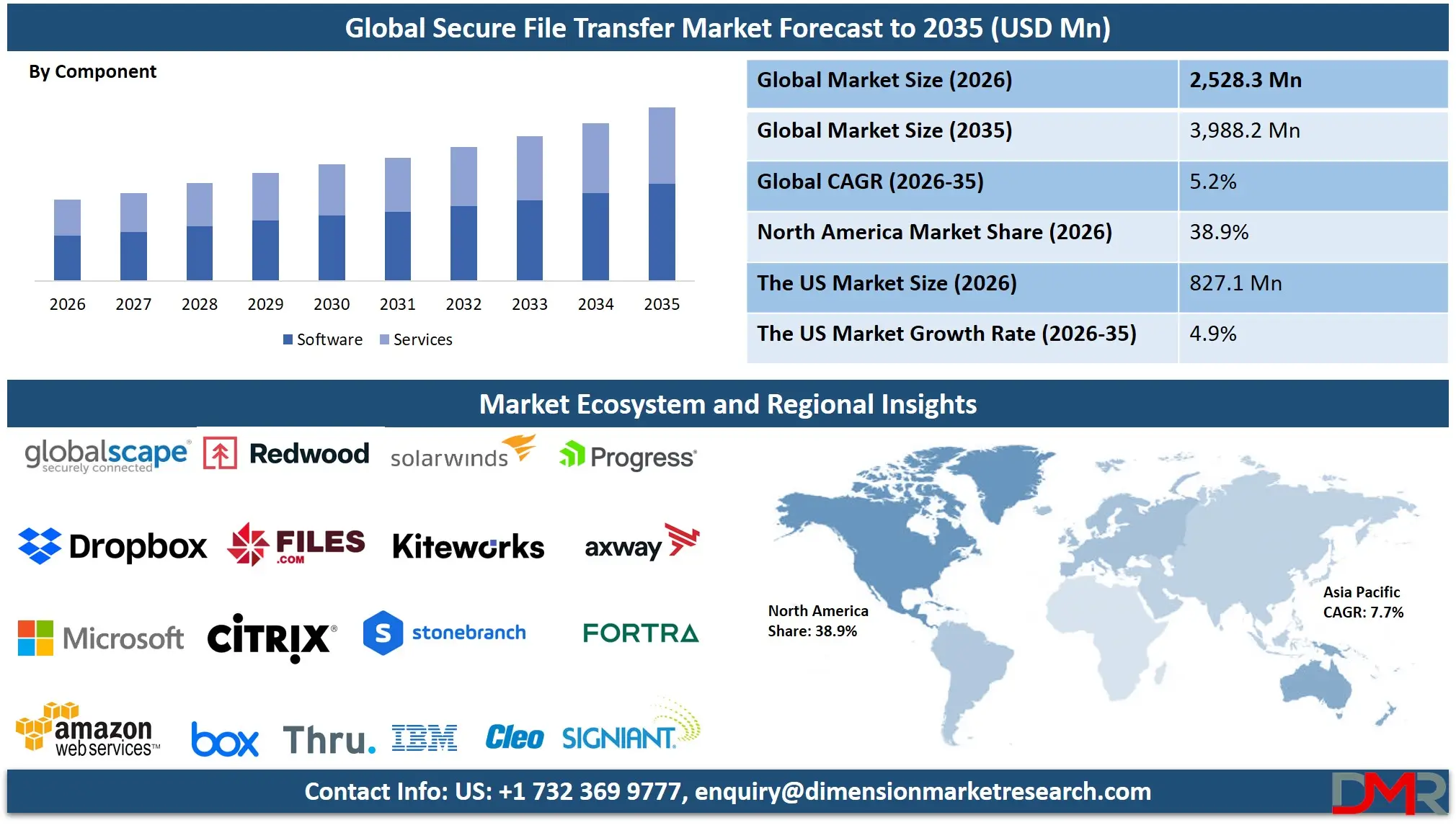
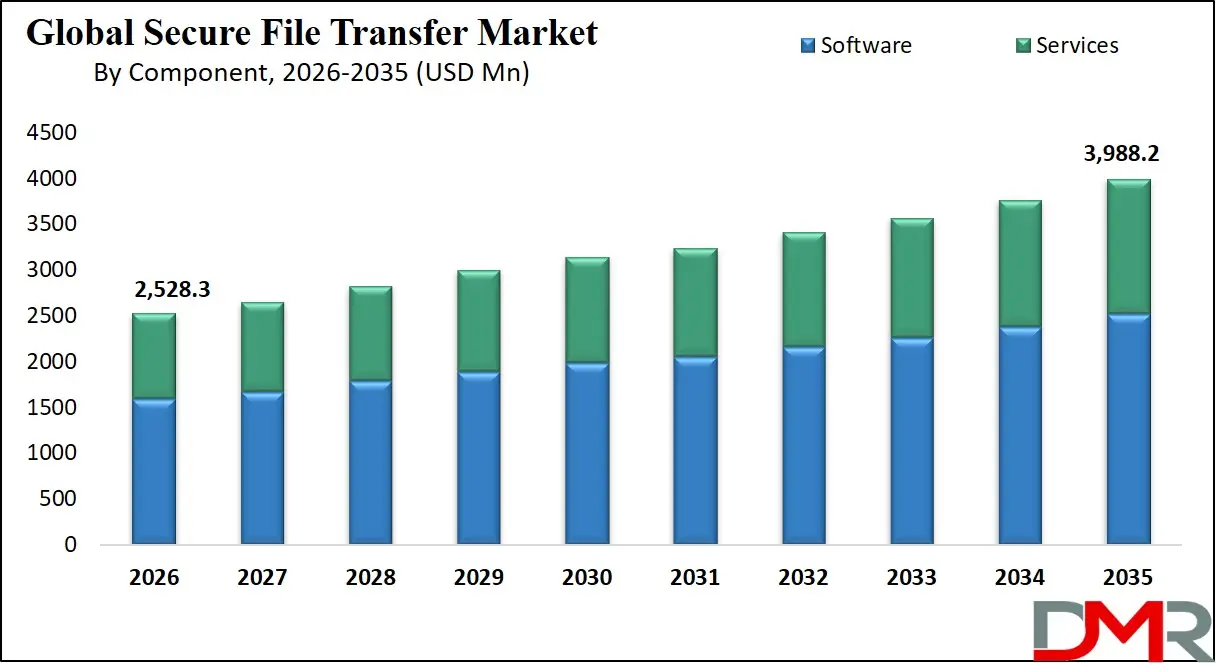
The Global Secure File Transfer Market is expected to reach a value of USD 2,528.3 million in 2026, and it is further anticipated to reach USD 3,988.2 million by 2035, growing at a CAGR of 5.2% during the forecast period.
ℹ
To learn more about this report –
Download Your Free Sample Report Here
The secure file transfer market has been growing consistently as organizations all over the world continue to heighten their preoccupation on data security, compliance with the regulations, and secure transfer of sensitive data across more decentralized workplaces. The market is comprised of software solutions such as secure file transfer systems, file encryption solutions, and transfer monitoring and analytics software, with the assistance of professional services such as consulting and integration, support and maintenance, and managed services.
Such solutions help organizations to safely exchange confidential data among themselves, with other organizations as well as partners, customers, and regulatory authorities. The growing amount of sensitive information being produced, combined with the coercive laws governing the protection of data, and the growing frequency of cyber-attacks on the information during its transfer, is contributing to the continuing need of effective secure file transfer services. Enterprises across all sectors are the primary adopters, with managed file transfer solutions gaining significant traction due to their comprehensive security features, automation capabilities, and audit trail functionality.
ℹ
To learn more about this report –
Download Your Free Sample Report Here
The US Secure File Transfer Market
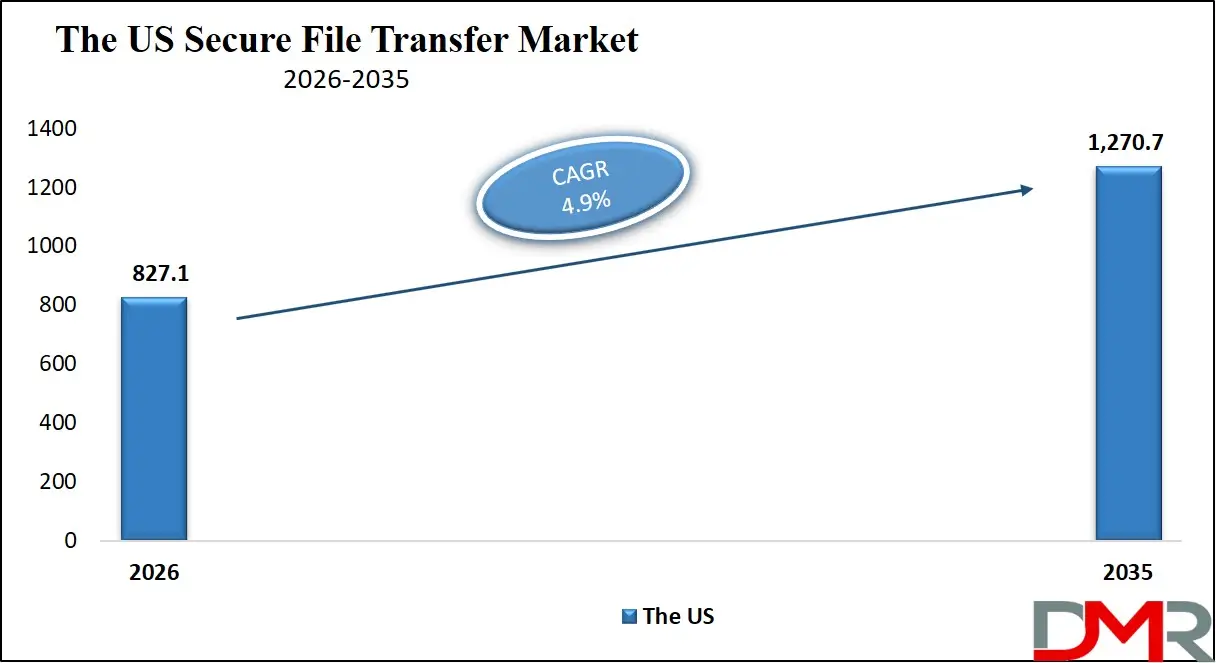
The US Secure File Transfer Market is projected to reach USD 827.1 million in 2026 at a compound annual growth rate of 4.9% over its forecast period, which is further forecasted to reach a value of USD 1,270.7 million by 2035.
ℹ
To learn more about this report –
Download Your Free Sample Report Here
The US continues to be the biggest and most developed market in secure file transfer solutions, owing to the rigorous regulatory environment involving HIPAA, SOX, GLBA and other state-based laws on data privacy. The market is marked by the great demand of managed file transfer platforms that ensure overall governance, visibility and control of sensitive data flows. Also, there is a growing acceptance of cloud-based secure file transfer solutions by mid-market enterprises, which is transforming the competitive environment as companies aim to lower the on-premises infrastructure expenses and still have solid security postures. The increase in remote and hybrid work models has only increased the need to have ad hoc file transfer solutions to facilitate safe collaboration without jeopardizing enterprise security measures.
The Europe Secure File Transfer Market
The Europe Secure File Transfer Market is estimated to be valued at USD 738.5 million in 2026 and is further anticipated to reach USD 1,145.2 million by 2035 at a CAGR of 5.0%.
The General Data Protection Regulation (GDPR) significantly influences the European market with its strict requirements to cross-border data transfers, data minimization and breach notification. These compliance pressures are driving significant investment in file encryption solutions and transfer monitoring and analytics tools that can offer provable evidence of compliance. The region is experiencing faster growth of the hybrid deployment model as organizations strike a balance between the operational flexibility of the cloud-based solutions and the data residency that is specified by the national data protection authorities. Moreover, manufacturing and logistics industries in Germany, France, and the Netherlands are now gradually implementing secure B2B file transfer solutions to safeguard sensitive supply chain data, engineering specifications and proprietary production information shared with partner networks globally.
The Japan Secure File Transfer Market
The Japan Secure File Transfer Market is projected to be valued at USD 268.4 million in 2026. It is further expected to witness steady growth, holding USD 405.7 million in 2035 at a CAGR of 4.7%.
The Japanese market is characterized by unique features that are determined by the strictness of the Japanese attitude to data security and the active digitalization of the traditional business processes. Japanese companies show a high preference in regards to managed file transfer solutions which provide extensive logging, elaborate audit trails and compatibility with existing identity and access management systems. Financial services sector is an important part of the market demand as banks and insurance firms upgrade the old infrastructure of file transfer in line with the new regulations of the Financial Services Agency. Also, the adoption of Industry 4.0 programs within the manufacturing industry is generating new demands to secure file transfer solutions that can safeguard intellectual property within CAD files, 3D models and proprietary production data shared among global project engineering departments as well as manufacturing sites.
Key Takeaways
- Market Size & Forecast: The Global Secure File Transfer market is projected to reach USD 2,528.3 million in 2026, expanding steadily to USD 3,988.2 million by 2035, driven by increasing data protection requirements and the exponentiating volume of sensitive data requiring secure transfer across organizational lines.
- Growth Rate & Outlook: The global market is projected to grow at a CAGR of 5.2%, owing to the inseparable threat environment of data in transit, the business need of file exchange in a form of automation, and the business need to prove that it has been able to meet the emerging regulations of data sovereignty.
- Primary Growth Drivers: The main drivers are the global implementation of data privacy laws that follow the GDPR template, the growing amount of sensitive information produced by IoT-gadgets and digital business processes, and the business need to eliminate unsecure file sharing applications and outdated FTP servers in favor of secure file transfer solutions.
- Key Market Trends: The convergence of secure file transfer with more comprehensive data security solutions, the introduction of artificial intelligence into transfer monitoring and analytics solutions to detect anomalies, the emergence of managed services solutions that take the operational load off internal IT staff and encourage the use of cloud-based deployment models.
- By Component Analysis: Software is poised to dominate this segment because it plays the central role of facilitating secure, encrypted and automated transfers of files. Enterprises are focusing on platforms, encryption, and compliance compliance monitoring tools, whereas services are primarily used to facilitate implementation and not generate revenue directly.
- By Type Analysis: Managed File Transfer is expected to dominate this segment with highest market share since it provides centralized control, automation, and compliance tracking. MFT is the solution of choice to basic transfer methods in enterprises that need high volume data transfer, seamless integration, and auditability.
- By Deployment Model Analysis: Cloud-based deployment is expected to dominate because it is scalable, flexible and cost-effective. It facilitates distant access, quicker deployment, and smooth updates, aiding digital transformation, and adoption of hybrids increases, although the primary deployment choice is cloud globally.
- Regional Leadership: North America is poised to dominate this market with 38.9% of the global market share in 2026, due to mature regulatory environment, high concentration of regulated industries and early adoption of advanced managed file transfer platforms that offer comprehensive governance and compliance services.
What is the Secure File Transfer?
Secure File transfer is defined as the process involving the distribution of digital files between systems, users or organizations, in a manner that safeguards data confidentiality, integrity and authentication by implementing protocols and technologies. It also uses encryption, secure access controls, and tracking to ensure that sensitive information is not accessed by unauthorized parties or in case of cyber threats unlike the conventional methods of file transfer. The typical ones are SFTP, FTPS, SCP and HTTPS based transfer where encryption standards are either SSL/TLS or SSH. Secure file transfer solutions have become very common in the transfer of financial documents, medical records, legal records and enterprise information within networks. They also aid in adherence to regulatory requirements through audit trails and data protection features. Comprehensively, secure file transfer is an essential part of contemporary digital infrastructure as it allows safe, reliable, and efficient data exchange within the internal environment and external stakeholders.
Use Cases
- Protected Health Information Exchange in Healthcare: Healthcare providers and insurers implement managed file transfer solutions with built in file encryption to safely transfer electronic health records, medical imaging studies, and insurance claims data and remain fully HIPAA compliant and create comprehensive audit trails to report to regulators and investigate breaches.
- Financial Transaction Processing in Banking: In banking, secure B2B file transfer systems are used to process millions of payment instructions, account statements, and regulatory reports with clearing houses, correspondent banks and government agencies in a manner that ensures the confidentiality and integrity of sensitive financial information over the course of transmission.
- Intellectual Property Protection in Manufacturing: Multinational manufacturers deploy secure file transfer systems with high-level encryption and access control to secure proprietary engineering specifications, CAD drawings, and product lifecycle management information to flow across global borders with contract manufacturers, suppliers, and design partners.
- Classified Document Handling in Government: Government agencies implement on-premises secure file transfer solutions with dedicated encryption modules and transfer monitoring and analytics tools to oversee the flow of classified and sensitive but unclassified information between agencies, contractors, and authorized external users and remain compliant with national security directives.
How AI is transforming the Secure File Transfer Market?
The introduction of artificial intelligence into secure file transfer solutions is also gaining momentum and is essentially improving threat detection features and efficiency. In transfer monitoring and analytics systems, anomaly detection algorithms, powered by AI, constantly scan file transfer logs, user activities, and other data access profiles to detect anomalies that could signal compromised credentials, insider threats, or new data exfiltration efforts. Such systems can automatically send out warning signals, block suspicious transfers or start other authentication challenges depending on real-time risk scoring, which will greatly decrease the amount of time that an organization is exposed to possible data breaches.
They are also using AI capabilities to streamline file transfer processes and allocate resources. Smart routing algorithms can be dynamically used to choose optimal transfer paths depending on network conditions, security needs and cost factors, especially when the situation requires accelerated transfer of files such as large media files or time sensitive financial information. Moreover, AI-based policy engines are being developed in secure file transfer systems, which can automatically label sensitive data through content inspection and apply suitable encryption standards, retention policies and access controls without involving the human security administrators.
Market Dynamics
Key Drivers in the Global Secure File Transfer Market
Escalating Regulatory Compliance Mandates
The global proliferation of comprehensive data protection regulations represents a primary catalyst for secure file transfer adoption. The presence of regulations such as GDPR in Europe, CCPA/CPRA in California, PIPL in China, LGPD in Brazil, and many sector-specific laws and regulations, such as HIPAA in healthcare and GLBA in financial services, all place high demands on sensitive data protection when it is in transit. Such frameworks require organizations to adopt proper technical and organizational safeguards to guarantee the integrity of data, keep detailed records of processing operations such as data transfers and prove adherence to regulatory bodies on demand.
Proliferation of Cyber Threats Targeting Data in Transit
The dynamic nature of the threat environment remains a primary force behind the need to develop secure file transfer solutions with high levels of security as malicious actors in the threat environment keep focusing on data as a weak point of attack. Man-in-the-middle attacks, credential theft targeting file transfer servers, and exploitation of unpatched legacy FTP infrastructure represent persistent threats that can result in significant data breaches. The publicity surrounding the breach of file transfer appliances has increased the awareness of security executives on the dangers that come with poorly secured data exchange systems.
Restraints in the Global Secure File Transfer Market
Budget Constraints and Competing IT Priorities
Although data protection is of critical importance, the secure file transfer initiatives frequently face hard decisions against other urgent IT budget distributions such as cloud migration, consolidation of cybersecurity tools and digital transformation projects. SMEs, in particular, might find enterprise-grade secure file transfer solutions to be prohibitively expensive relative to perceived risk exposure, particularly in the face of simple file transfer solutions being provided by existing infrastructure or in combination with other software platforms.
Complexity of Integration with Legacy Systems
The technological complexity of incorporating current secure file transfer systems into the existing enterprise technology infrastructure may slow the pace of adoption and inflate the overall cost of ownership. A variety of organizations have a heterogeneous application landscape, which includes decades-old mainframe systems, custom-written applications with limited API interfaces, and current cloud-native services that need to be involved in secure file exchange processes. The secure file transfer as a part of this diverse ecosystem would need specialized consulting and integration services to create trusted connections, adopt uniform security policy and flow of data between different systems.
Growth Opportunities in the Global Secure File Transfer Market
Expansion of Managed Services Offerings
Increasing complexity of secure file transfer environments and the continuing lack of in-house expertise make this a great opportunity to managed service providers to provide end-to-end operational support. Companies are increasingly outsourcing the daily operation of secure file transfer infrastructure, such as platform administration, user provisioning, security monitoring, patch management and compliance reporting to dedicated security operations centers with specialized service providers with extensive domain knowledge. This model is especially appealing to mid-market companies which need security solutions on a scale of an enterprise but which are too small to warrant internal teams.
Vertical-Specific Compliance Solutions
The subtle compliance needs of highly-regulated industries offer a rich opportunity to secure file transfer vendors to design and commercially package industry-specific solutions that meet unique regulatory and operational needs. Healthcare organizations need to find solutions that facilitate HIPAA compliant protected health information exchange with a full audit trail and business associate agreement management features. Banking institutions must have systems that are compatible with FFIEC regulations, SWIFT security rules, and new operation resilience standards. Federal government agencies require certified solutions to FedRAMP, FIPS 140-2, and other federal security standards with dedicated features of the ability to support classified information.
Trends in the Global Secure File Transfer Market
Accelerated Adoption of Cloud-Based Deployment Models
A significant market transformation towards cloud-based secure file transfer solutions is being experienced by organizations that are increasingly focused on operational agility, less overhead infrastructure management and scalability to support fluctuating file transfer volumes. Cloud deployment models remove capital costs incurred by buying hardware and maintaining data centers facilities and allow organizations to quickly add new transfer capacity as business needs change.
Integration of Advanced Analytics and Reporting
Sophisticated transfer monitoring and analytics tools are also being added to secure file transfer platforms, which allow security and compliance teams to have actionable intelligence about file movement patterns, user behaviors, and other possible risk indicators. More advanced analytics solutions than simple transfer logs can include anomaly detection algorithms to determine abnormal transfer volumes, unusual timing behavior, or access by geographic locations unrelated to the normal activities of the organization, as a sign of compromised credentials or insider threats.
Research Scope and Analysis
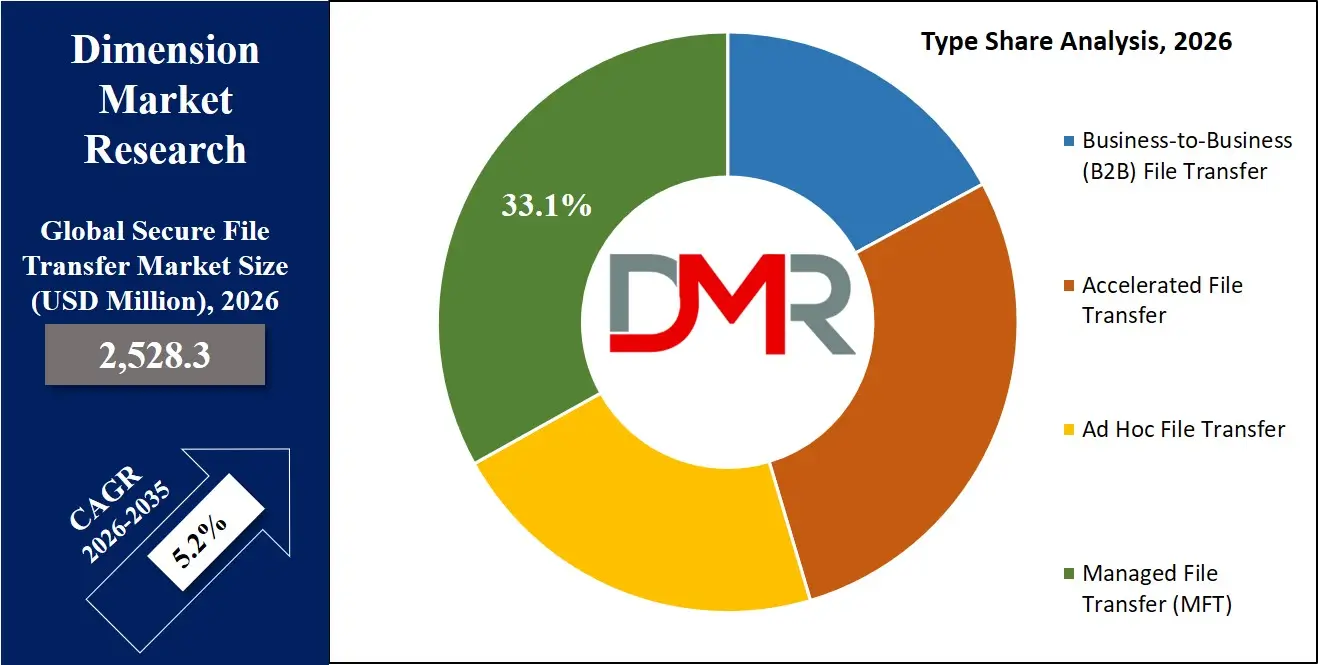
Secure file transfer market analysis highlights software, MFT, cloud deployment, SFTP, large enterprises, secure data exchange, and BFSI dominance driven by compliance, cybersecurity needs, and scalable digital transformation adoption across industries.
ℹ
To learn more about this report –
Download Your Free Sample Report Here
By Component Analysis
The software segment is the poised to be the leader in the secure file transfer market as it plays the central role in facilitating encrypted, automated, and policy-based data exchange among enterprises. Organizations put emphasis on secure file transfer platform, encryption tools, and monitoring systems in order to guarantee data protection, regulatory compliance, and operational efficiency. Large scale operations cannot be done without software solutions that are scalable and can be integrated with the current IT infrastructure and have other sophisticated features like audit trails and real time analytics. The increasing use of cloud computing and digital transformation projects also enhances the need of software-based solutions. Services like consulting and managed services are increasing, but they are more in support of software deployment and optimization and not core market revenue, which serves to strengthen the dominance of software.
By Type Analysis
Managed File Transfer (MFT) is expected to dominate this segment with the overall ability to perform secure, automated, and high-volume data transfers. Unlike ad hoc or basic B2B transfers, MFT provides centralized control, workflow automation, compliance tracking, and enhanced security features. Businesses like MFT solutions to facilitate complicated file transfers among various systems and partners maintaining data integrity and auditability. The growing regulatory compliance requirements in the industries like BFSI and healthcare further fuel MFT adoption. Also, MFT platforms are compatible with enterprise applications, and thus are the platform of choice in large organizations that handle sensitive and mission-critical data, further cementing their market leadership in this segment.
By Deployment Model Analysis
Cloud-based deployment is expected to dominate the market in context of deployment due to it is flexible, scalable and cost efficient. Enterprises are moving away more and more on-premises systems to cloud-based environments to enable remote working, global collaboration, and real-time access to data. Secure file transfer solutions based on the cloud are also attractive to both SMEs and large businesses because they are faster to implement, they are less expensive to maintain and because they update smoothly. Moreover, cloud solutions increase accessibility without compromising on the high level of security measures with encryption and compliance guidelines. The increasing use of hybrid and multi-cloud strategies also increases the need of cloud-based solutions. Despite the fact that on-premise deployment is still applicable in the highly regulated sectors, the industry trend heavily leans towards cloud adoption, which leads to its preeminence.
By Protocol Analysis
SFTP (Secure File Transfer Protocol) is poised to dominate the protocol segment because of its powerful security structure and its wide usage in enterprises. It is based on SSH (Secure Shell), though SFTP has the ability to transmit data in an encrypted form and authenticate securely and handle files reliably. People in different industries use it extensively in its transfer of sensitive information due to its strength and compatibility with other systems. In comparison with FTPS and SCP, SFTP is more flexible, firewall-friendly in its operation, and is easier to integrate with the new applications. Also, it is favored by businesses due to its capability to facilitate automated and large-scale transfers. With cybersecurity issues on the increase, SFTP is the most reliable and used protocol in secure file transfer systems.
By Enterprise Size Analysis
Large enterprises is expected to dominate this segment that have extensive data exchange requirements, sophisticated IT systems, and larger budgets to fund advanced security solutions. These organizations deal with huge amounts of sensitive information in multiple locations and partners, which require secure file transfer systems that are robust and scalable. They are also subject to stringent regulatory requirements, driving the adoption of advanced solutions such as Managed File Transfer and encryption platforms. Major companies spend a lot on automation, compliance, and integration functionalities that will guarantee efficiency in operations and security of data. Although SMEs are becoming more and more inclined to cloud-based solutions, their budgets and size are still less, which supports the presence of large enterprises in the market.
By Application Analysis
Secure data exchange is poised to dominate the application segment since it is the main purpose of secure file transfer solutions. Organizations across industries require reliable and protected methods to exchange sensitive information internally and externally. This encompasses financial records, patient details, legal files and operational information. The growing interest in data privacy laws and cybercrimes only intensifies the necessity to have secure data exchange solutions. Although file sharing, backup and compliance applications are essential, they are frequently involved in data exchange activities that are more comprehensive. The paramount significance of preserving the integrity, confidentiality, and availability of data guarantees that the secure data exchange has been the most dominant and primary usage in the market.
By Industry Vertical Analysis
The Banking, Financial Services, and Insurance (BFSI) sector is projected to dominate the secure file transfer market since it is highly dependent on secure data exchange and real-time data exchange and has high regulatory demands. Financial data, including transaction data, customer records and financial reports, is highly sensitive and thus security is a priority at the financial institutions. The necessity to adhere to regulations and standards leads to the constant investment in the development of secure file transfer solutions. BFSI organizations also need high speed, automated and auditable file transfer systems to facilitate everyday business and global transactions. Although other industries such as healthcare and IT have been expanding at a high rate, the sensitive character of financial information and strict compliance needs make BFSI the leader.
The Global Secure File Transfer Market Report is segmented on the basis of the following:
By Component
- Software
- Secure File Transfer Platforms
- File Encryption Solutions
- Transfer Monitoring & Analytics Tools
- Services
- Consulting & Integration
- Support & Maintenance
- Managed Services
By Type
- Business-to-Business (B2B) File Transfer
- Accelerated File Transfer
- Ad Hoc File Transfer
- Managed File Transfer (MFT)
By Deployment Model
- On-Premises
- Cloud-Based
- Hybrid
By Protocol
- SFTP (Secure File Transfer Protocol)
- FTPS (FTP Secure)
- SCP (Secure Copy Protocol)
- HTTPS-based Transfer
By Enterprise Size
- Small and Medium Enterprises (SMEs)
- Large Enterprises
By Application
- Secure Data Exchange
- File Sharing
- Data Backup & Archiving
- Compliance & Audit
By Industry Vertical
- BFSI
- Healthcare
- IT & Telecommunications
- Manufacturing
- Retail & E-commerce
- Government & Public Sector
- Media & Entertainment
- Logistics & Transportation
- Others
Regional Analysis
Leading Region by Market Share
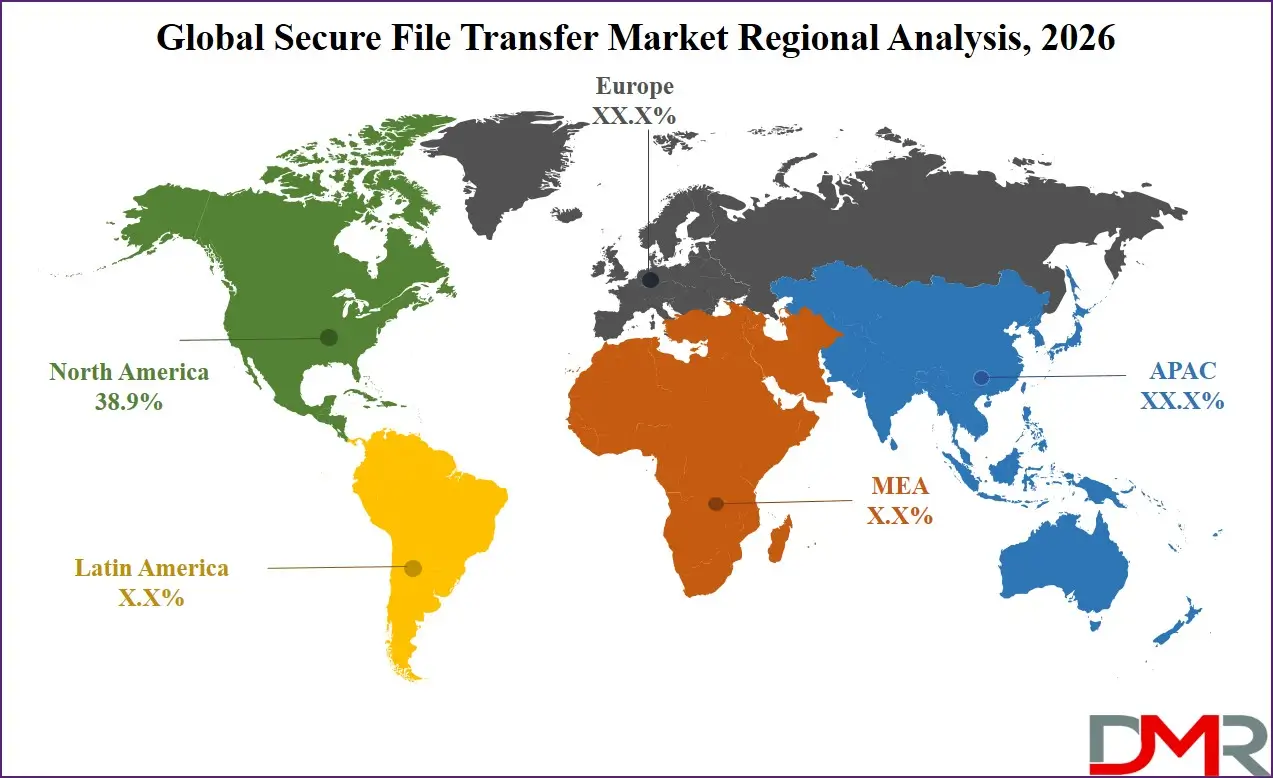
North America is poised to dominate the global secure file transfer market, projected to hold 38.9% of the global market share by the end of 2026. The US, which contributes the overwhelming proportion of market value in North America, leads because of a combination of several strengthening forces such as a highly developed regulatory climate with sector-specific requirements across healthcare, financial services, and government activities. The presence of a high concentration of global financial institutions, healthcare organizations, and technology companies in the area poses a significant demand on enterprise-level secure file transfer solutions that can comply with stringent security and compliance standards. Also, there is a higher level of cybersecurity awareness in the region and a relatively large IT spending per organization, which allows adopting a more advanced managed file transfer platform and other transfer monitoring and analytics systems earlier than in other parts of the globe. The availability of major secure file transfer vendors based in North America adds further market dominance in the region due to faster innovation cycles and strong partner ecosystems.
ℹ
To learn more about this report –
Download Your Free Sample Report Here
Fastest-Growing Regional Market
Asia-Pacific will be the fastest growing regional market in secure file transfer market due to the maturation of data protection regulatory frameworks, the speed of digitization of business processes in emerging economies, and the growing adoption of regional enterprises into global supply chains. The adoption of secure file transfer is facing regulatory tailwinds, as countries such as Japan, South Korea, Singapore, Australia and even more so China and India are enacting comprehensive data protection laws that require certain security measures to high-security data transmission. The strong manufacturing and logistics industries in the region that have intricate B2B file transfer processes with other international organizations are also a major demand center since organizations are keen on securing proprietary engineering information and supply chain information. Also, the financial services industry in the region is also experiencing a significant modernization, with banks and insurance providers changing out their old file transfer systems with newer managed file transfer solutions, which offer greater levels of security, automation, and compliance.
By Region
North America
Europe
- Germany
- The U.K.
- France
- Italy
- Russia
- Spain
- Benelux
- Nordic
- Rest of Europe
Asia-Pacific
- China
- Japan
- South Korea
- India
- ANZ
- ASEAN
- Rest of Asia-Pacific
Latin America
- Brazil
- Mexico
- Argentina
- Colombia
- Rest of Latin America
Middle East & Africa
- Saudi Arabia
- UAE
- South Africa
- Israel
- Egypt
- Rest of MEA
Competitive Landscape
The competitive landscape of the secure file transfer market is defined by the availability of established enterprise file transfer software vendors that offer end-to-end managed file transfer systems, specialized security vendors that are single-purpose file transfer providers, and emerging cloud-native providers that are disrupting traditional deployment models and pricing. Vendors who provide mature MFT platforms with wide protocol coverage, extensive integration, and advanced security and compliance features proven in years of experience with enterprise deployments in highly regulated markets are market leaders. Competitive differentiation is currently turning into an emphasis on aspects such as the ability to deploy clouds flexibly, sophisticated analytics and reporting functions, as well as the scope of managed services offerings that empower organizations to offload operational liability of secure file transfer infrastructure.
Some of the prominent players in the Global Secure File Transfer Market are:
- IBM
- Axway
- Fortra
- Progress Software
- Cleo
- Kiteworks
- SolarWinds
- Redwood Software
- Files.com
- Thru Inc.
- Globalscape
- Stonebranch
- Citrix Systems
- Box
- Dropbox
- Microsoft
- Amazon Web Services
- Signiant
- MASV
- Tresorit
- Other Key Players
Recent Developments
- February 2026: IBM declared major upgrades to its sterling secure file transfer platform, adding AI-driven anomaly detection features its transfer watch and analytics software to allow real-time detection of suspicious file transfer activity that could be an indication of a security threat emerging.
- October 2025: Progress Software has announced a significant release of its MOVEit managed file transfer platform, with major updates to offer new cloud-native deployment models and larger API integration options to streamline secure file transfer operations in hybrid and multi-cloud environments.
- August 2025: Broadcom finalized integrating purchased secure file transfer technologies into its enterprise security suite, releasing a single secure data exchange platform that integrates managed file transfer with expanded data loss prevention and encryption features.
- May 2025: Axway announced expanded managed services offerings for its secure file transfer platform, enabling organizations to fully outsource the operation, monitoring, and compliance reporting of their MFT infrastructure to Axway security specialists.
Report Details
| Report Characteristics |
| Market Size (2026) |
USD 2,528.3 Mn |
| Forecast Value (2035) |
USD 3,988.2 Mn |
| CAGR (2026–2035) |
5.2% |
| The US Market Size (2026) |
USD 827.1 Mn |
| Historical Data |
2021 – 2025 |
| Forecast Data |
2027 – 2035 |
| Base Year |
2025 |
| Estimate Year |
2026 |
| Segments Covered |
By Component (Software and Services), By Type (Business-to-Business (B2B) File Transfer, Accelerated File Transfer, Ad Hoc File Transfer, and Managed File Transfer (MFT)), By Deployment Model (On-Premises, Cloud-Based, and Hybrid), By Protocol (SFTP (Secure File Transfer Protocol), FTPS (FTP Secure), SCP (Secure Copy Protocol), and HTTPS-based Transfer), By Enterprise Size (Small and Medium Enterprises (SMEs), and Large Enterprises), By Application (Secure Data Exchange, File Sharing, Data Backup & Archiving, and Compliance & Audit), By Industry Vertical (BFSI, Healthcare, IT & Telecommunications, Manufacturing, Retail & E-commerce, Government & Public Sector, Media & Entertainment, Logistics & Transportation, and Others) |
| Regional Coverage |
North America – The US and Canada; Europe – Germany, The UK, France, Russia, Spain, Italy, Benelux, Nordic, & Rest of Europe; Asia-Pacific – China, Japan, South Korea, India, ANZ, ASEAN, Rest of APAC; Latin America – Brazil, Mexico, Argentina, Colombia, Rest of Latin America; Middle East & Africa – Saudi Arabia, UAE, South Africa, Turkey, Egypt, Israel, & Rest of MEA |
Frequently Asked Questions
How big is the Global Secure File Transfer Market?
▾ The Global Secure File Transfer market is poised to be valued at USD 2,528.3 million in 2026 and is projected to reach USD 3,988.2 million by 2035, driven by escalating data protection regulations, increasing cyber threats targeting data in transit, and the operational imperative to replace insecure legacy file transfer methods.
What is the CAGR of the Global Secure File Transfer Market from 2026 to 2035?
▾ The market is expected to grow at a CAGR of 5.2% from 2026 to 2035, reflecting sustained demand for secure data exchange capabilities across regulated industries and the growing recognition of secure file transfer as a foundational element of enterprise data protection strategies.
What factors are driving the growth of the Global Secure File Transfer Market?
▾ Key drivers include escalating regulatory compliance mandates globally, the proliferation of cyber threats specifically targeting data in transit, the operational inefficiency and security risks associated with legacy file transfer methods.
Which region held the largest share of the Secure File Transfer Market in 2026?
▾ North America is projected to hold 38.9% of the global market share in 2026, driven by a mature regulatory environment, high concentration of regulated industries, and early adoption of advanced managed file transfer platforms with comprehensive governance capabilities.
What are the major trends in the Global Secure File Transfer Market?
▾ Major trends include accelerated adoption of cloud-based deployment models, integration of advanced analytics and AI-powered anomaly detection within transfer monitoring tools, emphasis on user experience and self-service capabilities, and convergence of secure file transfer with broader data security platforms.
Who are the key players in the Global Secure File Transfer Market?
▾ Key players include established enterprise software vendors such as IBM, Broadcom, Progress Software, Globalscape, Cleo Communications, Axway, Ipswitch, HelpSystems, and OpenText, alongside specialized providers and emerging cloud-native vendors disrupting traditional deployment models.
How is the Global Secure File Transfer Market segmented?
▾ The market is segmented by Component, Type, Deployment Model, Protocol, Enterprise Size, Application, and Industry Vertical.
Which region is expected to grow the fastest in the Secure File Transfer Market?
▾ The Asia-Pacific region is expected to grow the fastest, fueled by the maturation of data protection regulatory frameworks, rapid digitization of business processes across emerging economies, and increasing integration of regional enterprises into global supply chains requiring secure B2B file exchange.