Global Security Operation Center as a Service (SOCaaS) Market Snapshot
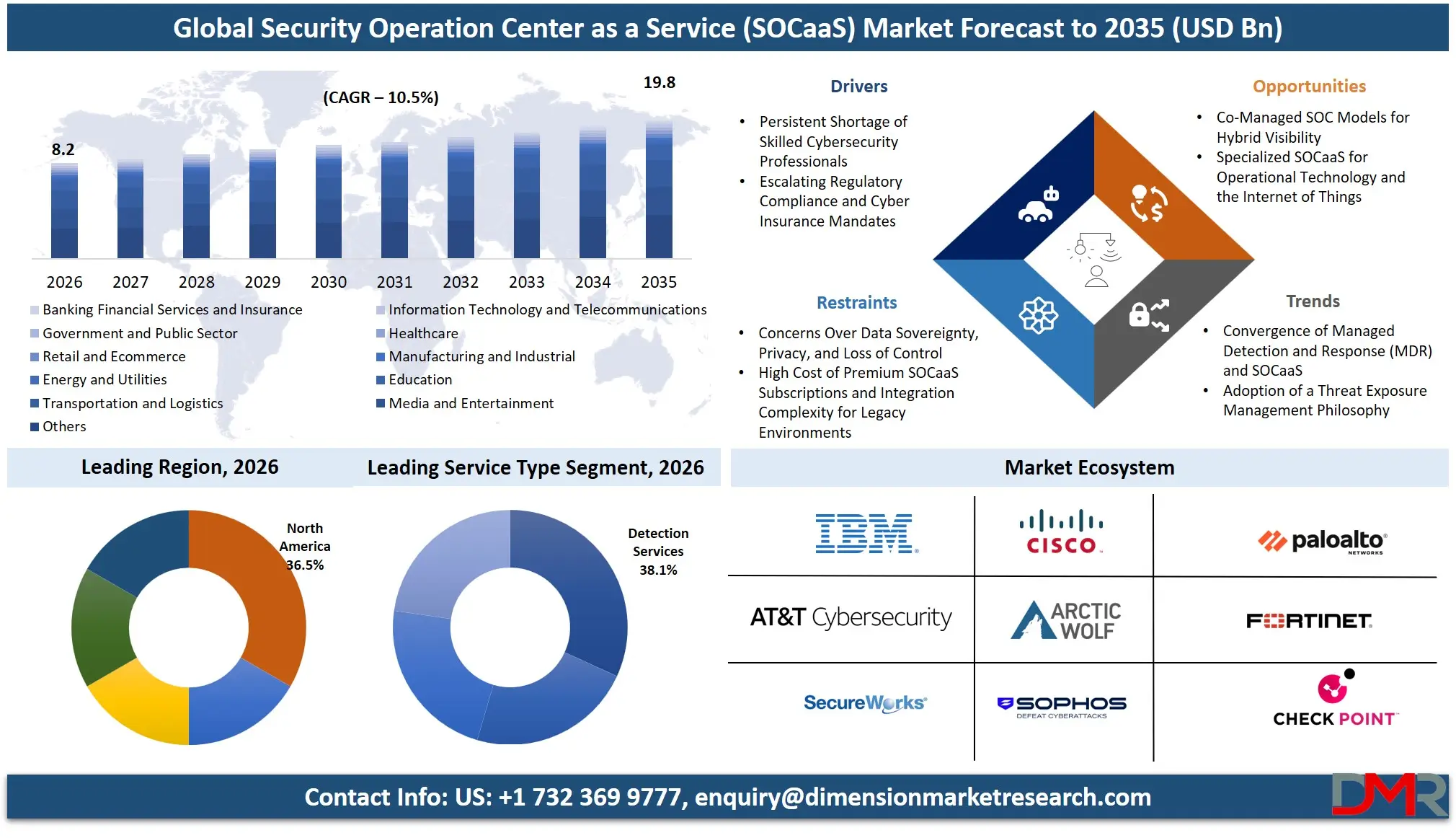
- Global Security Operation Center as a Service (SOCaaS) Market Size in 2026: USD 8.2 Billion
- Global Security Operation Center as a Service (SOCaaS) Market Size in 2035: USD 19.8 Billion
- Global CAGR from 2026 to 2035: 10.5%
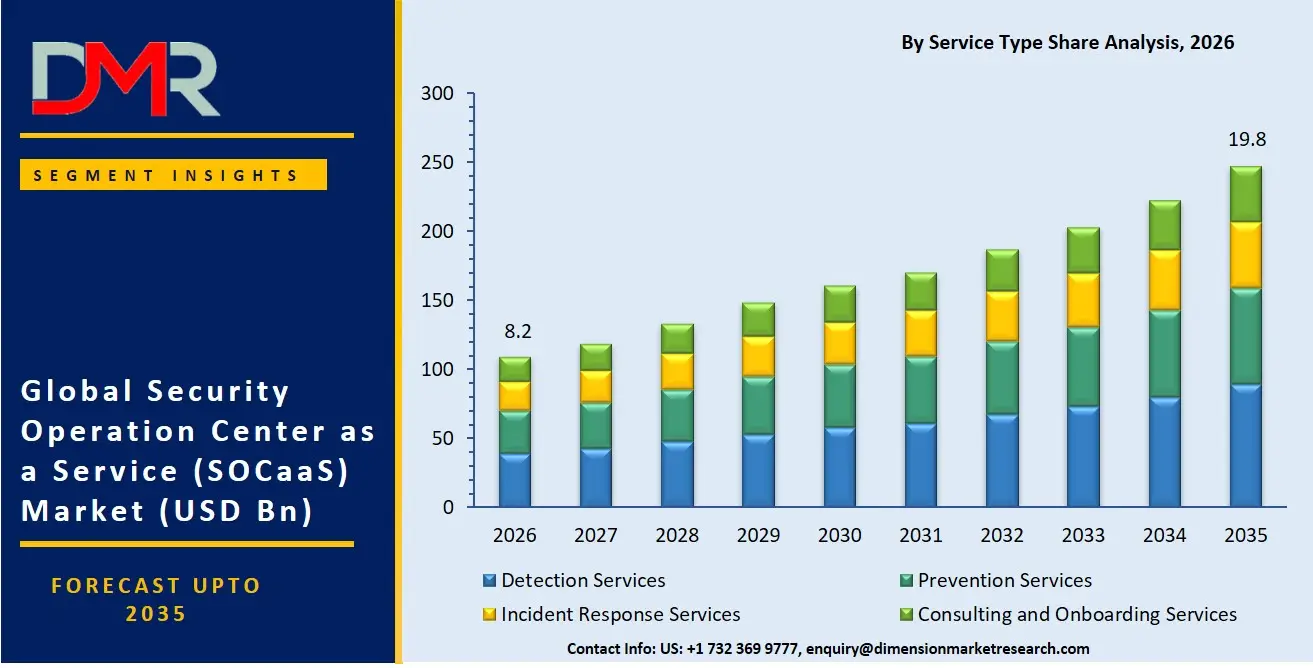
- Detection Services is the leading service type segment in 2026: 38.1%
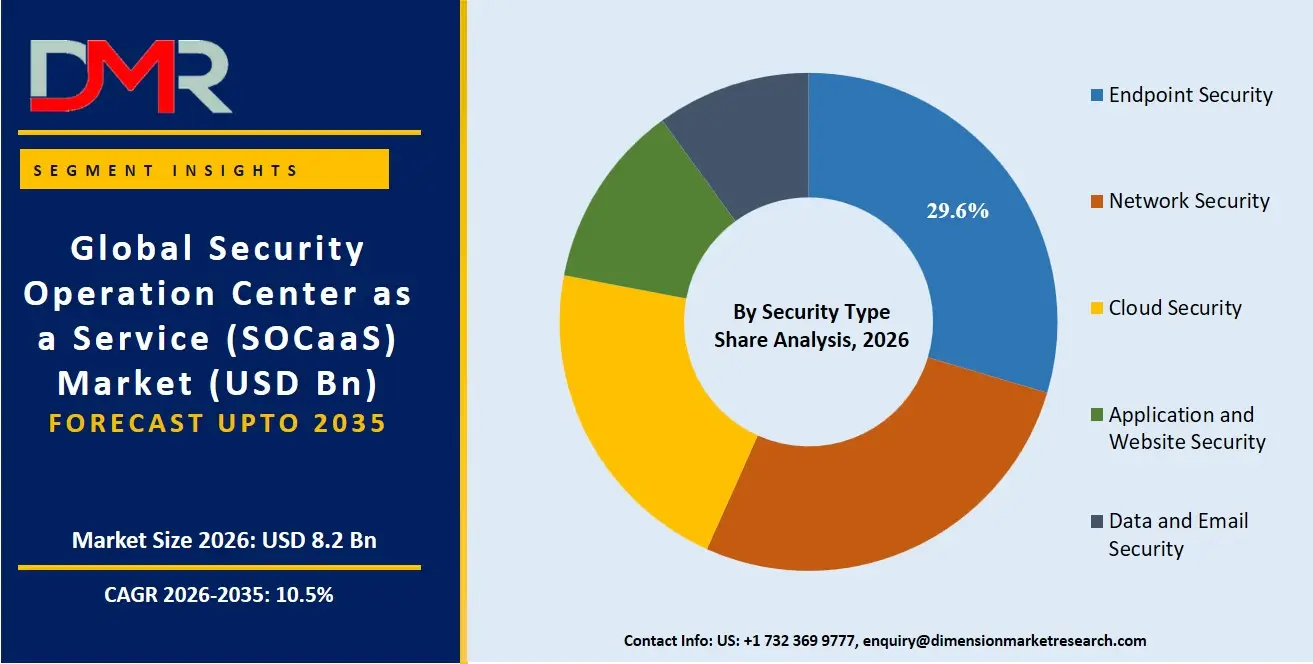
- Endpoint Security is the leading security type segment in 2026: 29.6%
- Large Enterprises is the leading organization size segment in 2026: 64.3%
- Banking, Financial Services, and Insurance is the leading industry vertical segment in 2026: 27.5%
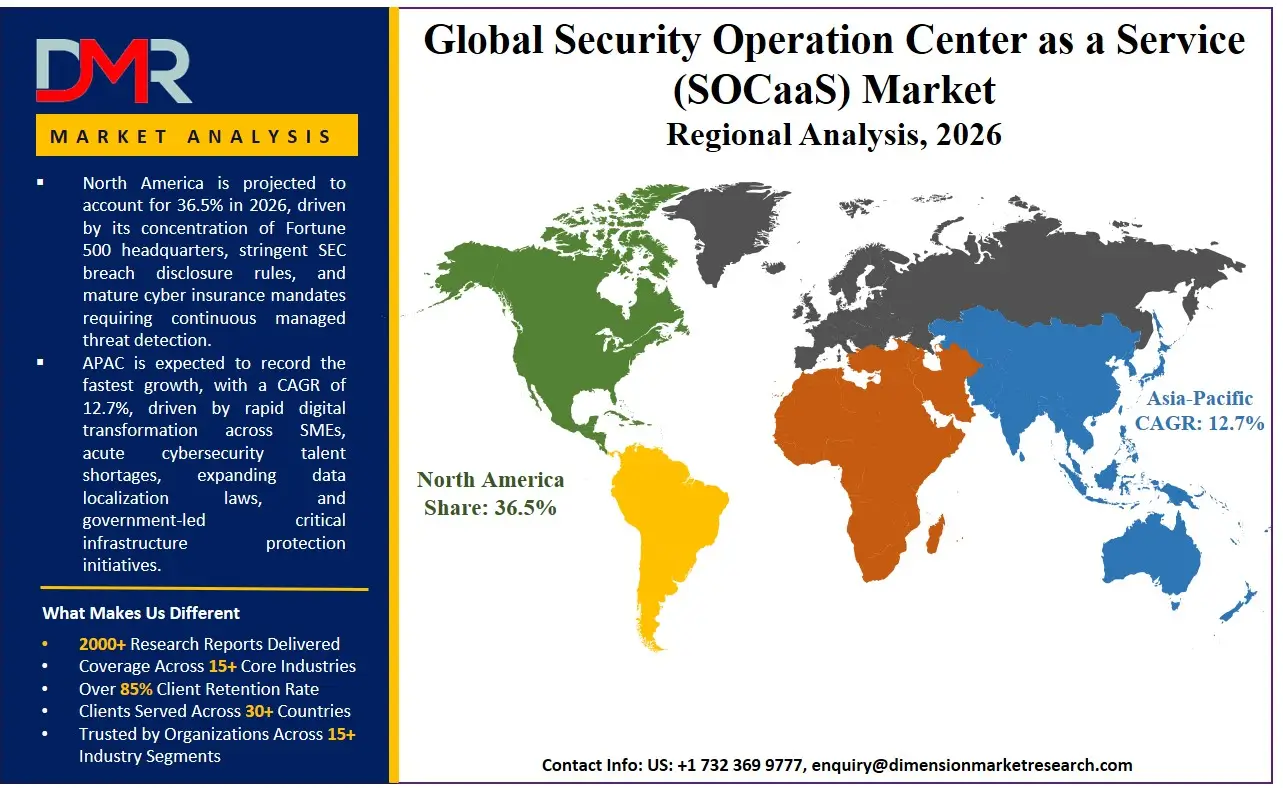
- North America is the leading region in 2026: 36.7%
What is the Global Security Operation Center as a Service (SOCaaS) and its Market Size?
Security Operation Center as a Service (SOCaaS) is a managed cybersecurity discipline that provides organizations with outsourced, 24/7 threat monitoring, detection, and incident response capabilities through a cloud-based platform and a team of expert security analysts. It integrates a comprehensive ecosystem of advanced security information and event management (SIEM) tools, AI-driven security orchestration, automation and response (SOAR) platforms, threat intelligence feeds, and expert human analysis to validate critical parameters such as mean time to detect (MTTD), mean time to respond (MTTR), alert fidelity, and containment efficacy across endpoint, network, cloud, and application layers. Enterprises, government agencies, and mid-market firms lacking in-house security talent or infrastructure depend on SOCaaS to ensure continuous security posture management, meet stringent regulatory compliance mandates, and build a resilient defense against increasingly sophisticated and evasive cyber threats.
ℹ
To learn more about this report –
Download Your Free Sample Report Here
The Global Security Operation Center as a Service (SOCaaS) Market is projected to be valued at USD 8.2 billion in 2026 and is projected to reach USD 19.8 billion by 2035, expanding at a CAGR of 10.5% during the forecast period. Growth is being driven by the escalating frequency of ransomware and supply chain attacks, an acute global shortage of skilled cybersecurity professionals, the mainstream adoption of hybrid cloud and work-from-anywhere models that dissolve traditional network perimeters, and the increasing stringency of compliance frameworks like GDPR, CCPA, and PCI DSS. Investment is accelerating as security teams move beyond reactive log monitoring toward proactive AI-powered threat hunting, autonomous incident triage, and integrated digital forensics to validate and neutralize threats before they manifest as business-impacting breaches.
Use Cases
- Continuous Threat Detection and Validation for Hybrid Enterprises: Organizations with distributed cloud workloads and remote endpoints use SOCaaS for real-time log management and analytics, correlating signals from cloud access security brokers (CASB), identity providers, and endpoint detection and response (EDR) tools to identify advanced persistent threats and credential-based attacks that evade siloed controls.
- Ransomware Defense and Accelerated Incident Containment: Manufacturing, healthcare, and financial institutions deploy SOCaaS for 24/7 monitoring of Indicators of Behavior and Indicators of Compromise. Upon detecting early-stage fileless malware or lateral movement, automated SOAR playbooks initiate threat containment by isolating infected endpoints and disabling compromised accounts, dramatically compressing recovery time.
- Compliance Assurance and Audit Readiness: BFSI and public sector entities utilize SOCaaS for continuous compliance assessment and reporting. The service maps telemetry to control frameworks (NIST, ISO 27001), generates automated compliance dashboards, and provides forensic audit trails for post-incident reporting and regulatory scrutiny, shifting from point-in-time audits to continuous assurance.
- Third-Party and Supply Chain Risk Mitigation: Organizations leverage SOCaaS for third-party risk monitoring by integrating external threat intelligence with internal network traffic analysis. Analysts detect anomalies indicative of a supply chain compromise, such as unusual communications from a trusted vendor's software update server, enabling rapid quarantine before the threat propagates.
Key Takeaways
- Market Size: The Global Security Operation Center as a Service (SOCaaS) Market is anticipated to be valued at USD 8.2 billion in 2026 and is forecast to reach USD 19.8 billion by 2035, expanding at a CAGR of 10.5%.
- Growth Outlook: Market expansion is supported by the industrialization of cybercrime, the dissolving network perimeter, hyperscale cloud adoption, the rise of generative AI-powered attacks, and a growing enterprise mandate for cost-effective, 24/7 cybersecurity resilience over in-house SOC build-outs.
- Primary Growth Drivers: An overwhelming volume of security alerts causing analyst fatigue, the immense complexity of securing multi-cloud environments, strict compliance mandates for data protection, and the inability of internal teams to execute proactive threat hunting are accelerating global investment in outsourced SOC solutions.
- By Service Type Analysis: Detection Services is projected to lead the service segment with a dominant 38.1% share in 2026, driven by the non-negotiable requirement for continuous security monitoring, SIEM management, and advanced threat hunting to identify stealthy intrusions that bypass preventive controls.
- By Security Type Analysis: Endpoint Security is expected to dominate the security type segment with a 29.6% share in 2026, supported by the massive proliferation of unmanaged devices and the critical role of EDR/XDR platforms in providing deep visibility into process-level attacks and initial access vectors.
- By Organization Size Analysis: Large Enterprises is anticipated to dominate with a 64.3% share in 2026, driven by their complex, globally distributed IT and OT estates that generate massive telemetry volumes requiring dedicated, 24/7 expert analysis and managed detection and response capabilities.
- By Industry Vertical Analysis: Banking, Financial Services, and Insurance is projected to lead with a 27.5% share in 2026, driven by the sector's role as a prime cybercrime target, non-negotiable data privacy regulations, and an acute need for fraud detection, anti-phishing protection, and business email compromise (BEC) defense.
How AI/Gen AI is Transforming the Security Operation Center as a Service (SOCaaS) Market?
Artificial intelligence is fundamentally transforming SOCaaS by enabling intelligent alert triage and predictive threat analysis across vast security telemetry datasets. Machine learning algorithms dynamically baseline "normal" network and user behavior, classify genuine threats from false positives in real-time, and predict an attack's kill chain progression under specific environmental conditions. Generative AI assistants are being integrated into SOAR platforms, allowing Tier-1 security analysts to create complex investigation playbooks and generate bespoke threat-hunting queries using natural language prompts, significantly reducing manual coding time and human error in incident triage and digital forensics processes.
The next frontier of adoption involves agentic AI workflows that orchestrate closed-loop incident response autonomously. In this paradigm, a SIEM analytics engine detects a subtle phishing-derived credential anomaly, instantly instructs the SOAR platform to enforce adaptive multi-factor authentication and isolate the affected endpoint, and then correlates the user entity behavior analytics (UEBA) baseline deviation with a specific MITRE ATT&CK technique to perform root-cause analysis. This capability compresses threat containment cycles from hours to seconds. However, for these AI models to be trusted in automated response decisions like network segmentation, they require strict governance on high-integrity training data derived from historical incident telemetry and expert-validated forensic reports to prevent business-disrupting false positives.
Key Drivers in the Global Security Operation Center as a Service (SOCaaS) Market
Persistent Shortage of Skilled Cybersecurity Professionals
The acute global deficit of skilled cybersecurity analysts and threat hunters is a primary driver for the SOCaaS market. Organizations struggle to recruit, train, and retain 24/7 security operations teams capable of managing modern SIEM, SOAR, and threat intelligence platforms. This talent vacuum directly fuels demand for outsourced SOC services that provide immediate access to experienced incident responders, forensic investigators, and compliance auditors. The growing sophistication of attack vectors, including fileless malware and advanced persistent threats, requires advanced human analytical skills that cannot be fully automated, making the expertise-as-a-service model essential for organizations that cannot compete for elite talent.
Escalating Regulatory Compliance and Cyber Insurance Mandates
A tightening web of global data protection and breach notification regulations is forcing organizations to adopt continuous monitoring and response capabilities. Frameworks like GDPR, PCI DSS 4.0, and SEC cybersecurity disclosure rules increasingly mandate demonstrable 24/7 detection controls and rapid incident response plans. Furthermore, cyber insurance providers are now strictly auditing cybersecurity posture before underwriting policies, often requiring continuous security monitoring and managed endpoint detection and response as prerequisites for coverage. SOCaaS directly fulfills these requirements by providing auditable log management, compliance reporting, and a demonstrable retention policy for forensic evidence, transforming it from an optional service into a business and legal necessity.
Restraints in the Global Security Operation Center as a Service (SOCaaS) Market
Concerns Over Data Sovereignty, Privacy, and Loss of Control
The central nervous system of a SOCaaS is its access to raw telemetry, including sensitive logs, network traffic patterns, and user activity data. Entrusting this data to a third party introduces significant concerns over data sovereignty, cross-border data transfer restrictions, and privileged access management. Organizations in highly regulated sectors or those handling state secrets may resist granting external analysts deep visibility into their operational and user data, fearing a loss of direct control over their security operations and the creation of a new supply chain risk where the security provider itself could become a breach vector. This governance friction can delay or block SOCaaS adoption, particularly for on-premises and OT system monitoring.
Growth Opportunities in the Global Security Operation Center as a Service (SOCaaS) Market
Co-Managed SOC Models for Hybrid Visibility
A significant growth opportunity lies in co-managed SOC models that integrate an organization's internal security team with an external SOCaaS provider. This approach addresses the "loss of control" restraint by providing a unified platform where internal analysts and external threat hunters collaborate on incidents, share threat intelligence, and jointly define SOAR playbooks. This model is particularly attractive to large enterprises with existing SIEM investments who want to augment their 24/7 coverage and access specialized expertise for advanced threat hunting and digital forensics without fully outsourcing their security operations. It creates a sticky, recurring revenue relationship built on partnership rather than pure out-tasking.
Specialized SOCaaS for Operational Technology and the Internet of Things
The convergence of IT and OT networks in manufacturing, energy, and healthcare creates a massive opportunity for specialized industrial SOCaaS. These environments use proprietary protocols (Modbus, DNP3) and require non-disruptive threat containment actions very different from standard IT environments. A generic SOCaaS is ill-equipped to analyze industrial control system alerts or safely respond to a threat on a production line. Providers who develop deep domain expertise in OT security, integrate with industrial asset management tools, and offer guaranteed safe remediation playbooks for connected device monitoring can unlock a high-value, underserved market segment with critical national infrastructure requirements.
Trends in the Global Security Operation Center as a Service (SOCaaS) Market
Convergence of Managed Detection and Response (MDR) and SOCaaS
The market is witnessing a convergence of MDR and SOCaaS into a unified, outcome-focused threat management stack. Rather than simply generating alerts, modern SOCaaS contracts are defined by MTTD and MTTR service level agreements. This trend is driving providers to tightly integrate EDR, XDR, and SOAR technologies into their service core. The focus is shifting from monitoring infrastructure to actively conducting threat containment and guided remediation. This convergence simplifies vendor management for customers and delivers a more integrated defense, where endpoint telemetry directly triggers managed network access control changes, accelerating the entire security lifecycle from detection to recovery.
Adoption of a Threat Exposure Management Philosophy
A forward-looking trend is the integration of Continuous Threat Exposure Management (CTEM) into the SOCaaS lifecycle. Service providers are evolving beyond reactive detection to proactively validate an organization's defenses. This involves continuous vulnerability scanning, automated security configuration management assessments, and breach and attack simulation (BAS) tools to validate whether network, endpoint, and email security controls are effective against specific advanced persistent threat and ransomware techniques. By providing this holistic exposure visibility program alongside 24/7 monitoring, SOCaaS providers are positioning themselves as strategic partners for cyber resilience, capable of validating an organization's security posture, not just detecting its failures.
Research Scope and Analysis
The Global Security Operation Center as a Service (SOCaaS) Market is segmented by service type, security type, organization size, application or threat type, and industry vertical. Service types include prevention, detection, incident response, and consulting. The study evaluates security across endpoints, networks, clouds, and applications, and analyzes adoption across small, medium, and large enterprises, diverse threat vectors, and key vertical industries.
ℹ
To learn more about this report –
Download Your Free Sample Report Here
By Service Type Analysis
Detection Services is poised to dominate the Global SOCaaS Market with a 38.1% market share in 2026, underpinned by the core value proposition of 24/7 continuous security monitoring, SIEM management, and proactive threat hunting to identify malicious activity that bypasses perimeter defenses.
ℹ
To learn more about this report –
Download Your Free Sample Report Here
These solutions are essential for achieving a low MTTD against advanced persistent threats and insider threats. Incident Response Services holds the second-highest share, driven by the critical need for rapid threat containment, digital forensics, and post-incident reporting to manage breaches when they inevitably occur. Prevention Services are projected to record a strong CAGR, as organizations increasingly demand integrated vulnerability management, security configuration management, and compliance assessment to proactively shrink their attack surface.
By Security Type Analysis
Endpoint Security is anticipated to dominate the market with a 29.6% share in 2026, as the endpoint remains the primary entry point for ransomware, phishing, and credential theft. Deep visibility through managed Endpoint Detection and Response (EDR) and Extended Detection and Response (XDR) is foundational to SOCaaS threat validation. Network Security accounts for the second-highest share, owing to the necessity of network traffic analysis and intrusion detection system management to identify lateral movement and command-and-control communication. Cloud Security testing is anticipated to expand at the highest CAGR, supported by the rapid migration to hybrid cloud environments and the critical requirement for Cloud Security Posture Management (CSPM) and workload protection to prevent misconfiguration-based breaches.
By Organization Size Analysis
Large Enterprises is projected to lead with a 64.3% market share in 2026, due to their complex, multi-cloud, and geographically dispersed IT/OT estates that generate an unmanageable volume of security telemetry. These organizations require a SOCaaS partner to co-manage SIEM, orchestrate SOAR, and provide advanced digital forensics. Small and Medium-Sized Enterprises (SMEs) are expected to register the highest CAGR, driven by a severe lack of in-house cybersecurity staff and budget. Facing the same advanced threats as large enterprises, SMEs are rapidly adopting fully managed security services for continuous monitoring, compliance reporting, and as-a-service incident response to build a defensible security posture without capital-intensive infrastructure investments.
By Application or Threat Type Analysis
Malware and Ransomware is expected to dominate the segment in 2026, as financially motivated, human-operated ransomware remains the most disruptive and prevalent threat facing global organizations. A core function of SOCaaS is the 24/7 detection of precursors like Cobalt Strike beacons, fileless malware execution, and unauthorized data exfiltration before encryption begins. Phishing and Social Engineering holds a significant share, reflecting its persistent role as the primary initial access vector for credential harvesting and business email compromise. Supply Chain Compromises are forecast to grow at the highest CAGR, owing to high-profile software supply chain attacks and increasing regulatory pressure for continuous third-party risk monitoring and management.
By Industry Vertical Analysis
Banking, Financial Services, and Insurance (BFSI) is projected to dominate the market with a 27.5% share in 2026, supported by an unparalleled threat landscape and the most stringent, non-negotiable regulatory oversight. The sector requires specialized detection for wire fraud, ATM logical attacks, SWIFT system monitoring, and data breach prevention, making continuous security monitoring and incident triage critical. Information Technology and Telecommunications holds the second-highest share, driven by the need to secure vast, complex infrastructure. Healthcare is anticipated to record the highest CAGR, driven by the escalating targeting of electronic health records and connected medical devices by ransomware operators, coupled with strict patient data privacy and network reliability requirements that demand immediate threat containment.
The Global Security Operation Center as a Service (SOCaaS) Market Report is segmented on the basis of the following:
By Service Type
- Detection Services
- Continuous Security Monitoring
- Security Information and Event Management
- Security Orchestration Automation and Response
- Threat Hunting
- Log Management and Analytics
- Prevention Services
- Risk Assessment
- Vulnerability Management
- Security Configuration Management
- Security Advisory Services
- Compliance Assessment
- Incident Response Services
- Incident Triage
- Threat Containment
- Digital Forensics
- Recovery and Remediation
- Post Incident Reporting
- Consulting and Onboarding Services
- Security Assessment
- SOC Deployment Planning
- Integration Services
- Security Awareness Training
- Compliance Consulting
By Security Type
- Endpoint Security
- Endpoint Detection and Response
- Extended Detection and Response
- Endpoint Protection Platform
- Mobile Endpoint Security
- Network Security
- Intrusion Detection System
- Intrusion Prevention System
- Firewall Management
- Network Traffic Analysis
- Network Access Control
- Cloud Security
- Public Cloud Security
- Private Cloud Security
- Hybrid Cloud Security
- Cloud Security Posture Management
- Cloud Access Security Broker
- Application and Website Security
- Web Application Firewall
- Application Security Testing
- API Security
- Runtime Application Protection
- Data and Email Security
- Data Loss Prevention
- Email Threat Protection
- Anti Phishing Protection
- Encryption Management
- Secure Email Gateway
By Organization Size
- Small and Medium Sized Enterprises
- Large Enterprises
By Application or Threat Type
- Malware and Ransomware
- Fileless Malware
- Ransomware Detection
- Trojan and Worm Protection
- Advanced Persistent Threats
- Nation State Attacks
- Long Term Intrusion Detection
- Insider Threats
- Malicious Insider Activity
- Negligent Insider Activity
- Distributed Denial of Service Attacks
- Volumetric Attacks
- Application Layer Attacks
- Phishing and Social Engineering
- Email Phishing
- Spear Phishing
- Business Email Compromise
- Internet of Things and Operational Technology Attacks
- Industrial Control System Security
- Connected Device Monitoring
- Supply Chain Compromises
- Third Party Risk Monitoring
- Software Supply Chain Protection
- Other Emerging Threats
By Industry Vertical
- Banking Financial Services and Insurance
- Information Technology and Telecommunications
- Government and Public Sector
- Healthcare
- Retail and Ecommerce
- Manufacturing and Industrial
- Energy and Utilities
- Education
- Transportation and Logistics
- Media and Entertainment
- Others
Regional Analysis
North America is the Leading Region in the Global SOCaaS Market
ℹ
To learn more about this report –
Download Your Free Sample Report Here
North America is poised to lead the Global SOCaaS Market with an estimated 36.7% revenue share in 2026. The region's dominance is anchored by a dense concentration of Fortune 500 corporate headquarters, world-leading cyber insurance markets, and stringent enforcement of regulations like SEC cybersecurity rules and state-level data privacy laws. Aggressive early adoption of AI-native threat detection platforms, a massive installed base of hybrid cloud infrastructure, and the presence of the most innovative, well-funded SOCaaS and MDR providers solidify its position as the primary global hub for advanced managed security operations.
Asia Pacific is the Fastest-Growing Region in the Global SOCaaS Market
Asia Pacific is projected to register the fastest CAGR of 12.7% through 2035, driven by its status as a booming engine for digital transformation across manufacturing, BFSI, and e-commerce. Massive SME growth in India, China, and ASEAN nations, coupled with a dire cybersecurity skills shortage, necessitates rapid adoption of fully managed detection and response. Accelerating smart city deployments, government-led data localization laws, and the expansion of industrial IoT in "Factory Asia" further fuel demand for specialized SOCaaS covering OT security, regulatory compliance, and continuous monitoring against ransomware targeting the regional supply chain.
The Europe SOCaaS Market
The Europe SOCaaS Market is estimated to be valued at USD 2.0 billion in 2026 and is further anticipated to reach USD 4.8 billion by 2035 at a CAGR of 9.8%. Europe represents the second-largest regional market, distinguished by its stringent regulatory framework driven by GDPR and a complex mosaic of national data sovereignty laws that mandate rigorous data privacy and breach notification compliance. The region's powerhouse manufacturing sector, particularly in Germany's Mittelstand and Industry 4.0 initiatives, is a significant growth engine, requiring specialized managed security services for industrial control system security and OT network traffic analysis that must ensure operational continuity alongside data integrity.
Latin America SOCaaS Market
The Latin America SOCaaS Market is expanding steadily as the region undergoes rapid digital banking and e-commerce growth, making it a prime target for financial malware and ransomware groups. Brazil and Mexico lead regional adoption, driven by their established BFSI sectors, new data protection laws like Brazil's LGPD, and a sharp increase in phishing and business email compromise attacks. The prohibitive cost of building and staffing an in-house 24/7 SOC makes the managed service model highly attractive. International MSSPs partnering with local integrators for compliance-fluent, Spanish and Portuguese-speaking incident response teams represent a key pathway to capturing this market.
Middle East and Africa SOCaaS Market
The Middle East and Africa SOCaaS Market is developing alongside massive smart city projects, economic diversification initiatives in the Gulf states, and the modernization of financial services infrastructure across Africa. Saudi Arabia and the UAE are the primary investment hubs, driven by strict national cybersecurity authority mandates for critical national infrastructure protection, which necessitate advanced threat hunting and continuous security monitoring. South Africa leads the African continent with its mature BFSI sector. The growing threat of disruptive ransomware against government and energy sectors is spurring demand for integrated incident response services and managed security awareness training to build a foundational human firewall against social engineering.
Major Countries Analysis
The US SOCaaS Market
ℹ
To learn more about this report –
Download Your Free Sample Report Here
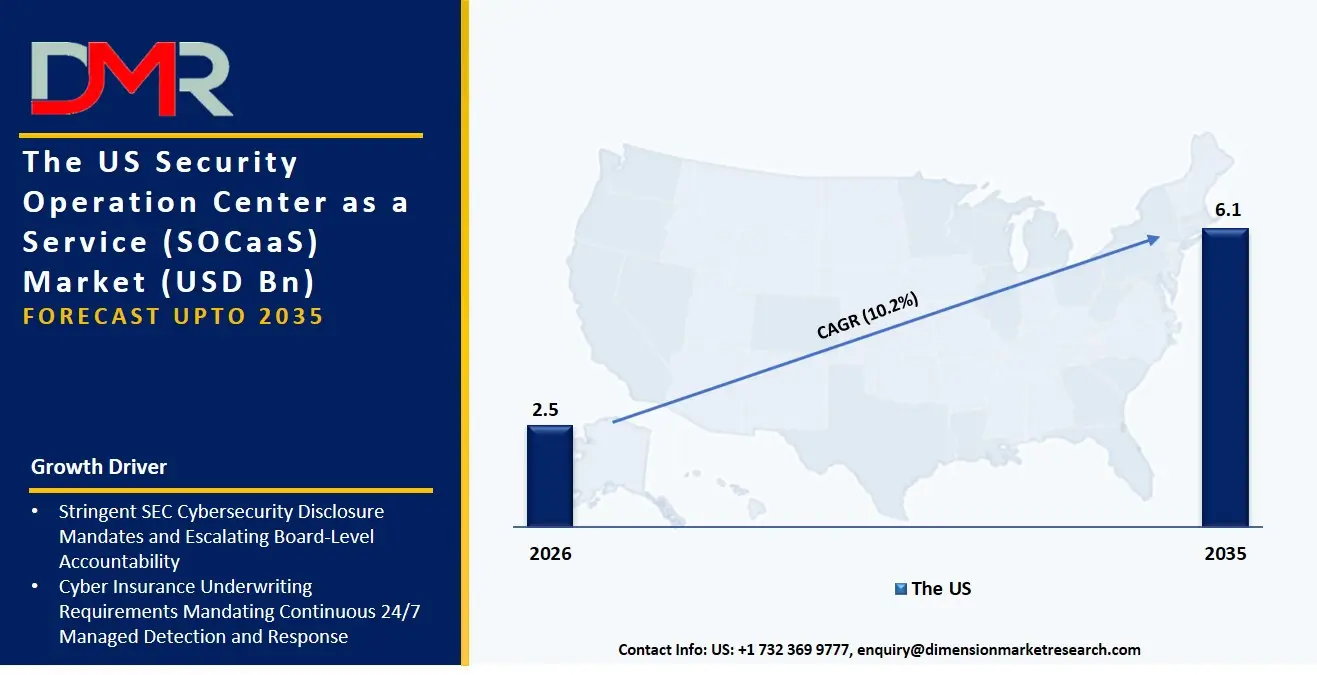
The United States SOCaaS Market is projected to be valued at USD 2.5 billion in 2026 and is expected to reach USD 6.1 billion by 2035, registering a CAGR of approximately 10.2% from 2026 to 2035. This robust trajectory reflects the U.S.'s position as the world's most targeted nation by cybercriminals and nation-state actors. Growth is fueled by the SEC's mandate for material incident reporting in 4 days, the widespread corporate adoption of cyber insurance requiring demonstrable EDR and 24/7 monitoring, and a relentless wave of double-extortion ransomware and supply chain compromises. The shift from on-premises SIEMs to cloud-native, AI-driven SOCaaS platforms is a defining driver of market expansion.
Japan SOCaaS Market
The Japan SOCaaS Market is valued at USD 690.0 million in 2026 and is forecast to reach USD 1.6 billion by 2035, expanding at a CAGR of approximately 9.5% between 2026 and 2035. Market development is heavily influenced by Japan's stringent Act on the Protection of Personal Information and the government's push for "Cyber-Physical Security" within the Society 5.0 initiative. The country's globally integrated automotive and high-tech manufacturing sectors demand meticulous network traffic analysis and insider threat detection to protect intellectual property. A strong cultural preference for managed and co-managed services from trusted, local security partners is driving sustained, quality-focused adoption of integrated detection and incident response.
Saudi Arabia SOCaaS Market
The Saudi Arabia SOCaaS Market is estimated at USD 180.0 million in 2026 and is projected to reach USD 490.0 million by 2035, expanding at a CAGR of 11.8%. Hyper-growth is directly tied to the Vision 2030 giga-projects and the cybersecurity mandates of the National Cybersecurity Authority (NCA). These massive, greenfield digital ecosystems in smart cities, logistics, and tourism require zero-trust architectures with 24/7 continuous security monitoring, advanced persistent threat detection, and OT-specific security for connected infrastructure. The market presents significant opportunities for international SOCaaS providers who establish in-country data residency and partner with local champions to deliver compliance-aligned, sovereignty-respecting managed security operations.
Regulatory Landscape
The regulatory landscape is the primary, non-negotiable catalyst for SOCaaS investment. In Europe, GDPR's 72-hour breach notification rule and threat of fines up to 4% of global turnover demand a 24/7 detection and incident response capability that SOCaaS intrinsically provides. In the US, the SEC's cybersecurity rules mandate public companies disclose material incidents within four business days, shifting cybersecurity from an IT risk to a board-level corporate governance issue and driving demand for post-incident reporting and digital forensics. PCI DSS 4.0 mandates continuous security posture validation for any entity handling cardholder data. These global frameworks collectively transform outsourced security operations from a cost-savings tactic into a legally mandated, demonstrable control for achieving continuous compliance and cyber resilience.
Investment and White Space Analysis
The strongest investment opportunities lie in AI-native detection platforms that fuse SIEM, SOAR, and UEBA into a single, low-noise interface that reduces Tier-1 alert triage drudgery. Significant white space exists in developing cost-effective, compliance-focused SOCaaS bundles for SMEs in lightly-regulated sectors that are now being targeted by supply chain attacks. Providers can differentiate through "co-managed" SIEM platforms that seamlessly integrate with an enterprise's existing Splunk or Microsoft Sentinel investments, and by offering "threat exposure as a service" that combines vulnerability management with adversary emulation. Emerging growth areas include specialized container/Kubernetes runtime security monitoring, and dedicated managed detection and response for the proprietary protocols of connected medical devices and industrial control systems.
By Region
North America
Europe
- Germany
- The U.K.
- France
- Italy
- Russia
- Spain
- Benelux
- Nordic
- Rest of Europe
Asia-Pacific
- China
- Japan
- South Korea
- India
- ANZ
- ASEAN
- Rest of Asia-Pacific
Latin America
- Brazil
- Mexico
- Argentina
- Colombia
- Rest of Latin America
Middle East & Africa
- Saudi Arabia
- UAE
- South Africa
- Israel
- Egypt
- Rest of MEA
Competitive Landscape
The Global SOCaaS Market features a dynamic landscape ranging from pure-play MDR specialists to global technology giants with integrated security services portfolios. At the high end, firms like CrowdStrike, SentinelOne, and Microsoft compete on the depth of their AI-driven threat intelligence, the openness of their XDR platforms, and the speed of their incident response SLAs. This tier competes intensely on mean time to detect and respond. The competitive field broadens significantly in the services domain, where MSSPs like AT&T Cybersecurity, Verizon, and NTT, alongside consultancies like Deloitte and Mandiant (now part of Google Cloud), differentiate on deep vertical expertise, managed SIEM/co-SOC models, and the human capital of their global threat hunting teams. Strategic differentiation increasingly hinges on providing a unified platform that fuses cloud-native security analytics with hands-on incident response, supported by transparent service level agreements and guaranteed compliance outcomes, not just telemetry generation.
Some of the prominent players in the Global Security Operation Center as a Service (SOCaaS) Market are:
- IBM Corporation
- Cisco Systems Inc.
- AT&T Cybersecurity
- Secureworks Inc.
- Arctic Wolf Networks Inc.
- Sophos Ltd.
- Palo Alto Networks Inc.
- Fortinet Inc.
- Check Point Software Technologies Ltd.
- Rapid7 Inc.
- Trustwave Holdings Inc.
- Orange Cyberdefense
- NTT DATA Group Corporation
- Verizon Business
- BT Group plc
- Capgemini SE
- Accenture plc
- DXC Technology Company
- Kyndryl Holdings Inc.
- Wipro Limited
- Tata Consultancy Services Limited
- Infosys Limited
- HCL Technologies Limited
- Fujitsu Limited
- NEC Corporation
- Telefonica Tech
- SentinelOne Inc.
- CrowdStrike Holdings Inc.
- eSentire Inc.
- Kudelski Security SA
- Other Key Players
Recent Developments
- In February 2026, Arctic Wolf expanded its Aurora Platform with advanced generative AI capabilities, introducing a knowledge assistant that helps SOC analysts use natural language to perform threat hunting, query security telemetry, and accelerate incident triage, with the goal of significantly shortening investigation and response workflows.
- In October 2025, Sophos had extended its Managed Detection and Response (MDR) offering with incident response retainer-style capabilities, positioning a unified service that combines proactive threat detection, preparedness assessments, and on-demand post-breach digital forensics and response, tailored for SMBs and mid market organizations that need predictable access to IR expertise.
- In September 2025, Palo Alto Networks aligned its Cortex XSIAM AI-driven SOC platform with its Unit 42 Managed XSIAM service to deliver a managed SOC offering that automates data ingestion, log management, alert correlation, and SOAR-style threat containment, enabling co managed enterprise deployments that offload day to day operations while retaining customer visibility and control.
Report Details
| Report Characteristics |
| Market Size (2026) |
USD 8.2 Bn |
| Forecast Value (2035) |
USD 19.8 Bn |
| CAGR (2026–2035) |
10.5% |
| The US Market Size (2026) |
USD 2.5 Bn |
| Historical Data |
2021 – 2025 |
| Forecast Data |
2027 – 2035 |
| Base Year |
2025 |
| Estimate Year |
2026 |
| Segments Covered |
By Service Type, By Security Type, By Organization Size, By Application or Threat Type, and By Industry Vertical |
| Regional Coverage |
North America – The US and Canada; Europe – Germany, The UK, France, Russia, Spain, Italy, Benelux, Nordic, & Rest of Europe; Asia-Pacific – China, Japan, South Korea, India, ANZ, ASEAN, Rest of APAC; Latin America – Brazil, Mexico, Argentina, Colombia, Rest of Latin America; Middle East & Africa – Saudi Arabia, UAE, South Africa, Turkey, Egypt, Israel, & Rest of MEA |
Frequently Asked Questions
How big is the Global Security Operation Center as a Service (SOCaaS) Market?
▾ The Global SOCaaS Market is valued at USD 8.2 billion in 2026 and is projected to reach USD 19.8 billion by 2035, reflecting strong global demand for outsourced threat detection, incident response, and continuous security validation.
What is the CAGR of the Global SOCaaS Market from 2026 to 2035?
▾ The market is projected to expand at a compound annual growth rate (CAGR) of 10.5% between 2026 and 2035, supported by sustained investment in 24/7 managed detection and response to counter sophisticated ransomware and supply chain threats.
What factors are driving the growth of the Global SOCaaS Market?
▾ Growth is driven by an unrelenting surge in ransomware and business email compromise attacks, a global cybersecurity skills gap, mandatory compliance with stricter breach notification laws, and the adoption of hybrid cloud models that necessitate continuous security monitoring and SOAR integration.
What are the major trends in the Global SOCaaS Market?
▾ Major trends include the convergence of MDR and SOCaaS into unified, outcome-focused platforms, the integration of generative AI for analyst augmentation, a shift toward proactive threat exposure management, and the rapid rise of specialized managed services for industrial OT and cloud-native application security.
Which region held the largest share of the Global SOCaaS Market in 2026?
▾ North America is expected to lead the global market with a 36.7% share in 2026, supported by a highly mature cybersecurity services culture, stringent SEC regulations, widespread cyber insurance mandates, and the presence of market-leading pure-play and hyperscale SOCaaS providers.
Which region is expected to grow the fastest in the Global SOCaaS Market?
▾ Asia Pacific is expected to record the fastest growth at a 12.7% CAGR through 2035, driven by a large, digitally transforming SME base, an acute cybersecurity talent shortage, and government-led data protection and critical infrastructure protection initiatives.
Who are the key players in the Global SOCaaS Market?
▾ Key market participants include CrowdStrike, SentinelOne, Microsoft, Palo Alto Networks, Arctic Wolf, ReliaQuest, Red Canary, Mandiant (Google Cloud), Deloitte, and Verizon, among other global technology and specialized security services firms.
How is the Global SOCaaS Market segmented?
▾ The market is segmented by service type, security type, organization size, application or threat type, and industry vertical, with regional analysis covering North America, Europe, Asia Pacific, Latin America, and the Middle East and Africa.