What is the Self-Healing Materials Market Size?
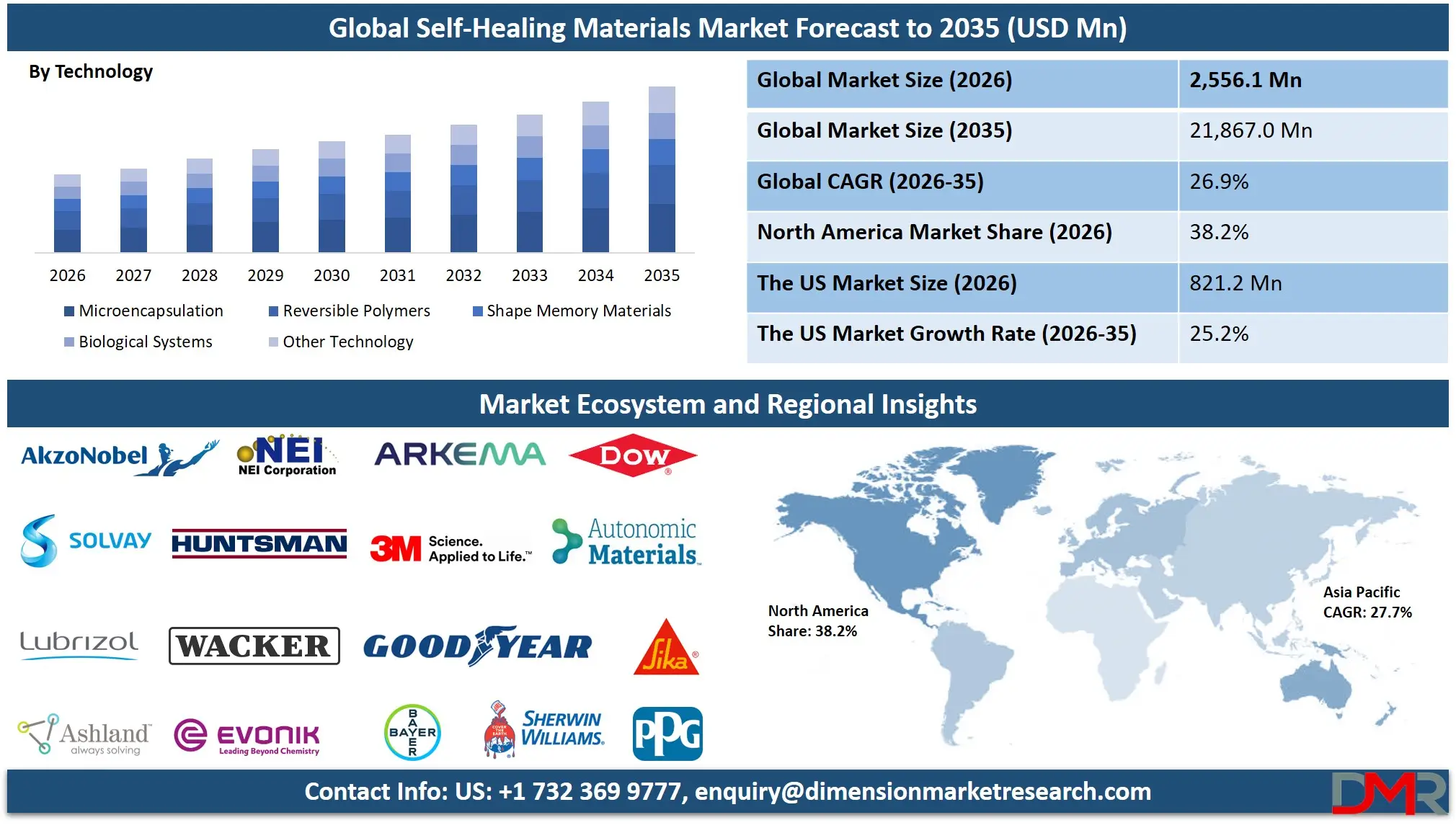
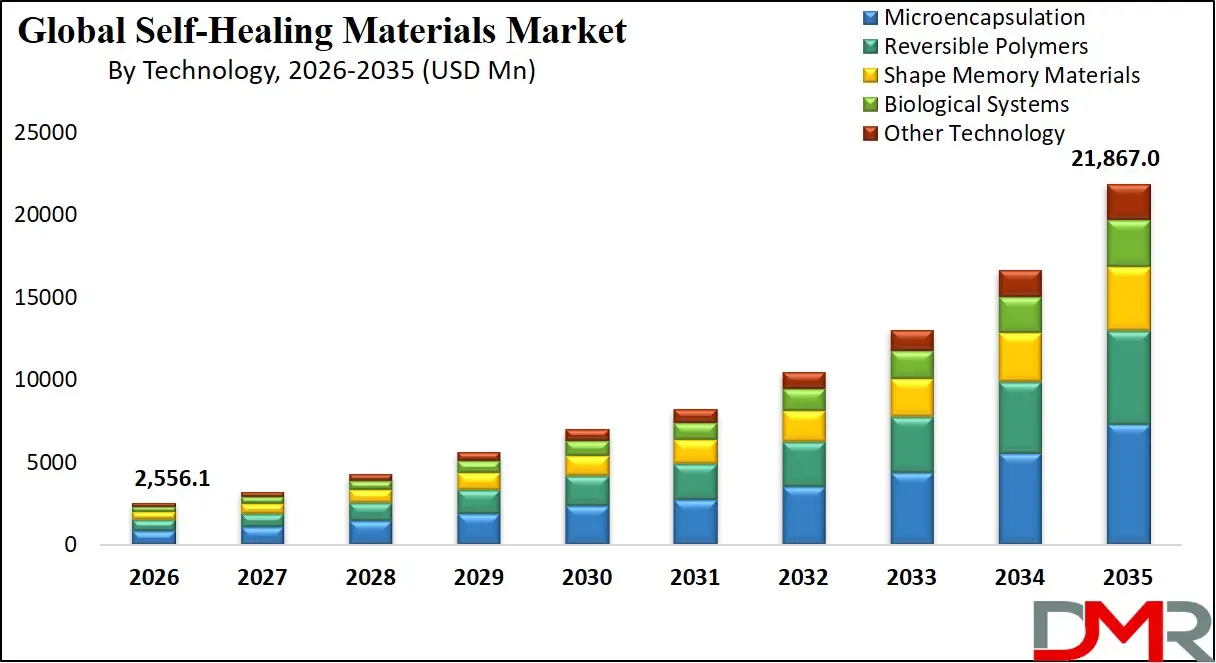
The Global Self-Healing Materials Market is expected to reach a value of USD 2,556.1 million in 2026, and it is further anticipated to reach USD 21,867.0 million by 2035, growing at a CAGR of 26.9% during the forecast period.
ℹ
To learn more about this report –
Download Your Free Sample Report Here
The self-healing materials market has shown rapid growth with companies accelerating their sustainability efforts and moving away from replaceable, maintenance-intensive infrastructure towards sustainable, self-managing systems. The market includes consulting, development, integration, and material engineering services that help enterprises to implement self-healing materials in concrete, coatings, polymers, and composites.
The need to adopt reversible polymer systems, microencapsulation, and bio-inspired materials systems is fueling the need for professional services. The most common adopters are infrastructure developers and manufacturers with intrinsic self-healing materials being the most preferred due to their capacity to undergo multiple healing cycles and its sustainability. The construction, automotive, aerospace and energy industries are some of the major consumers due to a demand for sustainable, safe and permanent material systems.
ℹ
To learn more about this report –
Download Your Free Sample Report Here
The US Self-Healing Materials Market
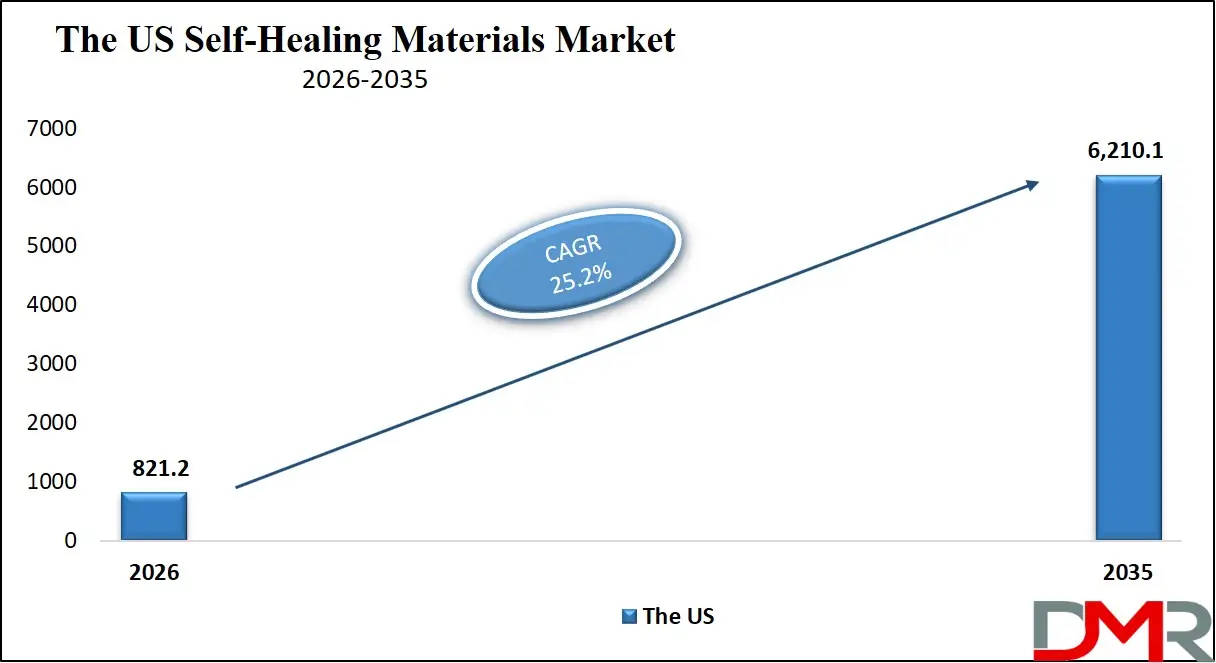
The US Self-Healing Materials Market is projected to reach USD 821.2 million in 2026 at a compound annual growth rate of 25.2% over its forecast period, which is further poised to reach a value of USD 6,210.1 million by 2035. The US remains the strongest and most mature market in the self-healing materials market, as the US government continues to implement initiatives to modernize critical infrastructure networks and advanced manufacturing clusters.
ℹ
To learn more about this report –
Download Your Free Sample Report Here
The market has been characterised by an increased need for self-healing concrete and asphalt services, where companies are focused on enhancing the lifespan of bridges, roads, and tunnels with microencapsulated healing agents. Similarly, the use of self-healing coatings in aerospace and energy sectors is driving the need for material consulting services to manage the performance testing and application-specific test frameworks.
The Europe Self-Healing Materials Market
The Europe Self-Healing Materials Market is estimated to be valued at USD 766.8 million in 2026 and is further anticipated to reach USD 6,560.1 million by 2035 at a CAGR of 26.9%. The regulatory regimes such as the European Green Deal and circular economy action plans affect the European market to a large extent and create the need to adopt sustainable material consulting and polymer recycling practices. The region is also seeing an enhanced growth of self-healing coatings development services as the German and French automotive and aerospace sectors are seeking to balance lightweight structures with environmental sustainability. Moreover, the drive for less construction waste is also pushing the service sector to develop cementitious and concrete-specific healing systems to deliver crack resistance and longer lifespans for the European infrastructure landscape.
The Japan Self-Healing Materials Market
The Japan Self-Healing Materials Market is projected to be valued at USD 204.5 million in 2026. It is further expected to witness robust growth, holding USD 1,749.4 million in 2035 at a CAGR of 26.9%. The Japanese market is a special case, where corporate investment is focused on resilient infrastructure and electronics to limit the effects of earthquake activity and an ageing public works portfolio. A high share of the expenditure is in polymer and ceramic material consulting and integration services as electronics conglomerates relocate mission critical components from passive packaging to autonomous self-healing systems. There is also a need to integrate heavily in the local market to build upon the existing repair-welding knowledge of metals and newly developed reversible polymer and biological material systems, which creates a niche in the integration of different materials and the lifecycle enhancement of performance.
Key Takeaways
- Market Size & Forecast: The Global Self-Healing Materials market is projected to reach USD 2,556.1 million in 2026, expanding dramatically to USD 21,867.0 million by 2035, driven by the duel drivers of sustainable infrastructures and the requirement to extend the lifetime of critical assets.
- Growth Rate & Outlook: Global market growth is expected at a CAGR of 26.9%, due to a lack of in-house material scientists and the increasing difficulty associated with incorporating microencapsulation and reversible polymer technologies into manufacturing processes.
- Primary Growth Drivers: Key factors include the mass shift from traditional high-maintenance materials to autonomic self-repair systems, material application consulting to prevent premature field deployment, and the need for shape memory materials development requiring unique skills.
- Key Market Trends: Key trends include the growth of application-specific self-healing systems (e.g., anti-corrosive aerospace coatings), the application of nature-inspired tools in intrinsic material optimization to auto-repair micro-cracks, and the move to lifecycle sustainability consulting as boards focus on ESG goals.
- By Material Analysis: Polymers are poised to lead this segment because of their flexibility, lightweight, and self-healing properties. They are versatile, cost-effective and can be used with intrinsic and extrinsic mechanisms, making them widely adopted and continually innovated on a global scale in coatings, electronics and automotive applications.
- By Technology Analysis: Microencapsulation is projected to dominate this segment owing to ease of integration and the healing process. The capsules release healing agents when damaged, making it cost efficient and expansive. Its applications in paints, concrete and composites drive high market acceptance.
- Regional Leadership: North America is poised to dominate this market with 38.2% of the market share in 2026 due to its well-developed technological ecosystem that takes full advantage of this infrastructure and makes it a leader in this market.
What is the Self-Healing Materials?
Self-healing materials professional services are the specialized advisory and technical implementation services offered by third-party experts, material scientists, and engineering consultancies to assist organizations through the entire materials lifecycle. These services, unlike raw material consumption (the polymer or coating itself), are related to the "how" of self-healing adoption. This involves Consulting to establish a strategic material selection roadmap and business case for adoption, implementation, and Migration to physically integrate healing agents into existing production workflows without disrupting output, and Integration and Optimization to ensure that self-healing systems effectively function within the application's operating environment. With 90% of material failures originating from micro-cracks, professional services are needed to achieve performance governance, healing efficiency verification, and lifecycle cost-benefit validation, making self-healing investments translate into tangible asset longevity, as opposed to theoretical material science.
Use Cases
- Autonomic Concrete Repair in Infrastructure: Infrastructure management agencies use consulting, integration, and microencapsulation services to integrate microencapsulated healing agents or bacterial spores into concrete, which heals concrete cracks after water ingress, preventing rebar corrosion and prolonging bridge and tunnel lifespans by many decades.
- Anti-Corrosion Coatings in Aerospace: Aviation OEMs use high-tech coatings consulting and testing services to apply self-healing polymer coatings on airframes that automatically heal scratches while maintaining aerodynamic performance and avoiding substrate corrosion, without the need for maintenance recycles.
- Damage-Proof Electronics in Consumer Goods: Consumer electronics OEMs use material class integration services to deploy reversible polymer matrices on device housings and semiconductor packaging, to enable self-repair of minor scratches and flex-induced micro-cracks on exposure to heat or light, increasing product durability.
- Self-Repairing Asphalt in Transportation: Transportation authority's use extrinsic microencapsulation services to embed healing-oil capsules in asphalt binders, so that when the asphalt cracks under wheel loads, healing agents are released to rejuvenate the bitumen and repair road surfaces without traffic interruptions.
How AI is transforming the Self-Healing Materials Market?
The self-healing materials professional services sector is transforming with the help of AI to expedite the discovery of new combinations of materials and to optimise healing performance in real-time. In the creation of new polymers and composites, AI-powered analytical tools can automatically simulate the response of reversible polymer networks to stress, thereby reducing the need for experimentation and time-to-formulation, and project risk. In integration and optimization, AI-powered monitoring features enable infrastructure managers to more accurately plan maintenance schedules to detect sub-surface crack growth, predict depletion of healing agent, and recommend actions such as targeted heat activation to maintain autonomic healing.
AI is also at the centre of material selection and business transformation projects. In consulting services, the use of smart compliance agents is used to monitor material performance under multi-stressed conditions to detect chemical degradation weakness, application problems, and lifecycle issues to ensure that companies adhere to norms such as ISO and ASTM standards.
Market Dynamics
Key Drivers in the Global Self-Healing Materials Market
The Global Material Science Skills Gap
Multinational companies are facing challenges in recruiting talents who have expertise in advanced material systems such as microencapsulation synthesis, shape memory alloys, and biological self-healing triggers. The demand for these skills is growing faster than the supply of talent, creating a skills mismatch in the job market. This has created a shift in companies outsourcing professional material engineering service companies instead of relying on their R&D. These providers help with critical steps such as material selection and integration with the production line, phase-gate testing and lifecycle service management.
Complexity of Intrinsic-Extrinsic Hybrid Systems
Large enterprises also typically adopt multiple self-healing mechanisms in a single component, mostly a combination of intrinsic reversible bonds and extrinsic healant capsules to cover damage at multiple locations, and ensure functional reliability for months to years. However, management of a hybrid healing environment is complex. Enterprises must harmonise trigger, healing, mechanical and processing criteria with multiple material classes and standards. This may lead to inefficiencies, incompatibilities and sub-optimal healing in the absence of expert knowledge.
Restraints in the Global Self-Healing Materials Market
Inertia of Validated Metallic Alloy Supply Chains
The majority of manufacturing companies currently use well-understood metals and alloys that have been refined over a long period of time, and are therefore highly tuned for their particular structural applications. These existing materials are a barrier to change, even though self-healing materials may offer improved lifecycle efficiencies. The introduction of new material classes, such as load-bearing self-healing polymers and ceramics, is expensive and risky. New material approval campaigns require much planning, fatigue evaluation and certification for safety. Companies are concerned about application failures, hidden flaws and unexpected degradation pathways during the transition.
High Upfront Formulation Costs
The economic uncertainty and business volatility has led to a greater caution by companies to invest in advanced materials R&D and retrofits. While self-healing durability remains a corporate priority, managers are under pressure to justify each investment and demonstrate return on investment for those investments compared to standard material costs. The charges and time frame of professional services firms offering bespoke microencapsulation synthesis and application engineering are more likely to be questioned. Companies are also looking to incorporate standard product-grade self-healing solutions that offer immediate operational gains or maintenance savings. The providers will be more likely to delay their long-term projects for bespoke materials development until the providers can offer a near-term return on investment.
Growth Opportunities in the Global Self-Healing Materials Market
Bio-Inspired Building Materials Platforms
A key growth opportunity for self-healing materials market is to help companies establish feasible, scalable biological systems for self-healing building materials. Many companies have attempted to use "bacteria concrete" ideas, but now they want their own durable settings that fit their specific environment, regulatory needs and supply-chain processes. The creation of these complex environments requires the expertise of biological material systems design, spore encapsulation, nutrient delivery, and germination-inducement. Material service companies can help businesses build long-lasting, self-healing building ecosystems that help seal cracks, prevent corrosion and monitor building health.
Offshore and Energy Sector Material Integration
The increasing need for material science expertise and knowledge of specific harsh-service industry needs is leading to the expansion of the services sector as material scientists develop industry specific solutions. These are corrosion-resistant coatings for offshore wind, self-healing composites for tidal energy turbine blades and self-healing polymers for subsea structures. Energy and power companies have to comply with high safety standards and deep-sea conditions. As such, they need partners for implementation that understand the self-healing technology and operational environment. To add value, professional service providers can offer to integrate extreme-environment material solutions with the existing monitoring systems, in line with the offshore regulations, and to control the activation time of the healing agent.
Trends in the Global Self-Healing Materials Market
The Rise of Sustainable Lifecycle Extension Services
The Product-as-a-Service and circular economy concepts are increasingly being embraced by companies, as opposed to planned obsolescence. Organisations are building business cases for Internal Asset Lifecycle Extension that offer self-healing benefits, instead of maintenance, repair and replacement cost centres. These approaches in material support value retention, waste reduction and carbon reduction. In response to this, self-healing material value added services suppliers are delivering expertise in cradle-to-grave design, recyclability in combination with healing agents and lifecycle cost modelling.
Quantum and Physics-Based Simulation Consulting
High performance simulation and digital validation of material healing processes is also becoming an important part of the material qualification process, as businesses are looking at reducing time-to-market and experimental costs. Companies are now looking for computational approaches that can forecast healing effectiveness and decrease field testing. So physics-based molecular dynamics consulting is emerging. Consulting service providers help companies model microcapsule rupture mechanisms, polymer chain re-entanglement and interfacial healing to inform design choices without requiring years of coupon-based testing.
Research Scope and Analysis
The self-healing materials market is driven by rising adoption of polymer-based materials, microencapsulation technologies, and intrinsic healing systems, with the construction industry leading demand due to durability, sustainability, and reduced maintenance requirements.
ℹ
To learn more about this report –
Download Your Free Sample Report Here
By Material Type Analysis
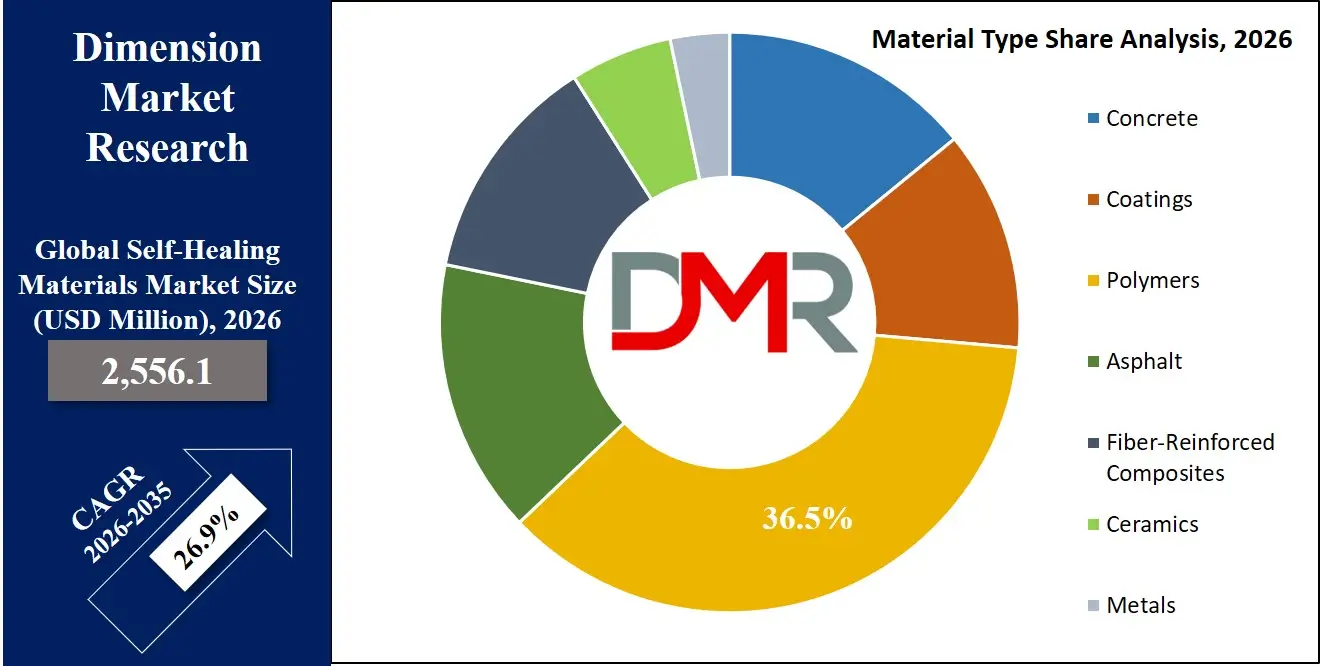
The material type segment is projected to be led by polymers for their excellent versatility, low weight and inherent self-healing properties. These can self-repair microcracks via reversible chemistry or release of healing agents, and are thus ideal for coatings, electronics and cars. They can be used with several self-healing technologies including microencapsulation and reversible chemistry. Moreover, compared to ceramics and metals, polymers are cheaper and easier to process, facilitating commercial scale-up. Polymer-based systems are increasingly preferred in protective coatings and flexible electronics for their durability and longevity. Ongoing development of bio-based and smart polymers also drives the rapid adoption of polymers, especially as sustainability considerations gain prominence in the end-use industries.
By Technology Analysis
Microencapsulation is expected to dominate the technology landscape because of its success and compatibility with conventional materials. This technology uses microcapsules containing healing agents that burst when damaged, releasing agents to heal the cracks. Its ease of use and effectiveness allow for its integration into coatings, concrete and composites. Being a passive approach, microencapsulation is easy to implement, unlike other technologies that require external stimuli or sophisticated material design. It is especially prevalent in infrastructure and industrial coatings, covering large areas and requiring economical solutions. Further, continuous innovations in capsule materials and chemistry improve its efficiency and lifespan. Its compatibility with a range of materials and scalability in mass production keeps it in the lead.
By Form Analysis
Intrinsic self-healing materials are poised to dominate this segment as they heal damage without the need for external agents. Their healing process is based on reversible chemical reactions or mobility of molecules in the material, allowing multiple healing cycles. This feature makes them attractive for applications where durability and longevity are critical, including electronics, aerospace, and advanced coatings. Intrinsic materials do not have the disadvantage of exhaustion of healing agents as seen in extrinsic systems, allowing them to maintain their properties over time. Their increased use is also due to advances in polymer science and materials science, which enable enhanced self-healing and mechanical performance. With a growing emphasis on durability and maintenance costs, intrinsic self-healing materials are increasingly becoming the materials of choice, especially in high-value and high-technology applications.
By End-Use Industry Analysis
The construction industry is the expected to be the major end-use industry in this market owing to the demand for long-lasting and maintenance-free materials. Self-healing concrete and coatings are extensively used to automatically repair cracks, substantially prolonging the life of structures like bridges, roads and buildings. This lowers costs and improves safety, making it very appealing to public and private-sector developers. The trend towards sustainable infrastructure and cost savings over the lifecycle also boosts usage. Moreover, the need for self-healing materials is high for global mega infrastructure projects in this industry. The construction industry provides the largest volume of use, and is the biggest revenue source in the market.
The Global Self-Healing Materials Market Report is segmented on the basis of the following:
By Material Type
- Concrete
- Coatings
- Polymers
- Asphalt
- Fiber-Reinforced Composites
- Ceramics
- Metals
By Technology
- Microencapsulation
- Reversible Polymers
- Shape Memory Materials
- Biological Systems
- Other Technology
By Form
By End-Use Industry
- Building & Construction
- Automotive & Transportation
- Aerospace
- Electronics & Semiconductors
- Energy & Power
- Healthcare
- Consumer Goods
- Other End User
Regional Analysis
Leading Region by Market Share
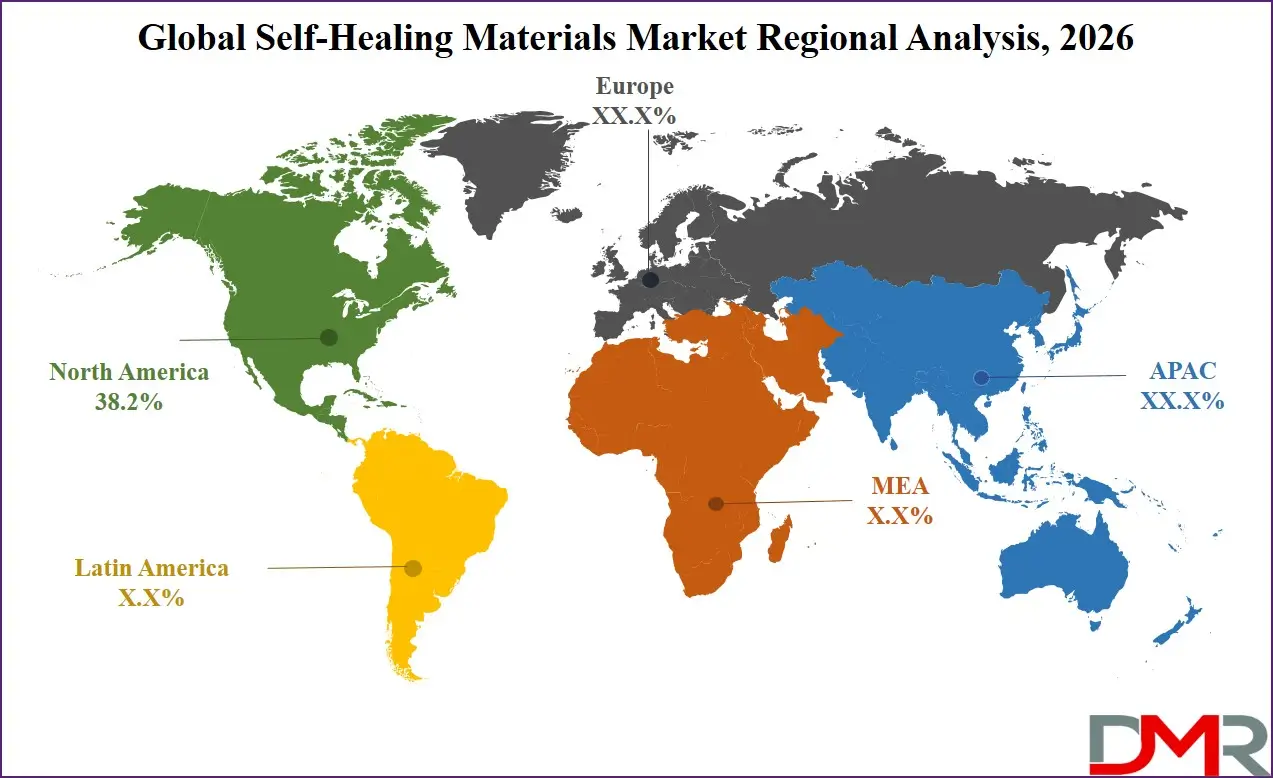
North America is poised to dominate the global self-healing materials market as it is projected to hold 38.2% of the market share by the end of 2026. North America's self-healing materials market is dominated by the United States which has the largest share of self-healing materials market due to the unrivalled density of advanced material science academia and federal infrastructure renewal initiatives. The region has a developed network of global chemical integrators, niche material engineering companies and a talent pool of polymer chemists and civil engineers. The US government's commitment to resilient infrastructure and advanced aerospace composites, as well as the retirement of old, corrosion-prone structures, are some of the factors driving the demand for self-healing concrete, coatings and composites, and lifecycle services. Additionally, the strong defense and aerospace climate continues to fund emerging self-healing technologies requiring professional services for qualification to mil-specs and supply-chain integration.
ℹ
To learn more about this report –
Download Your Free Sample Report Here
Fastest-Growing Regional Market
The Asia-Pacific region is projected to be the fastest-growing market for self-healing materials, as a result of the state-sponsored infrastructure upgrade programs in China, India, Japan and Southeast Asia. The rapid economic development, emergence of a manufacturing-driven economy, and rapid urbanization is forcing traditional construction conglomerates and transportation authorities to abandon high-cost traditional approaches. These conglomerates are in need of material transformation consulting to move towards autonomic repair business models. The region also suffers a shortage of material science professionals and it is essential to engage professional services for microencapsulation synthesis, application engineering, and managed life-cycle verification to address skill shortages and accelerate adoption of self-healing materials project execution.
By Region
North America
Europe
- Germany
- The U.K.
- France
- Italy
- Russia
- Spain
- Benelux
- Nordic
- Rest of Europe
Asia-Pacific
- China
- Japan
- South Korea
- India
- ANZ
- ASEAN
- Rest of Asia-Pacific
Latin America
- Brazil
- Mexico
- Argentina
- Colombia
- Rest of Latin America
Middle East & Africa
- Saudi Arabia
- UAE
- South Africa
- Israel
- Egypt
- Rest of MEA
Competitive Landscape
The global self-healing materials market has undergone a tremendous development with a mix of multinational chemical giants, professional service arms of the major material testing laboratories, and specialised biomimetic material start-ups. The competitive advantage will be determined by the close strategic partnerships with the major building materials companies, automotive OEMs or aerospace primes as they will provide the needed co-development opportunities and early access to new manufacturing technologies. The consolidation trend is moving fast with conventional polymer manufacturers and additives suppliers buying up biological crack-sealing and reversible chemistry specialist shops to survive. Unique intellectual property, such as automated capsule synthesis or application-specific healing agent formulations, are increasingly more important sources of added value than just commodity material delivery or case-study genericism.
Some of the prominent players in the Global Self-Healing Materials Market are:
- Autonomic Materials, Inc.
- BASF SE
- NEI Corporation
- Bayer AG
- The Goodyear Tire & Rubber Company
- Arkema S.A.
- Dow Inc.
- Covestro AG
- 3M Company
- Huntsman Corporation
- Sika AG
- Sherwin-Williams Company
- Wacker Chemie AG
- PPG Industries, Inc.
- Evonik Industries AG
- Ashland Global Holdings Inc.
- Lubrizol Corporation
- Solvay S.A.
- H.B. Fuller Company
- AkzoNobel N.V.
- Other Key Players
Recent Developments
- April 2026: BASF SE, Dow, and Covestro intensify R&D and sustainable polymer launches, expanding self-healing coatings and composites portfolios as the global demand, pressure on supply chains to localize and increasing use of industrial applications in the automotive, construction, and electronics industries grows.
- March 2026: CompPair, in partnership with CSEM and Com&Sens, join European Space Agency in commercializing HealTech self-healing composites, aimed at aerospace use with embedded sensing, autonomous repair, and enhanced durability of future spacecraft structures and missions around the world.
- April 2026: 3M, AkzoNobel and Arkema enhance their advanced materials and incorporate self-healing functions to coatings, adhesives and high-performance industrial uses, contributing to durability, sustainability ambitions and improved lifecycle performance in automotive, aerospace, electronics and construction sectors worldwide.
Report Details
| Report Characteristics |
| Market Size (2026) |
USD 2,556.1 Mn |
| Forecast Value (2035) |
USD 21,867.0 Mn |
| CAGR (2026–2035) |
26.9% |
| The US Market Size (2026) |
USD 821.2 Mn |
| Historical Data |
2021 – 2025 |
| Forecast Data |
2027 – 2035 |
| Base Year |
2025 |
| Estimate Year |
2026 |
| Segments Covered |
By Material Type (Concrete, Coatings, Polymers, Asphalt, Fiber-Reinforced Composites, Ceramics, Metals), By Technology (Microencapsulation, Reversible Polymers, Shape Memory Materials, Biological Systems, Other Technology), By Form (Intrinsic, Extrinsic), By End-Use Industry (Building & Construction, Automotive & Transportation, Aerospace, Electronics & Semiconductors, Energy & Power, Healthcare, Consumer Goods, Other End User) |
| Regional Coverage |
North America – The US and Canada; Europe – Germany, The UK, France, Russia, Spain, Italy, Benelux, Nordic, & Rest of Europe; Asia-Pacific – China, Japan, South Korea, India, ANZ, ASEAN, Rest of APAC; Latin America – Brazil, Mexico, Argentina, Colombia, Rest of Latin America; Middle East & Africa – Saudi Arabia, UAE, South Africa, Turkey, Egypt, Israel, & Rest of MEA |
Frequently Asked Questions
How big is the Global Self-Healing Materials Market?
▾ The Global Self-Healing Materials market is poised to be valued at USD 2,556.1 million in 2026 and is projected to reach USD 21,867.0 million by 2035, driven by the universal need for durable infrastructure, sustainable manufacturing, and lifecycle extension technologies.
What is the CAGR of the Global Self-Healing Materials Market from 2026 to 2035?
▾ The market is expected to grow at a CAGR of 26.9% from 2026 to 2035, reflecting the accelerating complexity of integrating bio-inspired and chemical healing mechanisms and the persistent shortage of internal material science talent.
What factors are driving the growth of the Global Self-Healing Materials Market?
▾ Key drivers include the global material science skills gap, the imperative to extend the life of aging civil and industrial assets, the management complexity of hybrid intrinsic-extrinsic healing systems, and the surge in demand for life-cycle sustainability consulting amid evolving environmental regulations.
Which region held the largest share of the Self-Healing Materials Market in 2026?
▾ North America is poised to held 38.2% of the market share in 2026, driven by a mature R&D ecosystem and aggressive federal and commercial investment in infrastructure resilience and aerospace material efficiency.
Which region is expected to grow the fastest in the Self-Healing Materials Market?
▾ The Asia-Pacific region is expected to grow the fastest, fueled by rapid infrastructure expansion in China, India, and Southeast Asia, where durability-focused material consulting is critical for transitioning massive construction volumes to autonomic healing operations.
What are the major trends in the Global Self-Healing Materials Market?
▾ Major trends include the integration of AI into molecular discovery workflows, the rise of biomineralization and green construction consulting, the demand for application-specific extreme-environment material solutions, and the focus on lifecycle extension within complex reinforced concrete and composite structures.
Who are the key players in the Global Self-Healing Materials Market?
▾ Key players include advanced material divisions of multinational chemical companies, construction product giants, and specialized biomimetic material developers, as well as professional engineering firms focused on material verification and application integration.
How is the Global Self-Healing Materials Market segmented?
▾ The market is segmented by Material Type (Concrete, Coatings, Polymers, Asphalt, Fiber-Reinforced Composites, Ceramics, Metals), Technology (Microencapsulation, Reversible Polymers, Shape Memory, Biological Systems), Form (Intrinsic, Extrinsic), and End-Use Industry (Building & Construction, Automotive & Transportation, Aerospace, and others).