Market Overview
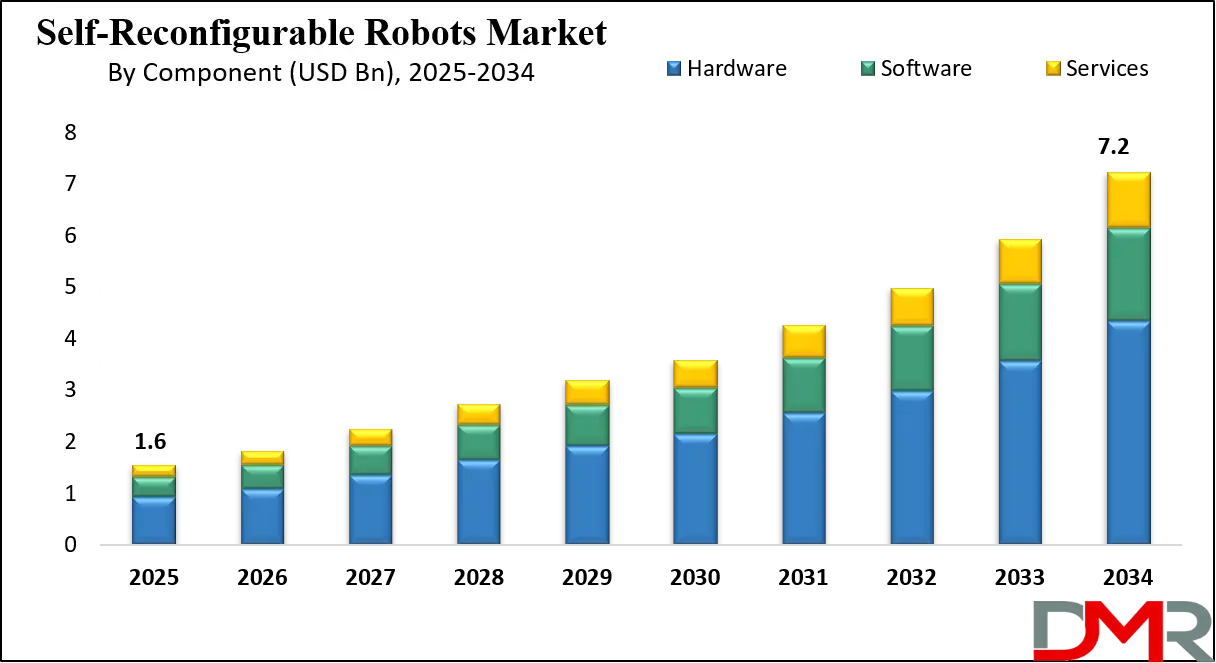
The global self-reconfigurable robots market was valued at USD 1.6 billion in 2025 and is projected to reach USD 7.2 billion by 2034, expanding at a CAGR of 18.7%, driven by rising adoption of modular robotics adaptive robotic systems and intelligent automation across industrial defense and research applications.
Self-reconfigurable robots are advanced robotic systems designed to autonomously or semi autonomously change their physical structure shape or functional configuration in response to task requirements environmental conditions or operational constraints. These robots are typically built using modular robotic units that can connect disconnect and rearrange themselves to form different morphologies enabling adaptability flexibility and fault tolerance. By integrating sensors actuators control algorithms and intelligent software architectures self-reconfigurable robots can optimize performance across diverse applications such as navigation manipulation load handling and exploration. Their ability to self-adapt makes them suitable for dynamic and unpredictable environments where conventional fixed structure robots face limitations.
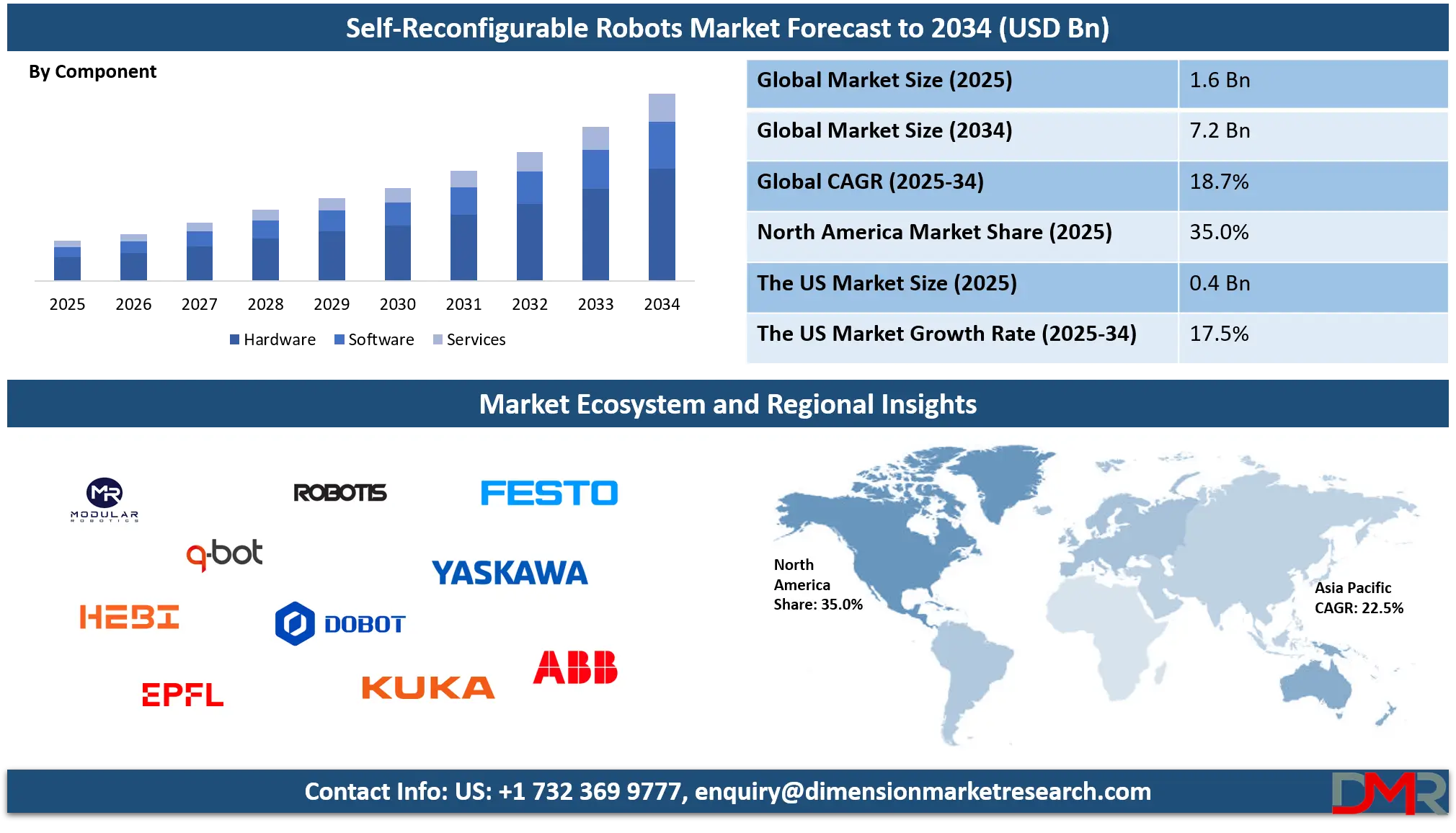
The global self-reconfigurable robots market represents the commercial and research driven ecosystem focused on the development deployment and advancement of modular robotic systems capable of physical and functional reconfiguration. This market is shaped by increasing demand for flexible automation intelligent robotics and adaptive machines across industries including manufacturing aerospace defense healthcare and academic research. Advancements in artificial intelligence machine learning embedded systems and robotic control software are accelerating the transition of self-reconfigurable robots from experimental prototypes to practical real world solutions. Growing investments in robotics research smart factories and autonomous systems are further supporting market expansion at a global level.
Additionally the global self-reconfigurable robots market is influenced by the rising need for scalable robotic platforms that can reduce downtime improve operational efficiency and adapt to multiple use cases without extensive hardware replacement. Industries are increasingly adopting modular robotics to address challenges such as customization variability and complex operational environments. Emerging applications in space exploration disaster response and next generation logistics are also contributing to market growth. As technology matures and production costs gradually decline the market is expected to witness broader adoption across both industrial and non-industrial sectors worldwide.
The US Self-Reconfigurable Robots Market
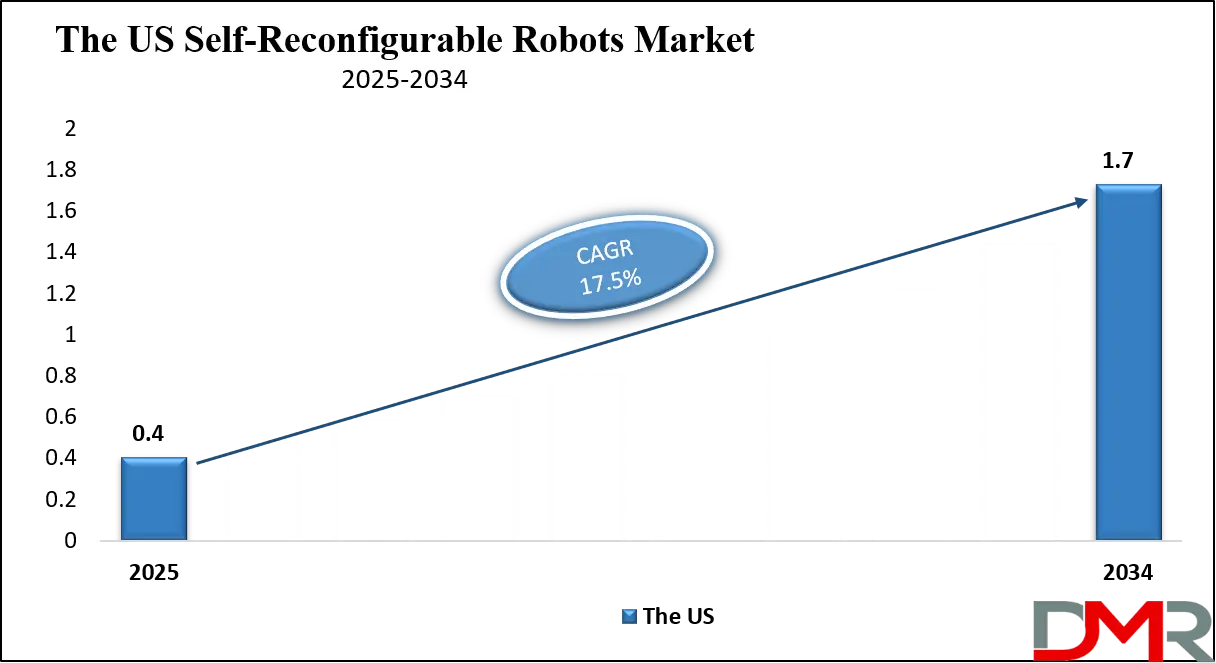
The U.S. Self-Reconfigurable Robots market size was valued at USD 0.4 billion in 2025. It is further expected to witness subsequent growth in the upcoming period, holding USD 1.7 billion in 2034 at a CAGR of 17.5%.
The US self-reconfigurable robots market is witnessing steady growth driven by strong investments in advanced robotics research autonomous systems and intelligent manufacturing technologies. The country has a well-established ecosystem of robotics developers defense contractors and academic institutions that actively contribute to the development of modular robotic systems and adaptive robotic platforms.
Increasing adoption of flexible automation in manufacturing facilities coupled with rising demand for intelligent robots capable of operating in dynamic environments is supporting market expansion. The presence of leading robotics companies and government backed research programs focused on artificial intelligence machine learning and robotic control systems further strengthens the market outlook in the United States.
Moreover the US market is benefiting from growing applications of self-reconfigurable robots in defense aerospace healthcare and space exploration activities. Defense agencies are leveraging reconfigurable robotic systems for surveillance reconnaissance and mission critical operations where adaptability and resilience are essential.
In healthcare and research settings modular robots are increasingly used for rehabilitation training simulation and experimental robotics development. Advancements in sensor integration embedded software and cloud connected robotic architectures are enhancing system performance and scalability. As industries continue to prioritize automation efficiency and operational flexibility the US self-reconfigurable robots market is expected to maintain strong growth momentum over the forecast period.
Europe Self-Reconfigurable Robots Market
The Europe self‑reconfigurable robots market was valued at approximately USD 35.0 million in 2025, driven by growing adoption of modular and adaptive robotic systems across industrial automation, aerospace, defense, and research sectors. European manufacturers are increasingly investing in smart factories and flexible production technologies, where self‑reconfigurable robots provide the ability to rapidly reconfigure for multiple tasks, optimize workflows, and improve operational efficiency. Strong support from government initiatives, robotics research programs, and innovation centers is further encouraging the deployment of advanced robotic solutions across the region.
In addition, Europe’s focus on Industry 4.0 and advanced manufacturing practices is fueling demand for intelligent robotic platforms that integrate artificial intelligence, sensor technologies, and embedded control systems. The presence of leading robotics technology providers and academic collaborations is accelerating the development of scalable and fault-tolerant modular systems suitable for complex applications. As manufacturers seek to enhance productivity, reduce downtime, and implement adaptive automation, the market is expected to maintain steady growth with a CAGR of 15.8%, reflecting Europe’s position as a key regional player in the global self‑reconfigurable robots market.
Japan Self-Reconfigurable Robots Market
The Japan self‑reconfigurable robots market was valued at approximately USD 22.0 million in 2025, driven by the country’s strong focus on robotics innovation, industrial automation, and intelligent manufacturing technologies. Japanese manufacturers are increasingly adopting modular and adaptive robotic systems to enhance production flexibility, optimize assembly processes, and improve operational efficiency across automotive, electronics, and industrial sectors. Government support for advanced robotics research, coupled with substantial investments in smart factory initiatives, is further fueling the deployment of self‑reconfigurable robots in both commercial and research applications.
In addition, Japan’s emphasis on integrating artificial intelligence, machine learning, and sensor-driven control into robotic systems is enabling the development of highly autonomous and adaptive platforms. These technologies allow robots to dynamically reconfigure for varying tasks, navigate complex environments, and maintain high precision and reliability. The growing demand for flexible automation solutions in manufacturing, healthcare, and research institutions is expected to sustain robust market growth at a CAGR of 18.9%, positioning Japan as one of the fastest-growing regional markets in the global self‑reconfigurable robots industry.
Global Self-Reconfigurable Robots Market: Key Takeaways
- Rapid Market Expansion: The global self-reconfigurable robots market is set to grow from USD 1.6 billion in 2025 to USD 7.2 billion by 2034, reflecting strong adoption of modular, adaptive, and intelligent robotic systems across industrial, defense, and research sectors.
- Dominance of Modular and Semi-Autonomous Systems: Homogeneous modular robots and semi-autonomous platforms lead the market, offering flexibility, fault tolerance, and reduced operational complexity, making them ideal for industrial automation and dynamic environments.
- Regional Leaders and Growth Hubs: Asia Pacific leads with 35% of global revenue, driven by China, Japan, and South Korea, while North America shows high growth potential due to advanced R&D, defense applications, and smart manufacturing adoption.
- AI as a Core Enabler: Artificial intelligence and machine learning are central to enhancing autonomy, self-reconfiguration, predictive performance, and human-robot collaboration, significantly improving operational efficiency across sectors.
- Expanding Applications across Industries: Self-reconfigurable robots are increasingly used in industrial manufacturing, defense, healthcare, space exploration, and research, highlighting their versatility and the growing demand for flexible, adaptive robotic solutions globally.
Global Self-Reconfigurable Robots Market: Use Cases
- Industrial Automation and Manufacturing: Self-Reconfigurable robots are used in flexible manufacturing to adapt quickly to changing production tasks. Modular robotic systems enable easy reconfiguration for assembly material handling and inspection improving efficiency and reducing downtime in smart factory environments.
- Defense and Security: In defense applications these robots support surveillance reconnaissance and hazardous missions. Their adaptive robotic structures allow operation in complex terrains while maintaining reliability through modular and fault tolerant design.
- Space Exploration: Self-Reconfigurable robots are deployed in space missions for exploration repair and assembly tasks. Modular robotics helps manage varying terrain and mission needs in planetary exploration and satellite servicing.
- Healthcare and Research: In healthcare and research settings these robots are used for rehabilitation training and experimental studies. Reconfigurable robotic platforms support customized therapy and advanced medical robotics development.
Impact of Artificial Intelligence on the global Self-Reconfigurable Robots market
Artificial intelligence has a significant impact on the global self-reconfigurable robots market by enhancing adaptability, autonomy and performance of modular robotic systems. AI-powered perception and decision-making algorithms enable robots to analyze sensory data, identify optimal configurations and reassign modules dynamically based on real-time task requirements. This improves operational efficiency and allows self-reconfigurable robots to function with minimal human intervention in complex environments. Integration of machine learning and intelligent control software also accelerates system learning enabling robots to predict effective reconfiguration strategies from past experiences and improve performance over time.
Moreover AI facilitates seamless collaboration between self-reconfigurable robots and other automated systems within industrial, defense and research applications. Natural language processing and cognitive computing enable intuitive human-robot interaction while computer vision and sensor fusion enhance environment awareness and autonomous navigation.
In manufacturing settings AI enables predictive maintenance and real-time optimization of robotic operations, reducing downtime and improving throughput. In sectors such as healthcare and space exploration artificial intelligence enhances precision adaptability and decision support, making self-reconfigurable robots more reliable and versatile for diverse use cases.
Global Self-Reconfigurable Robots Market: Stats & Facts
International Federation of Robotics (IFR)
- Global installations of industrial robots reached 541,302 units in 2023.
- Global operational stock of industrial robots was 4,281,585 units by end of 2023, marking a 10% YoY increase.
- A record 542,000 robots were installed in 2024, sustaining high deployment levels.
- The total number of industrial robots in operation worldwide in 2024 was 4,664,000 units, up 9% from 2023.
- Asia accounted for 74% of new robot installations in 2024.
- Europe accounted for 16% of robot deployments in 2024.
- The Americas accounted for 9% of global robot installations in 2024.
- China represented 54% of global industrial robot deployments in 2024.
- Industrial robot installations in Europe were 85,000 units in 2024 (second highest in history).
- 80% of European robot installations in 2024 took place within the EU.
- Germany saw 26,982 robot installations in 2024, maintaining leadership in Europe.
- Japan installed 44,500 robots in 2024, holding second place globally.
- India recorded 9,100 robot installations in 2024, marking growth.
- Global robot density reached 162 robots per 10,000 manufacturing employees in 2023, more than double from seven years prior.
- European Union’s robot density was 219 units per 10,000 workers in 2023.
- North America’s robot density was 197 units per 10,000 workers in 2023.
- Asia’s robot density stood at 182 units per 10,000 workers in 2023.
- South Korea led in robot density at 1,012 robots per 10,000 employees in 2023.
- In 2023, 70% of new industrial robot installations globally occurred in Asia.
- 92,393 industrial robots were installed in Europe in 2023, up 9% YoY.
- The United States accounted for 68% of robot installations in the Americas in 2023.
- Japan had 435,299 industrial robots operating in 2023, a 5% increase YoY.
- Robot installations in Europe in 2023 represented around 17% of global new deployments.
- Global industrial robot installations remained above 500,000 units for multiple consecutive years (2022–2024).
Government & Multilateral Program Data (via IFR aggregated)
- European Commission allocated USD 183.5 million for robotics research under its 2023–2025 work program.
- Horizon Europe framework budget (2021–2027) includes USD 100 billion for research, innovation, and robotics competitiveness.
- Germany’s national robotics and automation R&D programs receive significant budget support, enhancing industrial leadership in robotics.
- Japan maintains one of the highest operational stocks of industrial robots globally, reflecting sustained governmental emphasis on automation.
- Robot deployment growth in factories directly supports productivity and competitiveness policies in OECD economies, according to government analytics.
- Official data show that robot installations in the Americas have exceeded 50,000 units annually, illustrating continued automation momentum.
Global Self-Reconfigurable Robots Market: Market Dynamics
Global Self-Reconfigurable Robots Market: Driving Factors
Rising Demand for Flexible and Adaptive Automation
The growing need for flexible automation across manufacturing defense and research sectors is a key driver of the self-reconfigurable robots market. Modular robotic systems enable rapid adaptation to changing tasks production volumes and operational conditions without requiring complete system replacement. Integration of intelligent robotics artificial intelligence and adaptive control software allows these robots to improve efficiency reduce operational costs and support smart manufacturing initiatives globally.
Advancements in Artificial Intelligence and Robotics Technologies
Continuous advancements in artificial intelligence machine learning sensors and embedded systems are accelerating the development of self-reconfigurable robots. AI powered decision making enables dynamic configuration autonomous navigation and real time optimization of robotic structures. Improvements in robotic software platforms and connectivity are enhancing system reliability scalability and commercial viability across multiple industries.
Global Self-Reconfigurable Robots Market: Restraints
High Development and Integration Costs
The design and deployment of self-reconfigurable robots involve high initial costs due to complex hardware architectures advanced control algorithms and specialized modular components. Integration with existing automation systems also requires skilled expertise and customized solutions which can limit adoption especially among small and medium enterprises.
Technical Complexity and Standardization Challenges
Self-Reconfigurable robotic systems face challenges related to system complexity interoperability and lack of standardized modular interfaces. Ensuring reliable communication coordination and mechanical compatibility between modules increases development time and operational risk particularly in mission critical applications.
Global Self-Reconfigurable Robots Market: Opportunities
Growing Applications in Space and Defense Robotics
Expanding investments in space exploration and defense modernization programs present significant opportunities for the self-reconfigurable robots market. Adaptive robotic platforms are well suited for unpredictable environments planetary missions and surveillance operations where flexibility and resilience are essential. These sectors continue to drive demand for autonomous and modular robotics solutions.
Emergence of Smart Healthcare and Rehabilitation Robotics
The increasing focus on advanced healthcare technologies creates opportunities for self-reconfigurable robots in rehabilitation therapy medical training and assistive robotics. Modular robotic designs allow customization for patient specific needs while intelligent robotic control improves precision and safety in clinical environments.
Global Self-Reconfigurable Robots Market: Trends
Integration of AI Driven Autonomous Reconfiguration
A major trend in the market is the integration of AI driven autonomous reconfiguration capabilities. Machine learning algorithms enable robots to self-assess performance predict optimal configurations and adapt without human intervention. This trend is enhancing the autonomy and scalability of modular robotic systems across industries.
Shift toward Multi-Purpose Modular Robotic Platforms
Manufacturers are increasingly developing multi-purpose self-reconfigurable robots that can perform diverse tasks using a single modular platform. This trend supports cost efficiency extended lifecycle usage and broader adoption in industrial automation research institutions and defense applications worldwide.
Global Self-Reconfigurable Robots Market: Research Scope and Analysis
By Robot Type Analysis
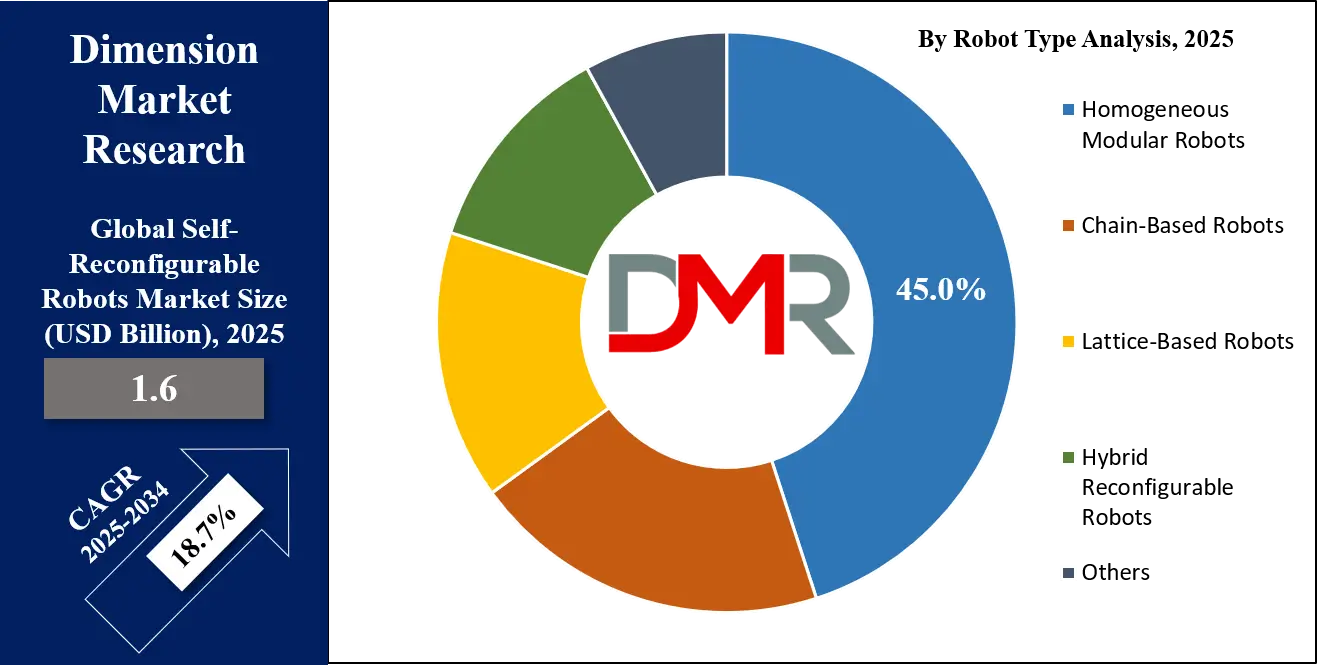
Homogeneous modular robots are anticipated to dominate the robot type segment by capturing around 45.0% of the total market share in 2025 due to their uniform structure simplicity and high scalability. These robots are composed of identical modules that can easily connect disconnect and rearrange to form different configurations based on task requirements. Their standardized design reduces manufacturing complexity lowers maintenance costs and improves system reliability making them highly suitable for industrial automation research laboratories and defense applications.
The ability to replace or add modules without disrupting overall system performance enhances fault tolerance and operational continuity. Integration with artificial intelligence adaptive control algorithms and sensor based feedback further strengthens their dominance by enabling efficient self-reconfiguration and autonomous decision making across dynamic environments.
Chain based robots also hold a significant position within the robot type segment as they offer high flexibility and mobility through serially connected modular units. These robots are particularly effective in applications requiring articulated movement navigation through confined spaces and continuous shape transformation. Chain based self-reconfigurable robots are widely used in exploration surveillance and inspection tasks where adaptability to uneven terrain or complex structures is critical.
Their ability to bend extend and reorient allows improved maneuverability compared to rigid configurations. Although they face challenges related to mechanical stability and control complexity ongoing advancements in robotic control software and actuator technology are enhancing their performance and supporting steady adoption within this market segment.
By Component Analysis
Hardware is anticipated to dominate the component segment by capturing around 60.0% of the total market share in 2025, primarily due to the high cost and critical importance of physical robotic components in self-reconfigurable systems. This includes modular units actuators sensors connectors power systems and structural elements that enable physical transformation and movement.
The complexity of designing durable and precise hardware capable of repeated reconfiguration significantly contributes to its larger revenue share. Growing demand for robust modular robotic platforms in industrial automation defense and research applications continues to drive investment in advanced hardware solutions that offer reliability scalability and fault tolerance in dynamic operating environments.
Software also plays a vital role in the component segment as it governs the intelligence coordination and adaptability of self-reconfigurable robots. Advanced robotic software platforms enable configuration planning motion control sensor integration and real time decision making. The increasing use of artificial intelligence machine learning and simulation tools is enhancing the capability of software to optimize reconfiguration strategies and system performance. While software accounts for a smaller share compared to hardware its importance is rapidly increasing as industries seek higher autonomy predictive capabilities and seamless integration with digital manufacturing and autonomous systems.
By Level of Autonomy Analysis
Semi autonomous robots are anticipated to dominate the level of autonomy segment by capturing around 70.0% of the total market share in 2025 due to their balanced combination of human oversight and intelligent automation. These systems allow operators to guide high level decisions while the robot manages reconfiguration movement and task execution through embedded control software and sensor based feedback. This approach reduces operational risk improves reliability and lowers implementation complexity making semi autonomous self-reconfigurable robots highly suitable for industrial automation defense operations and research environments. Their ability to integrate with existing workflows while offering adaptive robotic capabilities is a key factor supporting widespread adoption.
Fully autonomous robots represent a growing but smaller portion of the market as they rely heavily on advanced artificial intelligence machine learning and real time decision making systems. These robots are designed to independently assess environments select optimal configurations and execute tasks without human intervention. While they offer high efficiency and long term operational advantages challenges related to system validation safety compliance and development cost currently limit large scale deployment. However continuous advancements in autonomous robotics cognitive computing and intelligent control architectures are steadily improving performance and are expected to drive increased adoption over the forecast period.
By Application Analysis
Industrial automation and manufacturing are anticipated to dominate the application segment by capturing around 30.0% of the total market share in 2025 as industries increasingly adopt flexible and adaptive robotic systems to support dynamic production environments. Self-Reconfigurable robots enable manufacturers to quickly modify robotic layouts for different assembly processes material handling tasks and inspection requirements without extensive downtime. Their modular robotic design supports mass customization smart factories and Industry 4.0 initiatives by improving operational efficiency reducing labor dependency and enhancing production scalability. Integration with artificial intelligence sensor technologies and advanced control software further strengthens their role in modern manufacturing operations.
Education and research also represent an important application area within the self-reconfigurable robots market as universities laboratories and innovation centers use these systems for experimentation algorithm development and robotics training. Modular robotic platforms provide an ideal environment for studying adaptive behavior autonomous control and reconfiguration strategies. They are widely used in robotics education to demonstrate principles of distributed systems artificial intelligence and mechanical design. Continued investment in academic research and government funded robotics programs is supporting steady adoption of self-reconfigurable robots within this segment.
By End-User Industry Analysis
Aerospace and defense are anticipated to dominate the end-user industry segment by capturing around 35.0% of the total market share in 2025 due to the high demand for adaptive and resilient robotic systems in mission critical operations. Self-Reconfigurable robots are increasingly used for surveillance, reconnaissance, unmanned vehicle support, and maintenance tasks in challenging and unpredictable environments. Their modular design allows quick adaptation to different mission requirements, enhances operational reliability, and ensures continuity even if individual modules fail. Integration with advanced sensors, artificial intelligence, and autonomous control systems further strengthens their effectiveness in defense operations and aerospace applications, driving significant adoption in this segment.
Manufacturing and industrial sectors also hold a substantial share within the end-user market as companies adopt self-reconfigurable robots for flexible automation and smart production processes. These robots support assembly, material handling, quality inspection, and packaging operations while allowing quick reconfiguration to accommodate varying product lines and production volumes. By leveraging modular design, embedded control software, and AI-driven optimization, manufacturers can reduce downtime, improve efficiency, and implement scalable automation solutions. The increasing push for Industry 4.0 and adaptive manufacturing practices is further boosting demand in this segment.
The Self-Reconfigurable Robots Market Report is segmented on the basis of the following:
By Robot Type
- Homogeneous Modular Robots
- Chain-Based Robots
- Lattice-Based Robots
- Hybrid Reconfigurable Robots
- Others
By Component
- Hardware
- Software
- Services
By Level of Autonomy
- Semi-Autonomous Robots
- Fully Autonomous Robots
By Application
- Industrial Automation & Manufacturing
- Education & Research
- Defense & Security
- Space Exploration
- Healthcare & Medical Robotics
- Others
By End-User Industry
- Aerospace & Defense
- Manufacturing & Industrial
- Academic & Research Institutions
- Healthcare
- Others
Global Self-Reconfigurable Robots Market: Regional Analysis
Region with the Largest Revenue Share
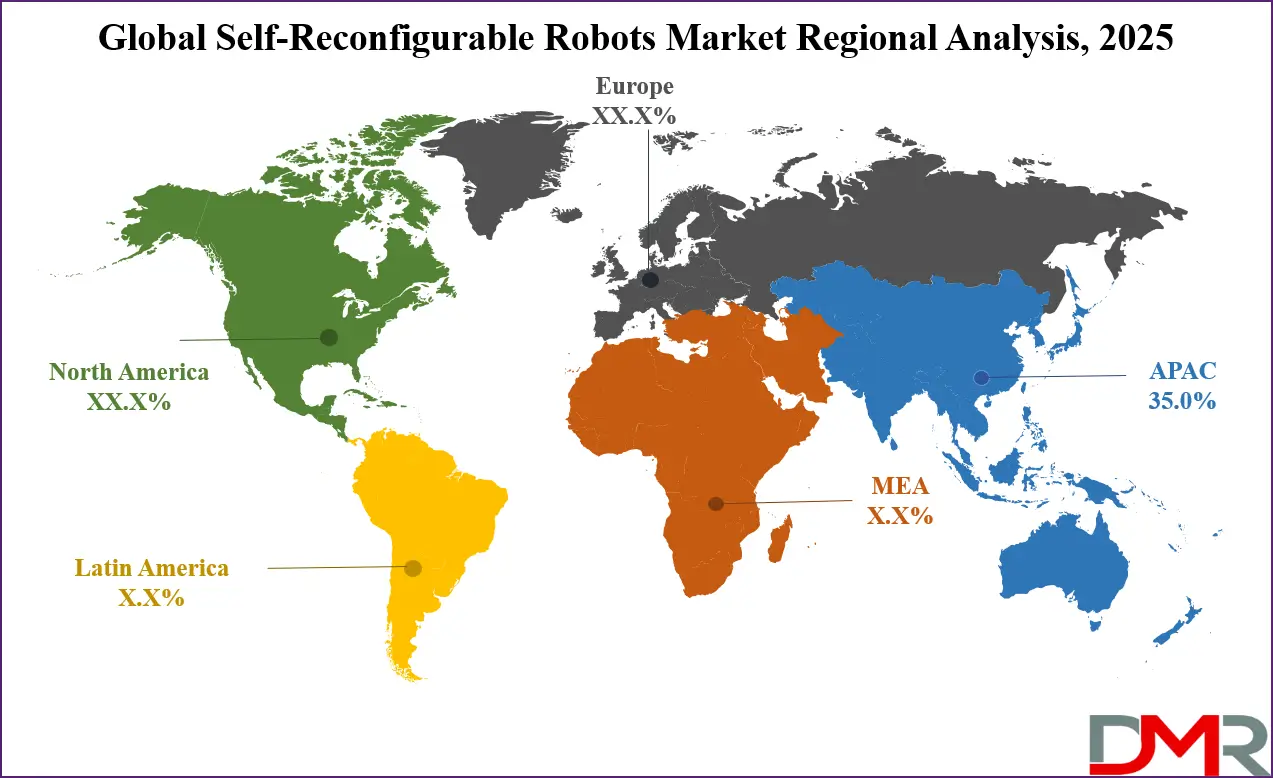
Asia Pacific is anticipated to lead the global self-reconfigurable robots market with around 35.0% of total revenue in 2025, driven by rapid industrialization, growing adoption of smart manufacturing, and significant investments in robotics research and development. Countries such as China, Japan, and South Korea are emerging as key hubs for modular and adaptive robotic systems, supported by government initiatives and strong industrial automation infrastructure. The region’s focus on flexible production, advanced manufacturing technologies, and integration of artificial intelligence and sensor based control systems is fueling demand for self-reconfigurable robots across manufacturing, defense, research, and logistics applications, making Asia Pacific the dominant regional market.
Region with significant growth
North America is expected to witness significant growth in the self-reconfigurable robots market over the forecast period due to increasing investments in advanced robotics research, autonomous systems, and smart manufacturing technologies. The presence of leading robotics companies, defense contractors, and research institutions is driving the development and adoption of modular and adaptive robotic platforms. Growing applications in defense operations, healthcare, and industrial automation, combined with advancements in artificial intelligence, machine learning, and intelligent control systems, are fueling demand. Supportive government initiatives and a focus on innovation in autonomous and flexible robotics are further accelerating market expansion in the region.
By Region
North America
Europe
- Germany
- The U.K.
- France
- Italy
- Russia
- Spain
- Benelux
- Nordic
- Rest of Europe
Asia-Pacific
- China
- Japan
- South Korea
- India
- ANZ
- ASEAN
- Rest of Asia-Pacific
Latin America
- Brazil
- Mexico
- Argentina
- Colombia
- Rest of Latin America
Middle East & Africa
- Saudi Arabia
- UAE
- South Africa
- Israel
- Egypt
- Rest of MEA
Global Self-Reconfigurable Robots Market: Competitive Landscape
The competitive landscape of the global self-reconfigurable robots market is characterized by intense innovation, continuous technological advancement, and strategic collaborations across industry participants. Market players are increasingly focusing on research and development to enhance modular robotic architectures, intelligent control systems, and adaptive autonomy capabilities to meet diverse application requirements across industrial, defense, healthcare, and research sectors.
Strategic initiatives such as partnerships, product enhancements, and integration of artificial intelligence and machine learning are strengthening competitive positioning and enabling faster deployment of advanced robotic solutions worldwide. The market also sees a shift toward scalable and cost effective modular platforms, fostering broader adoption and differentiation among solution providers in this dynamic environment.
Some of the prominent players in the global Self-Reconfigurable Robots market are:
- Modular Robotics Inc.
- Q-Bot Ltd.
- HEBI Robotics
- Roombots (EPFL)
- Robotis Co., Ltd.
- Shenzhen Yuejiang Technology Co., Ltd. (DOBOT)
- Festo AG & Co. KG
- Yaskawa Electric Corporation
- KUKA AG
- ABB Ltd.
- Universal Robots A/S
- Boston Dynamics
- Neurala Inc.
- Moley Robotics
- PAL Robotics
- Shadow Robot Company
- Mitsubishi Electric Corporation
- FANUC Corporation
- Omron Corporation
- Hirose Fukushima Robotics Laboratory
- Other Key Players
Global Self-Reconfigurable Robots Market: Recent Developments
- January 2026: Boston Dynamics unveiled the production‑ready version of its humanoid robot Atlas at a major tech event, showcasing advanced mobility, industrial task capability, and AI‑enabled adaptability that signal a shift toward widespread commercial deployment of embodied intelligent robotics.
- January 2026: Mobileye agreed to acquire a humanoid robotics startup in a strategic move to expand its embodied AI and automation capabilities, highlighting consolidation trends in robotics and adaptive machine intelligence.
- December 2025: Dexterity introduced Mech, an AI‑powered industrial super‑humanoid robot designed for autonomous logistics and manufacturing tasks, using onboard AI models for complex manipulation and navigation across warehouse environments.
- December 2025: A European cognitive robotics firm expanded its portfolio by acquiring a company focused on autonomous guided vehicles, integrating intelligent logistics solutions into its modular robotics ecosystem.
Report Details
| Report Characteristics |
| Market Size (2025) |
USD 1.6 Bn |
| Forecast Value (2034) |
USD 7.2 Bn |
| CAGR (2025–2034) |
18.7% |
| The US Market Size (2025) |
USD 0.4 Bn |
| Historical Data |
2019 – 2024 |
| Forecast Data |
2026 – 2034 |
| Base Year |
2024 |
| Estimate Year |
2025 |
| Report Coverage |
Market Revenue Estimation, Market Dynamics, Competitive Landscape, Growth Factors, etc. |
| Segments Covered |
By Robot Type (Homogeneous Modular Robots, Chain-Based Robots, Lattice-Based Robots, Hybrid Reconfigurable Robots, Others), By Component (Hardware, Software, Services), By Level of Autonomy (Semi-Autonomous Robots, Fully Autonomous Robots), By Application (Industrial Automation & Manufacturing, Education & Research, Defense & Security, Space Exploration, Healthcare & Medical Robotics, Others), By End-User Industry (Aerospace & Defense, Manufacturing & Industrial, Academic & Research Institutions, Healthcare, Others)
|
| Regional Coverage |
North America – US, Canada; Europe – Germany, UK, France, Russia, Spain, Italy, Benelux, Nordic, Rest of Europe; Asia-Pacific – China, Japan, South Korea, India, ANZ, ASEAN, Rest of APAC; Latin America – Brazil, Mexico, Argentina, Colombia, Rest of Latin America; Middle East & Africa – Saudi Arabia, UAE, South Africa, Turkey, Egypt, Israel, Rest of MEA |
| Prominent Players |
Modular Robotics Inc., Q-Bot Ltd., HEBI Robotics, Roombots (EPFL), Robotis Co., Ltd., Shenzhen Yuejiang Technology Co., Ltd. (DOBOT), Festo AG & Co. KG, Yaskawa Electric Corporation, and Others.
|
| Purchase Options |
We have three licenses to opt for: Single User License (Limited to 1 user), Multi-User License (Up to 5 Users), and Corporate Use License (Unlimited User) along with free report customization equivalent to 0 analyst working days, 3 analysts working days, and 5 analysts working days respectively. |
Frequently Asked Questions
The global Self-Reconfigurable Robots market size was valued at USD 1.6 billion in 2025 and is expected to reach USD 7.2 billion by the end of 2034.
The US Self-Reconfigurable Robots market was valued at USD 0.4 billion in 2025. It is expected to witness subsequent growth in the upcoming period as it holds USD 1.7 billion in 2034 at a CAGR of 17.5%.
Asia Pacific is expected to have the largest market share in the global Self-Reconfigurable Robots market, with a share of about 35.0% in 2025.
Some of the major key players in the global Self-Reconfigurable Robots market are Modular Robotics Inc., Q-Bot Ltd., HEBI Robotics, Roombots (EPFL), Robotis Co., Ltd., Shenzhen Yuejiang Technology Co., Ltd. (DOBOT), Festo AG & Co. KG, Yaskawa Electric Corporation, and Others.