Global Shadow AI Market Snapshot
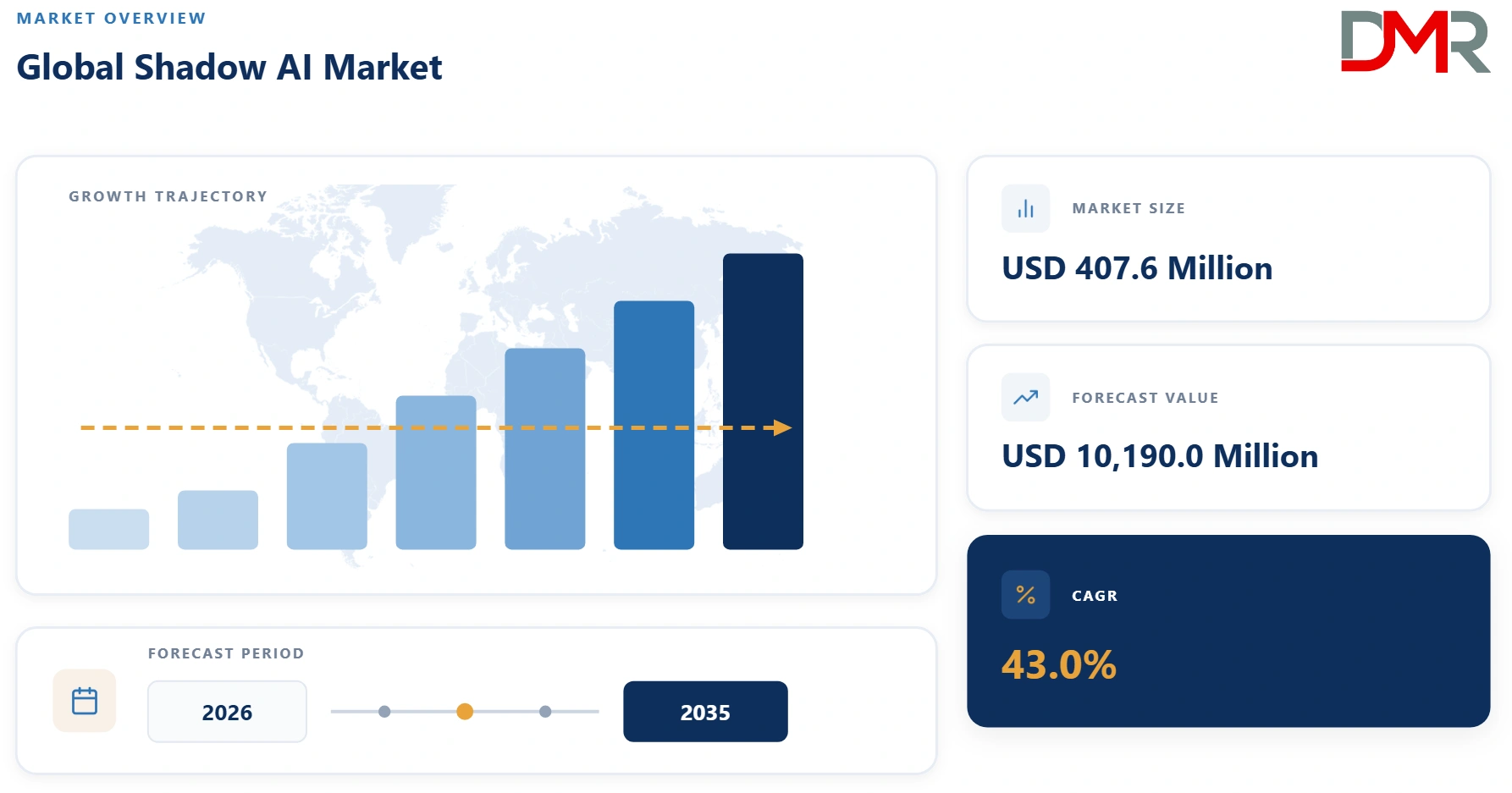
- Global Shadow AI Market Size in 2026: USD 407.6 Million
- Global Shadow AI Market Size in 2035: USD 10,190.0 Million
- Global CAGR from 2026 to 2035: 43.0%
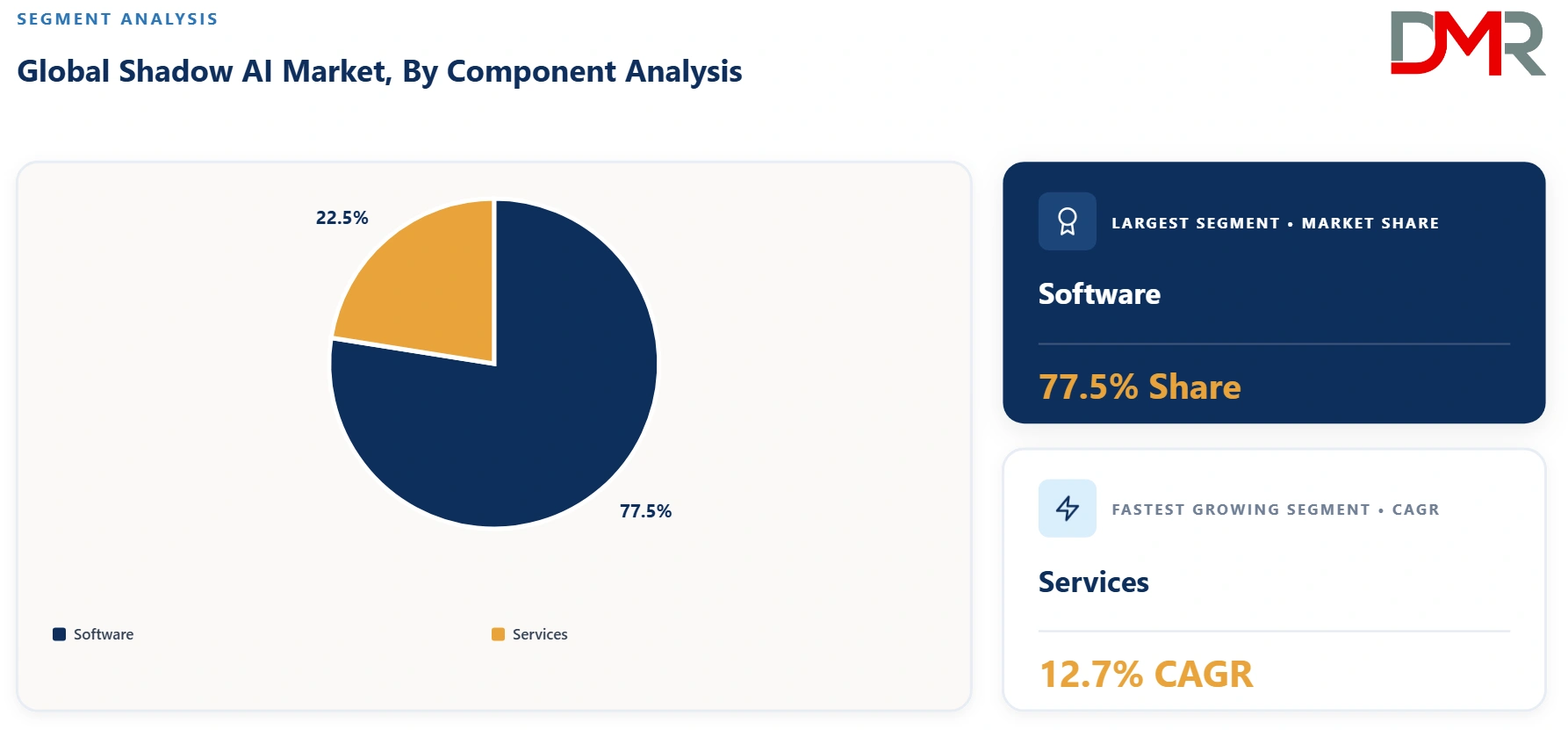
- Software is the leading component segment in 2026: 77.5%
- Cloud is the leading deployment mode segment in 2026: 67.2%
- Large Enterprises is the leading organization size segment in 2026: 61.3%
- Risk Management is the leading application segment in 2026: 31.8%
- BFSI is the leading end-user industry segment in 2026: 25.2%
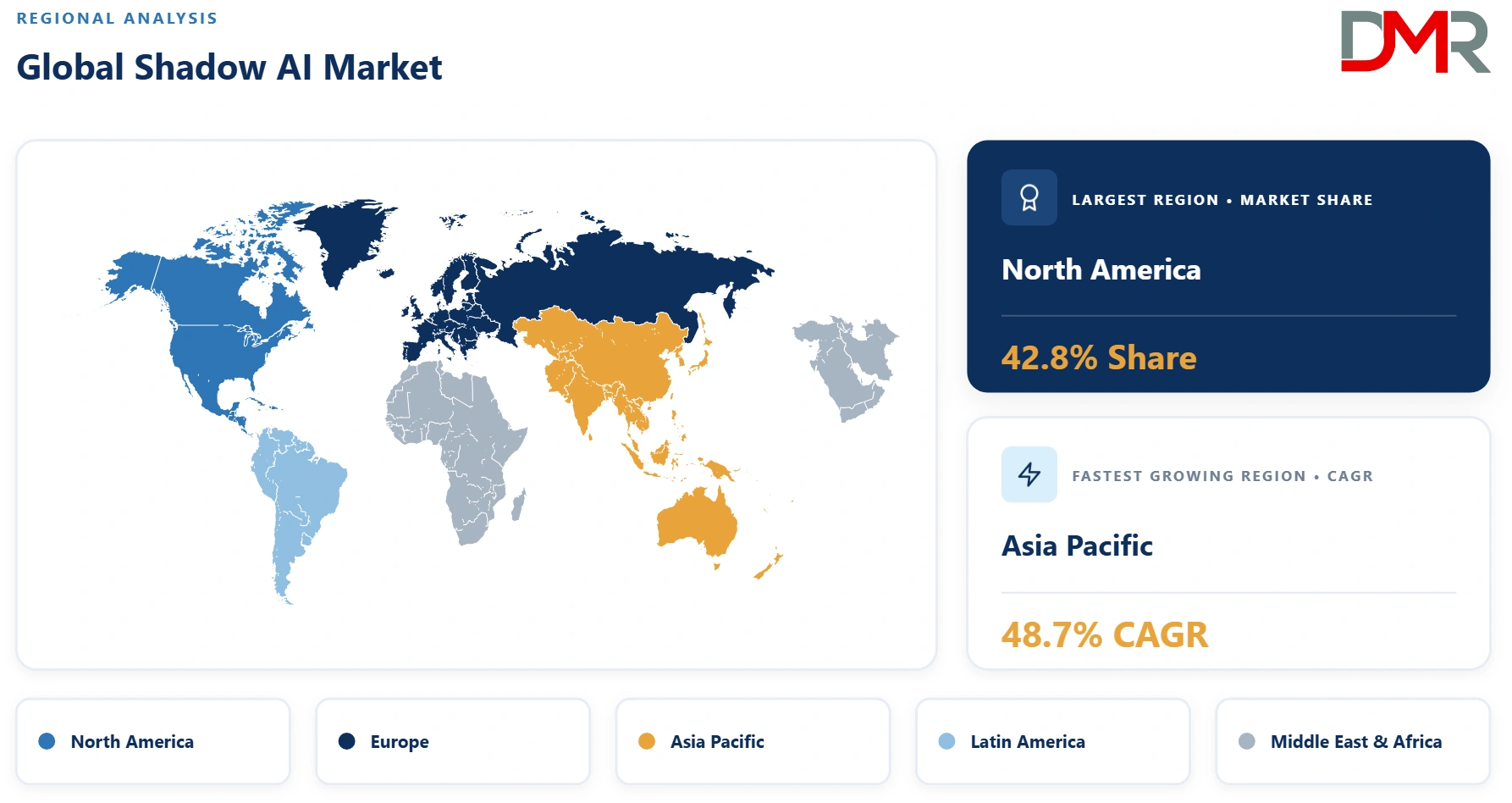
- North America is the leading region in 2026: 42.8%
- Asia-Pacific is expected to record the highest regional CAGR from 2026 to 2035: 48.7%
What is the Global Shadow AI Market and its Market Size?
The Global Shadow AI Market is projected to be valued at USD 407.6 million in 2026 and is anticipated to reach USD 10,190.0 Million by 2035, expanding at a CAGR of 43.0% during 2026-2035. Shadow AI refers to the unauthorized, unmanaged, or insufficiently governed adoption and use of artificial intelligence applications, generative AI tools, AI copilots, machine learning platforms, large language models, autonomous agents, and AI-enabled software within organizations without complete oversight from IT, cybersecurity, risk, legal, privacy, or compliance teams.
ℹ
To learn more about this report –
Download Your Free Sample Report Here
Rapid enterprise adoption of generative AI is creating significant visibility and governance challenges. Employees increasingly use publicly available AI platforms, coding assistants, browser extensions, AI-powered SaaS applications, personal AI accounts, and autonomous tools to accelerate everyday tasks. While these applications can improve productivity, unmanaged usage can expose confidential information, intellectual property, customer records, source code, financial data, healthcare information, credentials, and other sensitive enterprise assets.
Use Cases
- Shadow AI Discovery and Visibility: Enterprises detect unauthorized generative AI applications, personal AI accounts, embedded AI features, AI agents, and unapproved model interfaces being accessed across endpoints, browsers, networks, SaaS platforms, and cloud environments.
- Sensitive Data Protection: Security teams inspect prompts, files, uploads, AI-generated responses, API transactions, and user interactions to prevent confidential business information, intellectual property, personally identifiable information, healthcare data, and financial information from entering unauthorized AI platforms.
- AI Governance and Compliance: Organizations create centralized inventories of approved and unapproved AI systems, establish AI usage policies, perform risk classifications, maintain audit trails, assign ownership, and demonstrate compliance with emerging artificial intelligence regulations.
- AI Risk Management: Enterprises evaluate AI tools based on model ownership, data retention policies, training practices, third-party integrations, authentication, encryption, data residency, privacy risk, cybersecurity exposure, and regulatory implications.
Key Takeaways
- Market Size: The Global Shadow AI Market is projected to reach USD 407.6 million in 2026 and USD 10,190.0 Million by 2035, growing at a CAGR of 43.0%.
- Growth Outlook: Rapid enterprise adoption of generative AI, autonomous agents, AI copilots, embedded AI applications, and cloud-based AI platforms is creating strong demand for Shadow AI discovery, governance, security, compliance, and data protection solutions.
- By Component: Software is projected to dominate with 77.5% share in 2026, while Services are expected to exhibit the highest CAGR of 12.7% during 2026-2035.
- By Deployment Mode: Cloud is expected to lead with 67.2% share in 2026 and is projected to record the highest CAGR of 14.2% during 2026-2035.
- By Organization Size: Large Enterprises are expected to dominate with 61.3% share in 2026, while SMEs are projected to grow at the highest CAGR of 14.9% during 2026-2035.
- By Application: Risk Management is projected to hold 31.8% share in 2026, while Data Security and Privacy Management is expected to record the highest CAGR of 15.6% during 2026-2035.
- By End-User Industry: BFSI is projected to dominate with 25.2% share in 2026, while Healthcare is expected to register the highest CAGR of 15.6% during 2026-2035.
- Regional Analysis: North America is projected to lead with 42.8% share in 2026, equivalent to USD 174.5 million, while Asia-Pacific is expected to register the fastest CAGR of 48.7% during 2026-2035.
How AI and GenAI are Transforming the Global Shadow AI Market?
Artificial intelligence and generative AI are simultaneously creating the Shadow AI challenge and enabling organizations to control it. Employees can increasingly access generative AI assistants, AI search tools, coding copilots, content generation platforms, AI-enabled SaaS solutions, autonomous agents, and foundation models without traditional procurement or security approval processes.
AI-powered security platforms are being deployed to automatically identify generative AI applications, classify sanctioned and unsanctioned tools, differentiate corporate and personal accounts, inspect prompts, analyze file uploads, identify sensitive information, and assign dynamic risk scores to AI services.
Machine learning algorithms can continuously analyze employee behavior and application usage to distinguish legitimate productivity activity from potentially risky data transfers. This enables organizations to move from static AI blocking toward context-aware governance based on user identity, application reputation, information sensitivity, business function, and compliance requirements.
Agentic AI is further expanding the Shadow AI landscape because autonomous software agents can interact directly with enterprise applications, APIs, databases, cloud environments, communication platforms, and source code repositories. Organizations are consequently extending governance frameworks beyond human users to machine identities, AI agents, model context protocols, AI APIs, and agent-to-agent interactions.
Key Drivers in the Global Shadow AI Market
Rapid Proliferation of Unauthorized Generative AI Applications
The increasing accessibility of generative AI platforms is one of the most significant drivers of the Global Shadow AI Market. Employees across finance, marketing, software development, human resources, legal, sales, research, healthcare, and customer service increasingly use generative AI to automate repetitive work, summarize documents, generate content, analyze data, develop software, and support decision-making. Many AI tools are adopted independently through personal accounts, browser applications, free subscriptions, developer APIs, and embedded SaaS functions. This limits organizational visibility regarding what AI applications employees use, what information they share, where information is stored, and whether data is retained for model training.
Rising Sensitive Data and Intellectual Property Exposure
Generative AI introduces significant data leakage risks because employees can accidentally transfer confidential documents, source code, customer records, internal strategies, financial information, product designs, research material, credentials, or personally identifiable information into external AI applications. The growing use of public LLM platforms and AI copilots therefore creates an additional enterprise attack surface. Organizations increasingly require prompt-level inspection, file upload controls, sensitive data classification, access governance, user behavior analytics, application risk scoring, and real-time policy enforcement. This requirement is particularly strong across BFSI, healthcare, pharmaceuticals, manufacturing, government, technology, energy, telecommunications, and professional services.
Restraints in the Global Shadow AI Market
Complexity of Detecting Embedded and Local AI Applications
Shadow AI is becoming increasingly difficult to identify because AI capabilities are no longer limited to standalone chatbot platforms. AI functionality is increasingly embedded within SaaS applications, browsers, productivity platforms, cloud applications, developer environments, endpoints, APIs, local models, extensions, and autonomous agents.
Traditional network security tools may therefore fail to identify certain AI interactions, especially when models operate locally or through encrypted application layers. Organizations increasingly require integration across endpoint security, data protection, browser monitoring, cloud security, identity management, API protection, and AI governance systems.
Fragmented Regulatory and Governance Environment
AI regulations, privacy standards, cybersecurity rules, and responsible AI frameworks continue to evolve across countries and industries. Multinational organizations may need different AI policies depending on employee location, information type, application risk, model provider, industry, and jurisdiction. This regulatory fragmentation increases compliance complexity and can delay Shadow AI platform implementation, particularly where governance responsibilities are distributed across IT, cybersecurity, legal, risk, compliance, privacy, and data management departments.
Growth Opportunities in the Global Shadow AI Market
Unified Enterprise AI Security and Governance Platforms
Enterprises are increasingly seeking centralized platforms capable of discovering sanctioned and unsanctioned AI applications, maintaining AI inventories, monitoring prompts, securing AI agents, controlling access permissions, preventing data leakage, evaluating application risk, and managing regulatory compliance. Vendors that integrate AI governance with secure access service edge, cloud access security brokers, data loss prevention, identity security, data security posture management, and AI security posture management are positioned to capture significant market opportunities.
Agentic AI and Machine Identity Governance
The emergence of autonomous AI agents represents a substantial opportunity for Shadow AI security vendors. AI agents increasingly interact with APIs, databases, communication tools, source code repositories, cloud services, enterprise applications, and business workflows. Organizations therefore require capabilities to discover autonomous agents, classify machine identities, control agent permissions, monitor tool execution, maintain activity logs, identify unauthorized agents, and prevent excessive access to confidential enterprise resources.
Trends in the Global Shadow AI Market
Shift from AI Blocking Toward Governed AI Adoption
Organizations are gradually moving away from blanket restrictions on generative AI toward controlled and policy-driven AI adoption. Blocking all public AI applications can reduce productivity and may encourage employees to seek alternative unmonitored platforms. Modern Shadow AI security strategies instead classify applications as approved, tolerated, restricted, or prohibited. Access policies can then be applied based on employee identity, information sensitivity, AI application risk, business requirements, geography, and compliance obligations.
Rise of Shadow Agents and Unmanaged AI Infrastructure
Shadow AI is expanding beyond unauthorized chatbot usage toward unapproved AI agents, AI APIs, private models, developer frameworks, local language models, plugins, and model context protocol servers. This transition is increasing demand for continuous AI asset inventories, machine identity governance, runtime monitoring, AI application discovery, API security, model governance, and controls covering both human-to-AI and AI-to-AI interactions.
Research Scope and Analysis
The Global Shadow AI Market is segmented by component deployment mode organization size application and end user industry Component includes software and services Deployment includes on premises and cloud Organization size includes large enterprises and SMEs Applications include risk management compliance management data security and privacy management IT asset management and others End users include BFSI healthcare IT telecommunications retail government manufacturing energy utilities and others.
ℹ
To learn more about this report –
Download Your Free Sample Report Here
By Component Analysis
Software is projected to dominate the Global Shadow AI Market with 77.5% market share in 2026. Growing enterprise use of AI discovery, AI application inventory management, generative AI monitoring, data loss prevention, risk scoring, policy enforcement, access governance, audit management, and compliance platforms is supporting segment leadership. Software solutions provide continuous visibility into employee interactions with public AI applications, AI agents, embedded generative AI functions, cloud AI services, and enterprise models. Services are expected to register the highest CAGR of 12.7% during 2026-2035, supported by increasing demand for AI governance consulting, implementation, integration, employee training, security assessments, and managed AI security services.
By Deployment Mode
Cloud is projected to dominate the Global Shadow AI Market with 67.2% share in 2026. Cloud-based Shadow AI platforms support scalable deployment, centralized visibility, policy enforcement, distributed workforce protection, real-time application discovery, and integration with SaaS platforms and public generative AI environments. Cloud deployment is also expected to record the highest CAGR of 14.2% during 2026-2035, supported by increasing adoption of cloud-hosted AI models, AI APIs, enterprise copilots, SaaS applications, and autonomous AI agents.
By Organization Size
Large Enterprises are expected to dominate with 61.3% share in 2026. These organizations typically operate complex IT infrastructures with thousands of employees, large SaaS portfolios, multiple cloud environments, sensitive corporate datasets, and extensive regulatory obligations. Small and Medium Enterprises are projected to register the highest CAGR of 14.9% during 2026-2035 as affordable cloud-based AI governance and cybersecurity solutions become increasingly accessible.
By Application
Risk Management is projected to dominate with 31.8% share in 2026. Enterprises are increasingly focused on discovering unauthorized AI usage, identifying risky applications, evaluating third-party AI providers, monitoring employee behavior, assessing cyber exposure, and prioritizing mitigation strategies. Data Security and Privacy Management is expected to register the highest CAGR of 15.6% during 2026-2035, supported by increasing concerns regarding confidential information, personally identifiable information, regulated data, intellectual property, and sensitive prompts being transmitted to external AI platforms.
By End-User Industry
BFSI is projected to dominate with 25.2% market share in 2026. Financial institutions handle sensitive financial, transaction, customer, credit, identity, investment, and payment information and operate within highly regulated environments. Healthcare is expected to register the highest CAGR of 15.6% during 2026-2035, supported by increasing adoption of generative AI across clinical documentation, medical research, pharmaceutical development, patient communication, healthcare analytics, administrative workflows, and decision support.
The Global Shadow AI Market Report is Segmented on the Basis of the Following:
By Component
- Software
- Governance, Risk and Compliance Software
- Data Security and Privacy Management Software
- Policy and Compliance Management Software
- IT Asset Governance Software
- Audit and Reporting Software
- Services
- Professional Services
- Consulting and Advisory
- Implementation and Integration
- Training and Support
- Managed Services
By Deployment Mode
By Organization Size
- Large Enterprises
- Small and Medium Enterprises (SMEs)
By Application
- Risk Management
- Enterprise Risk Management
- IT and Cyber Risk Management
- Third-Party Risk Management
- Operational Risk Management
- Compliance Management
- Regulatory Compliance
- Policy Management
- Audit Management
- Compliance Monitoring and Reporting
- Data Security and Privacy Management
- Data Protection
- Privacy Management
- Access Governance
- Data Governance
- IT Asset Management
- Hardware Asset Management
- Software Asset Management
- Cloud Asset Management
- Others
By End-User Industry
- BFSI
- Healthcare
- IT & Telecommunications
- Retail & E-commerce
- Government & Public Sector
- Manufacturing
- Energy & Utilities
- Others
Regional Analysis
North America is the Leading Region in the Global Shadow AI Market
North America is projected to dominate the Global Shadow AI Market with 42.8% share in 2026, representing a market value of around USD 174.5 million. The regional market is projected to reach USD 3.49 billion by 2035, expanding at an estimated CAGR of 39.5% during 2026-2035. Regional leadership is supported by high enterprise penetration of generative AI, AI copilots, cloud-based productivity applications, AI development tools, and autonomous agents.
ℹ
To learn more about this report –
Download Your Free Sample Report Here
The United States accounts for the majority of regional demand due to its large technology, financial services, healthcare, government, retail, and professional services sectors. The presence of leading cybersecurity, cloud computing, AI security, data protection, identity management, and governance vendors further strengthens regional adoption. Enterprises are increasingly investing in Shadow AI discovery, AI application risk management, generative AI data loss prevention, secure AI gateways, AI asset inventories, and responsible AI governance frameworks.
Asia-Pacific is the Fastest-Growing Region in the Global Shadow AI Market
Asia-Pacific is projected to account for 22.4% of the Global Shadow AI Market in 2026, equivalent to around USD 91.3 million. The regional market is estimated to reach USD 3.25 billion by 2035, registering the highest CAGR of 48.7% during 2026-2035. Growth is supported by accelerating enterprise AI adoption across China, India, Japan, South Korea, Singapore, and Australia. Rapid cloud migration, expanding software development ecosystems, growing use of generative AI assistants, rising cybersecurity spending, and increasing regulatory attention toward AI governance are stimulating demand. India and China are expected to contribute substantially due to their large digital workforces and rapidly expanding AI ecosystems, while Japan, Singapore, South Korea, and Australia are increasingly implementing structured enterprise AI governance and security frameworks.
Europe Shadow AI Market
Europe is projected to account for 25.6% of the Global Shadow AI Market in 2026, representing a market value of around USD 104.3 million at an estimated CAGR of 41.2% during 2026-2035. Regional demand is supported by strict data protection requirements, emerging artificial intelligence regulations, responsible AI initiatives, and growing adoption of enterprise generative AI solutions. European organizations are increasingly implementing AI inventories, automated risk classification, data governance, transparency controls, auditability frameworks, human oversight mechanisms, and employee AI usage policies. Germany, the United Kingdom, France, Italy, the Netherlands, and Spain represent major markets due to their large financial, manufacturing, healthcare, government, and technology industries.
Latin America Shadow AI Market
Latin America is projected to account for 5.2% of the Global Shadow AI Market in 2026 registering an estimated CAGR of 44.8% during 2026-2035. Brazil and Mexico represent the primary regional markets due to rapid cloud adoption, growing enterprise digitization, expanding cybersecurity investment, and increasing use of generative AI within banking, telecommunications, retail, technology, and business services. Growing awareness of data protection risks and unauthorized employee use of AI applications is expected to accelerate adoption of Shadow AI discovery, data security, compliance management, and AI governance platforms.
Middle East and Africa Shadow AI Market
The Middle East and Africa region is projected to account for 4.0% of the Global Shadow AI Market in 2026. Saudi Arabia and the UAE are expected to emerge as major regional markets due to large-scale government investment in artificial intelligence, digital transformation, cloud computing, smart cities, cybersecurity, financial technology, and digital healthcare. Growth in enterprise generative AI adoption is creating stronger demand for AI governance, data sovereignty, cloud security, AI risk management, access control, and unauthorized AI usage monitoring.
Major Countries Analysis
The U.S. Shadow AI Market
The U.S. Shadow AI Market is projected to be valued at USD 153.6 million in 2026 and is expected to reach USD 3,050.0 million by 2035, expanding at a CAGR of 39.4% during the forecast period. The United States is projected to remain the largest individual national market for Shadow AI security and governance solutions through 2035. High generative AI usage among enterprises, extensive adoption of AI copilots, cloud platforms, autonomous agents, and AI-assisted software development is significantly increasing unmanaged AI exposure. Large U.S. organizations are increasingly integrating AI governance with secure web gateways, data loss prevention, identity security, cloud access security brokers, endpoint protection, browser security, and AI security posture management solutions.
China Shadow AI Market
China's Shadow AI Market is expected to expand rapidly during 2026-2035 due to continued development of domestic foundation models, generative AI platforms, AI assistants, enterprise copilots, and AI-enabled cloud services. Organizations increasingly require AI asset visibility, model governance, access controls, data localization, cybersecurity, and compliance capabilities to manage growing employee and application-level AI adoption.
India Shadow AI Market
India is projected to emerge as one of the fastest-growing country markets through 2035. The country's extensive IT services industry, software development workforce, digital enterprises, startups, banks, telecommunications providers, and business process outsourcing companies are increasingly adopting generative AI platforms. This creates demand for solutions capable of monitoring source code exposure, confidential customer information, credentials, intellectual property, prompt activity, AI APIs, and unauthorized employee AI usage.
Japan Shadow AI Market
Japan's market is expected to expand significantly during 2026-2035 as corporations increasingly use generative AI for workplace productivity, software development, manufacturing, research, customer support, and knowledge management. Large enterprises are implementing structured AI governance frameworks, approved AI environments, employee usage policies, data protection controls, and AI application monitoring capabilities.
Saudi Arabia Shadow AI Market
Saudi Arabia represents an emerging high-growth market supported by Vision 2030 and increasing investment in artificial intelligence, cloud computing, digital government, cybersecurity, smart infrastructure, healthcare, financial services, and energy technology. As generative AI adoption expands, organizations are increasingly emphasizing data sovereignty, AI governance, compliance management, AI risk assessment, and unauthorized application monitoring.
Regulatory Landscape
The regulatory landscape of the Global Shadow AI Market is increasingly influenced by artificial intelligence governance frameworks, privacy laws, cybersecurity requirements, data protection regulations, industry-specific compliance standards, and responsible AI principles. Organizations are increasingly required to identify AI systems operating within enterprise environments, classify applications based on risk, establish acceptable-use policies, maintain documentation, monitor sensitive data transfers, assess third-party AI vendors, and maintain appropriate accountability mechanisms. Regulatory requirements are accelerating demand for AI governance platforms capable of creating automated AI inventories, maintaining compliance records, tracking model and application ownership, monitoring employee AI usage, and generating auditable reports.
Technology Analysis
The Global Shadow AI Market is being shaped by advances in generative AI security, AI governance, data protection, identity management, and cloud security technologies. Enterprises are increasingly deploying AI discovery platforms that use network monitoring, browser telemetry, endpoint analysis, API inspection, and SaaS visibility to identify unauthorized AI applications and agents. Generative AI security tools monitor prompts, file uploads, model responses, and sensitive data transfers to reduce risks related to intellectual property, personal information, financial records, and source code exposure. AI governance platforms support centralized inventories, risk classification, policy enforcement, audit trails, and regulatory compliance. Integration with data loss prevention, secure web gateways, cloud access security brokers, and zero-trust architectures is strengthening enterprise control over AI usage. Emerging technologies such as AI Security Posture Management, machine identity governance, behavioral analytics, and agentic AI monitoring are expected to become increasingly important as autonomous AI agents expand across enterprise workflows.
Competitive Landscape
The Global Shadow AI Market is characterized by increasing competition among cybersecurity companies, AI security startups, cloud security vendors, data protection providers, governance risk and compliance companies, identity security providers, secure access service edge vendors, and AI-native governance platforms. Competition increasingly centers on unified platforms capable of discovering unauthorized AI applications, detecting AI agents, identifying embedded AI functionality, inspecting prompts, protecting sensitive data, assessing AI application risk, enforcing employee policies, controlling model access, monitoring machine identities, and maintaining enterprise AI inventories.
Established cybersecurity vendors benefit from large enterprise customer bases and extensive network, endpoint, cloud, browser, identity, and data telemetry. Emerging AI-native security vendors differentiate themselves through advanced model risk analysis, prompt security, AI red teaming, runtime protection, agent monitoring, and AI-specific governance capabilities.
Some of the Prominent Players in the Global Shadow AI Market Are:
- Microsoft Corporation
- Palo Alto Networks Inc.
- Netskope Inc.
- Cisco Systems Inc.
- Zscaler Inc.
- Cloudflare Inc.
- Forcepoint
- Broadcom Inc.
- IBM Corporation
- Google LLC
- Amazon Web Services Inc.
- CrowdStrike Holdings Inc.
- SentinelOne Inc.
- Check Point Software Technologies Ltd.
- Fortinet Inc.
- Proofpoint Inc.
- Cyberhaven Inc.
- Nightfall AI
- Varonis Systems Inc.
- BigID Inc.
- Securiti
- Normalyze
- Wiz Inc.
- Orca Security
- Rubrik Inc.
- Cohesity Inc.
- OneTrust LLC
- SailPoint Technologies Inc.
- Okta Inc.
- CyberArk Software Ltd.
- Saviynt Inc.
- Trend Micro Inc.
- Trellix
- Rapid7 Inc.
- Tenable Holdings Inc.
- Qualys Inc.
- ServiceNow Inc.
- ManageEngine
- Abnormal Security
- Protect AI
- Other Key Players
Recent Developments
- July 2026: Microsoft expanded the integration of Microsoft Purview with Microsoft Entra Internet Access, enabling real-time detection and blocking of sensitive data shared with unmanaged cloud and Shadow AI applications.
- June 2026: Netskope introduced the Netskope One AI Command Center, providing centralized AI discovery, risk assessment, correlated intelligence, and automated response for sanctioned and unsanctioned enterprise AI usage.
- March 2026: Palo Alto Networks launched Prisma AIRS 3.0, extending AI security across autonomous agents, applications, models, MCP servers, plugins, and Shadow AI environments with discovery, assessment, and runtime protection capabilities.
- October 2025: Palo Alto Networks launched Prisma AIRS 2.0, adding AI agent security, continuous AI red teaming, model security, and discovery of sanctioned and unsanctioned AI agents to strengthen enterprise Shadow AI governance.
Report Details
| Report Characteristics |
| Market Size (2026) |
USD 407.6 Mn |
| Forecast Value (2035) |
USD 10,190.0 Mn |
| CAGR (2026–2035) |
43.0% |
| The US Market Size (2026) |
USD 153.6 Mn |
| Historical Data |
2021 – 2025 |
| Forecast Data |
2026 – 2035 |
| Base Year |
2025 |
| Segments Covered |
By Component, By Deployment Mode, By Organization Size, By Application, and By End-User Industry |
| Regional Coverage |
North America – The US and Canada; Europe – Germany, France, The UK, Italy, Spain, Rest of Europe; Asia-Pacific – China, Japan, India, Australia, South Korea, Rest of APAC; Latin America – Mexico, Brazil, Colombia, Argentina, Rest of LATAM; Middle East & Africa – Saudi Arabia, The UAE, South Africa, Rest of MEA |
Frequently Asked Questions
How big is the Global Shadow AI Market?
▾ The Global Shadow AI Market is projected to be valued at USD 407.6 million in 2026 and is expected to reach USD 10,190.0 Million by 2035.
What is the CAGR of the Global Shadow AI Market during 2026-2035?
▾ The Global Shadow AI Market is anticipated to expand at a CAGR of 43.0% from 2026 to 2035.
Which component dominates the Global Shadow AI Market?
▾ Software is projected to dominate the component segment with 77.5% market share in 2026.
Which deployment mode dominates the Global Shadow AI Market?
▾ Cloud deployment is expected to dominate with 67.2% market share in 2026.
Which organization size dominates the Global Shadow AI Market?
▾ Large Enterprises are projected to dominate with 61.3% market share in 2026, while SMEs are expected to exhibit the highest growth.
Which application dominates the Global Shadow AI Market?
▾ Risk Management is projected to dominate with 31.8% share in 2026, while Data Security and Privacy Management is expected to record the highest CAGR.
Which end-user industry dominates the Global Shadow AI Market?
▾ BFSI is projected to dominate with 25.2% market share in 2026, while Healthcare is expected to register the highest CAGR.
Which region dominates the Global Shadow AI Market?
▾ North America is projected to dominate with 42.8% share in 2026, equivalent to around USD 174.5 million, and is estimated to reach USD 3.49 billion by 2035.
Which region is expected to grow fastest in Global Shadow AI Market ?
▾ Asia-Pacific is projected to register the highest CAGR of 48.7% during 2026-2035, increasing from USD 91.3 million in 2026 to USD 3.25 billion by 2035.
How is the Global Shadow AI Market segmented?
▾ The Global Shadow AI Market is segmented by Component, Deployment Mode, Organization Size, Application, and End-User Industry, with regional analysis covering North America, Europe, Asia-Pacific, Latin America, and the Middle East and Africa.