Singapore Alternative Protein Ingredients Market Snapshot
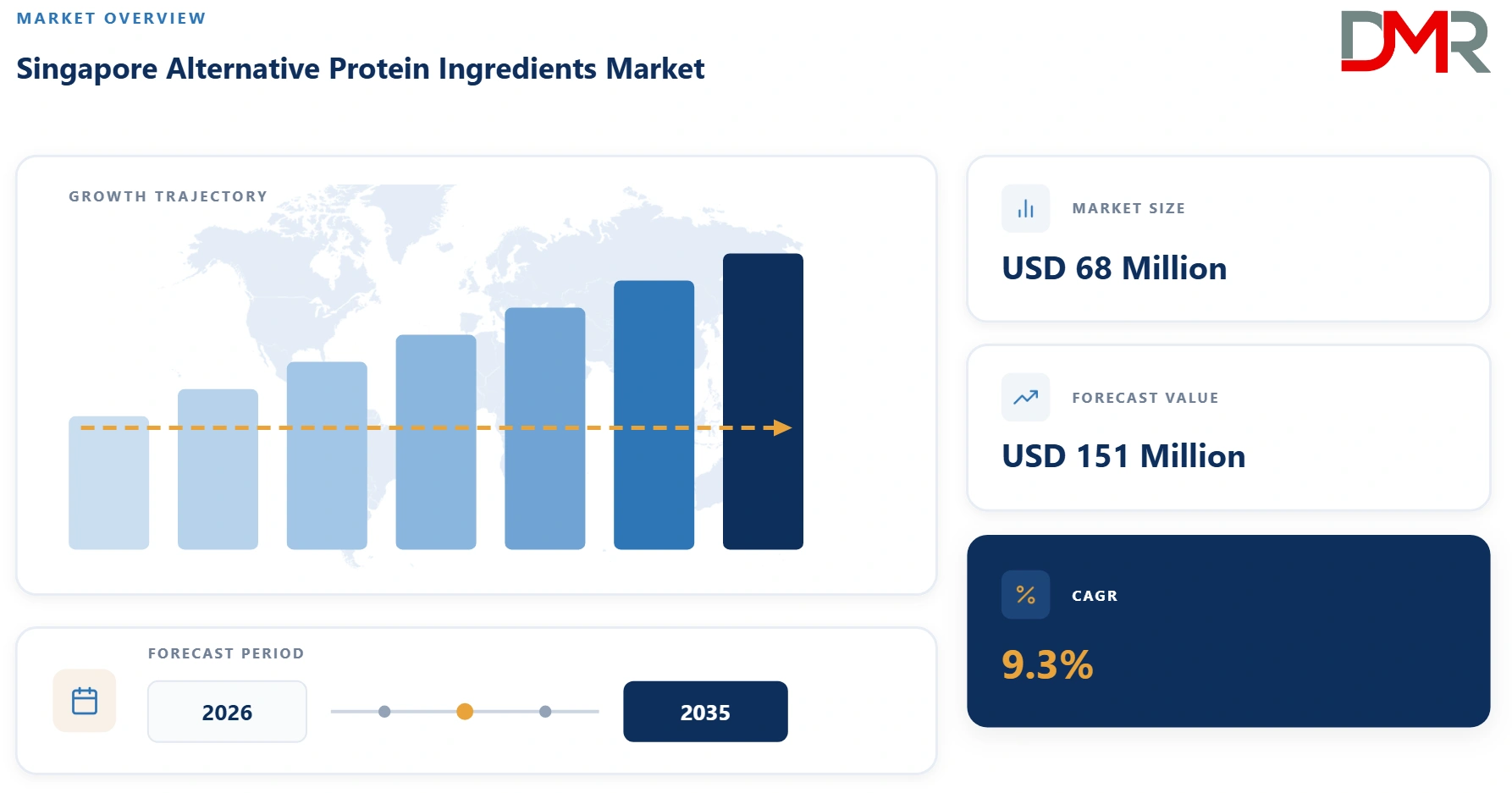
- Market Size 2026: USD 68 million
- Market Size 2035: USD 151 million
- CAGR, 2026-2035: 9.3%
- Leading protein-source segment: Plant-based protein, 66%
- Leading ingredient-type segment: Protein isolates, 43%
- Leading application segment: Meat & seafood alternatives, 38%
- Leading end-user segment: Food & beverage manufacturers, 58%
- Fastest-growing segment: Fermentation-derived protein, 17.2% CAGR
What is the Singapore Alternative Protein Ingredients and its Market Size?
The Singapore alternative protein ingredients market is estimated at approximately USD 68 million in 2026, with revenue projected to reach approximately USD 151 million by 2035, representing a 9.3% CAGR.
ℹ
To learn more about this report –
Download Your Free Sample Report Here
Singapore's alternative protein ingredients market comprises the B2B supply of protein ingredients derived from non-conventional animal sources, including plants, fungi, algae, insects, microorganisms, precision fermentation and cultivated-cell technologies. These ingredients are supplied as functional components for meat and seafood alternatives, dairy alternatives, bakery products, sports nutrition, ready-to-eat foods, beverages and animal nutrition. Singapore is particularly important as an R&D, pilot-scale manufacturing, regulatory and regional commercialization hub, rather than as a large agricultural producer. Its ecosystem combines ingredient suppliers, food manufacturers, biotechnology companies, research institutes, contract development and manufacturing organizations, and multinational food-ingredient companies. Singapore's limited land availability and heavy dependence on imported food reinforce the strategic importance of technologies that can produce protein with relatively low land requirements.
Use Cases
- Meat and seafood alternatives: Texturized proteins provide structure, bite, juiciness and protein content in plant-based meat and seafood.
- Dairy alternatives: Protein isolates and fermentation-derived proteins improve nutritional value, emulsification, texture and functionality in dairy-free products.
- Sports nutrition: Highly purified proteins support powders, bars, beverages and specialized high-protein nutritional products.
- Bakery and confectionery: Protein flours and functional concentrates increase protein content while improving foaming, binding and water retention.
- Ready-to-eat foods: Protein blends enable convenient high-protein meals, snacks and Asian-inspired prepared foods.
- Animal nutrition: Emerging microbial, algae, insect and duckweed proteins provide alternatives to conventional feed-protein inputs.
Key Takeaways
- Market size: The Singapore market is estimated at USD 68 million in 2026 and projected to reach USD 151 million by 2035.
- Growth: The market is forecast to expand at a 9.3% CAGR, supported by food innovation, regional exports and ingredient technology.
- Dominant source: Plant-based protein remains dominant at an estimated 66% share, reflecting established soy, wheat, pea, rice and mung-bean applications.
- Dominant ingredient: Protein isolates lead because manufacturers increasingly require higher protein concentration and predictable functionality.
- Fastest growth: Fermentation-derived proteins are forecast to grow at approximately 17.2% CAGR, albeit from a smaller base.
- Strategic advantage: Singapore's greatest competitive asset is its combination of regulatory clarity, R&D infrastructure, pilot-scale manufacturing, financing and access to Asian markets.
How Precision Fermentation and AI Are Transforming the Market?
Precision fermentation is emerging as one of the most important technologies for Singapore's alternative-protein ingredient industry. Microorganisms can be engineered or selected to produce specific proteins, fats, flavors or functional molecules, allowing ingredient manufacturers to move beyond the limitations of conventional agricultural protein sources. Singapore has developed pilot and scale-up infrastructure supporting fermentation-based food technologies, including ScaleUp Bio's facilities offering submerged fermentation from approximately 100 to 10,000 litres.
AI is increasingly complementary to fermentation by helping companies optimize microbial strains, media, fermentation conditions and downstream processing. Singapore's ecosystem is beginning to connect AI with bioreactors and food production; Life3 Biotech's planned microalgae facility, for example, is designed around AI-enabled bioreactors.
Key Drivers in the Singapore Alternative Protein Ingredients Market
Singapore's Role as an Asia-Pacific Food Innovation and Commercialization Hub
Singapore's limited agricultural land makes traditional domestic protein production difficult, but its infrastructure, logistics, research capabilities, skilled workforce and regulatory environment make it attractive for developing and commercializing alternative-protein technologies. Government agencies have actively supported the ecosystem through EDB, Enterprise Singapore, ASTAR and SFA programs. Singapore has also attracted multinational companies and shared infrastructure providers serving plant-based and fermentation technologies. The country's value proposition increasingly extends beyond domestic consumption: companies can use Singapore as a test market and then commercialize products across Southeast Asia and the wider Asia-Pacific region. EDB has specifically highlighted Singapore's ability to function as a regional launchpad and living laboratory for alternative-protein companies.
Rising Demand for Functional and Sustainable Protein Ingredients
Alternative protein adoption is shifting from simply replacing meat toward delivering higher protein density, improved nutrition, better texture and multifunctionality. Food manufacturers increasingly need ingredients that work reliably in Asian foods, beverages and convenience formats. Singapore-based research programs are therefore emphasizing protein functionality, nutrition and processing rather than merely creating meat analogues. SFA's 2025 Future Foods funding explicitly focused on improving the nutrition and functionality of alternative-protein products.
Restraints in the Singapore Alternative Protein Ingredients Market
High Production Costs and Limited Domestic Raw-Material Availability
Singapore does not possess the agricultural land required to produce large quantities of soybeans, peas, wheat, chickpeas or other major protein crops. The country therefore depends heavily on imported raw materials and finished ingredients. This creates exposure to freight costs, commodity prices, currency movements and geopolitical supply disruptions. Production costs can also be high because of Singapore's land, labor, utilities and industrial real-estate expenses. These constraints are particularly significant for cultivated and fermentation-derived proteins, where bioreactor, downstream-processing and quality-control costs can remain substantial.
Consumer Acceptance and Commercial-Scale Economics
Technology development does not automatically translate into mass-market demand. Singapore's alternative-protein sector has experienced challenges involving high production costs and weaker-than-expected consumer adoption. In February 2026, Singapore's Ministry of Sustainability and the Environment explicitly noted that global alternative-protein companies had faced difficulties scaling because of production costs and consumer acceptance.
Growth Opportunities in the Singapore Alternative Protein Ingredients Market
Precision Fermentation and Microbial Protein Ingredients
Precision fermentation offers Singapore an opportunity to specialize in high-value ingredients rather than compete directly with large agricultural economies in commodity protein production. Fermentation can generate proteins, fats and functional molecules with highly controlled characteristics and can be integrated into Singapore's existing biotechnology and bioprocessing capabilities. ScaleUp Bio provides fermentation capacity ranging from laboratory/pilot scale through 10,000-litre production, creating a pathway for startups and international companies to test commercial processes without building their own infrastructure.
Regional Ingredient Export and Asianized Formulation
Singapore's small domestic consumer base limits the ultimate scale of a purely local market, but this limitation can be overcome by treating Singapore as a regional ingredient and product-development platform. Asian consumers have diverse culinary preferences that require different textures, flavors and preparation methods from Western meat alternatives. Singapore-based companies can develop ingredients specifically optimized for noodles, dumplings, seafood analogues, Asian sauces, bakery products and ready-to-eat meals, then supply manufacturers throughout ASEAN and Asia-Pacific.
Trends in the Singapore Alternative Protein Ingredients Market
Shift From Commodity Plant Protein Toward High-Functionality Ingredients
The market is moving from basic protein replacement toward ingredients engineered for specific formulation outcomes. Protein isolates, blends, hydrolysates and specialized fermentation-derived ingredients increasingly compete on functionality, sensory performance and nutritional density. Singapore's food-tech infrastructure supports this shift because research organizations and pilot facilities can test ingredient behavior across multiple applications.
Convergence of Biotechnology, AI and Food Manufacturing
The boundary between food science and biotechnology is becoming increasingly blurred. Fermentation, microbial engineering, bioprocess optimization and AI are being integrated into ingredient development. Singapore's emerging infrastructure reflects this convergence, with new facilities combining biotechnology, fermentation, bioreactors, downstream processing and digital optimization. Life3 Biotech's planned AI-powered microalgae hub illustrates the direction of travel.
Research Scope and Analysis
The Singapore alternative protein ingredients market is segmented by protein source, ingredient type, application and end user. The analysis considers both established plant-protein ingredients and emerging microbial, fermentation-derived and cultivated-protein technologies. Because the market is relatively small, emerging categories can post high growth rates from low bases.
ℹ
To learn more about this report –
Download Your Free Sample Report Here
By Protein Source Analysis
Plant-based protein is estimated to dominate the Singapore alternative protein ingredients market in 2026 with approximately 66% share, supported by the maturity of soy, wheat, pea, rice and other plant proteins, established food-manufacturing applications and relatively straightforward regulatory pathways for conventional food ingredients. Soy remains important because of its established Asian consumption history, while pea and other pulse proteins benefit from demand for allergen diversification and clean-label formulations. Microbial and fermentation-derived proteins are forecast to be the fastest-growing category, at approximately 17.2% CAGR, as companies seek proteins with scalable production characteristics and more controlled functional performance. Fermentation technologies also benefit from Singapore's bioprocessing infrastructure and CDMO ecosystem. Soy protein is estimated to remain the second-largest source at approximately 21% share, although its relative share is expected to gradually decline as pea, rice, mung bean, fungal and fermentation-derived proteins diversify the ingredient mix. Singapore's research ecosystem has specifically investigated novel regional plant sources and more efficient protein extraction, reinforcing diversification.
By Ingredient Type Analysis
Protein isolates are estimated to lead the ingredient-type segment with approximately 43% share in 2026, reflecting their high protein concentration, consistent functionality and broad suitability for meat alternatives, sports nutrition, beverages and high-protein foods. Concentrates are estimated at roughly 27%, benefiting from lower costs and applications where maximum protein purity is unnecessary. Hydrolysates remain a smaller but rapidly developing niche because enzymatic processing can improve digestibility and formulation characteristics, particularly in sports and specialized nutrition. Protein blends are expected to be the fastest-growing format at approximately 12.5% CAGR, because manufacturers increasingly combine proteins to balance amino-acid profiles, flavor, texture, price and processing behavior. Blending also provides a practical mechanism for reducing dependence on a single raw material. Protein flours remain important in bakery and conventional food applications but generally carry lower value per kilogram than isolates and specialty ingredients.
By Application Analysis
Meat and seafood alternatives are estimated to account for approximately 38% of the 2026 market, making them the largest application. The category benefits from the need for texturized proteins with meat-like bite, water retention, binding and flavor-delivery properties. Singapore has developed capabilities in high-moisture extrusion, with facilities and companies supporting the development and production of plant-based meat products. Dairy alternatives represent the second-largest application at approximately 22%, supported by plant proteins and emerging precision-fermentation dairy proteins. Sports and nutrition is expected to be the fastest-growing application at approximately 13.8% CAGR, driven by high-protein diets, functional beverages and premium nutrition products. Ready-to-eat foods, bakery and animal nutrition provide additional growth opportunities. Over the forecast period, application diversity should become increasingly important as suppliers seek to reduce dependence on the relatively mature meat-alternative category.
By End User Analysis
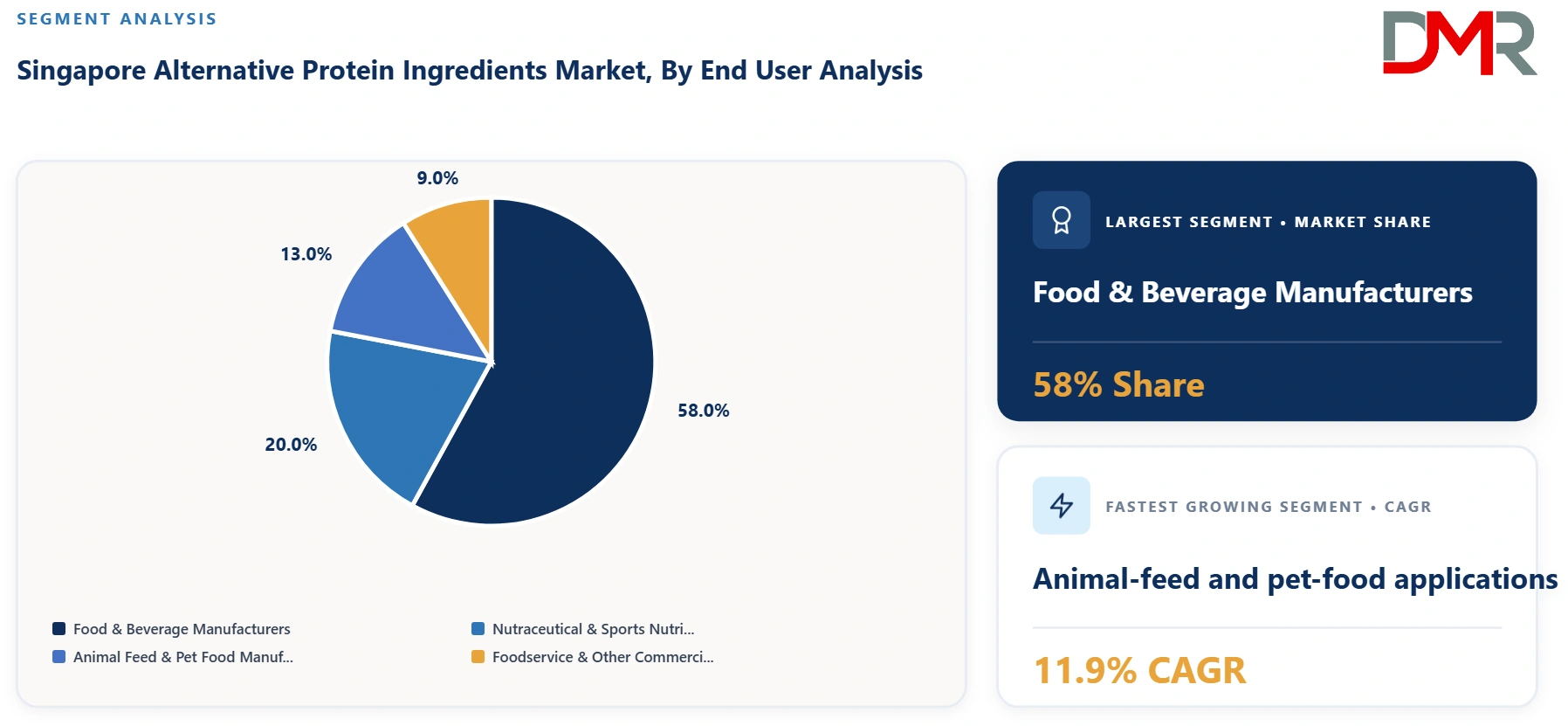
Food and beverage manufacturers are estimated to account for approximately 58% of the market in 2026, making them the dominant end-user group. These companies purchase protein isolates, concentrates, hydrolysates, flours and blends for use in finished foods and beverages, often requiring technical support alongside the ingredient itself. Nutraceutical and sports-nutrition manufacturers represent approximately 20%, supported by demand for concentrated and easily formulated proteins. Animal-feed and pet-food manufacturers account for roughly 13%, with microbial, algae, insect and emerging duckweed-derived proteins offering opportunities to diversify feed inputs. Foodservice and other commercial users make up the balance. Animal-feed and pet-food applications are projected to grow at approximately 11.9% CAGR, benefiting from new protein sources and pressure to diversify conventional feed ingredients. Singapore-based biotechnology companies are increasingly exploring algae and duckweed-based proteins, illustrating the potential for alternative proteins to expand beyond human food.
The Singapore Alternative Protein Ingredients Market Report is segmented on the basis of the following:
By Protein Source
- Plant-Based Protein
- Soy Protein
- Pea Protein
- Wheat Protein
- Rice Protein
- Potato Protein
- Other Plant Proteins
- Microbial Protein
- Mycoprotein
- Algae-Based Protein
- Insect Protein
- Fermentation-Derived Protein
- Cultivated Protein
By Ingredient Type
- Protein Isolates
- Protein Concentrates
- Protein Hydrolysates
- Protein Flours
- Protein Blends
By Application
- Meat & Seafood Alternatives
- Dairy Alternatives
- Bakery & Confectionery
- Sports & Nutrition
- Ready-to-Eat & Convenience Foods
- Animal Feed & Pet Food
- Other Food & Beverage Applications
By End User
- Food & Beverage Manufacturers
- Nutraceutical & Sports Nutrition Manufacturers
- Animal Feed & Pet Food Manufacturers
- Foodservice & Other Commercial Users
Regulatory Landscape
Singapore's regulatory framework is one of the market's strongest differentiators but also creates a meaningful compliance barrier for emerging ingredients. SFA's novel-food framework requires pre-market approval for foods or ingredients without a significant history of consumption, with safety assessments covering toxicity, allergenicity, manufacturing processes and dietary exposure. The framework was introduced in 2019 and has subsequently been incorporated into the broader Food Safety and Security Act regime. From 28 November 2025, supplying defined food without required pre-market approval became an offence. For ingredient suppliers, regulatory readiness can therefore become a competitive advantage: companies with strong safety dossiers, traceability, process controls and Singapore regulatory experience can shorten commercialization timelines. Fermentation-derived proteins and novel microbial ingredients face particular scrutiny because SFA assesses both the microorganism and production process. The regulatory environment should support credible commercialization while disadvantaging companies unable to meet scientific documentation requirements.
Investment and White Space Analysis
Investment opportunities are shifting from consumer-facing alternative-meat brands toward the infrastructure and ingredient layers of the value chain. Singapore's government has committed significant R&D funding, while shared infrastructure such as fermentation CDMOs, extrusion facilities and food innovation centers reduces capital requirements for emerging companies. SFA reported S$42 million awarded to 11 Future Foods and Food Safety projects in 2025 and S$64 million across 21 multi-year projects since 2024. The largest white spaces are specialty fermentation-derived proteins, low-cost protein blends, Asian-specific texturizing systems, algae and microbial ingredients, and processing technologies that improve sensory quality while lowering manufacturing costs. Ingredient companies can also capture regional demand by locating R&D and pilot production in Singapore while sourcing feedstocks from Australia, New Zealand and other Asian markets. The strongest investment proposition is therefore likely to be B2B enabling technology and ingredients rather than purely branded consumer products.
Competitive Landscape
The Singapore alternative protein ingredients market is moderately fragmented but increasingly ecosystem-driven. Large multinational ingredient companies compete alongside specialist food-tech companies, startups, research organizations and contract manufacturers. Competitive advantage is increasingly determined by access to processing infrastructure, regulatory expertise, formulation capability, ingredient functionality, production economics and regional customer relationships. Multinationals such as ADM, Bühler and Givaudan bring ingredient science and global distribution, while Singapore-linked platforms such as Nurasa and ScaleUp Bio provide commercialization infrastructure. Specialist companies differentiate through proprietary fermentation strains, plant-protein extraction, microbial biomass, algae cultivation or high-moisture extrusion. Partnerships are particularly important because startups can access pilot plants and manufacturing capabilities without committing to large capital expenditures. Singapore's ecosystem has deliberately developed shared infrastructure to accelerate commercialization.
Some of the prominent players in the Singapore Alternative Protein Ingredients Market are:
- Growthwell Foods
- Protein Plus Group
- Sophie’s BioNutrients
- Mottainai Food Tech
- Pullulo
- Karana
- Shiok Meats
- TurtleTree
- Umami Bioworks
- Avant
- Next Gen Foods
- ImpacFat
- Float Foods
- Gaia Foods
- Growthwell Group
- Oatside
- WhatIF Foods
- Alcheme Bio
- Algrow Biosciences
- Life3 Biotech
- Meatiply
- Ants Innovate
- Handprint Tech
- Eat Just
- Impossible Foods
- Beyond Meat
- Oatly
- ADM
- Cargill
- Ingredion
- Roquette
- Kerry Group
- IFF
- Givaudan
- DSM-Firmenich
- Novonesis
- Tate & Lyle
- Corbion
- BENEO
- Puratos
- Other Key Players
Recent Developments
- February 2026: Life3 Biotech announced the development of an AI-powered solar microalgae facility targeted for completion in Q4 2026, with approximately 5,000 litres of bioreactor capacity, reinforcing Singapore's move toward AI-enabled sustainable protein production.
- February 2026: Aleph Farms, the cultivated-meat company secured regulatory clearance for its thin-cut cultivated beef steaks in Singapore and announced plans for a first-half 2027 launch, with Cell Agritech supporting Singapore production.
- December 2025: Singapore Food Agency S$42 million to 11 Future Foods and Food Safety projects, including initiatives focused on improving the nutrition and functionality of alternative proteins and supporting precision-fermentation commercialization.
- September 2025: The Protein Brewery continued expanding its Singapore presence for Fermotein, its fermentation-derived protein and fiber ingredient, following Singapore regulatory approval and its Series B financing.
- June 2025: ScaleUp Bio continued strengthening fermentation development and manufacturing infrastructure, offering capabilities from laboratory through 10,000-litre scale and enabling alternative-protein developers to progress toward commercial production without immediately building dedicated facilities.
Report Details
| Report Characteristics |
| Market Size (2026) |
USD 68 Mn |
| Forecast Value (2035) |
USD 151 Mn |
| CAGR (2026–2035) |
9.3% |
| Historical Data |
2021 – 2025 |
| Forecast Data |
2026 – 2035 |
| Base Year |
2025 |
| Segments Covered |
By Protein Source, By Ingredient Type, By Application, By End User |
| Country Coverage |
Singapore |
Frequently Asked Questions
What is the Singapore Alternative Protein Ingredients Market size in 2026?
▾ The Singapore Alternative Protein Ingredients Market is estimated at USD 68 million in 2026, covering B2B alternative-protein ingredients supplied through Singapore's food-tech ecosystem.
What will the Singapore Alternative Protein Ingredients Market size be in 2035?
▾ The Singapore Alternative Protein Ingredients Market is projected to reach approximately USD 151 million by 2035, representing a 9.3% CAGR during 2026-2035.
Which protein source dominates the Singapore Alternative Protein Ingredients Market?
▾ Plant-based protein dominates the Singapore Alternative Protein Ingredients Market with an estimated 66% share in 2026, supported by established soy, wheat, pea and rice proteins.
Which is the fastest-growing segment in the Singapore Alternative Protein Ingredients Market?
▾ Fermentation-derived protein is expected to be the fastest-growing segment in the Singapore Alternative Protein Ingredients Market, with an estimated 17.2% CAGR through 2035.
What are the key growth drivers of the Singapore Alternative Protein Ingredients Market?
▾ The Singapore Alternative Protein Ingredients Market is driven by food-tech investment, regional export opportunities, sustainability objectives, protein diversification and demand for functional ingredients.
What are the major challenges facing the Singapore Alternative Protein Ingredients Market?
▾ The Singapore Alternative Protein Ingredients Market faces challenges including high production costs, imported feedstock dependence, consumer acceptance, technological scale-up and regulatory requirements.
Who are the key players in the Singapore Alternative Protein Ingredients Market?
▾ Key participants in the Singapore Alternative Protein Ingredients Market include ADM, Bühler, Givaudan, Wilmar, Nurasa, ScaleUp Bio, Growthwell, Shandi Global and The Protein Brewery.
How is regulation affecting the Singapore Alternative Protein Ingredients Market?
▾ Regulation strongly influences the Singapore Alternative Protein Ingredients Market because novel foods require SFA pre-market approval and scientific safety assessments before commercialization.