Singapore Cold Chain Logistics Market Snapshot
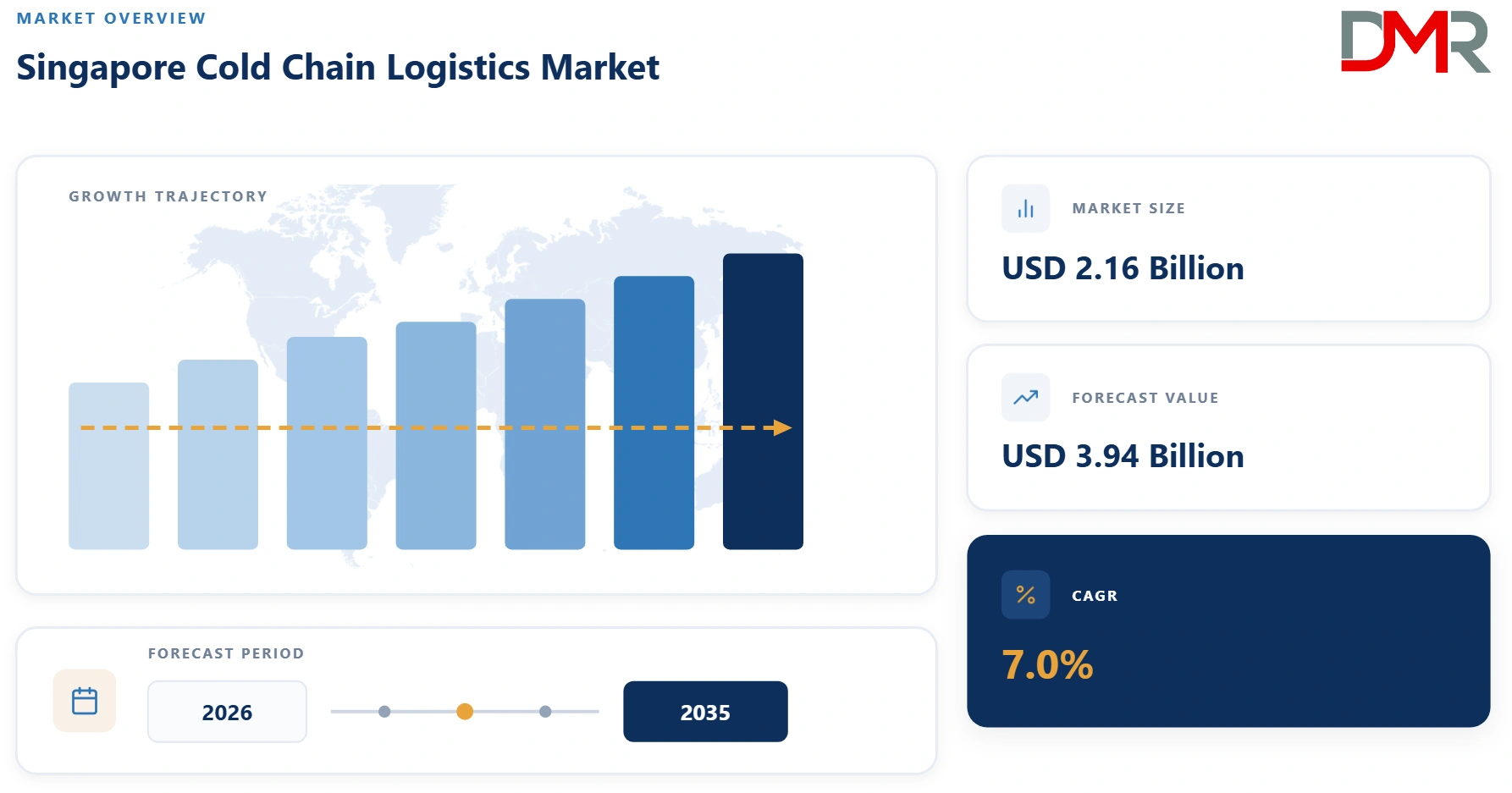
- Market Size in 2026: USD 2.16 Billion
- Market Size in 2035: USD 3.94 Billion
- CAGR, 2026-2035: 7.0%
- Leading Service Type: Refrigerated Warehouse, 55.0%
- Leading Application: Meat & Seafood, 27.0%
- Leading Temperature Type: Frozen, 56.0%
- Leading Technology: Dry Ice, 31.0%
- Fastest-Growing Segment: Alternative Protein, 10.8% CAGR
What is the Singapore Cold Chain Logistics and its Market Size?
The Singapore cold chain logistics market is estimated at USD 2.16 billion in 2026, increasing to approximately USD 3.94 billion by 2035, representing a 7.0% CAGR.
ℹ
To learn more about this report –
Download Your Free Sample Report Here
Singapore cold chain logistics comprises the infrastructure, transportation, storage, monitoring, packaging, handling, and value-added services used to preserve temperature-sensitive products from origin through final delivery. The market primarily serves frozen and chilled food, seafood, meat, dairy, fruits and vegetables, pharmaceuticals, biologics, vaccines, and emerging alternative-protein products. Its core value proposition is maintaining product quality, safety, shelf life, and regulatory compliance despite Singapore's tropical climate and highly import-dependent food system. More than 90% of Singapore's food is imported from over 180 countries and regions, making temperature-controlled logistics strategically important to food security and trade continuity.
Use Cases
- Frozen meat and seafood distribution: Maintains sub-zero temperatures from imported cargo through wholesale, foodservice, retail, and restaurant delivery.
- Fresh produce logistics: Extends shelf life of imported fruits and vegetables through controlled temperatures, humidity, packaging, and rapid distribution.
- Dairy distribution: Protects milk, cheese, butter, yogurt, and ice cream from temperature excursions during storage and transportation.
- Pharmaceutical logistics: Provides validated temperature-controlled storage and transportation for vaccines, biologics, medicines, and clinical-trial materials.
- E-commerce grocery fulfillment: Enables rapid, multi-temperature order fulfillment for online grocery platforms and direct-to-consumer food delivery.
- Strategic food stockpiling: Supports Singapore's resilience strategy by maintaining inventories of essential frozen proteins and other food products.
Key Takeaways
- Market Size: The market is estimated at USD 2.16 billion in 2026 and projected to approach USD 3.94 billion by 2035.
- Growth Rate: A roughly 7.0% CAGR reflects structural rather than speculative demand, supported by food imports, healthcare logistics, and regional trade.
- Key Drivers: Import dependence, food-security requirements, pharmaceutical expansion, e-commerce, automation, and tighter temperature-control standards are the principal growth engines.
- Segment Dominance: Refrigerated warehousing leads the service mix, while frozen logistics remains the largest temperature category.
- Fastest Growth: Alternative-protein logistics is expected to grow fastest as cultivated, fermentation-derived, and plant-based products require increasingly sophisticated temperature-controlled supply chains.
- Strategic Position: Singapore's ports, airport connectivity, high-quality infrastructure, and proximity to ASEAN markets reinforce its role as a regional cold-chain gateway.
How IoT, AI and Cloud Technologies are Transforming Singapore Cold Chain Logistics Market?
IoT sensors, cloud platforms, GPS trackers, automated warehouse systems, and AI-based analytics are increasingly embedded across Singapore's cold chain. Sensors monitor temperature, humidity, location, door openings, equipment condition, and shipment status in real time. Cloud-based control towers consolidate this data across warehouses, trucks, and international shipments, while AI can predict temperature excursions, equipment failures, demand fluctuations, and optimal delivery routes. Existing operators already use temperature monitoring, warehouse-management systems, digital shipment visibility, and automated material handling.
The main benefits are lower spoilage, better inventory rotation, faster exception management, improved asset utilization, reduced manual intervention, and stronger regulatory traceability. AI-enabled predictive maintenance can reduce refrigeration downtime, while automated storage and retrieval systems allow operators to maximize cubic capacity in land-constrained Singapore. Digitalization also changes competition: providers increasingly compete on visibility, data quality, predictive capabilities, integration with customer ERP systems, and measurable sustainability performance rather than warehouse space alone. DHL's autonomous-vehicle deployment in Singapore illustrates the shift toward increasingly automated logistics operations.
Key Drivers in the Singapore Cold Chain Logistics Market
Heavy Dependence on Imported Food
Singapore's structural reliance on imported food creates recurring demand for temperature-controlled storage, reefer containers, refrigerated trucks, cross-docking, and specialized handling. More than 90% of food is imported from over 180 countries or regions, exposing the domestic supply chain to long international transport routes and multiple temperature-sensitive handoffs. As sourcing diversifies, logistics providers must manage more origins, product specifications, and temperature regimes while preserving continuity across ports, airports, warehouses, and retailers. Food-security policy further increases the strategic importance of cold storage because stockpiling essential proteins requires substantial frozen capacity.
Expansion of Healthcare and Biopharmaceutical Logistics
Singapore's biomedical manufacturing and pharmaceutical ecosystem is generating a higher-value cold-chain requirement alongside conventional food logistics. Biologics, vaccines, clinical-trial materials, advanced therapies, and medical products require validated storage and precise transportation, often at 2–8°C or frozen conditions.
Restraints in the Singapore Cold Chain Logistics Market
High Land and Energy Costs
Singapore's limited land availability and expensive industrial real estate constrain the economics of cold storage. Refrigerated warehouses require insulated structures, refrigeration systems, backup power, specialized loading areas, and higher operating expenditure than ambient facilities. Electricity consumption is particularly significant because refrigeration must operate continuously, while tropical ambient conditions increase the cooling burden. Consequently, operators face pressure to maximize pallet density, automate storage, improve energy efficiency, and consolidate multiple customers within large facilities. Published market analysis identifies high land and utility costs as among the major constraints on Singapore's cold-chain development.
Operational and Regulatory Complexity
Cold-chain logistics requires continuous compliance with food-safety requirements, temperature specifications, licensing, traceability, product segregation, and increasingly stringent customer standards. Singapore Food Agency rules require licensing for cold stores handling chilled or frozen meat and seafood, while SS 668 provides industry guidance for chilled and frozen food cold-chain management. Temperature excursions can create product losses, recalls, liability exposure, and reputational damage.
Growth Opportunities in the Singapore Cold Chain Logistics Market
Automation and High-Density Cold Warehousing
Singapore's land constraints create an unusually strong business case for automated cold storage. Automated storage and retrieval systems, robotics, pallet shuttles, smart conveyors, AI-based inventory management, and automated guided vehicles can increase throughput without proportional increases in floor area. Operators can also combine multi-temperature zones with centralized distribution, improving inventory utilization and reducing duplicate infrastructure. The opportunity is particularly attractive for large facilities supporting food manufacturers, supermarket chains, pharmaceutical companies, and regional distribution programs.
Regional Cold-Chain Gateway Services
Singapore can use its airport, seaport, free-trade connectivity, and established logistics ecosystem to serve as a consolidation and redistribution hub for Southeast Asia. High-value pharmaceutical shipments can enter Singapore for quality-controlled storage before moving to neighboring ASEAN markets, while imported food can be consolidated for regional distribution. DHL and Kuehne+Nagel already position Singapore facilities as regional logistics hubs with temperature-controlled infrastructure.
Trends in the Singapore Cold Chain Logistics Market
Digital and Autonomous Cold Chains
Singapore's cold-chain sector is moving from basic temperature monitoring toward connected, predictive and increasingly autonomous operations. IoT sensors, WMS integration, cloud platforms, AI analytics and autonomous vehicles are becoming differentiators. DHL's December 2025 deployment of Singapore's first autonomous supply-chain vehicle demonstrates how automation is moving from pilot projects toward operational deployment.
Sustainability and Energy-Efficient Refrigeration
Environmental performance is becoming commercially relevant because cold-chain refrigeration consumes substantial energy. Operators are investing in solar power, efficient refrigeration, high-density designs, route optimization, reusable packaging and lower-carbon facilities. YCH's New DistriPark at Tuas, opened in November 2025, combines LEED Platinum certification with a 2.4 MWp solar installation, illustrating the direction of infrastructure development.
Research Scope and Analysis
The market is segmented by Service Type, Application, Temperature Type, and Technology. The estimates below represent the analyst's 2026 revenue mix within the defined cold-chain logistics market. They are calibrated against published market segmentation showing strong food-and-beverage and frozen-market concentration, while allowing for Singapore's growing pharmaceutical and high-value logistics requirements.
ℹ
To learn more about this report –
Download Your Free Sample Report Here
By Service Type Analysis
Refrigerated Warehouse is estimated to dominate with 55.0% share in 2026, supported by Singapore's land constraints, food-stockpiling requirements, import dependence, and increasing need for centralized multi-temperature distribution. Large facilities enable economies of scale and higher inventory density, making warehousing strategically more valuable than fragmented storage. Refrigerated Transportation accounts for approximately 45.0%, covering reefer trucking, airport transfers, port movements, last-mile distribution and temperature-controlled delivery. Refrigerated transportation is expected to be the fastest-growing service segment at approximately 8.0% CAGR, driven by e-commerce grocery, shorter replenishment cycles, pharmaceutical distribution and regional cross-border flows. The second-largest sub-service within transportation is estimated to be last-mile refrigerated distribution, as foodservice, grocery and healthcare customers increasingly require smaller, more frequent deliveries. CWT illustrates the scale of established warehouse infrastructure, operating a 750,000-square-foot multi-temperature-controlled cold hub with freezer, air-conditioned and ambient capacity.
By Application Analysis
Meat and Seafood is estimated to lead with 27.0% share in 2026, reflecting Singapore's substantial imported protein requirements, frozen-food inventories, restaurant demand, and strategic stockpiling. Fruit and Vegetable logistics represents approximately 21.0%, followed by Dairy Products at 17.0%. Alternative Protein is the fastest-growing application, at approximately 10.8% CAGR, although from a smaller base, because Singapore is actively developing alternative food production and increasingly diverse protein supply chains. Seafood and meat remain structurally dominant because they require stringent temperature control and often travel long distances before reaching consumers. Fruits and vegetables require additional management of humidity, ethylene, shelf life and phytosanitary controls, increasing demand for specialized packaging and monitoring. Kuehne+Nagel highlights these requirements within its perishables operations, including temperature management, air and ethylene management, customs compliance, and real-time tracking.
By Temperature Type Analysis
Frozen is estimated to hold 56.0% share in 2026, ahead of Chilled at 44.0%. Frozen logistics dominates because imported meat, seafood, processed foods, ready-to-eat products and strategic food reserves can remain in inventory for longer periods, creating sustained warehouse demand. Singapore's food-stockpiling system reinforces this position, with major facilities maintained at temperatures as low as approximately -23°C. Chilled is expected to grow faster, at approximately 8.1% CAGR, as demand rises for fresh produce, dairy, fresh meat, meal kits, premium foodservice and pharmaceutical products. Chilled logistics also benefits from the expansion of Singapore's local food-production ecosystem and the need to move products rapidly from production to consumption. The market is therefore gradually becoming more multi-temperature rather than simply frozen-focused.
By Technology Analysis
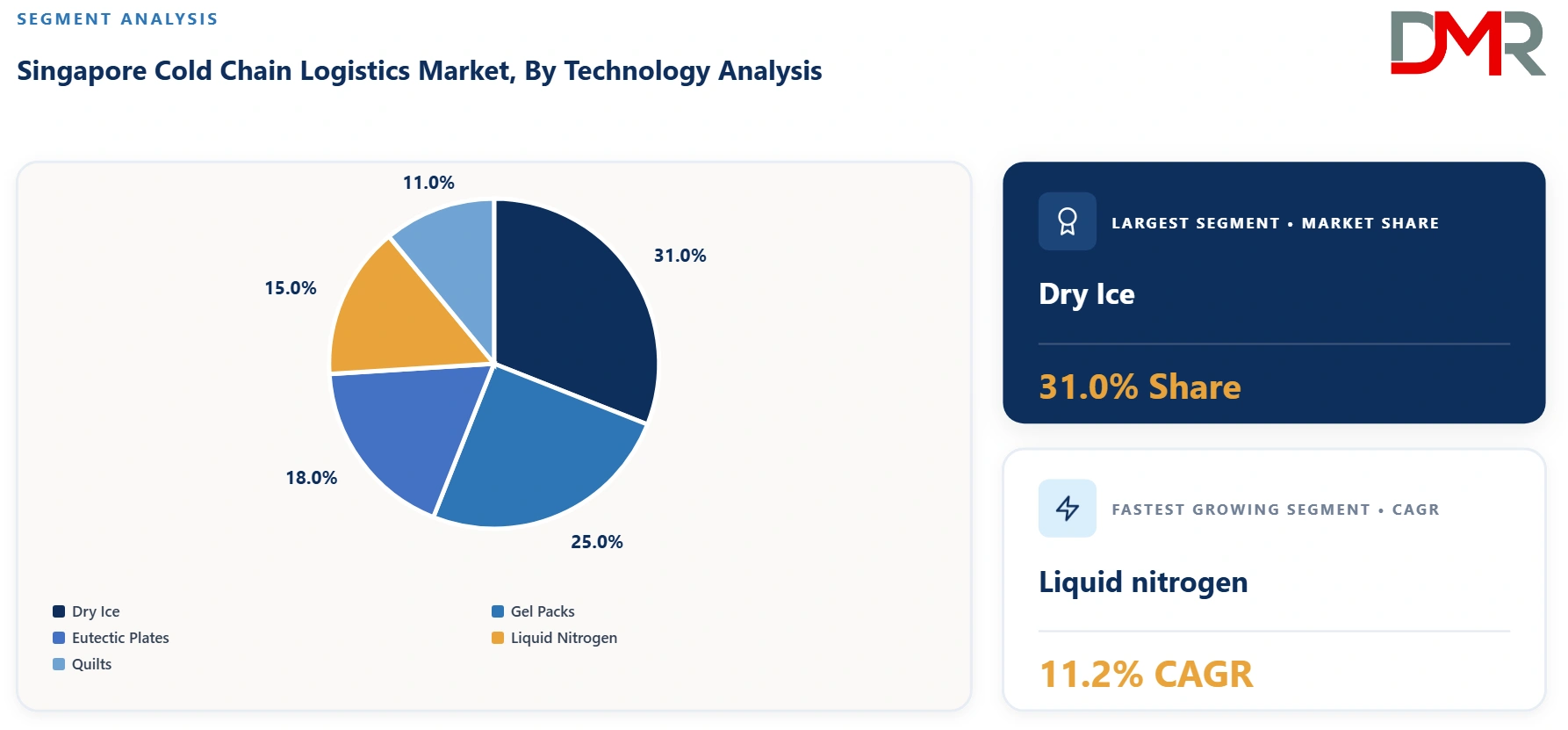
Dry Ice is estimated to represent 31.0% of the 2026 technology mix, particularly across frozen foods, pharmaceuticals, biological materials and specialized shipments where portable temperature control is required. Gel Packs follow at approximately 25.0%, especially for chilled pharmaceutical and food shipments. Eutectic Plates account for about 18.0%, while Liquid Nitrogen represents approximately 15.0% and Quilts 11.0%, with other technologies making up the balance. Liquid nitrogen and advanced active systems are expected to record the fastest growth, at approximately 11.2% CAGR, due to their relevance to high-value biologics, advanced therapies and deep-frozen products. DHL notes the growing role of active containers and specialized temperature-controlled solutions for biologics and vaccines, while Kuehne+Nagel highlights insulated containers, gel packs and specialized packaging for perishables.
The Singapore Cold Chain Logistics Market Report is segmented on the basis of the following:
By Service Type
- Refrigerated Warehouse
- Refrigerated Transportation
By Application
- Seafood
- Meat
- Fruit and Vegetable
- Dairy Products
- Alternative Protein
- Others
By Temperature Type
By Technology
- Dry Ice
- Gel Packs
- Eutectic Plates
- Liquid Nitrogen
- Quilts
Regulatory Landscape
Singapore's cold-chain market operates within a relatively stringent food-safety and logistics environment. The Singapore Food Agency requires licensing for cold stores handling chilled or frozen meat and seafood, while food-storage businesses are encouraged to maintain registration and traceability. SS 668 provides a standardized framework for cold-chain management of chilled and frozen food, supporting temperature integrity, food safety and quality. The regulatory environment creates entry barriers but also favors professional 3PL providers capable of documentation, monitoring and auditability. The regulatory trend is likely to increase demand for digital records, automated alerts, validated facilities and standardized operating procedures. Pharma logistics faces an even higher compliance threshold through GDP/GMP requirements, creating a premium market for certified operators.
Investment and White Space Analysis
Investment opportunity is concentrated in automated, energy-efficient and multi-temperature infrastructure rather than conventional low-density cold storage. Large operators can capture economies of scale through automation, solar generation, centralized control towers and high-density frozen storage. The most attractive white spaces are shared-user cold warehouses for SMEs, premium pharmaceutical and biologics hubs, regional ASEAN redistribution, temperature-controlled e-commerce fulfillment and sustainable refrigerated last-mile delivery. DHL's USD-equivalent multi-million investment in Singapore's pharmaceutical infrastructure and YCH's smart, solar-powered DistriPark demonstrate continuing capital commitment.
Investors should nevertheless account for high land costs, electricity consumption, utilization ramp-up risk, labor shortages and regulatory requirements. Partnerships between logistics companies, technology vendors, property developers and healthcare manufacturers are likely to become a preferred investment model.
Competitive Landscape
The Singapore cold chain logistics market is moderately consolidated but operationally fragmented, with global 3PLs competing alongside Singapore-based logistics specialists and asset-heavy cold-storage providers. Major participants include DHL Supply Chain, Kuehne+Nagel, CWT, YCH Group, GEODIS, Kerry Logistics, CEVA Logistics, DB Schenker, Lineage Logistics and other regional operators. Competition increasingly centers on facility quality, network connectivity, temperature integrity, digital visibility, regulatory certification, automation, sustainability and service reliability rather than price alone. CWT operates a 750,000-square-foot multi-temperature cold hub, while Kuehne+Nagel's Singapore logistics hub offers 46,000 square meters of warehousing, with more than 40% equipped for advanced chilled storage and related services.
Some of the prominent players in the Singapore Cold Chain Logistics Market are:
- CWT Logistics
- YCH Group
- Commonwealth Kokubu Logistics
- ST Logistics
- Lineage Logistics
- DHL Supply Chain
- Kuehne+Nagel
- DB Schenker
- GEODIS
- CEVA Logistics
- DSV
- Kerry Logistics
- Nippon Express
- JWD Group
- Agility Logistics
- Sinotrans
- Kintetsu World Express
- XPO Logistics
- SATS
- PSA International
- Maersk
- UPS Supply Chain Solutions
- FedEx
- Yusen Logistics
- Toll Group
- CJ Logistics
- NNR Global Logistics
- Bolloré Logistics
- Rhenus Logistics
- KWE
- DP World
- Schenker
- Tee Yih Jia Food Manufacturing
- Shin Yao Ya
- ITC Cold Chain Logistics
- Jurong Cold Store
- NCS Cold Stores
- Mandai Link Logistics
- Fairbanks Logistics
- QAF Fruits Cold Store
- Other Key Players
Recent Developments
- In March 2026, DHL received the Best Logistics & Supply Chain Management Supplier award at the Asia-Pacific Biopharma Excellence Awards, highlighting its Singapore Pharma Hub, expanding cold-chain airfreight network, and healthcare-logistics investments.
- In December 2025, DHL Supply Chain launched Singapore's first autonomous supply-chain vehicle, integrating electric autonomous transportation with warehouse-management systems and real-time monitoring as part of its broader automation roadmap.
- In November 2025, YCH Group opened New DistriPark at Tuas, a 17,000-square-meter repurposed logistics facility featuring LEED Platinum certification and a 2.4 MWp solar installation supporting its low-carbon logistics strategy.
- In August 2025, YCH Group expanded its regional supply-chain strategy, emphasizing multimodal ASEAN infrastructure, digitalization, sustainability, and cold-chain capabilities amid shifting global trade patterns.
- In April 2025, DHL Group announced a €500 million Asia-Pacific healthcare-logistics investment, targeting compliant warehousing, specialized cold-chain capacity, last-mile vehicles, and advanced visibility systems.
- In April 2025, DHL Supply Chain launched an 8,200-square-meter Pharma Hub in Singapore, providing GMP/GDP-compliant ambient and 2–8°C cold-room capacity with connectivity to Changi Airport and Tuas Mega Port.
Report Details
| Report Characteristics |
| Market Size (2026) |
USD 2.16 Bn |
| Forecast Value (2035) |
USD 3.94 Bn |
| CAGR (2026–2035) |
7.0% |
| Historical Data |
2021 – 2025 |
| Forecast Data |
2026 – 2035 |
| Base Year |
2025 |
| Segments Covered |
By Service Type, By Application, By Temperature Type, By Technology |
| Country Coverage |
Singapore |
Frequently Asked Questions
What is the Singapore Cold Chain Logistics Market size in 2026?
▾ The Singapore Cold Chain Logistics Market is estimated at USD 2.16 billion in 2026, based on the defined market scope and analyst estimates.
What will the Singapore Cold Chain Logistics Market size be by 2035?
▾ The Singapore Cold Chain Logistics Market is projected to reach approximately USD 3.94 billion by 2035, supported by sustained demand for temperature-controlled logistics.
What CAGR will the Singapore Cold Chain Logistics Market register from 2026 to 2035?
▾ The Singapore Cold Chain Logistics Market is expected to expand at approximately 7.0% CAGR from 2026 to 2035.
What are the key drivers of the Singapore Cold Chain Logistics Market?
▾ The Singapore Cold Chain Logistics Market is primarily driven by food-import dependence, food-security requirements, pharmaceutical growth, e-commerce, and increasing demand for temperature-controlled distribution.
What are the major trends in the Singapore Cold Chain Logistics Market?
▾ Major Singapore Cold Chain Logistics Market trends include automation, IoT-enabled monitoring, AI-based predictive analytics, sustainable refrigeration, and integrated regional supply-chain visibility.
Who are the key players in the Singapore Cold Chain Logistics Market?
▾ Key players in the Singapore Cold Chain Logistics Market include DHL Supply Chain, Kuehne+Nagel, CWT, YCH Group, GEODIS, Kerry Logistics, CEVA Logistics, DB Schenker, and Lineage Logistics.
Which segment dominates the Singapore Cold Chain Logistics Market?
▾ Refrigerated warehousing dominates the Singapore Cold Chain Logistics Market by service type, while frozen logistics leads by temperature type.
Which is the fastest-growing segment in the Singapore Cold Chain Logistics Market?
▾ Alternative protein logistics is projected to be the fastest-growing application segment in the Singapore Cold Chain Logistics Market, with an estimated 10.8% CAGR through 2035.