Singapore Food & Beverage Contract Manufacturing Market Snapshot
- Market Size in 2026: USD 0.93 billion
- Market Size in 2035: USD 1.78 billion
- CAGR, 2026-2035: 7.5%
- Leading Service Type in 2026: Manufacturing & Processing, 52%
- Leading Food Category in 2026: Beverages, 24%
- Leading Client Type in 2026: Large National & Multinational Brands, 30%
- Leading Facility Certification in 2026: Standard Certified, 46%
- Fastest-Growing Segment: Nutritional & Dietary Supplements, 10.4% CAGR
What is the Singapore Food & Beverage Contract Manufacturing and its Market Size?
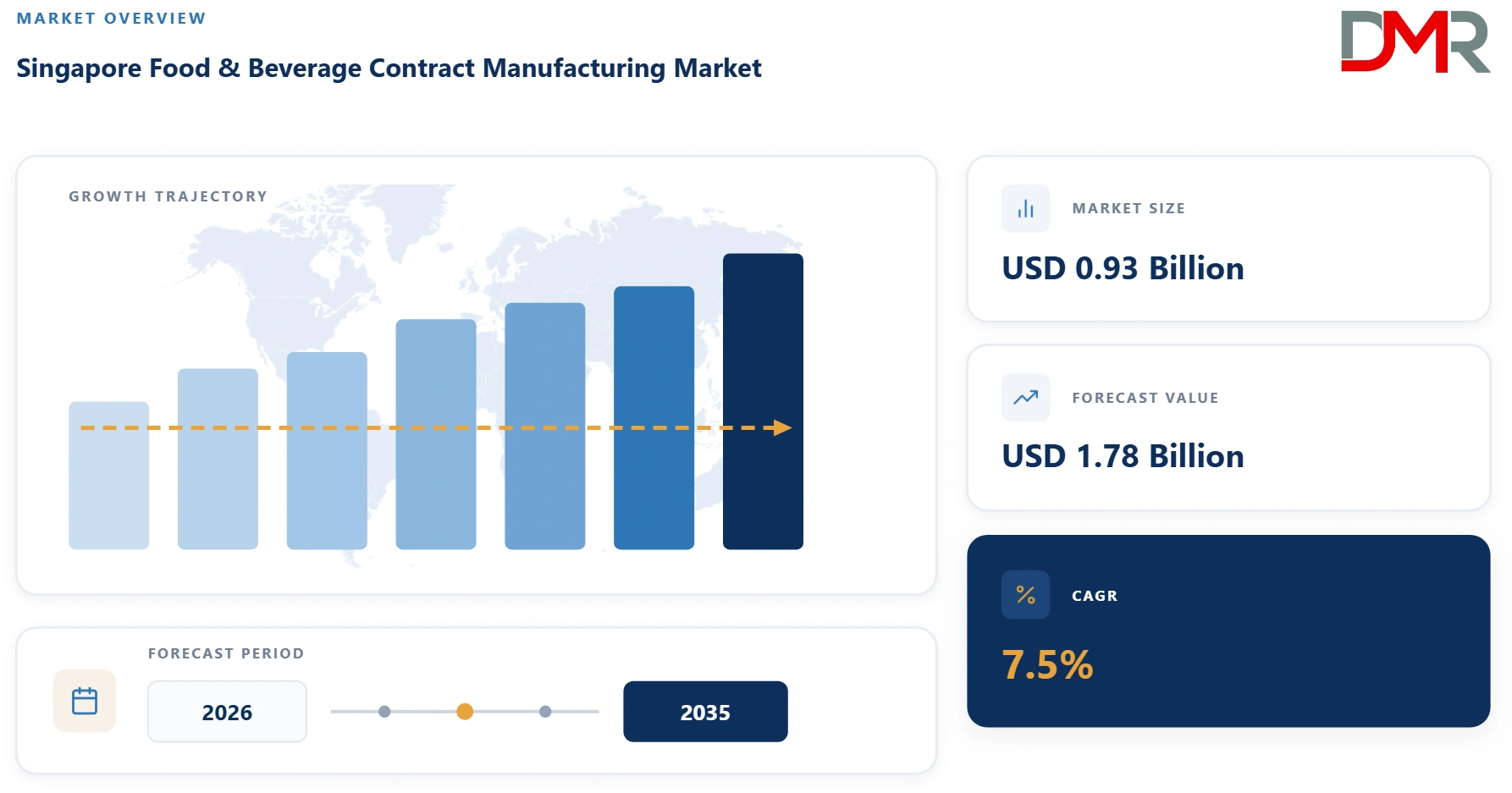
The Singapore food and beverage contract manufacturing market is estimated at USD 0.93 billion in 2026 and is projected to reach approximately USD 1.78 billion by 2035, representing a 7.5% CAGR.
ℹ
To learn more about this report –
Download Your Free Sample Report Here
Singapore food and beverage contract manufacturing comprises outsourced services in which brand owners engage specialist manufacturers to formulate, process, produce, package, label, store or distribute food and beverage products. Services span OEM/ODM production, private-label manufacturing, co-packing, recipe development, pilot production, quality assurance, warehousing and fulfilment. Contract manufacturers allow emerging brands, retailers, foodservice operators and multinational companies to access licensed facilities, specialised equipment, technical expertise and established food-safety systems without making equivalent capital investments. This model is particularly relevant in Singapore, where manufacturing costs, land constraints and manpower availability make asset-light production economically attractive. Singapore's SFA requires establishments manufacturing, processing, preparing or packaging food for distribution to obtain the appropriate licence.
Use Cases
- Private-label product manufacturing: Retailers outsource production to launch differentiated food products without constructing their own manufacturing facilities.
- Beverage co-packing: Beverage brands use specialist facilities for formulation, filling, labelling and packaging across multiple container formats.
- Ready-meal production: Food companies outsource cooking, chilling, freezing, packing and distribution of ready-to-eat and ready-to-cook meals.
- Functional-food development: Brands collaborate with manufacturers to formulate protein-rich, low-sugar, fortified and specialised dietary products.
- Alternative-protein manufacturing: FoodTech companies access extrusion, blending and processing infrastructure to commercialise plant-based and hybrid proteins.
- Export-oriented OEM production: International brands use Singapore facilities to develop premium Asian products for regional and global markets.
Key Takeaways
- Market size: The market is estimated at USD 0.93 billion in 2026 and is forecast to reach USD 1.78 billion by 2035.
- Growth: A projected 7.5% CAGR is supported by outsourcing, private-label expansion, convenience foods and specialist manufacturing requirements.
- Key driver: High Singapore operating costs and limited industrial space encourage brands to adopt asset-light manufacturing models.
- Segment dominance: Manufacturing and processing accounts for approximately 52% of contract-manufacturing revenue, while beverages represent the largest food-category opportunity.
- Fastest growth: Nutritional and dietary supplements are expected to expand at approximately 10.4% annually as functional nutrition and personalised wellness products gain traction.
- Strategic advantage: Singapore's food-safety reputation, regional connectivity and government-backed food-innovation infrastructure strengthen its role as an Asian production and export hub.
How AI/Gen AI is Transforming the Singapore Food & Beverage Contract Manufacturing Market?
AI, automation, robotics, IoT-enabled production monitoring and advanced processing technologies are increasingly embedded in Singapore's contract-manufacturing ecosystem. Applications include automated material handling, predictive maintenance, computer-vision quality inspection, production scheduling, formulation optimisation and real-time traceability. In February 2026, Enterprise Singapore and IMDA refreshed the Food Manufacturing Industry Digital Plan to help more than 1,500 manufacturers identify relevant digital solutions; more than 90% of food-manufacturing businesses had already adopted at least one sector-specific digital solution by 2025.
Technology improves throughput, reduces labour dependence, increases consistency and allows manufacturers to operate smaller production runs economically. Advanced technologies such as HPP, extrusion, retort processing and automated packaging also enable products with longer shelf life and improved nutritional or sensory characteristics.
Key Drivers in the Singapore Food & Beverage Contract Manufacturing Market
Rising Demand for Asset-Light Manufacturing
The fundamental driver is the growing willingness of food and beverage brands to outsource production rather than commit capital to factories, equipment, specialised personnel and compliance infrastructure. Singapore's expensive industrial real estate and labour environment make this proposition particularly compelling. Contract manufacturers can spread equipment and compliance costs across multiple customers while allowing brand owners to focus on marketing, distribution and product development.
Growth of Convenience, Functional and Premium Foods
Urban lifestyles and sophisticated consumer demand are increasing requirements for frozen meals, ready-to-eat products, functional beverages, snacks and specialised nutritional products. Manufacturers increasingly need multiple processing technologies and short product-development cycles, encouraging brands to partner with specialists rather than build every capability internally.
Restraints in the Singapore Food & Beverage Contract Manufacturing Market
High Manufacturing and Operating Costs
Singapore provides strong infrastructure and regulatory credibility, but production costs remain materially higher than those of many neighbouring manufacturing locations. Labour, utilities, industrial space, compliance, logistics and imported ingredients can compress contract-manufacturer margins and make high-volume commodity production difficult to compete on price.
Minimum Order Quantities and Capacity Constraints
Many contract manufacturers need minimum production runs to achieve acceptable equipment utilisation and economics. This can restrict access for very small brands and early-stage FoodTech businesses, particularly where products require dedicated allergen controls, specialised packaging or novel processing.
Growth Opportunities in the Singapore Food & Beverage Contract Manufacturing Market
Alternative Proteins and Novel Foods
Singapore has developed a distinctive ecosystem around plant-based, hybrid and cultivated foods. Contract manufacturing provides an important bridge between laboratory-scale innovation and commercial production because FoodTech companies frequently lack the capital and operational expertise needed to establish dedicated factories.
Export-Oriented Regional Manufacturing
Singapore can serve as a premium production base for Southeast Asian and Asian brands seeking internationally recognised food-safety standards, sophisticated processing and regional logistics. Contract manufacturers can increasingly sell manufacturing capabilities rather than only finished goods.
Trends in the Singapore Food & Beverage Contract Manufacturing Market
Full-Service OEM/ODM Partnerships
Contract manufacturers are moving beyond processing and packaging toward integrated services covering formulation, R&D, ingredient sourcing, product design, manufacturing, packaging and distribution. This creates deeper customer relationships and increases switching costs.
Automation and Digitally Enabled Factories
Digital transformation is becoming a competitive requirement rather than an optional productivity project. AI, robotics, automated guided vehicles, sensor-based monitoring and data-driven quality systems are being adopted to compensate for manpower constraints and improve consistency.
Research Scope and Analysis
The market is segmented By Service Type, By Food Category, By Client Type and By Facility Certification. These dimensions capture the revenue-generating service model, product demand, customer structure and compliance/certification positioning of Singapore's contract-manufacturing ecosysSingapore Food and Beverage Contract Manufacturing Market By Service Type Analysis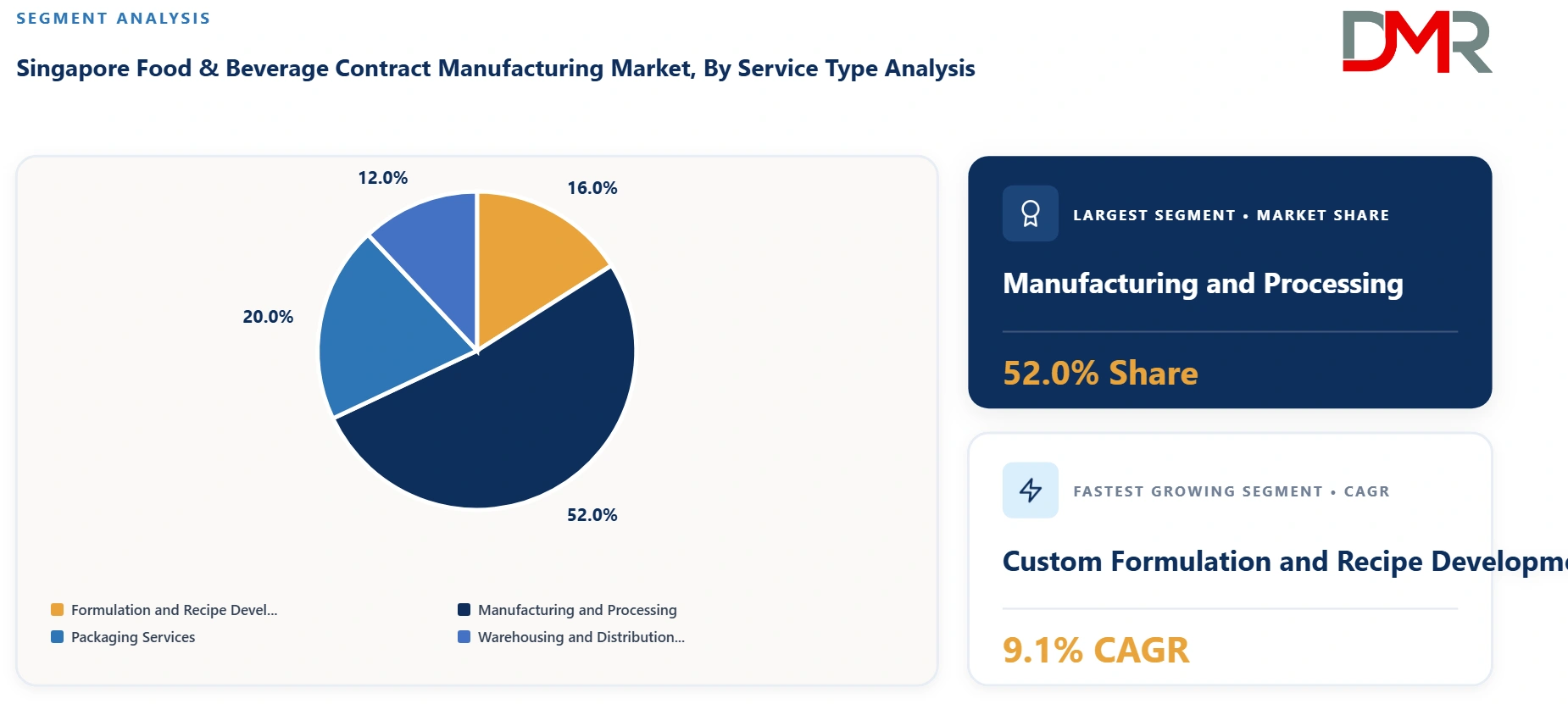
ℹ
To learn more about this report –
Download Your Free Sample Report Here
By Service Type Analysis
Manufacturing and Processing dominates with an estimated 52% share in 2026, reflecting the central role of cooking, blending, extrusion, freezing, thermal processing and other physical production activities in contract manufacturing. Packaging services represent approximately 20%, making them the second-largest sub-segment because many brands outsource filling, labelling and final pack assembly even when formulation or production is partially retained in-house. Custom formulation and recipe development accounts for approximately 16%, while warehousing and distribution support contributes about 12%. Custom Formulation and Recipe Development is the fastest-growing service sub-segment, at approximately 9.1% CAGR, supported by demand for functional foods, lower-sugar products, alternative proteins and differentiated Asian flavours. Singapore's FoodInnovate programme further supports this trend by providing shared production technologies and development resources that help companies commercialise products faster without making equivalent equipment investments.
By Food Category Analysis
Beverages represent the largest category at approximately 24% of 2026 market revenue, supported by demand for functional drinks, coffee, tea, juices, concentrates, sports beverages and private-label beverages. Bakery and Snacks follow with approximately 18%, benefiting from frozen bakery, confectionery and snack outsourcing, while Ready-to-Eat and Prepared Meals account for approximately 17%. Nutritional and Dietary Supplements are projected to be the fastest-growing category at 10.4% CAGR, driven by functional nutrition, protein products, metabolic-health positioning and premium wellness products. Singapore's beverage OEM ecosystem includes capabilities spanning formulation, contract packing and delivery, while newer ingredient technologies such as allulose are opening additional opportunities for lower-sugar functional beverages.
By Client Type Analysis
Large National and Multinational Brands hold the largest share at approximately 30% in 2026, reflecting their larger production volumes, complex SKU requirements and preference for outsourcing non-core manufacturing capabilities. Emerging and Small Brands account for approximately 28%, making them the second-largest client group, followed by Mid-Sized Regional Brands at 24% and Retailer Private Label Programs at 18%. Emerging and small brands are expected to be the fastest-growing client segment, with an estimated 9.8% CAGR, because outsourced manufacturing significantly reduces upfront capital requirements and accelerates time-to-market. Shared facilities and contract manufacturing platforms are particularly important for these customers because conventional manufacturers may impose minimum-order requirements that make early-stage market testing difficult.
By Facility Certification Analysis
Standard Certified facilities account for approximately 46% of 2026 revenue, representing mainstream manufacturers serving broad food categories under Singapore's food-safety licensing framework and internationally recognised quality systems. Kosher/Halal-certified facilities represent approximately 28%, reflecting the importance of Southeast Asian and Middle Eastern export markets and the strong demand for halal-compatible production. Allergen-Free/Free-From certified facilities account for around 16%, while Organic-Certified facilities contribute approximately 10%. Allergen-free/free-from manufacturing is expected to be the fastest-growing certification-oriented sub-segment at approximately 9.5% CAGR, supported by consumer demand for specialised diets and the premiumisation of food products. Certification and traceability are increasingly important differentiators because SFA licensing requires manufacturers to maintain food-safety controls and traceability systems.
The Singapore Food & Beverage Contract Manufacturing Market Report is segmented on the basis of the following:
By Service Type
- Formulation and Recipe Development
- Manufacturing and Processing
- Packaging Services
- Warehousing and Distribution Support
By Food Category
- Bakery and Snacks
- Beverages
- Dairy and Frozen Foods
- Sauces, Dressings and Condiments
- Nutritional and Dietary Supplements
- Ready-to-Eat and Prepared Meals
- Others
By Client Type
- Emerging and Small Brands
- Mid-Sized Regional Brands
- Large National and Multinational Brands
- Retailer Private Label Programs
By Facility Certification
- Organic-Certified
- Allergen-Free/Free-From Certified
- Kosher/Halal Certified
- Standard Certified
Regulatory Landscape
Singapore's contract-manufacturing market operates under a comparatively stringent food-safety framework administered by the Singapore Food Agency. Food processing establishments must be licensed, maintain suitable premises and process controls, and ensure qualified food handlers. Licences are generally valid for one year, with fees varying by establishment size. The regulatory environment raises compliance costs but simultaneously creates a competitive advantage for Singapore manufacturers selling to premium domestic and export customers. The SAFE framework introduced additional transparency around food-establishment grades from January 2026. Beverage manufacturers are also affected by the Beverage Container Return Scheme introduced from April 2026.
Investment and White Space Analysis
The strongest investment white spaces are functional beverages, nutritional supplements, alternative proteins, allergen-controlled products, small-batch manufacturing and digitally enabled co-packing. Singapore's combination of food-tech infrastructure, government support and regional connectivity makes it especially attractive for higher-value rather than commodity manufacturing. Contract manufacturers that offer low-to-medium minimum order quantities, rapid formulation, automated production and integrated regulatory support can capture underserved emerging-brand demand. Alternative-protein infrastructure is another strategic opportunity, as Singapore has explicitly developed contract-manufacturing capabilities to help FoodTech firms commercialise products without heavy capital expenditure.
Competitive Landscape
The Singapore food and beverage contract-manufacturing market is moderately fragmented, combining established food manufacturers, specialised beverage OEMs, private-label producers, alternative-protein platforms and smaller co-packers. Competition is increasingly based on production flexibility, food-safety credentials, technology, minimum order quantities, formulation expertise, packaging capabilities and export readiness rather than price alone. Larger manufacturers differentiate through scale and international distribution, while specialist providers compete through HPP, extrusion, functional-food formulation, allergen management or rapid product development. Partnerships, technology investments, new factories and expansion into regional markets are becoming more important strategic tools.
Some of the prominent players in the Singapore Food & Beverage Contract Manufacturing Market are:
- SATS Ltd.
- Country Foods
- Foodgnostic
- RM Food Manufacturing
- Foodfare
- FG Food Industries
- Mushan Foods
- Gourmet Supplies
- Juicy Folks
- Growthwell Foods
- Amoy Canning Corporation
- Tee Yih Jia Food Manufacturing
- Hock Seng Food
- Gold Kili Trading Enterprise
- Gold Roast Food Industry
- Future Enterprises
- Kawan Food Manufacturing
- Ben Foods
- Commonwealth Kokubu Logistics
- Sunshine Bakeries
- Prima Limited
- Gardenia Foods
- The Soup Spoon
- Del Monte Foods Singapore
- F&N Foods
- Yeo Hiap Seng
- Old Chang Kee
- Polar Puffs & Cakes
- Bengawan Solo
- BreadTalk Group
- Select Group
- Kimly Group
- Neo Group
- TungLok Group
- Elsie's Kitchen
- Eng Lee Food Industries
- Sin Hup Seng
- Chia Khim Lee Food Industries
- Chop Hup Chong Food Industries
- Chung Hwa Food Industries
- Other Key Players
Recent Developments
- In February 2026, Enterprise Singapore and IMDA refreshed the Food Manufacturing Industry Digital Plan, responding to AI advances and rising cost/manpower pressures; more than 90% of food manufacturers had adopted at least one sector-specific digital solution by 2025.
- In February 2026, Kwong Cheong Thye opened a new factory that is twice the size of its previous facility, incorporates advanced machinery and AGVs, and is expected to increase production capacity sixfold while supporting export expansion.
- In May 2025, Tee Yih Jia expanded its ready-to-eat and ambient-food portfolio while developing customised OEM solutions covering product concepts, mould design, production, packing and labelling for retail and B2B customers.
- In May 2025, Turion Labs launched in Singapore as a full-stack biotech innovation platform combining shared infrastructure, contract research and regulatory support, addressing the high infrastructure costs facing early-stage food and biotech ventures.
- In May 2025, Nurasa and Quality Meat introduced Q-protein, a hybrid meat product designed to deliver improved nutritional characteristics while retaining conventional meat taste and texture, with plans for local scale-up and exp
Report Details
| Report Characteristics |
| Market Size (2026) |
USD 0.93 Bn |
| Forecast Value (2035) |
USD 1.78 Bn |
| CAGR (2026–2035) |
7.5% |
| Historical Data |
2021 – 2025 |
| Forecast Data |
2026 – 2035 |
| Base Year |
2025 |
| Segments Covered |
By Service Type, By Food Category, By Client Type, By Facility Certification |
| Country Coverage |
Singapore |
Frequently Asked Questions
What is the Singapore Food & Beverage Contract Manufacturing market size in 2026?
▾ The Singapore Food & Beverage Contract Manufacturing market is estimated at USD 0.93 billion in 2026, covering outsourced manufacturing, formulation, packaging, private-label production, warehousing and related services.
What will the Singapore Food & Beverage Contract Manufacturing market size reach by 2035?
▾ The Singapore Food & Beverage Contract Manufacturing market is projected to reach approximately USD 1.78 billion by 2035, supported by outsourcing, convenience foods, functional nutrition and export-oriented production.
What is the expected CAGR of the Singapore Food & Beverage Contract Manufacturing market from 2026 to 2035?
▾ The Singapore Food & Beverage Contract Manufacturing market is forecast to grow at approximately 7.5% CAGR between 2026 and 2035, with specialised services growing faster.
What are the key factors driving the Singapore Food & Beverage Contract Manufacturing market?
▾ The Singapore Food & Beverage Contract Manufacturing market is driven by asset-light manufacturing, private-label expansion, convenience foods, FoodTech innovation, product complexity and regional export opportunities.
Which segment dominates the Singapore Food & Beverage Contract Manufacturing market?
▾ Manufacturing and Processing dominates the Singapore Food & Beverage Contract Manufacturing market, accounting for approximately 52% share in 2026, followed by Packaging Services.
Which is the fastest-growing segment in the Singapore Food & Beverage Contract Manufacturing market?
▾ Nutritional and Dietary Supplements are expected to be the fastest-growing segment in the Singapore Food & Beverage Contract Manufacturing market, expanding at approximately 10.4% CAGR.
Who are the major players in the Singapore Food & Beverage Contract Manufacturing market?
▾ Major participants in the Singapore Food & Beverage Contract Manufacturing market include Tee Yih Jia, Mushan Foods, Natural Fruits & Drinks, Juicy Folks, FG Food Industries and Asian Blending.
What are the key trends in the Singapore Food & Beverage Contract Manufacturing market?
▾ Key trends shaping the Singapore Food & Beverage Contract Manufacturing market include automation, AI-enabled manufacturing, functional foods, alternative proteins, private-label growth and integrated OEM/ODM services.