Singapore Food Innovation & Processing Technology Market Snapshot
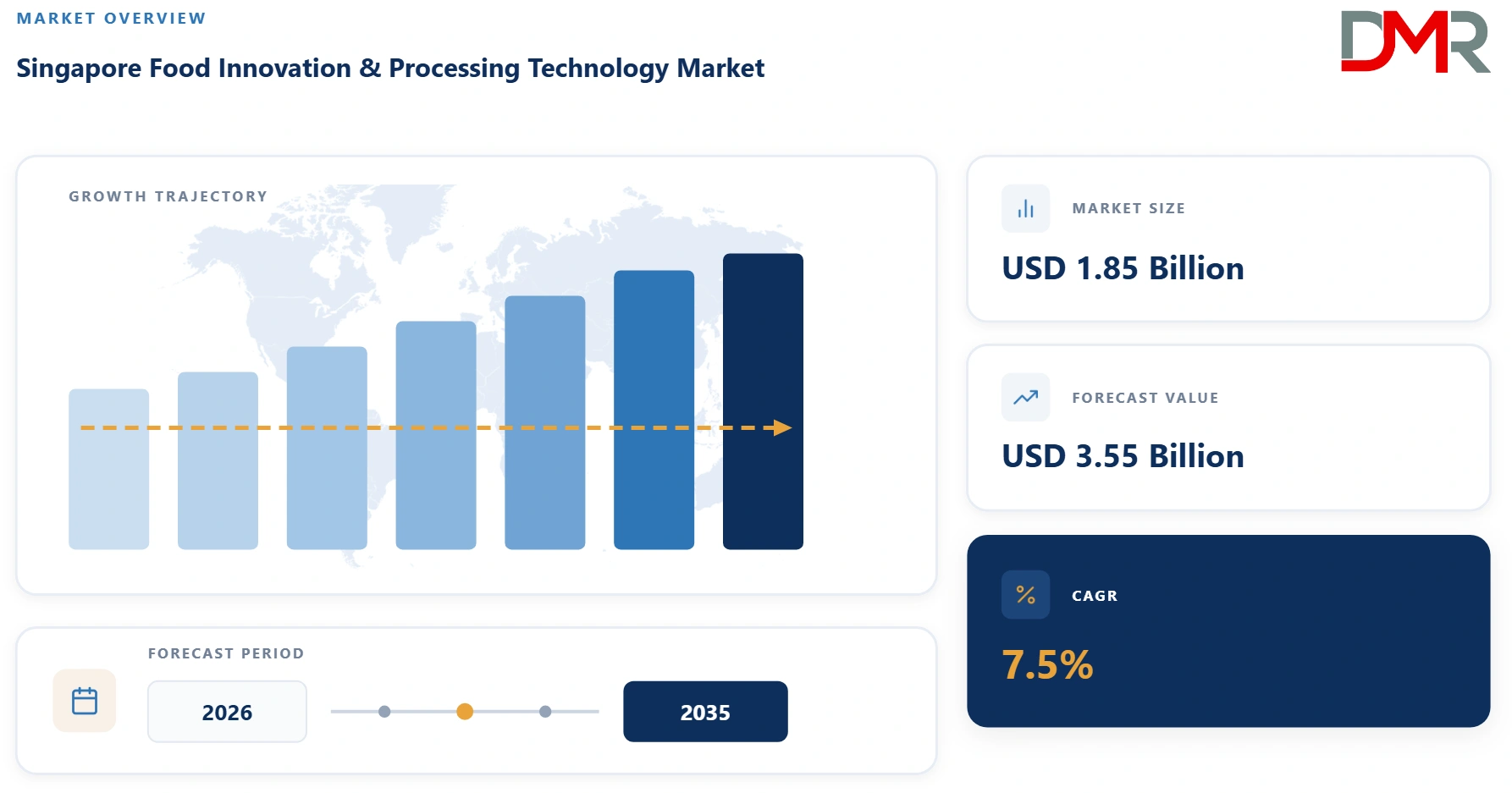
- Market Size, 2026: USD 1.85 billion
- Market Size, 2035: USD 3.55 billion
- CAGR, 2026–2035: 7.5%
- Leading Technology Segment, 2026: Food Processing Equipment, 41%
- Leading Processing Function, 2026: Thermal Processing, 23%
- Leading Food Category, 2026: Processed & Convenience Foods, 21%
- Leading End User, 2026: Food Manufacturers, 34%
- Fastest-Growing Segment: Digital Food Processing Technologies, 13.2% CAGR
What is the Singapore Food Innovation & Processing Technology and its Market Size?
The Singapore Food Innovation & Processing Technology market is estimated at USD 1.85 billion in 2026 and is projected to reach approximately USD 3.55 billion by 2035, representing a 7.5% CAGR.
ℹ
To learn more about this report –
Download Your Free Sample Report Here
The Singapore Food Innovation & Processing Technology market comprises technologies, equipment, software, automation systems and specialized processing solutions used to manufacture, preserve, inspect, package and commercialize food and beverage products in Singapore. It spans conventional equipment such as milling, mixing, thermal-processing and filling systems alongside robotics, manufacturing-execution systems, AI-enabled analytics, precision fermentation, alternative-protein processing, food-safety technologies and pilot-scale innovation infrastructure. The market's central value proposition is enabling manufacturers to produce safer, more consistent and higher-value foods with lower labor intensity, better resource efficiency and faster product-development cycles. Singapore's strong R&D infrastructure and role as a Southeast Asian commercialization hub further expand demand for advanced processing technologies.
Use Cases
- Automated production: Robotics and automated lines reduce manual intervention and improve throughput, consistency and worker productivity.
- Smart quality control: Machine vision, sensors and analytics identify defects, contamination risks and process deviations in real time.
- Energy-efficient processing: Advanced heating, evaporation and refrigeration systems reduce energy consumption and production costs.
- Novel-food commercialization: Fermentation, cultivated-food and alternative-protein platforms help companies move innovations from laboratory to commercial scale.
- Digital traceability: MES, IoT and integrated data systems provide batch-level visibility across production and quality processes.
- Product development: Pilot plants, sensory laboratories and food-design centers accelerate formulation, testing and regional commercialization.
Key Takeaways
- Market Size: The market is estimated at USD 1.85 billion in 2026, reaching USD 3.55 billion by 2035.
- Growth: The forecast 7.5% CAGR reflects increasing technology intensity within Singapore's food-manufacturing sector.
- Primary Driver: Labor constraints and productivity requirements are accelerating robotics, automation, MES and AI adoption.
- Technology Leadership: Conventional food-processing equipment remains the largest technology category, while digital technologies grow substantially faster.
- Fastest Growth: Digital Food Processing Technologies are projected to grow at approximately 13.2% CAGR.
- Innovation: Singapore's FoodInnovate ecosystem has supported more than 650 new innovative products and a network of 16 shared R&D and pilot-production facilities.
How AI/Gen AI is Transforming the Singapore Food Innovation & Processing Technology Market?
AI is increasingly being embedded into manufacturing analytics, predictive maintenance, machine vision, production scheduling, demand forecasting and automated ordering. Singapore's refreshed 2026 Food Manufacturing Industry Digital Plan explicitly incorporates AI and generative AI, including manufacturing analytics and predictive-maintenance applications. At Kwong Cheong Thye, an MES monitors fermentation variables such as temperature and humidity and is expected to increase soya-sauce yields from approximately 70% to 90%.
The principal benefits are improved yield, lower downtime, greater process consistency, reduced administrative workload and better utilization of scarce skilled labor. AI also enables manufacturers to convert previously disconnected machine, quality and production data into actionable operating intelligence.
Key Drivers in the Singapore Food Innovation & Processing Technology Market
Labor Constraints and Productivity Imperatives
Singapore's high operating costs and structural manpower constraints are among the strongest catalysts for food-processing automation. Food manufacturers increasingly require equipment that can perform repetitive handling, filling, sorting, packaging, inspection and material movement with fewer workers. The government's 2026 digital plan specifically identifies rising operational costs, manpower constraints and productivity pressures as key challenges facing food manufacturers. Automation therefore shifts from an optional productivity investment to a strategic necessity. Robotics, automated guided vehicles, MES and machine vision are particularly attractive because they address both labor availability and production consistency.
Regional Demand and Singapore's Innovation-Hub Position
Singapore's food-processing technology market benefits from its position as a regional headquarters, R&D and commercialization hub. Multinational food companies use Singapore to develop products for Asian consumers, while local companies use its infrastructure to export finished foods and technologies. Singapore's FoodInnovate ecosystem has already generated hundreds of innovative products and developed shared R&D and pilot-production infrastructure. This creates demand not only for production equipment but also for pilot-scale processing, sensory science, formulation, alternative proteins and digital manufacturing.
Restraints in the Singapore Food Innovation & Processing Technology Market
High Capital Expenditure and Limited SME Investment Capacity
Advanced processing equipment, robotics, MES platforms, machine vision and novel-food production systems require significant upfront investment. Smaller food manufacturers can struggle to justify capital-intensive projects when production volumes are relatively low or product portfolios change frequently. Integration costs can extend beyond equipment procurement to include facility modification, software integration, cybersecurity, employee training and validation. The result is a two-speed market in which larger manufacturers adopt sophisticated automation rapidly while smaller companies frequently begin with lower-cost cloud, ERP, analytics or individual automation solutions.
Regulatory and Technical Complexity for Novel Foods
Novel food technologies face more stringent technical requirements than conventional food-processing applications. Singapore requires pre-market approval for novel foods, including products involving certain cell-culture, fermentation and other emerging technologies. The framework requires scientific evidence addressing toxicity, allergenicity, production-method safety and dietary exposure.
Growth Opportunities in the Singapore Food Innovation & Processing Technology Market
AI-Enabled Smart Factories
The largest technology opportunity lies in combining conventional food-processing machinery with AI, IoT sensors, MES, machine vision and predictive analytics. Singapore is particularly suitable for this transition because its manufacturers operate in a digitally sophisticated industrial environment and increasingly need to offset labor and cost pressures. The refreshed IDP explicitly organizes solutions around optimizing manufacturing and scaling operations.
Alternative Proteins and Precision Fermentation
Alternative proteins, fermentation-derived ingredients and other novel food technologies offer a high-value growth avenue. Singapore has developed a relatively mature ecosystem of shared facilities, contract manufacturing and regulatory expertise that can help food-tech companies progress from laboratory validation to commercial production. ScaleUp Bio, for example, provides submerged microbial and precision-fermentation capabilities for food-tech companies.
Trends in the Singapore Food Innovation & Processing Technology Market
Shift from Standalone Machinery to Connected Production Platforms
Food manufacturers increasingly prefer integrated production systems rather than isolated machines. MES, sensors, robotics, machine vision and analytics are being combined to provide real-time visibility over production and quality. Singapore's refreshed digital plan reflects this shift toward manufacturing optimization and data-driven operations.
Sustainability Moving into Process-Equipment Procurement
Energy consumption, water use, waste reduction and carbon intensity are increasingly incorporated into equipment decisions. Efficient evaporators, heat recovery, electrification and resource-monitoring systems can lower operating costs while supporting corporate sustainability objectives.
Research Scope and Analysis
The market is segmented by Technology, Processing Function, Food Category and End User. These dimensions capture equipment and software demand, production processes, downstream application markets and purchasing organizations. Estimates reflect Singapore-based technology spending and associated food-manufacturing applications rather than the value of food products themselves.
ℹ
To learn more about this report –
Download Your Free Sample Report Here
By Technology Analysis
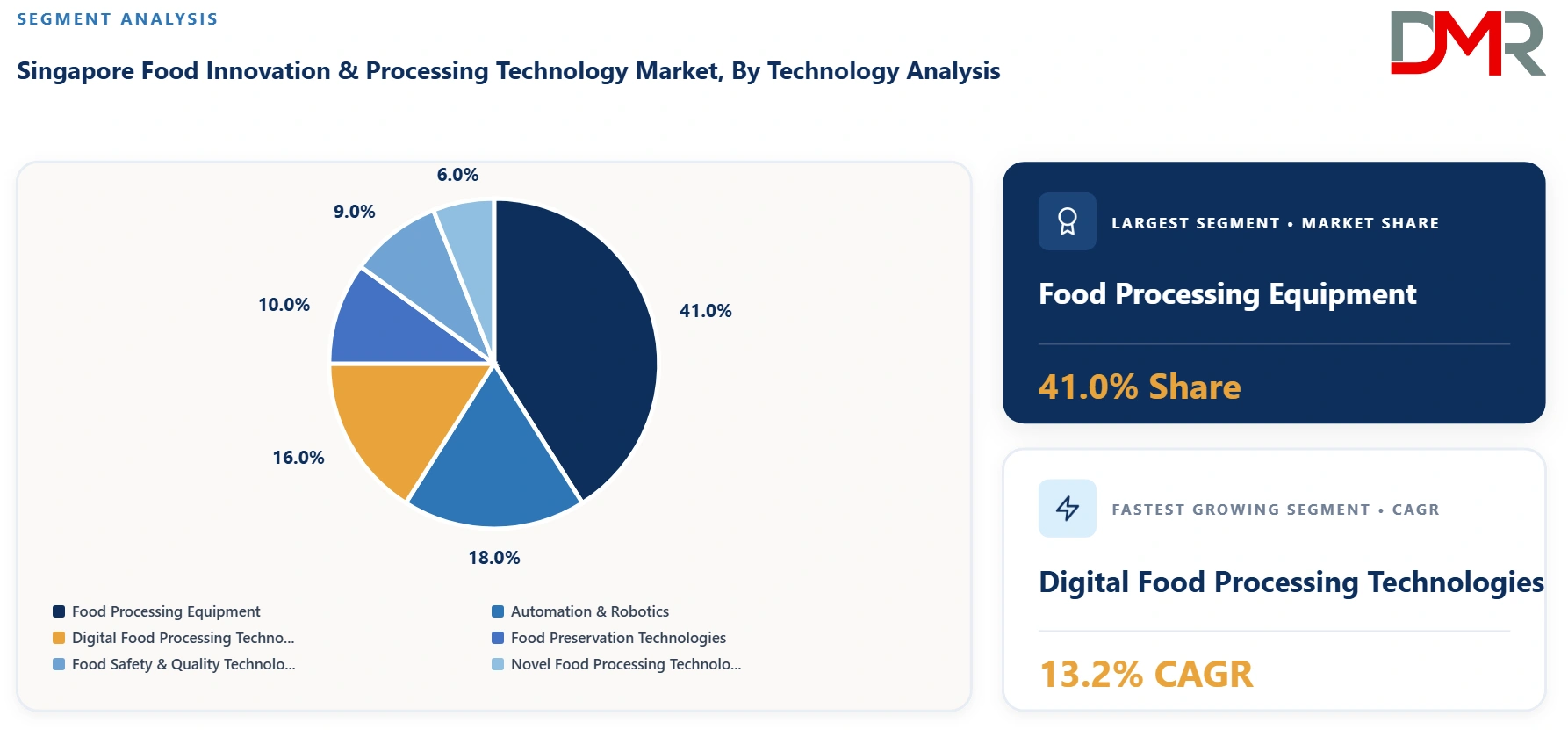
Food Processing Equipment is estimated to be the dominant technology segment in 2026, accounting for approximately 41% of market revenue. Its leadership reflects the large installed base of conventional processing requirements thermal systems, mixers, milling equipment, filling lines, filtration systems and related machinery which remain essential even as factories digitalize. Automation & Robotics is the second-largest segment at approximately 18%, supported by labor constraints and productivity requirements. Digital Food Processing Technologies account for around 16% but represent the fastest-growing segment, at approximately 13.2% CAGR, as manufacturers increasingly deploy MES, manufacturing analytics, AI, IoT and predictive maintenance. Food Preservation Technologies represent roughly 10%, while Food Safety & Quality Technologies account for about 9%. Novel Food Processing Technologies represent approximately 6% today but have strategic importance because precision fermentation, cultivated food and alternative-protein processing can command higher technology intensity. The market is consequently transitioning from machinery-centric procurement toward integrated physical-digital production environments.
By Processing Function Analysis
Thermal Processing is estimated to lead the processing-function segment with approximately 23% share in 2026, reflecting its broad application across beverages, dairy, sauces, ready meals, bakery products and other processed foods. Mixing & Blending is the second-largest category at approximately 16%, driven by high-volume applications across beverages, sauces, dairy, nutraceutical foods and processed foods. Inspection & Quality Control is expected to be the fastest-growing function, with an estimated 11.8% CAGR, supported by increasing food-safety requirements, automated machine vision, traceability and real-time process monitoring. Size Reduction & Milling accounts for roughly 12%, followed by Filling & Dosing at 11%, Separation & Filtration at 10%, Drying & Dehydration at 9%, Forming & Extrusion at 6% and Fermentation at 5%. Fermentation nevertheless has disproportionately high strategic value because precision-fermentation applications can generate new demand for bioreactors, downstream separation, purification and drying technologies.
By Food Category Analysis
Processed & Convenience Foods is estimated to be the leading food-category application, representing approximately 21% of technology demand in 2026. Singapore's urban consumer base, foodservice ecosystem and export-oriented manufacturers support continued investment in ready-to-eat, ready-to-cook and shelf-stable products. Beverages represent the second-largest category at around 17%, benefiting from substantial production of malt beverages, dairy alternatives, functional beverages and specialty drinks. Plant-Based Foods are forecast to be the fastest-growing category at approximately 12.5% CAGR, supported by innovation in alternative proteins, formulation and sustainable food production. Dairy & Dairy Alternatives account for 14%, bakery & confectionery 13%, meat/poultry/seafood 10%, grains & cereals 8%, fruits & vegetables 6% and functional/nutraceutical foods 5%. Demand is increasingly shifting toward flexible production lines capable of producing multiple formulations and smaller batches.
By End User Analysis
Food Manufacturers represent the largest end-user group at approximately 34% of the 2026 market, reflecting their broad requirements for processing machinery, automation, quality systems and digital production infrastructure. Beverage Manufacturers are the second-largest group at approximately 15%, with significant requirements for thermal treatment, blending, filling, packaging and process control. Contract Food Manufacturers are expected to be the fastest-growing end-user category at approximately 11.2% CAGR, as startups and emerging brands increasingly outsource production rather than build dedicated factories. Dairy processors account for 11%, meat & seafood processors 10%, bakery & confectionery manufacturers 8%, ingredient manufacturers 7% and foodservice/commercial kitchens 7%. The contract-manufacturing opportunity is particularly important for alternative proteins and precision-fermentation businesses because shared infrastructure reduces upfront capital requirements and accelerates commercialization.
The Singapore Food Innovation & Processing Technology Market Report is segmented on the basis of the following:
By Technology
- Food Processing Equipment
- Automation & Robotics
- Digital Food Processing Technologies
- Food Preservation Technologies
- Food Safety & Quality Technologies
- Novel Food Processing Technologies
By Processing Function
- Size Reduction & Milling
- Mixing & Blending
- Separation & Filtration
- Thermal Processing
- Drying & Dehydration
- Fermentation
- Forming & Extrusion
- Filling & Dosing
- Inspection & Quality Control
By Food Category
- Meat, Poultry & Seafood
- Dairy & Dairy Alternatives
- Bakery & Confectionery
- Fruits & Vegetables
- Grains & Cereals
- Processed & Convenience Foods
- Beverages
- Plant-Based Foods
- Functional & Nutraceutical Foods
By End User
- Food Manufacturers
- Beverage Manufacturers
- Dairy Processors
- Meat & Seafood Processors
- Bakery & Confectionery Manufacturers
- Ingredient Manufacturers
- Contract Food Manufacturers
- Foodservice & Commercial Kitchens
Regulatory Landscape
Singapore's regulatory environment is simultaneously a market enabler and a barrier to entry. The Food Safety and Security Act and associated 2025 regulations formalize requirements for defined foods, including novel and genetically modified foods, while SFA requires pre-market approval for applicable novel foods. This favors technology suppliers capable of providing validated, traceable and hygienically designed processing systems. The opportunity is strongest in technologies that generate auditable process data, support HACCP/GFSI-oriented controls and simplify regulatory documentation. The principal risk is longer commercialization cycles for emerging food technologies, particularly cultivated foods and novel fermentation products, where manufacturing-process changes may require further assessment.
Investment and White Space Analysis
Investment white space is concentrated in AI-enabled process optimization, energy-efficient thermal processing, inspection automation, fermentation scale-up, downstream processing and modular contract manufacturing. Singapore's ecosystem already contains shared pilot infrastructure and food-tech companies, reducing the need to build capabilities entirely from scratch. The largest whitespace is therefore not basic equipment but integrated technology stacks connecting equipment, software, quality data and sustainability metrics. Suppliers that can combine machine vision, MES, AI analytics and predictive maintenance with hygienic equipment have an opportunity to capture higher-value recurring revenue. Another attractive niche is modular processing infrastructure for emerging brands, enabling flexible small-batch production without major capital expenditure.
Competitive Landscape
The Singapore market is moderately fragmented at the technology-supplier level but relatively concentrated among multinational equipment, ingredient and food-technology companies. Competition occurs across equipment performance, automation capability, food-safety credentials, energy efficiency, engineering support and lifecycle service. Large international players compete alongside specialist Asian suppliers and local system integrators. Major strategies include technology partnerships, R&D-center investments, regional headquarters, acquisitions, customer co-development and expansion into alternative proteins. Singapore's attractiveness as an Asian innovation hub is encouraging multinational companies to locate food-design, pilot-production and R&D capabilities locally. dsm-firmenich, Cargill and Nestlé are examples of companies using Singapore facilities to develop and commercialize food innovations for Asian and global markets.
Some of the prominent players in the Singapore Food Innovation & Processing Technology Market are:
- Tetra Pak
- GEA Group
- Bühler Group
- Krones
- JBT Marel
- Ishida
- MULTIVAC
- Syntegon Technology
- Alfa Laval
- SPX FLOW
- Heat and Control
- IMA Group
- Shibuya Corporation
- Shikoku Kakoki
- Fuji Machinery
- Ishikawa Seisakusho
- Yamato Scale
- FANUC
- Mitsubishi Electric
- Omron
- Keyence
- Yaskawa Electric
- Siemens
- ABB
- Rockwell Automation
- Schneider Electric
- Beckhoff Automation
- Bosch Rexroth
- SMC Corporation
- Fuji Electric
- Yokogawa Electric
- Azbil Corporation
- Food Pro Industries
- Meyasu
- Global Machinery
- Prosper Automated Technology
- Robodizz Solutions
- Soon Hoe Industrial Automation
- Solutionpack Machinery
- Key Technology
- Other Key Players
Recent Developments
- February 2026: Singapore refreshed its Food Manufacturing Industry Digital Plan, introducing expanded AI, manufacturing analytics, MES and logistics-control capabilities for more than 1,500 food manufacturers.
- January 2026: Haid launched a Singapore production and R&D facility focused on advanced animal and aquaculture nutrition, technology transfer, traceability and regional manufacturing capabilities.
- April 2025: Cargill opened a transformed Innovation Center in Singapore to accelerate food innovation for Asian markets, supporting product development across beverages, bakery, chocolate, sauces and alternative-protein-related applications.
- January 2025: German specialty-chemicals company MÜNZING established its Asia-Pacific headquarters in Singapore, alongside a 500-square-meter warehouse supporting regional distribution of food-processing additives and other products.
Report Details
| Report Characteristics |
| Market Size (2026) |
USD 1.85 Bn |
| Forecast Value (2035) |
USD 3.55 Bn |
| CAGR (2026–2035) |
7.5% |
| Historical Data |
2021 – 2025 |
| Forecast Data |
2026 – 2035 |
| Base Year |
2025 |
| Segments Covered |
By Technology, By Processing Function, By Food Category, By End User |
| Country Coverage |
Singapore |
Frequently Asked Questions
What is the Singapore Food Innovation & Processing Technology Market size in 2026?
▾ The Singapore Food Innovation & Processing Technology Market is estimated at approximately USD 1.85 billion in 2026, covering processing equipment, automation, digital technologies, preservation and emerging processing solutions.
What will the Singapore Food Innovation & Processing Technology Market be worth in 2035?
▾ The Singapore Food Innovation & Processing Technology Market is projected to reach approximately USD 3.55 billion by 2035, supported by automation, digitalization and food-innovation investment.
What is the CAGR of the Singapore Food Innovation & Processing Technology Market from 2026 to 2035?
▾ The Singapore Food Innovation & Processing Technology Market is expected to expand at approximately 7.5% CAGR during 2026–2035.
What are the key factors driving the Singapore Food Innovation & Processing Technology Market?
▾ The Singapore Food Innovation & Processing Technology Market is driven by labor constraints, manufacturing-cost pressures, food-safety requirements, sustainability targets, AI adoption and Singapore's regional food-tech hub position.
Which technology segment dominates the Singapore Food Innovation & Processing Technology Market?
▾ Food Processing Equipment dominates the Singapore Food Innovation & Processing Technology Market, accounting for approximately 41% of the market in 2026.
Which is the fastest-growing segment in the Singapore Food Innovation & Processing Technology Market?
▾ Digital Food Processing Technologies are expected to be the fastest-growing segment in the Singapore Food Innovation & Processing Technology Market, registering an estimated 13.2% CAGR.
Who are the key players in the Singapore Food Innovation & Processing Technology Market?
▾ The Singapore Food Innovation & Processing Technology Market includes multinational food and ingredient companies, processing-equipment suppliers, automation providers, technology specialists, contract manufacturers and Singapore-based food-tech companies.
What are the major trends shaping the Singapore Food Innovation & Processing Technology Market?
▾ Major trends in the Singapore Food Innovation & Processing Technology Market include AI-enabled manufacturing, robotics, smart quality control, predictive maintenance, sustainable processing, digital traceability and alternative-protein technologies.
How is AI impacting the Singapore Food Innovation & Processing Technology Market?
▾ AI is transforming the Singapore Food Innovation & Processing Technology Market through predictive maintenance, manufacturing analytics, machine vision, production optimization, quality control and automated decision-making.
How is regulation affecting the Singapore Food Innovation & Processing Technology Market?
▾ Regulation influences the Singapore Food Innovation & Processing Technology Market through food-safety requirements, novel-food approvals, manufacturing validation, traceability and compliance requirements for emerging processing technologies.
What are the major applications of the Singapore Food Innovation & Processing Technology Market?
▾ Major applications of the Singapore Food Innovation & Processing Technology Market include thermal processing, mixing, milling, fermentation, drying, filling, inspection, preservation, automation and digital production management.
What is the segmentation of the Singapore Food Innovation & Processing Technology Market?
▾ The Singapore Food Innovation & Processing Technology Market is segmented by Technology, Processing Function, Food Category and End User, covering conventional and emerging food-processing applications.