Market Snapshot
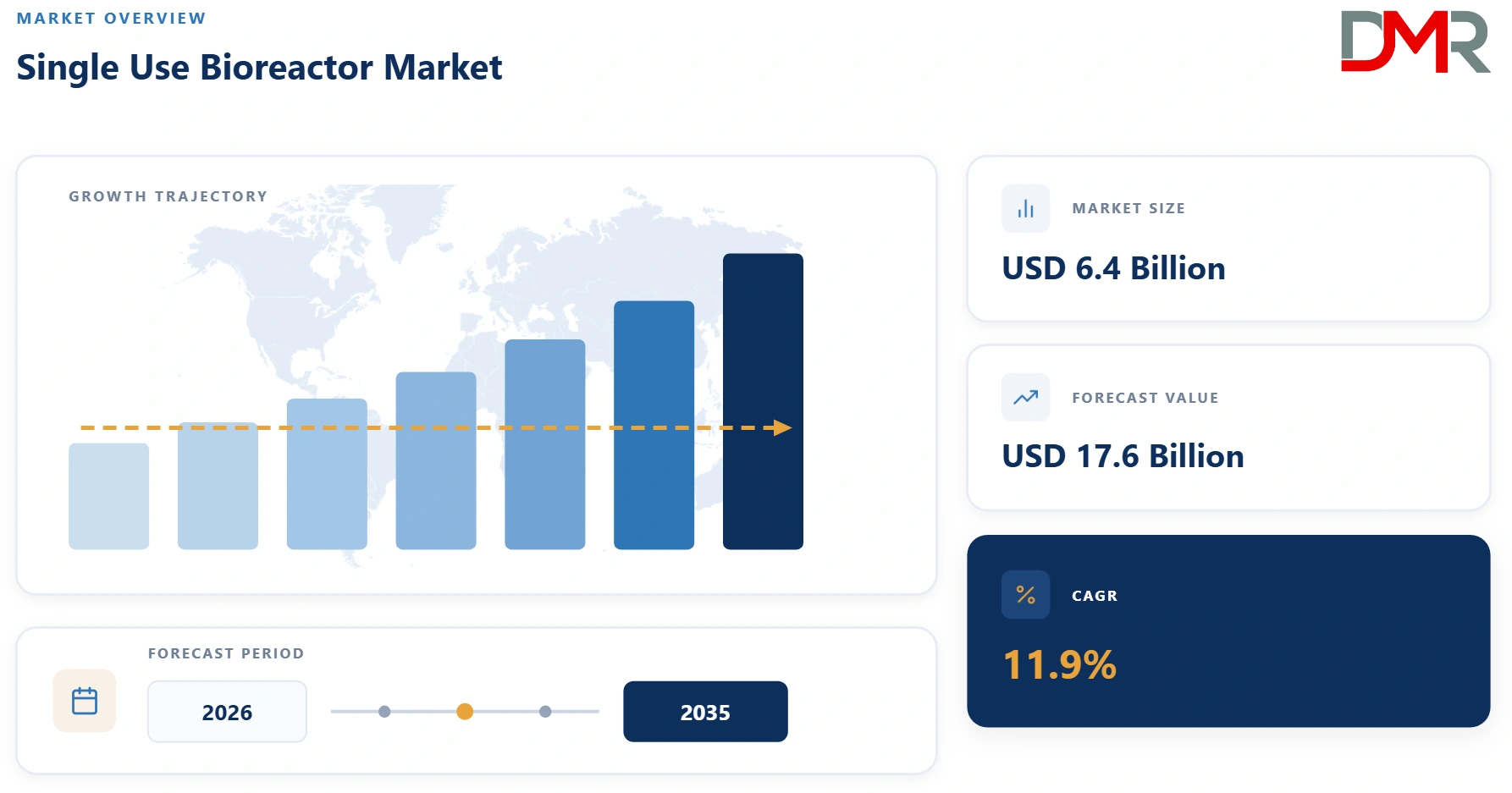
- Market Size (2026): USD 6.4 Bn
- Forecast Value (2035): USD 17.6 Bn
- CAGR (2026-2035): 11.9%
- Largest Region (2026): North America, approximately 41.6%
- Fastest-Growing Region: Asia-Pacific
- Leading Product Type (2026): Stirred-tank Single-use Bioreactors, around 72.4%
- Leading Application (2026): Monoclonal Antibodies, close to 43.7%
- Key Players: Sartorius AG, Thermo Fisher Scientific Inc., Cytiva, and Others
What is Single Use Bioreactor Market and its Market Size?
Global Single Use Bioreactor Market size is estimated to reach USD 6.4 Bn in 2026 and is further anticipated to reach USD 17.6 Bn by 2035, at a CAGR of 11.9%.
ℹ
To learn more about this report –
Download Your Free Sample Report Here
A single-use bioreactor is a controlled cultivation system in which the product-contact vessel and associated fluid path are supplied as sterile disposable components, normally polymer bags, tubing, connectors, filters, and sensors. The market includes stirred-tank, rocking, airlift, bubble-column, and fermentation platforms from benchtop development scale through commercial production. Revenue encompasses reusable hardware, control units, disposable vessels, integrated sensing, and selected platform services. Conventional stainless-steel reactors, general laboratory shakers, media, downstream purification equipment, and unrelated single-use assemblies are excluded unless sold as an integral bioreactor package.
Biopharmaceutical manufacturers use these systems for monoclonal antibodies, vaccines, recombinant proteins, biosimilars, viral vectors, engineered cells, and other biologics. Procurement decisions center on mass transfer, mixing, shear profile, working-volume flexibility, automation, closed processing, film integrity, extractables and leachables data, scale-up comparability, and supply assurance. Operators also assess the installed controller base, compatibility with process analytical technology, validation support, bag-change ergonomics, and the availability of qualified consumables across manufacturing sites.
The economic proposition differs from fixed stainless-steel capacity. Single-use platforms can reduce cleaning and sterilization infrastructure, lower water and steam demand, shorten changeovers, and support multi-product facilities with smaller initial capital commitments. These benefits are valuable for clinical pipelines, uncertain demand, regional manufacturing, and contract production. At very large and highly utilized scales, consumable spending, waste management, oxygen-transfer limits, and dependence on proprietary bags can narrow the advantage.
Structural growth is linked to the expanding biologics pipeline, increased outsourcing to contract manufacturers, adoption of modular facilities, and commercial interest in intensified fed-batch and perfusion processes. Cell and gene therapy adds demand for smaller closed systems, while new high-volume designs extend the addressable commercial scale. Suppliers that combine consistent vessel geometry, scalable automation, strong validation packages, dual-source strategies, and responsive technical support are positioned to capture recurring consumables revenue and long-term platform relationships.
Use Cases
- Monoclonal Antibody Manufacturing: Biopharmaceutical producers use stirred-tank single-use systems for seed expansion, fed-batch production, and intensified perfusion, reducing turnaround between campaigns while maintaining controlled mixing, gas transfer, temperature, and pH across clinical and commercial batches.
- Cell and Gene Therapy Processing: Developers employ closed, low-volume bioreactors for T-cell, stem-cell, viral-vector, and other advanced therapy workflows where contamination control, gentle agitation, traceable data, and rapid transfer from process development to manufacturing are central requirements.
- Vaccine and Recombinant Protein Production: Manufacturers deploy disposable reactors for mammalian, insect, yeast, and selected microbial cultures, enabling flexible campaign scheduling and faster facility changeover when responding to multiple antigens, regional demand, or variable product forecasts.
- CDMO Multi-product Facilities: Contract manufacturers standardize single-use platforms across development suites and production lines to serve diverse clients, limit product carryover, shorten cleaning validation, and add capacity in modular increments without committing to a dedicated stainless-steel train.
Key Takeaways
- Market Size & Share: Global revenue is estimated at USD 6.4 Bn in 2026 and is forecast to reach USD 17.6 Bn by 2035.
- Product Type Analysis: Single-use Fermenters are projected to expand fastest at a CAGR of 14.8% between 2026 and 2035.
- Working Volume Analysis: The 1,001-2,000 L category is expected to lead with approximately 36.5% of 2026 revenue.
- Application Analysis: Monoclonal Antibodies account for an estimated 43.7%, while Cell and Gene Therapies grow at 15.9% CAGR.
- Regional Analysis: North America contributes about 41.6% of 2026 revenue, while Asia-Pacific is forecast to grow at 14.4% CAGR.
- Competitive Dynamics: The ten profiled suppliers are estimated to represent nearly 68.0% of platform and vessel revenue, with recurring consumables reinforcing installed-base competition.
How AI/Gen AI is Transforming the Single Use Bioreactor Market?
Artificial intelligence is improving how single-use bioreactors are developed, scaled, and controlled. Models trained on historical runs can relate agitation, gas flow, feed strategy, temperature, pH, dissolved oxygen, viable cell density, and metabolite profiles to productivity and quality outcomes. This supports earlier detection of process drift, faster design-of-experiments work, and more informed scale transfer. Equipment suppliers are also connecting controller data, in-line sensors, and digital twins to recommend operating ranges or maintenance actions while retaining operator approval.
Generative AI is being evaluated as an engineering and knowledge-management layer. It can organize batch records, summarize deviations, retrieve approved procedures, draft validation content for expert review, and help teams compare recipes across vessel sizes. Its value depends on structured data, controlled vocabularies, traceable source material, cybersecurity, and clear limits on autonomous action. Because bioreactor decisions can affect product quality, qualified control logic and human oversight remain essential.
- Soft Sensors: Predictive models estimate biomass, metabolites, or product titer from available process signals when direct measurement is delayed or impractical.
- Adaptive Process Control: Models recommend feed, agitation, and aeration adjustments within validated boundaries to stabilize culture performance.
- Scale-up Modeling: Digital twins compare mixing, oxygen transfer, and shear conditions across development and manufacturing vessels.
- Deviation Assistance: Controlled generative tools summarize alarms, trends, batch history, and approved procedures for investigation teams.
Key Drivers in the Global Single Use Bioreactor Market
Expansion of Biologics and Advanced Therapy Pipelines
Biopharmaceutical pipelines increasingly include monoclonal antibodies, recombinant proteins, vaccines, viral vectors, and cell-based therapies that require controlled cultivation. Many programs enter development with uncertain clinical outcomes and variable commercial demand, making flexible capacity more attractive than a dedicated stainless-steel facility. Single-use bioreactors allow companies to begin with small development vessels, scale through comparable platforms, and add production units as demand becomes clearer. The approach also supports distributed manufacturing and smaller patient populations. As more molecules progress into clinical and commercial production, demand expands for both reusable control hardware and recurring sterile vessels, sensors, tubing, and connectors.
Shift Toward Modular Multi-product Manufacturing
Manufacturers and CDMOs are designing facilities that can change campaigns quickly, serve multiple clients, and enter operation with less fixed utility infrastructure. Disposable product-contact paths reduce cleaning and sterilization requirements, limit cross-product carryover, and shorten changeover tasks. They can also lower initial capital needs for water-for-injection, clean steam, and large fixed vessels. These advantages are especially relevant to regional biologics capacity, clinical manufacturing, and facilities that manage diverse portfolios. Standardizing vessel families and automation across scales further reduces technology-transfer friction. The resulting installed base creates recurring demand for qualified bags and assemblies throughout each system's operating life.
Restraints in the Global Single Use Bioreactor Market
Consumable Integrity, Supply Dependence, and Qualification Burden
A single-use reactor relies on a sterile polymer vessel and numerous welded or connected components. Film defects, leaks, transport damage, connector failure, sensor variation, or delayed consumable delivery can interrupt valuable batches. Buyers therefore require extensive extractables and leachables data, supplier change notification, integrity testing, lot traceability, and contingency inventory. Proprietary bag designs can also create dependence on one supplier after a platform is validated. Dual sourcing is difficult when geometry, materials, and interfaces differ. Manufacturers must balance the operational benefits of disposability against recurring qualification work, supply-chain exposure, storage requirements, and the financial impact of holding critical consumables.
Scale, Mass-transfer, and Waste-management Constraints
Single-use systems are not optimal for every process. Very large volumes, demanding microbial oxygen-transfer requirements, high heat loads, abrasive media, or continuous use can favor stainless-steel equipment. Polymer films and disposable assemblies also create solid waste that must be segregated, treated, or incinerated under local rules. Although water and energy savings may offset part of the environmental burden, buyers increasingly request credible life-cycle data and recycling options. At higher commercial scales, operators must manage bag handling, mixing uniformity, pressure limits, and facility logistics. These constraints slow adoption where production is stable, campaigns are long, and existing stainless assets remain fully utilized.
Growth Opportunities in the Global Single Use Bioreactor Market
High-volume and Intensified Single-use Production
Larger vessel designs and higher-productivity cell culture are extending single-use processing into commercial volumes previously associated with stainless steel. Systems above 2,000 L, combined with intensified fed-batch or perfusion, can raise output without matching increases in facility footprint. This creates opportunities in new biologics plants, capacity expansions, and regional production hubs. Suppliers can differentiate through improved gas transfer, low working-volume capability, stable mixing, integrated perfusion interfaces, and scalable control recipes. Commercial adoption will depend on demonstrating consistent performance, manageable bag installation, reliable supply, and economics across multiple annual campaigns. Process-development services that translate cell-line needs into qualified scale-up strategies provide additional revenue.
Closed Platforms for Cell Therapy and Distributed Manufacturing
Advanced therapies require smaller batches, strict contamination control, and manufacturing models that may be centralized, regional, or close to treatment centers. Compact single-use bioreactors can support cell expansion and vector production within closed workflows, reducing open manipulations and cleanroom dependence. Opportunity exists for systems that combine gentle mixing, automated media exchange, in-line sensing, electronic records, and standardized disposable kits. Vendors can also develop scale-out orchestration software and service models for networks of parallel reactors. Success requires compatibility with fragile cells, validated materials, repeatable operator procedures, and economic fit for low-volume products. Partnerships with therapy developers and CDMOs can speed platform qualification.
Trends in the Global Single Use Bioreactor Market
Process Intensification and Perfusion-ready Design
Biomanufacturers are increasing viable cell density and volumetric productivity through concentrated fed-batch, continuous fed-batch, and perfusion strategies. Reactor design is responding with improved impellers, gas transfer, turndown capability, cell-retention interfaces, and sensors suited to longer processes. Higher output from a smaller vessel can reduce facility footprint and shift the scale decision in favor of disposables. The tradeoff is greater process complexity, media consumption, and reliance on stable automation. Suppliers are therefore integrating bioreactors with perfusion devices, feed systems, analytics, and digital models. Platform comparisons increasingly emphasize productivity per square meter and cost per gram rather than nominal vessel volume alone.
Sustainable Materials and Circularity Programs
Customers are asking suppliers to reduce fossil-based content, packaging, transport volume, and end-of-life impacts without changing qualified product performance. Vendors are introducing mass-balance certified polymers, lighter assemblies, take-back pilots, and waste-treatment partnerships. Sustainability claims are moving toward quantified life-cycle assessment that accounts for manufacturing, transport, cleaning utilities avoided, and disposal. Adoption remains complex because bioprocess waste can be contaminated and multiple polymer types are difficult to separate. Even so, procurement teams increasingly include carbon, water, and waste criteria alongside quality and cost. Suppliers that preserve film integrity and regulatory documentation while offering credible circularity pathways can strengthen long-term platform relationships.
Research Scope and Analysis
The report evaluates product type working volume cell type application and end user while identifying the leading revenue category and the highest growth category within each axis across the 2026 to 2035 forecast period.
ℹ
To learn more about this report –
Download Your Free Sample Report Here
By Product Type
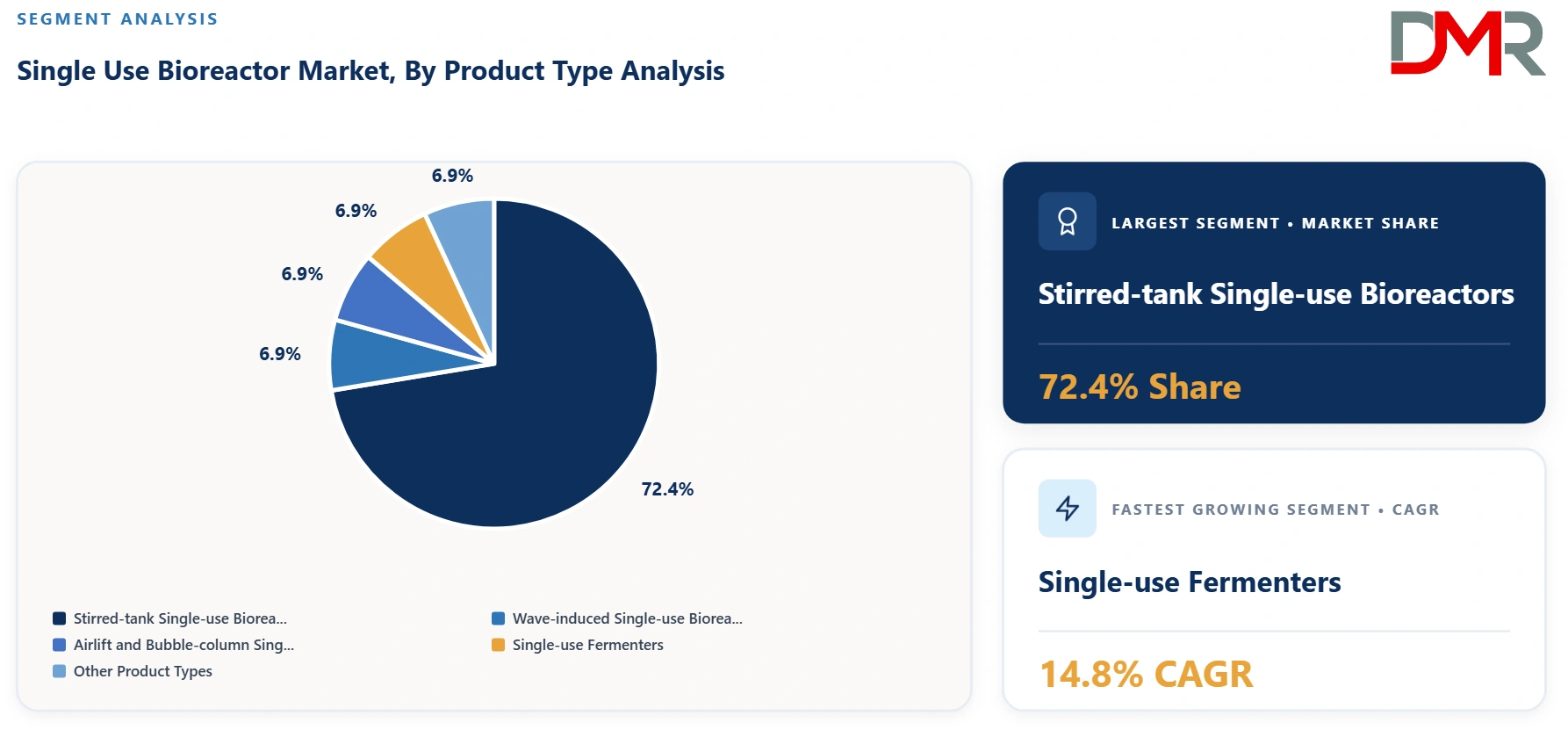
Stirred-tank Single-use Bioreactors are estimated to lead with around 72.4% of 2026 revenue. Their cylindrical or cuboid vessels, impeller-driven mixing, broad controller support, and scalable process knowledge make them suitable for mammalian cell culture from development through commercial manufacturing. Established qualification packages and operator familiarity further reinforce procurement preference. Growth, however, is concentrated in Single-use Fermenters, forecast to expand at a CAGR of 14.8% between 2026 and 2035. Improved oxygen transfer, cooling, agitation, and film durability are opening selected bacterial and yeast applications that previously favored stainless steel. Adoption will be strongest where moderate batch sizes, multi-product operation, and rapid turnaround outweigh the economics of fixed high-volume fermentation assets.
By Working Volume
The 1,001-2,000 L category is expected to hold approximately 36.5% of 2026 revenue. This range is widely accepted for commercial mammalian cell culture, fits modular manufacturing suites, and can be scaled out through multiple parallel units. It also aligns with common suite dimensions and material-handling practices. Growth, however, is concentrated in Above 2,000 L systems, projected to record a CAGR of 14.2% from 2026 to 2035. New 3,000 L to 5,000 L platforms, improved mixing, and higher facility utilization are expanding the commercial ceiling for single-use production. Adoption will depend on bag installation ergonomics, failure-risk controls, validation data, and reliable consumable supply at production scale.
By Cell Type
Mammalian Cells are estimated to account for nearly 69.1% of 2026 revenue because CHO and related cell lines underpin a large share of antibody, recombinant protein, vaccine, and viral-vector production. Single-use stirred tanks are well established for these comparatively lower-shear cultures, supported by extensive process knowledge, qualified media strategies, and established quality-control methods at multiple scales. Growth, however, is concentrated in Bacterial Cells, forecast to expand at a CAGR of 13.3% between 2026 and 2035. Advances in single-use fermentation are addressing oxygen-transfer, heat-removal, pressure, and agitation demands. The opportunity includes plasmid DNA, enzymes, recombinant proteins, and selected industrial biotechnology processes where faster changeover and reduced cleaning infrastructure improve project economics.
By Application
Monoclonal Antibodies are projected to lead with close to 43.7% of 2026 revenue. Their extensive clinical pipeline, established CHO processes, biosimilar activity, and broad commercial manufacturing base support repeated purchases of production vessels and seed-train systems. Long product campaigns also generate predictable replacement-vessel demand. Growth, however, is concentrated in Cell and Gene Therapies, expected to register a CAGR of 15.9% through 2035. Viral-vector and cell-expansion workflows need closed processing, flexible volumes, gentle mixing, and scale-out capability. Platform vendors are developing dedicated vessels, automated media handling, perfusion interfaces, and digital records to improve transfer from early development into regulated manufacturing across clinical programs and distributed production networks.
By End User
Biopharmaceutical and Biotechnology Companies are estimated to hold around 60.8% of 2026 revenue, reflecting direct investment in process development, clinical manufacturing, and commercial biologics capacity. Large sponsors also standardize preferred platforms across internal sites and partner networks, supporting recurring consumables purchases. Growth, however, is concentrated in Contract Development and Manufacturing Organizations, projected to advance at a CAGR of 13.8% from 2026 to 2035. CDMOs require flexible multi-product suites that can accommodate varied cell lines, molecules, scales, and client schedules. Single-use reactors support faster changeovers and modular capacity additions, while common equipment families help contract manufacturers transfer processes across development and production locations and strengthen utilization across multi-client manufacturing portfolios.
The Global Single Use Bioreactor Market Report is Segmented Based on the Following
By Product Type
- Stirred-tank Single-use Bioreactors
- Wave-induced Single-use Bioreactors
- Airlift and Bubble-column Single-use Bioreactors
- Single-use Fermenters
- Other Product Types
By Working Volume
- Less than 500 L
- 500-1,000 L
- 1,001-2,000 L
- Above 2,000 L
- Other Working Volumes
By Cell Type
- Mammalian Cells
- Bacterial Cells
- Yeast Cells
- Insect Cells
- Plant Cells
- Other Cell Types
By Application
- Monoclonal Antibodies
- Vaccines
- Cell and Gene Therapies
- Recombinant Proteins
- Biosimilars
- Other Applications
By End User
- Biopharmaceutical and Biotechnology Companies
- Contract Development and Manufacturing Organizations
- Academic and Research Institutes
- Other End Users
Regional Analysis
Demand is concentrated in established biologics manufacturing centers, while new regional capacity and advanced therapy investment are widening adoption across Asia-Pacific, Latin America, and the Middle East.
Region with the Largest Revenue Share
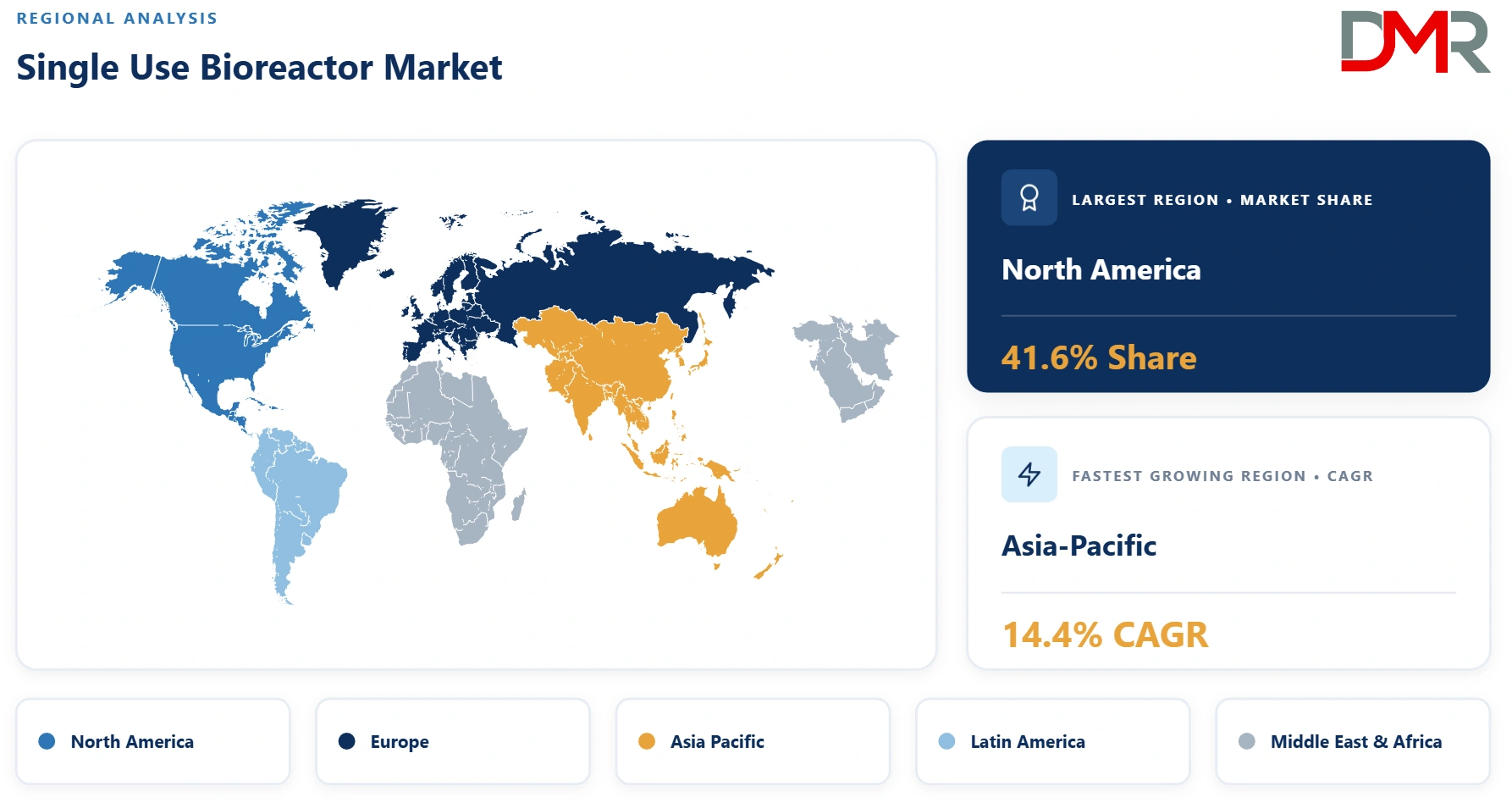
North America is estimated to hold approximately 41.6% of global revenue in 2026. The region benefits from a large biologics pipeline, substantial installed biomanufacturing capacity, active cell and gene therapy development, and strong participation by global equipment suppliers and CDMOs. The United States anchors demand through clinical development clusters, commercial antibody production, modular facility investment, and domestic capacity programs. Buyers also have access to experienced engineering, validation, and service organizations. Growth is supported by process intensification and regional supply-chain strategies, although project timing remains sensitive to biotechnology funding, pipeline attrition, and the utilization of capacity built during earlier expansion cycles.
ℹ
To learn more about this report –
Download Your Free Sample Report Here
Region with the Highest CAGR
Asia-Pacific is projected to register the highest regional CAGR of 14.4% between 2026 and 2035. China, South Korea, Singapore, Japan, India, and Australia are expanding biologics development, biosimilar production, vaccine capacity, and contract manufacturing. New facilities can adopt disposable platforms without replacing a large legacy stainless-steel base, while local suppliers are broadening reactor and consumable availability. International vendors are adding technical support, manufacturing, and partnerships to improve regional supply assurance. Adoption will advance fastest where local validation expertise, qualified film supply, automation skills, and regulatory acceptance develop alongside capital investment in commercial bioprocessing.
By Region
- North America: The US, Canada
- Europe: Germany, France, The UK, Italy, Spain, Rest of Europe
- Asia-Pacific: China, Japan, India, Australia, South Korea, Rest of APAC
- Latin America: Mexico, Brazil, Colombia, Argentina, Rest of LATAM
- Middle East & Africa: Saudi Arabia, The UAE, South Africa, Rest of MEA
Technology Analysis
Single-use bioreactor technology combines a reusable frame and controller with a gamma-sterilized vessel, tubing, connectors, filters, sensors, and mixing hardware. Stirred-tank systems dominate scale-up, while rocking platforms support seed trains and shear-sensitive cultures. Innovation is focused on wider turndown ratios, stronger films, improved impeller geometry, high-capacity gas transfer, integrated perfusion, and noninvasive sensing. Controllers are moving toward interoperable data architectures, automated recipes, and digital twins. Technical differentiation increasingly rests on comparable hydrodynamics across scales, reliable vessel installation, closed sampling, and documented extractables and leachables. High-volume and microbial applications will test pressure, heat-removal, oxygen-transfer, bag-integrity, installation ergonomics, and process-control limits at scale.
Investment and White Space Analysis
Investment is shifting from broad capacity expansion toward platforms that solve defined manufacturing constraints. Attractive white spaces include reactors above 2,000 L, compact cell-therapy systems, microbial single-use fermentation, integrated perfusion, low-cost qualified sensors, and vendor-neutral automation. Regional consumable manufacturing and film redundancy are also investable because buyers seek shorter lead times and supply assurance. Service opportunities include lifecycle assessment, integrity testing, validation, scale-up modeling, and fleet data management. Entrants face high qualification barriers, so partnerships with CDMOs and therapy developers can provide reference processes. Capital should prioritize recurring consumables, defensible vessel geometry, regulatory documentation, and the ability to support customers across multiple scales and geographies.
Competitive Landscape
The market is moderately concentrated among global bioprocess suppliers with installed controller bases, qualified vessel families, broad application data, and international service networks. Competition centers on mixing and gas-transfer performance, working-volume range, bag integrity, extractables and leachables documentation, automation, scale comparability, delivery reliability, and total cost per batch. Recurring vessel purchases give leading platforms durable account relationships after process validation. Specialists compete in low-shear reactors, high-volume systems, fermentation, advanced therapy formats, sensors, and custom assemblies. Partnerships link reactor vendors with analytics, perfusion, automation, and CDMO capabilities. Acquisition activity is expected around differentiated vessel technology, digital process tools, and critical consumable components, while regional manufacturers increase price competition and local supply options.
Some of the Prominent Players in the Global Single Use Bioreactor Market Are:
- Sartorius AG
- Thermo Fisher Scientific Inc.
- Cytiva
- Merck KGaA
- Pall Corporation
- Eppendorf SE
- Getinge AB
- PBS Biotech, Inc.
- ABEC
- Solaris Biotech USA LLC
- Distek, Inc.
- INFORS HT
- CESCO Bioengineering Co., Ltd.
- Biostream International Ltd.
- Bioengineering AG
- bbi-biotech GmbH
- CerCell A/S
- Finesse Solutions, Inc.
- Meissner Filtration Products, Inc.
- Repligen Corporation
- Saint-Gobain Life Sciences
- Parker Hannifin Corporation
- Avantor, Inc.
- Entegris, Inc.
- Asahi Kasei Bioprocess America, Inc.
- OmniBRx Biotechnologies Pvt. Ltd.
- Esco Aster Pte. Ltd.
- Solida Biotech GmbH
- Celltainer Biotech B.V.
- Kuhner Shaker AG
- Able Corporation & Biott Corporation
- BIONET
- IKA-Werke GmbH & Co. KG
- ZETA GmbH
- GEA Group AG
- Lepure Biotech Co., Ltd.
- Tofflon Science and Technology Co., Ltd.
- Shanghai Bailun Biotechnology Co., Ltd.
- Hitachi, Ltd.
- Praj Hipurity Systems Limited
- Other Key Players
Recent Developments
- In July 2026, Sartorius reported the launch of its Ambr 250 HT Cell Therapies Vessel, designed to improve process development, scale transfer, and structured data generation for cell therapy workflows.
- In January 2026, Sartorius expanded its bio-circular offering after achieving ISCC Plus certification for sites covering Ambr bioreactor vessels and selected single-use fluid-management products.
- In August 2025, Cytiva and Culture Biosciences expanded their collaboration to include hardware commercialization and technology development for cloud-connected bioreactor systems.
- In July 2025, Thermo Fisher Scientific highlighted the expansion of its DynaDrive single-use bioreactor portfolio with a 5 L bench-scale system intended to support scale-up from development to commercial production.
- In September 2024, MilliporeSigma, the US and Canada life science business of Merck KGaA, launched the Mobius ADC Reactor, a scalable single-use system designed for antibody-drug conjugate manufacturing.
| Report Characteristics |
| Market Size (2026) |
USD 6.4 Bn |
| Forecast Value (2035) |
USD 17.6 Bn |
| CAGR (2026-2035) |
11.9% |
| The US Market Size (2026) |
USD 2.2 Bn |
| Historical Data |
2021-2025 |
| Forecast Data |
2026-2035 |
| Base Year |
2025 |
| Segments Covered |
By Product Type, By Working Volume, By Cell Type, By Application, By End User |
| Regional Coverage |
North America, Europe, Asia-Pacific, Latin America, Middle East & Africa |
Frequently Asked Questions
How big is the Global Single Use Bioreactor Market?
▾ Global Single Use Bioreactor Market size is estimated to reach USD 6.4 Bn in 2026 and is projected to reach USD 17.6 Bn by 2035, growing at a CAGR of 11.9%. Expansion reflects flexible biologics manufacturing, modular facilities, process intensification, regional capacity investment, and recurring demand for sterile vessels, sensors, tubing, and related assemblies.
What is the growth rate of the Global Single Use Bioreactor Market?
▾ The market is expanding at an estimated CAGR of 11.9% from 2026 to 2035. Growth is supported by larger biologics pipelines, process intensification, adoption by CDMOs, regional manufacturing investment, and continued replacement of selected fixed stainless-steel capacity with flexible disposable systems. Higher-volume reactors and closed advanced-therapy platforms broaden the addressable market.
Which region holds the largest share in the Global Single Use Bioreactor Market?
▾ North America leads the market, holding approximately 41.6% of global revenue in 2026. Its position is supported by extensive biologics research, commercial manufacturing, advanced therapy development, CDMO capacity, and a mature base of bioprocess engineering and validation expertise. The United States contributes most regional revenue through concentrated biotechnology clusters and manufacturing investment.
Who are the key players in the Global Single Use Bioreactor Market?
▾ Prominent operating companies include Sartorius AG, Thermo Fisher Scientific Inc., Cytiva, and Merck KGaA. The broader field includes global bioprocess groups, specialist reactor developers, automation providers, film and assembly suppliers, and regional equipment manufacturers. Competition focuses on scale comparability, vessel integrity, automation, validation support, delivery reliability, and recurring consumable economics.
Which segment is leading the Global Single Use Bioreactor Market?
▾ The Stirred-tank Single-use Bioreactors segment leads product revenue, accounting for roughly 72.4% in 2026. Its position reflects scalable impeller-driven mixing, established mammalian cell processes, wide controller availability, and use from process development through commercial manufacturing. Familiar hydrodynamics, qualified consumables, and broad service networks reinforce customer preference across large biologics programs.
Which segment is expanding fastest in the Global Single Use Bioreactor Market?
▾ The Cell and Gene Therapies application segment is projected to record the highest growth, registering a CAGR of 15.9% through 2035. Demand is supported by closed cell expansion, viral-vector production, flexible scale-out, and specialized low-volume manufacturing requirements. Vendors are developing gentle mixing, integrated perfusion, automated media handling, and electronic batch-data capabilities for these workflows.
What are the major growth drivers in the Global Single Use Bioreactor Market?
▾ Market expansion is primarily propelled by the growth of biologics and advanced therapy pipelines and the shift toward modular multi-product manufacturing. Reduced cleaning infrastructure, faster changeover, scale flexibility, and recurring adoption by contract manufacturers further support demand. Larger vessel formats, intensified processing, and new regional capacity extend single-use adoption into a broader range of commercial production programs.