What is the Skills-Based Hiring Technology Market Size?
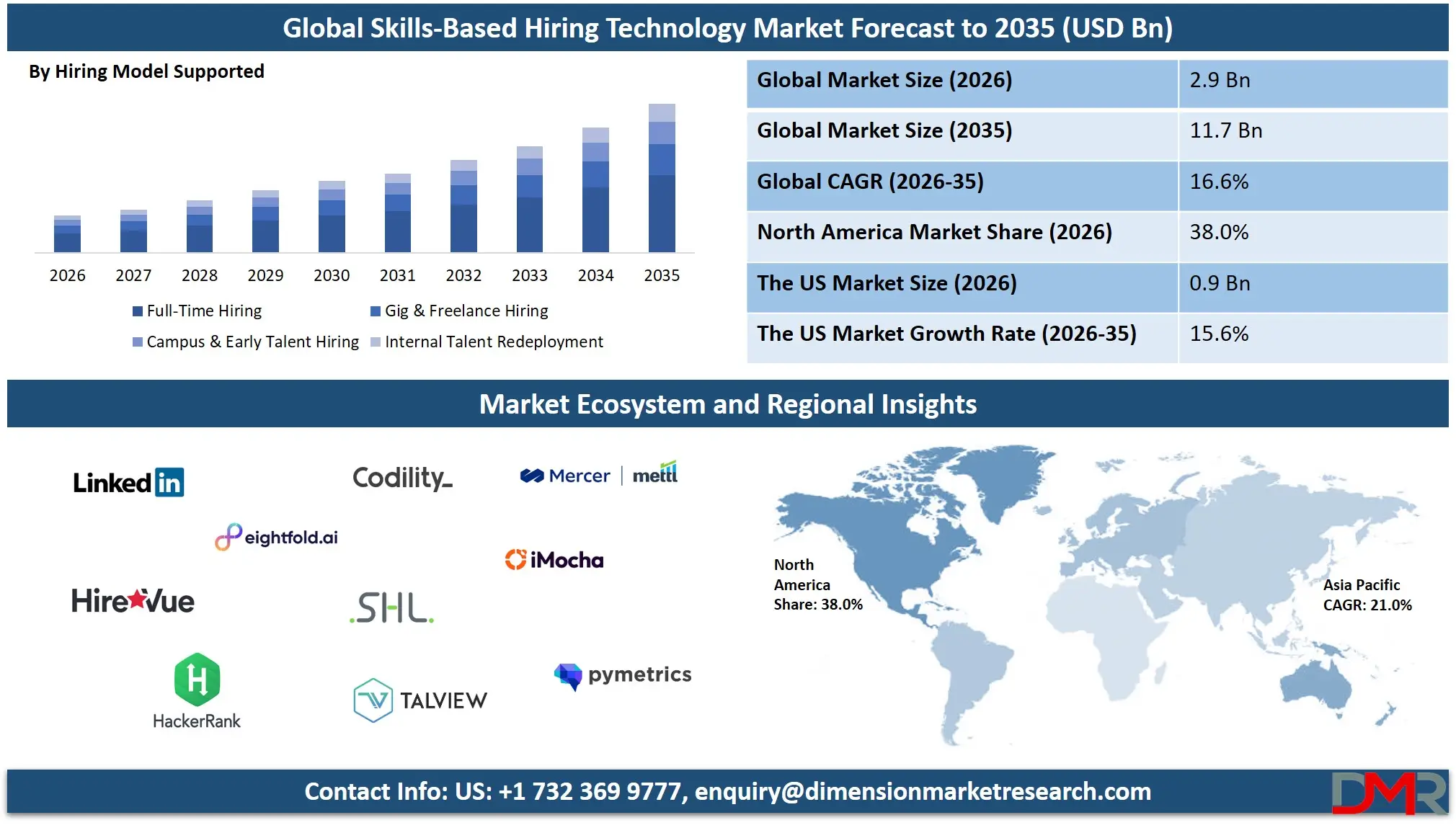
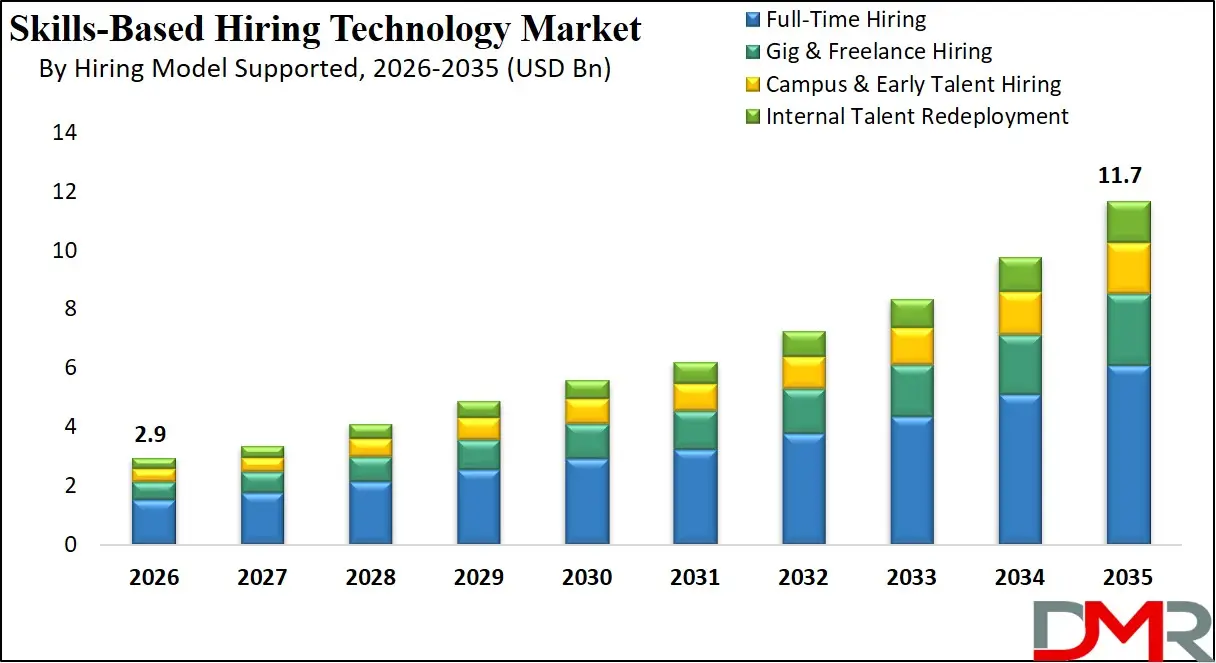
The global Skills-Based Hiring Technology Market size is projected to reach USD 2.9 billion in 2026 and grow at a CAGR of 16.6% to USD 11.7 billion by 2035, driven by the adoption of AI recruitment tools, skill assessment platforms, and competency-based hiring solutions that improve talent matching and workforce efficiency.
ℹ
To learn more about this report –
Download Your Free Sample Report Here
The Skills-Based Hiring Technology Market targets the platforms that will help to hire more accurately and efficiently because of the skills of applicants instead of their degrees. The constant skill gaps spur growth, the Organisation for Economic Co-Operation and Development has indicated that more than one-third of firms struggle to find employees who have the appropriate skills.
Blistering digitalization and automation are further expanding the need of quantifiable technical and cognitive skills. Skilling programs initiated by government are also hastening the transition towards skills-first hiring models. In the future, the market will continue to grow, as companies will focus on workforce flexibility and exact talent fit.
ℹ
To learn more about this report –
Download Your Free Sample Report Here
US Skills-Based Hiring Technology Market
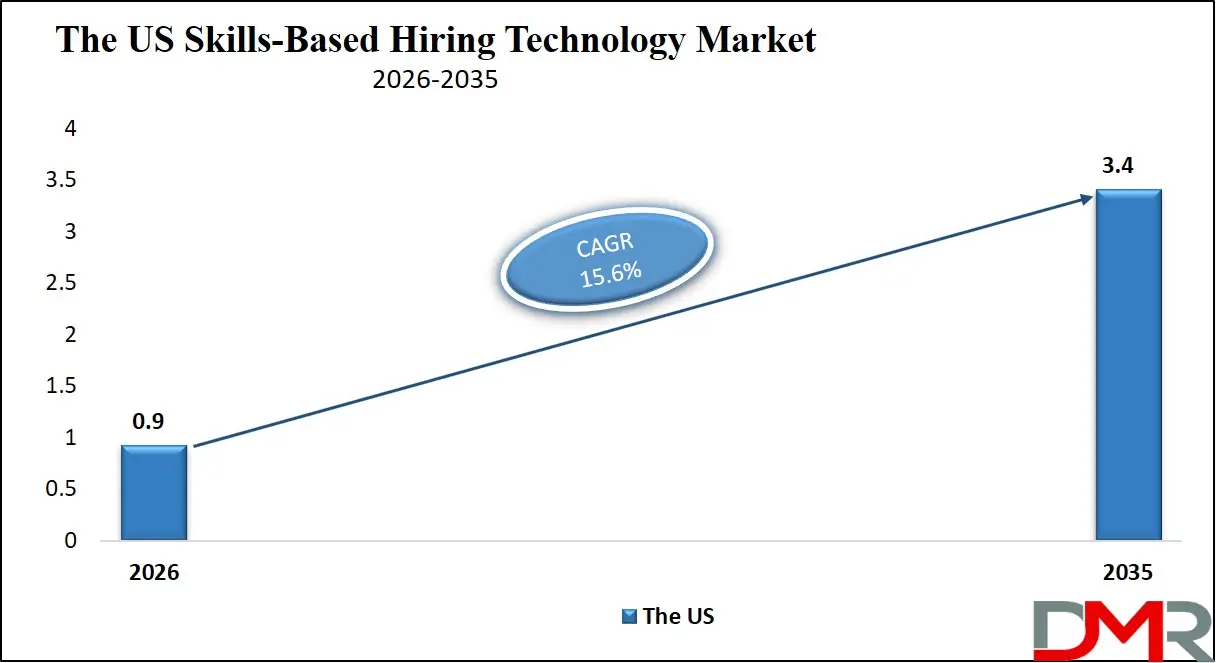
The US Skills-Based Hiring Technology Market is projected to reach USD 0.9 billion in 2026 and grow at a compound annual growth rate of 15.6%, reaching USD 3.4 billion by 2035.
ℹ
To learn more about this report –
Download Your Free Sample Report Here
The U.S. Skills-Based Hiring Technology Market leads globally, driven by strong adoption of AI-based recruitment and skill assessment platforms. The U.S. Bureau of Labor Statistics projects about 6.7 million new jobs from 2023 to 2033, increasing demand for skills-first hiring. Government-led workforce initiatives are also supporting reskilling and digital talent development, pushing enterprises to adopt competency-based and data-driven hiring solutions for better talent matching and reduced skill gaps.
Europe Skills-Based Hiring Technology Market
Europe Skills-Based Hiring Technology Market is anticipated to reach USD 783.0 million in 2026, expanding at a CAGR of 15.9%, driven by strong adoption of AI-based recruitment and skill assessment platforms across enterprises. The region benefits from strict labor regulations and a strong focus on fair, bias-free hiring practices under EU workforce policies. Increasing digital transformation across industries such as IT, BFSI, and manufacturing is further accelerating demand for competency-based hiring solutions. Additionally, growing emphasis on reskilling and internal mobility is strengthening the adoption of skills intelligence platforms across European organizations.
Japan Skills-Based Hiring Technology Market
Japan Skills-Based Hiring Technology Market is anticipated to reach USD 203.0 million in 2026, expanding at a CAGR of 14.6%, driven by increasing adoption of AI-powered recruitment and skill assessment platforms. The market is supported by Japan's aging workforce and acute talent shortages, pushing enterprises to adopt skills-first hiring strategies. Growing digital transformation across manufacturing, IT, and services sectors is further accelerating platform adoption. Additionally, rising focus on workforce efficiency and internal talent mobility is strengthening demand for competency-based hiring solutions in the country.
Key Takeaways
- Market Size: The Skills-Based Hiring Technology Market is projected to reach USD 2.9 billion in 2026 and grow to USD 11.7 billion by 2035.
- Growth Rate and Outlook: The market is expected to expand at a CAGR of 16.6%, driven by increasing adoption of AI-powered recruitment and skill intelligence platforms.
- Primary Growth Drivers: Rising global skill gaps, digital transformation, and shift toward competency-based hiring models are key growth drivers.
- By Component Analysis: Software Platforms dominate with 72% share, led by AI-driven assessment, talent matching, and analytics solutions.
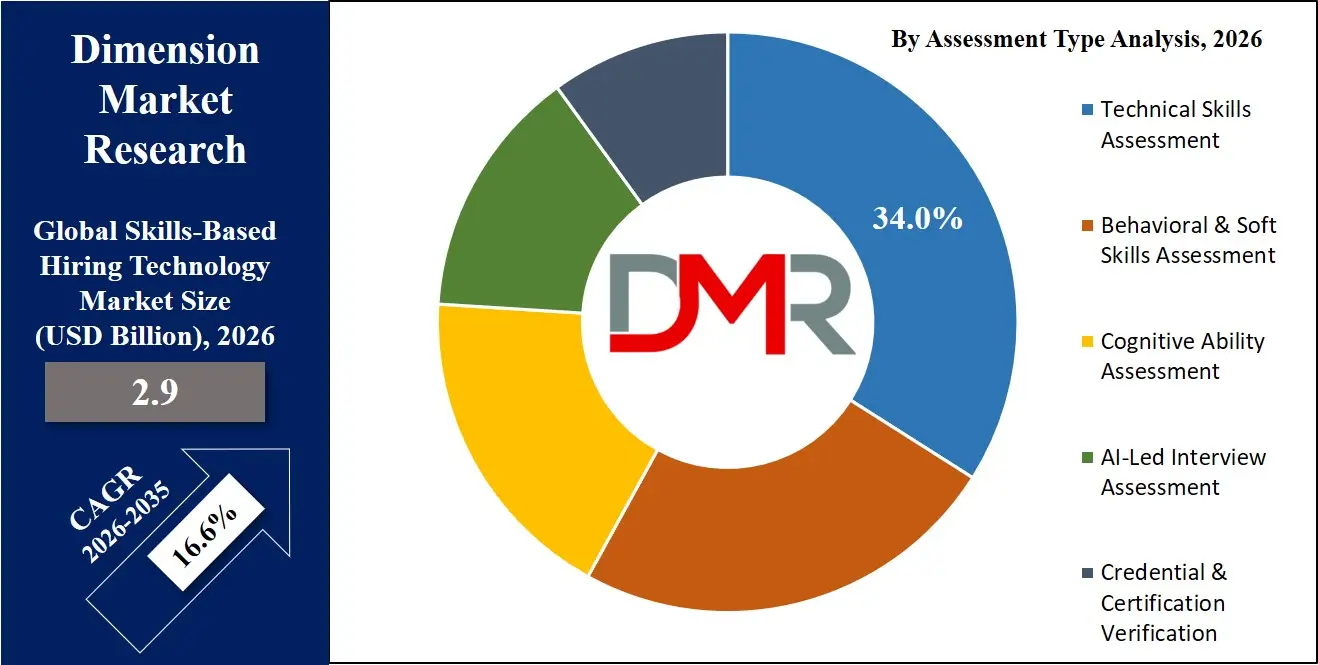
- By Assessment Type Analysis: Technical Skills Assessment leads with 34% share, driven by strong demand for coding and role-based evaluations.
- By Hiring Model Supported Analysis: Full-Time Hiring dominates with 52% share due to structured enterprise workforce requirements.
- Regional Leadership: North America leads the market with 38% share, supported by advanced HR tech adoption and strong enterprise presence.
What is Skills-Based Hiring Technology?
Skills Based Hiring Technology refer to digital tools that help recruit applicants according to their skills and competencies and not their degrees or job titles, and scales and analytics that are powered by AI to enhance accuracy and reduce bias in hiring. The Organisation for Economic Co-operation and Development says that extensive skill misalignments in the labor markets are fueling the movement towards skills-first hiring. The use of this technology is growing in the candidate screening, workforce planning, and talent matching, with government initiatives to enhance employability and bridge skill gaps.
Use Cases
- Recruitment and Candidate Screening: Skills-based hiring technology evaluates candidates using AI-driven assessments, coding tests, and competency scoring instead of traditional resumes. It helps employers quickly identify job-ready talent and improve screening efficiency. This reduces hiring bias and improves quality of hire.
- Internal Mobility and Workforce Planning: Organizations use skill mapping tools to identify employee capabilities across departments. It enables better role matching, succession planning, and internal talent redeployment. This improves workforce utilization and retention.
- Learning and Development Alignment: The technology identifies skill gaps and connects employees with targeted training programs. It supports continuous upskilling and reskilling based on evolving job roles. This strengthens workforce readiness and adaptability.
- Gig and Project-Based Hiring: Companies match freelancers and contract workers to roles based on verified skills and assessments. It ensures faster project staffing and better talent-role alignment. This improves flexibility and reduces hiring turnaround time.
How AI is Transforming the Skills-Based Hiring Technology Market
AI is changing the Skills-Based Hiring Technology Market providing the opportunity to assess skills in real-time, predict scores of candidates, and match talents automatically. It improves the accuracy of hiring through assessing large volumes of data out of resumes, assessments, and behavioral patterns. AI-based platforms also decrease prejudice and enhance the recruitment process decision-making. Also, it assists in ongoing workforce planning, recognizing skills gaps and future talent requirements.
Market Dynamics
Key Drivers in the Global Skills-Based Hiring Technology Market
Increased need of talent based on skill
To close growing skill gaps in industries, organizations are moving towards competency-based hiring as opposed to degree-based hiring. This change is influenced by the necessity to identify employment candidates faster and more accurately. Skills-based platforms enable businesses to save time on the hiring process and enhance the quality of the workforce. They also facilitate mass hiring in the fields of technology, healthcare and BFSI. On the whole, this driver is increasing the uptake of AI-powered hiring solution worldwide.
Quick AI and Data Adoption
By incorporating AI, machine learning and analytics in the hiring process, decision-making is becoming much more accurate. These technologies facilitate automated resumes screening, forecasted scoring, and automated matching of candidates and jobs. Organizations save on manual work and enhance hiring efficiency. AI also aids in reducing unconscious bias in recruitment results. Consequently, companies are quickly investing in high-tech job ad platforms.
Restraints in the Global Skills-Based Hiring Technology Market
Data privacy and compliance issues.
The personal and behavioral information of applicants is core to skills-based hiring platforms, which are susceptible to data privacy issues and regulatory compliance. Tough data protection regulations in areas such as Europe and North America make operations more complicated. Businesses have to assure a safe management of candidate information on platforms. Failure to comply may result in legal and reputational threats. These issues slack adoption of highly regulated industries.
Poor Implementation and Integration Costs.
Implementing sophisticated AI-based recruitment solutions will demand a substantial amount of money in software, integration, and training. SMEs tend to be limited in their budgets when implementing such solutions. It can also be a complex and time-consuming task to integrate with legacy HR systems. Along with that, constant upgrade and customization raise operating expenses in the long run. This restricts its adoption to cost sensitive organizations.
Growth Opportunities in the Global Skills-Based Hiring Technology Market
Growth of in-house Talent Markets
Companies are paying more attention to internal mobility, establishing digital talent exchanges. These websites pair employees with in-house opportunities according to skills and competencies. This decreases dependence on external hiring and enhances the use of the workforce. It also increases retention and career development of employees. The trend brings about good growth opportunities to skills-based hiring technologies.
Increase in Gig and Freelance Workforce
The increasing gig economy is establishing pressure on flexible and skills-authenticated hiring systems. Freelancers and contract workers are being employed by companies to work on projects. Skills-based platforms aid in checking the capabilities and providing a quicker match of talents. This enhances the agility of workforce and delays in hiring. Consequently, new employment avenues are being created in non-conventional models of employment.
Trends in the Global Skills-Based Hiring Technology Market
Move to AI-Based Skills Intelligence Platforms
There is a high migration in the market towards unified platforms that integrate assessment, analytics, and workforce intelligence. These systems offer full visibility of skills of employees and candidates. The insights produced by AI can assist organizations in predicting future skills. This pattern is substituting a disjointed recruitment technology with combined systems. It is greatly transforming enterprise employment policies.
Growing Emphasis on Unbiased and Non-discriminatory Recruiting
Companies are moving away to skills-based hiring practices to enhance diversity and minimized unconscious bias in the hiring process. AI-based tools are also created to be objective in regard to candidates, as they are based on competencies. This guarantees equitable hiring results in terms of demographics and geographies. Hiring practices are also being made inclusive by governments and enterprises. This is boosting ethical adoption of hiring technologies.
Research Scope and Analysis
By Component Analysis
The component segment of the Skills-Based Hiring Technology Market is projected to be dominated by software platforms, which will take up approximately 72.0% of the total share in 2026 due to the increasing popularity of AI-based assessment applications, talent intelligence, and automated candidate matching solutions. These platforms are the backbone of skills-first hiring as they allow the use of data to conduct assessments and expedite hiring. Services, on the other hand, have a supporting yet vital role in market growth, as they assist organizations to implement, customize, and integrate such platforms into the pre-existing HR ecosystems. They encompass deployment, training, consulting and managed hiring assistance. Services will be crucial specifically to businesses that have moved to more advanced systems first-time, so that they can seamlessly transition and streamline workflow processes with hiring.
By Assessment Type Analysis
It is anticipated that the assessment type segment of the Skills-Based Hiring Technology Market will predominantly consist of technical skills assessment, which will occupy approximately 34.0% of the total share by 2026 due to the demand of coding tests, role-specific simulations, and job-ready skill assessment in IT, engineering, and technical jobs. These tests assist employers to gauge the real world ability well and minimize the mismatch in hiring.
ℹ
To learn more about this report –
Download Your Free Sample Report Here
Another important segment is the behavioral and soft skills assessment, which is aimed at assessing communication, teamwork, leadership, and the personality traits of an employee using psychometric tests and scenarios-based assessments. It assists organizations to comprehend cultural fit and workplace compatibility beyond technical expertise. Combined, the two segments guarantee an equal consideration of the candidate capability and organizational fit.
By Hiring Model Supported Analysis
Full-Time Hiring will take over the hiring model category of the Skills-Based Hiring Technology Market, with a market share of approximately 52.0% in 2026, due to the high demand of a stable and long-term workforce planning and structured competency-based hiring by enterprises. This model is favourable to organizations because it aids in comprehensive skills evaluation, enhanced staff retention and alignment with the organizational strategies of growth. Conversely, Gig and Freelance Hiring is picking up with companies expanding the use of flexible staffing models to meet project and short term needs. It is also dependent on skills verification platforms to instantly align talent with needs of certain tasks. It is a better model that enhances the agility of the workforce, shortens the period of hiring and facilitates availability of global talent pool.
By Deployment Model Analysis
The deployment model segment of the Skills-Based Hiring Technology Market is projected to be dominated by Cloud-Based deployment, which will occupy about 68.0% of the total share in 2026 due to its scalability, lower initial cost, and its integration with AI-driven recruitment and HR systems. It allows real time access to talent information, remote recruitment, and expedited the use of skill evaluation tools over international companies. On-Premise deployment, albeit with a smaller portion, is still applicable to organizations that have high data security, compliance, and internal IT control needs. It is more suitable in industries that are highly controlled like in the government and banks where sensitive information about the candidate needs to be controlled. Nevertheless, its increased maintenance and infrastructure costs restrict its wider use than the cloud-based solutions.
By Core Technology Analysis
The core technology portion of the Skills-Based Hiring Technology Market is projected to be dominated by Artificial Intelligence-Based Decision Engines, which are projected to take about 37.0% of the total share in 2026, due to their capability to automate the evaluation of the applicants, predictive scoring, and skill-based matching. These systems increase the accuracy of hiring based on high volume data sets of assessments, resumes and behavioral data to inform hiring suggestions on the best candidates. Cloud-Native Platform Architecture is also important, as it facilitates scalable, flexible, and real-time deployment of hiring solutions across businesses. It enhances easier assimilation with HR systems, quicker updates, and ease of access around the globe without excessive reliance on infrastructure. This structure enhances efficiency of the system and provides continuity of performance in mass recruitment.
By Integration Ecosystem Analysis
It is projected that Applicant Tracking System (ATS) integration will take over the integration ecosystem segment of the Skills-Based Hiring Technology Market, occupying approximately 35.0% of the total share in 2026, as it allows the seamless parsing of resumes, tracking candidates and automated workflow management of the already existing recruitment pipelines. It assists organizations to improve efficiency in hiring by integrating skill assessments into the conventional hiring systems. The integration of the Human Capital Management (HCM) system is also an important factor as it links the skills data to more workforce management capabilities like employee performance, talent development, and succession planning. The integration enables organizations to have a single perspective of the capabilities of workforce throughout the employee lifecycle. It eventually helps in making improved strategic decisions and optimal talent in the long term.
By Enterprise Size Analysis
Large enterprises are expected to dominate the enterprise size segment of the Skills-Based Hiring Technology Market, capturing around 61.0% of the total share in 2026, driven by high-volume hiring needs, global talent operations, and strong adoption of AI-driven recruitment and skill assessment platforms. These organizations invest heavily in advanced hiring technologies to improve workforce quality, reduce skill mismatches, and support data-driven talent strategies. SMEs, while holding a smaller share, are steadily increasing adoption due to rising availability of cost-effective cloud-based solutions and subscription-based hiring platforms. These solutions help SMEs streamline recruitment, access wider talent pools, and improve hiring efficiency without heavy infrastructure investment. Overall, SMEs represent a high-growth segment as digital hiring tools become more accessible and scalable.
By Application Analysis
Candidate Screening & Shortlisting is expected to dominate the application segment of the Skills-Based Hiring Technology Market, capturing around 36.0% of the total share in 2026, driven by the increasing need for faster, more accurate, and AI-driven evaluation of job applicants. These solutions help organizations automate resume parsing, skill assessment, and candidate ranking to improve hiring efficiency and reduce manual effort. Internal Mobility & Workforce Planning also plays a key role by enabling organizations to map employee skills, identify hidden talent, and recommend internal role transitions. This supports better workforce utilization, succession planning, and retention. Overall, it strengthens long-term talent optimization by aligning employee capabilities with evolving business needs.
By End-User Industry Analysis
IT & Telecom is expected to dominate the end-user industry segment of the Skills-Based Hiring Technology Market, capturing around 26.0% of the total share in 2026, driven by strong demand for highly skilled professionals in software development, cloud computing, cybersecurity, and data engineering. These companies heavily rely on AI-driven skill assessment and talent intelligence platforms to quickly identify and hire job-ready candidates. BFSI also represents a significant segment, as banks and financial institutions adopt skills-based hiring to evaluate analytical, risk management, and digital finance capabilities. This helps improve hiring accuracy, regulatory compliance, and workforce efficiency in a highly regulated environment. Overall, BFSI is increasingly leveraging digital hiring tools to close skill gaps and support digital transformation initiatives.
The Global Skills-Based Hiring Technology Market Report is segmented on the basis of the following:
By Component
- Software Platforms
- Skill Assessment Platforms
- AI-Based Matching Platforms
- Talent Intelligence Platforms
- Internal Talent Marketplace Platforms
- Services
- Implementation & Integration
- Assessment Content Development
- Managed Hiring Solutions
By Assessment Type
- Technical Skills Assessment
- Behavioral & Soft Skills Assessment
- Cognitive Ability Assessment
- AI-Led Interview Assessment
- Credential & Certification Verification
By Hiring Model Supported
- Full-Time Hiring
- Gig & Freelance Hiring
- Campus & Early Talent Hiring
- Internal Talent Redeployment
By Deployment Model
- Cloud-Based Deployment
- On-Premise Deployment
By Core Technology
- Artificial Intelligence-Based Decision Engines
- Cloud-Native Platform Architecture
- Natural Language Processing for Skill Extraction
- Simulation & Gamified Assessment Engines
- Distributed Credential Verification Technologies
By Integration Ecosystem
- Applicant Tracking System Integration
- Human Capital Management System Integration
- Standalone Skill Intelligence Platforms
- Learning System Integration
By Enterprise Size
By Application
- Candidate Screening & Shortlisting
- Internal Mobility & Workforce Planning
- Learning & Skill Development Alignment
- Employee Evaluation & Promotion
- Project-Based & Gig Talent Matching
By End-User Industry
- IT & Telecom
- BFSI
- Healthcare & Life Sciences
- Manufacturing & Engineering
- Retail & E-commerce
- Education & EdTech
- Government & Public Sector
- Others
Regional Analysis
Leading Region by Market Share
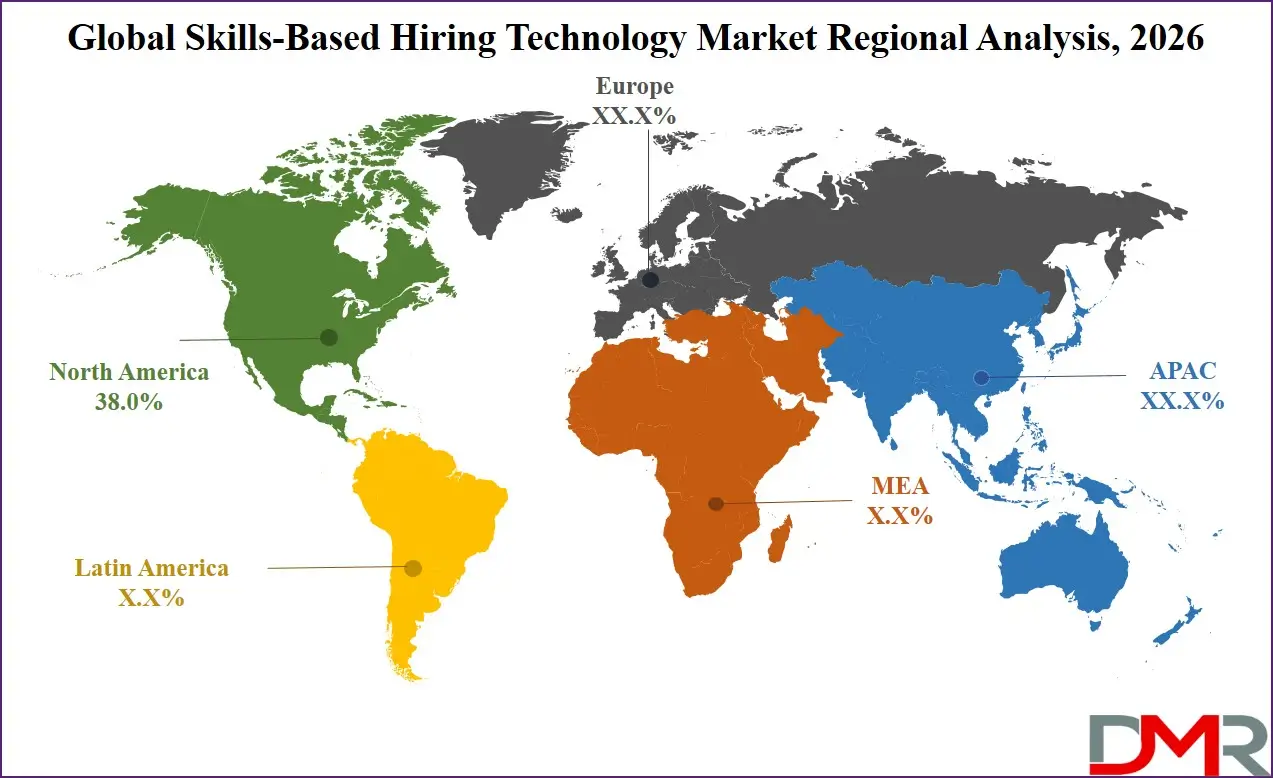
North America is expected to remain the leading region in the Skills-Based Hiring Technology Market, accounting for around 38.0% of the total market share in 2026. This dominance is driven by early adoption of AI-powered recruitment platforms and advanced HR technology ecosystems. Strong presence of major enterprises and tech-driven hiring practices further supports market growth. Additionally, increasing focus on skills-first hiring and workforce digitalization continues to strengthen regional leadership.
ℹ
To learn more about this report –
Download Your Free Sample Report Here
Fastest-Growing Regional Market
Asia-Pacific is expected to be the fastest-growing region in the Skills-Based Hiring Technology Market, driven by rapid digital adoption and rising demand for skilled talent. Growth is supported by expanding IT, manufacturing, and services sectors adopting AI-based hiring tools. Government-led skilling initiatives and workforce digitalization are further accelerating adoption. The region's large young workforce and growing gig economy also strengthen market expansion.
By Region
North America
Europe
- Germany
- The U.K.
- France
- Italy
- Russia
- Spain
- Benelux
- Nordic
- Rest of Europe
Asia-Pacific
- China
- Japan
- South Korea
- India
- ANZ
- ASEAN
- Rest of Asia-Pacific
Latin America
- Brazil
- Mexico
- Argentina
- Colombia
- Rest of Latin America
Middle East & Africa
- Saudi Arabia
- UAE
- South Africa
- Israel
- Egypt
- Rest of MEA
Competitive Landscape
The competitive landscape of the Skills-Based Hiring Technology Market is highly dynamic, driven by rapid innovation in AI-powered recruitment and talent intelligence solutions. Market players are focusing on enhancing skill assessment accuracy, automation, and predictive analytics capabilities. Continuous product upgrades and platform integrations are intensifying competition across global vendors. Additionally, increasing demand for end-to-end hiring ecosystems is pushing companies toward strategic partnerships and technological differentiation.
Some of the prominent players in the Global Skills-Based Hiring Technology Market are:
- LinkedIn
- Eightfold AI
- HireVue
- HackerRank
- Codility
- SHL
- Mercer Mettl
- iMocha
- Talview
- Pymetrics
- Vervoe
- Criteria Corp
- Harver
- TestGorilla
- Bryq
- Plum
- AssessFirst
- SkillSurvey
- Xobin
- CodeSignal
- Other Key Players
Recent Developments
- April 2026: Eightfold AI launched AI Interview Companion and expanded Talent Agents, enhancing end-to-end AI-driven candidate evaluation and interview automation across the hiring lifecycle.
- October 2025: HireVue introduced AI Interviewer capabilities, enabling faster and more standardized skill-based interview assessments using advanced AI evaluation models.
- October 2025: Eightfold AI secured USD 35M funding for AI digital twin and workforce intelligence expansion, supporting advanced talent matching and internal mobility solutions.
Report Details
| Report Characteristics |
| Market Size (2026) |
USD 2.9 Bn |
| Forecast Value (2035) |
USD 11.7 Bn |
| CAGR (2026–2035) |
16.6% |
| Historical Data |
2021 – 2025 |
| Forecast Data |
2027 – 2035 |
| Base Year |
2025 |
| Estimate Year |
2026 |
| Segments Covered |
By Component (Software Platforms, Services),
By Assessment Type (Technical Skills Assessment, Behavioral & Soft Skills Assessment, Cognitive Ability Assessment, AI-Led Interview Assessment, Credential & Certification Verification),
By Hiring Model Supported (Full-Time Hiring, Gig & Freelance Hiring, Campus & Early Talent Hiring, Internal Talent Redeployment),
By Deployment Model (Cloud-Based Deployment, On-Premise Deployment),
By Core Technology (Artificial Intelligence-Based Decision Engines, Cloud-Native Platform Architecture, Natural Language Processing for Skill Extraction, Simulation & Gamified Assessment Engines, Distributed Credential Verification Technologies),
By Integration Ecosystem (Applicant Tracking System Integration, Human Capital Management System Integration, Standalone Skill Intelligence Platforms, Learning System Integration),
By Enterprise Size (Large Enterprises, SMEs),
By Application (Candidate Screening & Shortlisting, Internal Mobility & Workforce Planning, Learning & Skill Development Alignment, Employee Evaluation & Promotion, Project-Based & Gig Talent Matching),
By End-User Industry (IT & Telecom, BFSI, Healthcare & Life Sciences, Manufacturing & Engineering, Retail & E-commerce, Education & EdTech, Government & Public Sector, Others) |
| Regional Coverage |
North America – The US and Canada;
Europe – Germany, The UK, France, Russia, Spain, Italy, Benelux, Nordic, & Rest of Europe;
Asia-Pacific – China, Japan, South Korea, India, ANZ, ASEAN, Rest of APAC;
Latin America – Brazil, Mexico, Argentina, Colombia, Rest of Latin America;
Middle East & Africa – Saudi Arabia, UAE, South Africa, Turkey, Egypt, Israel, & Rest of MEA |
Frequently Asked Questions
How big is the Skills-Based Hiring Technology Market?
▾ The Skills-Based Hiring Technology Market is projected to reach USD 2.9 billion in 2026 and expand significantly to USD 11.7 billion by 2035, driven by rising adoption of AI-driven recruitment and skill assessment platforms.
What is the CAGR of the Skills-Based Hiring Technology Market from 2026 to 2035?
▾ The Skills-Based Hiring Technology Market is projected to reach USD 2.9 billion in 2026 and expand significantly to USD 11.7 billion by 2035, driven by rising adoption of AI-driven recruitment and skill assessment platforms.
What factors are driving the growth of the Skills-Based Hiring Technology Market?
▾ Growth is driven by widening global skill gaps, rapid digital transformation, and increased adoption of AI-based recruitment tools.
What are the major trends in the Skills-Based Hiring Technology Market?
▾ Key trends include AI-powered skill intelligence platforms, integration of hiring tools with HR ecosystems, and increased focus on bias-free recruitment
Which region held the largest share of the Skills-Based Hiring Technology Market in 2026?
▾ North America held the largest share in 2026, accounting for around 38% of the total market, driven by strong enterprise adoption of advanced HR technologies and AI-driven hiring systems.
Which region is expected to grow the fastest in the Skills-Based Hiring Technology Market?
▾ Asia-Pacific is expected to grow the fastest, supported by rapid digitalization, expanding IT and services sectors, and increasing government-led workforce skilling initiatives.
Who are the key players in the Skills-Based Hiring Technology Market?
▾ Key players include LinkedIn, Eightfold AI, HireVue, HackerRank, Codility, SHL, Mercer Mettl, iMocha, Talview, Pymetrics, Vervoe, Criteria Corp, Harver, TestGorilla, Bryq, Plum, AssessFirst, SkillSurvey, Xobin, CodeSignal, and other emerging HR tech companies.
How is the Skills-Based Hiring Technology Market segmented?
▾ The market is segmented by Component, Assessment Type, Hiring Model Supported, Deployment Model, Core Technology, Integration Ecosystem, Enterprise Size, Application, and End-User Industry.