What is the Small Language Model Market Size?
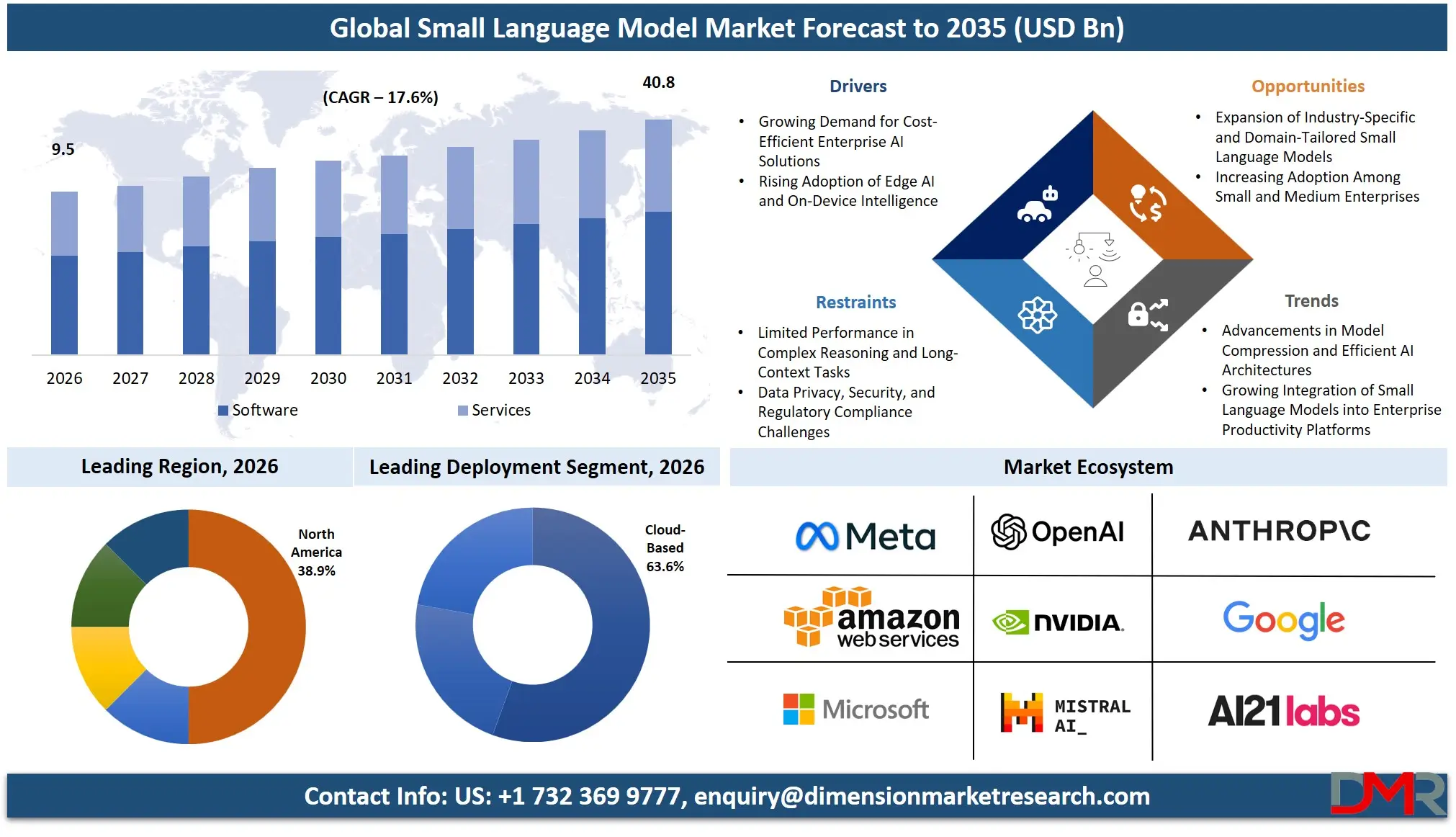
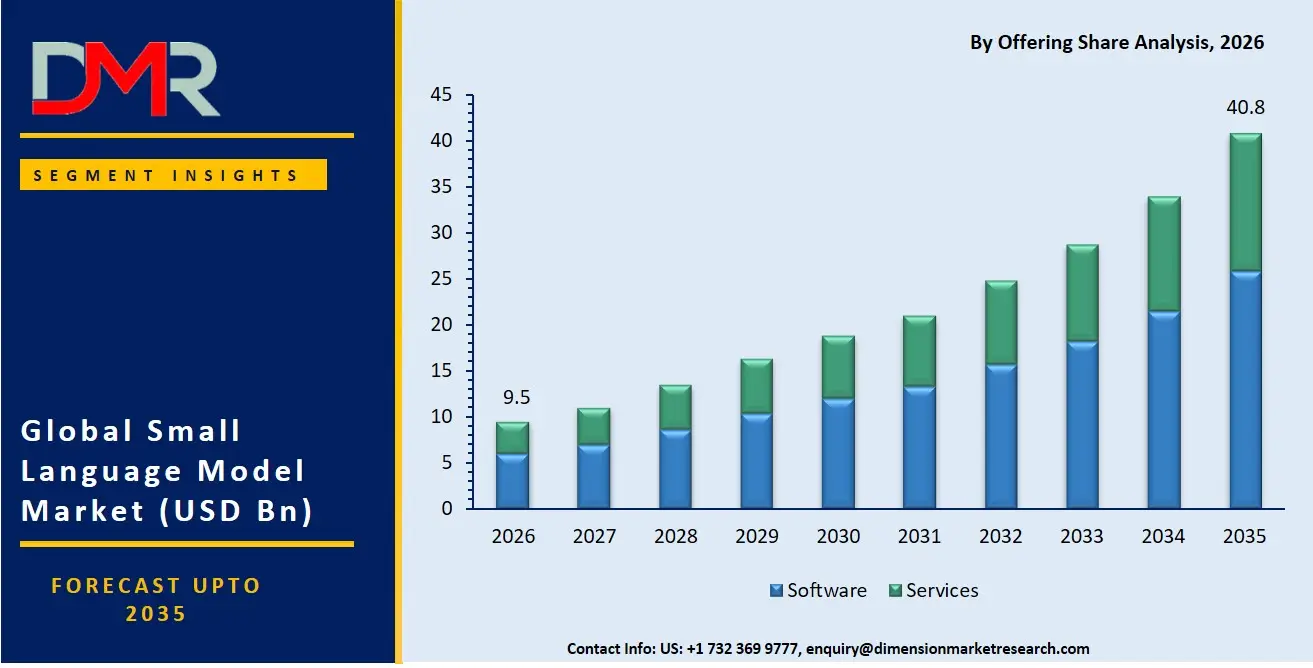
The Global Small Language Model Market is expected to reach a value of USD 9.5 billion in 2026, and it is further anticipated to reach USD 40.8 billion by 2035, growing at a CAGR of 17.6% during the forecast period.
ℹ
To learn more about this report –
Download Your Free Sample Report Here
The small language model market has been expanding rapidly as enterprises shift focus from massive, general-purpose large language models (LLMs) to efficient, specialized, and cost-effective SLMs. The market consists of software solutions and a comprehensive suite of services, including consulting & advisory, custom model development, model training & fine-tuning, integration & deployment, and support & maintenance, which assist organizations in building and operating task-specific AI. The increasing demand for low-latency inference, data privacy, on-device processing, and domain-specific accuracy is driving the necessity of specialized SLMs. Enterprises are the most frequent adopters, with open-source models and cloud-based deployment remaining popular due to their customizability and rapid scalability. The BFSI, healthcare, and legal industries are key players as they require secure, compliant, and highly precise AI systems that can run within their controlled environments.
The US Small Language Model Market
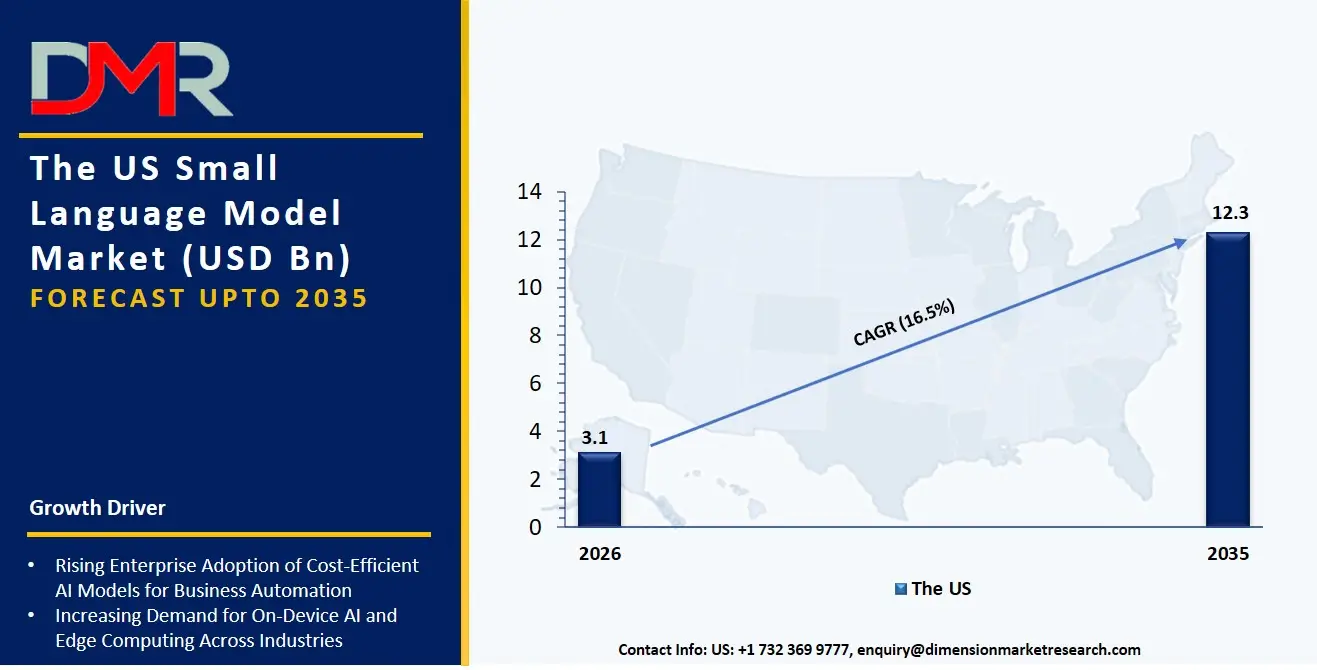
The US Small Language Model Market is projected to reach USD 3.1 billion in 2026 at a compound annual growth rate of 16.5% over its forecast period, culminating in a value of USD 12.3 billion by 2035.
ℹ
To learn more about this report –
Download Your Free Sample Report Here
The US continues to be the largest and most advanced market for small language models, driven by a surge in enterprise demand for cost-efficient AI inference and the growing distribution of edge computing infrastructure. The market has been typified by high demand for custom model development services, whereby organizations refactor general-purpose LLMs into lean, domain-specific SLMs for tasks like contract analysis and clinical trial matching. Furthermore, the implementation of SLMs for on-device code generation assistants in software development is producing a parallel need for integration & deployment services to embed these models directly into integrated development environments (IDEs) and CI/CD pipelines.
The Europe Small Language Model Market
The Europe Small Language Model Market is estimated to be valued at USD 2.7 billion in 2026 and is further anticipated to reach USD 11.5 billion by 2035 at a CAGR of 17.4%. The regulatory frameworks including GDPR and the EU AI Act significantly impact the European market, driving the need for consulting & advisory services and a strong preference for on-premises and edge deployments to guarantee data sovereignty. Accelerated growth in the adoption of open-source models is also being experienced in the region as manufacturing and automotive industries in Germany and France seek to balance operational technology (OT) data security with AI-driven analytics. In addition, initiatives such as GAIA-X are challenging service providers to develop dedicated model training & fine-tuning processes that ensure data residency and interoperability across the fragmented European AI ecosystem.
The Japan Small Language Model Market
The Japan Small Language Model Market is projected to be valued at USD 1.0 billion in 2026. It is further expected to witness robust growth, holding USD 3.9 billion by 2035 at a CAGR of 16.3%. The Japanese market is unique, with a corporate drive toward Society 5.0 in response to a declining workforce and outdated, siloed legacy systems. Custom model development and integration & deployment services constitute a large part of the spending as large conglomerates adapt bilingual (Japanese-English) SLMs for mission-critical applications off the cloud. There is also a strong need to deeply integrate these models into local market contexts, bridging the gap between old Electronic Medical Record (EMR) systems and industrial control systems with new AI-powered semantic search interfaces, forming a niche in enterprise knowledge management and workflow automation.
Key Takeaways
- Market Size & Forecast: The Global Small Language Model market is projected to reach USD 9.5 billion in 2026, expanding dramatically to USD 40.8 billion by 2035, fueled by the dual drivers of enterprise demand for cost-efficient AI and the mandatory shift toward domain-specific, secure data processing.
- Growth Rate & Outlook: Global market growth is expected at a CAGR of 17.6%, driven by the prohibitive inference costs of large language models and the escalating complexity of managing Retrieval-Augmented Generation (RAG) pipelines and model quantization.
- Primary Growth Drivers: Key forces include the widespread migration from single, monolithic AI models to ensembles of task-specific SLMs, the need for consulting & advisory to avoid costly architectural missteps, and the integration of on-device AI requiring specialized custom model development skills.
- Key Market Trends: Major trends include the rise of industry-specific SLMs (e.g., for legal contract review, medical coding), the use of automated tools within model training & fine-tuning to curate synthetic data for low-resource languages, and the shift toward support & maintenance as model drift and continuous validation become critical governance concerns.
- By Deployment Analysis: On-premises and edge models are expected to dominate enterprise discussions due to data gravity and regulatory constraints. Professional services are increasingly required to build seamless integration layers that connect on-device SLMs with centralized cloud-based knowledge stores.
- By End User Analysis: BFSI (Banking, Financial Services, and Insurance) and Healthcare & Life Sciences are the most lucrative verticals due to stringent compliance needs and high-value use cases. Legal is the fastest-growing sector, as document-heavy workflows require robust data extraction & document analysis capabilities facilitated by specialized, secure SLMs.
- Regional Leadership: North America is poised to dominate this market with 38.9% of the market share in 2026, due to its well-developed AI ecosystem, high concentration of model builders, and enterprises that utilize this infrastructure to its fullest, solidifying its leadership position.
What is the Small Language Model?
Small Language Models are specialized AI models, typically with fewer than 10 billion parameters, offered through proprietary or open-source licenses. The market encompasses the tools (software) and expert assistance (services) that enable organizations to navigate the entire SLM lifecycle. These services, unlike the model weights themselves, are related to the how of SLM adoption. This involves Consulting & Advisory to establish a strategic roadmap and identify high-ROI use cases; Custom Model Development and Model Training & Fine-Tuning to adapt base models on proprietary data without sending it to public APIs; and Integration & Deployment to securely embed these compact models into mobile apps, edge devices, and private cloud infrastructure. With 90% of enterprises planning to deploy generative AI in secure, controlled environments, professional services are needed to achieve task-specific accuracy, data privacy, and cost governance, making AI investments translate into tangible operational efficiency as opposed to technical debt.
Use Cases
- Privacy-Safe Contract Intelligence in Legal: Law firms hire Custom Model Development services to build an SLM that can summarize and extract clauses from thousands of legal documents, running entirely on-premises to ensure attorney-client privilege is never breached.
- Real-Time Clinical Coding in Healthcare: Hospital networks use Model Training & Fine-Tuning and Integration & Deployment services to adapt a text-based SLM to convert physician notes directly into ICD-10 medical billing codes on edge devices, improving accuracy and compliance without cloud latency.
- Multilingual Customer Support in E-commerce: Global retailers utilize Support & Maintenance and proprietary multimodal SLMs for real-time, low-latency translation and localization within chatbots, maintaining brand voice consistently across dozens of markets without the cost of massive LLMs.
- Secure On-Device Code Generation: Large software firms deploy open-source, sub-1-billion-parameter models for code generation & assistance, fine-tuned on their internal codebase and deployed on developers' laptops via edge deployment, preventing source code leakage and boosting productivity.
How AI is Transforming the Small Language Model Market?
AI is transforming the small language model market by accelerating the process of model distillation and enhancing operational efficiency. In Model Training & Fine-Tuning, AI-powered quantization and pruning tools have the potential to automatically compress state-of-the-art LLMs into highly performant SLMs, significantly reducing memory footprint and inference latency while preserving task-specific accuracy. Meanwhile, AI-driven features in Integration & Deployment allow businesses to better manage model sprawl by automatically selecting the optimal SLM for a given task from a library, routing queries dynamically to balance cost, speed, and quality.
Governance and consulting projects are also revolving around AI. In the area of Support & Maintenance, intelligent monitoring agents are used to continuously check deployed SLMs for data drift, toxic outputs, and factual hallucination, keeping organizations in line with emerging AI safety frameworks. Moreover, generative assistants are complementing consulting & advisory by simulating the performance of different model architectures on sample enterprise data, giving stakeholders a clear projection of accuracy and cost before committing technical resources to a custom model development project.
Market Dynamics
Key Drivers in the Global Small Language Model Market
Growing Demand for Cost-Efficient Enterprise AI Solutions
Organizations are increasingly adopting Small Language Models (SLMs) because they provide strong language capabilities while requiring significantly lower computational resources than large language models. Their reduced infrastructure requirements lower deployment and operating costs, making AI adoption feasible for enterprises of all sizes. SLMs enable fast inference, efficient fine-tuning, and lower energy consumption, making them suitable for customer service, document processing, coding assistance, and enterprise search. As businesses seek practical AI solutions with measurable returns on investment, demand for compact, scalable, and affordable language models continues to accelerate across industries, driving sustained market growth globally.
Rising Adoption of Edge AI and On-Device Intelligence
The increasing deployment of AI applications on smartphones, laptops, IoT devices, industrial systems, and autonomous equipment is driving demand for Small Language Models. Their compact architecture enables real-time inference with minimal latency while reducing dependence on cloud connectivity. Enterprises increasingly prefer on-device AI to improve privacy, lower bandwidth usage, and enhance response speed in mission-critical applications. SLMs support intelligent assistants, predictive maintenance, healthcare diagnostics, automotive systems, and industrial automation across edge environments. As edge computing infrastructure expands globally, organizations continue investing in lightweight language models capable of delivering efficient, secure, and responsive AI experiences.
Restraints in the Global Small Language Model Market
Limited Performance in Highly Complex Reasoning Tasks
Despite significant advances, Small Language Models still face limitations when handling highly complex reasoning, long-context understanding, and specialized knowledge-intensive tasks. Their smaller parameter count restricts the depth of contextual comprehension compared with larger foundation models. Enterprises requiring advanced scientific research, legal analysis, multi-step reasoning, or sophisticated creative generation may prefer larger AI models despite higher operating costs. These performance limitations can reduce adoption for certain enterprise use cases where maximum accuracy is essential. Vendors continue improving optimization techniques, but balancing efficiency and advanced reasoning remains a key challenge for market expansion.
Data Privacy, Security, and Regulatory Compliance Challenges
Organizations deploying Small Language Models must address growing concerns regarding data privacy, intellectual property protection, AI governance, and regulatory compliance. Many enterprise applications process confidential financial, healthcare, legal, and customer information that requires strict security controls. Businesses must implement responsible AI practices, secure model deployment, access controls, and compliance with evolving regional regulations governing AI usage and data protection. Failure to meet these requirements can expose organizations to operational, legal, and reputational risks. These compliance complexities may delay implementation, particularly in highly regulated industries with stringent security and governance requirements.
Growth Opportunities in the Global Small Language Model Market
Expansion of Industry-Specific Small Language Models
The growing demand for domain-specific AI creates significant opportunities for vendors developing industry-focused Small Language Models. Enterprises increasingly require specialized models trained on financial, healthcare, legal, manufacturing, engineering, and scientific datasets to improve accuracy and regulatory compliance. Domain-specific SLMs deliver higher performance for specialized workflows while maintaining computational efficiency and lower deployment costs. Organizations benefit from improved productivity, contextual understanding, and reduced hallucinations compared with general-purpose models. As industry digitization accelerates, customized Small Language Models are expected to become an important growth area across regulated and knowledge-intensive sectors worldwide.
Increasing Adoption Among Small and Medium Enterprises
Small and medium enterprises represent a substantial growth opportunity due to their increasing interest in affordable AI technologies. Unlike large foundation models requiring extensive infrastructure, Small Language Models can be deployed using modest computing resources and lower investment. Cloud-based AI services, subscription pricing, and pre-trained models enable SMEs to automate customer service, document management, marketing, sales, and internal knowledge management. As digital transformation expands among smaller businesses, demand for scalable, cost-effective, and easy-to-deploy AI solutions will continue increasing. This trend significantly broadens the commercial adoption potential of the global SLM market.
Trends in the Global Small Language Model Market
Growing Focus on Model Compression and Efficient AI Architectures
A major trend shaping the Small Language Model market is the development of highly efficient AI architectures through model compression, quantization, pruning, and knowledge distillation. These optimization techniques reduce memory usage and computational requirements while maintaining competitive language performance. Technology companies increasingly prioritize compact AI models capable of running efficiently on edge devices, enterprise servers, and consumer hardware. This trend supports broader AI accessibility, faster deployment, and lower operating costs while enabling organizations to implement intelligent applications across diverse computing environments without requiring expensive GPU infrastructure.
Increasing Integration with Enterprise Productivity Platforms
Small Language Models are increasingly being integrated into enterprise software platforms, productivity applications, customer relationship management systems, collaboration tools, and business process automation solutions. Organizations are embedding AI capabilities directly into existing workflows to improve employee productivity, automate repetitive tasks, summarize documents, generate content, and enhance enterprise search. Software vendors continue launching AI-powered assistants optimized for business environments using efficient language models that deliver low-latency performance. As enterprises prioritize practical AI adoption with measurable business value, integration of Small Language Models into everyday business applications is becoming a defining market trend.
Research Scope and Analysis
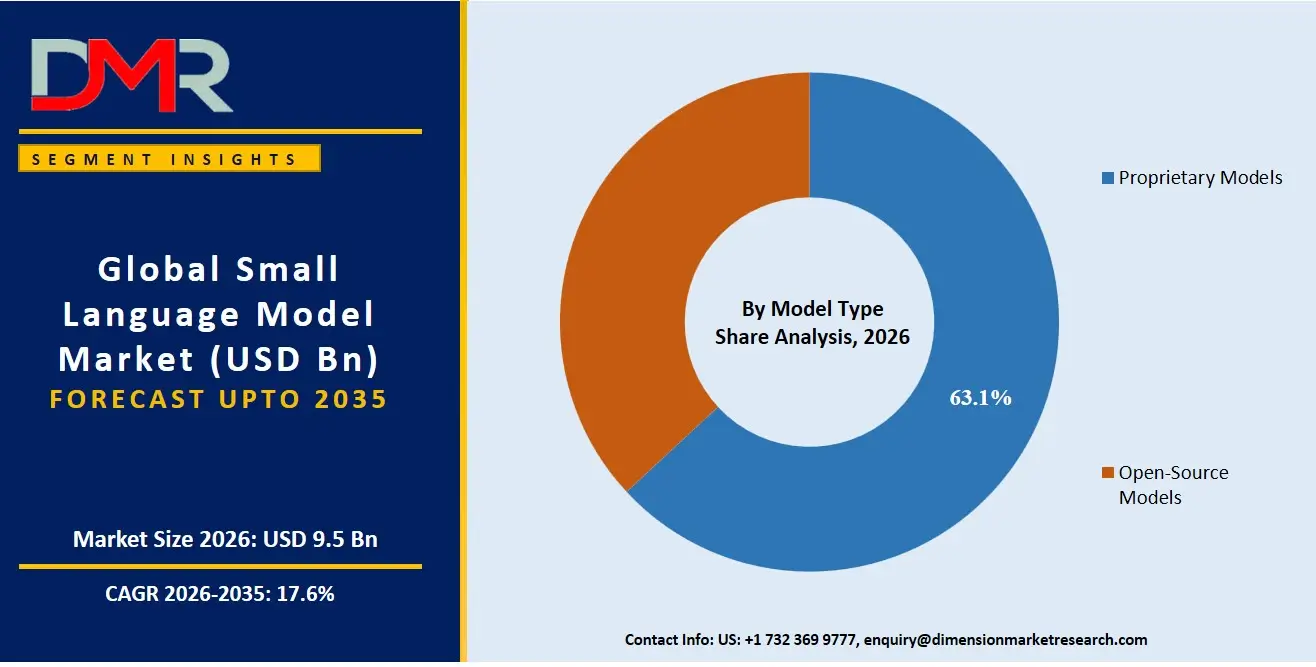
The Global Small Language Model Market is segmented by Offering, Model Type, Data Modality, Model Size, Deployment, Enterprise Size, Technology, Application, and End User. The market covers software and services, proprietary and open-source models, multiple AI modalities, deployment environments, enterprise categories, AI technologies, business applications, and key industry verticals across global markets.
ℹ
To learn more about this report –
Download Your Free Sample Report Here
By Offering Analysis
The Software segment is poised to dominate the global Small Language Model market because enterprises primarily invest in scalable AI platforms that enable model deployment, inference, customization, and integration into business applications. Software solutions provide reusable AI capabilities across customer service, content generation, document processing, coding assistance, and enterprise search while reducing operational costs.
ℹ
To learn more about this report –
Download Your Free Sample Report Here
Continuous advancements in model optimization, inference efficiency, and deployment frameworks have accelerated software adoption across cloud and edge environments. Organizations increasingly prioritize software ownership to maintain data security, intellectual property, and model flexibility, making software the largest revenue-generating segment compared with implementation and consulting services.
By Model Type Analysis
Proprietary Models is projected to dominate the market due to their superior enterprise-grade performance, dedicated vendor support, security controls, and commercial deployment capabilities. Businesses prefer proprietary models because they offer optimized accuracy, continuous updates, advanced guardrails, regulatory compliance, and seamless integration with enterprise software ecosystems. Leading AI vendors invest heavily in research, infrastructure, and fine-tuning, enabling proprietary models to deliver reliable performance across specialized business applications. Enterprises handling sensitive customer, financial, and healthcare data often prioritize commercial models with guaranteed service levels, governance features, and technical support, strengthening the dominance of proprietary Small Language Models across global industries.
By Data Modality Analysis
The Text modality is expected to dominate the Small Language Model market because most enterprise AI applications involve natural language understanding and generation. Businesses widely deploy text-based models for document summarization, customer support, knowledge management, search, email automation, contract analysis, report generation, and enterprise productivity. Text data is abundant, standardized, and easier to process than multimodal information, enabling efficient model training and deployment. Continuous demand for conversational AI, intelligent assistants, and automated business workflows further strengthens text-based applications. As organizations digitize documentation and communication, text remains the primary modality driving commercial adoption of Small Language Models.
By Model Size Analysis
The 1 Billion to 5 Billion Parameters is expected to dominate because it provides the optimal balance between computational efficiency, inference speed, deployment flexibility, and language performance. Models within this range deliver high-quality outputs while requiring significantly fewer computing resources than larger foundation models. Enterprises increasingly deploy these models on cloud, edge, and on-premises environments for customer support, enterprise search, coding assistance, document analysis, and workflow automation. Their lower infrastructure costs, faster response times, and easier fine-tuning make them suitable for commercial AI applications, driving widespread enterprise adoption across industries and regions.
By Deployment Analysis
The Cloud-Based deployment segment is expected to dominate the Small Language Model market because it enables organizations to deploy AI applications rapidly without investing in expensive on-premises infrastructure. Cloud platforms provide scalable computing resources, managed AI services, continuous updates, centralized monitoring, and simplified model management. Enterprises benefit from flexible pricing, faster implementation, and seamless integration with existing cloud-native business applications. Growing adoption of hybrid work, SaaS platforms, and enterprise digital transformation further accelerates cloud-based deployments. Continuous investments by leading cloud providers in AI infrastructure and optimized inference services reinforce cloud deployment as the preferred implementation model.
By Enterprise Size Analysis
Large Enterprises is anticipated to dominate the market because they possess the financial resources, computing infrastructure, proprietary datasets, and skilled AI professionals required for successful Small Language Model implementation. These organizations increasingly integrate SLMs into customer engagement, knowledge management, software development, document processing, cybersecurity, and operational automation. Large enterprises also demand enterprise-grade governance, security, compliance, and customization capabilities, driving investments in commercial AI platforms. Their ongoing digital transformation initiatives, extensive AI budgets, and focus on improving workforce productivity position them as the largest adopters of Small Language Model technologies across global industries.
By Technology Analysis
Deep Learning-Based technology is poised to dominate the Small Language Model market because transformer-based neural networks provide superior language understanding, contextual reasoning, text generation, and multilingual capabilities compared with traditional machine learning or rule-based systems. Continuous innovations in model compression, parameter optimization, quantization, and efficient training have significantly improved deep learning performance while reducing computational requirements. These advancements enable organizations to deploy compact yet powerful language models across cloud and edge environments. As generative AI adoption accelerates across industries, deep learning remains the technological foundation supporting nearly all commercially successful Small Language Models.
By Application Analysis
Chatbots & Virtual Assistants is poised to dominate the Small Language Model market because organizations increasingly automate customer interactions, employee assistance, IT support, and knowledge retrieval using conversational AI. Small Language Models provide fast inference, lower operational costs, and efficient deployment while delivering accurate, context-aware responses suitable for enterprise environments. Businesses utilize AI assistants to improve customer experience, reduce service costs, enhance employee productivity, and enable 24/7 support. Growing integration with collaboration platforms, CRM systems, and enterprise applications
The Global Small Language Model Market Report is segmented on the basis of the following:
By Offering
- Software
- Services
- Consulting & Advisory
- Custom Model Development
- Model Training & Fine-Tuning
- Integration & Deployment
- Support & Maintenance
By Model Type
- Proprietary Models
- Open-Source Models
By Data Modality
- Text
- Voice
- Image
- Video
- Code
- Multimodal
By Model Size
- Below 1 Billion Parameters
- 1 Billion to 5 Billion Parameters
- 5 Billion to 10 Billion Parameters
- Above 10 Billion Parameters
By Deployment
- Cloud-Based
- On-Premises
- Edge
By Enterprise Size
- Large Enterprises
- Small & Medium Enterprises
By Technology
- Deep Learning-Based
- Machine Learning-Based
- Rule-Based Systems
By Application
- Chatbots & Virtual Assistants
- Content Generation
- Semantic Search & Information Retrieval
- Sentiment Analysis
- Translation & Localization
- Data Extraction & Document Analysis
- Code Generation & Assistance
- Enterprise Knowledge Management
- Others
By End User
- Banking, Financial Services & Insurance
- Healthcare & Life Sciences
- Retail & E-commerce
- IT & Telecommunications
- Manufacturing
- Government & Public Sector
- Media & Entertainment
- Education
- Automotive
- Legal
- Others
Regional Analysis
Leading Region by Market Share
ℹ
To learn more about this report –
Download Your Free Sample Report Here
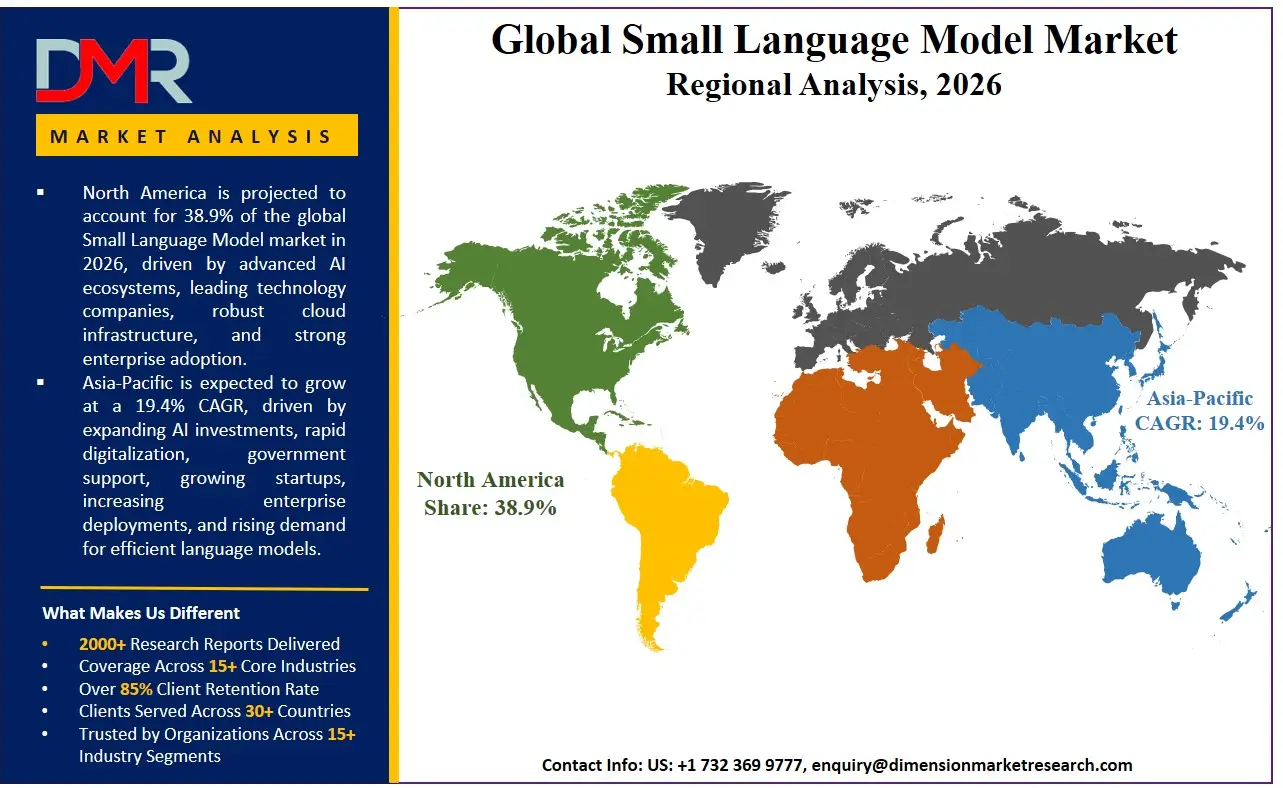
North America is poised to dominate the global small language model market, as it is projected to hold 38.9% of the market share by the end of 2026. The United States, which dominates North America, has the highest share in the SLM market because of the unmatched concentration of frontier AI research labs, venture capital funding, and the aggressive AI-integration agendas of Fortune 500 companies. The area has an established ecosystem of global system integrators, boutique AI consultancies, and a rich pool of talent in model compression and on-device ML engineering. Enterprise investment in retrieval-augmented generation, on-device assistants, and the systematic retirement of costly LLM dependencies contribute to the continued demand for custom model development and model training & fine-tuning services. Moreover, a highly active open-source community continuously spawns new SLM architectures that need expert integration & deployment services to achieve rapid scaling and enterprise-grade security compliance.
Fastest-Growing Regional Market
Asia-Pacific is expected to be the most rapidly expanding small language model market, driven by government-led digital sovereignty initiatives and a mobile-first digital transformation across India, China, Japan, and Southeast Asia. The fast-paced economic growth, a rising population of non-English-speaking digital consumers, and the dynamic expansion of local manufacturing and e-commerce giants are compelling established conglomerates to adopt language and culturally-aligned AI. Consulting & advisory is in high demand to help these large organizations pivot from monolithic, Western-centric LLMs to sovereign, multilingual SLM operating models. There is also a severe lack of deep learning talent in the region, making it necessary to outsource model training & fine-tuning on native languages, custom model development for local contexts, and support & maintenance to cover the skills gap and enable faster, more cost-effective investments in localized AI projects.
By Region
North America
Europe
- Germany
- The U.K.
- France
- Italy
- Russia
- Spain
- Benelux
- Nordic
- Rest of Europe
Asia-Pacific
- China
- Japan
- South Korea
- India
- ANZ
- ASEAN
- Rest of Asia-Pacific
Latin America
- Brazil
- Mexico
- Argentina
- Colombia
- Rest of Latin America
Middle East & Africa
- Saudi Arabia
- UAE
- South Africa
- Israel
- Egypt
- Rest of MEA
Competitive Landscape
The competitive environment of the global small language model market has become highly dynamic, with a heterogeneous array of AI-native model builders, the professional service divisions of major cloud hyperscalers, and specialized ML consultancies. The key to success lies in profound strategic expertise in model distillation, parameter-efficient fine-tuning, and quantization, as these skills determine the cost and performance profile of a deployed SLM. The movement toward market consolidation is rapidly progressing, with traditional IT outsourcing companies acquiring niche AI boutiques specializing in edge model optimization and industry-specific multimodal model development to stay relevant. Proprietary intellectual property, including automated model evaluation frameworks and industry-specific data curation pipelines for fine-tuning, is becoming a more important basis of competitive differentiation than simple reselling of GPU compute or generic data science project management.
Some of the prominent players in the Global Small Language Model Market are:
- OpenAI
- Google
- Microsoft
- Meta Platforms
- Anthropic
- Mistral AI
- Cohere
- AI21 Labs
- Databricks
- NVIDIA
- IBM
- Amazon Web Services
- Hugging Face
- Snowflake
- Oracle
- SAP
- Salesforce
- Alibaba Cloud
- Baidu
- Tencent
- Other Key Players
Recent Developments
- September 2025: Meta Platforms expanded access to its open-weight Llama models for U.S. government agencies and allied organizations, enabling secure fine-tuning and on-premises deployment for mission-critical and sensitive AI applications.
- April 2025: Hugging Face and OpenAI announced Open Responses, an open inference specification designed to improve interoperability for AI agents and multimodal models across different platforms and providers.
- May 2024: Microsoft and Databricks continued expanding enterprise generative AI capabilities through Azure Databricks, enabling customers to fine-tune, deploy, and manage open-source foundation models such as Meta Llama for enterprise AI workloads.
Report Details
| Report Characteristics |
| Market Size (2026) |
USD 9.5 Bn |
| Forecast Value (2035) |
USD 40.8 Bn |
| CAGR (2026–2035) |
17.6% |
| The US Market Size (2026) |
USD 3.1 Bn |
| Historical Data |
2021 – 2025 |
| Forecast Data |
2027 – 2035 |
| Base Year |
2025 |
| Estimate Year |
2026 |
| Segments Covered |
By Offering, By Model Type, By Data Modality, By Model Size, By Deployment, By Enterprise Size, By Technology, By Application, By End User |
| Regional Coverage |
North America – The US and Canada; Europe – Germany, The UK, France, Russia, Spain, Italy, Benelux, Nordic, & Rest of Europe; Asia-Pacific – China, Japan, South Korea, India, ANZ, ASEAN, Rest of APAC; Latin America – Brazil, Mexico, Argentina, Colombia, Rest of Latin America; Middle East & Africa – Saudi Arabia, UAE, South Africa, Turkey, Egypt, Israel, & Rest of MEA |
Frequently Asked Questions
How big is the Global Small Language Model Market?
▾ The Global Small Language Model market is poised to be valued at USD 9.5 billion in 2026 and is projected to reach USD 40.8 billion by 2035, driven by the universal need for cost-efficient, specialized, and secure AI processing across enterprise workflows.
What is the CAGR of the Global Small Language Model Market from 2026 to 2035?
▾ The market is expected to grow at a CAGR of 17.6% from 2026 to 2035, reflecting the accelerating need to escape the prohibitive costs of large language models and the persistent shortage of internal talent capable of compressing and fine-tuning open-source models.
What factors are driving the growth of the Global Small Language Model Market?
▾ Key drivers include the unsustainable economics of LLM inference at scale, the critical imperative for data privacy and on-device processing, the management complexity of model distillation, and the surge in demand for consulting & advisory amid evolving AI regulatory frameworks globally.
Which region held the largest share of the Small Language Model Market in 2026?
▾ North America is poised to hold 38.9% of the market share in 2026, driven by a mature AI research ecosystem and aggressive enterprise investment in custom model development and deploying SLMs for a multitude of domain-specific tasks.
Which region is expected to grow the fastest in the Small Language Model Market?
▾ The Asia-Pacific region is expected to grow the fastest, fueled by rapid, mobile-first digital transformation in India, China, and Japan, where model training & fine-tuning on local languages and cultural contexts is critical for transitioning large conglomerates to AI-native operations.
What are the major trends in the Global Small Language Model Market?
▾ Major trends include the integration of SLMs into "Model-as-a-Client" architectures, the rise of sustainable Green AI and GreenOps consulting, the demand for industry-specific multimodal SLMs, and the focus on rigorous support & maintenance to combat model drift in complex production environments.
Who are the key players in the Global Small Language Model Market?
▾ Key players include AI-native model builders like Meta, Mistral AI, and Cohere; full-stack platforms like Google, Microsoft, and Databricks; and the enabling ecosystem including Hugging Face, Nvidia, and specialized data-centric AI consultancies like Scale AI and Snorkel AI.
How is the Global Small Language Model Market segmented?
▾ The market is segmented by Offering, Model Type, Data Modality, Model Size, Deployment, Enterprise Size, Technology, Application, and End User.