Market Overview
The global smart hospital market covers digitally interconnected clinical environments where hardware, software, and services combine to automate care delivery, optimize asset use, and reduce operational waste. The market spans connected medical devices, imaging systems, electronic health records, pharmacy automation, remote patient monitoring, and the supporting AI, IoT, cloud, and analytics layers that bind these systems together. It excludes standalone health IT products sold outside an integrated hospital infrastructure context.
Hospitals worldwide face a convergence of pressures that no single technology resolves alone. Aging populations, chronic-disease caseloads, and workforce shortages are forcing health systems to buy platforms rather than point solutions. As reported by HealthIT.gov, 80% of U.S. hospitals had adopted all four foundational digital patient-engagement capabilities by 2025, signaling that baseline connectivity is now a threshold rather than a competitive advantage.
Vendors that once sold discrete devices now compete as full-stack infrastructure partners. Health systems evaluating smart-hospital contracts increasingly demand unified architectures that cover device connectivity, clinical AI, cybersecurity, and managed services under a single commercial agreement. Buyers unwilling to manage multi-vendor complexity are reshaping what winning looks like for technology providers in this space.
Key Takeaways
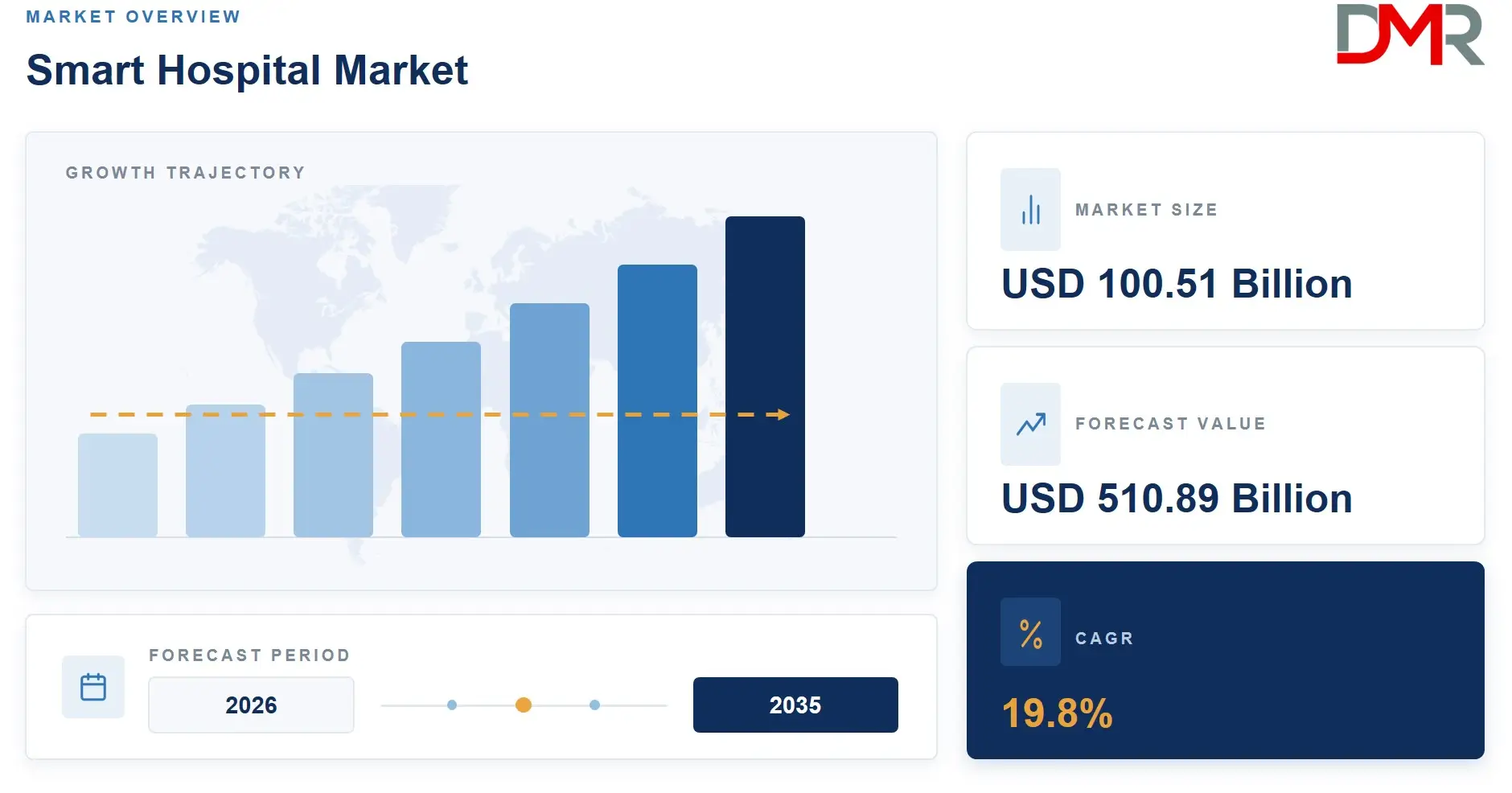
- The market size is USD 100.51 Billion in 2026, and is projected to hit USD 510.89 Billion by 2035 at a CAGR of 19.8%.
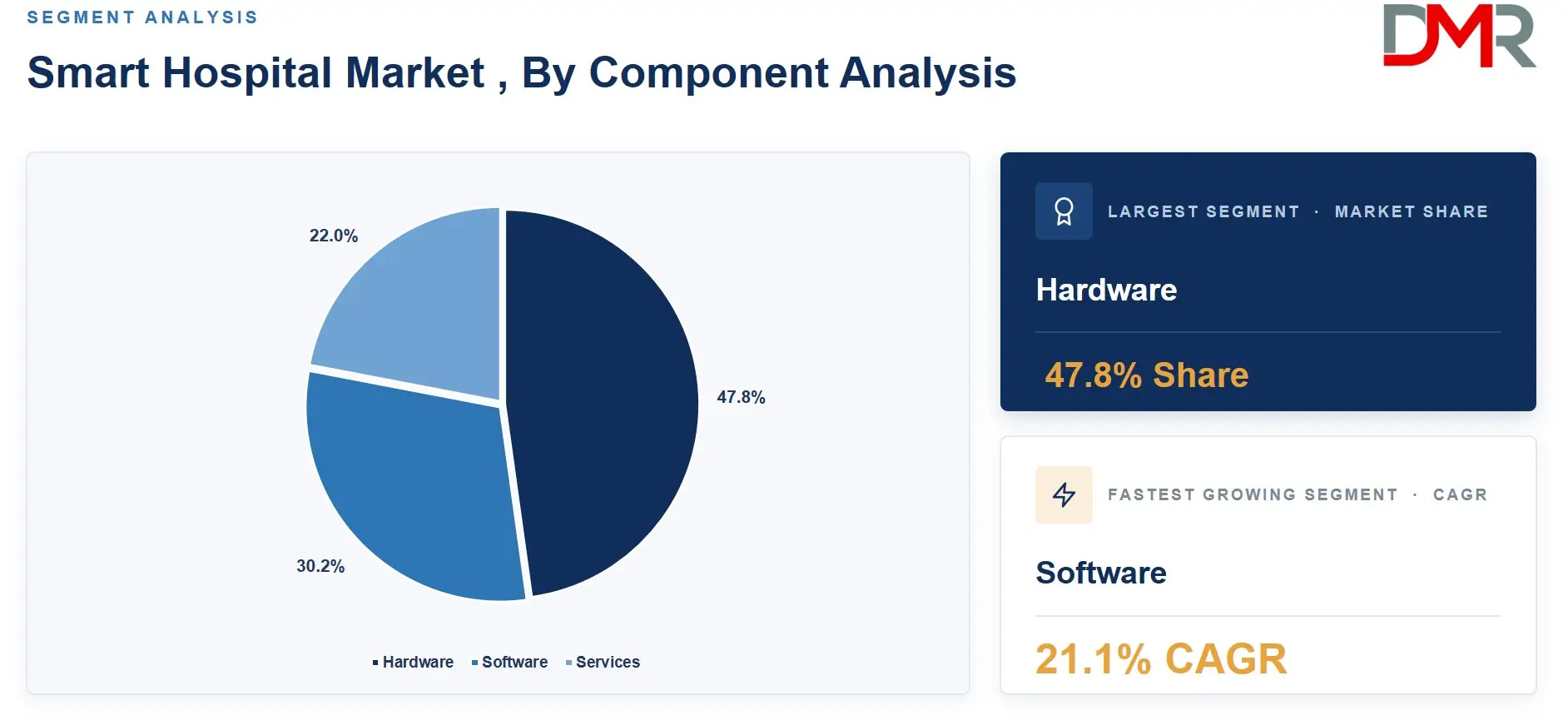
- By Component: Hardware led with a 47.8% share in 2026.
- By Application: Electronic Health Record (EHR) led with a 30.4% share in 2026.
- By Technology: Artificial Intelligence (AI) led as the largest category in 2026.
- By End User: Hospitals and Clinics led as the largest category in 2026.
- By Connectivity: Wireless led as the largest category in 2026.
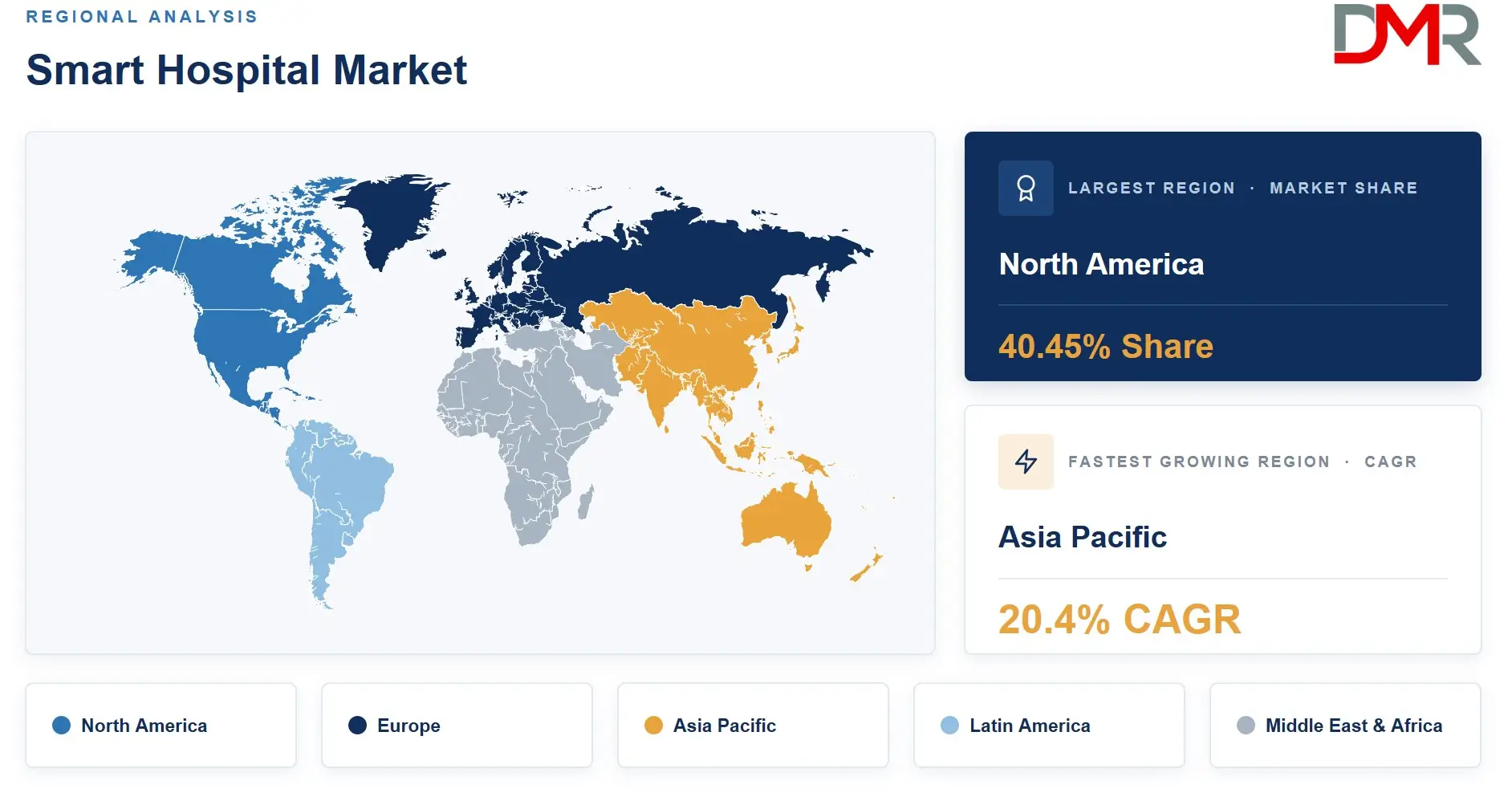
- By Region: North America led with a 40.45% share, valued at USD 40.66 Billion, in 2026.
- GE HealthCare reached 100 AI-enabled FDA-authorized medical device listings in July 2025, leading the global market for the fourth consecutive year.
Market Size and Forecast
The Global Smart Hospital Market size is estimated at USD 100.51 Billion in 2026, and is projected to reach USD 510.89 Billion by 2035, exhibiting a CAGR of 19.8% during the forecast period.
Hospital digitalization programs funded by public-sector bodies in North America, Europe, and Asia Pacific pulled forward infrastructure spending that analysts had modeled for later in the decade. As reported by HealthIT.gov, 99% of U.S. hospitals enabled patients to view their health information electronically by 2025. Near-universal baseline adoption means vendors can no longer grow by selling first-generation connectivity. Revenue now depends on deeper integration layers: clinical AI, predictive analytics, and managed cybersecurity.
ℹ
To learn more about this report –
Download Your Free Sample Report Here
Forecast assumptions rest on three structural anchors. Health system consolidation is concentrating purchasing decisions among fewer, larger buyers with higher deal values per contract. Subscription-based commercial models are replacing capital expenditure cycles, smoothing revenue recognition for vendors and lowering adoption barriers for mid-market hospitals. A shift toward outcomes-linked pricing in enterprise contracts adds a performance floor to vendor revenue projections through 2035.
Component Analysis
Hardware accounted for 47.8% of component demand in 2026, the highest of any category.
Connected medical devices, servers, networking gear, imaging systems, and sensor arrays form the physical foundation of every smart-hospital deployment. No software or AI layer operates without this infrastructure in place. Changi General Hospital's 2025 smart-hospital case study, as published in PMC, confirmed that automated laboratory processes at its Shimadzu-CGH Clinomics Centre produced approximately 0.4 annualized full-time-equivalent productivity savings, underscoring that hardware-enabled automation delivers measurable labor value beyond initial capital outlay.
ℹ
To learn more about this report –
Download Your Free Sample Report Here
Software and Services represent the faster-growing share of contract value even as Hardware dominates volume. Buyers are adding clinical decision-support platforms, EHR-integrated AI modules, and managed cybersecurity services on top of existing device estates. Based on data from a 2025 nature.com case study, IoT actuators were 60% more cost-effective than traditional programmable-logic-controller systems for wireless remote equipment regulation, giving connectivity-first hardware vendors a structural cost argument over legacy automation suppliers.
Application Analysis
Electronic Health Record (EHR) led the application segment with a 30.4% share in 2026.
EHR platforms hold the largest share because they serve as the integration hub for every other smart-hospital capability. Predictive AI, remote monitoring alerts, pharmacy automation triggers, and asset-tracking events all route through or reference the EHR. Vendors that control the EHR layer hold structural pricing power over adjacent application categories.
Remote Patient Monitoring is the fastest-scaling application outside EHR. Post-acute and chronic-care programs are generating high-frequency biometric streams that EHR systems were not originally built to process. Pharmacy Automation and Medical Asset Tracking are gaining contract share in large health systems where labor cost reduction has become a board-level priority. Other Applications covering operational analytics and environmental monitoring are growing as hospitals look beyond clinical use cases to optimize facility costs.
Technology Analysis
Artificial Intelligence (AI) led the technology segment as the largest category in 2026.
AI commands the technology segment because it operates across every other layer of the smart-hospital stack. Predictive analytics, image recognition, and natural language processing each address a distinct hospital workflow, giving AI vendors multiple entry points within a single health system account. Buyers procuring one AI capability frequently expand into adjacent modules, compounding contract value over time.
IoT and Cloud Computing follow AI in adoption and are increasingly procured together rather than separately. Big Data and Analytics platforms are shifting from standalone reporting tools to embedded decision-support layers within EHR and operational dashboards. Machine Learning, Robotics, and 5G Connectivity represent the frontier of smart-hospital investment, with 5G enabling the low-latency device communication that real-time surgical robotics and mobile monitoring require.
End User Analysis
With Hospitals and Clinics as the largest end-user category in 2026, general and specialty hospitals drive the majority of smart-hospital contract value.
Large hospitals concentrate capital, clinical complexity, and regulatory exposure in a single facility, making the return on smart-infrastructure investment easier to justify at the board level. General hospitals anchor most vendor land-and-expand strategies because a single contract spans multiple departments, care pathways, and technology layers.
Outpatient and Ambulatory Centers, ASCs, Long-Term Care Centers, and Research and Diagnostics Facilities each represent distinct adoption curves. ASCs are scaling pharmacy automation and asset tracking faster than their inpatient counterparts because procedure volume and supply cost are directly visible on the profit line. Long-Term Care Centers are early adopters of remote monitoring platforms tied to payer reimbursement programs. Research and Diagnostics Facilities are driving demand for AI-powered imaging and laboratory automation.
Connectivity Analysis
Wireless led the connectivity segment as the largest category in 2026.
Wireless connectivity dominates because retrofitting legacy hospitals with wired infrastructure carries prohibitive disruption costs. Mobile nursing stations, portable imaging units, and wearable patient monitors all depend on reliable wireless networks. Health systems prioritizing wireless-first architectures are also enabling the real-time location systems and computer vision applications that automate bed flow and patient safety monitoring.
Wired connectivity retains a role in high-bandwidth, low-latency applications such as surgical imaging suites and central server connectivity. Hospitals running parallel wired and wireless networks are generating the redundancy that enterprise cybersecurity frameworks now require, particularly as zero-trust architectures become core design requirements for connected medical devices.
Key Market Segments
By Component
- Hardware
- Connected medical devices
- Servers and networking gear
- Imaging systems
- Sensor arrays and edge gateways
- Software
- Services
By Application
- Electronic Health Record (EHR)
- Remote Patient Monitoring
- Pharmacy Automation
- Medical Asset Tracking
- Other Applications
By Technology
- Artificial Intelligence (AI)
- Predictive analytics
- Image recognition
- Natural language processing
- Internet of Things (IoT)
- Cloud Computing
- Big Data & Analytics
- Machine Learning
- Robotics
- 5G Connectivity
- Others
By End User
- Hospitals and Clinics
- General hospitals
- Specialty hospitals
- Outpatient and Ambulatory Centers
- Ambulatory Surgical Centers (ASCs)
- Long-Term Care Centers
- Research and Diagnostics Facilities
By Connectivity
Regional Analysis
North America led the smart hospital market with a 40.45% share, valued at USD 40.66 Billion, in 2026.
ℹ
To learn more about this report –
Download Your Free Sample Report Here
North America
North America's lead reflects decades of EHR infrastructure investment, high hospital capital budgets, and a reimbursement environment that rewards care quality metrics tied to digital systems. U.S. federal digitalization mandates, combined with private health system competition on patient experience, pulled enterprise smart-hospital spending forward. Canadian hospital networks are following U.S. adoption patterns with a two-to-three-year lag, driven by provincial digital-health funding programs.
Europe
European health systems are scaling smart-hospital programs under national digitalization strategies, with Germany, France, and the UK committing multi-year public funding to hospital infrastructure modernization. Regulatory alignment across EU member states on health data standards is accelerating cross-border interoperability investment. Procurement cycles remain longer than in North America because public-tendering requirements add lead time between vendor selection and contract execution.
Asia Pacific
Asia Pacific is the fastest-growing region in the smart hospital market. China is investing in hospital digitalization at scale as a strategic healthcare modernization priority, with state-backed procurement programs driving volume across tier-one and tier-two hospital networks. India and Southeast Asian markets represent retrofit-first opportunities where mid-market hospitals cannot finance greenfield digital facilities but can absorb modular platform upgrades. Japan and South Korea are scaling robotics and AI-enabled diagnostic systems in response to acute clinical workforce shortages.
Latin America
Latin America's smart-hospital adoption is concentrated in Brazil and Mexico, where private hospital groups are investing in connected infrastructure to differentiate on care quality. Public-sector procurement in the region is constrained by fiscal pressure, limiting growth to private and PPP-funded hospital networks through 2028.
Middle East & Africa
GCC governments, particularly in Saudi Arabia and the UAE, are funding hospital digitalization as part of national economic diversification programs. Greenfield hospital builds in the Gulf region create opportunities for full-stack smart-hospital deployments rather than incremental retrofits. Sub-Saharan Africa remains an early-stage market where connectivity infrastructure gaps constrain enterprise-grade smart-hospital rollouts.
Key Regions and Countries
North America
Europe
- Germany
- France
- The UK
- Spain
- Italy
- Rest of Europe
Asia Pacific
- China
- Japan
- South Korea
- India
- Australia
- Rest of APAC
Latin America
- Brazil
- Mexico
- Rest of Latin America
Middle East & Africa
- GCC
- South Africa
- Rest of MEA
Macroeconomic Impact
Hospital operating margins in most developed markets remained compressed through 2024 and 2025 as labor costs, energy prices, and supply chain inflation outpaced reimbursement rate adjustments. A 2025 intelligent-logistics case study published in Nature found that smart-hospital technology reduced ineffective equipment energy consumption by 42%, giving CFOs a quantifiable ROI argument for capital allocation in an environment where discretionary investment competes directly with staffing costs.
Interest rate environments in North America and Europe raised the cost of long-term capital borrowing for hospital infrastructure projects through 2024. Subscription-based smart-hospital commercial models gained traction precisely because they shift infrastructure cost from capital expenditure to operating expenditure, preserving borrowing capacity for clinical expansion. Currency depreciation in emerging markets is widening the price gap between locally available basic infrastructure and premium smart-hospital platforms from U.S. and European vendors.
Market Dynamics
Driver: AI and Workforce Pressures Accelerating Smart Infrastructure Spend
Aging populations and chronic-disease caseloads are forcing hospitals to sustain care volume with smaller clinical teams. Persistent nursing and physician shortages are not cyclical. Health systems in North America, Europe, and Asia Pacific are responding by investing in virtual care platforms, intelligent command centers, and AI-enabled workflow automation that extend the capacity of existing clinical staff rather than waiting for workforce pipelines to recover.
Operational data confirms the return is measurable. As published by Nature in 2025, AI-driven equipment-health monitoring analyzed more than 200 characteristics, prioritizing maintenance and reducing sudden energy losses tied to equipment failures by 67%. The same case study reported that intelligent path planning cut hospital logistics handling mileage by 22%. A data-to-AI-to-automation workflow reduced overall energy use by 25% to 32%, compressing operating costs at a level that justifies enterprise-wide platform investment. In November 2025, GE HealthCare signed a definitive agreement to acquire Intelerad for a base price of $2.3 billion, directly targeting cloud-first enterprise imaging as the next layer of smart-hospital infrastructure where scale creates durable competitive advantage.
Restraint: Capital Costs and Cybersecurity Complexity Slowing Deployment
Interconnected IoT networks, cloud infrastructure, clinical AI platforms, and enterprise cybersecurity layers each carry substantial upfront costs. Mid-market and public-sector hospitals face the highest friction because capital budgets are fixed, procurement cycles are long, and the ROI horizon for full smart-hospital platforms often exceeds board-approved payback thresholds. High entry cost is not just a financial barrier. It concentrates early adoption among large private health systems, leaving the majority of global hospital volume underserved by current commercial models.
Health-data privacy exposure and ransomware risk add a second layer of deployment resistance beyond capital. Fragmented interoperability standards across device manufacturers, EHR vendors, and cloud platforms mean that integration work consumes a disproportionate share of project budgets. As reported by Nature in 2025, smart-hospital air-conditioning power consumption fell by 35% once intelligent controls were operational, but achieving that outcome required a fully integrated sensor, IoT, and building-management ecosystem. Hospitals that cannot achieve full integration capture only a fraction of the available operational savings, undermining the business case that justifies the initial investment.
Opportunity: Subscription Models and AI-at-Home Unlock New Revenue Pools
Mid-market hospitals that cannot finance greenfield digital facilities represent the largest underserved segment in the smart hospital market. Retrofit-first platforms that deploy modular smart-building capabilities over existing infrastructure lower the adoption threshold without requiring system-wide replacement. Smart-Hospital-as-a-Service commercial models bundling hardware, software, integration, and managed cybersecurity into subscription contracts are converting previously inaccessible capital-constrained buyers into recurring revenue customers.
AI-powered hospital-at-home orchestration is extending the smart-hospital perimeter beyond the physical facility. Data from the AHA's 2026 market scan of AdventHealth's smart-room implementation showed that virtual pharmacist interactions allowed clinicians to access medication information in approximately 30% less time. B2B2C remote monitoring partnerships linking health systems, payers, device manufacturers, and community care providers are creating new commercial structures that distribute both risk and revenue across a broader ecosystem of participants.
Porter's Five Forces
Competitive rivalry in the smart hospital market is high among a set of large, well-capitalized incumbents who compete across hardware, software, and services simultaneously. New entrants face substantial barriers because clinical-grade platform integration requires regulatory clearance, health system trust, and multi-year implementation cycles that pure-technology startups rarely survive alone. Supplier power is moderate. Semiconductor, cloud infrastructure, and connectivity components are sourced from concentrated markets, but leading vendors have diversified supply chains and multi-cloud architectures.
Buyer power is rising. Large health systems are consolidating procurement and demanding outcomes-linked pricing, while smaller hospitals are gaining leverage through group purchasing organizations. The threat of substitutes is low at the platform level but real at the component level, where open-source clinical AI tools and off-the-shelf IoT hardware allow sophisticated buyers to assemble partial alternatives to proprietary platforms. Findings from a 2025 Nature case study illustrate the technical moat required to compete: enterprise-grade smart-hospital logistics platforms were engineered to handle emergency scheduling loads above 500 queries per second with response times below 200 milliseconds, and disaster-recovery architectures required backup nodes at least 200 km apart, a recovery-point objective below 5 minutes, and failover in 10 seconds with recovery times under 30 seconds. Meeting those specifications excludes most new entrants from enterprise procurement without a credentialed infrastructure partner.
AI and Gen AI Impact
Predictive AI has moved from pilot programs into standard clinical operations faster than most market forecasts anticipated. The ASTP/ONC 2025 data brief confirmed that 71% of U.S. non-federal acute-care hospitals used predictive AI in 2024, up from 66% in 2023. Among those hospitals, 93% deployed it to predict inpatient health trajectories, 88% used it to identify high-risk outpatients, 67% applied it to scheduling, 58% to billing, 53% to treatment recommendation, and 37% to continuous patient monitoring. Hospitals that have not yet embedded predictive AI in scheduling and revenue cycle operations face a widening efficiency gap against competitors that have.
Generative AI is reshaping clinical documentation at the point of care. In February 2026, Epic Systems launched its built-in ambient scribe tool, AI Charting, alongside Curiosity, a family of generative AI models trained on over 300 million deidentified records from the Cosmos network to forecast longitudinal patient outcomes. Vendors that embed generative AI natively into EHR workflows are reducing documentation time without adding a separate application layer, compressing clinician cognitive load and strengthening EHR platform stickiness in competitive health system accounts.
Market Trends
Ambient AI and Real-Time Systems Converging Across Clinical Workflows
Ambient AI documentation and conversational clinical interfaces are moving from proof-of-concept into daily care routines at early-mover health systems. Real-time location systems and computer vision are converging to automate bed flow, asset tracking, and patient safety monitoring from a single data platform. A 2025 Nature case study reported that batch removal of medical waste in a smart-logistics workflow reduced cold-chain energy consumption by 19%, illustrating that AI-driven operational automation now extends well beyond clinical care into facility management. Vendors that connect ambient AI to operational AI within a unified hospital command architecture will capture the next wave of enterprise contract renewals.
Market Competition Overview
The smart hospital market is moderately consolidated at the platform level, with a small group of large vendors competing for enterprise health system contracts while a broader base of specialized providers serves point-solution demand. Leading vendors hold advantage through full-stack portfolios that cover hardware, clinical AI, cloud infrastructure, and managed services, making displacement costly and time-consuming for health systems mid-cycle. As reported by HealthIT.gov in 2025, more than four in five hospitals supported patient access through health apps, and 70% enabled HL7 FHIR-based app access, signaling that interoperability is now a baseline procurement requirement rather than a differentiator.
In February 2026, GE HealthCare rolled out ReadyFix in the United States, an AWS cloud-hosted remote fleet management solution for connected ECG workstations, demonstrating how leading vendors are using cloud-native device management to deepen post-sale relationships and raise switching costs. Challengers are gaining share by targeting clinical AI modules that incumbent EHR vendors have been slow to embed natively, particularly in scheduling optimization, revenue cycle automation, and ambient documentation. Zero-trust cybersecurity architecture requirements are creating a new competitive dimension where vendors with credentialed security frameworks win deals that others cannot reach.
Pricing Analysis
Smart-hospital pricing spans a wide range depending on deployment scope, integration complexity, and commercial model. Greenfield enterprise deployments at large health systems carry multi-year contract values measured in tens of millions of dollars, while modular retrofit solutions for mid-market hospitals are priced to fit operating budget cycles rather than capital allocation processes. Data from a 2025 Nature case study quantified the energy-cost savings that justify premium platform pricing: a hospital reduced annual electricity use from 18,948 MWh to 16,477 MWh, a saving of 2,471 MWh. Monthly savings peaked at 402 MWh in August, with June, July, and September delivering 261, 302, and 259 MWh respectively.
Subscription-based pricing models are compressing upfront cost barriers for buyers while extending vendor revenue visibility over multi-year contract terms. Market leaders price managed-service bundles at a premium over component-only contracts because integration and cybersecurity management carry labor cost that challengers cannot absorb at scale. Challengers targeting single-application segments such as ambient documentation or pharmacy automation are pricing on productivity-per-clinician metrics rather than infrastructure footprint, giving them a faster ROI story in competitive evaluations.
Company Profiles
Koninklijke Philips N.V. competes as a platform integrator rather than a device-only vendor, positioning its smart-hospital offering around continuous bedside monitoring connected to enterprise diagnostic informatics. In March 2026, Philips introduced its platform-based care intelligence architecture at HIMSS 2026 in Las Vegas, unifying bedside monitoring with diagnostic data to eliminate information silos across active hospital environments. The architecture strategy creates account depth by making Philips the connective layer between clinical data sources, raising the complexity and cost of switching to a competing platform mid-contract.
GE HealthCare has pursued scale through AI device authorization velocity and targeted acquisitions. By July 2025, GE HealthCare had reached 100 AI-enabled FDA-authorized medical device listings, leading the global market for the fourth consecutive year. Consecutive years at the top of the FDA authorization count signal that GE HealthCare is building a regulatory runway that competitors cannot replicate quickly, creating a durable first-mover position in AI-enabled clinical imaging and diagnostics.
Key Players
- Koninklijke Philips N.V.
- GE Healthcare (General Electric)
- Siemens Healthineers
- Medtronic plc
- Honeywell Life Care Solutions
- Oracle Health (Cerner Corporation)
- IBM Watson Health
- Microsoft Corporation
- Cisco Systems
- McKesson Corporation
- Epic Systems
- Allscripts Healthcare Solutions (Veradigm LLC)
- STANLEY Healthcare
- Schneider Electric
- SAP SE
- BD (Becton Dickinson)
- Abbott Laboratories
- Huawei Technologies
- NVIDIA Corporation
- Johnson Controls Digital Health
Supply Chain and Value Chain Analysis
The smart hospital supply chain flows from semiconductor and component manufacturers through device and systems integrators, then through software platform developers and cloud infrastructure providers, before reaching health system procurement and implementation teams. Maximum value creation sits at the platform integration layer, where vendors that bind hardware, clinical AI, and managed services into a single contractual relationship capture the highest margin and the strongest retention rates. Raw component supply for connected medical devices and edge gateways is exposed to semiconductor availability constraints, which introduce lead-time risk for hardware-heavy deployments. Implementation services represent a significant cost and timeline risk point, particularly in large-scale greenfield deployments where multi-vendor coordination failures have historically extended project timelines and eroded initial ROI projections.
Regulatory Landscape
The U.S. FDA's AI-enabled medical device authorization framework is the most consequential regulatory structure in the global smart hospital market. Vendors accumulating authorized AI devices gain procurement eligibility in hospital systems that require FDA clearance before clinical deployment, creating a regulatory moat that compounds with each new authorization. In the EU, the Medical Device Regulation and the AI Act together impose conformity requirements on AI-driven clinical tools, adding certification timelines that slow European market entry for vendors without pre-existing regulatory infrastructure. Health data privacy regimes including HIPAA in the U.S. and GDPR across Europe impose compliance costs that disproportionately affect smaller vendors entering the market without established legal and security teams.
Investment and White Space Analysis
Investment is concentrating at two ends of the market. Large health systems are attracting enterprise platform capital from vendors pursuing multi-year managed-service contracts with high switching costs. Mid-market hospitals represent a structural white space where subscription-based and retrofit-first platforms have not yet achieved meaningful penetration relative to the size of the addressable base. Asia Pacific, particularly India and Southeast Asia, offers high-growth opportunity with low current vendor concentration, making it the most attractive geographic white space for providers with scalable, lower-cost deployment models. AI-powered hospital-at-home and B2B2C remote monitoring partnerships represent product-level white space where no single vendor has yet captured a dominant position, leaving room for purpose-built entrants to establish scale before platform incumbents absorb the category.
Recent Developments
- January 2024: GE HealthCare announced an agreement to acquire MIM Software, targeting an expansion of its digital solutions across oncology, neurology, cardiology, and urology care segments.
- April 2024: GE HealthCare completed the acquisition of MIM Software, formally absorbing its multi-specialty imaging applications into the GE HealthCare portfolio.
- December 2024: AIIMS New Delhi and Wipro GE HealthCare signed an MoU to establish the AI Health Innovations Hub, backed by a $1 million commitment over 5 years from Wipro GE HealthCare.
- Early 2025: GE HealthCare highlighted its integration of digital workflow and AI Orchestrator technologies ahead of HIMSS 2025, focusing on reducing clinician burnout and improving hospital operational flow.
- March 2025: GE HealthCare officially unveiled its Genesis portfolio at HIMSS 2025, a cloud-suite purpose-built for medical image data migration, storage, and access across health system networks.
- July 2025: GE HealthCare reached 100 AI-enabled medical device authorizations listed by the U.S. FDA, leading the global market for the fourth consecutive year.
- November 2025: Siemens Healthineers debuted its AI-enabled radiology services suite alongside the ActExcell Operational Twin, a predictive digital simulation tool using internal supercomputers to model workflow changes and reduce scan-room transit and patient wait times.
- December 2025: Medtronic plc scaled its smart-monitoring presence by deploying the MiniMed 780G system, embedding digital monitoring and automated continuous glucose tracking into its clinical device portfolio.
Report Details
| Report Characteristics |
| Market Value (2026) |
USD 100.51 Billion |
| Forecast Revenue (2035) |
USD 510.89 Billion |
| CAGR (2026–2035) |
19.8% |
| Historical Data |
2020 – 2024 |
| Forecast Data |
2026 – 2035 |
| Base Year |
2025 |
| Estimate Year |
2026 |
| Report Coverage |
Revenue Forecast, Market Dynamics, Competitive Landscape, Recent Developments |
| Segments Covered |
By Component, By Application, By Technology, By End User, By Connectivity |
| Regional Coverage |
North America – US, Canada; Europe – Germany, France, UK, Spain, Italy, Rest of Europe; Asia-Pacific – China, Japan, South Korea, India, Australia, Rest of APAC; Latin America – Brazil, Mexico, Rest of Latin America; Middle East & Africa – GCC, South Africa, Rest of MEA |
| Prominent Players |
Koninklijke Philips N.V., GE Healthcare, Siemens Healthineers, Medtronic plc, Honeywell Life Care Solutions, Oracle Health, IBM Watson Health, Microsoft Corporation, Cisco Systems, McKesson Corporation, Epic Systems, Allscripts Healthcare Solutions, STANLEY Healthcare, Schneider Electric, SAP SE, BD, Abbott Laboratories, Huawei Technologies, NVIDIA Corporation, Johnson Controls Digital Health |
Frequently Asked Questions
What is the biggest investment opportunity in the Smart Hospital market?
▾ Mid-market and retrofit-first hospital segments represent the largest underserved investment opportunity. Subscription-based smart-hospital platforms bundling hardware, software, and managed cybersecurity are converting capital-constrained buyers into recurring revenue customers at scale. Asia Pacific, particularly India and Southeast Asia, offers the highest growth-to-competition ratio among regional opportunities.
Who are the top companies in the Smart Hospital market?
▾ Leading vendors include Koninklijke Philips N.V., GE Healthcare, Siemens Healthineers, Medtronic plc, Epic Systems, Oracle Health, Microsoft Corporation, Cisco Systems, NVIDIA Corporation, and IBM Watson Health. GE HealthCare held the top position for AI-enabled FDA-authorized medical devices for four consecutive years through 2025. Platform breadth and regulatory authorization depth are the primary competitive differentiators at the enterprise level.
Which segment is growing fastest in the Smart Hospital market and why?
▾ The Technology segment, specifically Artificial Intelligence, is the fastest-growing area within the smart hospital market. Predictive AI adoption among U.S. hospitals rose from 66% in 2023 to 71% in 2024, and generative AI tools embedded in EHR workflows are compressing clinical documentation time at a rate that accelerates platform expansion within existing health system accounts.
Which region is growing fastest in the Smart Hospital market and why?
▾ Asia Pacific is the fastest-growing region, driven by state-backed hospital digitalization programs in China, acute workforce shortages accelerating automation investment in Japan and South Korea, and a large mid-market retrofit opportunity across India and Southeast Asia. Unlike North America, where baseline EHR adoption is near-universal, Asia Pacific combines high volume with relatively low current smart-hospital penetration, producing the steepest growth trajectory through 2035.
What is the biggest challenge holding Smart Hospital Market back?
▾ High upfront capital requirements for interconnected IoT, cloud, network, automation, and cybersecurity infrastructure remain the primary barrier to broad smart-hospital adoption. Fragmented interoperability standards across device manufacturers and EHR vendors compound deployment cost and timeline risk. Mid-market hospitals that represent the majority of global hospital volume cannot access enterprise-grade platforms under current capital expenditure pricing models, constraining the addressable market until subscription-based alternatives achieve wider distribution.