Market Snapshot
- Global Smart Retinal Implants Market valued at USD 25.28 Million in 2025, projected to reach USD 103.16 Million by 2035 at a CAGR of 15.1%.
- By Product Type, Subretinal Implants led with a 55.7% share in 2025; Cortical Visual Prostheses is the fastest-growing sub-segment.
- By Implant Platform, Wired Systems commanded a 62.2% share; Wireless Systems is the fastest-growing category.
- By Component, the Implant Array held a 46.7% share; Processing Units are expanding fastest.
- By Disease Indication, Retinitis Pigmentosa accounted for a 66.71% share; Geographic Atrophy due to AMD is the fastest-growing indication.
- By End User, Hospitals and Ophthalmic Surgery Centers held a 35.71% share; Academic and Research Institutes are the fastest-growing end user.
- North America dominated regionally with a 42.7% share; Asia-Pacific is the fastest-growing region.
Market Overview
The global smart retinal implants market covers surgically placed or surgically-adjacent electro-optical devices designed to restore partial functional vision in patients with advanced degenerative retinal diseases. Covered devices include subretinal, epiretinal, suprachoroidal, and cortical visual prostheses together with the associated external camera systems, processing units, and power transmission modules. The market excludes pharmaceutical or gene therapy interventions, standalone low-vision aids, and diagnostic imaging tools for retinal assessment.
Clinical evidence now shapes buyer expectations directly. The 2025 PRIMA subretinal photovoltaic implant study reported a mean visual acuity improvement of 0.51 logMAR, corresponding to roughly 25.5 ETDRS letters gained at 12 months, as confirmed by data from the University of Pittsburgh Medical Center. Physicians treating geographic atrophy now have a quantified performance benchmark against which competing device platforms will be judged, raising the evidentiary bar for market entry.
Strategic consolidation has begun reshaping the competitive map. Science Corporation's April 2024 acquisition of the PRIMA retinal implant intellectual property from Pixium Vision transferred a major clinical-stage asset to a better-capitalized operator, signaling that IP aggregation will define market leadership over the medium term. Smaller players without proprietary clinical data or differentiated electrode architectures face acquisition or exit.
Market Size and Forecast
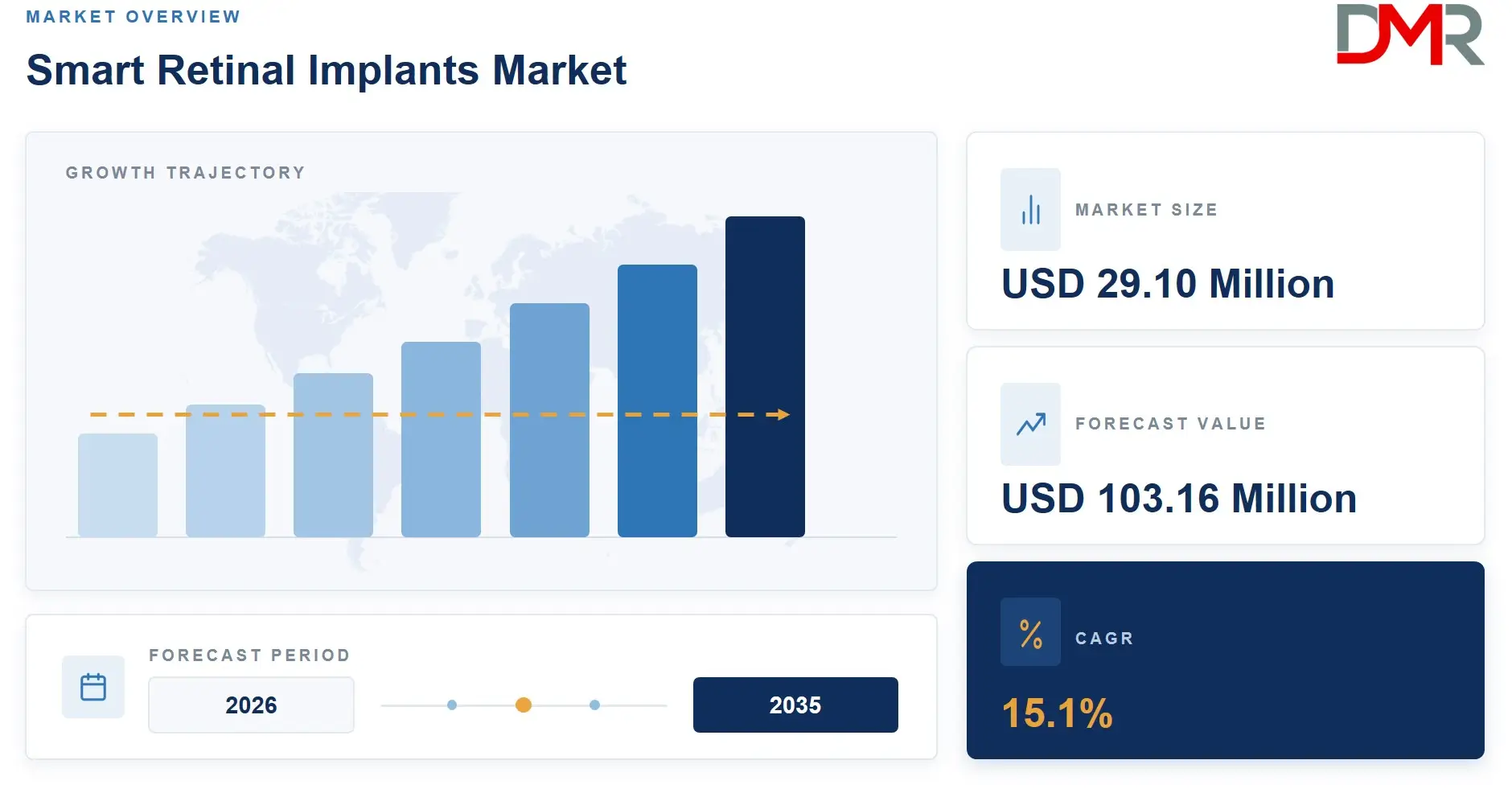
The Global Smart Retinal Implants Market size is estimated at USD 29.10 Million in 2026 from USD 25.28 Million in 2025, and is projected to reach USD 103.16 Million by 2035, exhibiting a CAGR of 15.1% during the forecast period.
Clinical performance data from 2025 anchors the demand trajectory. The PRIMA subretinal implant trial reported that 81% of participants achieved a clinically meaningful visual improvement of at least 0.2 logMAR at 12 months, as reported by Retinal Physician. That threshold matters for reimbursement discussions: payers increasingly require functional vision endpoints rather than device implantation rates before approving coverage, and a four-fifths success rate in early trials shifts those conversations materially.
ℹ
To learn more about this report –
Download Your Free Sample Report Here
Peak individual outcomes reinforce investor confidence at the high end. The best-responding PRIMA recipient gained up to 59 ETDRS letters, equivalent to approximately 10 lines of visual acuity, within one year, per data from the University of Pittsburgh Medical Center. Science Corporation's March 2026 close of an oversubscribed USD 230 million Series C financing round for PRIMA BCI commercialization reflects the market's willingness to price in that upside. Double-digit CAGR over the forecast decade assumes continued clinical-stage attrition, progressive reimbursement approvals in North America and Europe, and at least two additional regulatory clearances by 2030.
Product Type Analysis
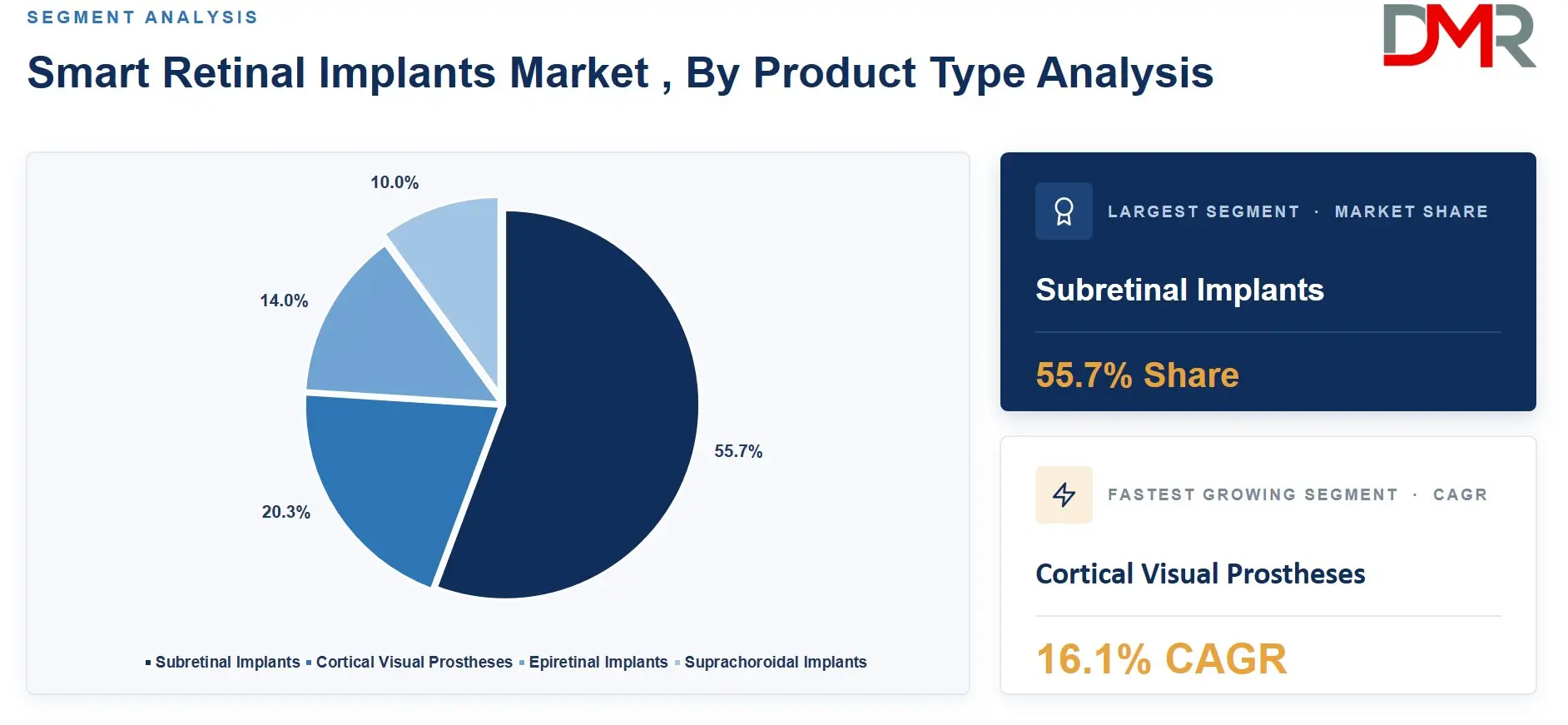
Subretinal Implants led the Product Type segment with a 55.7% share in 2026.
Subretinal placement exploits surviving bipolar cell layers, allowing photovoltaic or active-electrode arrays to interface with intact retinal circuitry rather than bypassing it entirely. Surgeons prefer this anatomy because it reduces the signal processing burden on external hardware. The 2025 PRIMA subretinal trial results gave the category a clinical anchor that epiretinal competitors have not matched at equivalent electrode count.
ℹ
To learn more about this report –
Download Your Free Sample Report Here
Cortical Visual Prostheses are the fastest-growing product type, driven by their applicability to patients ineligible for intraocular devices, including those with optic nerve damage. Epiretinal implants retain a clinical footprint built on early regulatory approvals but lose ground as subretinal outcomes surpass them. Suprachoroidal implants attract surgical interest for their reduced-risk placement approach, carving a mid-tier position between epiretinal and subretinal categories for centres with limited vitreoretinal surgical capacity.
Implant Platform Analysis
With a 62.2% share in 2026, Wired Systems outpaced all other Implant Platform categories.
Wired platforms maintain dominance because transcutaneous cable connections allow higher sustained power delivery, supporting the dense electrode arrays that produce superior spatial resolution. Hospitals already invested in surgical infrastructure for wired-implant procedures favour the known complication profile over untested wireless alternatives. Power stability justifies the surgical complexity for specialist centres treating severe retinitis pigmentosa cases.
Wireless Systems are the fastest-growing platform category. A 2025 wireless retinal implant trial across 32 participants completing 12-month follow-up showed that 81.3% achieved clinically meaningful visual acuity gains and 84.4% reported using the prosthetic vision system at home for reading, per the University of Pittsburgh Medical Center. Wireless adoption will accelerate as inductive power transfer efficiency improves, removing the surgical infection risk associated with percutaneous leads. Hybrid Systems occupy an interim position for centres transitioning from wired architectures without committing fully to wireless power budgets.
Component Analysis
Implant Array accounted for 46.7% of Component demand in 2026, the highest of any category.
The electrode array is the value-determining component in any retinal prosthesis system. Array design — electrode count, pitch, material, and encapsulation quality — directly governs clinical outcome. Manufacturers that control proprietary array fabrication retain pricing power independent of external components sourcing.
Processing Units are the fastest-growing component as on-device computation moves from simple pulse generators to real-time scene-optimizing algorithms. External Glasses and Camera Systems are commoditising as consumer-grade optics supply chains mature. Power Transmission Modules and Surgical Accessories remain essential but generate lower per-unit margins than the core implantable components.
Disease Indication Analysis
Retinitis Pigmentosa captured 66.71% of the Disease Indication segment in 2026, ahead of all rivals.
Retinitis Pigmentosa dominates because it presents in younger patients who retain viable inner retinal layers and whose disease progression is well-characterized, making them the clearest candidates for functional implant outcomes. Ophthalmic surgery centres that built early protocols around RP patients now benefit from accumulated procedural expertise that barriers new indications from replicating quickly.
Geographic Atrophy due to AMD is the fastest-growing indication, reflecting the larger global patient population and the PRIMA trial's direct targeting of this cohort. AMD patients average older ages and higher comorbidity burdens, requiring device manufacturers to widen safety envelopes beyond RP-focused designs. Other Degenerative Retinal Disorders present a long-tail opportunity as label expansions follow post-market clinical evidence accumulation.
End User Analysis
A 35.71% share made Hospitals and Ophthalmic Surgery Centers the clear leader across End User categories in 2026.
Hospitals hold the largest share because retinal implant surgery requires a full operating-room environment, anaesthesiology support, and post-operative monitoring capacity that outpatient facilities cannot replicate. Volume concentration at tertiary centres also enables the surgical team experience that drives complication rates down over time, creating a self-reinforcing adoption loop within leading institutions.
Academic and Research Institutes are the fastest-growing end user segment as investigational device exemptions and early-feasibility study protocols expand device exposure before commercial clearance. Specialty Eye Clinics handle pre- and post-surgical management but rarely perform primary implantation, positioning them as patient-routing partners rather than primary customers for device manufacturers.
Key Market Segments
By Product Type
- Subretinal Implants
- Cortical Visual Prostheses
- Epiretinal Implants
- Suprachoroidal Implants
By Implant Platform
- Wired Systems
- Wireless Systems
- Hybrid Systems
By Component
- Implant Array
- Processing Unit
- External Glasses and Camera System
- Power Transmission Module
- Surgical Accessories and Tools
By Material
- Biocompatible Metals (Platinum, Titanium)
- Polymers (Polyimide, Silicone)
- Ceramics
- Nanomaterials (Graphene, Carbon Nanotubes)
- Hybrid Materials
By Disease Indication
- Retinitis Pigmentosa
- Geographic Atrophy Due to AMD
- Other Degenerative Retinal Disorders
By End User
- Hospitals and Ophthalmic Surgery Centers
- Academic and Research Institutes
- Specialty Eye Clinics
Regional Analysis
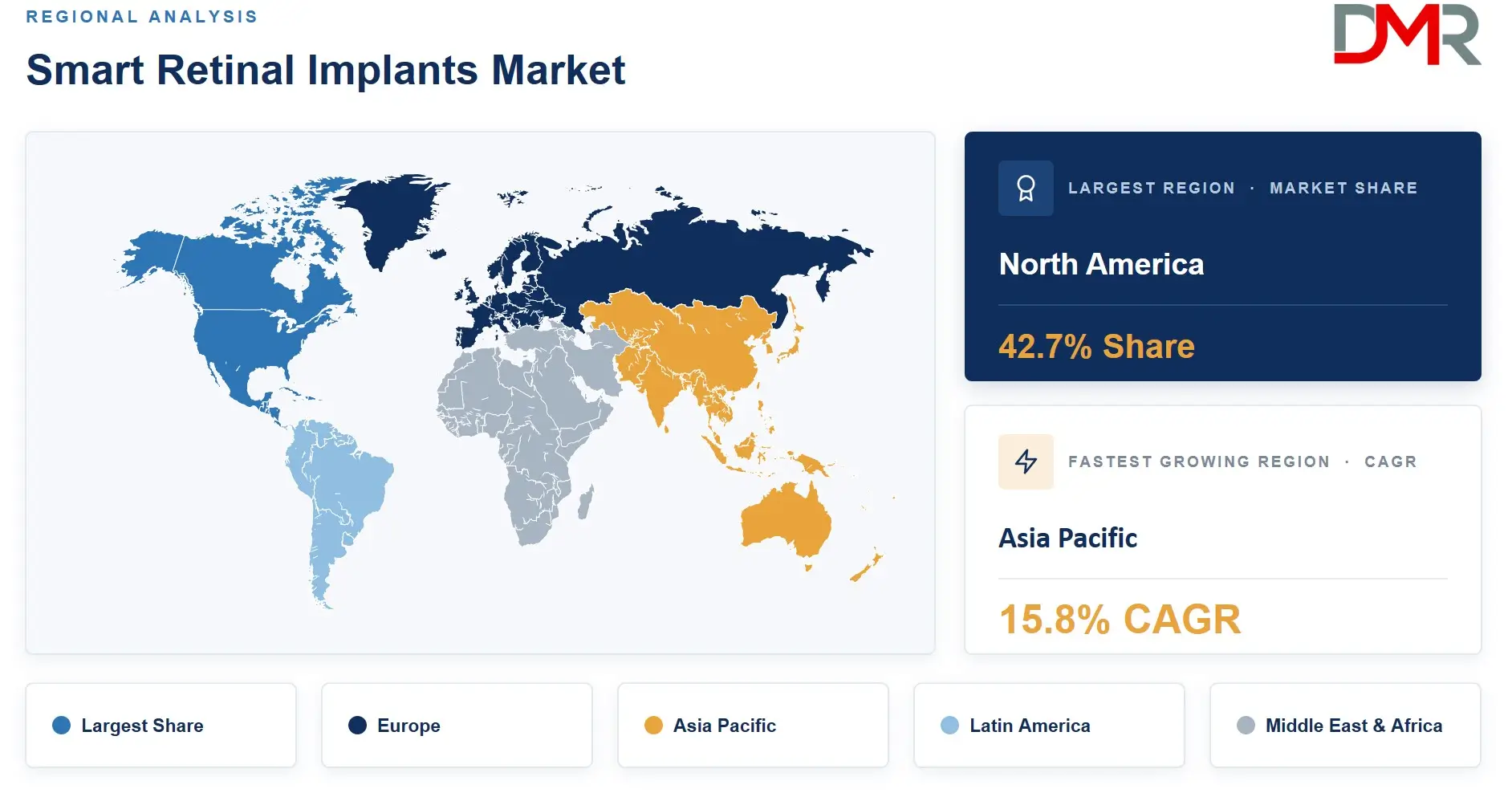
North America led the regional breakdown with a 42.7% share in 2026, corresponding to approximately USD 10.79 Million of total market value.
North America's lead reflects the concentration of FDA-cleared investigational device programs, specialist vitreoretinal surgical centres, and a reimbursement infrastructure more receptive to breakthrough-designated devices than any other region. The US healthcare system's willingness to fund experimental procedures under coverage-with-evidence-development agreements gives device manufacturers a commercially viable pathway before full payer approval. Canada contributes incremental volume through academic medical centres running FDA-parallel Health Canada programs.
Asia-Pacific is the fastest-growing region, with China, Japan, and South Korea investing in domestic ophthalmic device manufacturing to reduce import dependency on US and European implant systems. Europe benefits from CE-mark pathways and coordinated cross-border rare-disease patient registries that aggregate RP and AMD candidate pools faster than fragmented national health systems could alone. Latin America and Middle East and Africa remain nascent markets where patient identification infrastructure is the primary limiting factor ahead of device cost. Design modelling work from 2025 quantified a 30 Hz operating frame rate with 9.8 ms stimulus pulses and a 23.5 ms per-frame pre-charging window, per PMC, establishing the temporal engineering parameters that underpin next-generation photovoltaic pixel designs being commercialised across all regions.
ℹ
To learn more about this report –
Download Your Free Sample Report Here
Key Regions and Countries
North America
Europe
- Germany
- France
- The UK
- Spain
- Italy
- Rest of Europe
Asia Pacific
- China
- Japan
- South Korea
- India
- Australia
- Rest of APAC
Latin America
- Brazil
- Mexico
- Rest of Latin America
Middle East & Africa
- GCC
- South Africa
- Rest of MEA
Market Dynamics
Disease Prevalence and Device Performance Unlock a Defined Candidate Pool
Retinitis Pigmentosa and geographic atrophy due to AMD collectively affect tens of millions of people globally, but device candidates require functioning inner retinal layers, narrowing the addressable population to a concentrated, identifiable group. Surgeons can pre-screen candidates with retinal imaging before implantation, reducing procedural waste. The 2025–2026 PRIMA subretinal photovoltaic trial confirmed that 84% of the 38 implanted patients used the smart retinal implant system at home for reading tasks at the 12-month mark, as reported by Retinal Physician, demonstrating real-world utility rather than just laboratory performance.
Parallel engineering advances in microelectronics, wireless power transfer, and high-density electrode arrays give manufacturers a credible roadmap for improving resolution across successive device generations. Regulatory agencies in the US and EU have granted breakthrough and orphan device designations to multiple candidates, compressing review timelines and reducing clinical development costs for next-generation systems.
Device Cost and Surgical Complexity Cap Near-Term Patient Access
Smart retinal implants carry six-figure total treatment costs when surgical fees, hospitalization, and device price are combined. Most national health insurers have not yet established coverage pathways, confining access to self-pay patients or clinical-trial participants. A 2025 systematic review published in PMC found that all implanted patients in aggregated studies remained legally blind with best-corrected visual acuity worse than 20/200, despite meaningful letter gains. That ceiling limits the reimbursement case that manufacturers can build with payers who require restoration to functional independence thresholds. Beyond cost, the PRIMA trial reported that 68.4% of participants experienced at least one serious procedure- or device-related event in year one, as confirmed by Retinal Physician. Post-implant rehabilitation burden further reduces physician referral rates: 15.8% of PRIMA participants discontinued or were lost to follow-up within 12 months, signalling patient attrition risk that health system planners factor into programme design.
On-Device AI and Emerging Market Expansion Create Compounding Growth Vectors
Fully integrated devices incorporating real-time AI signal optimization represent the highest-margin segment of the next product generation. A 2025 Nature Communications study showed that reducing photovoltaic pixel size from 100 µm to 22 µm raised grating acuity to 28 µm, approaching the natural resolution limit of the human fovea. Smaller pixels combined with AI-driven stimulation algorithms can extract far greater functional vision from the same number of electrodes, a development path that extends product lifecycles and supports premium pricing. Science Corporation's March 2026 expansion of PRIMA clinical trials to include Stargardt disease and retinitis pigmentosa alongside the existing geographic atrophy indication directly widens the commercially addressable patient pool without requiring a new device platform.
Emerging markets across Southeast Asia, South Asia, and Sub-Saharan Africa carry rising retinal disease burdens coupled with underinvestment in specialist surgical capacity. Device companies that establish training partnerships with regional ophthalmic surgery centres now secure first-mover positions before global competitors scale distribution. Vertical integration models that connect implant hardware with digital vision-training platforms and remote monitoring services create recurring post-procedure revenue streams that diversify away from single implantation events.
Market Trends
Next-Generation Bionic Eyes and Real-World Evidence Redefine Market Standards
Transition from first-generation prostheses to high-electrode-count bionic eyes is accelerating as clinical trial data accumulates. Participants in the 2025 wireless smart retinal implant trial improved by an average of 25 letters (approximately five lines), and 81% gained at least 10 letters, per the University of Pittsburgh Medical Center. Post-market clinical evidence is now central to label-expansion strategies, with regulators and payers both requiring real-world performance data before broadening approved indications. Consolidation of retinal implant intellectual property portfolios signals that the next competitive battleground is proprietary clinical datasets, not device hardware alone.
Market Competition Overview
The smart retinal implants market is highly fragmented at present, with more than a dozen companies at varying stages of clinical development but no single player commanding a majority commercial share. Most participants are pre-revenue or early-revenue stage, relying on grant funding, strategic partnerships, and venture capital rather than product margins to sustain operations. Market structure modelling published in PMC in 2025 established that field-confinement electrode strategies at 30 frames per second can match external smart-glasses video refresh rates, meaning hardware performance gaps between leading and emerging players will narrow as design knowledge becomes more widely published. Consolidation is already under way through IP acquisitions rather than full-company mergers, allowing better-capitalised players to absorb clinical assets without full integration costs.
Competitive positioning hinges on three factors: proprietary electrode array architecture, reimbursement traction in at least one major market, and post-implant rehabilitation support infrastructure. Players lacking all three face sustained margin pressure even after regulatory approval. Organisations that control both the implant hardware and the external processing ecosystem hold a structural advantage in physician adoption because integrated systems reduce per-case complication rates compared with multi-vendor setups.
Company Profiles
Science Corporation has repositioned itself as the most clinically advanced commercial-stage operator in the smart retinal implants space following the 2024 acquisition of the PRIMA subretinal photovoltaic implant IP from Pixium Vision. The company's strategy centres on broadening the PRIMA clinical data package across multiple retinal disease indications before pursuing full commercial reimbursement approval. A severe complication rate of 10.5% in the first-generation PRIMA cohort — including cases of macular hole, ocular hypertension, retinal detachment, and proliferative vitreoretinopathy as reported by Retinal Physician — represents the primary clinical risk that the next-generation device iteration must address to achieve payer acceptance at scale.
Pixium Vision SA transitioned from lead developer of the PRIMA platform to a licensor following the 2024 IP transfer, a structural shift that reflects the capital intensity of retinal prosthesis commercialisation. The company's residual value lies in historical clinical datasets and any retained manufacturing know-how. Retina Implant AG and Bionic Vision Technologies Pty Ltd maintain active device programs but face the same capital and reimbursement barriers that constrain market-wide scaling. LambdaVision, Inc. differentiates through a protein-based retinal implant approach that bypasses traditional electrode arrays entirely, targeting a distinct patient sub-population and regulatory pathway.
Key Players
- Science Corporation
- Pixium Vision SA
- Retina Implant AG
- Nano Retina Ltd.
- Bionic Vision Technologies Pty Ltd
- iBionics Inc.
- Boston Scientific Corporation
- GenSight Biologics SA
- Intelligent Implants GmbH
- LambdaVision, Inc.
- NIDEK CO., LTD.
- Ocumetics Technology Corporation
- Ophthorobotics AG
- Optobionics Corporation
- Second Sight Medical Products, Inc.
- VisionCare Ophthalmic Technologies, Inc.
Recent Developments
Full development log — inline references excluded from this list appear in their relevant sections above.
- January 2026 — Cortigent presented the Orion Visual Cortical Prosthesis System at NANS 2026, highlighting advances in brain-implant technology designed to restore visual perception in individuals who are blind.
- January 2026 — Cortigent presented six-year Early Feasibility Study results for its Orion Visual Cortical Prosthesis System, demonstrating continued progress in cortical artificial vision research across an extended follow-up period.
- Spring 2024 — Nano Retina ceased operations, resulting in the discontinuation of its NR600 retinal implant program due to insufficient investor support, removing one active clinical-stage program from the global pipeline.
Report Details
| Report Characteristics |
| Market Value (2025) |
USD 25.28 Million |
| Market Value (2026) |
USD 29.10 Million |
| Forecast Revenue (2035) |
USD 103.16 Million |
| CAGR (2026–2035) |
15.1% |
| Base Year for Estimation |
2025 |
| Historic Period |
2020 – 2024 |
| Forecast Period |
2026 – 2035 |
| Report Coverage |
Revenue Forecast, Market Dynamics, Competitive Landscape, Recent Developments |
| Segments Covered |
By Product Type (Subretinal Implants, Cortical Visual Prostheses, Epiretinal Implants, Suprachoroidal Implants), By Implant Platform (Wired Systems, Wireless Systems, Hybrid Systems), By Component (Implant Array, Processing Unit, External Glasses and Camera System, Power Transmission Module, Surgical Accessories and Tools), By Material (Biocompatible Metals, Polymers, Ceramics, Nanomaterials, Hybrid Materials), By Disease Indication (Retinitis Pigmentosa, Geographic Atrophy Due to AMD, Other Degenerative Retinal Disorders), By End User (Hospitals and Ophthalmic Surgery Centers, Academic and Research Institutes, Specialty Eye Clinics) |
| Regional Analysis |
North America – US and Canada; Europe – Germany, France, The UK, Spain, Italy, and Rest of Europe; Asia Pacific – China, Japan, South Korea, India, Australia, and Rest of APAC; Latin America – Brazil, Mexico, and Rest of Latin America; Middle East & Africa – GCC, South Africa, and Rest of MEA |
| Competitive Landscape |
Science Corporation, Pixium Vision SA, Retina Implant AG, Nano Retina Ltd., Bionic Vision Technologies Pty Ltd, iBionics Inc., Boston Scientific Corporation, GenSight Biologics SA, Intelligent Implants GmbH, LambdaVision Inc., NIDEK CO. LTD., Ocumetics Technology Corporation, Ophthorobotics AG, Optobionics Corporation, Second Sight Medical Products Inc., VisionCare Ophthalmic Technologies Inc. |
| Customization Scope |
Customization for segments and region or country level will be provided. Additional customization can be done based on requirements. |
| Purchase Options |
Three license options: Single User License, Multi-User License (Up to 5 Users), and Corporate Use License (Unlimited Users and Printable PDF) |
Frequently Asked Questions
Who are the top companies in Smart Retinal Implants Market ?
▾ Science Corporation, Pixium Vision SA, Retina Implant AG, Bionic Vision Technologies Pty Ltd, LambdaVision Inc., iBionics Inc., Boston Scientific Corporation, GenSight Biologics SA, Intelligent Implants GmbH, NIDEK CO. LTD., Ocumetics Technology Corporation, Ophthorobotics AG, Optobionics Corporation, Second Sight Medical Products Inc., and VisionCare Ophthalmic Technologies Inc. are the key players. Science Corporation currently holds the most advanced commercial-stage clinical asset through the PRIMA photovoltaic subretinal implant platform.
What is the biggest investment opportunity in Smart Retinal Implants Market ?
▾ The clearest opportunity lies in fully integrated devices combining high-density electrode arrays with on-device AI signal processing for real-time vision optimization. Geographic Atrophy due to AMD is the fastest-growing disease indication and carries the largest untreated patient pool. Investors entering pre-commercialization platforms with proprietary clinical data and reimbursement strategies in North America stand to capture the highest returns before the market consolidates.
Which segment is growing fastest in Smart Retinal Implants Market and why?
▾ Among product types, Cortical Visual Prostheses are the fastest-growing sub-segment because they serve patients ineligible for intraocular devices, expanding the addressable population beyond candidates with intact retinal tissue. Wireless Systems lead platform growth as inductive charging designs eliminate percutaneous lead infection risk. Academic and Research Institutes are the fastest-growing end user, reflecting expanded investigational device exemption programs ahead of broader commercial clearances.
Which region is growing fastest in Smart Retinal Implants Market and why?
▾ Asia-Pacific is the fastest-growing region, driven by rising healthcare expenditure, a large and underserved retinal disease patient base, and government-backed ophthalmic device manufacturing initiatives in China, Japan, and South Korea. Unlike North America, where clinical trial capacity is mature, Asia-Pacific growth reflects genuine unmet need combined with fresh institutional investment in specialist surgical infrastructure.
What is the biggest challenge holding Smart Retinal Implants Market back?
▾ Device and surgical procedure costs, combined with absent or limited reimbursement pathways in most markets, represent the primary barrier to scale. The PRIMA trial's finding that 68.4% of patients experienced at least one serious adverse event in year one gives payers grounds to delay coverage decisions pending larger safety datasets. Until at least one major payer jurisdiction establishes a formal coverage framework, device companies will remain dependent on grants, trial budgets, and self-pay patients for commercial revenue.