What is the Sodium Ion Battery Market Size?
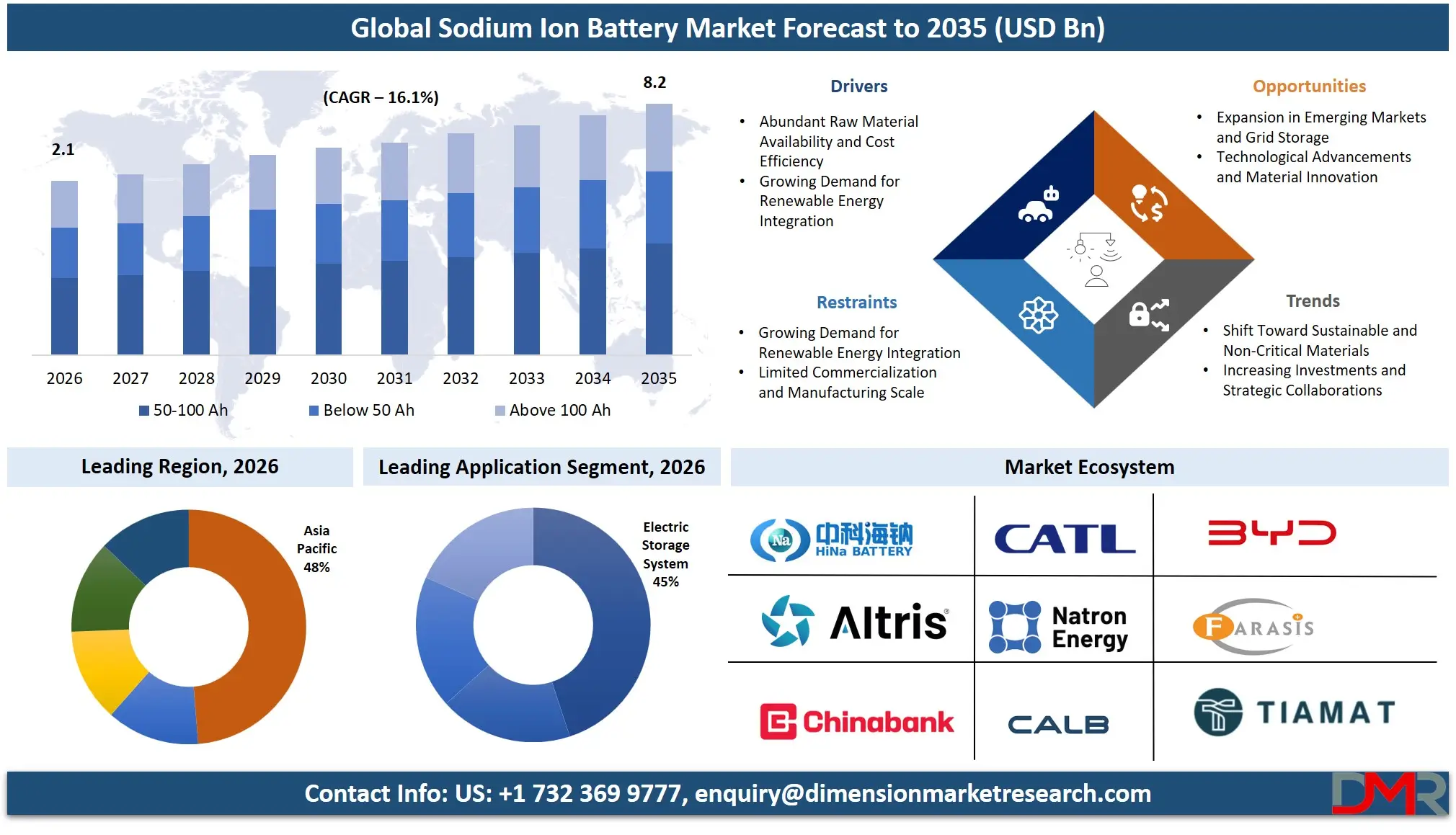
The Sodium Ion Battery Market size is expected to be USD 2.1 billion in 2026 and increase at a compound annual growth rate of 16.1% to USD 8.2 billion in 2035 due is availability and affordability of raw materials.
ℹ
To learn more about this report –
Download Your Free Sample Report Here
The Sodium Ion Battery market is rapidly becoming an efficient and environmentally friendly solution to lithium-ion batteries owing to their abundance in raw materials and increasing needs for high-energy storage. This includes the types of battery chemistry, manufacture process, and integration systems that have been employed in both mobile and stationary applications. The market is witnessing significant traction due to growing concerns on the supply chain, politics, and environment associated with lithium-ion batteries. The technology advancement in terms of energy and cycle life, along with increased investment in grid scale storage, is boosting its commercial viability.
The US Sodium Ion Battery Market
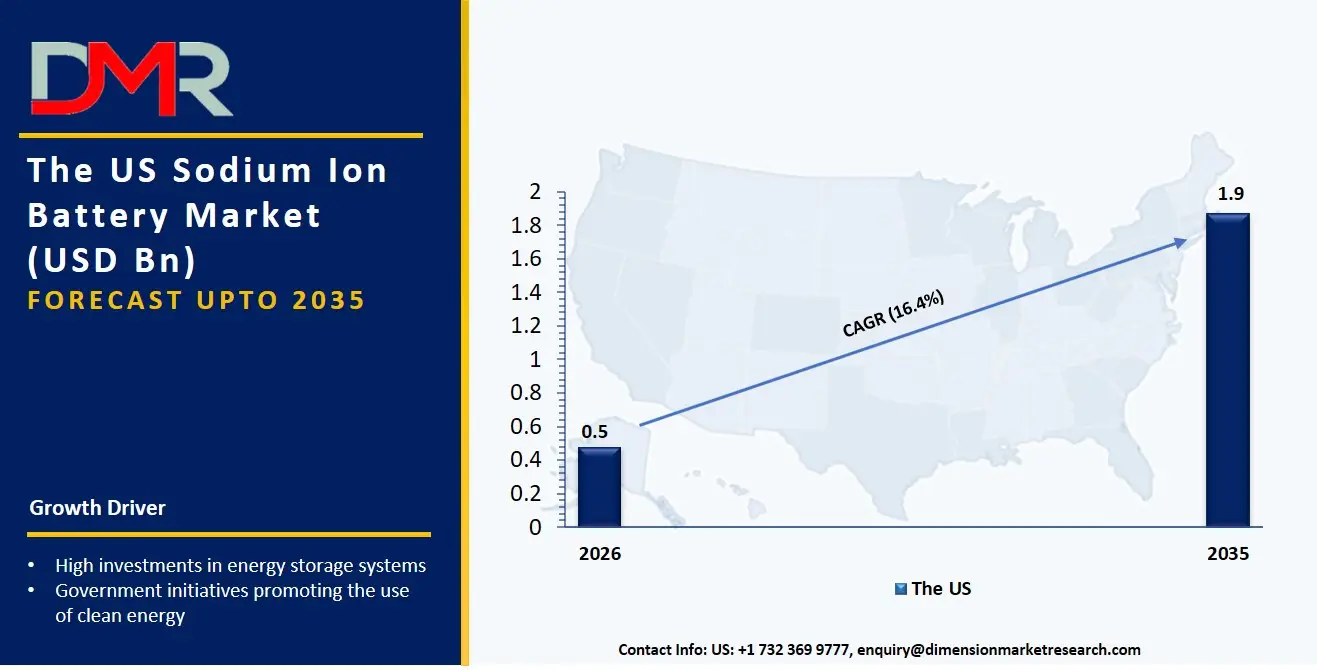
The US Sodium Ion Battery Market size is estimated to be USD 500 million in 2026 and is expected to increase at a CAGR of 16.4% over the forecast period.
ℹ
To learn more about this report –
Download Your Free Sample Report Here
There has been continuous growth in the US market owing to high investments in energy storage systems and government initiatives promoting the use of clean energy. The federal incentives being provided to incorporate renewable energy have resulted in the increased use of sodium-ion batteries. The domestic producers are emphasizing decreasing their reliance on lithium imports, while research organizations continue improving their batteries. The existence of a good innovation ecosystem, together with the collaboration between private companies and government departments, will help promote this process.
Europe Sodium Ion Battery Market
The Europe Sodium Ion Battery Market size is estimated to be USD 378 million in 2026 and is expected to increase at a CAGR of 15.7% over the forecast period.
The sodium ion battery market in Europe is booming due to sustainable development objectives and policies like the European Green Deal. Europe stresses the reduction of carbon footprint and the reliance on critical minerals; therefore, sodium ion batteries have become very popular. Excellent synergy among battery makers, automobile firms, and universities is stimulating technological developments. There is a growing investment in battery manufacturing and recycling plants. There is also an increased demand for renewable energy storage systems.
Japan Sodium Ion Battery Market
The market size of Japan Sodium Ion Battery will be USD 210 million in 2026 and at a CAGR of 15.3% in the forecast period.
The market of Japan operates on the basis of technological innovations, the strong industrial base of the country, and government programs related to new battery technologies. It is important to note that Japan is now interested in developing its batteries with the use of other materials than lithium-ion because of energy security issues. Urbanization and energy-efficient storage facilities contribute to the development of the market of Japan. Companies invest in research and development in order to increase efficiency and battery life cycle.
Key Takeaways
- Market Size & Forecast: The Sodium Ion Battery Market size is projected to reach USD 2.1 billion in 2026 and is anticipated to have a value of USD 8.2 billion in 2035.
- Growth Rate & Outlook: The Sodium Ion Battery Market size is set to grow at a compound annual growth rate of 16.1% during the forecast period of 2026 to 2035.
- Primary Growth Drivers: Some of the major growth drivers in the market are Availability and Affordability of Raw Materials, and more.
- Key Market Trends: Some of the major trends in the market are Trend Towards Sustainable and Non-Critical Elements, and more.
- By Capacity Type: 50-100 Ah segment is anticipated to get the majority share of the Sodium Ion Battery Market in 2026.
- By Battery Chemistry Type: Layered oxide is expected to get the largest revenue share in 2026 in the Sodium Ion Battery Market.
- By Application Type: ESS segment is expected to get the largest revenue share in 2026 in the Sodium Ion Battery Market.
- Regional Leadership: Asia Pacific is set to lead the Sodium Ion Battery Market with an estimated 48.0% share in 2026.
What is the Sodium Ion Battery?
Sodium-ion batteries are rechargeable batteries that store electrochemical energy through sodium ion movements from cathode to anode within the battery cells. These batteries are comprised of different parts such as sodium cathode, hard carbon anode, electrolyte, and separators. The functioning of the sodium-ion batteries is akin to the lithium-ion batteries except that sodium replaces lithium because it is abundant and cheap.
Use Cases
- Energy Storage Using Grids: Sodium-ion batteries find common use in utility-scale storage solutions to ensure stability of renewable energy generation, to handle peak loads, and to make grid operations more reliable because of high cost-efficiency and long lifetime cycles.
- Transportation of Electric Vehicles: The batteries are actively employed in low-speed electric vehicles, two-wheelers, and in public transportation systems where cost efficiency and safety of use matter.
- Backup Power Supply Solutions: The use of sodium-ion batteries is popular in telecommunications tower facilities, data centers, and other backup power solutions owing to high stability and low rate of degradation.
- Energy Storage for Industries: Sodium ion batteries are utilized in industrial applications as energy balancing, energy costs saving, and integration with on-site renewable energy systems solutions.
How AI Is Transforming the Sodium Ion Battery Market
Artificial intelligence is becoming increasingly important in facilitating the process of research and development for the sodium-ion batteries market. AI-powered simulations and material discovery platforms help in discovering more efficient electrodes in less time, resulting in better performance of the battery with regard to its density and number of life cycles.
AI technology is also helping in improving the manufacturing process through predictive maintenance and quality control, as well as the supply chain optimization process. Lastly, AI is improving battery management through real-time monitoring and performance optimization as well as safety improvements.
Market Dynamic
Driving Factors in the Sodium Ion Battery Market
Availability and Affordability of Raw Materials
Sodium ion batteries enjoy the advantage of abundant sources of sodium ions, resulting in lower raw materials costs as compared to other battery technologies that require lithium and cobalt. This factor proves especially important considering the existing limitations on supplies of raw materials and their fluctuations in prices on the market.
Restraints in the Sodium Ion Battery Market
Low Energy Density Relative to Lithium-ion Batteries
A key disadvantage associated with sodium ion batteries is the low energy density, which limits their use in high-end applications like long-range electric cars. It affects their competitive edge in certain sectors where small and light energy storage solutions are important.
Opportunities in the Sodium Ion Battery Market
Expansion of Sodium Ion Batteries in Emerging Markets and Grid Energy Storage
The emerging countries with rising demands for energy have huge potential in the deployment of sodium ion batteries due to their affordability and scalability. Increased investment in grid modernization and rural electrification augments the growth potential of these batteries.
Trends in the Sodium Ion Battery Market
Trend Towards Sustainable and Non-Critical Elements
There is a shift towards decreasing reliance on critical metals such as lithium and cobalt. Sodium-ion batteries are sustainable since they use non-critical elements that are plentiful and have a less damaging effect on the environment.
Research Scope and Analysis
Research scope and analysis of the sodium ion battery market focuses on evaluating key segments such as battery chemistry, capacity, application, and end users. It examines leading segments driving revenue and identifies high-growth areas supported by technological advancements, cost advantages, and rising demand for sustainable, large-scale energy storage and affordable mobility solutions.
ℹ
To learn more about this report –
Download Your Free Sample Report Here
By Battery Chemistry Analysis
Chemistry of layered oxides is projected to hold dominance in the market for sodium-ion batteries with about 42% share by 2026, due to better electrochemical performance and high energy density compared to other chemistries. The segment has advantage of developments made through ongoing research and suitability in terms of manufacturing process. On the other hand, the chemistry of Prussian blue/white is projected to witness the fastest growth among all chemistries, attributed to low cost and scalability of materials along with better structural stability.
By Capacity Analysis
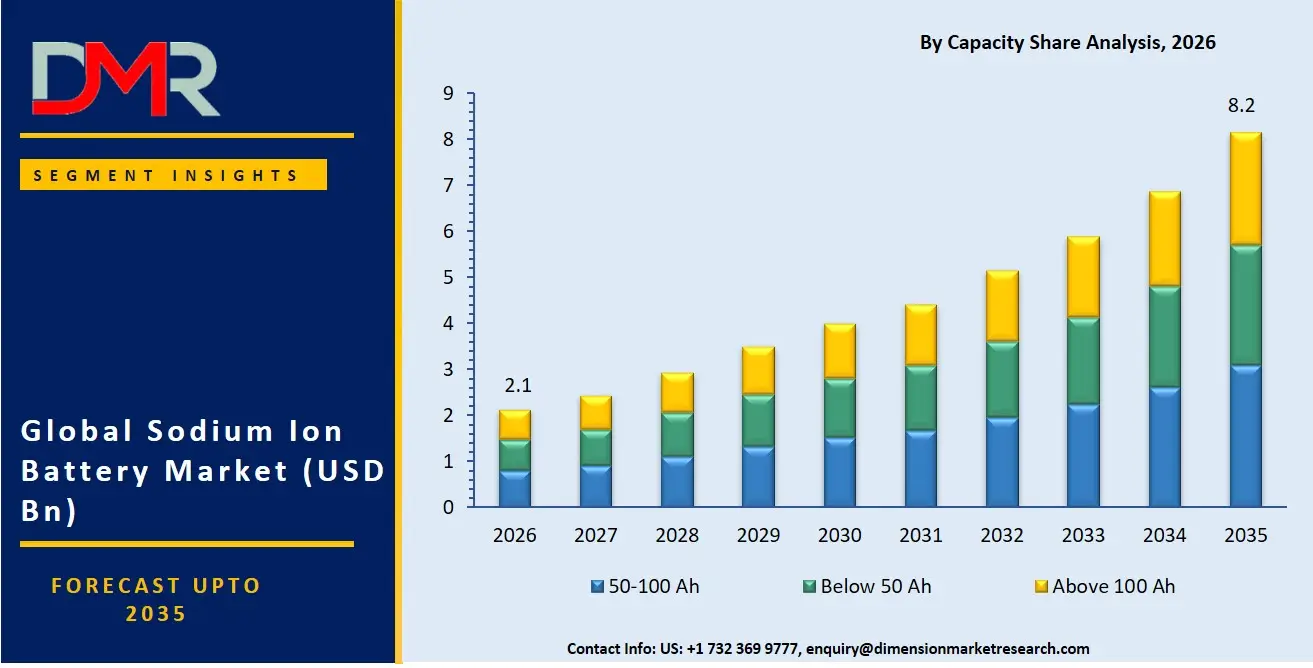
The 50-100 Ah category is forecasted to dominate the market by acquiring a share of 38% in 2026 owing to its efficiency and flexibility to be used in several applications such as electric vehicles and industrial storage systems. The capacity range of 50-100 Ah provides the best combination in terms of price, efficiency, and size.
ℹ
To learn more about this report –
Download Your Free Sample Report Here
However, the segment exceeding 100 Ah is expected to experience the highest growth rate as a result of increasing demand for battery energy storage systems on a larger scale.
By Application Analysis
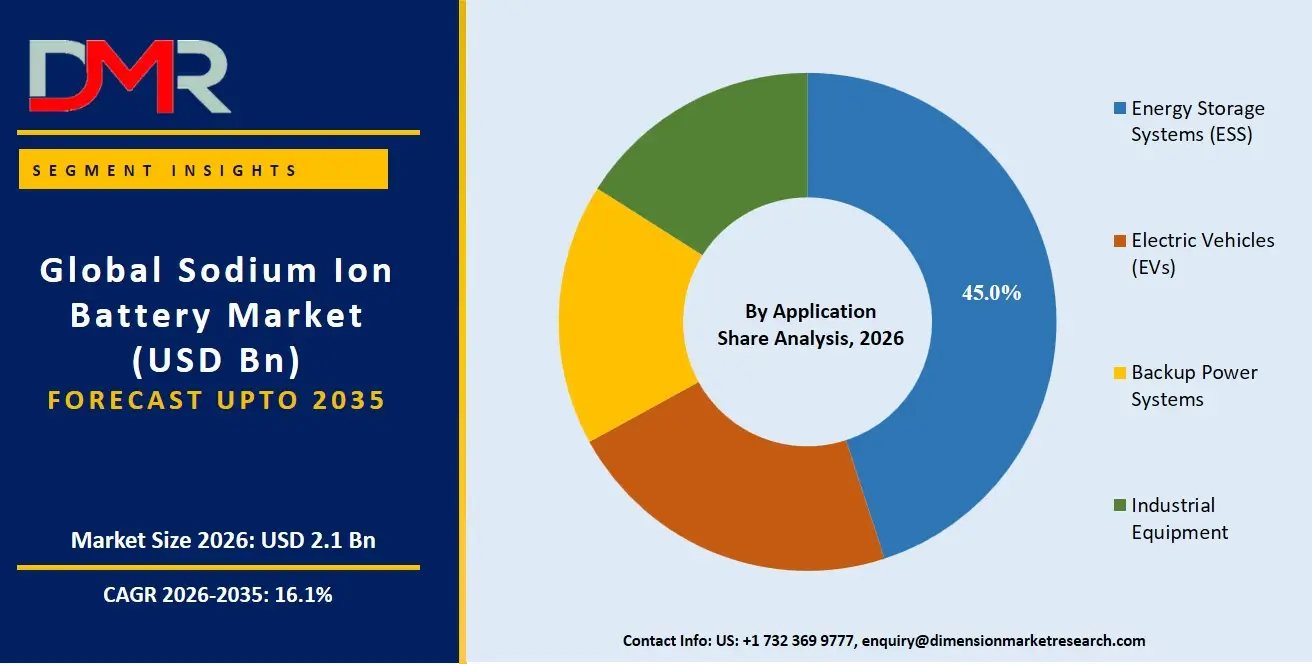
Energy Storage Systems (ESS) is forecast to become the dominant category, holding a market share of 45% by 2026, as sodium ion batteries are very appropriate for stationary energy storage. This is because of their lower costs and longevity which makes them ideal for use in grid-scale energy storage systems. In the Energy Storage Systems category, Utility-scale storage is leading, owing to the rise in adoption of renewable energy sources. Electric vehicles, especially 2-wheeled and 3-wheeled EVs, will remain the fastest-growing category.
By End User Analysis
The segment of utilities is estimated to dominate the market with an approximately 36% share in 2026 owing to growing investments in the process of grid modernization and incorporation of renewable sources of energy. Sodium-ion batteries are gaining popularity among utilities owing to their cost effectiveness and scalability. The fastest growth rate will be witnessed in the telecommunications and data centers segment due to increasing demand for reliable back-up systems.
The Sodium Ion Battery Market Report is segmented on the basis of the following:
By Battery Chemistry
- Layered Oxide
- Prussian Blue/Prussian White
- Polyanionic (Phosphate-Based)
- Other Emerging Chemistries
By Capacity
- Below 50 Ah
- 50–100 Ah
- Above 100 Ah
By Application
- Electric Vehicles (EVs)
- Passenger Vehicles
- Commercial Vehicles
- Two-Wheelers & Three-Wheelers
- Energy Storage Systems (ESS)
- Utility-Scale Storage
- Commercial & Industrial Storage
- Residential Storage
- Backup Power Systems
- Telecommunications
- UPS
- Data Centers
- Industrial Equipment
By End User
- Automotive
- Utilities
- Commercial & Industrial
- Residential
- Telecommunications & Data Centers
Regional Analysis
Leading Region in the Sodium Ion Battery Market
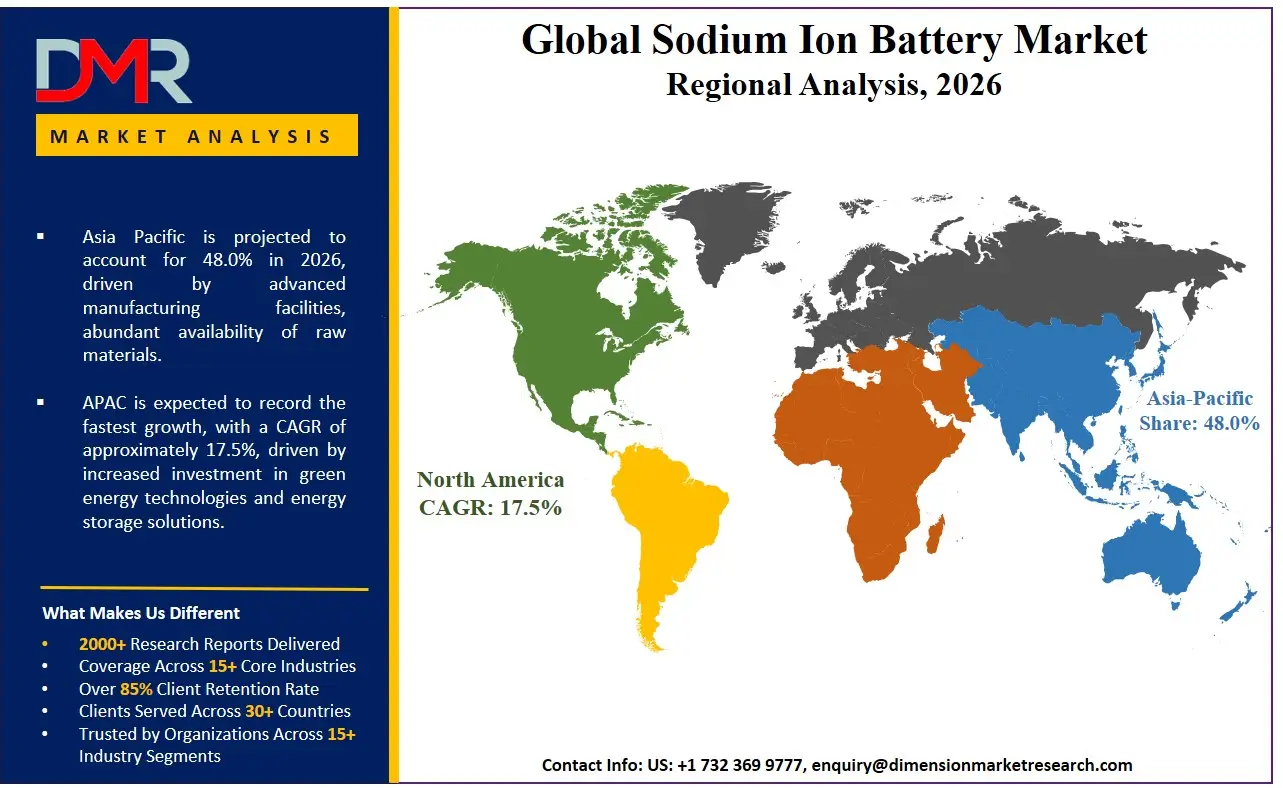
Asia-Pacific is anticipated to hold a lion's share of the market at 48% in 2026 owing to advanced manufacturing facilities, abundant availability of raw materials, and increased demand for energy. Countries in the Asia-Pacific region have made huge investments in the manufacturing sector as well as renewable energy technologies. Favorable government policies, high rates of industrialization, and rising popularity of electric vehicles further cement its lead status.
ℹ
To learn more about this report –
Download Your Free Sample Report Here
Fastest Growing Region in the Sodium Ion Battery Market
North America is expected to experience the highest rate of growth as a result of increased investment in green energy technologies and energy storage solutions. Some of the factors contributing to its growth include government incentives, technological innovations, and efforts towards minimizing dependence on foreign raw materials. North America has seen an uptake of sodium ion batteries for energy storage and commercial purposes through research and development efforts.
By Region
North America
Europe
- Germany
- The U.K.
- France
- Italy
- Russia
- Spain
- Benelux
- Nordic
- Rest of Europe
Asia-Pacific
- China
- Japan
- South Korea
- India
- ANZ
- ASEAN
- Rest of Asia-Pacific
Latin America
- Brazil
- Mexico
- Argentina
- Colombia
- Rest of Latin America
Middle East & Africa
- Saudi Arabia
- UAE
- South Africa
- Israel
- Egypt
- Rest of MEA
Competitive Landscape
The sodium ion battery market is highly competitive, with competition stemming from innovations, cost reductions, and partnerships among firms. There are significant barriers to entry in the sodium ion batteries market due to technology and capital investment needed. The companies involved in the market are making investments in research and partnerships to fast track the process and also using vertical integration tactics.
Some of the prominent players in the global Sodium Ion Battery are:
- Contemporary Amperex Technology Co., Limited (CATL)
- HiNa Battery Technology Co., Ltd.
- Farasis Energy, Inc.
- BYD Company Limited
- Natron Energy, Inc.
- Altris AB
- Tiamat Energy
- Northvolt AB
- Faradion Limited
- Reliance New Energy Limited
- Tianneng Battery Group Co., Ltd.
- Zhejiang Narada Power Source Co., Ltd.
- Great Power Energy & Technology Co., Ltd.
- China BAK Battery, Inc.
- EVE Energy Co., Ltd.
- SVOLT Energy Technology Co., Ltd.
- CALB Co., Ltd.
- Sunwoda Electronic Co., Ltd.
- Gotion High-Tech Co., Ltd.
- JAC Motors
- Other Key Players
Recent Developments
- In February 2026, CHANGAN Automobile, along with CATL, have launched the first ever mass-produced passenger car that uses sodium-ion batteries. According to their strategic agreement, the company CATL will provide CHANGAN vehicles, such as AVATR, Deepal, Qiyuan, and UNI, with its Naxtra sodium-ion batteries. The debut is considered to be a great achievement in the field of battery development, as it provides the development of a dual-chemistry system consisting of sodium-ion and lithium-ion batteries.
- In October 2025, The new battery from Alsym Energy called the Na-Series sodium-ion energy storage battery offers safety, sustainability, and affordability to meet energy storage demands. Being made of non-flammable and non-toxic chemicals, the battery can be deployed in urban areas, commercial spaces, and other critical infrastructures. Being made up of inexpensive and widely available materials, the Na-Series cuts down on energy storage costs while offering high-rate charging and discharging capabilities that make it useful in a number of applications.
- In April 2025, The CATL Company introduced its brand of sodium-ion batteries called Naxtra, as well as the initiation of mass production of sodium-ion batteries for cars and trucks. These batteries will feature high safety levels, great low-temperature performance, and broad operational capacity under any extreme temperatures. According to the CATL Company, the new generation of sodium-ion batteries is capable of providing a high level of energy density and an extended driving range at the same time while conforming to China's standards for battery safety.
Report Details
| Report Characteristics |
| Market Size (2026) |
USD 2.1 Bn |
| Forecast Value (2035) |
USD 8.2 Bn |
| CAGR (2026–2035) |
16.1% |
| Historical Period |
2021 – 2025 |
| Forecast Period |
2027 – 2035 |
| Base Year |
2025 |
| Estimate Year |
2026 |
| Segments Covered |
By Battery Chemistry, By Capacity, By Application, By End User |
| Regional Coverage |
North America – The US and Canada; Europe – Germany, The UK, France, Russia, Spain, Italy, Benelux, Nordic, & Rest of Europe; Asia-Pacific – China, Japan, South Korea, India, ANZ, ASEAN, Rest of APAC; Latin America – Brazil, Mexico, Argentina, Colombia, Rest of Latin America; Middle East & Africa – Saudi Arabia, UAE, South Africa, Turkey, Egypt, Israel, & Rest of MEA |
Frequently Asked Questions
How big is the Sodium Ion Battery Market?
▾ The Sodium Ion Battery Market size is expected to reach USD 2.1 billion by 2026 and is projected to reach USD 8.2 billion by the end of 2035.
What is the CAGR of the Sodium Ion Battery Market from 2026 to 2035?
▾ The market is growing at a CAGR of 16.1 percent over the forecasted period.
What factors are driving the growth of the Sodium Ion Battery Market?
▾ Availability and Affordability of Raw Materials, and more are the factors driving the growth of the Sodium Ion Battery Market.
What are the major trends in the Sodium Ion Battery Market?
▾ Trend Towards Sustainable and Non-Critical Elements, and more are some of the major trends in the market.
Who are the key players in the Sodium Ion Battery Market?
▾ Some of the key players in the Sodium Ion Battery Market include CATL, BYD, Altris, and more
How is the Sodium Ion Battery Market segmented?
▾ The Sodium Ion Battery Market is segmented by battery chemistry, capacity, application, end user.
Which region held the largest share of the Sodium Ion Battery Market in 2026?
▾ Asia Pacific is set to lead the Sodium Ion Battery Market with an estimated 48.0% share in 2026.
Which region is expected to grow the fastest in the Sodium Ion Battery Market?
▾ North America is the fastest-growing region in the Sodium Ion Battery Market during the forecast period.