Market Overview
The Software Defined Data Center market encompasses compute virtualization, software-defined networking, software-defined storage, and the orchestration and management platforms that bind these layers into a single policy-driven operational environment. The scope excludes physical hardware sold without accompanying software-defined control layers, colocation services where no virtualization software is deployed by the operator, and standalone point security appliances. Buyers include enterprises, hyperscalers, government agencies, and managed service providers replacing fixed-function hardware stacks with programmable, vendor-agnostic infrastructure.
Red Hat's March–April 2025 survey of 1,010 IT decision-makers found that 71% of organizations had virtualized more than half of their IT infrastructure, with server virtualization reaching 84% adoption, storage virtualization reaching 81%, and network virtualization reaching 77%. These figures confirm that virtualization has crossed from early majority into late majority across enterprise segments, shifting competitive pressure from adoption advocacy to performance differentiation and migration services.
SDDC sits at the center of a broader infrastructure convergence that connects public-cloud operating models with on-premises and edge environments. Enterprises no longer treat the data center as a physically bounded asset. Buyers now demand that on-premises resources respond to the same API calls and automation workflows they use in AWS, Azure, or Google Cloud. Software-defined control planes are the technical mechanism that makes that consistency possible.
The US Software Defined Data Center Market
The US Software Defined Data Center Market is experiencing substantial growth, supported by increasing adoption of cloud computing, enterprise virtualization, artificial intelligence, and automated infrastructure management. The presence of major technology companies, hyperscale cloud providers, and established enterprise IT infrastructure is accelerating demand for software-defined compute, networking, and storage solutions.
Growing investments in private cloud modernization, hybrid cloud platforms, and AI-ready computing infrastructure are encouraging organizations to adopt programmable data center architectures. Additionally, increasing emphasis on cybersecurity, workload portability, and infrastructure optimization is creating opportunities for virtualization platforms and software-defined storage providers.
The Europe Software Defined Data Center Market
The Europe Software Defined Data Center Market is expanding as enterprises invest in hybrid cloud infrastructure, digital transformation, and automated IT operations. Increasing regulatory requirements related to data protection, cybersecurity, and digital resilience are encouraging organizations to modernize their infrastructure through software-defined technologies.
Countries such as Germany, the United Kingdom, and France are witnessing demand for private and hybrid SDDC solutions among financial institutions, government organizations, telecommunications providers, and large enterprises. The growing emphasis on data sovereignty, infrastructure flexibility, and workload security is expected to support regional market growth.
The Japan Software Defined Data Center Market
The Japan Software Defined Data Center Market is supported by increasing enterprise investment in digital transformation, cloud infrastructure modernization, and automated IT management solutions. Japanese organizations are increasingly adopting virtualization, software-defined networking, and software-defined storage to improve infrastructure scalability, resource utilization, and operational efficiency.
Government-supported digital transformation initiatives, including programs promoted by the Ministry of Economy, Trade and Industry (METI), are encouraging organizations to modernize legacy IT systems. Growing demand for hybrid cloud architectures, edge computing, and AI-enabled applications is expected to create opportunities for software-defined data center vendors across Japan.
Key Takeaways
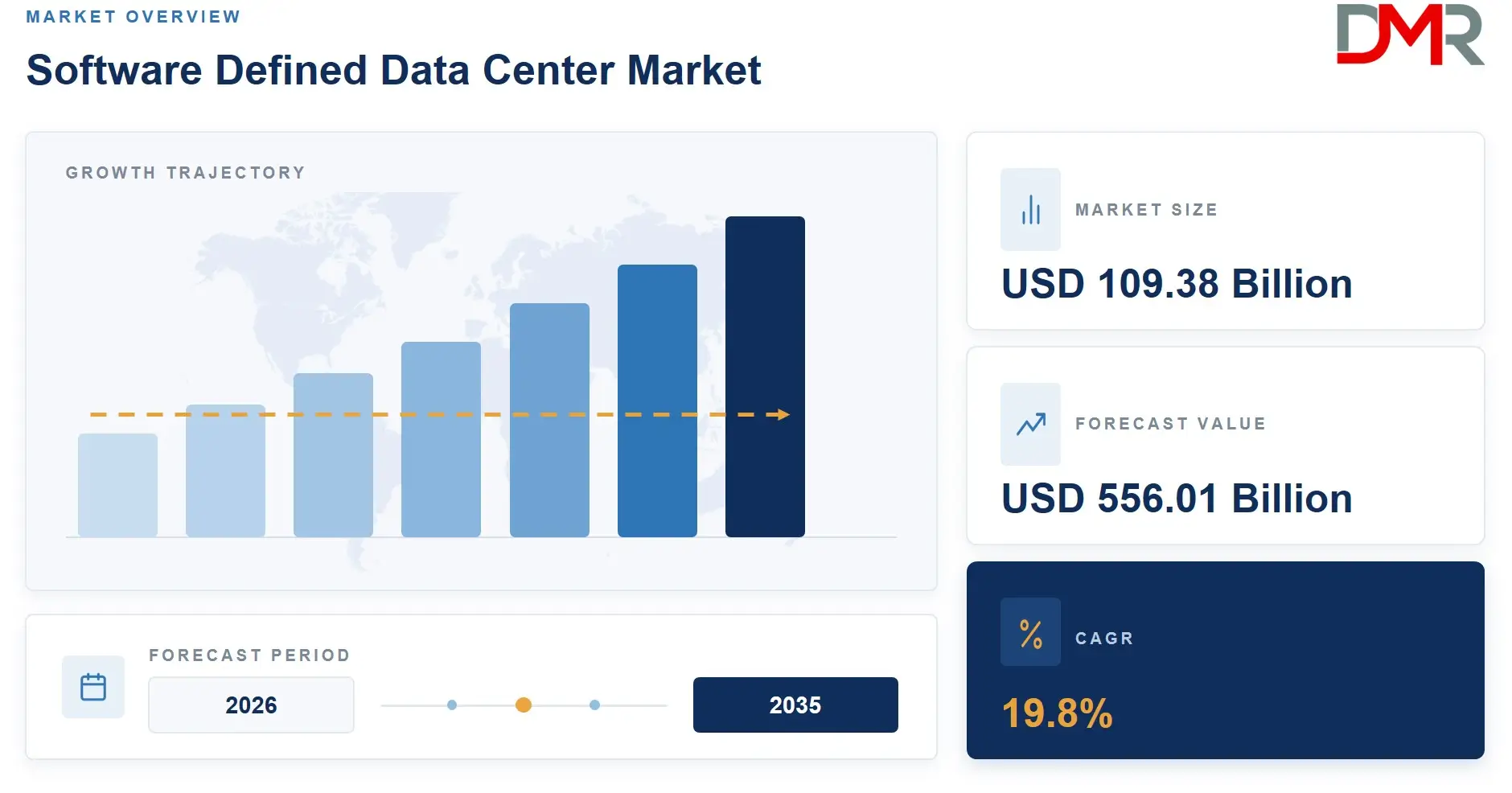
- The market size is USD 109.38 Billion in 2026, and is projected to hit USD 556.01 Billion by 2035 at a CAGR of 19.8%.
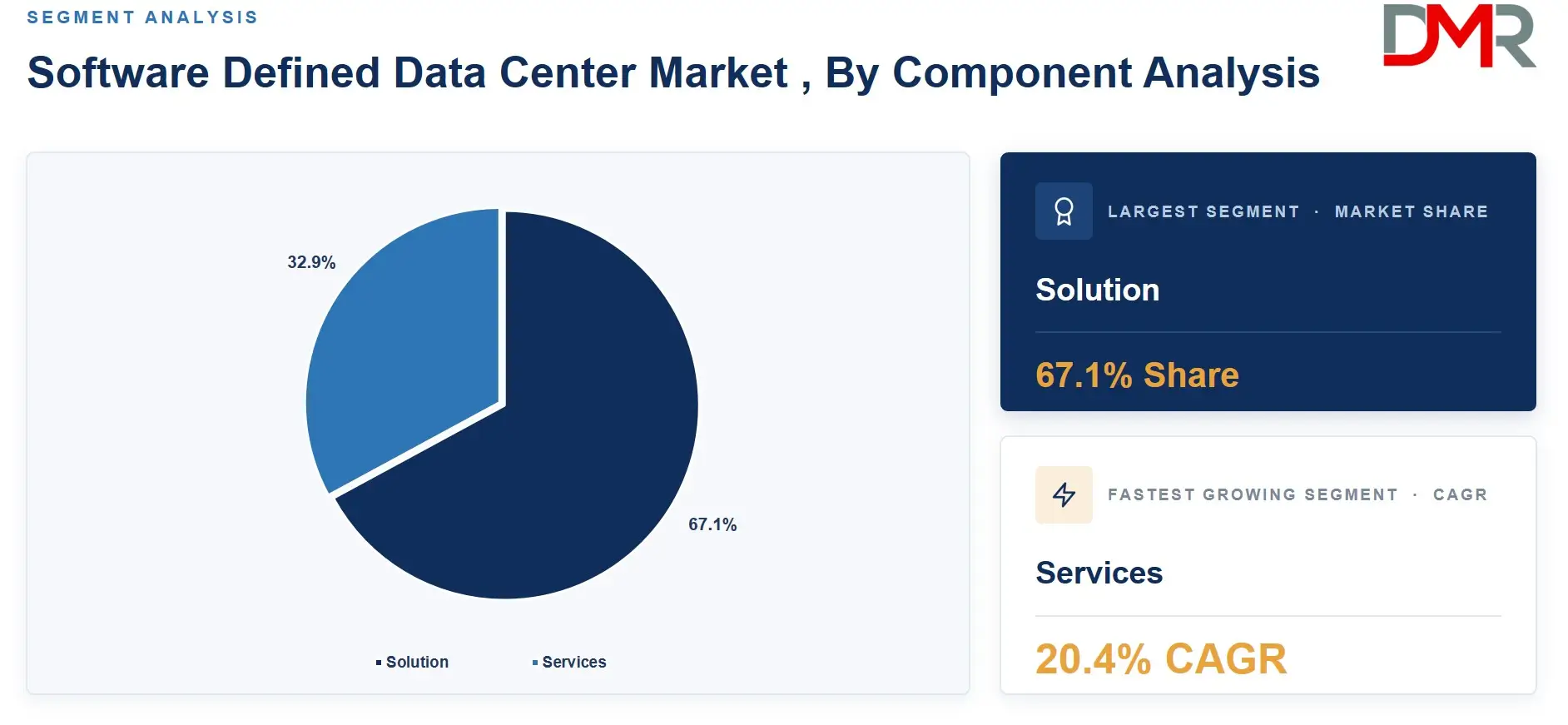
- By Component: Solution led as the largest category with a 67.1% share in 2026.
- By Solution Type: Software-Defined Compute (SDC) led with a 38.6% share in 2026.
- By Deployment: Public led with a 50.2% share in 2026.
- By Enterprise Size: Large Enterprises led with a 58.4% share in 2026.
- By End Use: IT and Telecom led with a 27.1% share in 2026.
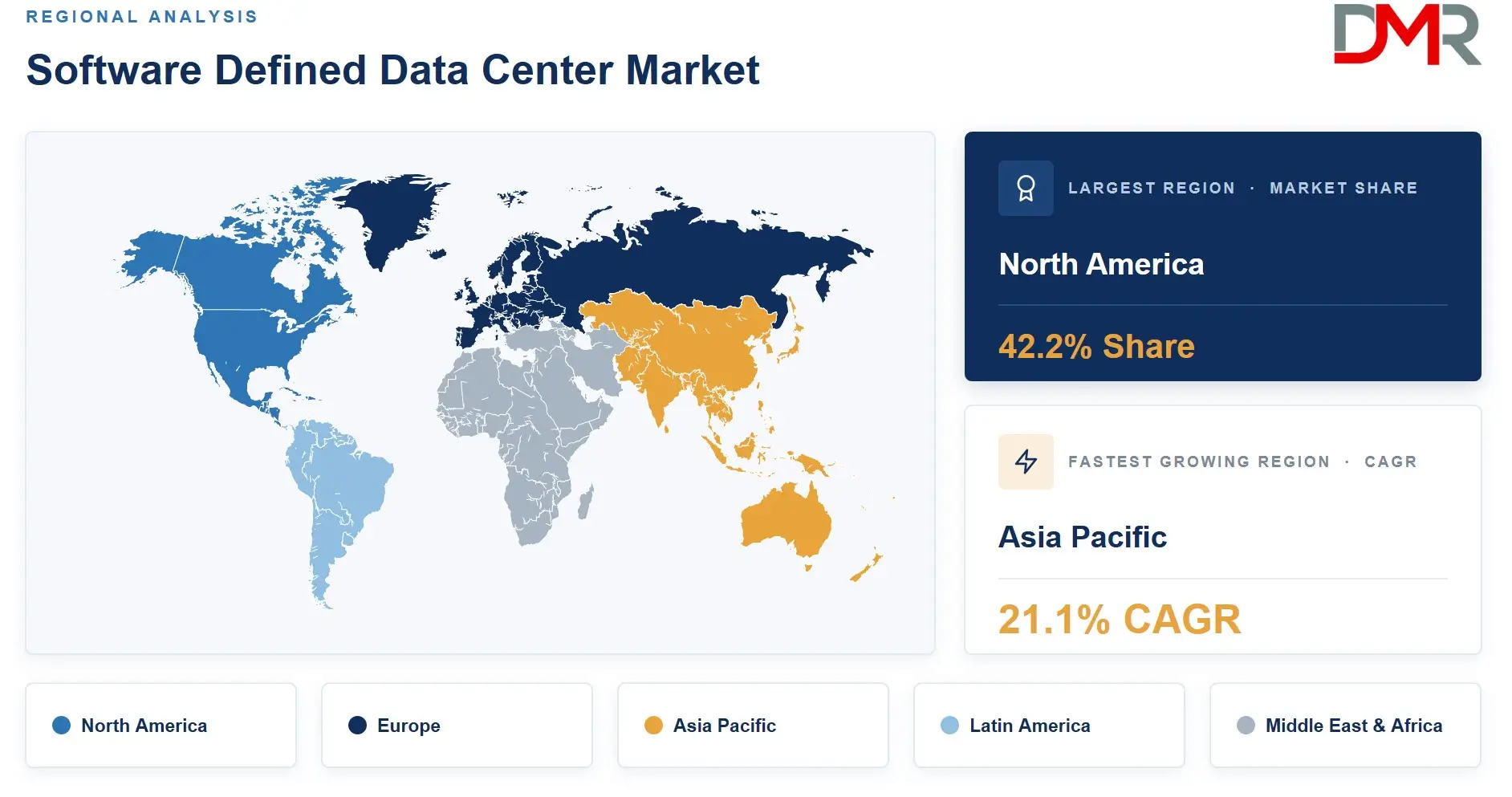
- By Region: North America led with a 42.2% share in 2026, valued at USD 46.16 Billion.
- Asia Pacific is the fastest-growing region, expanding at a 21.1% CAGR through the forecast period.
Market Size and Forecast
The Global Software Defined Data Center Market size is estimated at USD 109.38 Billion in 2026, and is projected to reach USD 556.01 Billion by 2035, exhibiting a CAGR of 19.8% during the forecast period.
VMware Cloud Foundation customers reported a 60% improvement in infrastructure-maintenance efficiency and a 20% rise in IT full-time-equivalent productivity in a January 2025 economic validation by VMware. Application procurement and deployment cycles compressed from weeks to a single day. These validated outcomes signal that enterprise ROI from SDDC deployment has become quantifiable and auditable, accelerating budget approval cycles and reducing the sales friction that historically slowed large-scale rollouts.
ℹ
To learn more about this report –
Download Your Free Sample Report Here
The 19.8% CAGR reflects two compounding forces: the backlog of hardware-centric data centers still awaiting modernization, and the emergence of AI workloads that demand elastic, programmable infrastructure. Legacy refresh cycles alone would sustain high single-digit growth. AI-readiness requirements are the additional driver that lifts the forecast into the high-teens range. Vendors that position their platforms as AI-ready infrastructure will capture disproportionate deal value as enterprises earmark capital for GPU cluster buildouts through 2035.
Component Analysis
Solution accounted for 67.1% of component demand in 2026, the highest of any category.
Enterprise buyers allocate the majority of SDDC spend to software licenses, platforms, and integrated solution stacks rather than professional services alone. A 67.1% component share reflects a market where platform consolidation has accelerated. Buyers select fewer, broader software platforms and pay larger per-seat or per-core licensing fees, concentrating revenue with vendors that offer end-to-end compute, networking, and storage software under a single commercial agreement.
ℹ
To learn more about this report –
Download Your Free Sample Report Here
Services carries the remaining share and captures a fast-growing slice of deal value as enterprises require implementation, migration, and managed-operations support. Complex migration programs moving workloads off VMware's legacy licensing model or transitioning from hardware-defined environments represent a sustained services revenue stream. Specialist integrators and hyperscaler professional services teams are scaling capacity to meet this demand.
Solution Type Analysis
Software-Defined Compute (SDC) led the Solution Type segment with a 38.6% share in 2026.
Compute virtualization retains the largest segment share because it was the first layer enterprises standardized and remains the control plane through which storage and networking resources are allocated. Microsoft's Windows Server 2025 Hyper-V, supporting up to 4 PB of memory and 2,048 logical processors per physical host with individual virtual machines able to use up to 240 TB of memory, illustrates how hypervisor platforms are scaling to absorb AI and in-memory database workloads that previously required dedicated bare-metal hardware.
Software-Defined Storage is the fastest-growing sub-segment, propelled by AI training pipelines, object storage demand, and the need for workload-portable storage abstractions. Dell PowerFlex Ultra, as disclosed in Dell's September 2025 announcement, achieved up to 80% storage efficiency and reduced physical storage footprints by more than 50% while delivering availability of up to 10 nines. Dell ObjectScale's S3-over-RDMA implementation produced up to 230% greater throughput, 80% lower latency, and 98% lower CPU utilization than traditional S3 in October 2025 testing. These gains shift the cost-benefit calculus firmly toward software-defined storage even for latency-sensitive workloads. Software-Defined Networking rounds out the segment, with zero-trust microsegmentation driving renewed investment as security is embedded into the network control plane rather than deployed as a standalone overlay.
Deployment Analysis
With a 50.2% share in 2026, Public outpaced all other Deployment categories.
The public deployment segment is expected to dominate the Global Software Defined Data Center Market, accounting for 50.2% of total market revenue in 2026. This leadership is driven by increasing enterprise adoption of cloud-hosted virtualization, software-defined networking, software-defined storage, and automated infrastructure management platforms. Public SDDC solutions enable organizations to access programmable computing resources without directly managing physical data center infrastructure, supporting operational flexibility, scalability, and consumption-based pricing models.
Private deployment remains important among large enterprises, government agencies, financial institutions, and organizations managing sensitive workloads. These environments provide greater control over infrastructure configurations, security policies, performance, and regulatory compliance. Hybrid deployment is also gaining traction as businesses integrate private SDDC infrastructure with public cloud resources through centralized management and orchestration platforms.
Regional adoption patterns vary considerably. While public deployment leads the global market, European enterprises in regulated industries demonstrate strong demand for private and hybrid SDDC architectures because of data protection, cybersecurity, and operational control requirements. For market measurement, public deployment includes software-defined infrastructure services operated by cloud providers, while conventional colocation facilities without operator-deployed software-defined control layers are excluded.
Enterprise Size Analysis
Large Enterprises captured 58.4% of the Enterprise Size segment in 2026, ahead of all rivals.
Large enterprises lead spending because SDDC deployments at scale require the architectural complexity, multisite coordination, and vendor negotiation leverage that only organizations above a certain size can sustain. Security, compliance, and uptime mandates in regulated verticals further concentrate demand among enterprises with dedicated infrastructure engineering teams. SMEs represent a structurally underserved opportunity. Hyperconverged infrastructure vendors and managed SDDC providers have reduced the engineering barrier, but SME budget cycles and limited internal expertise continue to slow adoption.
End Use Analysis
IT and Telecom led the End Use segment as the largest category in 2026.
IT and Telecom organizations hold a 27.1% end-use share because they operate the infrastructure that other verticals depend on. Telecom carriers use SDDC to virtualize radio access network functions, core network services, and edge compute nodes, compressing hardware costs while improving service elasticity. BFSI follows as the second-largest vertical, driven by real-time transaction processing, regulatory compliance, and fraud detection workloads that require programmable compute and deterministic storage performance.
Healthcare and government are the verticals with the clearest near-term expansion potential. Healthcare organizations are moving medical imaging archives and electronic health record platforms onto software-defined storage, while government agencies across North America and Europe are deploying sovereign SDDC environments to meet data-residency obligations. Manufacturing and retail are adopting edge-native SDDC configurations to support smart factory automation and distributed retail infrastructure.
Key Market Segments
By Component
By Solution Type
- Software-Defined Compute (SDC)
- Software-Defined Networking (SDN)
- Software-Defined Storage (SDS)
- Others
By Deployment
By Enterprise Size
By End Use
- IT and Telecom
- BFSI
- Government
- Healthcare
- Manufacturing
- Retail and E-commerce
- Others
Regional Analysis
North America led the Software Defined Data Center market with a 42.2% share in 2026, valued at USD 46.16 Billion.
ℹ
To learn more about this report –
Download Your Free Sample Report Here
North America
North America's 42.2% share rests on the concentration of global hyperscalers, a large installed base of enterprise data centers undergoing software-defined modernization, and a mature ecosystem of SDDC software vendors headquartered in the region. United States enterprises lead capital allocation toward private AI infrastructure, which requires GPU-aware SDDC control planes and high-throughput software-defined storage. A global retail chain deploying Scale Computing's hyperconverged platform reported 40% lower hardware costs and a 50% reduction in support-ticket volume through consolidated, remotely managed infrastructure, according to Scale Computing case data. Canadian federal and provincial government agencies are driving sovereign SDDC procurement, adding a public-sector demand layer that complements private enterprise spending.
Asia Pacific
Asia Pacific is the fastest-growing region at a 21.1% CAGR, propelled by hyperscaler data center construction across Singapore, Japan, Australia, and India, combined with national digital infrastructure programs in China and South Korea. Japanese enterprises are accelerating on-premises modernization to meet the Ministry of Economy, Trade and Industry's digital transformation guidelines. India's expanding financial services sector and government cloud mandates are pulling SDDC adoption into a market that historically relied on managed hosting. The region's faster growth rate relative to North America signals that SDDC is now a mainstream procurement category across emerging and developed Asian economies, not a niche enterprise segment.
Europe
European enterprises operate under the strictest data-residency and sovereignty requirements globally, encouraging strong adoption of private and hybrid SDDC deployments among regulated enterprises, even as public deployment accounts for the largest share of the global market. GDPR enforcement, the NIS2 Directive, and sector-specific banking regulations in Germany, France, and the United Kingdom require organizations to maintain auditable control over compute, storage, and network layers. Sovereign SDDC platforms combining local data residency with automated compliance reporting are a primary growth vector for vendors serving European government and regulated-industry buyers.
Latin America
Brazil and Mexico lead SDDC adoption in Latin America, driven by banking sector modernization and the expansion of cloud infrastructure operated by hyperscalers. Brazilian banks face Central Bank of Brazil digital resilience requirements that require programmable, redundant infrastructure. Currency volatility and import tariffs on hardware create a structural incentive to maximize utilization of existing physical assets through software-defined abstraction rather than buying new equipment.
Middle East and Africa
GCC nations are directing sovereign wealth investment into national data center programs, with Saudi Arabia's Vision 2030 and the UAE's digital economy agenda funding large-scale hyperscale and government cloud infrastructure. SDDC adoption in the GCC benefits from greenfield construction where software-defined architectures can be designed in from day one rather than layered over legacy hardware. Sub-Saharan Africa remains at an early adoption stage, with South Africa hosting the region's most developed enterprise SDDC market.
Key Regions and Countries
North America
Europe
- Germany
- France
- The UK
- Spain
- Italy
- Rest of Europe
Asia Pacific
- China
- Japan
- South Korea
- India
- Australia
- Rest of APAC
Latin America
- Brazil
- Mexico
- Rest of Latin America
Middle East & Africa
- GCC
- South Africa
- Rest of MEA
Macroeconomic Impact
Enterprise technology capital budgets are sensitive to interest rate environments, and the high-rate period from 2022 to 2024 delayed some SDDC refresh programs as CFOs prioritized return-on-deployed-capital over new platform commitments. Rate normalization across North America and Europe in 2025 has restored approval momentum for multi-year infrastructure programs, benefiting SDDC vendors with subscription and consumption-based pricing models that distribute capital outlay over time. Enterprises that deferred refresh decisions now face compounded technical debt as hypervisor support windows close and AI workload requirements expose the limits of hardware-centric architectures.
Trade policy uncertainty introduces a separate variable. Tariffs on imported semiconductors and server hardware in the United States and retaliatory measures in China create hardware cost pressure that inadvertently supports SDDC adoption by making maximum utilization of existing physical assets an economic priority. Vendors positioned to extract more workload capacity from deployed hardware through software-defined optimization benefit when hardware replacement costs rise.
Market Dynamics
Driver: Infrastructure Automation Compressing Provisioning Cycles and Lifting Utilization
Measured productivity outcomes are converting SDDC from a strategic intent into a capital-budget line item. Organizations standardizing on Red Hat Enterprise Linux reported 34% higher IT-infrastructure-team efficiency, 48% faster deployment of on-premises virtual servers, and 46% faster completion of security updates in a study published by Red Hat in April 2025. These gains translate directly into headcount economics: infrastructure teams handle higher workload volumes without proportional staff increases, compressing the payback period on platform investments.
Automation at the provisioning layer produces the most visible near-term return. Dell Private Cloud automation reduced provisioning steps by 90% compared with manual processes and built a private-cloud cluster in 2.5 hours without manual intervention after initiation, according to Dell's May 2025 internal testing. Dell Technologies released Dell Private Cloud as a software-driven disaggregated infrastructure platform in May 2025, validating blueprints from Broadcom, Nutanix, and Red Hat. Enterprises running 10 to 20 provisioning cycles per quarter quantify this as hundreds of engineering hours recovered annually, a figure that exceeds software licensing costs in most total-cost-of-ownership models.
Restraint: Migration Complexity and Talent Scarcity Extending Deployment Timelines
Legacy application dependencies impose a structural ceiling on deployment velocity. Applications written against hardware-specific APIs, proprietary storage protocols, or fixed network topologies do not migrate cleanly to software-defined environments without re-architecture. Multivendor interoperability gaps compound the problem when enterprises operate mixed compute, storage, and networking stacks from incompatible vendors. Each integration point requires custom scripting, extended testing windows, and rollback planning that extends project timelines from months into years for large-scale programs.
Cross-domain SDDC engineering talent covering compute, storage, networking, and security orchestration simultaneously remains scarce in every major geography. Enterprises compete with cloud providers and system integrators for the same limited pool of certified engineers. Higher deployment risk and elevated integration costs from talent constraints push some organizations toward managed SDDC services rather than in-house builds, shifting margin from software vendors to service providers and increasing total program cost.
Opportunity: VMware-Alternative Migration and GPU-Aware Private AI Infrastructure
Enterprises reassessing virtualization portfolios following Broadcom's subscription and packaging changes after the VMware acquisition represent the most concentrated near-term demand pool in the market. Organizations locked into VMware licensing structures are actively evaluating Red Hat OpenShift Virtualization, Nutanix AHV, and open-source alternatives. VMware-alternative migration services capture transition revenue from both the software replacement and the professional services required to move hundreds of virtual machines without production disruption.
GPU-aware SDDC control planes represent the structural opportunity that will sustain high-growth forecasts through 2035. Private AI infrastructure requires dynamic allocation of GPU accelerators, high-throughput NVMe storage, and low-latency east-west network capacity. Enterprises building private AI clusters need orchestration layers that treat GPU resources with the same programmability as CPU compute pools. The VMware Cloud Foundation economic model published in January 2025 calculated a 47% reduction in capital expenditure, 17.6% lower total cost of ownership, and a five-year ROI of 114%, illustrating the financial framework enterprises apply when justifying AI-ready SDDC investments.
Porter's Five Forces
The SDDC market's competitive structure is defined by high barriers to entry, concentrated supplier power, and intensifying rivalry among a small number of platform incumbents. New entrants face a tripartite challenge: building software stacks that integrate across heterogeneous hardware, achieving hypervisor and management plane certifications that enterprise procurement requires, and funding the go-to-market capacity to displace vendors with decade-long installed-base relationships. These barriers limit meaningful new entry to well-capitalized acquirers, as IBM's $6.4 billion HashiCorp purchase and HPE's $14 billion Juniper acquisition illustrate. Supplier power among semiconductor and hardware OEM manufacturers is moderate to high, since SDDC software runs on hardware whose architecture shapes what software features are technically feasible. Lightbits' software-defined NVMe/TCP storage produced 3 times more read IOPS and 6 times more mixed-workload IOPS than Ceph while reducing read latency by 17 times and mixed-workload latency by 22 times, demonstrating that storage software performance is now a differentiator that gives buyers genuine switching incentive across storage control plane vendors. Buyer bargaining power is growing as the VMware pricing disruption has made enterprises more willing to run competitive evaluations and negotiate aggressively on multi-year licensing terms. Substitutes in the form of public-cloud-only operating models remain a credible alternative, though latency, data sovereignty, and AI cost economics are returning workloads on-premises. Rivalry is concentrated among five or six global platform vendors competing on automation depth, AI integration, and security embedding across the full SDDC stack.
AI and Gen AI Impact
AI is reshaping the SDDC market at the management and orchestration layer faster than at the workload layer. AI-driven data center infrastructure management platforms are replacing static capacity planning spreadsheets with predictive optimization engines that reallocate compute, storage, and network resources ahead of demand peaks. HPE Compute Ops Management reduces time spent managing software-defined and virtualized servers by up to 75% and cuts downtime by as much as 4.8 hours per server annually, according to HPE's June 2025 announcement. Vendors embedding AI directly into the management plane are compressing the operational gap between enterprises with large infrastructure teams and those running lean IT organizations.
Generative AI at the infrastructure layer introduces a second-order effect: large language model inference and training workloads are the single largest driver of new private SDDC deployments in 2025. Enterprises that cannot or will not route sensitive data through public AI APIs are building private GPU clusters that require SDDC control planes capable of scheduling GPU, CPU, high-bandwidth storage, and RDMA networking as a unified elastic resource pool. Early movers that have deployed AI-aware orchestration layers hold a provisioning speed advantage that late adopters will spend 12 to 18 months recovering through vendor evaluation, procurement, and integration cycles.
Market Trends
Kubernetes-Native Convergence and AI-Driven Predictive Infrastructure Management
Kubernetes-native infrastructure management is collapsing the operational boundary between virtual machines, containers, and bare-metal workloads. Platform operators can now apply the same policy framework to a containerized microservice and a legacy VM running on the same cluster. Nutanix's 2025 Enterprise Cloud Index, drawn from 1,500 decision-makers, found that almost 90% of surveyed organizations had containerized applications and 94% reported benefiting from cloud-native applications. AI-driven digital twin platforms that model infrastructure capacity in real time are extending this convergence by enabling predictive rebalancing before performance degradation occurs rather than after. Composable and disaggregated infrastructure is the architectural foundation enabling these workload management advances, decoupling resource provisioning from fixed server configurations to match the fluid demands of AI and mixed-workload environments.
Market Competition Overview
The SDDC market is moderately consolidated at the platform layer, with five to six vendors capturing the majority of platform software revenue, while a much larger ecosystem of specialist vendors competes across individual layers including storage, networking, and orchestration. Platform consolidation accelerated following Broadcom's VMware acquisition, which disrupted incumbent customer relationships and created space for challengers to present credible migration pathways. Market leaders sustain share through management plane integration depth, partner certification ecosystems, and professional services capacity that smaller vendors cannot replicate at the same scale.
Challenger vendors are gaining share in storage and networking sub-segments where performance differentiation is measurable and switching costs are lower than at the hypervisor layer. Acquisition activity in 2025 compressed the number of independent networking and automation vendors available as targets, signaling that platform leaders are prioritizing portfolio completeness over organic development speed. Vendors that close AI orchestration gaps through acquisition or partnership before 2026 will be positioned to defend platform revenue as GPU cluster deployments become the dominant new workload category.
Pricing Analysis
SDDC pricing structures vary by deployment model and licensing philosophy. Public-cloud-hosted SDDC platforms use consumption-based pricing tied to compute hours, storage terabytes, and network egress, giving buyers variable cost exposure that rises with workload growth. Private SDDC platforms use per-core, per-socket, or per-VM subscription licensing that creates predictable annual cost but front-loads commitment risk. Dell PowerStore Elite, delivering up to 3 times the IOPS, throughput, and storage density of previous-generation models, with up to 5.8 PB of effective capacity in a single 3U appliance, illustrates how hardware-bundled software platforms justify premium pricing through consolidation economics that reduce total rack footprint cost.
Broadcom's restructuring of VMware licensing toward higher-cost subscription bundles has introduced upward pricing pressure across the market. Competitors are pricing migration incentives to capture displaced customers, compressing near-term licensing margins but building installed-base depth that generates renewal revenue through 2030. Enterprises evaluating total cost of ownership across a five-year horizon find that software-defined consolidation offsets licensing cost increases through reduced hardware, power, and facilities expenditure.
Company Profiles
IBM Corporation positions the SDDC market at the intersection of hybrid-cloud software and enterprise-grade reliability. IBM Power11's virtualization stack is engineered for 99.9999% uptime with zero planned downtime for system maintenance, and IBM Power Cyber Vault delivers a ransomware-alert guarantee of under one minute, according to IBM's July 2025 disclosure. IBM's $6.4 billion HashiCorp acquisition added Terraform and Vault to its hybrid-cloud portfolio, extending IBM's reach into multicloud infrastructure lifecycle automation. The risk for IBM is portfolio complexity: integrating HashiCorp tools with IBM Cloud Pak and Red Hat OpenShift requires sustained engineering investment and clear messaging to buyers navigating an already crowded platform market.
VMware, Inc. (operating as part of Broadcom's software division) retains the largest installed base of any private SDDC platform vendor, built on two decades of enterprise hypervisor deployments. VMware Cloud Foundation 9.0, launched by Broadcom in June 2025, integrates virtual machines, containers, networking, storage, security, and infrastructure automation under a single private-cloud platform. Broadcom's pricing and bundling changes have created customer retention risk at exactly the moment when competing platforms have reached sufficient maturity to absorb large migrations. VMware's competitive advantage rests on management plane depth and the operational familiarity that enterprise infrastructure teams have accumulated over years of vSphere deployments.
Dell Technologies is a major provider of enterprise infrastructure solutions supporting software-defined data center environments. Its portfolio includes Dell PowerFlex, PowerStore, and Dell Private Cloud solutions designed to support infrastructure automation, software-defined storage, and scalable enterprise computing. The company focuses on flexible infrastructure deployment, centralized management, and integration with virtualization platforms. Its software-driven infrastructure strategy supports enterprises modernizing private cloud environments and adopting hybrid cloud operating models.
Nutanix is a prominent provider of hyperconverged infrastructure, hybrid multicloud management, and enterprise virtualization solutions. The company's Nutanix Cloud Platform combines compute virtualization, software-defined storage, networking capabilities, and management automation within an integrated infrastructure environment. Nutanix AHV provides an enterprise virtualization option for organizations seeking alternatives to traditional hypervisor platforms. The company emphasizes operational simplicity, infrastructure scalability, workload portability, and support for private and hybrid cloud deployments.
Red Hat, a subsidiary of IBM, provides open-source enterprise software platforms supporting software-defined infrastructure and hybrid cloud environments. Its Red Hat OpenShift platform enables organizations to manage containerized applications and virtual machines through an integrated cloud-native operating model. Red Hat OpenShift Virtualization supports the management of virtualized workloads alongside containers, helping enterprises modernize legacy infrastructure while adopting Kubernetes-based architectures. The company's open hybrid cloud strategy emphasizes interoperability, automation, and infrastructure flexibility.
Broadcom is a major enterprise infrastructure software provider following its acquisition of VMware in November 2023. VMware Cloud Foundation integrates virtualization, software-defined storage, networking, security, and infrastructure automation into a unified private cloud platform. The portfolio supports enterprise data center modernization, hybrid cloud infrastructure, and increasingly AI-oriented workloads. Broadcom's software strategy focuses on integrated infrastructure platforms, subscription-based licensing, operational efficiency, and enterprise-grade management capabilities.
Scale Computing provides hyperconverged infrastructure and edge computing solutions designed to simplify IT operations across distributed environments. Its platform combines virtualization, software-defined storage, automated infrastructure management, and system availability capabilities. The company's solutions are particularly relevant for small and medium-sized enterprises, retail organizations, and distributed business locations requiring simplified infrastructure management with limited on-site IT resources.
Lightbits develops software-defined storage solutions optimized for high-performance computing, cloud infrastructure, and demanding enterprise workloads. Its storage architecture uses NVMe over TCP technology to provide scalable, low-latency storage access over standard networking infrastructure. The company focuses on disaggregated storage, performance optimization, and flexible resource allocation for virtualized applications, cloud-native workloads, and AI-oriented computing environments.
Some of the Prominent Players in the Global Software Defined Data Center Market Are:
- Broadcom Inc. (VMware)
- Dell Technologies Inc.
- Nutanix, Inc.
- International Business Machines Corporation (IBM)
- Red Hat, Inc. (IBM)
- Microsoft Corporation
- Cisco Systems, Inc.
- Hewlett Packard Enterprise Company
- Oracle Corporation
- Cloud Software Group, Inc. (Citrix)
- NEC Corporation
- SAP SE
- Scale Computing
- Lightbits Labs Ltd.
- Lenovo Group Limited
- Huawei Technologies Co., Ltd.
- NetApp, Inc.
- Veeam Software
- Other Key Players
Supply Chain and Value Chain Analysis
The SDDC value chain runs from semiconductor and hardware OEM manufacturers through software platform developers, system integrators, hyperscaler distribution partners, and managed service providers to the enterprise end user. Maximum value creation concentrates at the software platform and orchestration layer, where vendors charge recurring subscription fees and maintain the management-plane relationships that determine platform stickiness. Hardware OEMs capture component revenue but face margin pressure as software-defined abstraction commoditizes physical infrastructure specifications.
The biggest supply chain risk sits at the hardware-software integration layer. Certified compatibility between SDDC software versions and specific hardware firmware releases requires continuous qualification work. A firmware update that breaks a hypervisor driver or storage controller plugin can halt production deployments. Vendors that own both hardware and software layers, such as Dell with PowerFlex and PowerStore, reduce this risk for buyers but create single-vendor dependency that procurement teams must weigh against integration reliability.
Regulatory Landscape
European regulators impose the most comprehensive data sovereignty and infrastructure compliance requirements affecting SDDC deployments. GDPR mandates data-residency controls that private and sovereign SDDC configurations satisfy by design, giving on-premises and colocation SDDC deployments a structural compliance advantage over public-cloud-only architectures for personal data processing workloads. The NIS2 Directive, effective across EU member states from October 2024, requires critical infrastructure operators to meet minimum cybersecurity and incident-reporting standards that translate into technical requirements for network segmentation, access control, and audit logging across SDDC environments.
United States federal procurement requirements under FedRAMP and Executive Order 14028 on cybersecurity create a parallel compliance framework that favors SDDC vendors with FedRAMP-authorized platforms. Broadcom's launch of VMware Cloud Foundation Advanced Cyber Compliance in August 2025, targeting regulated private-cloud environments, directly addresses this regulatory demand vector. Regulated-industry certifications are becoming a competitive moat for vendors that can demonstrate compliance automation within their management planes.
Investment and White Space Analysis
Investment is concentrating in three vectors: AI-ready private SDDC infrastructure, VMware-alternative migration platforms, and sovereign SDDC offerings for government and regulated-industry buyers. GPU-aware orchestration platforms that can schedule accelerators alongside standard compute, storage, and networking resources remain underserved relative to demand. No single vendor has established a clear category lead in AI-native SDDC management, creating entry opportunity for specialists and platform challengers building toward that capability.
Edge-native micro-SDDC platforms for 5G sites, factories, and retail locations represent white space in a segment where most existing platforms were designed for large data center footprints. SME-focused managed SDDC services are similarly underpenetrated. Latin America and the Middle East offer regional white space where enterprise IT modernization budgets are increasing but incumbent vendor coverage remains thin. Early-mover vendors establishing partner ecosystems in these regions before 2027 will face lower customer acquisition costs than late arrivals competing against entrenched relationships.
Recent Developments
- February 2025 — IBM completed its $6.4 billion acquisition of HashiCorp, adding Terraform, Vault, and multicloud infrastructure lifecycle automation tools to IBM's hybrid-cloud software portfolio.
- June 2025 — Broadcom launched VMware Cloud Foundation 9.0 as a unified private-cloud platform integrating virtual machines, containers, networking, storage, security, and infrastructure automation under a single commercial offering.
- July 2025 — Hewlett Packard Enterprise completed its approximately $14 billion acquisition of Juniper Networks, combining HPE's hybrid-cloud infrastructure portfolio with Juniper's AI-native networking capabilities.
- August 2025 — Broadcom launched VMware Cloud Foundation Advanced Cyber Compliance alongside new VMware vDefend and Avi Load Balancer capabilities, targeting regulated private-cloud environments with embedded compliance automation.
- September 2025 — Dell Technologies made Dell Private Cloud generally available, with Dell Automation Platform orchestration and support for PowerStore, PowerFlex, and PowerMax disaggregated infrastructure configurations.
Report Details
| Report Characteristics |
| Market Value (2026) |
USD 109.38 Billion |
| Forecast Revenue (2035) |
USD 556.01 Billion |
| CAGR (2026–2035) |
19.8% |
| Historical Data |
2020 – 2024 |
| Base Year |
2025 |
| Estimated Year |
2026 |
| Forecast Period |
2026–2035 |
| Report Coverage |
Revenue Forecast, Market Dynamics, Competitive Landscape, Recent Developments |
| Segments Covered |
By Component (Solution, Services); By Solution Type (Software-Defined Compute, Software-Defined Networking, Software-Defined Storage, Others); By Deployment (Public, Private, Hybrid); By Enterprise Size (Large Enterprises, SMEs); By End Use (IT and Telecom, BFSI, Government, Healthcare, Manufacturing, Retail and E-commerce, Others) |
| Regional Coverage |
North America – US, Canada; Europe – Germany, France, UK, Spain, Italy, Rest of Europe; Asia-Pacific – China, Japan, South Korea, India, Australia, Rest of APAC; Latin America – Brazil, Mexico, Rest of Latin America; Middle East & Africa – GCC, South Africa, Rest of MEA |
| Prominent Players |
Broadcom Inc. (VMware), Dell Technologies Inc., Nutanix, Inc., International Business Machines Corporation (IBM), Red Hat, Inc. (IBM), Microsoft Corporation, Cisco Systems, Inc., Hewlett Packard Enterprise Company, Oracle Corporation, Cloud Software Group, Inc. (Citrix), NEC Corporation, SAP SE, Scale Computing, Lightbits Labs Ltd., Lenovo Group Limited, Huawei Technologies Co., Ltd., NetApp, Inc., Veeam Software., and Other Key Players |
| Customization Scope |
Customization for segments and region or country level will be provided. Additional customization can be done based on requirements. |
| Purchase Options |
Three license options: Single User License, Multi-User License (Up to 5 Users), and Corporate Use License (Unlimited Users and Printable PDF) |
Frequently Asked Questions
What is the biggest investment opportunity in the Software Defined Data Center market?
▾ GPU-aware SDDC control planes for private AI infrastructure represent the highest-value investment opportunity through 2035. Enterprises building on-premises AI clusters require orchestration platforms that treat GPU accelerators, high-throughput NVMe storage, and RDMA networking as a unified programmable resource pool, and no vendor holds a dominant position in this segment today.
Who are the top companies in the Software Defined Data Center market?
▾ Leading vendors include Cisco Systems, Dell Software, Hewlett-Packard Enterprise, IBM Corporation, Microsoft, Oracle, SAP SE, and VMware (under Broadcom). Platform incumbents compete on management plane integration depth, AI orchestration capabilities, and the breadth of certified hardware partner ecosystems.
Which segment is growing fastest in the Software Defined Data Center market and why?
▾ Software-Defined Storage is the fastest-growing solution sub-segment, driven by AI training data pipelines, object storage demand from cloud-native applications, and the need for workload-portable storage abstractions. Performance gains from NVMe/TCP and disaggregated flash architectures have closed the latency gap with hardware-defined alternatives, removing the primary technical objection to software-defined storage adoption.
Which region is growing fastest in the Software Defined Data Center market and why?
▾ Asia Pacific is growing at a 21.1% CAGR, the fastest of any region, supported by hyperscaler data center construction across Singapore, Japan, Australia, and India, national digital infrastructure programs in China and South Korea, and rising enterprise adoption in India's expanding financial services sector. The region's CAGR exceeds the global average of 19.8%, indicating that SDDC adoption is accelerating faster in Asia than in more mature Western markets.
What is the biggest challenge holding Software Defined Data Center Market back?
▾ Legacy application dependencies and multivendor interoperability gaps are the primary structural barrier, extending migration timelines and elevating program costs to levels that slow enterprise decision-making. A shortage of cross-domain SDDC engineering talent covering compute, storage, networking, and security orchestration simultaneously compounds deployment risk and pushes some organizations toward managed services at higher total program cost.
How big is the Global Software Defined Data Center Market?
▾ The Global Software Defined Data Center Market is projected to reach USD 109.38 billion in 2026 and is expected to grow to USD 556.01 billion by 2035, driven by increasing adoption of infrastructure virtualization, hybrid cloud solutions, automation technologies, and AI-ready data center infrastructure.
What is the CAGR of the Software Defined Data Center Market?
▾ The Global Software Defined Data Center Market is projected to grow at a CAGR of 19.8% during the forecast period from 2026 to 2035, supported by increasing enterprise investments in software-defined compute, networking, storage, and cloud infrastructure management.
What is a Software Defined Data Center?
▾ A Software Defined Data Center (SDDC) is an IT infrastructure architecture in which computing, storage, networking, and management resources are virtualized and controlled through software rather than relying entirely on dedicated hardware configurations. SDDC solutions enable automated resource provisioning, centralized infrastructure management, improved scalability, and greater operational flexibility.
What is the outlook for the US Software Defined Data Center Market?
▾ The United States represents a major contributor to the North American Software Defined Data Center Market, supported by its established cloud computing ecosystem, strong presence of virtualization technology providers, and increasing investments in AI-ready enterprise infrastructure. Growing adoption of hybrid cloud platforms, software-defined networking, and automated infrastructure management is expected to support market expansion throughout the forecast period.