Global Software Development Outsourcing Market Snapshot
- Global Software Development Outsourcing Market Size in 2026: USD 618.4 Billion
- Global Software Development Outsourcing Market Size in 2035: USD 1,407.8 Billion
- Global CAGR from 2026 to 2035: 9.6%
- Leading Service Type Segment: Application Development, 37.9% share
- Leading Outsourcing Model: Dedicated Development Teams, 38.0% share
- Leading End-Use Industry: BFSI, 26.0% share
- Fastest-Growing Segment: Artificial Intelligence & Machine Learning, 13.5% CAGR
- Leading Region: Asia-Pacific, 31.8% share
- Fastest-Growing Region: Middle East & Africa, 13.2% CAGR
What is the Global Software Development Outsourcing and its Market Size?
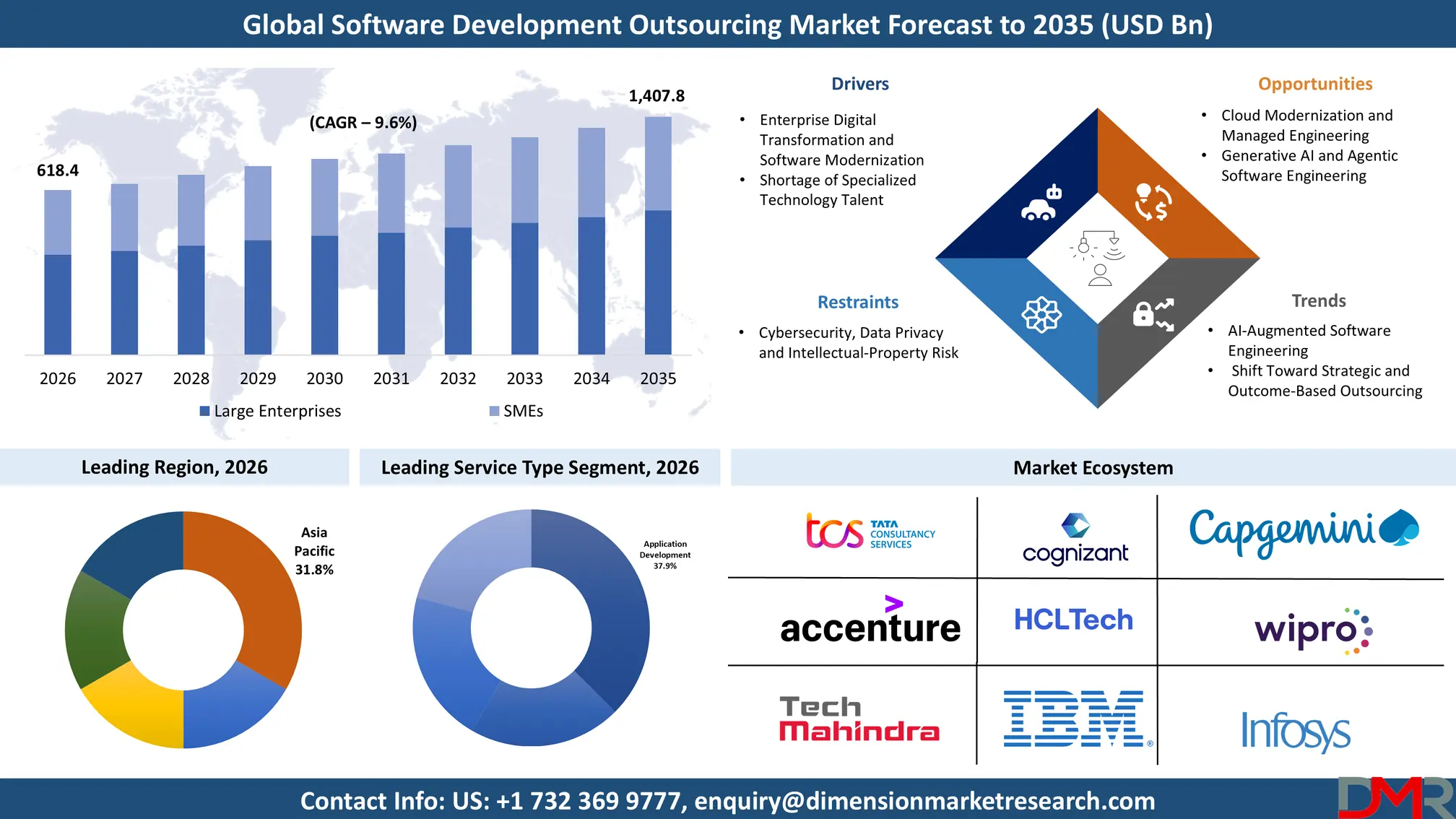
The Global Software Development Outsourcing Market is projected to reach USD 618.4 billion in 2026 and grow at a compound annual growth rate of 9.6% from there until 2035 to reach a value of USD 1,407.8 billion.
ℹ
To learn more about this report –
Download Your Free Sample Report Here
Growth is being supported by enterprise digital transformation, cloud-native modernization, demand for AI capabilities, cybersecurity requirements, pressure to accelerate product launches, and persistent shortages of specialized engineering talent. Outsourcing is increasingly shifting from a labor-arbitrage model toward strategic technology partnerships in which providers contribute architecture, product engineering, AI implementation, cloud modernization, industry expertise, and managed capabilities.
Use Cases
- Application Development: External engineering teams develop enterprise, customer-facing, web, and mobile applications at scale.
- Cloud & DevOps: Providers migrate, modernize, automate, and continuously operate cloud-native software environments.
- Legacy Modernization: Outsourced specialists replace outdated architectures with modern cloud, API, data, and AI-enabled platforms.
- AI/ML Engineering: Providers build machine-learning systems, generative-AI applications, agents, recommendation engines, and automation.
- Software Testing & QA: Specialized teams automate testing and improve software quality, security, reliability, and release velocity.
- Maintenance & Support: External teams provide application monitoring, upgrades, bug fixing, optimization, and ongoing technical support.
Key Takeaways
- Market scale: The market is estimated at $618.4 billion in 2026, potentially exceeding USD 1.4 trillion by 2035.
- Primary driver: Enterprises increasingly outsource to obtain scarce engineering and AI capabilities while accelerating digital transformation.
- Dominant service: Application development remains the largest service category, accounting for approximately 37.9%.
- Fastest opportunity: AI/ML engineering is expected to be among the fastest-growing technology categories as enterprises move from AI experimentation toward production deployment.
- Regional leadership: Asia-Pacific remains the largest regional market, supported by large delivery ecosystems and strong enterprise demand.
- Regional acceleration: Middle East & Africa is expected to record the fastest growth, driven by digital-government, smart-city, cloud, fintech, and economic-diversification programs.
- Strategic shift: Buyers increasingly prioritize specialized talent, security, AI capability, speed, and measurable business outcomes over hourly cost alone.
How AI/Gen AI is Transforming the Software Development Outsourcing Market?
Artificial intelligence is changing software outsourcing from a people-intensive delivery model toward an increasingly AI-augmented engineering model. Generative-AI coding assistants, automated testing, AI agents, code-generation systems, intelligent documentation, and automated modernization tools are being incorporated across the development lifecycle. Infosys, for example, announced a 2026 collaboration with Cursor to establish a software-engineering Center of Excellence and expand AI-assisted development across its engineering workforce.
Cloud computing is similarly increasing demand for cloud-native development, DevOps, platform engineering, Kubernetes, application modernization, and managed cloud services. AI also creates new demand rather than simply eliminating traditional development work: lower development costs can expand the number of organizations capable of building software, while increasing complexity creates demand for architects, AI engineers, cybersecurity specialists, and domain experts.
Key Drivers in the Global Software Development Outsourcing Market
Enterprise Digital Transformation and Software Modernization
Enterprise software has become a core component of competitiveness across banking, healthcare, manufacturing, telecommunications, retail, logistics, and government. Organizations are replacing legacy applications, developing digital customer interfaces, migrating workloads to cloud platforms, implementing data platforms, and integrating AI into operational processes. This creates a continuous requirement for software engineers rather than a one-time development need.
Shortage of Specialized Technology Talent
The strongest structural driver is the difficulty many organizations face in recruiting and retaining engineers with advanced expertise in AI/ML, cybersecurity, cloud architecture, DevOps, data engineering, platform engineering, and specialized enterprise platforms. Outsourcing provides access to geographically distributed talent pools without requiring clients to recruit every skill internally.
Restraints in the Global Software Development Outsourcing Market
Cybersecurity, Data Privacy and Intellectual-Property Risk
Software outsourcing frequently requires external developers to access source code, cloud infrastructure, databases, APIs, customer information, development environments, and proprietary business processes. A security incident at an external provider can therefore create financial, regulatory, reputational, and intellectual-property exposure for the client. Cross-border development introduces additional complexity because data may be accessed or transferred across multiple jurisdictions.
Growth Opportunities in the Global Software Development Outsourcing Market
Generative AI and Agentic Software Engineering
Generative AI represents one of the largest opportunities for outsourcing providers because it can be incorporated into nearly every stage of software delivery. Providers can combine AI coding assistants with human architects and engineers to accelerate application development, testing, documentation, modernization, and maintenance.
Cloud Modernization and Managed Engineering
Large installed bases of legacy applications create a long-term opportunity for providers that can combine modernization consulting, application engineering, cloud migration, DevOps, cybersecurity, data engineering, and managed services.
Trends in the Global Software Development Outsourcing Market
AI-Augmented Software Engineering
AI is increasingly embedded directly into development workflows, including code generation, code review, testing, refactoring, documentation, debugging, and architecture assistance. This is likely to shift the economic structure of outsourcing toward greater output per engineer and higher demand for senior engineering judgment.
Shift Toward Strategic and Outcome-Based Outsourcing
Enterprises increasingly want outsourcing partners that can own business outcomes, modernize technology estates, provide specialized capabilities, and support long-term innovation. Cost reduction remains important but is increasingly supplemented by speed, expertise, security, quality, and innovation.
Research Scope and Analysis
The market is analyzed across service type, outsourcing model, organization size, technology, and end-use industry. Segment shares are analyst estimates designed to align with published market benchmarks while reflecting the changing mix of traditional development, cloud engineering, AI, modernization, and managed services.
ℹ
To learn more about this report –
Download Your Free Sample Report Here
By Service Type Analysis
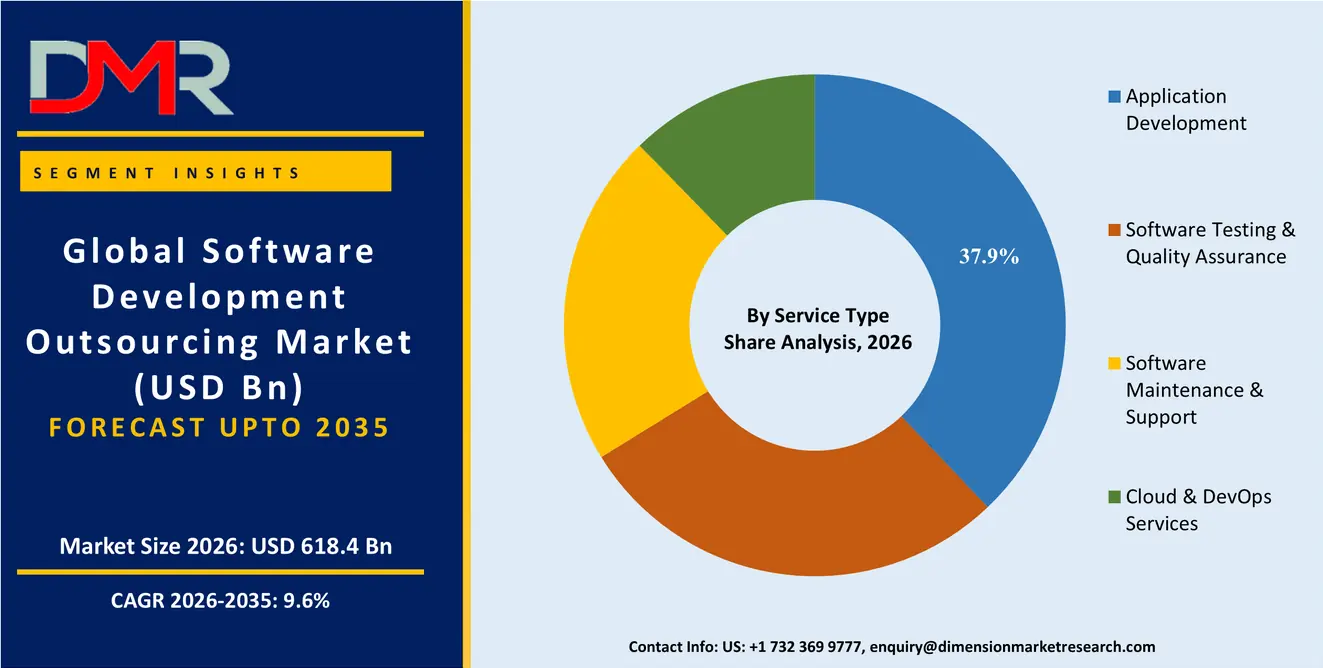
Application Development is estimated to remain the dominant service category in 2026, with approximately 37.9% market share, consistent with the latest published market segmentation. Enterprises continue to outsource customer applications, enterprise platforms, mobile applications, APIs, digital commerce systems, and internal business applications because these projects require large engineering teams and frequent technology updates. Software Maintenance & Support is expected to remain the second-largest category at approximately 25%, supported by the enormous installed base of enterprise applications requiring continuous upgrades and security fixes. Cloud & DevOps Services is expected to be the fastest-growing service category, with an estimated 12.8% CAGR, as enterprises migrate from traditional architectures to cloud-native platforms and continuous-delivery environments. Software Testing & QA remains strategically important as automated testing, security testing, performance testing, and AI-generated code increase the volume and complexity of software releases. Application development nevertheless retains leadership because outsourcing remains deeply embedded in new-product engineering and enterprise digital transformation.
By Outsourcing Model Analysis
Dedicated Development Teams are estimated to represent approximately 38.0% of 2026 spending, making them the largest model in this segmentation. The model is attractive for enterprises seeking long-term access to engineering capacity while retaining direct control over product roadmaps and priorities. Project-Based Outsourcing is estimated at approximately 29%, remaining important for defined applications, modernization projects, MVPs, and short-to-medium-term transformation programs. Managed Services are expected to be the fastest-growing category, with an estimated 13.0% CAGR, as enterprises increasingly transfer responsibility for application maintenance, cloud operations, DevOps, cybersecurity, and continuous engineering to external partners. Staff Augmentation remains relevant where organizations want flexible access to specialists without fully transferring project ownership. Overall, the market is gradually moving from transactional labor procurement toward long-term dedicated and managed engineering relationships.
By Organization Size Analysis
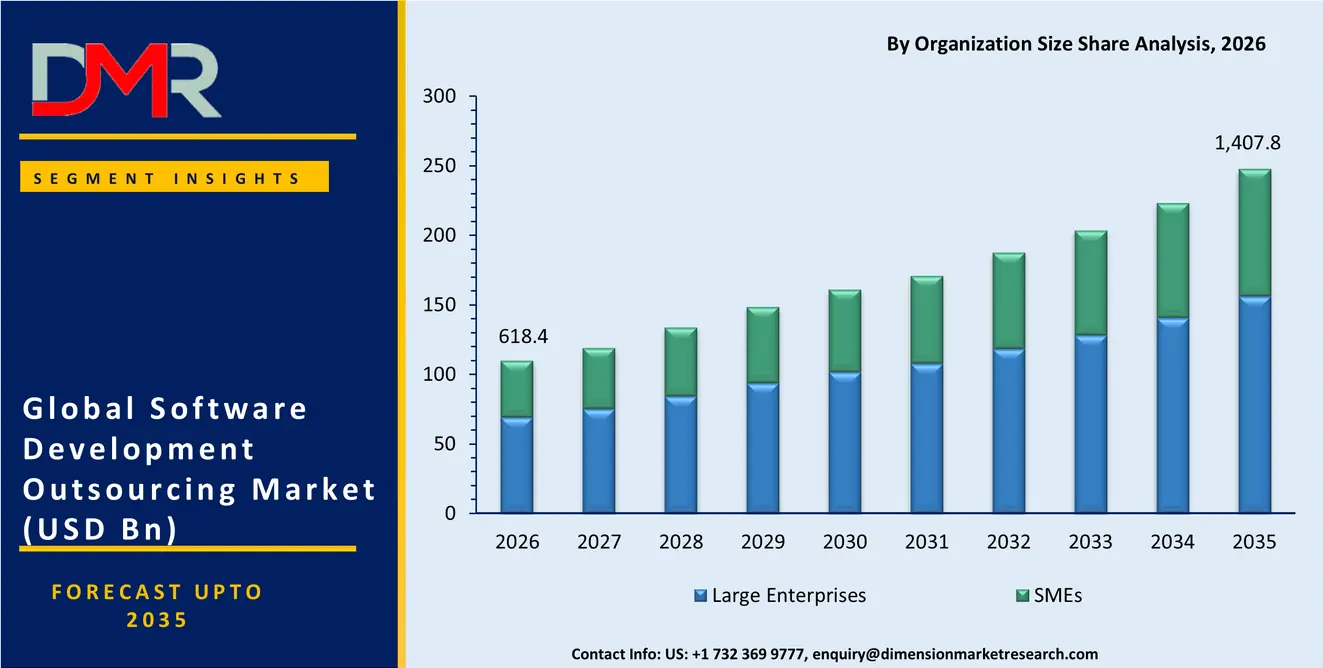
Large Enterprises remain the dominant customer group, representing an estimated 71% share of 2026 outsourcing expenditure. Large companies operate extensive application estates, multinational infrastructure, legacy systems, and complex regulatory environments, making external engineering partners valuable for modernization and specialized capabilities. SMEs, however, are expected to be the fastest-growing category, with an estimated 11.3% CAGR.
ℹ
To learn more about this report –
Download Your Free Sample Report Here
Cloud infrastructure, SaaS development tools, AI coding systems, and remote collaboration have reduced the barriers preventing smaller businesses from accessing external engineering teams. SMEs increasingly outsource MVP development, mobile applications, e-commerce systems, cloud implementation, cybersecurity, and AI integration rather than building complete engineering departments internally. This is expanding the addressable customer base beyond traditional multinational outsourcing buyers. Published market analysis likewise identifies large enterprises as the dominant segment while SMEs record faster growth.
By Technology Analysis
Web & Mobile Development remains the largest technology category, estimated at approximately 31% of 2026 spending, because virtually every industry continues to require customer-facing and employee-facing digital interfaces. Cloud Computing is the second-largest category at roughly 24%, supported by cloud migration, modernization, DevOps, and cloud-native application development. Artificial Intelligence & Machine Learning is expected to be the fastest-growing segment, with an estimated 13.5% CAGR, as enterprises move from experimentation to production AI systems. Cybersecurity also represents a high-value growth area because outsourced applications increasingly handle sensitive customer and business data. IoT continues to expand in manufacturing, logistics, healthcare, energy, and smart infrastructure, while blockchain remains a comparatively smaller niche focused on specialized financial, supply-chain, identity, and asset-tokenization applications. AI is likely to become the most important source of mix change during the forecast period.
By End Use Industry Analysis
BFSI is estimated to remain the largest end-use industry, representing approximately 26% of 2026 market revenue, due to heavy spending on digital banking, payments, fraud detection, cybersecurity, cloud modernization, regulatory technology, and customer applications. IT & Telecommunications is expected to remain the second-largest category at roughly 20%-21%. Healthcare & Life Sciences is projected to be among the fastest-growing segments, at approximately 12.9% CAGR, driven by electronic health systems, digital therapeutics, patient applications, analytics, AI, and regulatory modernization. Retail & E-Commerce continues to generate strong demand for mobile commerce, personalization, supply-chain software, payment systems, and omnichannel platforms. Manufacturing is increasingly important because industrial software, IoT, digital twins, automation, and AI require integration of operational technology and enterprise software. Published research similarly identifies BFSI as the leading end-use segment and healthcare as one of the fastest-growing categories.
The Global Software Development Outsourcing Market Report is segmented on the basis of the following:
By Service Type
- Application Development
- Software Testing & Quality Assurance
- Software Maintenance & Support
- Cloud & DevOps Services
By Outsourcing Model
- Project-Based Outsourcing
- Dedicated Development Team
- Staff Augmentation
- Managed Services
By Organization Size
- Small & Medium Enterprises
- Large Enterprises
By Technology
- Web & Mobile Development
- Cloud Computing
- Artificial Intelligence & Machine Learning
- Internet of Things
- Blockchain
- Cybersecurity
By End-Use Industry
- BFSI
- Healthcare & Life Sciences
- IT & Telecommunications
- Retail & E-Commerce
- Manufacturing
- Media & Entertainment
- Travel & Hospitality
- Government & Public Sector
- Other Industries
Regional Analysis
Asia Pacific is the Leading Region in the Global Software Development Outsourcing Market
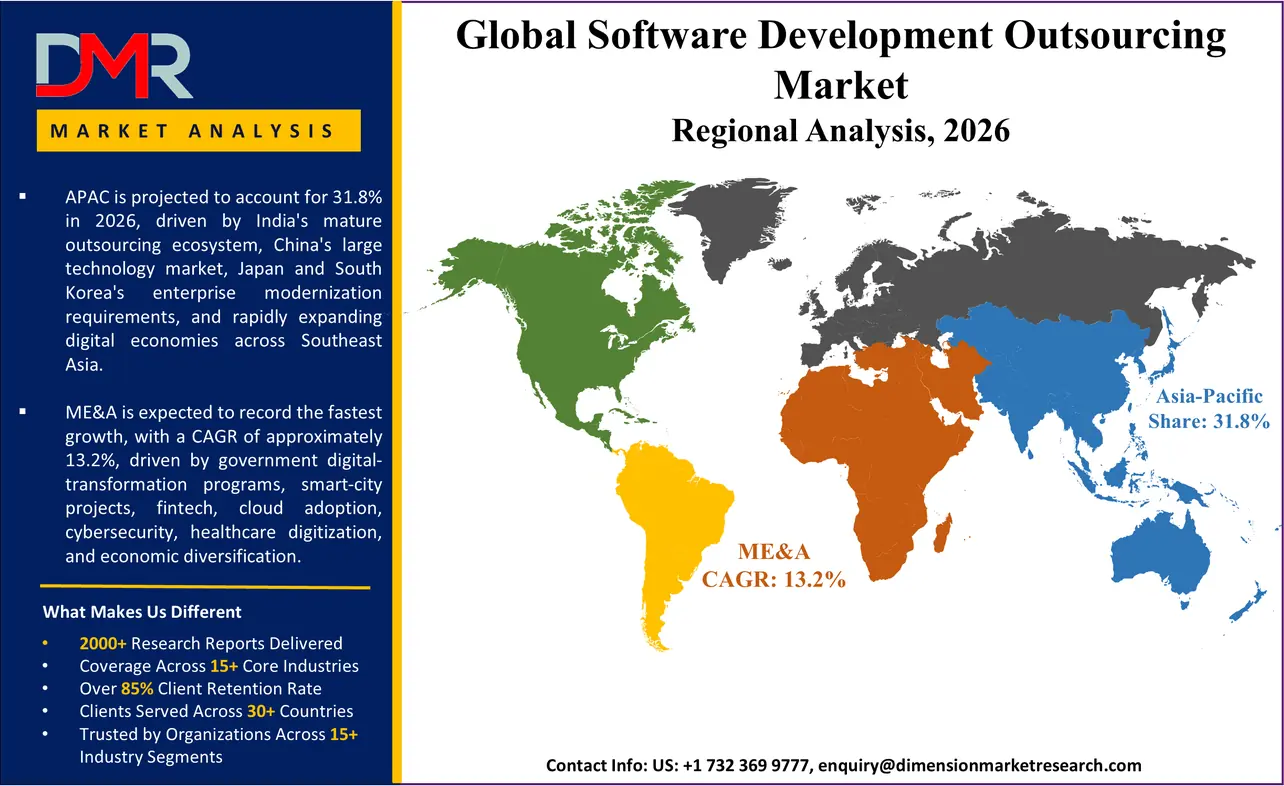
Asia-Pacific is expected to remain the largest regional market, accounting for approximately 31.8% of global revenue in 2026, or roughly USD 196.6 billion. The region benefits from India's mature outsourcing ecosystem, China's large technology market, Japan and South Korea's enterprise modernization requirements, and rapidly expanding digital economies across Southeast Asia. India is particularly important because software services account for more than 40% of its services exports, while software-service exports reached approximately $204.7 billion in FY2025. Government policy is also supporting cloud services, GCC expansion, AI capabilities, and technology exports.
ℹ
To learn more about this report –
Download Your Free Sample Report Here
ME&A is the Fastest-Growing Region in the Global Software Development Outsourcing Market
Middle East & Africa is projected to be the fastest-growing regional market, with an estimated 13.2% CAGR. Growth is being supported by government digital-transformation programs, smart-city projects, fintech, cloud adoption, cybersecurity, healthcare digitization, and economic diversification. Saudi Arabia and the UAE are particularly significant because government and enterprise investments are creating demand for locally delivered as well as international software-engineering capabilities. Published market analysis similarly identifies MEA as the fastest-growing regional market.
The Europe Software Development Outsourcing Market
The European market is estimated at approximately USD 142.2 billion in 2026 and is projected to reach roughly USD 294 billion by 2035, representing an estimated 8.5% CAGR. Demand is being shaped by enterprise cloud migration, AI adoption, cybersecurity, industrial digitization, legacy modernization, and strict privacy requirements. GDPR remains particularly important for outsourcing arrangements involving European personal data, including when processing is performed outside Europe.
North America Software Development Outsourcing Market
North America represents one of the highest-value software development outsourcing markets, supported by strong enterprise technology spending, rapid AI adoption, cloud modernization, cybersecurity requirements, and persistent demand for specialized engineering talent. The regional market is estimated at approximately USD 181 billion in 2026 and is projected to reach around USD 335 billion by 2035, representing an estimated 7.1% CAGR. The United States accounts for the overwhelming majority of regional demand, while Canada serves as both a major technology market and a nearshore delivery location.
Latin America Software Development Outsourcing Market
Latin America is estimated at approximately USD 48 billion in 2026 and could reach roughly USD 108 billion by 2035, representing an estimated 9.4% CAGR. The region benefits from nearshore delivery to U.S. customers, overlapping working hours, growing engineering talent, competitive costs, and increasing demand for cloud and digital products. Brazil, Mexico, Argentina, and Colombia are expected to remain the principal delivery and customer markets.
Major Countries Analysis
United States Software Development Outsourcing Market
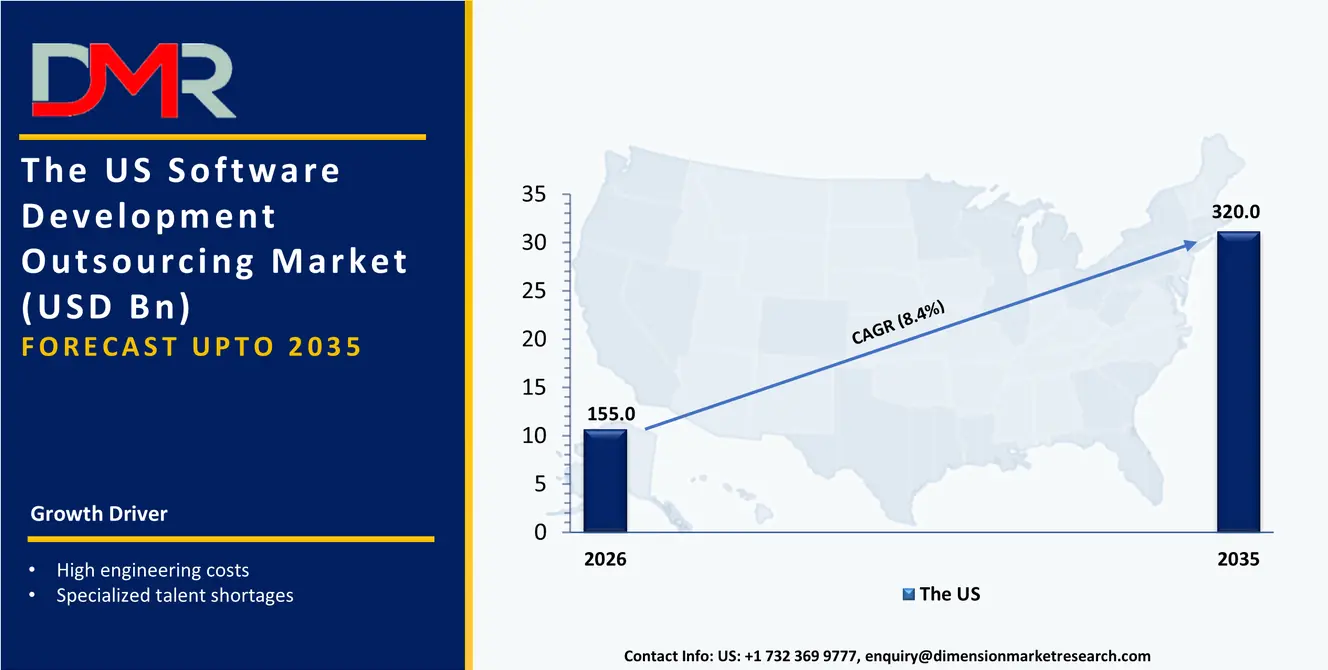
The U.S. Software Development Outsourcing Market is estimated at approximately USD 155 billion in 2026 and could reach USD 320 billion by 2035, representing approximately 8.4% CAGR. Demand is driven by high engineering costs, specialized talent shortages, enterprise AI adoption, cloud modernization, cybersecurity, software-product development, and the need to accelerate time-to-market. U.S. enterprises are increasingly using external providers for AI engineering, modernization, cloud transformation, and specialized product development rather than only low-cost coding.
ℹ
To learn more about this report –
Download Your Free Sample Report Here
Japan Software Development Outsourcing Market
Japan's market is estimated at approximately USD 34 billion in 2026 and is projected to reach around USD 72 billion by 2035, representing approximately 8.7% CAGR. Aging demographics, shortages of engineering talent, enterprise modernization, cloud migration, manufacturing digitization, robotics, AI, and legacy-system replacement are major drivers. Japan is also increasingly important for high-value engineering outsourcing rather than purely labor-cost-driven services.
Saudi Arabia Software Development Outsourcing Market
Saudi Arabia's market is estimated at approximately USD 4.2 billion in 2026 and is projected to reach around USD 11.8 billion by 2035, representing approximately 12.3% CAGR. Vision 2030 digital-government programs, fintech, cloud adoption, smart-city projects, cybersecurity, and economic diversification are major growth drivers. The Kingdom is also investing in local technology capabilities, creating demand for both international engineering providers and local service delivery.
Regulatory Landscape
Regulation is becoming a major differentiator in software outsourcing. In Europe, GDPR imposes requirements on organizations processing EU personal data and places continuing obligations on international transfers, making contractual safeguards, security controls, processor governance, and data-transfer mechanisms important in outsourcing contracts.
India has similarly strengthened its privacy regime through the Digital Personal Data Protection Act and associated rules, increasing requirements around personal-data processing and governance. India's privacy framework is particularly relevant because the country is one of the world's largest software-services delivery markets. Saudi Arabia's PDPL and rules governing transfers outside the Kingdom add another layer of compliance for providers serving Saudi customers. In addition, providers increasingly need ISO 27001-style security controls, secure software-development practices, sector-specific requirements, contractual IP protections, access controls, auditability, and AI-governance procedures.
Investment and White Space Analysis
The largest investment opportunities are emerging around AI-native engineering, legacy modernization, cloud-native development, cybersecurity, healthcare software, industrial AI, and managed engineering services. Providers capable of combining AI with domain expertise should have an advantage over firms competing primarily on labor cost. Emerging delivery locations in the Middle East, Latin America, Southeast Asia, and secondary Indian cities offer opportunities for capacity expansion. Another major white space is the SME segment: smaller organizations increasingly have access to cloud and AI technologies but often lack internal architecture, security, DevOps, and AI expertise. AI-assisted development also creates opportunities for specialized providers that can offer faster delivery while maintaining human governance, security, testing, and compliance.
By Region
North America
Europe
- Germany
- France
- The U.K.
- Italy
- Spain
- Rest of Europe
Asia-Pacific
- China
- Japan
- India
- Australia
- South Korea
- Rest of APAC
Latin America
- Mexico
- Brazil
- Rest of LATAM
Middle East & Africa
- Saudi Arabia
- The UAE
- South Africa
- Rest of MEA
Competitive Landscape
The Global Software Development Outsourcing Market is highly competitive and relatively fragmented, with large multinational technology-services firms competing alongside regional IT companies, specialized engineering providers, digital agencies, and niche AI-development firms. Major participants increasingly compete through AI capabilities, cloud expertise, industry specialization, cybersecurity, engineering talent, proprietary platforms, delivery scale, and strategic partnerships. The traditional distinction between consulting, systems integration, software engineering, and outsourcing is becoming less important as customers seek end-to-end transformation. Large providers are investing heavily in AI, acquiring specialist capabilities, creating Centers of Excellence, and developing partnerships with major technology platforms.
Some of the prominent players in the Global Software Development Outsourcing Market are:
- Accenture
- Tata Consultancy Services (TCS)
- Infosys
- Cognizant
- HCLTech
- Wipro
- Capgemini
- EPAM Systems
- Tech Mahindra
- LTIMindtree
- NTT DATA
- DXC Technology
- IBM
- Deloitte
- PwC
- Kyndryl
- CGI
- Globant
- Endava
- Persistent Systems
- Thoughtworks
- Mphasis
- Coforge
- Virtusa
- Birlasoft
- Hexaware Technologies
- UST
- Synechron
- Nagarro
- GlobalLogic
- Luxoft
- Grid Dynamics
- EPAM Continuum
- SoftServe
- ScienceSoft
- Itransition
- ELEKS
- Intellectsoft
- Netguru
- BairesDev
- Other Key Players
Recent Developments
- In June 2026, Accenture agreed to acquire Industries eXcellence Group, strengthening software, automation, industrial AI, digital-twin, cloud, and engineering capabilities for manufacturing customers and expanding related Centers of Excellence in Italy and India.
- In May 2026, Capgemini announced an investment in the OpenAI Deployment Company, strengthening its enterprise-AI deployment capabilities and expanding its ability to integrate frontier AI into clients' business workflows and technology environments.
- In May 2026, HCLTech expanded its collaboration with Pegasystems to combine HCLTech AI Force with Pega Blueprint for AI-powered legacy-system discovery, modernization, cloud-native application development, and enterprise transformation.
- In April 2026, Infosys announced a strategic collaboration with OpenAI focused on enterprise AI transformation, with early applications including software engineering, legacy modernization, DevOps automation, and other engineering-led use cases.
- In March 2026, TCS and ABB strengthened their strategic partnership across IT infrastructure, applications, industrial AI, digital twins, factory modernization, data centers, and emerging technology initiatives.
- In March 2026, Wipro and Harness announced a strategic collaboration combining Wipro's WEGA agent-native platform with Harness' AI software-delivery capabilities to accelerate AI-native development with stronger speed, reliability, and governance.
- In January 2026, Infosys announced a strategic collaboration with Cursor, creating a Center of Excellence for AI-assisted software engineering and enabling its developers to use enterprise-grade AI coding capabilities for greenfield and brownfield projects.
Report Details
| Report Characteristics |
| Market Size (2026) |
USD 618.4 Bn |
| Forecast Value (2035) |
USD 1,407.8 Bn |
| CAGR (2026–2035) |
9.6% |
| Historical Period |
2021 – 2025 |
| Forecast Period |
2027 – 2035 |
| Base Year |
2025 |
| Estimate Year |
2026 |
| Segments Covered |
By Service Type, By Outsourcing Model, By Organization Size, By Technology, By End-Use Industry |
| Regional Coverage |
North America – The US and Canada; Europe – Germany, The UK, France, Spain, Italy, & Rest of Europe; Asia-Pacific – China, Japan, South Korea, India, Australia, Rest of APAC; Latin America – Brazil, Mexico, Argentina, Colombia, Rest of Latin America; Middle East & Africa – Saudi Arabia, The UAE, South Africa, & Rest of MEA |
Frequently Asked Questions
What is the Software Development Outsourcing Market size in 2026?
▾ The global market is estimated at USD 618.4 billion in 2026, although published estimates differ substantially according to market-definition and methodology differences.
What will the market be worth in 2035?
▾ Under the base-case 9.6% growth trajectory, the market could reach approximately USD 1.41 trillion by 2035.
What is the expected CAGR in Software Development Outsourcing Market ?
▾ The base-case CAGR is estimated at approximately 9.6% from 2026 to 2035, consistent with the latest published 2026-2031 market benchmark.
What is driving market growth in Software Development Outsourcing Market?
▾ Digital transformation, cloud migration, AI adoption, specialized talent shortages, cybersecurity, legacy modernization, and pressure to accelerate software delivery are the principal drivers.
Which technology segment is growing fastest in Software Development Outsourcing Market ?
▾ Artificial Intelligence & Machine Learning is expected to be among the fastest-growing technology categories, supported by enterprise generative-AI adoption and AI-enabled software engineering.
Which region leads the Software Development Outsourcing Market ?
▾ Asia-Pacific is the largest region, supported by major technology-delivery ecosystems and strong enterprise demand.
Which region is growing fastest in Software Development Outsourcing Market ?
▾ Middle East & Africa is projected to grow fastest, supported by digital-government, smart-city, fintech, cloud, AI, and economic-diversification investments.
Who are the major players in Software Development Outsourcing Market ?
▾ Major participants include Accenture, TCS, Infosys, HCLTech, Wipro, Cognizant, Capgemini, EPAM, Globant, LTIMindtree, Tech Mahindra, Persistent Systems, and numerous regional specialists.