What is the Solid-State Battery Electrolyte Chemical Market Size?
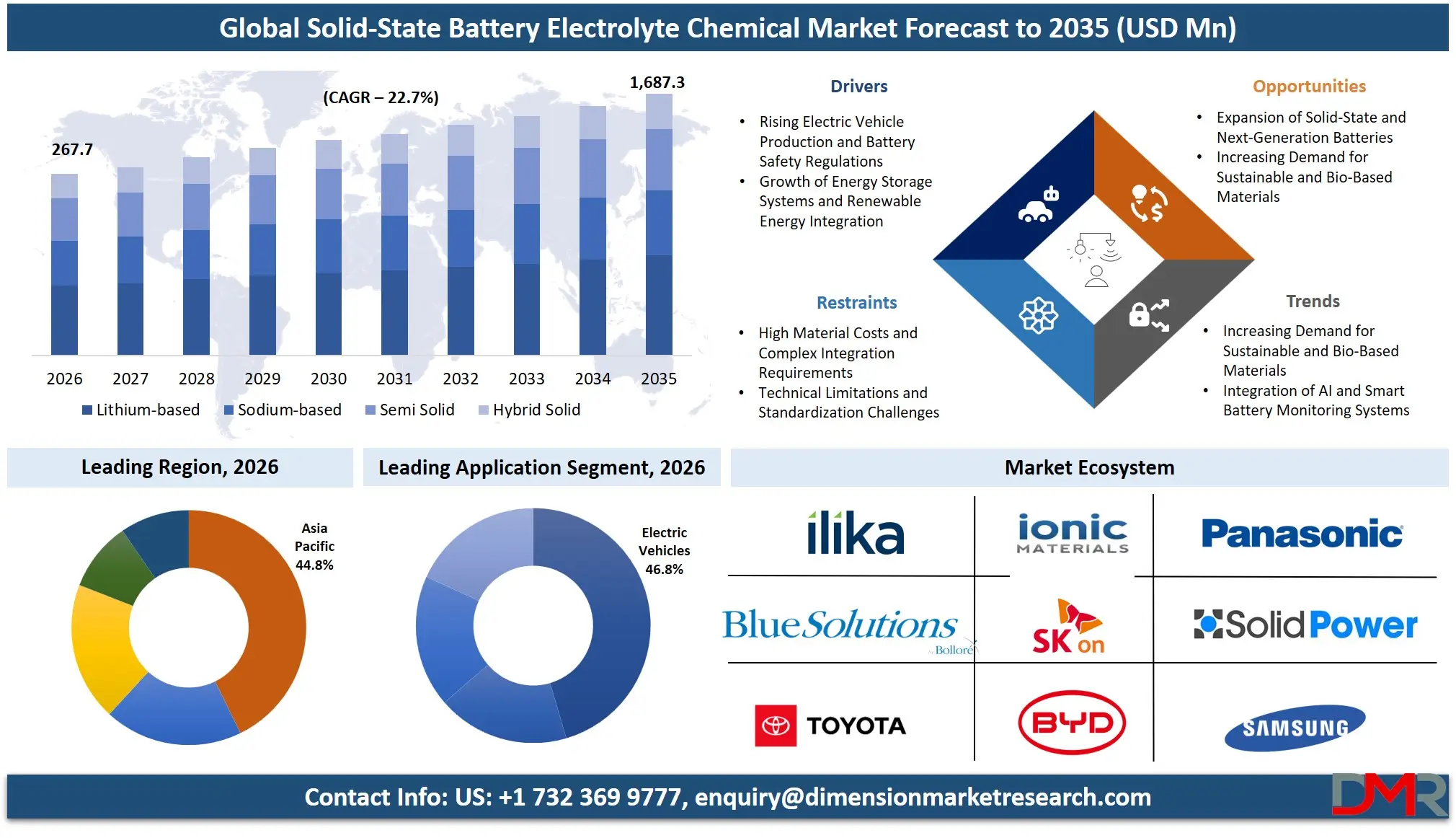
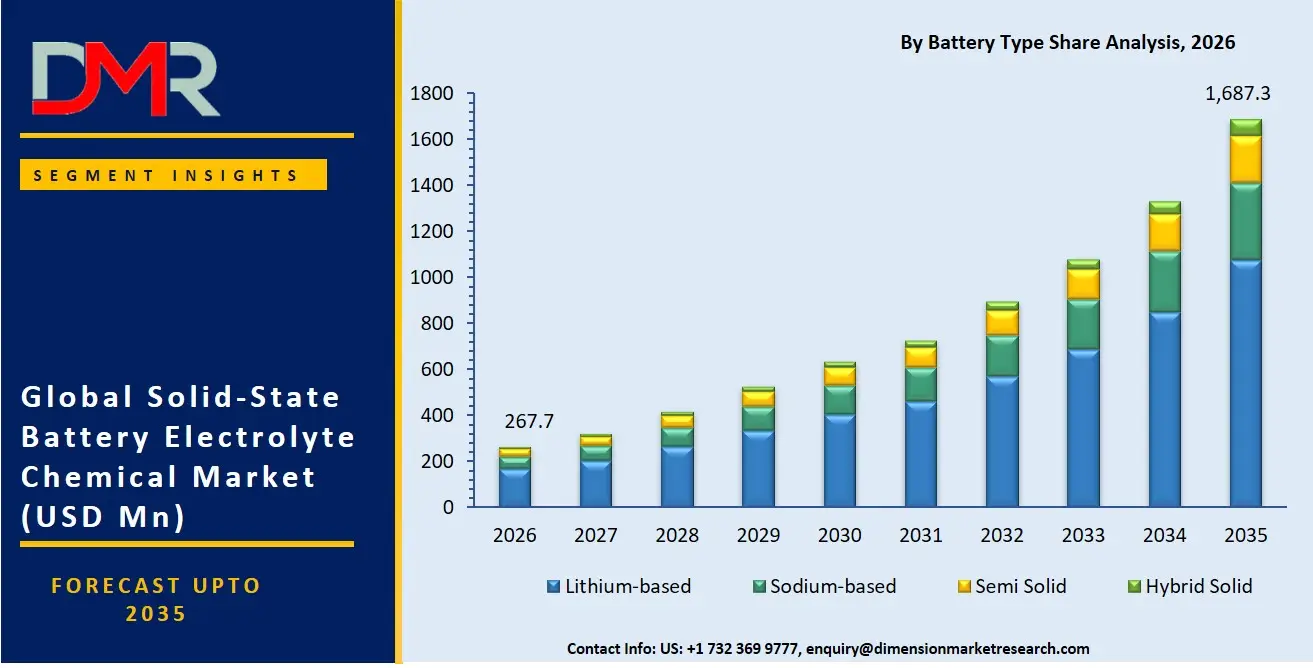
The Solid-State Battery Electrolyte Chemical Market size is expected to be USD 267.7 million in 2026 and increase at a compound annual growth rate of 22.7% to USD 1,687.3 million in 2035 due to implementation of government initiatives aimed at supporting EVs, the introduction of environmental regulations, and the construction of factories producing batteries.
ℹ
To learn more about this report –
Download Your Free Sample Report Here
The Solid-State Battery Electrolyte Chemical Market refers to an industry involved in the investigation, production, and promotion of chemical substances used in solid-state batteries. Unlike traditional electrolytes that have liquid form, solid electrolytes utilize several types of solid electrolytes including sulfides, oxides, polymers, halides, and hybrid electrolytes. These electrolytes provide several benefits in terms of higher energy densities, enhanced thermal stability, improved safety, and battery longevity. The market is gaining popularity due to increasing energy storage demands in future applications such as electric vehicles and consumer electronics.
ℹ
To learn more about this report –
Download Your Free Sample Report Here
The US Solid-State Battery Electrolyte Chemical Market
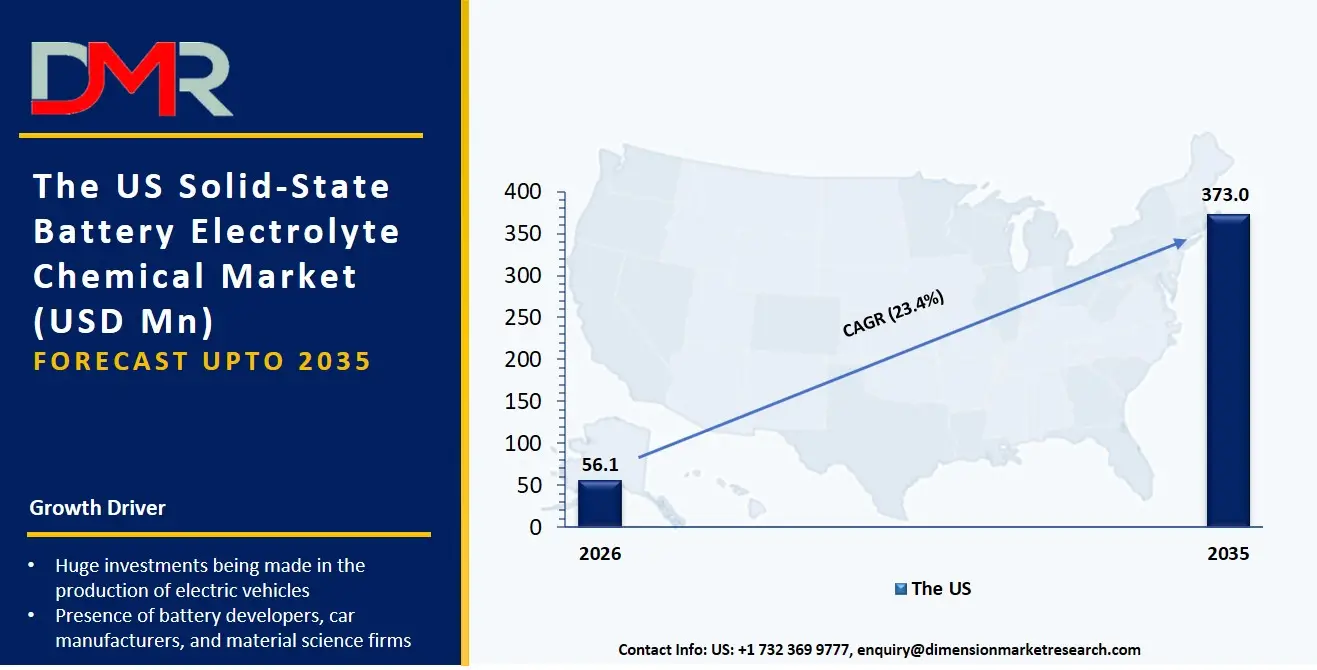
The US Solid-State Battery Electrolyte Chemical Market size is estimated to be USD 56.1 million in 2026 and is expected to increase at a CAGR of 23.4% over the forecast period.
There are robust opportunities in the US Solid-State Battery Electrolyte Chemical market as there are huge investments being made in the production of electric vehicles, battery technology research, and building up the supply chain in the US. With government incentives for developing clean energy technology, there will be extensive research and development in this sector. The presence of battery developers, car manufacturers, and material science firms will also help boost commercialization in this industry. In addition to this, there will also be an increased need for longer-range electric vehicles and safer energy storage solutions.
ℹ
To learn more about this report –
Download Your Free Sample Report Here
Europe Solid-State Battery Electrolyte Chemical Market
The Europe Solid-State Battery Electrolyte Chemical Market size is estimated to be USD 58.9 million in 2026 and is expected to increase at a CAGR of 22.1% over the forecast period.
Europe can be considered an advanced market for solid-state electrolyte chemical solutions due to sustainability legislations and stringent decarbonization targets within European climate laws. Investment in battery manufacturing facilities and EV charging networks is driving the need for superior performance electrolytes. Nations like Germany, France, and Sweden are investing heavily in innovations in batteries via funding schemes and industry partnerships. The region has also seen fast progress in green recyclable and sustainable electrolyte solutions. Automakers are collaborating with battery innovators for developing next-generation batteries using solid-state electrolytes.
Japan Solid-State Battery Electrolyte Chemical Market
The market size of Japan Solid-State Battery Electrolyte Chemical will be USD 18.7 million in 2026 and at a CAGR of 21.4% in the forecast period.
Japan continues to be one of the leading regions for innovation within the market for the Electrolytes for Solid-State Batteries. It is because of its strong expertise in developing technologies for batteries and their advanced materials. There are favorable government policies in Japan aimed at advancing energy-efficient transport systems and innovative batteries. There have been numerous investments in the development of sulfide-based electrolytes by the electronics and automotive sectors in Japan. The region enjoys advantages in terms of precision manufacturing and miniaturization of electronics.
Key Takeaways
- Market Size & Forecast: The Solid-State Battery Electrolyte Chemical Market size is projected to reach USD 267.7 million in 2026 and is anticipated to have a value of USD 1,687.3 million in 2035.
- Growth Rate & Outlook: The Solid-State Battery Electrolyte Chemical Market size is set to grow at a compound annual growth rate of 22.7% during the forecast period of 2026 to 2035.
- Primary Growth Drivers: Some of the major growth drivers in the market include Growing Demand for Batteries With High Energy Density for Electric Cars, and more.
- Key Market Trends: Some of the major trends in the market are Growing Use of Sulfide-Based Electrolyte Solutions, and more.
- By Battery Type: The lithium-based segment is anticipated to get the majority share of the Solid-State Battery Electrolyte Chemical market in 2026.
- By Material Composition: Lithium-based is expected to get the largest revenue share in 2026 in the Solid-State Battery Electrolyte Chemical market.
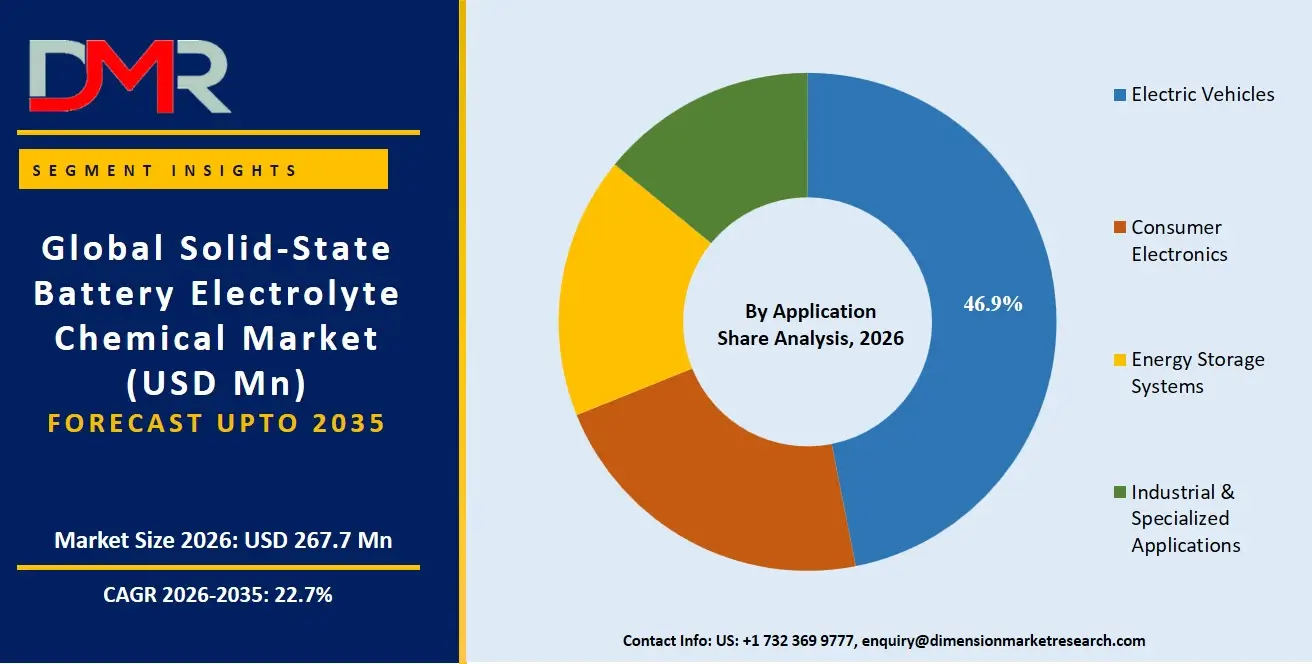
- By Application: The Electric Vehicles segment is expected to get the largest revenue share in 2026 in the Solid-State Battery Electrolyte Chemical market.
- Regional Leadership: Asia Pacific is set to lead the Solid-State Battery Electrolyte Chemical market with an estimated 44.8% share in 2026.
What is the Solid-State Battery Electrolyte Chemical?
Solid-State Battery Electrolyte Chemical refers to particular classes of chemicals that serve as an ion-conducting medium within solid-state batteries. Unlike normal liquid electrolytes, the chemical compounds under this category exist in solid form and allow the passage of lithium or sodium ions from the anode to cathode while ensuring higher efficiency in batteries. Some of these types include sulfide, oxide, polymer, halide, and composite electrolytes, amongst others. These compounds are gaining popularity due to their increasing application in the field of battery research and development.
Use Cases
- Electric Vehicles: Materials that constitute solid-state electrolytes are widely utilized in batteries used in electric vehicles. The use of sulfide and oxide electrolytes not only helps in lowering the fire hazard in these vehicles due to the use of liquid electrolytes but also increases their energy capacity. They are increasingly being used by manufacturers to produce next-generation lithium-metal battery systems.
- Consumer Electronics: Solid-state electrolytes are employed in the manufacture of smartphones, laptops, wearable and portable gadgets for producing thinner batteries and extending their operational time. Superior stability offered by these materials also helps in the production of miniature electronic devices. They provide a higher level of safety to consumer electronic products.
- Energy Storage Systems: These electrolytes are used in grid-level as well as residential energy storage systems for reliable energy storage and efficient operation of the system. They enable safe storage of renewable energy produced using solar or wind power plants. Improved longevity further minimizes maintenance costs.
- Aerospace and Defense: Aerospace and defense industries are using these chemical compounds in satellites, unmanned aerial vehicles and other military devices to increase battery performance. They exhibit increased durability and stability at extreme temperature and pressure conditions.
How AI Is Transforming the Solid-State Battery Electrolyte Chemical Market
Artificial intelligence has brought changes to the Solid-State Battery Electrolyte Chemicals market, including faster material discovery, performance improvement, and battery design. Simulation software based on artificial intelligence enables scientists to find new compositions of electrolytes with enhanced ion conductivity, thermal stability, and electrochemistry properties. Moreover, machine learning helps cut down development time as it predicts material behavior and manufacturing parameters.
AI technologies facilitate manufacturing by providing predictive maintenance and automated quality inspection. Artificial intelligence provides analytics in charge of managing supply chains and forecasting raw materials demands. Finally, battery management systems that incorporate artificial intelligence improve vehicle charging efficiency and ensure better lifecycle performance and safety of solid-state batteries.
Market Dynamic
Driving Factors in the Solid-State Battery Electrolyte Chemical Market
Growing Demand for Batteries With High Energy Density for Electric Cars
The increasing number of electric vehicles constitutes another crucial driver of the development of the Solid-State Battery Electrolyte Chemical market. Automotive companies require advanced battery solutions capable of ensuring better efficiency in terms of longevity and fast charging. Solid-state electrolytes allow designing lithium metal batteries with substantially higher energy densities than standard lithium-ion batteries. The implementation of government initiatives aimed at supporting EVs, the introduction of environmental regulations, and the construction of factories producing batteries are some of the principal triggers of the commercialization process.
Restraints in the Solid-State Battery Electrolyte Chemical Market
Need for Batteries with High Energy Density to Power Electric Cars
In addition, the rising number of electric cars represents another key factor that promotes the emergence of the Solid-State Battery Electrolyte Chemistry market. There is a need for a highly efficient battery with increased longevity and faster charging for automobiles. Solid-state batteries have an enhanced energy density compared to the traditional lithium-ion batteries. Some of the key factors that promote the commercialization of this market include governmental policies for promoting EVs, green regulations, and battery manufacturing plants.
Opportunities in the Solid-State Battery Electrolyte Chemical Market
Grid-Scale Energy Storage Infrastructure Expansion
Renewable energy installations are growing at a rapid rate, thus presenting excellent prospects for solid-state battery electrolyte chemistry in grid-scale energy storage infrastructure. Energy and utility companies need more reliable forms of energy storage that can help accommodate renewable energy generation. This is because solid-state batteries provide higher thermal stability, better performance life cycles, and lower fire hazards than lithium-ion cells. Smart grid projects will drive significant interest in electrolytes.
Trends in the Solid-State Battery Electrolyte Chemical Market
Growing Use of Sulfide-Based Electrolyte Solutions
A growing number of sulfide-based electrolyte solutions are being utilized due to their high ionic conductivity as well as compatibility with lithium metal anodes. These electrolyte solutions exhibit fast charging rates and improved energy efficiency, making them interesting candidates for use in manufacturing electric vehicles. The problem related to moisture sensitivity in these types of electrolyte solutions is currently being tackled in order to ensure their potential commercialization.
Research Scope and Analysis
Market analysis for the Solid-State Battery Electrolyte Chemical Industry is based on electrolyte chemistry, materials used, types of batteries, applications, and regional demand. The analysis takes into account technology innovations, commercialization, production trends, regulations, investment activity, and other factors in the automotive, consumer electronics, aviation/aerospace, industry, and energy storage sectors.
ℹ
To learn more about this report –
Download Your Free Sample Report Here
By Electrolyte Chemistry Analysis
In terms of segments within electrolyte chemistry, electrolytes based on sulfides are predicted to hold the leading position in the Solid-State Battery Electrolyte Chemicals Market in 2026 with around 39.4% of the market share because of their high conductivity and compatibility with lithium-metal batteries. Materials such as argyrodites and LGPS are gaining popularity among the materials used in electric vehicles' batteries since they provide higher energy density and quick charging capabilities. Despite some limitations associated with water-sensitivity issues, manufacturers have been focusing their efforts on the development of sulfide electrolyte technology. Additionally, it is forecasted that composite and hybrid electrolytes will experience the highest growth rate due to their capability to integrate ceramic and polymer properties.
By Material Composition Analysis
The Solid-State Battery Electrolyte Chemical Market is likely to witness lithium-based materials as its top-performing segment, with a predicted market share of 41.8% by 2026. Lithium phosphorus sulfides and LLZO materials are popular choices owing to their excellent ion conductivity and electrochemical stability properties. Their suitability for high energy density batteries has made them ideal for electric vehicle and electronics applications. The ceramic electrolyte chemical material segment is also witnessing remarkable popularity on account of their higher thermal stability and strength. However, composite materials are forecasted to exhibit a high CAGR during the forecast period because of growing demand for hybrid electrolyte systems.
By Battery Type Analysis
It is expected that solid-state batteries based on lithium will account for a major share of 63.7 percent in the forecast period owing to the high commercial appeal of solid-state batteries fueled by their demand in electric vehicle and consumer electronics segments. Solid-state lithium metal batteries have gained considerable interest from investors owing to the ability of these batteries to achieve a higher energy density along with longer lifespans when compared to traditional lithium-ion batteries. Lithium-based solid-state batteries have gained preference among automobile companies in order to increase battery life in vehicles as well as improve safety standards. It is projected that semi-solid-state batteries will witness faster growth during the forecast period owing to their transitional nature between lithium-ion and solid-state batteries.
By Application Analysis
The solid-state battery electrolyte chemical market is predicted to be dominated by the Electric Vehicles segment with an estimated market share of 46.9% in 2026. The growing penetration of electric vehicles globally, along with strong emission standards, has led to this dominance. The majority of the demand comes from passenger EVs owing to the increased consumer inclination towards electric vehicles with high mileage and fast charging. Further, Energy Storage Systems are forecasted to witness the highest growth rate amongst the application segments in the solid-state battery electrolyte chemicals market, owing to the rising demand for safer and efficient storage technologies.
The Solid-State Battery Electrolyte Chemical Market Report is segmented on the basis of the following:
By Electrolyte Chemistry
- Sulfide-Based Electrolytes
- Argyrodite-based (Li₆PS₅Cl)
- LGPS (Lithium Germanium Phosphorus Sulfide)
- Li₃PS₄-based
- Thio-LISICON
- Others
- Oxide-Based Electrolytes
- Garnet-type (LLZO)
- NASICON-type
- Perovskite-type
- LISICON-type
- Others
- Polymer-Based Electrolytes
- Polyethylene Oxide (PEO)
- Polyacrylonitrile (PAN)
- Polycarbonate-based
- PMMA-based
- Others
- Halide-Based Electrolytes
- Chloride-based
- Bromide-based
- Fluoride-based
- Composite / Hybrid Electrolytes
- Ceramic–Polymer Composites
- Sulfide–Polymer Hybrids
- Oxide–Polymer Hybrids
- Others
By Material Composition
- Lithium-Based Materials
- Lithium Phosphorus Sulfides
- Lithium Lanthanum Zirconium Oxides (LLZO)
- Lithium Phosphorus Oxynitride (LiPON)
- Lithium Borates
- Ceramic Electrolyte Materials
- Oxides
- Sulfides
- Phosphates
- Silicates
- Polymer Electrolyte Materials
- PEO
- PAN
- PMMA
- Polycarbonate
- Composite Materials
- Ceramic–Polymer Composites
- Hybrid Electrolytes
- Multi-phase Materials
By Battery Type
- Lithium-Based Solid-State Batteries
- Lithium Metal Batteries
- Lithium-Ion Batteries
- Lithium-Sulfur Batteries
- Sodium-Based Solid-State Batteries
- Semi-Solid-State Batteries
- Hybrid Solid-State Batteries
By Application
- Electric Vehicles
- Passenger EVs
- Commercial EVs
- Two & Three-Wheelers
- Consumer Electronics
- Smartphones
- Laptops
- Wearables
- Portable Electronics
- Energy Storage Systems
- Residential Storage
- Utility/Grid Storage
- Industrial & Specialized Applications
- Medical Devices
- Aerospace & Defense
- Industrial Electronics
- Robotics
Regional Analysis
Leading Region in the Solid-State Battery Electrolyte Chemical Market
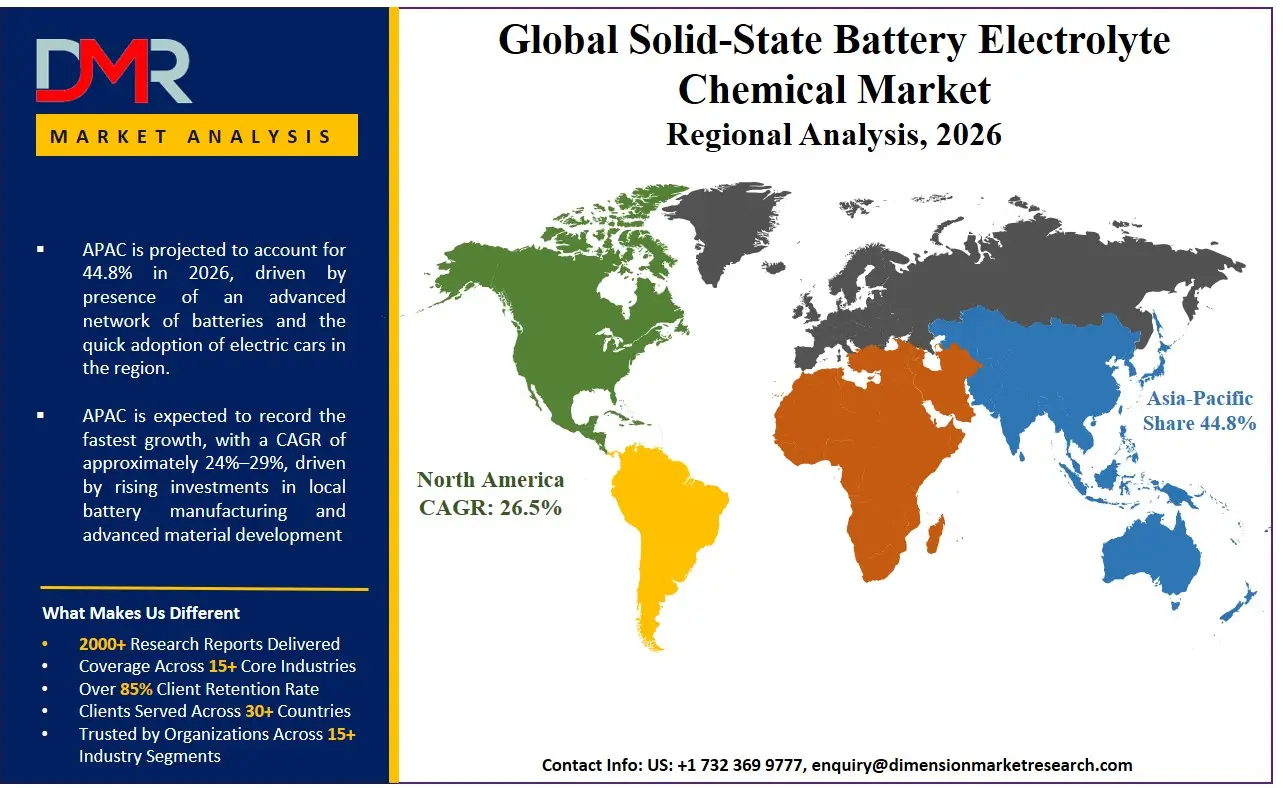
Asia-Pacific Region will dominate the Solid-State Battery Electrolyte Chemicals Market with a market share of 44.8% in 2026. The presence of an advanced network of batteries and the quick adoption of electric cars in the region, along with massive investments in energy storage solutions, makes it a preferred destination for growth. Countries such as China, Japan, and South Korea have been instrumental in introducing innovation in batteries with significant investments in research and development, as well as industrial efforts from their governments.
ℹ
To learn more about this report –
Download Your Free Sample Report Here
Fastest Growing Region in the Solid-State Battery Electrolyte Chemical Market
North America is predicted to become the fastest growing region in the market for Solid-State Battery Electrolyte Chemical owing to rising investments in local battery manufacturing and advanced material development. Government initiatives encouraging the use of electric vehicles and renewable energy sources have led to a surge in the demand for new-age batteries. There are many developments being seen in battery gigafactories and collaborations between automotive and technology firms in the region. The emphasis on localization of the supply chain and energy security will also contribute towards the growth of the market.
By Region
North America
Europe
- Germany
- The U.K.
- France
- Italy
- Russia
- Spain
- Benelux
- Nordic
- Rest of Europe
Asia-Pacific
- China
- Japan
- South Korea
- India
- ANZ
- ASEAN
- Rest of Asia-Pacific
Latin America
- Brazil
- Mexico
- Argentina
- Colombia
- Rest of Latin America
Middle East & Africa
- Saudi Arabia
- UAE
- South Africa
- Israel
- Egypt
- Rest of MEA
Competitive Landscape
The market for Solid-State Battery Electrolyte Chemicals is marked by fierce technology-based competition, large investments in research, and active development of intellectual property. The players in this market are working towards enhancing their competitive position through collaboration strategies, pilot production capacity growth, and supply chain agreements. Large investments are being made in the development of novel materials, especially sulfide and hybrid electrolyte materials. The entry barriers in the market are high because of the complexity in manufacturing process, cost of research, and strict quality control standards.
Some of the prominent players in the global Solid-State Battery Electrolyte Chemical are:
- Toyota Motor Corporation
- QuantumScape Corporation
- Solid Power Inc.
- Contemporary Amperex Technology Co., Limited (CATL)
- Samsung SDI
- LG Energy Solution
- Panasonic Energy
- ProLogium Technology
- Idemitsu Kosan Co., Ltd.
- Factorial Energy
- Ampcera Inc.
- Ionic Materials Inc.
- Blue Solutions
- Ilika plc
- Murata Manufacturing Co., Ltd.
- SK On
- BYD Company Ltd.
- Gotion High-Tech
- Nissan Motor Corporation
- Honda Motor Co, Ltd.
- Other Key Players
Recent Developments
- In April 2026, Solidion Technology Inc. unveiled new patent rights related to their liquid to solid electrolyte system, which will allow lithium-ion battery producers to develop semi-solid and solid state batteries without any new investment in production machinery. Their unique liquid electrolyte is converted into a semi-solid or solid electrolyte while still being incorporated in the battery cells, minimizing the risk of fire and improving safety.
- In April 2026, SAIC, a Chinese automaker, disclosed plans for the adoption of semi-solid-state batteries in various models within the year, while sticking to its plan for the commercial launch of full solid-state batteries by 2027. This approach underscores the quick adoption of modern battery technology into large-scale production. This trend is characterized by a greater emphasis on cost effectiveness, enhanced safety, and long-distance travel in electric cars' manufacturing process. In addition to its plans for adopting new battery technology, SAIC has set out aggressive targets for car sales and revenue generation.
- In January 2026, Scientists from the Paul Scherrer Institute (PSI) in Switzerland have invented a new fabrication technique to solve some of the crucial issues associated with solid-state batteries by increasing the density of the electrolyte and stabilizing the lithium interface. The technology utilizes a combination of two technologies that complement each other in achieving higher efficiency. The study is centered on argyrodite Li₆PS₅Cl (LPSCl) as a sulphide solid electrolyte that has good lithium ion conductance and facilitates fast charging.
Report Details
| Report Characteristics |
| Market Size (2026) |
USD 267.7 Mn |
| Forecast Value (2035) |
USD 1,687.3 Mn |
| CAGR (2026–2035) |
22.7% |
| Historical Period |
2021 – 2025 |
| Forecast Period |
2027 – 2035 |
| Base Year |
2025 |
| Estimate Year |
2026 |
| Segments Covered |
By Electrolyte Chemistry, By Material Composition, By Battery Type, By Application |
| Regional Coverage |
North America – The US and Canada; Europe – Germany, The UK, France, Russia, Spain, Italy, Benelux, Nordic, & Rest of Europe; Asia-Pacific – China, Japan, South Korea, India, ANZ, ASEAN, Rest of APAC; Latin America – Brazil, Mexico, Argentina, Colombia, Rest of Latin America; Middle East & Africa – Saudi Arabia, UAE, South Africa, Turkey, Egypt, Israel, & Rest of MEA |
Frequently Asked Questions
How big is the Solid-State Battery Electrolyte Chemical Market?
▾ The Solid-State Battery Electrolyte Chemical Market size is expected to reach USD 267.7 million by 2026 and is projected to reach USD 1,687.3 million by the end of 2035.
What is the CAGR of the Solid-State Battery Electrolyte Chemical Market from 2026 to 2035?
▾ The market is growing at a CAGR of 11.3 percent over the forecasted period.
What factors are driving the growth of the Solid-State Battery Electrolyte Chemical Market?
▾ Growing Demand for Batteries With High Energy Density for Electric Cars, and more are the factors driving the growth of the Solid-State Battery Electrolyte Chemical Market.
What are the major trends in the Solid-State Battery Electrolyte Chemical Market?
▾ Growing Use of Sulfide-Based Electrolyte Solutions, and more are some of the major trends in the market.
Who are the key players in the Solid-State Battery Electrolyte Chemical Market?
▾ Some of the key players in the Solid-State Battery Electrolyte Chemical Market include LG, Samsung, BYD, and more.
How is the Solid-State Battery Electrolyte Chemical Market segmented?
▾ The Solid-State Battery Electrolyte Chemical Market is segmented by electrolyte chemistry, material composition, battery type, application.
Which region held the largest share of the Solid-State Battery Electrolyte Chemical Market in 2026?
▾ Asia pacific is set to lead the Solid-State Battery Electrolyte Chemical market with an estimated 44.8% share in 2026.
Which region is expected to grow the fastest in the Solid-State Battery Electrolyte Chemical Market?
▾ North America is the fastest-growing region in the Solid-State Battery Electrolyte Chemical market during the forecast period.