South Africa Children Entertainment Centers Market Snapshot
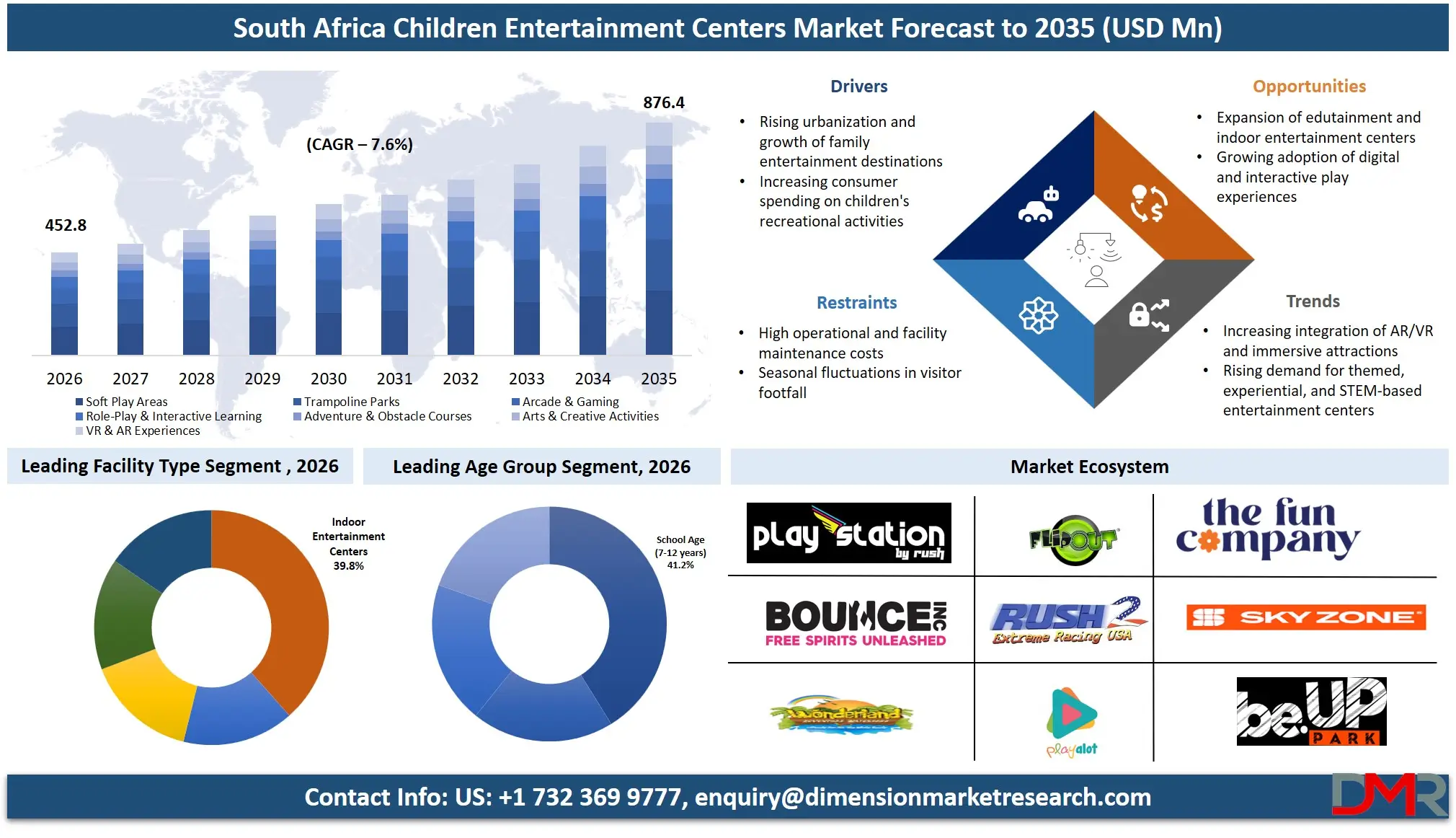
- Market Size (2026): USD 452.8 Million
- Market Size (2035): USD 876.4 Million
- Forecast CAGR (2026–2035): 7.6%
- Leading Facility Type (2026): Indoor Entertainment Centers (39.8%)
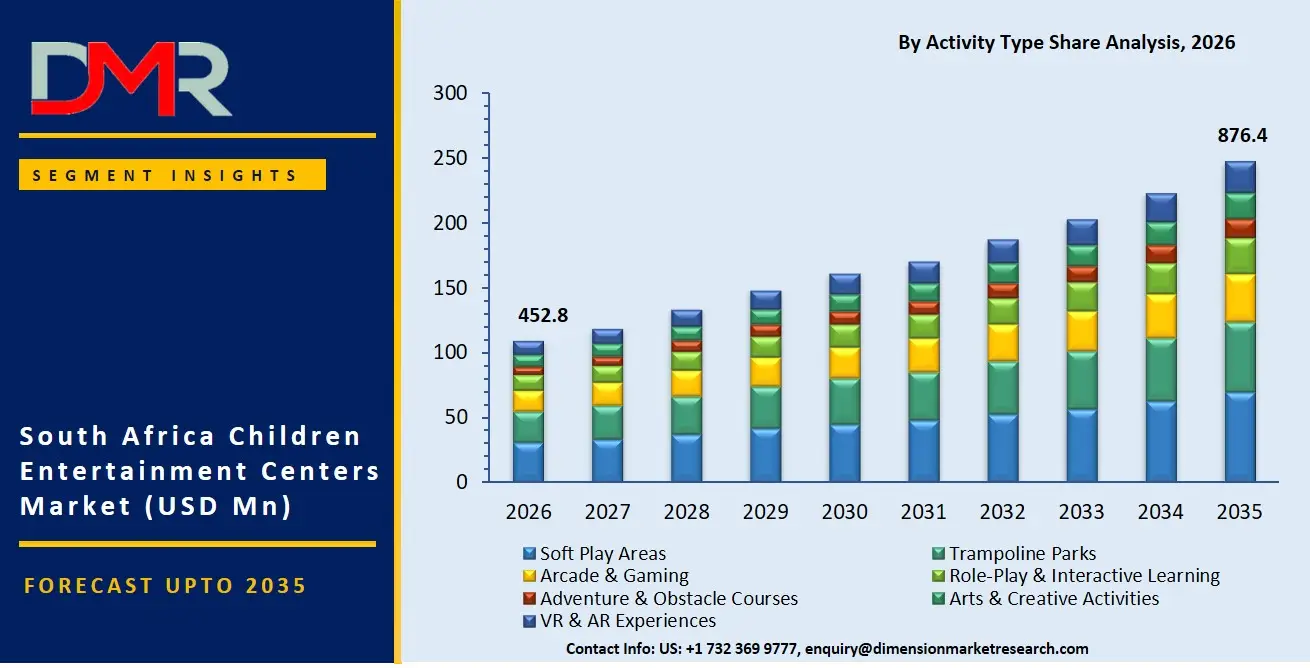
- Leading Activity Type (2026): Arcade & Gaming (27.6%)
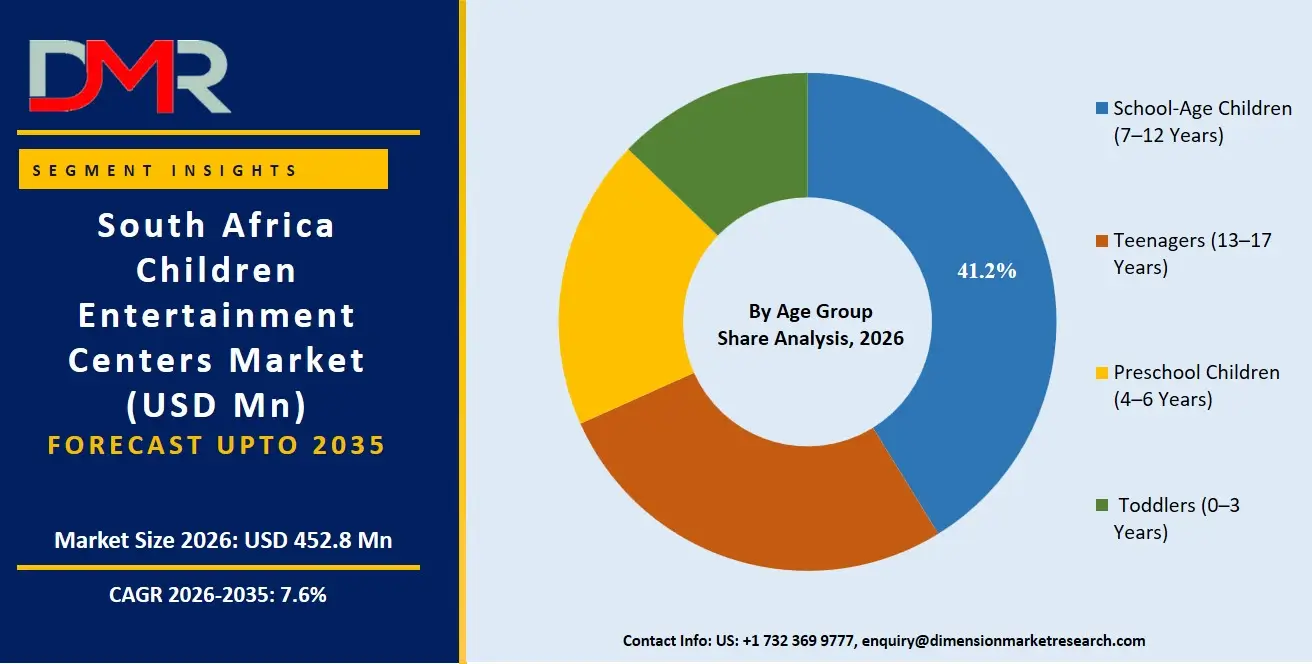
- Leading Age Group (2026): School-Age Children (7–12 Years) (41.2%)
- Fastest Growing Segment: VR & AR Experiences (11.8% CAGR)
- Largest Revenue Source: Admission Fees (35.4%)
What is South Africa Children Entertainment Centers and its Market Size?
The South Africa Children Entertainment Centers (CEC) Market comprises commercial recreational facilities designed specifically for children and families, offering educational, physical, creative, and technology-enabled entertainment experiences. These facilities include indoor play centers, trampoline parks, family entertainment centers (FECs), arcade gaming zones, edutainment venues, role-play cities, soft play centers, and immersive virtual reality attractions.
Entertainment centers operate through multiple revenue channels including admission tickets, memberships, birthday parties, educational programs, gaming, food and beverage sales, and merchandise. Modern facilities increasingly combine entertainment with education, helping children develop cognitive, social, creative, and physical skills while providing safe recreational environments for families.
ℹ
To learn more about this report –
Download Your Free Sample Report Here
Growing urbanization, increasing disposable incomes among middle-income households, expanding shopping malls, and heightened demand for structured recreational activities continue to support market development across South Africa.
The South Africa Children Entertainment Centers Market is estimated to reach USD 452.8 million in 2026 and is projected to expand to approximately USD 876.4 million by 2035, registering a compound annual growth rate (CAGR) of 7.6% during the forecast period.
Growth is supported by increasing investments in family entertainment infrastructure, modernization of retail malls, rising awareness regarding child development through experiential learning, and growing popularity of interactive digital attractions. Increasing adoption of technology-enabled attractions, including VR, AR, RFID tracking systems, and digital ticketing—is transforming the customer experience while improving operational efficiency.
Tourism recovery, increasing youth population, and expansion of premium leisure destinations further strengthen long-term market prospects.
Use Cases
- Indoor Family Recreation: Indoor entertainment centers provide safe, weather-independent recreational environments where children engage in physical activities, interactive games, and educational experiences throughout the year.
- Birthday Parties and Celebrations: Entertainment centers have become preferred venues for birthday parties by offering complete event management, themed experiences, catering, decorations, and supervised entertainment.
- Educational Learning Programs: Edutainment centers combine learning with entertainment through role-playing, science activities, creative workshops, robotics, coding, and STEM-based experiences that support child development.
- Tourism and Shopping Mall Attractions: Children's entertainment facilities increase shopping mall foot traffic, extend visitor dwell time, and encourage higher consumer spending among families and tourists.
- Physical Activity and Wellness: Soft play areas, climbing structures, obstacle courses, trampoline parks, and adventure activities encourage physical fitness while reducing children's screen time.
- Digital Interactive Entertainment: VR, AR, motion gaming, and interactive digital attractions provide immersive experiences that appeal to technology-oriented younger generations
Key Takeaways
- The South Africa Children Entertainment Centers Market is expected to grow from USD 452.8 million in 2026 to USD 876.4 million by 2035 at a CAGR of 7.6%.
- Increasing urbanization, expanding middle-class households, and rising expenditure on children's recreation remain primary market growth drivers.
- Indoor Entertainment Centers dominate the facility segment due to year-round operations and increasing mall-based developments.
- VR & AR Experiences represent the fastest-growing activity category owing to rapid technology adoption.
- Increasing investments in experiential retail and educational entertainment continue reshaping competitive dynamics.
How AI/Gen AI is Transforming the South Africa Children Entertainment Centers Market?
Digital transformation is reshaping children's entertainment facilities throughout South Africa. Artificial Intelligence (AI), Internet of Things (IoT), Virtual Reality (VR), Augmented Reality (AR), RFID technologies, cloud-based management software, and mobile applications are significantly improving customer engagement and operational performance.
Entertainment operators increasingly utilize AI-driven customer analytics to understand visitor preferences, optimize pricing strategies, personalize promotions, and forecast attendance patterns. IoT-enabled equipment provides real-time monitoring of attractions, improving maintenance schedules, operational efficiency, and safety compliance.
Immersive VR and AR attractions have emerged as premium offerings, enabling children to participate in educational adventures, interactive gaming, virtual sports, and simulated exploration experiences that traditional playgrounds cannot provide.
Cloud-based booking platforms simplify reservations, membership management, digital payments, and loyalty programs while reducing administrative costs. Mobile applications enable parents to purchase tickets, monitor children through RFID wristbands, receive real-time notifications, and access personalized promotions.
Technology also enhances safety through facial recognition systems, automated access control, occupancy monitoring, digital surveillance, and emergency response capabilities. These innovations improve customer trust while enabling operators to efficiently manage high visitor volumes.
As customer expectations continue evolving toward interactive and personalized experiences, technology investment has become a major competitive differentiator across South Africa's entertainment center industry.
Key Drivers in the South Africa Children Entertainment Centers Market
Rising Urbanization and Increasing Disposable Household Income
South Africa's expanding urban population has significantly increased demand for organized recreational facilities designed specifically for children. Families living in metropolitan regions such as Johannesburg, Pretoria, Cape Town, Durban, and Gqeberha increasingly seek secure indoor entertainment venues that combine recreation with educational value.
The growth of shopping malls has further accelerated market expansion by integrating family entertainment centers as anchor attractions. These facilities encourage longer visitor stays while increasing retail spending for surrounding businesses. Parents are also allocating greater portions of discretionary income toward children's developmental activities rather than conventional toys or passive entertainment.
Expansion of Experiential Retail and Family-Oriented Leisure Destinations
Retail developers increasingly recognize entertainment facilities as essential components of modern shopping destinations. Rather than functioning solely as retail spaces, shopping malls now prioritize experience-driven attractions that increase customer engagement.
Children's entertainment centers generate consistent foot traffic throughout weekdays, weekends, holidays, and school vacations, making them attractive long-term tenants for commercial property developers. Operators are diversifying attractions by integrating climbing walls, digital gaming, STEM learning zones, VR experiences, creative workshops, and interactive role-play environments.
Restraints in the South Africa Children Entertainment Centers Market
High Capital Investment and Operating Costs
Developing premium children's entertainment facilities requires substantial investment in real estate, equipment, safety infrastructure, digital technologies, maintenance, and trained staff. Operating expenses, including electricity, insurance, equipment replacement, security, sanitation, and compliance with safety regulations continue increasing, affecting profitability.
Economic Uncertainty and Consumer Spending Pressure
Although demand for family entertainment continues expanding, household spending remains vulnerable to inflation, unemployment, and broader economic fluctuations. During periods of financial uncertainty, discretionary expenditures such as entertainment and leisure activities are frequently reduced by consumers.
Growth Opportunities in the South Africa Children Entertainment Centers Market
Expansion into Secondary Cities
While Johannesburg and Cape Town remain major markets, numerous secondary cities remain underserved by premium entertainment facilities. Growing commercial developments in regions such as Bloemfontein, Polokwane, Mbombela, Rustenburg, and Kimberley create opportunities for market expansion.
Educational Entertainment and STEM Learning
Parents increasingly value entertainment experiences that combine recreation with education Interactive science exhibits, robotics, coding workshops, engineering activities, creative arts, and career role-play experiences are becoming highly attractive. Educational institutions also represent important partnership opportunities through school excursions and structured learning programs.
Trends in the South Africa Children Entertainment Centers Market
Rapid Adoption of Immersive Digital Experiences
Operators are investing heavily in VR gaming, AR treasure hunts, interactive projection systems, digital climbing walls, and motion-sensitive attractions. These technologies create highly differentiated experiences while encouraging repeat visits.
Integrated Family Lifestyle Destinations
Entertainment centers increasingly combine restaurants, cafés, co-working spaces, wellness facilities, cinemas, and retail shopping into integrated family destinations. Parents seek convenient locations where multiple leisure activities can be completed during a single visit.
Research Scope and Analysis
The South Africa Children Entertainment Centers Market has been analyzed based on Facility Type, Activity Type, Age Group, and Revenue Source. Market performance varies across these segments depending on consumer preferences, urbanization, technological adoption, disposable income, and investment in family-oriented recreational infrastructure. While traditional indoor play centers continue to dominate, immersive digital experiences and educational entertainment are emerging as high-growth categories.
ℹ
To learn more about this report –
Download Your Free Sample Report Here
By Facility Type Analysis
The South Africa Children Entertainment Centers Market is segmented into Indoor Entertainment Centers, Outdoor Entertainment Centers, Family Entertainment Centers (FECs), Edutainment Centers, and Theme-Based Entertainment Centers. Indoor Entertainment Centers dominated the market with 39.8% of total revenue in 2026, driven by their ability to operate throughout the year regardless of weather conditions, strong presence in shopping malls, and growing preference for safe, climate-controlled environments. These facilities offer a diverse range of attractions, including soft play zones, trampolines, arcade games, VR experiences, climbing walls, and birthday party venues, making them the preferred choice for families. Family Entertainment Centers (FECs) ranked as the second-largest segment with approximately 24.5% market share, supported by their ability to serve multiple age groups through a combination of gaming, dining, bowling, cinemas, and children's attractions, resulting in longer visitor stays and higher spending per visit.
Theme-Based Entertainment Centers are projected to be the fastest-growing facility type, registering a 9.4% CAGR during the forecast period. Rising consumer demand for immersive and experience-driven entertainment is encouraging operators to develop fantasy-themed parks, science and adventure centers, and interactive storytelling environments that offer differentiated experiences beyond conventional play areas. Continuous investments in innovative concepts and destination-based entertainment are expected to accelerate growth in this segment over the coming years.
By Activity Type Analysis
Based on activity type, the market is segmented into Soft Play Areas, Trampoline Parks, Arcade & Gaming, Role-Play & Interactive Learning, Adventure & Obstacle Courses, Arts & Creative Activities, and VR & AR Experiences. Arcade & Gaming accounted for the largest market share of 27.6% in 2026 owing to the growing popularity of redemption games, digital simulators, esports, racing games, and multiplayer interactive attractions among children and teenagers. The adoption of cashless payment systems, digital reward programs, and modern gaming technologies has further enhanced customer engagement. Soft Play Areas remained the second-largest segment with nearly 21.8% market share, driven by increasing demand from toddlers and preschool children for safe environments that support physical activity and early childhood development.
ℹ
To learn more about this report –
Download Your Free Sample Report Here
VR & AR Experiences are expected to record the fastest growth, expanding at a 11.8% CAGR through 2035. Entertainment operators are increasingly investing in immersive technologies such as virtual reality gaming, augmented reality treasure hunts, motion-based attractions, and mixed-reality educational experiences to attract digitally connected consumers. These premium attractions not only improve visitor engagement but also support higher ticket prices and stronger repeat visitation rates.
By Age Group Analysis
The market is categorized by age group into Toddlers (0–3 Years), Preschool Children (4–6 Years), School-Age Children (7–12 Years), and Teenagers (13–17 Years). School-Age Children (7–12 Years) represented the largest segment with 41.2% of market revenue in 2026, as children in this age group actively participate in a wide variety of attractions including climbing structures, trampolines, arcade games, obstacle courses, educational workshops, sports simulators, and VR experiences. Additionally, parents tend to spend more on birthday parties, school outings, and extracurricular recreational activities for this age group. Preschool Children (4–6 Years) accounted for the second-largest share at approximately 28.1%, supported by strong demand for soft play zones, creative learning activities, storytelling sessions, and sensory-based educational experiences.
Teenagers (13–17 Years) are anticipated to be the fastest-growing age segment, registering a 9.8% CAGR during the forecast period. The increasing popularity of esports, VR gaming, escape rooms, adventure courses, and social entertainment experiences is encouraging operators to expand attractions specifically designed for older children and teenagers, helping improve customer retention and increase average spending per visit.
By Revenue Source Analysis
Based on revenue source, the market is segmented into Admission Fees, Memberships, Birthday Parties & Events, Food & Beverage, Merchandise, and Arcade & Gaming Revenue. Admission Fees remained the largest revenue contributor, accounting for 35.4% of total market revenue in 2026 due to steady daily visitor traffic and flexible pricing models such as hourly tickets, unlimited play packages, family bundles, and seasonal promotions. Birthday Parties & Events represented the second-largest revenue stream with approximately 22.9% market share, as parents increasingly prefer professionally organized celebrations that include themed decorations, catering, entertainment, photography, and event management services.
Membership Programs are projected to witness the fastest growth, registering a 10.3% CAGR through 2035. Monthly and annual membership plans provide operators with recurring revenue while encouraging repeat visits through exclusive discounts, loyalty rewards, unlimited play access, and members-only events. The growing emphasis on customer retention and long-term engagement is expected to drive continued expansion of membership-based business models.
The South Africa Children Entertainment Centers Market Report is segmented on the basis of the following:
By Facility Type
- Indoor Entertainment Centers
- Outdoor Entertainment Centers
- Family Entertainment Centers (FECs)
- Edutainment Centers
- Theme-Based Entertainment Centers
By Activity Type
- Soft Play Areas
- Trampoline Parks
- Arcade & Gaming
- Role-Play & Interactive Learning
- Adventure & Obstacle Courses
- Arts & Creative Activities
- VR & AR Experiences
By Age Group
- Toddlers (0–3 Years)
- Preschool Children (4–6 Years)
- School-Age Children (7–12 Years)
- Teenagers (13–17 Years)
By Revenue Source
- Admission Fees
- Memberships
- Birthday Parties & Events
- Food & Beverage
- Merchandise
- Arcade & Gaming Revenue
Competitive Landscape
The South Africa Children Entertainment Centers Market is moderately fragmented, with a mix of international entertainment brands, regional operators, shopping mall-based family entertainment centers, and independent indoor playground providers competing for market share. Competition is primarily based on the quality of attractions, customer experience, safety standards, pricing strategies, technological innovation, and location. As consumer preferences evolve toward experiential and technology-enabled recreation, operators are increasingly investing in immersive attractions such as virtual reality (VR), augmented reality (AR), interactive gaming, and STEM-focused edutainment experiences to differentiate their offerings.
Leading market participants are adopting strategies including facility expansion, partnerships with shopping mall developers, franchise development, digital ticketing platforms, customer loyalty programs, and themed entertainment concepts to strengthen their market presence. Companies are also focusing on birthday party packages, school partnerships, seasonal events, and membership-based programs to increase customer retention and generate recurring revenue. The growing integration of food and beverage services, retail offerings, and family-oriented entertainment under one roof is further intensifying competition across the market.
Some of the prominent players in the South Africa Children Entertainment Centers Market are
- Bounce Inc.
- Rush Extreme
- be.UP Park
- PlayStation by Rush
- The Fun Company
- Wonderland Amusement Centers
- Adventure Golf
- Playalot
- Kids World
- Total Ninja
- Flip Out
- Sky Zone
- Chuck E. Cheese
- KidZania
- Timezone
- Magic Planet
- Fun City
- Playtopia
- Cheeky Monkeys
- Happy Island
- Funtropolis
- Planet Play
- Jump Street
- Kidz Play Park
- Playhouse
- Funland
- Kids Corner
- Xtreme Indoor Karting
- Gravity Active Entertainment
- Urban Play
- Adventure Zone
- Funworld
- Mega Play
- Kidz Fun House
- Jump Around
- Happy Kids Play Centre
- Fun Factory
- Adventure Castle
- Play World
- Kidz World Play Centre
- Other Key Players
Recent Developments
- March 2026: Bounce Inc. South Africa expanded its indoor adventure offerings by introducing new interactive ninja courses and digital climbing experiences at selected facilities. The expansion was aimed at increasing customer engagement among older children and teenagers while enhancing repeat visitation through technology-enabled attractions.
- January 2026: Total Ninja South Africa announced the launch of upgraded obstacle courses featuring smart timing systems and interactive performance tracking. The initiative was designed to improve visitor experiences and strengthen the company's position within the growing adventure entertainment segment.
- October 2025: The Fun Company expanded its presence in major shopping malls by introducing next-generation arcade machines, immersive VR gaming zones, and digital prize redemption systems. These investments were intended to modernize customer experiences and increase family foot traffic.
- August 2025: Rush Extreme Sports invested in expanding trampoline and adventure facilities by adding dedicated children's play zones, climbing walls, and family activity packages. The company also enhanced online booking capabilities and membership programs to improve customer convenience and retention.
- May 2025: Play Africa introduced new educational play experiences focused on science, creativity, and early childhood development. The expansion included interactive learning exhibits and collaborative programs with schools to strengthen its position in the growing edutainment segment.
Report Details
| Report Characteristics |
| Market Size (2026) |
USD 452.8 Mn |
| Forecast Value (2035) |
USD 876.4 Mn |
| CAGR (2026–2035) |
7.6% |
| Historical Period |
2021 – 2025 |
| Forecast Period |
2027 – 2035 |
| Base Year |
2025 |
| Estimate Year |
2026 |
| Segments Covered |
By Facility Type, By Activity Type, By Age Group, By Revenue Source |
| Country Coverage |
South Africa |
Frequently Asked Questions
What is the projected market size of the South Africa Children Entertainment Centers Market?
▾ The market is projected to grow from USD 452.8 million in 2026 to approximately USD 876.4 million by 2035, driven by increasing demand for organized family entertainment and experiential leisure activities.
What is the expected CAGR during the forecast period?
▾ The market is expected to register a CAGR of 7.6% between 2026 and 2035, supported by rising urbanization, growing disposable income, and investments in technology-enabled entertainment facilities.
What are the major factors driving market growth?
▾ Key growth drivers include expanding shopping mall infrastructure, increasing demand for safe indoor recreation, growing expenditure on children's leisure activities, rising popularity of birthday party venues, and continuous investment in immersive entertainment technologies.
Which facility type dominates the market?
▾ Indoor Entertainment Centers held the largest market share in 2026, accounting for 39.8% of total revenue due to their year-round accessibility, climate-controlled environments, and diverse entertainment offerings.
Which activity segment is expected to grow the fastest?
▾ VR & AR Experiences are projected to be the fastest-growing activity segment, expanding at a 11.8% CAGR through 2035 as consumers increasingly seek immersive and technology-driven entertainment experiences.
Who are the major companies operating in the market?
▾ Major market participants include Bounce Inc., Play Africa, Total Ninja, Rush Extreme Sports, The Fun Company, The Magic Company, Adventure Zone, CityROCK Indoor Climbing, Kids Empire, and Happy Island Waterworld, among others.
What are the major opportunities in the market?
▾ Significant opportunities exist in expanding into underserved secondary cities, developing technology-enabled attractions, strengthening membership programs, investing in STEM-based edutainment, and establishing family entertainment centers within mixed-use retail developments.