South Africa Cold Chain Logistics Market Snapshot
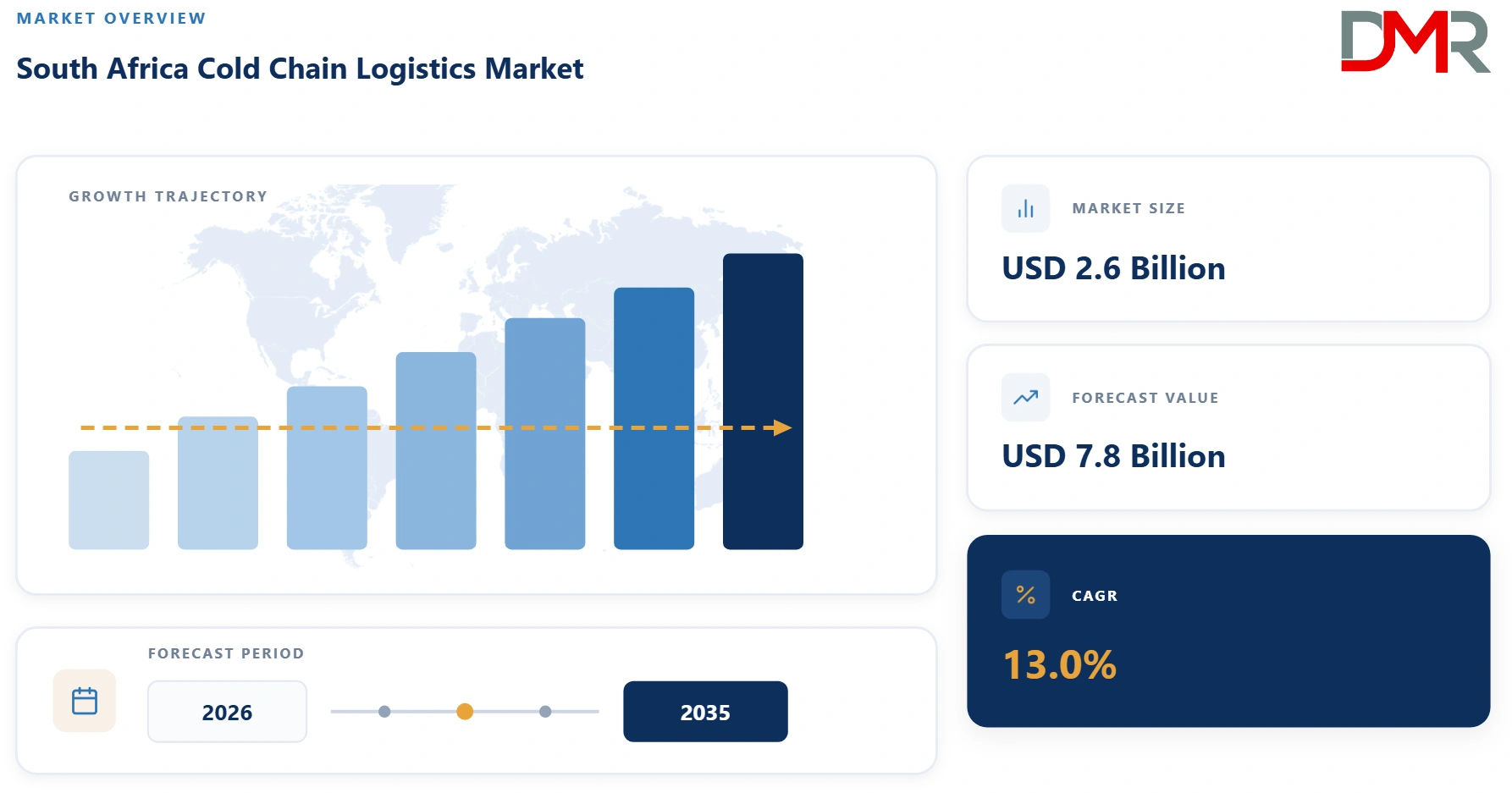
- Market Size in 2026: USD 2.6 billion
- Market Size in 2035: USD 7.8 billion
- CAGR, 2026–2035: 13.0%
- Leading Service Type: Refrigerated Transportation, 56%
- Leading Application: Meat, 28%
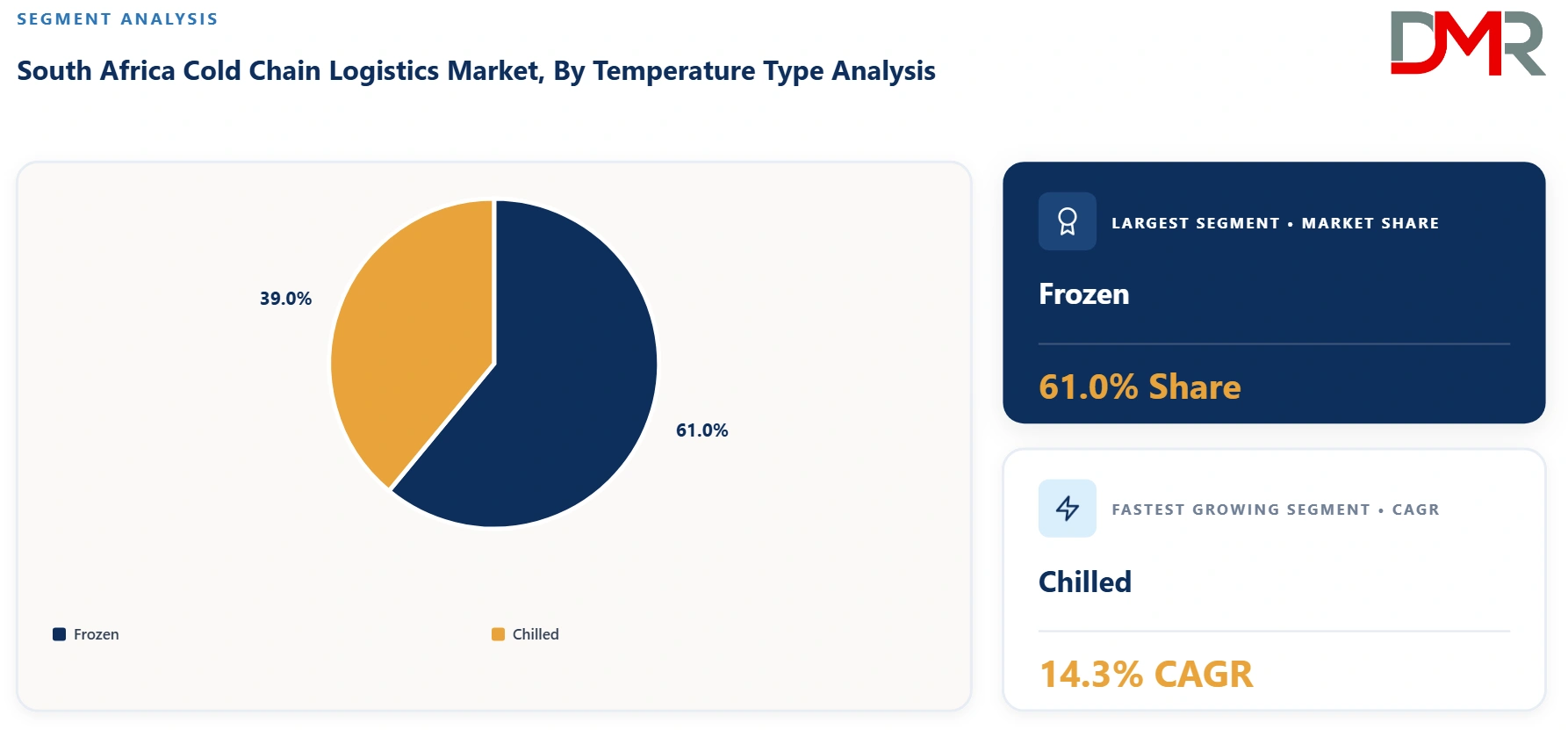
- Leading Temperature Type: Frozen, 61%
- Leading Technology: Dry Ice, 34%
- Fastest-Growing Segment: Alternative Protein, 16.2% CAGR
What is the South Africa Cold Chain Logistics and its Market Size?
The South Africa cold chain logistics market is estimated at USD 2.6 billion in 2026, increasing to approximately USD 7.8 billion by 2035, representing a projected 13.0% CAGR.
ℹ
To learn more about this report –
Download Your Free Sample Report Here
South Africa's cold chain logistics market comprises the infrastructure, transportation, warehousing, handling, packaging, monitoring and distribution services used to maintain temperature-sensitive products within specified thermal conditions from origin to final consumption. It covers refrigerated warehouses, cold stores, reefer trucks, containers, last-mile delivery, temperature-monitoring systems and specialized packaging. Major users include food processors, retailers, agricultural exporters, pharmaceutical companies, hospitals and food-service operators. The market's fundamental value proposition is preservation: maintaining product quality, extending shelf life, reducing spoilage and satisfying increasingly stringent food-safety and export requirements. South Africa's geographic position, agricultural production base and major ports make temperature-controlled logistics particularly important to its domestic and export supply chains.
Use Cases
- Meat and poultry distribution: Temperature-controlled transport preserves frozen and chilled meat quality from processors to retailers.
- Fruit and vegetable exports: Cold-chain infrastructure maintains freshness and extends shelf life during export movements.
- Dairy logistics: Refrigerated storage and transportation protect milk, cheese, yoghurt and other temperature-sensitive products.
- Seafood distribution: Frozen and chilled infrastructure preserves seafood quality across ports, processors, wholesalers and retailers.
- Pharmaceutical logistics: Validated temperature-controlled environments protect vaccines, biologics and temperature-sensitive medicines.
- Alternative proteins: Refrigerated and frozen distribution supports emerging plant-based and other protein categories.
Key Takeaways
- Market size: Estimated at USD 2.6 billion in 2026 and projected to reach USD 7.8 billion by 2035.
- Growth: The market is forecast to expand at approximately 13.0% CAGR, supported by infrastructure modernization and rising temperature-sensitive trade.
- Primary drivers: Food consumption, agricultural exports, pharmaceutical distribution, modern retail and technology adoption.
- Dominant service: Refrigerated transportation is estimated to account for 56% of 2026 market revenue.
- Dominant application: Meat is estimated to represent 28%, reflecting substantial frozen and chilled protein volumes.
- Fastest-growing application: Alternative protein logistics is projected to expand at approximately 16.2% CAGR from a smaller base.
- Technology shift: IoT sensors, cloud platforms, automated warehouses and predictive analytics are moving cold chains toward real-time visibility.
How AI/Gen AI is Transforming the South Africa Cold Chain Logistics Market?
AI, IoT and cloud technologies are increasingly embedded across South Africa's temperature-controlled supply chain. IoT sensors monitor vehicle, container and warehouse temperatures, humidity, door openings and equipment status, while cloud platforms consolidate data into centralized control towers. AI can analyze historical temperature, traffic, demand and equipment data to predict spoilage risks, optimize routes and anticipate refrigeration failures. Maersk specifically identifies sensor-driven automation, smart reefer trucks and cloud-based visibility as emerging tools in Southern African cold chains.
The principal benefits are lower spoilage, better asset utilization, faster exception management, improved compliance documentation and reduced manual intervention. Real-time alerts allow operators to intervene before thermal excursions become product losses. Digital records also support food-safety audits and export documentation.
Key Drivers in the South Africa Cold Chain Logistics Market
Expansion of Perishable Food Production and Exports
South Africa's agricultural and food economy is a foundational demand generator for cold-chain services. Citrus, table grapes, berries, apples, pears, seafood, meat and dairy require controlled environments across harvesting, processing, storage, inland transportation and export. Government data indicates strong 2025 agricultural export performance, with table grapes, berries, citrus, apples and pears among the leading export categories.
Modern Retail, Frozen Foods and Healthcare Demand
Modern grocery retail and changing consumer behavior are expanding the requirement for frozen and chilled distribution. Frozen poultry, meat, dairy, ready meals and convenience products require dependable temperature-controlled distribution to supermarkets, restaurants and food-service operators. South African consumer research also indicates resilient demand for processed meat, seafood and alternatives to meat, with frozen processed poultry performing particularly strongly.
Restraints in the South Africa Cold Chain Logistics Market
Electricity Costs, Reliability and Infrastructure Constraints
Cold-chain facilities are energy-intensive because refrigeration systems must operate continuously. Electricity costs therefore materially influence warehouse economics, while power interruptions can cause product losses, equipment damage and service disruption. Operators increasingly need generators, battery systems, solar generation and energy-management technologies, raising capital requirements.
High Capital Intensity and Skills Requirements
Cold-chain logistics requires specialized warehouses, insulation, refrigeration systems, reefer vehicles, monitoring devices and maintenance capabilities. Building a modern cold store can require substantially more capital than conventional ambient warehousing.
Growth Opportunities in the South Africa Cold Chain Logistics Market
Renewable-Powered and Energy-Efficient Cold Storage
The combination of high electricity requirements and sustainability pressure creates a strong investment opportunity for solar-assisted refrigeration, battery storage, high-efficiency compressors, thermal storage and intelligent energy-management systems.
Export-Oriented Integrated Logistics Platforms
South Africa has an opportunity to develop integrated "farm-to-port" cold-chain platforms combining packhouses, pre-cooling, storage, trucking, rail, container handling, customs, inspection and shipping. This is particularly attractive around Cape Town, Durban/Gqeberha and major agricultural corridors. Maersk's investment in the Belcon Cold Store demonstrates the commercial potential of locating cold storage facilities alongside freight and export infrastructure.
Trends in the South Africa Cold Chain Logistics Market
Digitization and Real-Time Temperature Visibility
Temperature monitoring is evolving from periodic manual checks toward continuous sensor-based monitoring. IoT devices, telematics and cloud control towers provide real-time alerts and historical records, allowing operators to intervene before products are damaged. Digital visibility also supports regulatory compliance and strengthens customer confidence.
Acquisitions and Infrastructure Platforms
The market is becoming more organized as investment funds and strategic logistics companies consolidate cold-storage and distribution assets. CCH has expanded through multiple acquisitions, while A.P. Moller Capital acquired Vector Logistics and continues to support its expansion.
Research Scope and Analysis
The market is segmented by Service Type, Application, Temperature Type and Technology. These dimensions capture where cold-chain revenue is generated, what products drive demand, the thermal conditions required and the technologies used to preserve temperature integrity.
ℹ
To learn more about this report –
Download Your Free Sample Report Here
By Service Type Analysis
Refrigerated Transportation is estimated to be the dominant service category in 2026, accounting for approximately 56% of market revenue, with refrigerated warehousing representing roughly 44%. Transportation leads because South Africa's large geographic footprint requires temperature-controlled movement between agricultural regions, processors, distribution centers, ports and retailers. Road remains particularly important for domestic distribution, while reefer containers support export trade. Refrigerated Warehousing is the second-largest segment at approximately 44% and is expected to grow as retailers and food producers outsource inventory storage and require strategically located multi-temperature facilities. Within the service category, refrigerated warehousing is the faster-growing sub-segment, at approximately 14.1% CAGR, compared with about 12.1% for refrigerated transportation, because warehouse modernization, export staging and strategic inventory buffering are creating new capacity requirements. Recent investments by Maersk and CCH illustrate the capital flowing into temperature-controlled storage.
By Application Analysis
Meat is estimated to lead the application segment with approximately 28% share in 2026, followed by fruit and vegetables at 24% and dairy products at approximately 18%. Meat benefits from high frozen and chilled volumes, extensive retail distribution and demand for poultry, beef and processed protein. South African consumer demand for frozen processed poultry has remained resilient, reinforcing the importance of cold logistics. Alternative Protein is projected to be the fastest-growing application at approximately 16.2% CAGR, albeit from a substantially smaller base, as plant-based products increasingly require chilled or frozen distribution and retailers broaden category offerings. Seafood represents approximately 13%, while "others" account for the balance. Fruit and vegetables have particularly strong export potential because South Africa is a major producer and exporter of citrus, grapes, berries, apples and pears.
By Temperature Type Analysis
Frozen is estimated to account for approximately 61% of 2026 market revenue, making it the leading temperature category. Frozen logistics benefits from high-volume meat, poultry, seafood, frozen vegetables, prepared foods and ice-cream distribution. Frozen products also permit longer inventory cycles than chilled goods, creating substantial requirements for cold-storage capacity. Chilled represents approximately 39% of the market and includes fresh meat, dairy, fruit, vegetables and selected pharmaceutical products. Chilled is nevertheless the faster-growing category, estimated at approximately 14.3% CAGR, versus 12.2% for frozen. Growth reflects fresh-produce exports, premium food categories, dairy consumption and demand for fresher products with shorter supply chains. Regulatory requirements for product-temperature monitoring are increasing the importance of reliable chilled infrastructure, particularly for exports.
By Technology Analysis
Dry Ice is estimated to represent approximately 34% of the technology segment in 2026, followed by gel packs at 26%, eutectic plates at 17%, liquid nitrogen at 9% and quilts at 14%. Dry ice remains important because it is effective for frozen-product transportation, pharmaceutical shipments and applications requiring low-temperature protection without conventional mechanical refrigeration. Liquid nitrogen is expected to be the fastest-growing technology, at approximately 17.1% CAGR, supported by specialized food processing, biotechnology, pharmaceutical and high-value temperature-sensitive applications. Gel packs retain a significant position because of their low cost and suitability for chilled pharmaceutical, food and last-mile shipments. Quilts are increasingly used as supplementary thermal protection in transit rather than as a stand-alone refrigeration technology. The market is gradually moving toward hybrid systems combining passive packaging with active refrigeration and IoT temperature monitoring.
The South Africa Cold Chain Logistics Market Report is segmented on the basis of the following:
By Service Type
- Refrigerated Warehouse
- Refrigerated Transportation
By Application
- Seafood
- Meat
- Fruit & Vegetable
- Dairy Products
- Alternative Protein
- Others
By Temperature Type
By Technology
- Dry Ice
- Gel Packs
- Eutectic Plates
- Liquid Nitrogen
- Quilts
Regulatory Landscape
South Africa's cold-chain industry operates under a relatively stringent food-safety and export-control framework. The Department of Health regulates food hygiene and transportation, while PPECB plays a central role in quality assurance and cold-chain management for perishable exports. The 2025 Perishable Products Export Control regulations specify temperature sensors, automatic tamper-proof recorders, insulation standards, calibration and temperature-record requirements for cold-storage facilities. These rules raise compliance costs but simultaneously create opportunities for monitoring software, validated refrigeration systems, calibration services and digital traceability. Providers able to demonstrate continuous temperature integrity should gain competitive advantages in export and pharmaceutical segments. Regulatory complexity is therefore both a barrier to entry and a market-quality catalyst.
Investment and White Space Analysis
Investment white space is concentrated in export-oriented cold storage, secondary cities, energy-efficient facilities, last-mile chilled distribution and integrated cold-chain platforms. Existing capacity is concentrated around Johannesburg/Gauteng, Cape Town/Western Cape and Durban/KwaZulu-Natal, while agricultural production regions can experience weaker access to sophisticated temperature-controlled infrastructure. CCH's expansion into Gqeberha and iDube illustrates the attractiveness of port-linked and export-oriented capacity. Maersk's Cape Town investment further demonstrates institutional confidence in export cold-chain infrastructure. Additional white space exists in renewable-powered rural cold stores, SME-focused shared-user facilities, pharmaceutical last-mile networks and digital control-tower services. Investors should prioritize assets with multi-temperature capability, strong power resilience and proximity to ports or high-density consumption centers..
Competitive Landscape
South Africa's cold-chain logistics market is moderately fragmented but consolidating, with large integrated logistics providers competing alongside specialist cold-storage operators. Leading participants include Vector Logistics, Commercial Cold Holdings, Maersk, Imperial Logistics and Etlin International, while numerous regional operators serve specific commodities or geographic corridors. Competitive differentiation increasingly depends on network density, storage capacity, fleet reliability, temperature visibility, export expertise and energy efficiency rather than transportation price alone. M&A is an important strategy because acquiring established cold-storage facilities provides immediate customer relationships and geographic coverage..
Some of the prominent players in the South Africa Cold Chain Logistics Market are:
- Commercial Cold Holdings (CCH)
- Vector Logistics
- Imperial Logistics
- Bidvest International Logistics
- Africold Logistics
- Cold Chain Solutions
- Etlin International
- Maersk
- Lineage Logistics
- DSV
- DHL Supply Chain
- Kuehne+Nagel
- Rhenus Logistics
- Transnet Freight Rail
- MDS Logistics
- Super Group
- Barloworld Logistics
- CEVA Logistics
- DP World Logistics
- Americold Logistics
- RSA Group
- CCS Logistics
- Sequence Logistics
- iDube Cold Storage
- Port Elizabeth Cold Storage (PECS)
- SAFT Cold Storage
- Cold Chain Africa
- Chilleweni Cold Storage
- Cold Chain Logistics
- Africold
- Baleka Freight
- Bidfood South Africa
- RCL Foods
- Clover
- Cargill South Africa
- Nestlé South Africa
- Unilever South Africa
- Pioneer Foods
- Transpharm
- Onelogix Group
- Other Key Players
Recent Developments
- October 2025: Maersk officially opened the Belcon Cold Store in Cape Town, forming part of its approximately R1.72 billion South African cold-chain investment program and adding around 32,000 pallet positions near major export infrastructure.
- February 2025: CCH detailed its technology transformation program, consolidating acquired businesses onto a shared technology architecture incorporating enterprise resource planning (ERP) and warehouse management systems (WMS).
- August 2024: CCH operationalized its Greenbushes greenfield cold-storage facility in Gqeberha and acquired iDube Cold Store, strengthening its temperature-controlled infrastructure across the Eastern Cape and KwaZulu-Natal.
- July 2024: A.P. Moller Capital appointed Keith Glenn Pienaar to lead Vector Logistics following its acquisition of the South African frozen-logistics operator from RCL Foods, marking a new phase of strategic expansion.
- April 2024: CCH continued expanding its multi-site temperature-controlled logistics platform through acquisitions including CCS and Sequence, alongside greenfield capacity development and the conversion of facilities for export-oriented cold-chain operations.
Report Details
| Report Characteristics |
| Market Size (2026) |
USD 2.6 Bn |
| Forecast Value (2035) |
USD 7.8 Bn |
| CAGR (2026–2035) |
13.0% |
| Historical Data |
2021 – 2025 |
| Forecast Data |
2026 – 2035 |
| Base Year |
2025 |
| Segments Covered |
By Service Type, By Application, By Temperature Type, By Technology |
| Country Coverage |
South Africa |
Frequently Asked Questions
What is the size of the South Africa Cold Chain Logistics Market in 2026?
▾ The South Africa Cold Chain Logistics Market is estimated at approximately USD 2.6 billion in 2026, supported by expanding food, pharmaceutical and agricultural logistics requirements.
What will the South Africa Cold Chain Logistics Market be worth by 2035?
▾ The South Africa Cold Chain Logistics Market is projected to reach approximately USD 7.8 billion by 2035, driven by infrastructure expansion, exports and increasing demand for temperature-controlled distribution.
What CAGR is expected for the South Africa Cold Chain Logistics Market from 2026 to 2035?
▾ The South Africa Cold Chain Logistics Market is projected to expand at approximately 13.0% CAGR from 2026 to 2035, reflecting sustained investment and rising temperature-sensitive product volumes.
What are the key factors driving the South Africa Cold Chain Logistics Market?
▾ The South Africa Cold Chain Logistics Market is driven by agricultural exports, frozen-food consumption, pharmaceutical distribution, modern retail, cold-storage investments and increasing adoption of digital monitoring technologies.
Which segment dominates the South Africa Cold Chain Logistics Market?
▾ Refrigerated transportation dominates the South Africa Cold Chain Logistics Market by service type, while meat leads by application and frozen products lead by temperature type.
Which is the fastest-growing segment in the South Africa Cold Chain Logistics Market?
▾ Alternative protein is projected to be the fastest-growing application in the South Africa Cold Chain Logistics Market, with an estimated 16.2% CAGR during 2026–2035.