South Africa Food Packaging Market Snapshot
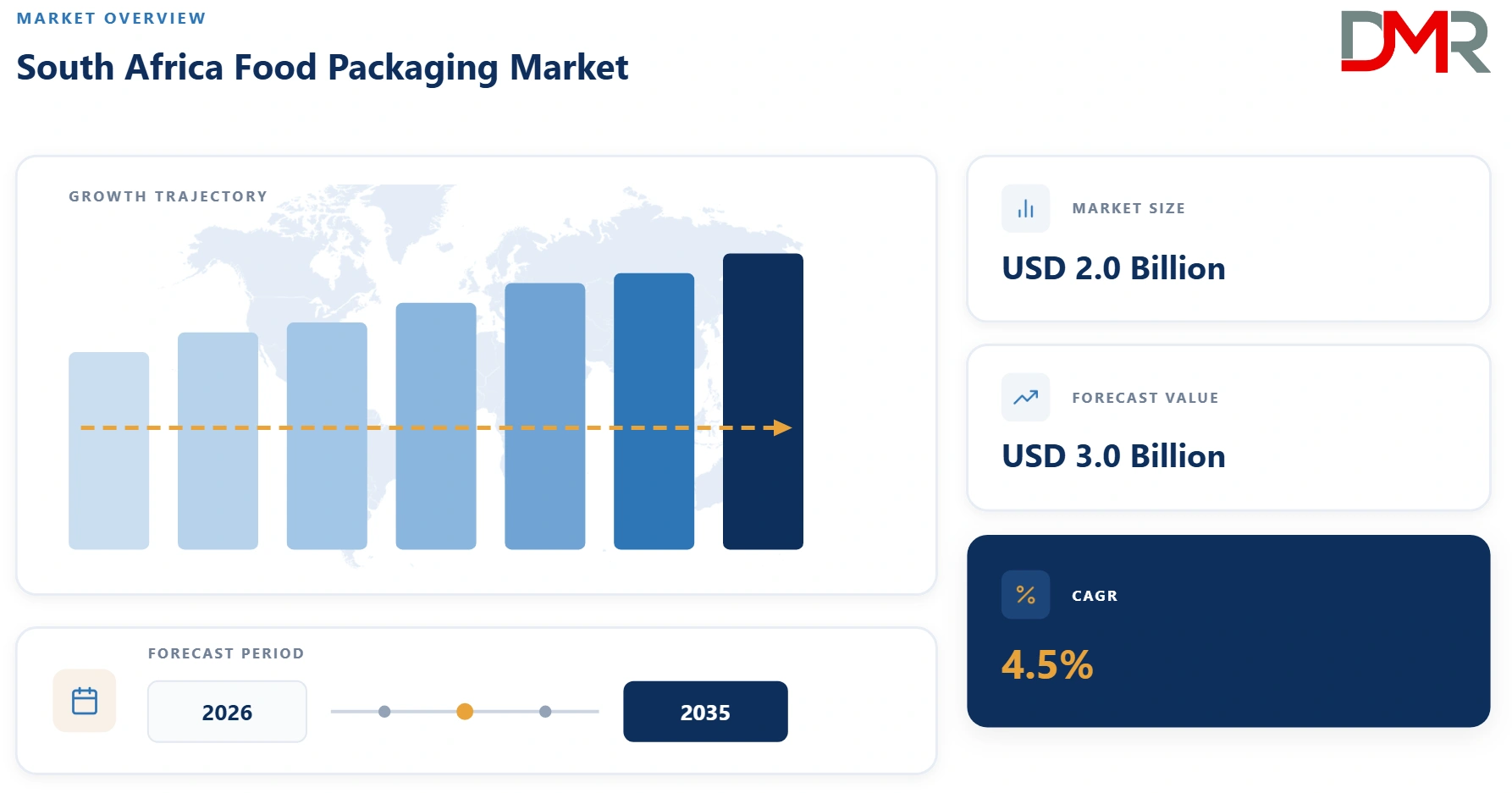
- Market size 2026: USD 2.0 billion
- Market Size 2035: USD 3.0 billion
- CAGR, 2026–2035: 4.5%
- Leading packaging type Flexible, 31% share
- Leading application: Snacks & Side Dishes, 17% share
- Fastest-growing segment: Paper & Paperboard, 5.5% CAGR
What is the South Africa Food Packaging and its Market Size?
The South Africa food packaging market is estimated at approximately USD 2.0 billion in 2026 and is forecast to reach approximately USD 3.0 billion by 2035, representing an estimated 4.5% CAGR.
ℹ
To learn more about this report –
Download Your Free Sample Report Here
South Africa's food packaging market comprises packaging products and systems used to protect, preserve, contain, transport, display and sell food products across retail, foodservice and institutional channels. It includes flexible films, pouches, bags and wraps; paper and paperboard cartons; rigid plastic tubs, trays and containers; glass jars and bottles; metal cans; and other emerging formats. Packaging suppliers convert polymers, paperboard, glass, aluminum, steel and multilayer materials into food-contact solutions designed to maintain product safety, extend shelf life, reduce food loss, facilitate distribution and provide branding and consumer convenience. The market therefore sits at the intersection of food manufacturing, materials conversion, logistics, modern retail and recycling.
Use Cases
- Bakery and confectionery: Flexible films, paperboard cartons and resealable packs protect freshness and improve shelf presentation.
- Dairy products: Liquid cartons, rigid plastic cups and flexible formats provide chilled-product protection and portion control.
- Snacks and side dishes: Lightweight pouches, films and trays support portability, branding and controlled portions.
- Convenience foods: Retortable pouches, trays and cartons enable ready-meal, frozen and heat-and-eat applications.
- Meat, fish and poultry: Vacuum packs, barrier films and trays extend shelf life while supporting food safety.
- Fresh produce: Ventilated cartons, trays, films and punnets protect produce through handling, storage and distribution.
Key Takeaways
- Market size: The market is estimated at USD 2.0 billion in 2026, reaching approximately USD 3.0 billion by 2035.
- Growth: The modeled 2026–2035 CAGR is 4.5%, indicating sustained mid-single-digit expansion.
- Growth drivers: Convenience foods, organized retail, food-safety requirements, smaller pack sizes and sustainability initiatives are central growth catalysts.
- Segment dominance: Flexible packaging is estimated to lead with approximately 31% of 2026 market value.
- Application leadership: Snacks and side dishes are modeled as the largest application at approximately 17%.
- Fastest growth: Paper and paperboard is expected to be among the fastest-growing packaging categories as brands pursue recyclable and fiber-based alternatives.
How AI/Gen AI is Transforming the South Africa Food Packaging Market?
AI, machine vision, automated inspection, digital printing and connected production systems are increasingly influencing South African food-packaging operations. Packaging converters can use machine vision to detect seal, print and dimensional defects; predictive analytics to reduce unplanned downtime; and digital printing to economically produce shorter customized runs. Digital technologies also support packaging traceability, SKU management and faster product launches.
The principal benefits are lower scrap rates, better production consistency, improved line utilization and shorter changeover times. Digital printing additionally allows food brands to create regionalized, promotional and limited-edition packaging without committing to large conventional print runs.
Key Drivers in the South Africa Food Packaging Market
Growth of Convenience, Portion-Controlled and Packaged Foods
South African consumers continue to place greater emphasis on convenience, affordability, portability and food safety, supporting demand for smaller packs, resealable pouches, single-serve formats and ready-to-eat packaging. Euromonitor identifies a broad movement toward smaller and single-serve packaging across plant-based dairy, processed fruit and vegetables, sauces, confectionery, meals and soups. This trend is particularly important in an inflation-sensitive market because smaller pack sizes lower the immediate purchase price even when the unit economics are less favorable.
Modern Retail, Food Processing and Distribution Infrastructure
The expansion and sophistication of supermarkets, convenience stores, food processors and organized distribution networks are strengthening demand for standardized, machine-compatible packaging. Modern retail requires packaging that withstands automated filling, palletization, transportation and shelf handling while maximizing visual impact.
Restraints in the South Africa Food Packaging Market
Raw-Material Volatility and Consumer Affordability
Packaging manufacturers remain exposed to fluctuations in polymer, paper, aluminum, energy, transport and imported input costs. These pressures are difficult to pass through immediately when food producers and retailers face intense price competition. Constrained household spending can also reduce food volumes or encourage consumers to trade down to lower-cost products and smaller pack sizes.
Recycling Infrastructure and Regulatory Complexity
South Africa's mandatory Extended Producer Responsibility framework places greater responsibility on producers for packaging placed on the market. The EPR regulations cover paper and packaging waste streams and require obligated producers to participate in appropriate EPR arrangements.
Growth Opportunities in the South Africa Food Packaging Market
Recyclable and Fiber-Based Packaging Substitution
The strongest structural opportunity is the development of packaging that combines food safety and shelf-life performance with easier recovery or recycling. Paperboard cartons, recyclable mono-material films, recycled PET and lightweight fiber-based formats can capture value as food manufacturers respond to EPR obligations and corporate sustainability commitments.
High-Barrier Flexible Packaging and Smart Formats
Flexible packaging offers substantial material-efficiency advantages and remains a major opportunity where suppliers can improve recyclability without sacrificing oxygen, moisture, aroma or grease barriers. High-barrier pouches, vacuum films, retortable structures, resealable bags and lightweight lidding films can replace heavier rigid formats in selected applications.
Trends in the South Africa Food Packaging Market
Smaller Packs and Convenience-Oriented Design
Smaller, single-serve and portion-controlled packs are becoming increasingly important as consumers balance affordability with convenience. Resealable pouches, sachets, brick cartons and compact trays are gaining relevance across sauces, dairy, snacks, meals and processed foods.
Sustainability Shifting From Material Choice to Design
Sustainability is moving beyond simply replacing plastic. Packaging developers increasingly focus on lightweighting, mono-material construction, recycled content, recyclability, renewable fibers and end-of-life economics. South Africa's EPR system reinforces this design-for-recycling approach by linking producer responsibility to packaging recovery.
Research Scope and Analysis
The market is analyzed by Packaging Type and Application, consistent with the principal public market-study framework. Packaging analysis evaluates material/form economics; application analysis reflects food-category demand; and regional analysis captures manufacturing, retail, logistics and agricultural concentration.
ℹ
To learn more about this report –
Download Your Free Sample Report Here
By Packaging Type Analysis
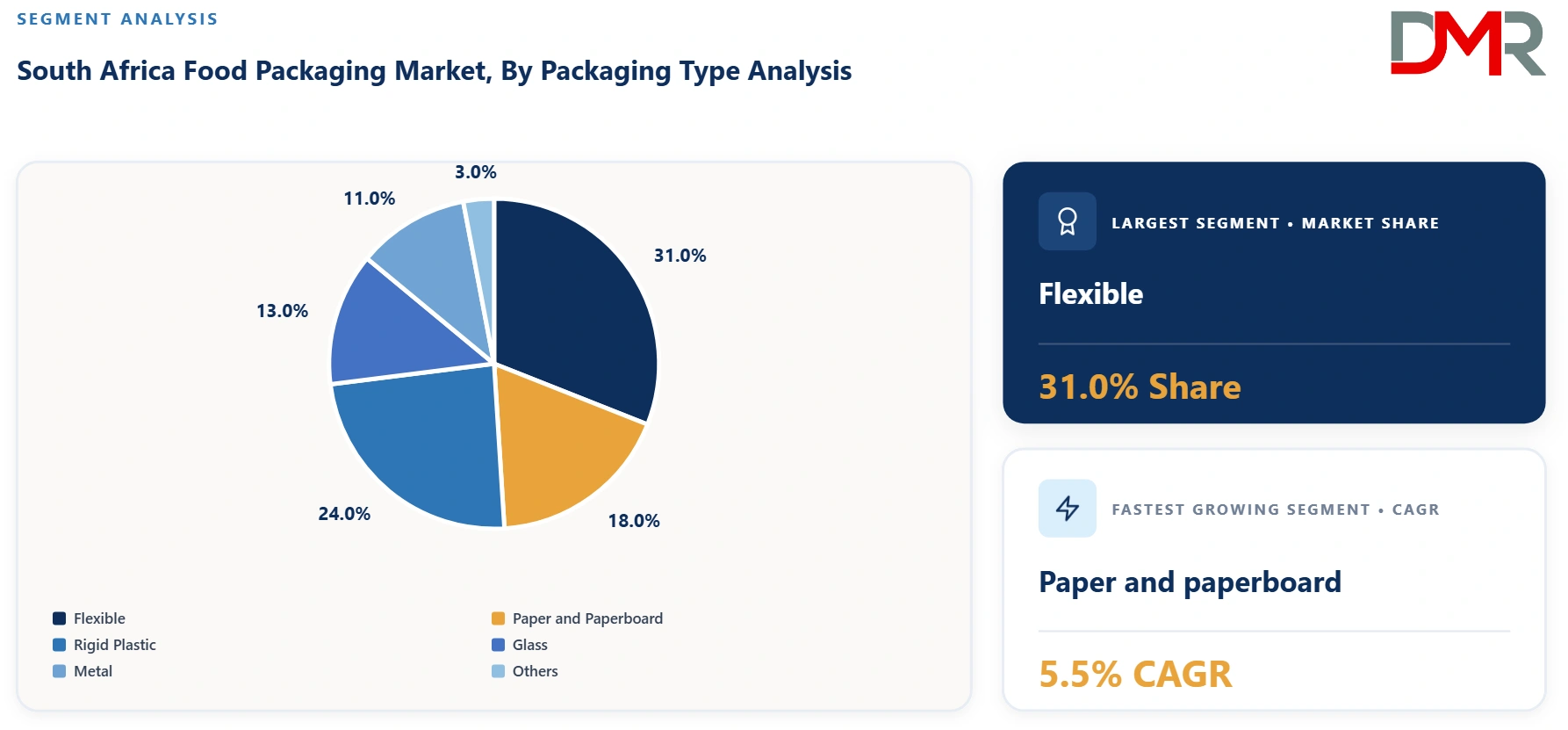
Flexible packaging is estimated to be the dominant packaging type in 2026, accounting for approximately 31% of market value. Its leadership is supported by lightweight construction, low material intensity, strong barrier performance, printing flexibility and suitability for snacks, bakery, sauces, meat, dairy and convenience foods. Independent market estimates also identify flexible packaging as a major and relatively fast-growing South African packaging category. Paper and paperboard, estimated at approximately 18%, is a major category and is expected to be the fastest-growing segment at about 5.5% CAGR, driven by recyclability objectives, EPR requirements and substitution opportunities. Rigid plastic, at roughly 24%, remains a major category because PET, PP and HDPE provide durability, transparency, barrier performance and compatibility with automated filling. Glass and metal are estimated at approximately 13% and 11%, respectively, while other formats account for about 3%. The principal competitive battleground is shifting toward recyclable flexible structures, recycled-content rigid plastic and high-performance fiber-based packaging.
By Application Analysis
Snacks and side dishes are modeled as the leading application in 2026 with approximately 17% share, reflecting high consumption frequency and extensive use of flexible bags, pouches, laminates, trays and portion packs. Bakery, confectionery, pasta and noodles, estimated at about 15%, represent the second-largest application and benefit from high-volume everyday consumption and strong requirements for moisture and aroma protection. Convenience foods, at approximately 15%, are expected to be the fastest-growing application at around 5.2% CAGR, supported by ready meals, frozen foods, prepared dishes and consumer demand for quick preparation. Dairy products account for approximately 14%, although Euromonitor expects dairy packaging volumes to remain pressured by weak demand and structural changes in the category. Meat, fish and poultry represent approximately 14%, supported by vacuum packaging, modified-atmosphere packaging and barrier trays; sauces and condiments represent 10%; fruits and vegetables 8%; and other applications 7%. The application mix increasingly favors packaging that combines convenience with shelf-life extension.
The South Africa Food Packaging Market Report is segmented on the basis of the following:
By Packaging Type
- Flexible
- Paper and Paperboard
- Rigid Plastic
- Glass
- Metal
- Others
By Application
- Bakery, Confectionery, Pasta, and Noodles
- Dairy Products
- Sauces, Dressings, and Condiments
- Snacks and Side Dishes
- Convenience Foods
- Meat, Fish, and Poultry
- Fruits and Vegetables
- Others
Regulatory Landscape
South Africa's EPR framework is one of the most important structural forces affecting food packaging. Producers placing more than 10 tonnes of identified packaging products on the market annually must comply through an appropriate EPR scheme or producer-responsibility organization. The framework is pushing converters and food brands toward packaging designs with better recyclability, lower material intensity and more traceable end-of-life pathways. PET, liquid-board, plastics, paper and metal packaging are supported by specialized producer-responsibility structures. The principal risk is higher compliance cost for difficult-to-recycle multilayer structures. Conversely, the regulatory environment creates white space for mono-material films, recycled PET, fiber-based formats, recyclable coatings and packaging redesign services.
Investment and White Space Analysis
The most attractive investment opportunities lie where packaging demand, sustainability requirements and technical differentiation overlap. High-barrier recyclable flexible packaging is a priority area because it can address meat, snacks, bakery, dairy and convenience-food requirements while reducing material consumption. Fiber-based food packaging represents another attractive white space, particularly in cartons, trays and foodservice formats. Recycled-material infrastructure also offers growth potential as EPR expands demand for recovered PET, paper fiber and other packaging feedstocks. Companies with local converting capacity, strong food-safety capabilities, recycling partnerships and design-for-recycling expertise should have an advantage. Investment risks include relatively slow overall market growth, inflation-sensitive food demand, infrastructure constraints and potentially higher costs for sustainable materials.
Competitive Landscape
The South African food-packaging market is moderately fragmented, with large integrated packaging groups competing alongside specialized converters, regional manufacturers and multinational suppliers. Leading companies compete through manufacturing scale, material science, product innovation, sustainability credentials, food-safety performance, customer proximity and long-term contracts with food processors and retailers. Major players include Nampak, Mpact, Mondi, Amcor, Huhtamaki and other international and local packaging specialists. Market leaders are increasingly using portfolio expansion, M&A, capacity investment, recycling partnerships and sustainable-material innovation to differentiate themselves. Mordor Intelligence identifies Mondi, Nampak, Mpact, Consol Glass and Smurfit Kappa among notable packaging-industry participants in South Africa..
Some of the prominent players in the South Africa Food Packaging Market are:
- Nampak
- Mpact
- Amcor
- Mondi
- Constantia Flexibles
- Huhtamaki
- Tetra Pak
- Sealed Air
- Sonoco Products Company
- Polyoak Packaging
- Transpaco
- Novus Holdings
- Consol Glass
- ALPLA
- Boxmore Packaging
- Berry Global
- Smurfit Westrock
- Bidvest Packaging
- Astrapak
- Flexible Packages Converters
- CTP Flexibles
- Trempak Trading
- Richflex
- Foster International Packaging
- Kangopak
- Pak Plastics
- UFlex
- Guala Closures Group
- Ardagh Group
- Greif
- Clover Packaging
- Dalgen Packaging
- Adex Plastics & Machinery
- ROTOPAK
- Bowler Plastics
- Italpac
- Nioro Plastics
- Cibapac
- Hosaf
- Plastipak
- Other Key Players
Recent Developments
- March 2026: Mpact reported FY2025 revenue of R14 billion, up 5%, while highlighting volume growth in containerboard and agricultural packaging supported by fruit-sector demand and recent capital investment.
- May 2025: Nampak reported improved first-half performance, including 22% growth in trading profit, while noting that beverage-can demand exceeded available supply and that capacity expansion remained a strategic priority.
- April 2025: Amcor completed its combination with Berry Global, creating a larger packaging group with expanded material-science and innovation capabilities and approximately USD 650 million in identified synergies.
- April 2025: Mondi completed its acquisition of Schumacher Packaging's Western European operations, adding more than one billion square meters of packaging capacity and strengthening its sustainable corrugated and solid-board offering.
- April 2025: Tetra Pak South Africa expanded its local food-packaging portfolio with Tetra Recart, a paper-based carton format designed for shelf-stable foods such as vegetables and soups and positioned as an alternative to conventional cans.
Report Details
| Report Characteristics |
| Market Size (2026) |
USD 2.0 Bn |
| Forecast Value (2035) |
USD 3.0 Bn |
| CAGR (2026–2035) |
4.5% |
| Historical Data |
2021 – 2025 |
| Forecast Data |
2026 – 2035 |
| Base Year |
2025 |
| Segments Covered |
By Packaging Type, By Application |
| Country Coverage |
South Africa |
Frequently Asked Questions
What is the South Africa Food Packaging Market size in 2026?
▾ The South Africa Food Packaging Market is estimated at approximately USD 2.0 billion in 2026, based on the latest published market benchmark and forecast assumptions.
What will the South Africa Food Packaging Market be worth in 2035?
▾ The South Africa Food Packaging Market is projected to reach approximately USD 3.0 billion by 2035, reflecting sustained demand for packaged and convenience foods.
What is the CAGR of the South Africa Food Packaging Market from 2026 to 2035?
▾ The South Africa Food Packaging Market is expected to grow at a 4.5% CAGR from 2026 to 2035, driven by packaging innovation, retail development and sustainability.
What are the key drivers of the South Africa Food Packaging Market?
▾ The South Africa Food Packaging Market is driven by convenience-food consumption, smaller pack sizes, organized retail, food-safety requirements, shelf-life extension and growing sustainability initiatives.
Which segment dominates the South Africa Food Packaging Market?
▾ Flexible packaging is estimated to dominate the South Africa Food Packaging Market, accounting for approximately 31% of the market in 2026.
Which is the fastest-growing segment in the South Africa Food Packaging Market?
▾ Paper and paperboard packaging is expected to be among the fastest-growing segments in the South Africa Food Packaging Market, with an estimated 5.5% CAGR.
Who are the key players in the South Africa Food Packaging Market?
▾ Key players in the South Africa Food Packaging Market include Nampak, Mpact, Mondi, Amcor, Huhtamaki, Tetra Pak and Consol Glass, alongside regional packaging manufacturers.
How is the South Africa Food Packaging Market segmented?
▾ The South Africa Food Packaging Market is segmented by packaging type, application and region, covering flexible, paper and paperboard, rigid plastic, glass, metal and other formats.