South Africa Food Safety Testing Market Snapshot
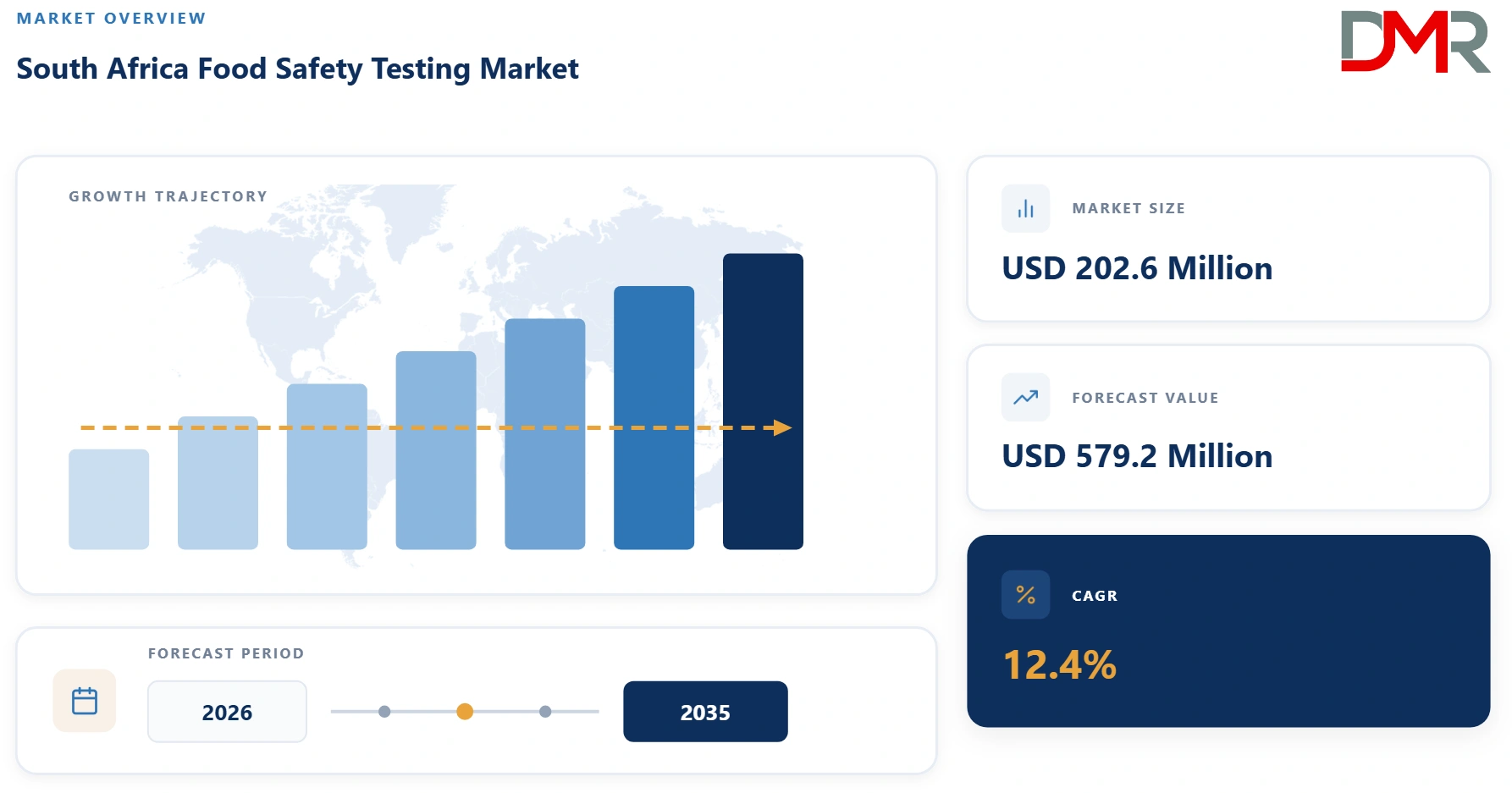
- Market Size 2026: USD 202.6 Million
- Market Size 2035: USD 579.2 Million
- CAGR, 2026–2035: 12.4%
- By Type: Pathogen, 38.0% share
- By Food Tested: Meat and Meat Products, 27.0% share
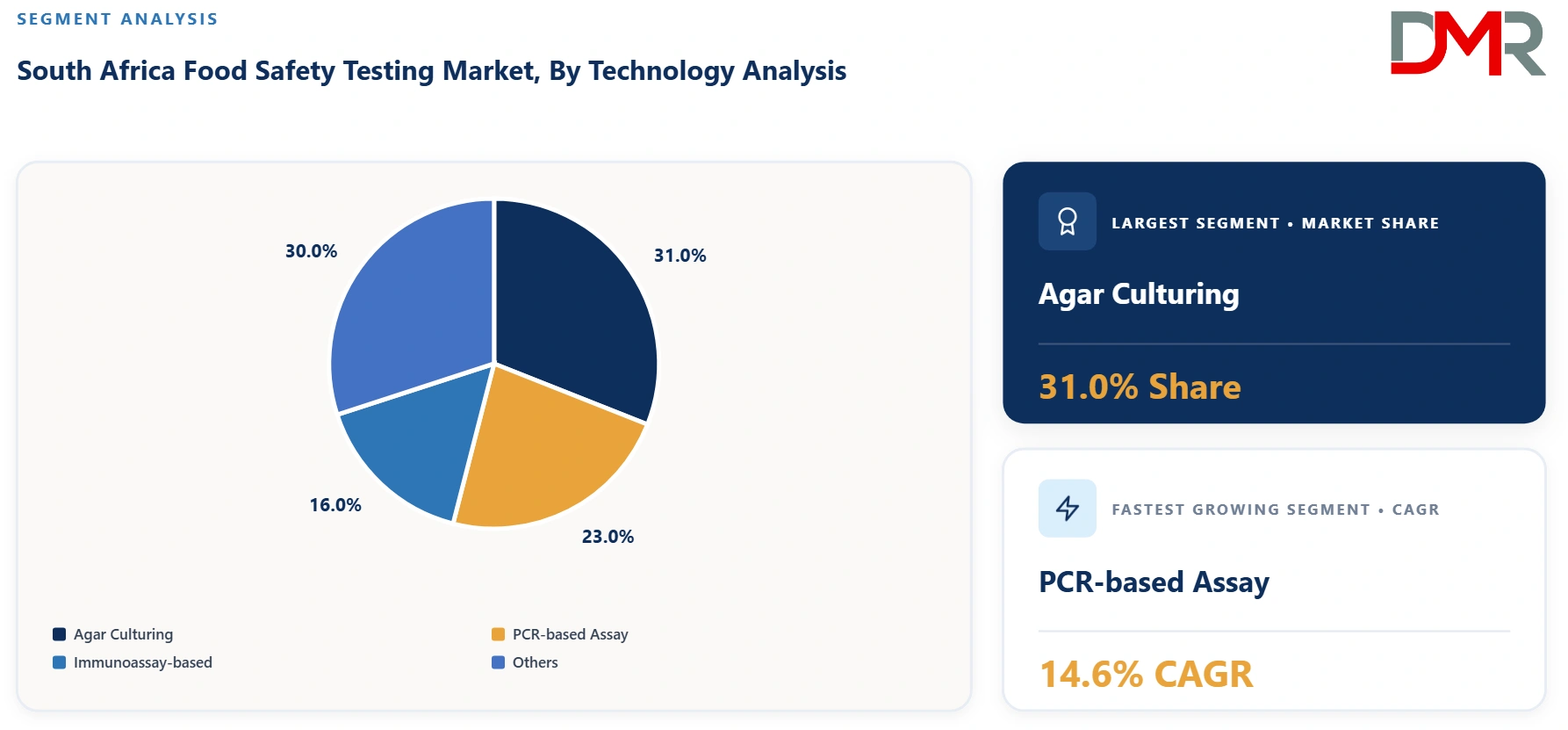
- By Technology: Agar Culturing, 31.0% share
- Fastest-Growing Segment: PCR-based Assay, 14.6% CAGR
What is the South Africa Food Safety Testing and its Market Size?
The South African food safety testing market is estimated at USD 202.6 million in 2026 and is projected to reach approximately USD 579.2 million by 2035, representing an implied 12.4% CAGR from 2026 to 2035.
ℹ
To learn more about this report –
Download Your Free Sample Report Here
South Africa food safety testing is the analytical testing market supporting the detection, identification, quantification, and monitoring of biological, chemical, physical, and genetic hazards in food and food-processing environments. It encompasses laboratory services, analytical instruments, reagents, sampling, microbiological testing, pathogen detection, GMO analysis, pesticide and chemical-residue testing, mycotoxin and heavy-metal analysis, allergen testing, authenticity testing, and related quality assessments. Testing is performed by commercial laboratories, government institutions, research organizations, and in-house food manufacturers. The market’s primary value proposition is reducing food-safety risks while helping producers, retailers, importers, exporters, and regulators demonstrate compliance with South African and international requirements.
Use Cases
- Pathogen Detection: Identification of Salmonella, Listeria, pathogenic E. coli, Campylobacter and other organisms in food products.
- Chemical Contaminant Testing: Detection of pesticide residues, veterinary drugs, mycotoxins, additives and other chemical hazards.
- Food Authenticity Testing: Verification of species, ingredients, origin, adulteration and composition claims across food supply chains.
- GMO Testing: Identification and quantification of genetically modified ingredients in imported and domestically produced food.
- Export Compliance: Verification that agricultural and processed-food products satisfy destination-market safety and residue requirements.
- Shelf-Life and Quality Testing: Measurement of microbial stability, spoilage organisms, physical parameters and product durability.
Key Takeaways
- The South African food safety testing market is estimated at USD 202.6 million in 2026 and is forecast to approach USD 579.2 million by 2035.
- The market benefits from regulatory compliance, foodborne-disease prevention, export requirements, increasing processed-food production and rising consumer scrutiny.
- Pathogen testing is expected to remain the largest testing category, reflecting recurring microbiological monitoring requirements.
- Meat and meat products represent the largest food-testing application because of high pathogen exposure, large production volumes and stringent processing controls.
- Agar culturing remains the largest technology segment because it is established, comparatively economical and widely accepted for routine microbiology.
- PCR-based assays are expected to be the fastest-growing technology because they provide faster, highly specific molecular detection.
How AI/Gen AI is Transforming the South Africa Food Safety Testing Market?
Advanced molecular diagnostics, particularly PCR, qPCR, multiplex PCR, DNA sequencing and rapid immunoassays, are changing South African food safety testing by reducing turnaround times and improving sensitivity. Commercial laboratories increasingly combine conventional culture methods with PCR, ELISA, ELFA and other rapid techniques for pathogen, allergen, GMO and authenticity testing. SGS South Africa, for example, lists PCR, ELISA, ELFA and LAMP among its rapid microbiological testing capabilities.
The principal benefits are faster release of products, earlier identification of contamination, reduced inventory-holding costs, improved traceability and more effective outbreak investigation. Digital laboratory information systems and data platforms also support automated reporting and risk-based testing programs.
Key Drivers in the South Africa Food Safety Testing Market
Increasing Consumer Awareness and Food Safety Concerns
Growing consumer awareness regarding foodborne illnesses, contamination, adulteration, allergens, chemical residues and product quality is strengthening demand for the South Africa Food Safety Testing Market. Consumers are increasingly attentive to the safety, composition and origin of packaged and processed food products, encouraging manufacturers and retailers to strengthen quality-control programs. Greater access to information through digital media and public awareness campaigns has also increased scrutiny of food-safety practices. Food manufacturers are consequently conducting more frequent microbiological, chemical, allergen and authenticity testing to protect brand reputation and reduce product-recall risks.
Strengthening Food Safety Regulations and Compliance Requirements
Regulatory requirements remain a fundamental growth driver for the South Africa Food Safety Testing Market. The national food-control framework includes requirements covering food hygiene, microbiological standards, contaminants, pesticides and veterinary drugs, labeling, HACCP and other food-safety parameters. These requirements create recurring testing demand among manufacturers, processors, importers, exporters and food-service operators. South African authorities also maintain microbiological standards for foodstuffs and related products, while agricultural product standards incorporate requirements related to chemical composition and microbiological contaminants.
Restraints in the South Africa Food Safety Testing Market
High Operational and Infrastructure Costs
High infrastructure and operating costs represent a significant restraint for the South Africa Food Safety Testing Market. Establishing and maintaining advanced laboratories requires substantial investment in analytical instruments, laboratory facilities, validated methods, reference materials, quality-control systems and skilled personnel. Technologies used for advanced chemical, molecular and contaminant testing can require particularly high capital expenditure. Laboratories must also maintain appropriate accreditation, proficiency testing and quality-management procedures, increasing recurring operating expenses.
Shortage of Specialized Skills and Regulatory Complexity
Limited availability of highly specialized laboratory personnel can constrain the expansion of the South Africa Food Safety Testing Market. Advanced testing requires microbiologists, molecular biologists, analytical chemists, laboratory quality specialists and technicians with experience in sophisticated instrumentation and validated analytical procedures. At the same time, South Africa's food-control environment involves multiple authorities and numerous regulations covering different aspects of food safety. This regulatory complexity can make compliance more difficult for food businesses and testing providers, particularly smaller organizations with limited regulatory resources.
Growth Opportunities in the South Africa Food Safety Testing Market
Adoption of Rapid Molecular and Advanced Testing Technologies
The increasing adoption of rapid molecular and advanced analytical technologies represents a major opportunity for the South Africa Food Safety Testing Market. PCR-based assays, immunoassays, rapid microbiological techniques and advanced instrumental methods can provide faster and more specific detection than conventional approaches for selected applications. Food manufacturers increasingly require rapid results to reduce production delays, minimize inventory holding and accelerate product release. Molecular methods are particularly attractive for pathogen detection, while advanced chromatography and mass spectrometry can support analysis of pesticides, mycotoxins, veterinary residues and other contaminants. Laboratories that invest in multiplex testing, automated workflows and digital reporting can differentiate through turnaround time and analytical breadth.
Expansion of Processed Food and Export-Oriented Testing
Expansion of processed-food manufacturing and international food trade provides another important opportunity for the South Africa Food Safety Testing Market. Processed foods typically involve multiple ingredients, suppliers and manufacturing stages, increasing the need for microbiological, chemical, allergen, authenticity and compositional testing. Exporters also require testing to demonstrate compliance with customer specifications and international food-safety requirements. Agricultural and food-processing businesses can therefore increase testing frequency across raw materials, production environments and finished products. Opportunities are particularly attractive in meat, dairy, cereals, grains, fruits, vegetables, seafood and other export-oriented categories.
Trends in the South Africa Food Safety Testing Market
Shift Toward Rapid and Culture-Independent Testing
The South Africa Food Safety Testing Market is gradually moving toward faster and more sensitive analytical workflows. Traditional culture-based methods remain important for routine microbiological testing, but PCR, immunoassays and other rapid approaches are gaining adoption where shorter turnaround times and greater specificity are important. Laboratories are increasingly combining conventional and rapid techniques rather than completely replacing established methods.
Greater Emphasis on Preventive and Risk-Based Food Safety
Food manufacturers are increasingly moving from reactive testing toward preventive, risk-based food-safety management. Instead of relying exclusively on finished-product testing, businesses are expanding environmental monitoring, supplier verification, raw-material screening and process-control programs. This approach aligns testing more closely with HACCP and broader food-safety management systems. It also increases demand for recurring laboratory services because testing is incorporated into routine quality programs.
Research Scope and Analysis
The market is segmented by Type, Food Tested, and Technology. Type captures the hazard being tested; Food Tested identifies major product matrices; Technology describes analytical methodology; and Region highlights the geographic concentration of testing demand and laboratory infrastructure.
ℹ
To learn more about this report –
Download Your Free Sample Report Here
By Type Analysis
Pathogen is estimated to dominate the South African food safety testing market in 2026 with approximately 38.0% share, supported by recurring requirements for Salmonella, Listeria, E. coli, Campylobacter, yeast, molds and other microorganisms across meat, dairy, processed food and fresh produce. Pathogen testing is relatively frequent because contamination can arise throughout production and distribution, creating repeat demand for environmental and finished-product testing. SGS identifies Salmonella, Listeria monocytogenes, pathogenic E. coli, Campylobacter and Cronobacter among important foodborne pathogens and provides both culture and molecular detection approaches.Chemical & Toxin is estimated to be the second-largest category at approximately 25.0%, driven by pesticide residues, mycotoxins, veterinary-drug residues, additives and other contaminants. GMO testing is smaller at approximately 12%, but is expected to be among the faster-growing categories at roughly 13.8% CAGR, supported by labeling, supply-chain verification, imported ingredients and consumer demand for transparency. Heavy metals, radioactivity and other specialized testing account for the balance.
By Food Tested Analysis
Meat and Meat Products are estimated to represent approximately 27.0% of the market in 2026, making them the largest food-testing category. High pathogen risk, large production volumes, intensive processing and strict hygiene controls generate recurring microbiological testing requirements. Poultry and meat are particularly relevant to Salmonella, Campylobacter and pathogenic E. coli testing. Dairy and Dairy Products represent the second-largest segment at approximately 18.0%, supported by routine microbiological, chemical, compositional and shelf-life analysis. Fruits, Vegetables and Nuts are expected to be the fastest-growing major food category, with an estimated 13.9% CAGR, driven by export activity, pesticide-residue testing, mycotoxin risks in selected commodities and retailer specifications. Processed food is another significant segment because complex ingredient supply chains increase demand for allergen, authenticity, microbiological and chemical testing. Cereals, grains and pulses remain important for mycotoxins, pesticide residues and microbiological quality, while beverages, seafood, egg products, flour-based products, oils, sugar and salt constitute specialized but recurring testing niches.
By Technology Analysis
Agar Culturing is estimated to hold the largest technology share in 2026 at approximately 31.0%, reflecting its established position in routine microbiological testing, relatively low operating cost, broad laboratory familiarity and acceptance for enumeration and confirmation of microorganisms. It remains particularly relevant to high-volume routine testing programs. PCR-based Assay is estimated at approximately 23.0% share but is projected to be the fastest-growing technology, with an estimated 14.6% CAGR through 2035. Its growth is supported by shorter turnaround times, high specificity, multiplexing capabilities and increasing demand for rapid pathogen detection. SGS South Africa already offers PCR, ELISA, ELFA and LAMP within its rapid microbiological testing portfolio. Immunoassay-based methods represent approximately 16.0% and remain important for allergens, toxins and selected pathogen applications. GC-MS, HPLC/LC-MS, ICP-MS/OES and other instrumental technologies comprise the remainder and are particularly important for pesticides, contaminants, heavy metals, additives and complex chemical analyses.
The South Africa Food Safety Testing Market Report is segmented on the basis of the following:
By Type
- Pathogen
- Genetically Modified Organism
- Chemical and Toxin
- Others
By Food Tested
- Meat and Meat Products
- Dairy and Dairy Products
- Cereals, Grains and Pulses
- Processed Food
- Others
By Technology
- Agar Culturing
- PCR-based Assay
- Immunoassay-based
- Others
Regulatory Landscape
South Africa’s food safety testing market is strongly influenced by the Foodstuffs, Cosmetics and Disinfectants Act and associated regulations covering hygiene, microbiological standards, HACCP, food premises, transport and inspection. The Department of Health maintains dedicated regulatory functions for chemical safety, contaminants, GM foods, pesticides and maximum residue limits. Regulatory evolution creates recurring demand for accredited laboratories capable of producing legally defensible results. A major opportunity exists in compliance-as-a-service, where laboratories combine testing with regulatory interpretation, sampling plans, supplier audits and digital documentation. The principal risk is compliance complexity: laboratories must continuously validate methods and maintain accreditation as requirements evolve. Regulatory harmonization with export markets could further increase demand for sophisticated residue, authenticity, allergen and molecular testing.
Investment and White Space Analysis
The most attractive investment white spaces are rapid molecular diagnostics, regional laboratory capacity, advanced chemical-contaminant testing, food authenticity and integrated digital food assurance. Consolidation demonstrates that strategic buyers value established accredited laboratories and their customer relationships; Mérieux NutriSciences’ 2025 acquisition of Bureau Veritas’ South African food-testing activities is a prominent example. Smaller laboratories can differentiate through rapid turnaround, niche analytical capabilities and regional sample collection rather than competing solely on price. Investment risks include high equipment costs, shortages of experienced analytical scientists, accreditation requirements and uneven sample volumes. Investors should prioritize laboratories with recurring industrial contracts, strong ISO/IEC 17025 capabilities, diversified customer bases and scalable molecular or instrumental testing platforms.
Competitive Landscape
The South African food safety testing market is moderately fragmented but increasingly consolidating, with multinational testing, inspection and certification groups competing alongside independent laboratories, public institutions and in-house facilities. Major providers differentiate through accreditation, geographic coverage, turnaround time, analytical breadth, technical expertise and ability to support international compliance. The competitive model is shifting from standalone laboratory testing toward integrated food assurance encompassing inspection, auditing, certification, regulatory consulting, environmental monitoring and digital risk management. The National Laboratory Association database illustrates the breadth of the ecosystem, with commercial, independent, research and in-house laboratories offering food, microbiological, chemical, molecular and contaminant testing.
Some of the prominent players in the South Africa Food Safety Testing Market are:
- SGS South Africa
- Intertek South Africa
- Bureau Veritas South Africa
- Eurofins Scientific
- ALS South Africa
- TÜV SÜD South Africa
- Mérieux NutriSciences
- QIMA
- DNV
- Bio-Rad Laboratories
- SABS Food and Health
- Deltamune
- Assurecloud
- Food Consulting Services
- Food Chain Laboratories
- Lactolab
- CSIR Consulting and Analytical Services
- ARC Irene Analytical Services
- QPRO International
- Quantum Analytical Services
- Quality Sure
- Aspirata Microbiological
- Randox Laboratories
- Fera Science
- Neogen
- Thermo Fisher Scientific
- Agilent Technologies
- QIAGEN
- 3M Food Safety
- Romer Labs
- Charm Sciences
- Merck
- Waters Corporation
- PerkinElmer
- Shimadzu
- Bruker
- LGC Standards
- Microbac Laboratories
- NSF International
- AsureQuality
- Other Key Players
Recent Developments
- In March 2026, Fera Science announced the acquisition of South African proficiency-testing specialist Qotho Minerals, expanding laboratory-assurance and proficiency-testing capabilities in Africa, with relevance to agri-food laboratory networks.
- In September 2025, the National Consumer Commission and South African Bureau of Standards entered a three-year strategic alliance, including joint compliance inspections and access to SABS laboratory testing to identify contaminated or substandard products.
- In July 2025, Carlyle announced an agreement to sell Safety SA, a South African testing, inspection, certification and training business, to Centre Testing International, highlighting continued international interest in Africa’s testing and assurance infrastructure.
- In March 2025, SGS launched lactic-acid and acetic-acid testing services in South Africa, supporting food preservation, pathogen control and food-waste reduction applications.
- In February 2025, Mérieux NutriSciences completed its acquisition of Bureau Veritas’ food-testing activities in South Africa, strengthening its African testing capabilities and expanding its broader laboratory services.
- In February 2025, SGS announced that its food-assurance operations had received a BRCGS five-star rating, reinforcing its positioning in food safety, quality and assurance services.
Report Details
| Report Characteristics |
| Market Size (2026) |
USD 202.6 Mn |
| Forecast Value (2035) |
USD 576.2 Mn |
| CAGR (2026–2035) |
12.4% |
| Historical Data |
2021 – 2025 |
| Forecast Data |
2026 – 2035 |
| Base Year |
2025 |
| Segments Covered |
By Type, By Food Tested, By Technology |
| Country Coverage |
South Africa |
Frequently Asked Questions
What is the size of the South Africa Food Safety Testing Market in 2026?
▾ The South Africa Food Safety Testing Market is estimated at approximately USD 202.6 million in 2026, based on the market's forecast trajectory.
What will the South Africa Food Safety Testing Market be worth by 2035?
▾ The South Africa Food Safety Testing Market is projected to reach approximately USD 579.2 million by 2035, reflecting strong long-term demand.
What is the CAGR of the South Africa Food Safety Testing Market?
▾ The South Africa Food Safety Testing Market is estimated to grow at an implied 12.4% CAGR from 2026 to 2035, driven by regulatory and testing requirements.
What are the key drivers of the South Africa Food Safety Testing Market?
▾ The South Africa Food Safety Testing Market is driven by stricter food-safety regulations, pathogen monitoring, export requirements, processed-food production and consumer awareness.
Which segment dominates the South Africa Food Safety Testing Market?
▾ Pathogen testing is estimated to dominate the South Africa Food Safety Testing Market, accounting for approximately 38.0% of the market in 2026.
Which technology is growing fastest in the South Africa Food Safety Testing Market?
▾ PCR-based assays are expected to be the fastest-growing technology segment in the South Africa Food Safety Testing Market, with an estimated 14.6% CAGR.
Who are the key players in the South Africa Food Safety Testing Market?
▾ Key players in the South Africa Food Safety Testing Market include SGS, Mérieux NutriSciences, Bureau Veritas, Intertek, Eurofins, Applus+, Fera Science and SABS.
How is the South Africa Food Safety Testing Market segmented?
▾ The South Africa Food Safety Testing Market is segmented by Type, Food Tested, Technology, covering pathogen, chemical, GMO, microbiological and advanced analytical testing.