South America Contact Intraocular Lenses Market Snapshot
- South America Contact Intraocular Lenses Market Size in 2026: USD 629.2 Million
- South America Contact Intraocular Lenses Market Size in 2035: USD 1,120.6 Million
- South America CAGR from 2026 to 2035: 6.6%
- Monofocal IOLs is the leading product type segment in 2026: 56.3%
- Silicone Hydrogel is the leading material segment in 2026: 43.7%
- Myopia & Refractive Correction is the leading application segment in 2026: 40.8%
- Hospitals & Eye Clinics is the leading distribution channel segment in 2026: 46.6%
What is the South America Contact Intraocular Lenses and its Market Size?
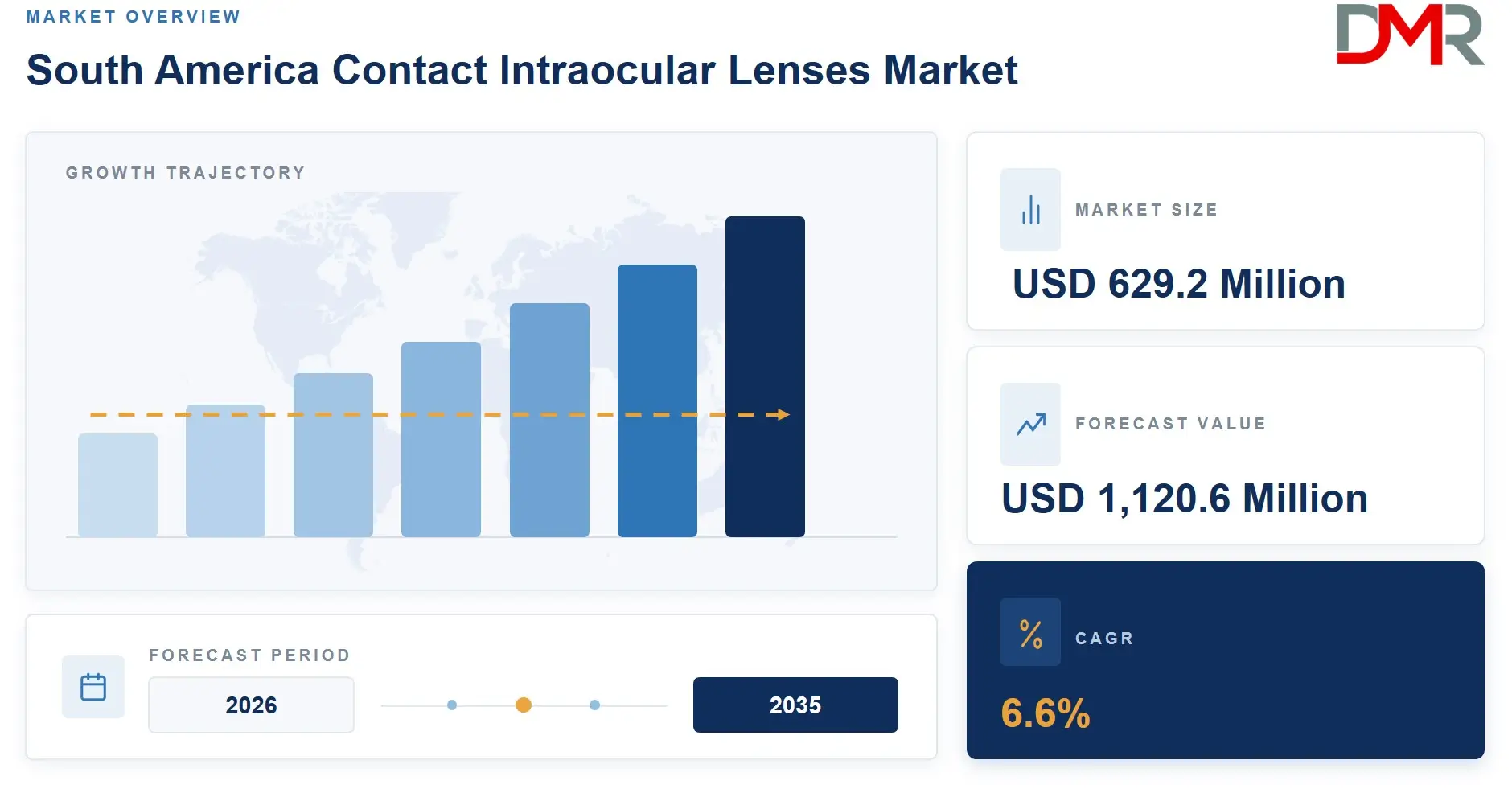
The South America Contact and Intraocular Lenses Market is estimated at USD 629.2 million in 2026 and is projected to reach USD 1,120.6 million by 2035, expanding at a CAGR of 6.6% during the forecast period. Growth reflects the region's substantial burden of refractive errors, ageing population, rising cataract procedure volumes, expanding optical retail networks, and increasing adoption of disposable and cosmetic contact lenses. Brazil is the largest country market because of its population, ophthalmology infrastructure, local manufacturing capabilities, and extensive public and private healthcare systems. Argentina, Colombia, Chile, and Peru provide additional growth opportunities. Products are regulated nationally by authorities such as ANVISA in Brazil, ANMAT in Argentina, INVIMA in Colombia, and ISP in Chile, making registration, local representation, quality documentation, import controls, and post-market surveillance central to market access.
ℹ
To learn more about this report –
Download Your Free Sample Report Here
Use Cases
- Community Vision Screening Programs: Public health authorities, schools, hospitals, and private eye-care providers conduct vision screening among children and adults, supporting earlier diagnosis, referral, and demand for professionally fitted corrective lenses.
- Orthokeratology (Ortho-K) for Myopia Control in Children and Adolescents: Ophthalmology clinics in São Paulo, Rio de Janeiro, Buenos Aires, Bogotá, Santiago, and Lima increasingly offer overnight ortho-K lenses to manage childhood myopia, supported by growing clinical awareness and parental interest in non-surgical control options.
- Cataract Surgery Volume Growth in an Aging Population: Public tertiary hospitals and expanding private ophthalmology chains perform rising volumes of phacoemulsification cataract surgery with IOL implantation, particularly across South America's rapidly growing population of adults aged 60 and above.
- Premium Presbyopia-Correcting IOLs Among Urban, Privately Insured Patients: Multifocal, extended depth of focus (EDOF), and toric IOLs are gaining traction among patients seeking spectacle independence after cataract surgery, particularly through private hospitals and specialist clinics.
Key Takeaways
- Market Size: The South America Contact and Intraocular Lenses Market is estimated at USD 629.2 million in 2026 and forecast to reach USD 1,120.6 million by 2035, expanding at a CAGR of 6.6%.
- Growth Outlook: Growth is sustained by the region's substantial burden of refractive errors, an ageing population driving cataract procedures, expanding insurance and private-pay demand for premium lens categories, and e-commerce growth in daily-wear and cosmetic contact lenses.
- Primary Growth Drivers: Explained in expanded detail below, covering refractive-error prevalence, ageing and cataract surgery growth, healthcare infrastructure investment, private-provider expansion, and rising willingness to pay for premium and cosmetic vision products.
- By Material Analysis: Silicone Hydrogel is projected to lead the contact lens material segment with a 43.7% share in 2026 due to superior oxygen permeability and comfort for extended wear, while Hydrophobic Acrylic leads IOL materials due to reduced posterior capsule opacification rates.
- By Application Analysis: Myopia & Refractive Correction is forecast to lead with a 40.8% share in 2026, while Cataract Surgery is expected to see the fastest growth at roughly 7.1% CAGR as surgical capacity expands across secondary cities and underserved communities.
- By Distribution Channel Analysis: Hospitals & Eye Clinics is projected to lead with a 46.6% share in 2026, while E-commerce/Online Channels is expected to be the fastest-growing distribution channel at 8.8% CAGR, driven by daily and cosmetic lens sales to younger consumers.
- By End-User Analysis: Hospitals are projected to lead with a 48.2% share in 2026, while ophthalmology and eye-care clinics and retail optical chains gain share as private networks expand across South American countries.
How AI/Gen AI is Transforming the Contact Intraocular Lenses Market?
Artificial intelligence is increasingly embedded in South American ophthalmic pathways, from AI-assisted screening and corneal topography to AI-supported biometry and IOL power calculation used before cataract surgery. Regional health-technology companies and hospital networks are exploring teleophthalmology platforms to extend specialist screening capacity into underserved communities. Generative AI tools are also beginning to support multilingual patient education, clinical documentation, lens-fitting simulation, and synthetic training data. Adoption remains at an early stage and depends on clinical validation, data governance, cybersecurity, practitioner acceptance, and integration with hospital information systems.
Key Drivers in the South America Contact and Intraocular Lenses Market
High Burden of Refractive Errors Among Children and Adults
Refractive errors represent a substantial and persistent source of demand across South America. Urbanization, prolonged screen exposure, intensive near work, limited outdoor activity, and greater awareness of vision correction are encouraging uptake among students, working-age adults, and other digitally active consumers. Myopia, astigmatism, hyperopia, and presbyopia support demand for spherical, toric, multifocal, and specialty lenses. School screening, private optometry services, optical retail expansion, and online product discovery are improving diagnosis and product awareness, although access and professional fitting quality vary considerably between countries, major cities, peripheral urban areas, and remote communities.
Rapidly Aging Population and Expanding Cataract Surgical Capacity
The number of older residents is rising across South America, while diabetes and other chronic conditions add to the need for ophthalmic assessment and cataract care. Brazil's Unified Health System and public programs elsewhere support high-volume cataract procedures, while private hospitals and ophthalmology clinics serve insured and self-paying patients. Expansion of phacoemulsification, biometry, surgical training, and day-care capacity is increasing IOL implantation. However, waiting lists, workforce concentration, and uneven access remain important barriers. As surgical capacity expands beyond major tertiary centres, both standard monofocal implantation and premium toric, multifocal, and EDOF procedures should increase.
Healthcare Investment and Expansion of Regional Distribution
South America combines strong import dependence with an established ophthalmic manufacturing base, particularly in Brazil. Authorized representation, regulatory registration, distributor capability, tender participation, and inventory management remain central to market success. Currency volatility and customs procedures can significantly affect the landed cost of imported premium lenses. Suppliers that establish local warehousing, practitioner training, technical support, and responsive public- and private-sector procurement capabilities can reduce lead times and strengthen customer relationships. Brazil also provides opportunities for domestic production, contract manufacturing, packaging, and regional export, while distributors in Argentina, Colombia, Chile, and Peru serve as important commercial gateways.
Rising Consumer Willingness to Pay for Premium and Cosmetic Eyewear Alternatives
Beyond medical necessity, consumer trends are reshaping demand at the retail end of the market. Young urban consumers are adopting coloured and cosmetic contact lenses as fashion and beauty products, while daily disposables appeal to users seeking convenience and hygiene. Optical chains, marketplaces, social media, and specialist e-commerce platforms are widening product discovery and availability. This expands the addressable market beyond patients with a purely clinical refractive need but also raises concerns about unregistered products, counterfeit lenses, inadequate fitting, unsafe wear, and misleading promotional claims. Regulators and professional bodies are therefore emphasizing authorized products and practitioner guidance.
Restraints in the South America Contact and Intraocular Lenses Market
Regulatory Oversight and Country-Specific Registration Complexity
Both contact lenses and intraocular lenses are regulated medical devices across South America, with IOLs generally subject to higher-risk requirements and more extensive evidence. Manufacturers must address separate registration, local-holder, import, Portuguese- or Spanish-language labeling, vigilance, and renewal requirements. Brazil is overseen by ANVISA, while Argentina, Colombia, Chile, Peru, and other countries maintain their own authorities and pathways. This fragmented framework increases time-to-market and compliance costs, particularly for premium IOLs, orthokeratology lenses, and products sold through digital channels. Regulatory timelines and reliance requirements also differ, preventing a single regional authorization strategy.
Price Sensitivity and Insurance Reimbursement Limitations
Basic cataract surgery and monofocal IOLs may receive public or private coverage, depending on the country and provider network. Premium multifocal, toric, and EDOF IOLs generally require substantial co-payment or full private payment, while contact lenses are predominantly out-of-pocket purchases. Income inequality and currency depreciation constrain premium adoption and increase demand for reusable, value-priced, and locally manufactured products. Differences in reimbursement, public tenders, import duties, taxes, and hospital procurement across South American countries complicate pricing and market-access strategies. Aggressive public purchasing can improve volume but compress supplier margins.
Growth Opportunities in the South America Contact and Intraocular Lenses Market
Expansion of Eye Care Access Beyond Major Cities
Substantial white-space opportunity exists in extending cataract surgery, diagnostic services, and professional contact-lens fitting beyond São Paulo, Rio de Janeiro, Buenos Aires, Bogotá, Santiago, Lima, and other major centres. Secondary cities, peripheral urban districts, and remote communities often have fewer ophthalmologists, specialist clinics, and advanced diagnostic systems. Mobile screening, public-private partnerships, teleophthalmology, referral networks, and expansion of optical chains can improve access and unlock incremental demand during the forecast period.
Myopia-Control Product Innovation
Continued evidence generation supporting ortho-K lenses, soft multifocal myopia-control contact lenses, and complementary clinical approaches creates opportunities for manufacturers that can demonstrate safety and efficacy in slowing axial-length progression. Demand is supported by parental concern over childhood myopia and growing practitioner interest, although adoption remains constrained by specialist fitting requirements, cost, follow-up needs, regulatory authorization, and the importance of careful patient selection.
Trends in the South America Contact and Intraocular Lenses Market
Expansion of Eye Care Access Beyond Major Cities
Significant growth opportunities lie in expanding cataract surgery and modern contact-lens fitting beyond South America's leading metropolitan areas. Smaller cities, peripheral communities, and remote regions remain underserved because specialist density, fitting services, and advanced diagnostic equipment are limited. Government screening, mobile clinics, private facilities, optical retail expansion, and referral networks can improve diagnosis and treatment. Teleophthalmology and remote follow-up can reduce travel barriers and extend specialist capacity. Manufacturers that support practitioner training, affordable product tiers, reliable inventory, patient education, and aftercare can reach underserved groups while building durable relationships with hospitals, clinics, distributors, and optical retailers.
Myopia-Control Product Innovation
Growing clinical evidence supporting orthokeratology lenses, soft multifocal myopia-control contact lenses, and complementary pharmacological treatments is creating opportunities in South America. Manufacturers that demonstrate clinically meaningful reductions in axial-length progression among children and adolescents can capture demand through specialist clinics. Awareness is rising among parents and practitioners, particularly in Brazil, Argentina, Chile, and Colombia. However, premium pricing, limited insurance coverage, specialist fitting requirements, follow-up needs, and uneven regulatory availability constrain adoption. Professional education, localized evidence, accessible price points, and partnerships with pediatric ophthalmology and optometry networks will be important for sustainable expansion.
Trends in the South America Contact Intraocular Lenses Market
Expansion of Eye Care Access into Lower-Tier Cities and Rural Counties
Significant growth opportunities lie in expanding cataract surgery and modern contact lens fitting beyond South America’s leading metropolitan areas into tier-3 and tier-4 cities and rural counties. These markets remain underserved because ophthalmologist density, specialist facilities, and access to advanced diagnostic equipment are comparatively limited. Government-supported screening and rural outreach programs, combined with the geographic expansion of private eye hospital chains, could improve diagnosis, referrals, and treatment availability. Teleophthalmology and remote follow-up platforms can further reduce access barriers, enabling providers and manufacturers to reach previously untapped patient groups and generate sustained incremental demand throughout the forecast period across these underserved regions.
Myopia-Control Product Innovation
Growing clinical evidence supporting orthokeratology lenses, soft multifocal myopia-control contact lenses, and complementary pharmacological treatments is creating attractive opportunities for product innovation in South America. Manufacturers that can demonstrate clinically meaningful reductions in axial length progression, particularly among children and adolescents, will be well positioned to capture demand. Strong parental awareness and willingness to pay for effective preventive solutions support premium product adoption. Meanwhile, South America’s public health focus on childhood myopia is encouraging clinical research, professional education, and regulatory attention.
Research Scope and Segment Analysis
The South America Contact Intraocular Lenses Market is segmented by product type, material, application, distribution channel, and end user, reflecting the distinct clinical and consumer dynamics of the two underlying product categories that make up this combined market.
By Product Type Analysis
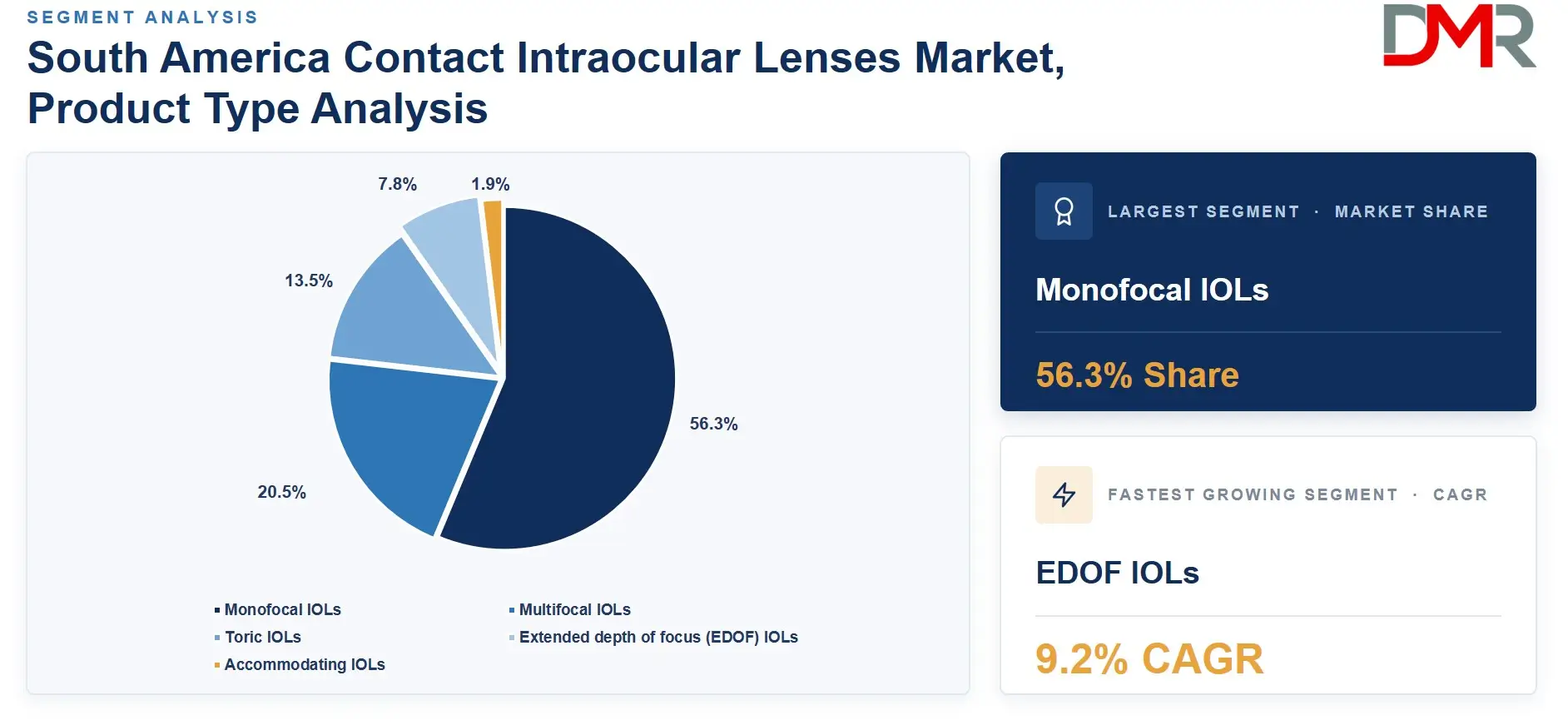
Monofocal IOLs are projected to dominate the product segment, holding an estimated 56.3% share of IOL revenue in 2026. They remain the standard option for high-volume cataract surgery across public health systems and value-oriented private care, keeping their volume well ahead of premium categories. Extended Depth of Focus IOLs are projected to post the highest CAGR, at an estimated 9.2% through 2035. Starting from an estimated 7.8% share in 2026, EDOF designs are gaining among privately insured and self-paying urban patients seeking broader functional vision with fewer halo and glare concerns than some multifocal designs.
ℹ
To learn more about this report –
Download Your Free Sample Report Here
By Material Analysis
Silicone Hydrogel is projected to lead the contact-lens material segment with an estimated 43.7% share in 2026, reflecting its high oxygen permeability and comfort. Conventional hydrogel retains meaningful share in affordable daily and reusable lenses, particularly among price-sensitive consumers. Rigid gas-permeable materials occupy a smaller but clinically important niche in specialty fitting, keratoconus management, irregular corneas, and orthokeratology. Hydrophobic acrylic leads IOL materials because of its foldability, optical performance, and broad adoption in phacoemulsification, while hydrophilic acrylic and PMMA remain relevant in selected value-oriented and public procurement settings.
By Application Analysis
Myopia & Refractive Correction is expected to lead the combined market with an estimated 40.8% share of application-based revenue in 2026, encompassing daily disposable, reusable soft, toric, multifocal, and specialty contact lenses. Cataract Surgery is projected to be the fastest-growing application at 7.1% CAGR during the forecast period, propelled by demographic ageing, diabetes prevalence, expanding surgical capacity, improving insurance access, and growing willingness to pay for premium visual outcomes.
By Distribution Channel Analysis
Hospitals & Eye Clinics are projected to remain the leading distribution channel with an estimated 46.6% share in 2026, reflecting the fact that intraocular lenses are surgically implanted exclusively within hospital and ambulatory surgical center settings, and that a substantial share of prescription and myopia-control contact lens fittings, particularly orthokeratology, require in-clinic professional fitting and follow-up care. E-commerce and Online Channels, however, are projected to be the fastest-growing distribution channel at 8.8% CAGR during 2026–2035, driven overwhelmingly by daily disposable and cosmetic contact lens sales to younger, digitally native consumers through major regional e-commerce platforms and livestreaming social-commerce formats, a distribution dynamic considerably more pronounced in South America than in most other major global contact lens markets.
By End User Analysis
Hospitals are projected to lead the end-user segmentation with an estimated 48.2% share in 2026, reflecting their central role in cataract surgery and complex ophthalmic care. Ophthalmology and eye-care clinics represent a growing share of premium IOL procedures and professionally fitted contact lenses, particularly in Brazil, Argentina, Colombia, and Chile. Ambulatory surgical centres are expanding as efficient settings for routine cataract procedures, while retail optical chains remain central to contact-lens fitting, recurring purchases, and cosmetic-lens sales.
The South America Contact Intraocular Lenses Market Report is segmented based on the following:
By Product Type
- Monofocal IOLs
- Multifocal IOLs
- Toric IOLs
- Extended depth of focus (EDOF) IOLs
- Accommodating IOLs
By Material
- Hydrogel
- Silicone hydrogel
- Rigid gas permeable materials
- Hydrophobic acrylic
- Hydrophilic acrylic
- Polymethyl methacrylate (PMMA)
- Silicone
By Application
- Myopia and refractive correction
- Astigmatism correction
- Presbyopia correction
- Cataract surgery
- Cosmetic and aesthetic use
By Distribution Channel
- Hospitals and eye clinics
- Optical retail stores
- E-commerce/online channels
- Others
By End User
- Hospitals
- Ophthalmology and eye care clinics
- Ambulatory surgical centers
- Retail optical chains
- Others
Technology Analysis
Innovation is reshaping the contact and intraocular lenses market through silicone hydrogel materials, advanced lens coatings, myopia-control designs, toric and multifocal optics, and extended-depth-of-focus IOLs. Digital fitting platforms, corneal topography, AI-assisted measurements, and precision biometry are improving customization and clinical outcomes. Opportunities are strongest in pediatric myopia management, premium cataract surgery, and products offering greater comfort and visual independence. However, high development costs, complex manufacturing, clinician training needs, and uncertain reimbursement may slow adoption. Companies delivering demonstrable safety, durability, and superior vision outcomes can command premium pricing, strengthen brand differentiation, and expand market share across clinical and retail channels while raising competitive pressure on conventional product manufacturers worldwide.
Epidemiology Analysis
Rising prevalence of myopia, astigmatism, presbyopia, and age-related cataracts is the fundamental demand driver for contact and intraocular lenses. Longer screen exposure, reduced outdoor activity, urbanization, and ageing populations are enlarging the addressable patient base, particularly among children requiring myopia control and older adults needing cataract surgery. This creates opportunities for orthokeratology lenses, multifocal contacts, toric products, and premium IOLs. Key risks include low diagnosis rates, unequal access to eye care, affordability constraints, and inconsistent treatment adherence. Markets with strong screening programs, expanding ophthalmology capacity, and insurance coverage should experience faster procedure volumes, higher product penetration, and sustained revenue growth for manufacturers, distributors, and specialized eye-care providers worldwide.
Competitive Landscape
The South America Contact and Intraocular Lenses Market includes multinational suppliers, Brazilian manufacturers, authorized importers, regional distributors, public procurement agencies, ophthalmology clinics, and optical retail chains. Alcon, Johnson & Johnson Vision, CooperVision, Bausch + Lomb, Carl Zeiss Meditec, HOYA, Menicon, Rayner, STAAR Surgical, and Brazil-based Mediphacos maintain recognition across contact-lens and IOL categories. Competition centres on regulatory authorization, clinical evidence, practitioner relationships, distributor reach, local production, tender pricing, and product availability. Currency exposure, taxes, and import lead times make inventory planning and local support important differentiators. Premium suppliers compete through optical performance and surgeon education, while contact-lens brands increasingly use reusable and daily-disposable formats, cosmetic portfolios, digital marketing, and omnichannel retail partnerships.
Some of the prominent players in the South America Contact Intraocular Lenses Market are:
- Alcon
- Johnson & Johnson Vision
- CooperVision
- Bausch + Lomb
- Carl Zeiss Meditec
- HOYA Surgical Optics
- EssilorLuxottica
- Rayner
- STAAR Surgical
- Lenstec
- HumanOptics
- SIFI
- Teleon Surgical
- OPHTEC
- Medicontur
- VSY Biotechnology
- Hanita Lenses
- Biotech Vision Care
- Aurolab
- Appasamy Associates
- Mediphacos
- Solótica
- Optolentes
- Menicon
- SEED
- PEGAVISION
- Clearlab
- Interojo
- SynergEyes
- BostonSight
- Contamac
- Euclid Vision
- Mark’ennovy
- NIDEK
- BVI Medical
- Cristalens Industrie
- Pförtner
- Contalent
- Futuralent
- Lenticon
- Other Key Players
Recent Developments
- April 2026: Alcon launched the Clareon TruPlus enhanced monofocal and toric IOL platform at ASCRS 2026. The launch illustrates continued innovation in intermediate vision and astigmatism correction and creates a future portfolio-expansion opportunity for premium cataract providers in South America, subject to country registrations and commercial availability.
- April 2026: CooperVision introduced its MADE BETTER sustainability platform, beginning with the MyDay daily disposable family. The initiative increases attention to materials, manufacturing, packaging, and end-of-life impacts, an increasingly relevant consideration for South American optical retailers and consumers purchasing high-volume daily disposable lenses.
- March 2026: CooperVision presented additional research on multifocal contact-lens fitting and presbyopia management at the Netherlands Contact Lens Congress. The findings support more proactive fitting of early-presbyopic patients, a commercially relevant group within South America's growing middle-aged consumer population.
Report Details
| Report Characteristics |
| Market Size (2026) |
USD 629.2 Million |
| Forecast Value (2035) |
USD 1,120.6 Million |
| CAGR (2026–2035) |
6.6% |
| Historical Data |
2021 – 2025 |
| Forecast Data |
2026 – 2035 |
| Base Year |
2025 |
| Segments Covered |
By Product Type, By Material, By Application, By Distribution Channel, and By End User |
| Regional Coverage |
Argentina, Bolivia, Brazil, Chile, Colombia, Ecuador, Guyana, Paraguay, Peru, Suriname, Uruguay, and Venezuela |
Frequently Asked Questions
How big is the South America Contact and Intraocular Lenses Market?
▾ The South America Contact and Intraocular Lenses Market is estimated at USD 629.2 million in 2026 and is projected to reach USD 1,120.6 million by 2035, reflecting sustained demand for refractive correction, rising cataract procedures, expanding optical retail, public healthcare volumes, and private ophthalmology networks.
What is the CAGR of the South America Contact and Intraocular Lenses Market from 2026 to 2035?
▾ The market is projected to expand at a CAGR of 6.6% between 2026 and 2035, supported by expanding cataract surgery capacity, broader optical retail access, increasing awareness of refractive correction, premium IOL adoption, and e-commerce-driven contact-lens sales.
What factors are driving the growth of the South America Contact and Intraocular Lenses Market?
▾ Growth is driven by refractive errors, population ageing, diabetes-related eye-care needs, rising cataract surgery volumes, public and private healthcare investment, optical-chain expansion, urbanization, and consumer demand for premium and cosmetic contact-lens and IOL categories.
What are the major trends in the South America Contact and Intraocular Lenses Market?
▾ Major trends include premiumization of cataract outcomes through multifocal, toric, and EDOF IOL adoption; increasing use of daily disposable silicone-hydrogel lenses; expansion of private ophthalmology and day-surgery services; and growth of regulated e-commerce and omnichannel retail for corrective and cosmetic contact lenses.
Who are the key players in the South America Contact and Intraocular Lenses Market?
▾ Key participants include Alcon, Johnson & Johnson Vision, CooperVision, Bausch + Lomb, Carl Zeiss Meditec, HOYA, Menicon, Rayner, STAAR Surgical, Mediphacos, and authorized country distributors serving hospitals, clinics, and optical retailers.
How is the South America Contact and Intraocular Lenses Market segmented?
▾ The market is segmented by product type, material, application, distribution channel, and end user, with performance shaped by South America's refractive-correction demand, ageing population, cataract surgery requirements, income disparities, regulatory fragmentation, and country-specific healthcare access.