Market Snapshot
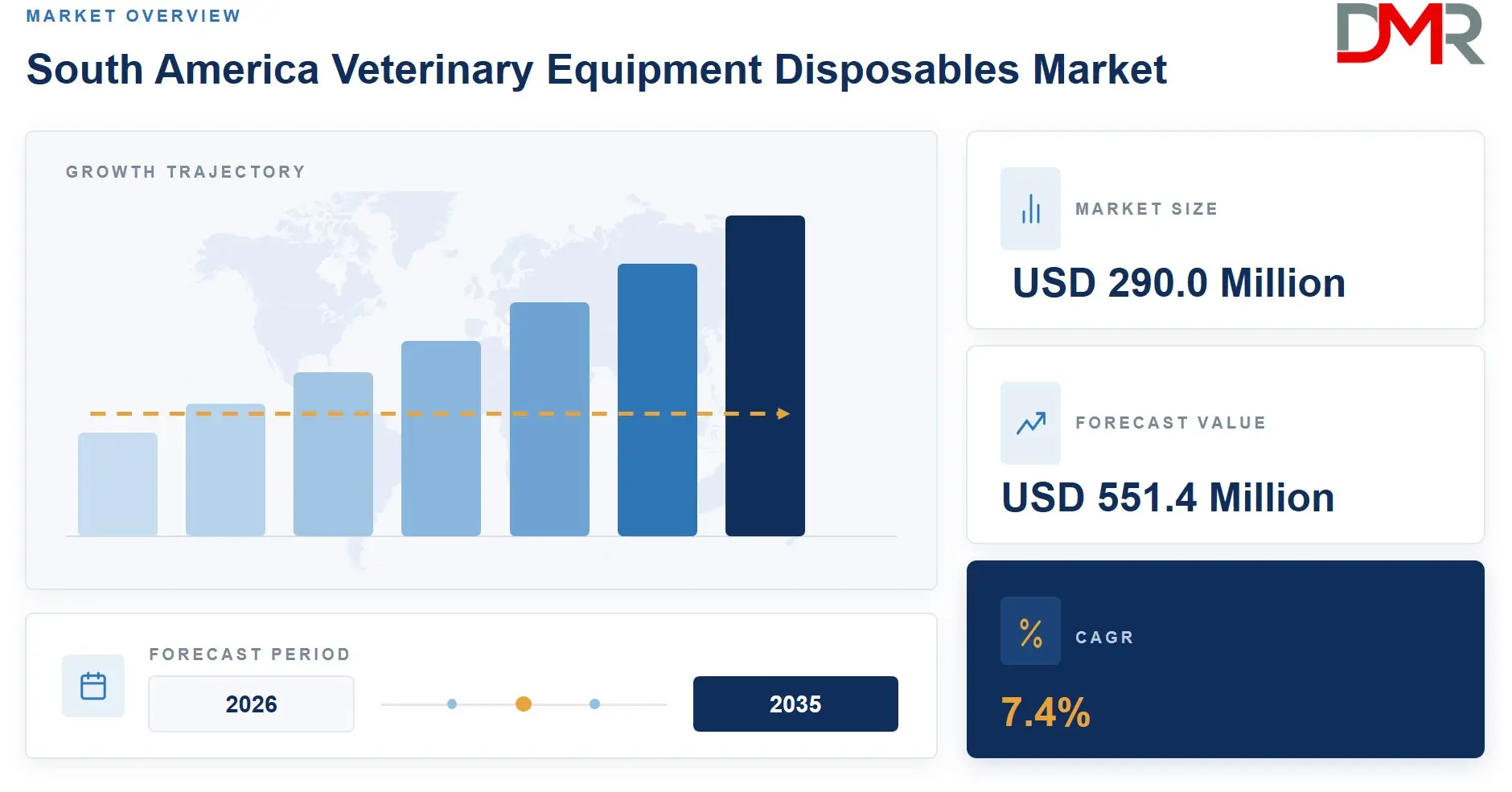
- Market Size (2026): USD 290.0 Mn
- Forecast Value (2035): USD 551.4 Mn
- CAGR (2026-2035): 7.4%
- Leading Product (2026): Equipment & Accessories, around 67%
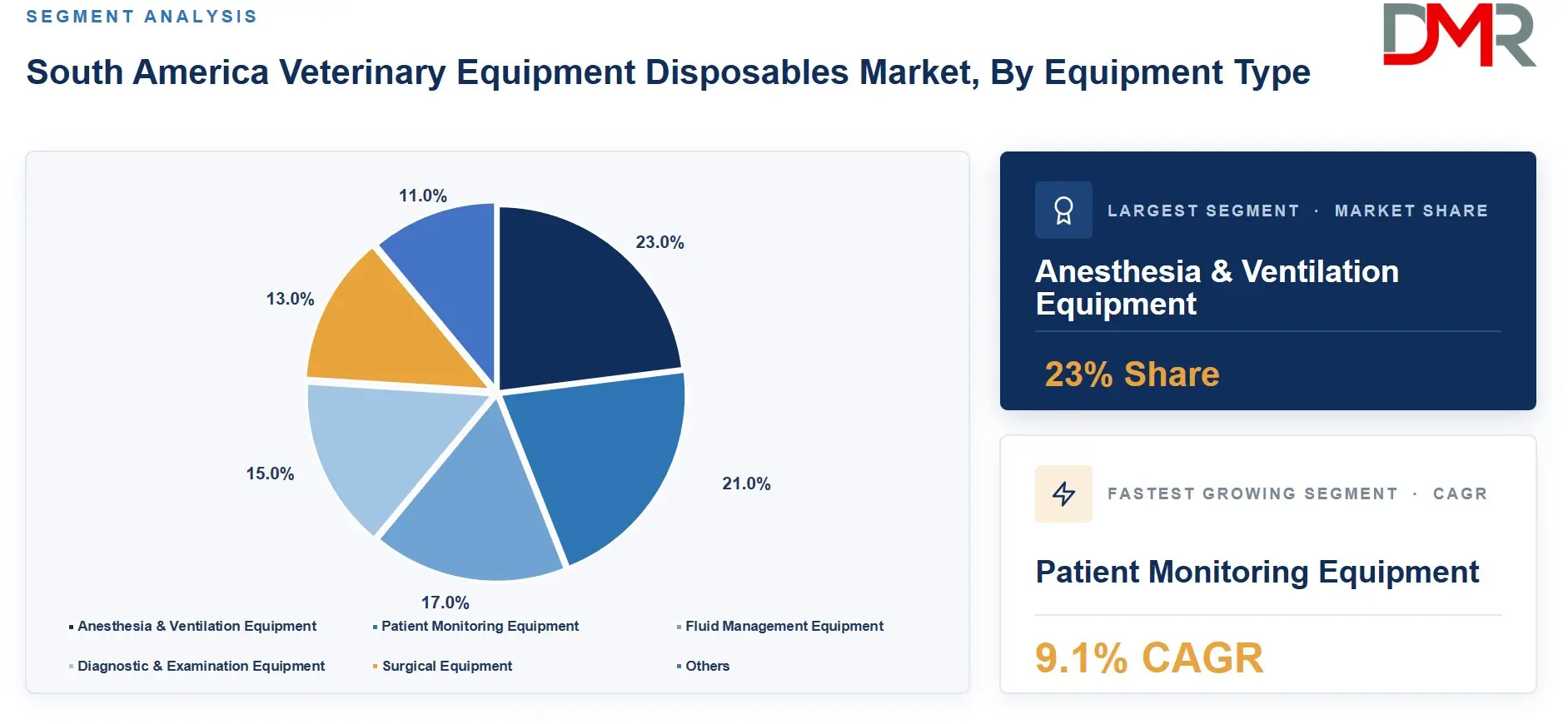
- Leading Equipment Type (2026): Anesthesia & Ventilation Equipment, close to 23%
- Key Players: B. Braun SE, Midmark Corporation, Covetrus, Inc. and others
What is South America Veterinary Equipment Disposables Market and its Market Size?
The South America Veterinary Equipment Disposables Market size is estimated to reach USD 290.0 Mn in 2026 and is further anticipated to reach USD 551.4 Mn by 2035, at a CAGR of 7.4%.
ℹ
To learn more about this report –
Download Your Free Sample Report Here
This market covers capital equipment, accessories and recurring disposable products used in veterinary diagnosis, anesthesia, surgery, critical care, examination, fluid delivery and patient monitoring across South America. The figures represent demand generated inside the region, rather than the worldwide revenue of companies headquartered in South American countries. The boundary includes products used for companion animals, livestock and equine care, while excluding pharmaceuticals, vaccines, feed additives and routine pet retail merchandise.
Demand is anchored by Brazil because it combines a large companion animal population, a dense private clinic base and substantial livestock production. Argentina provides the second major pool of demand, while Chile, Colombia and Peru add smaller but increasingly formalized veterinary channels. Imported equipment remains important, but local distributors and regional manufacturers are gaining relevance in examination furniture, protective textiles, radiology systems, basic anesthesia products and clinic consumables.
Commercial change is coming from two directions. Urban hospitals are moving toward higher-acuity care with multiparameter monitoring, digital imaging, controlled anesthesia and intensive-care workflows, while livestock operators are tightening biosecurity and procedure standardization. This combination supports both higher-value equipment replacement and faster recurring consumption of needles, IV sets, catheters, drapes, gloves and wound-care materials.
Use Cases
- Urban Companion Animal Surgery: Multi-specialty veterinary hospitals deploy anesthesia machines, monitors, IV sets, catheters and sterile surgical consumables for soft-tissue and orthopedic procedures. Standardized perioperative equipment reduces variation between clinicians and allows hospitals to manage more complex cases without sending patients to human medical facilities.
- Livestock Field Treatment: Large-animal veterinarians use portable examination tools, syringes, needles, infusion supplies and protective consumables when treating cattle, dairy herds and breeding stock outside fixed clinics. Portable formats shorten response time and support more consistent hygiene where electricity, sterilization capacity and controlled treatment rooms are limited.
- Diagnostic Laboratory Workflow: Veterinary laboratories and referral centers combine specimen collection consumables with analyzers, imaging interfaces and patient-monitoring tools to move animals from triage to confirmatory testing. Better workflow integration reduces repeat sampling, improves traceability and creates a more predictable replenishment cycle for single-use products.
- Emergency and Critical Care: Referral hospitals deploy oxygen delivery systems, pulse oximetry, multiparameter monitors, infusion devices and airway consumables for trauma, poisoning and respiratory distress. The equipment supports continuous observation, while disposable circuits and fluid-management products help clinicians turn over critical-care stations without compromising infection-control routines.
Key Takeaways
- Market Size & Share: Regional revenue is projected to reach USD 551.4 Mn by 2035 as clinic modernization and recurring consumable use broaden.
- Product Analysis: Equipment & Accessories is expected to account for approximately 67% of product revenue in 2026.
- Demand Concentration: Brazil is estimated to generate about 56% of South American demand in 2026, followed by Argentina and Chile.
- Disposable Momentum: Catheters & IV Sets are projected to expand at a CAGR of 9.8% through 2035 as inpatient and surgical workflows become more standardized.
- Care Setting Shift: Veterinary Hospitals & Clinics are set to represent roughly 61% of end-user revenue in 2026.
- Technology Direction: Patient Monitoring Equipment is forecast to grow at a CAGR of 9.1% as referral hospitals adopt continuous monitoring for anesthesia and critical care.
How AI/Gen AI is Transforming the South America Veterinary Equipment Disposables Market?
AI has a practical, mostly operational role in this regional equipment sector. Computer vision can assist image triage and measurement in radiography and ultrasound, while machine-learning models can flag abnormal vital-sign patterns from connected monitors. For distributors, demand forecasting is becoming more useful because disposable consumption varies by clinic case mix, seasonality and livestock disease events. These applications do not replace veterinarians; they help prioritize attention and reduce avoidable workflow friction.
Generative AI is more relevant to documentation than to direct device control. Large language models can draft equipment maintenance notes, translate product instructions into Portuguese and Spanish, structure adverse-event reports and help clinic groups standardize operating procedures. Adoption will remain constrained by data quality, liability and uneven connectivity, so the strongest near-term value sits in administrative support and decision assistance rather than autonomous treatment.
- Computer Vision: Supports image measurements, quality checks and triage prompts in veterinary radiography and ultrasound.
- Predictive Monitoring: Uses vital-sign trends to identify deterioration patterns during anesthesia and intensive care.
- Demand Forecasting: Helps distributors plan inventories of fast-moving syringes, catheters, circuits and wound-care products.
- LLM Documentation: Assists multilingual technical documentation, service records, procurement summaries and regulatory paperwork.
Key Drivers in the South America Veterinary Equipment Disposables Market
Regional demand is being pulled by higher clinical intensity in companion animal care and by stricter procedure control in production animals. Both forces raise equipment utilization and the recurring consumption of sterile supplies.
- Expansion of Advanced Companion Animal Care: Veterinary Hospitals & Clinics are expected to represent around 61% of end-user revenue in 2026 as urban pet owners increasingly seek surgery, emergency medicine, imaging and specialty treatment. Higher-acuity cases require anesthesia workstations, oxygen delivery, multiparameter monitoring and fluid management alongside single-use circuits, needles and catheters. Brazil has the deepest private-care network, but referral models are also becoming more visible in Argentina, Chile and Colombia. As clinics extend operating hours and add surgical capacity, the commercial effect is not limited to one-time equipment purchases.
- Livestock Biosecurity and Procedure Standardization: Livestock Animals are projected to account for approximately 32% of animal-type revenue in 2026, giving the market a second demand base beyond pets. Cattle, dairy, poultry and breeding operations require dependable injection, infusion, examination and protective products during routine care and outbreak response. Disease-control pressure encourages more disciplined use of sterile needles, syringes, gloves and sampling materials, while field veterinarians need portable equipment that tolerates decentralized working conditions. The mechanism is especially important in Brazil and Argentina, where animal production is economically significant.
Restraints in the South America Veterinary Equipment Disposables Market
Growth is constrained less by clinical need than by affordability, import dependence and uneven purchasing power across care settings. These factors lengthen replacement cycles and encourage buyers to prioritize essential equipment.
- Import Cost and Currency Exposure: Equipment & Accessories are projected to hold close to 67% of product revenue in 2026, yet a meaningful share of advanced monitors, anesthesia systems and imaging components is imported. Currency volatility can therefore change local acquisition costs faster than clinic pricing can adjust. Smaller practices may extend the life of installed equipment, buy refurbished units or delay upgrades until financing improves. Import duties, freight, technical-service availability and spare-parts lead times add to the ownership burden.
- Fragmented Service and Technical Support: Anesthesia & Ventilation Equipment is expected to represent approximately 23% of equipment-type revenue in 2026, but adoption outside major cities can be limited by maintenance capacity and user training. A device that cannot be calibrated, repaired or supplied with compatible accessories becomes a clinical risk, so buyers often favor familiar platforms even when newer alternatives have better specifications. Distributor coverage also varies widely across the continent, particularly outside Brazil's main urban centers. Vendors without dependable after-sales infrastructure may struggle to convert demonstrations into sustained installed-base growth.
Growth Opportunities in the South America Veterinary Equipment Disposables Market
White space is strongest where suppliers can lower the total cost of ownership or build recurring revenue around under-equipped care settings. Mid-sized clinics and regional livestock networks are particularly attractive.
- Mid-Tier Clinic Modernization Packages: Patient Monitoring Equipment is forecast to expand at a CAGR of 9.1% from 2026 to 2035, creating an opening for vendors that package monitors with anesthesia accessories, installation, training and service rather than selling devices independently. Many mid-sized clinics want to perform safer surgery but cannot justify premium hospital-grade systems designed for human care. Veterinary-specific bundles with financing, preventive maintenance and predictable consumable pricing can shorten the purchase decision. The opportunity is commercially important in secondary cities where pet spending is rising but referral infrastructure remains thin.
- Higher-Value Fluid Management Consumables: Catheters & IV Sets are projected to grow at a CAGR of 9.8% through 2035, faster than the headline market, as clinics formalize inpatient care and perioperative fluid protocols. Suppliers can move beyond commodity products by offering species-appropriate sizes, closed systems, safety features, better connectors and procedure kits assembled for common veterinary workflows. Local assembly or regional stocking can also reduce import delays for fast-moving items.
Trends in the South America Veterinary Equipment Disposables Market
Purchasing behavior is shifting toward connected monitoring, portable equipment and standardized consumable kits. Buyers increasingly evaluate workflow fit and service availability alongside the purchase price.
- Portable and Connected Clinical Equipment: Diagnostic & Examination Equipment is estimated to account for around 17% of equipment-type revenue in 2026, while portable radiography, handheld ultrasound and connected monitoring are widening the locations where veterinary care can be delivered. Mobility matters for livestock work, emergency response and smaller clinics that cannot dedicate rooms to fixed systems. Connectivity also allows patient data to move more easily into practice-management records and referral workflows. The trend favors compact platforms with rechargeable power, intuitive interfaces and local technical support.
- Shift Toward Single-Use Procedure Standardization: Syringes & Needles are expected to lead disposable-type revenue with approximately 28% in 2026, reflecting their broad use across vaccination, medication delivery, sampling and routine treatment. The market is gradually moving from loosely assembled supplies toward procedure-specific packs that combine needles, catheters, drapes, gloves and wound-care items. Clinic groups value this approach because it reduces preparation variability and makes stock control easier across locations. Livestock teams gain similar benefits when field kits are standardized by procedure.
Research Scope and Analysis
Segment performance is assessed across product, equipment type, disposable type, animal type and end user. Each axis identifies where 2026 revenue is concentrated and which sub-segment is expected to expand fastest through 2035, together with the commercial mechanism behind that shift.
ℹ
To learn more about this report –
Download Your Free Sample Report Here
By Product
Equipment & Accessories is projected to hold the largest product share in 2026, accounting for around 67% of revenue because anesthesia systems, monitors, examination devices and fluid-management hardware carry higher unit values than routine consumables. Clinics also maintain installed equipment for several years, creating a substantial capital base that supports accessories and service. Growth, however, is concentrated in Disposables & Consumables, expanding at a CAGR of 9.3% between 2026 and 2035. Higher procedure volumes, infection-control discipline and multi-site clinic procurement are increasing recurring use of syringes, catheters, circuits, drapes and wound-care products.
By Equipment Type
Anesthesia & Ventilation Equipment is expected to lead equipment-type revenue in 2026 with close to 23% as surgical caseloads expand and clinics formalize perioperative safety. Anesthesia machines, vaporizers, ventilators and gas-management accessories are core infrastructure for referral and general surgical practices, which keeps replacement demand relatively stable. The steeper trajectory sits with Patient Monitoring Equipment, forecast to grow at a CAGR of 9.1% through 2035. Multiparameter monitors, pulse oximetry and capnography are moving from premium referral hospitals into a broader clinic base as veterinarians seek continuous data during anesthesia and critical care.
By Disposable Type
Syringes & Needles are set to remain the largest disposable category in 2026, representing approximately 28% of revenue because they are used across vaccination, medication administration, blood collection and routine livestock treatment. Their high procedure frequency and broad species coverage make them a dependable replenishment category for distributors. Growth, however, is concentrated in Catheters & IV Sets, which are projected to expand at a CAGR of 9.8% from 2026 to 2035. More clinics are adopting structured inpatient, surgical and emergency protocols that require reliable vascular access and controlled fluid delivery. Safety connectors, species-specific sizing and procedure kits increase average selling value, while recurring replacement gives suppliers an opportunity to build contracted purchasing relationships with larger clinic groups.
By Animal Type
Companion Animals are projected to account for roughly 57% of animal-type revenue in 2026, supported by the concentration of advanced veterinary services in urban dog and cat care. Owners are more willing to pay for diagnostics, surgery and intensive treatment, so companion-animal hospitals use a wider mix of monitors, anesthesia equipment and single-use supplies. The faster-growing sub-segment is Livestock Animals, forecast to expand at a CAGR of 8.6% through 2035. Commercial cattle, dairy and poultry systems are increasing attention to biosecurity, disease surveillance and standardized treatment procedures.
By End User
Veterinary Hospitals & Clinics are expected to dominate end-user revenue in 2026 with around 61% because they purchase both capital equipment and a broad range of recurring consumables. Surgical theaters, examination rooms, emergency wards and inpatient areas create multiple points of equipment utilization within one account, making larger hospitals especially valuable to distributors. Growth, however, is concentrated in Diagnostic Laboratories, expanding at a CAGR of 9.5% between 2026 and 2035. Referral testing, pathology, imaging support and disease surveillance are becoming more structured across major urban and livestock markets. Laboratories also consume specimen-collection and protective materials at predictable rates.
The South America Veterinary Equipment Disposables Market Report is Segmented Based on the Following
By Product
- Equipment & Accessories
- Disposables & Consumables
By Equipment Type
- Anesthesia & Ventilation Equipment
- Patient Monitoring Equipment
- Fluid Management Equipment
- Diagnostic & Examination Equipment
- Surgical Equipment
- Others
By Disposable Type
- Syringes & Needles
- Catheters & IV Sets
- Wound Management Consumables
- Airway & Anesthesia Consumables
- Surgical Drapes, Gloves & Protective Consumables
- Others
By Animal Type
- Companion Animals
- Livestock Animals
- Equine & Other Animals
By End User
- Veterinary Hospitals & Clinics
- Diagnostic Laboratories
- Research & Academic Institutes
- Farms & Livestock Facilities
- Others
Competitive Landscape
Competition combines global medical-device manufacturers, veterinary specialists, regional equipment makers and animal-health distributors. Large suppliers compete on installed-base reliability, breadth of accessories, technical training and service coverage, while smaller regional firms can win on price, local customization and faster support. Distribution capability is especially important because many buyers prefer one supplier for equipment, maintenance and recurring consumables. Brazil attracts the deepest vendor presence, while Argentina, Chile and Colombia are often served through national distributors or regional partners. Strategic priorities include expanding service networks, introducing portable systems, bundling consumables with equipment and developing clinic-specific financing. Adjacent animal-health companies also matter because established veterinary sales forces can provide a route to market for devices and disposables.
Some of the Prominent Players in the South America Veterinary Equipment Disposables Market Are
- B. Braun SE
- Midmark Corporation
- Covetrus, Inc.
- Medtronic plc
- Masimo Corporation
- Nonin Medical, Inc.
- Mindray Animal Medical
- Esaote S.p.A.
- FUJIFILM Holdings Corporation
- IDEXX Laboratories, Inc.
- Avante Animal Health
- Dispomed Ltd.
- DRE Veterinary
- EICKEMEYER Veterinary Equipment
- Burtons Medical Equipment Ltd.
- Shor-Line
- Jorgensen Laboratories
- KRUUSE
- Smiths Medical
- Vetland Medical Sales & Services
- Digicare Biomedical Technology
- Infusomat Veterinary
- ICRx Solutions
- Pet Med Brasil
- Metalvet
- Brasmed Vet
- Laboratorios Richmond
- Vetanco S.A.
- Biogénesis Bagó
- Labyes S.A.
- König S.A.
- Holliday Scott S.A.
- Tecnovet S.A.
- Drag Pharma
- Provet S.A.
- Agrovet Market Animal Health
- Veterquimica S.A.
- Vetsmart
- Vetnil
- Ourofino Saúde Animal
- Other Key Players
Recent Developments
- In August 2026, PET South America opened in São Paulo as a major regional business platform for veterinary and pet-sector suppliers, giving equipment and consumable vendors direct access to professional buyers from Brazil and neighboring South American markets.
- In March 2026, Pet Med Brasil highlighted its expanded participation across veterinary congresses in Brazil and Latin America, reinforcing regional distribution and awareness for technical textile products used in clinical protection, recovery and routine veterinary care.
- In August 2025, ICRx Solutions presented veterinary diagnostic imaging systems at PET South America in São Paulo and introduced a locally produced portable X-ray unit, strengthening the availability of mobile imaging equipment for clinics and field-oriented veterinary practices.
- In August 2025, PET South America brought together a large professional buyer base and hundreds of exhibiting brands in São Paulo, increasing the visibility of new veterinary equipment, clinic technologies and supply partnerships across the South American market.
- In February 2025, construction advanced on the first municipal veterinary hospital in Santos, Brazil, a facility planned to expand free specialist care for dogs and cats and create incremental demand for examination, treatment, surgical and monitoring equipment.
Report Details
| Report Characteristics |
| Market Size (2026) |
USD 290.0 Mn |
| Forecast Value (2035) |
USD 551.4 Mn |
| CAGR (2026-2035) |
7.4% |
| Historical Data |
2021 - 2025 |
| Forecast Data |
2026 - 2035 |
| Base Year |
2025 |
| Segments Covered |
By Product, By Equipment Type, By Disposable Type, By Animal Type and By End User |
| Regional Coverage |
South America - Brazil, Argentina, Chile, Colombia, Peru, Rest of South America |
Frequently Asked Questions
How big is the South America Veterinary Equipment Disposables Market?
▾ The South America Veterinary Equipment Disposables Market is estimated at USD 290.0 Mn in 2026. Demand covers veterinary equipment, accessories and recurring consumables used across companion animal, livestock and equine care. Brazil accounts for the largest demand pool, while Argentina, Chile, Colombia and Peru provide additional growth through clinic modernization and livestock-care investment.
What is the growth rate of the South America Veterinary Equipment Disposables Market?
▾ Regional revenue is forecast to grow at a CAGR of 7.4% from 2026 to 2035. Expansion is supported by higher surgical and diagnostic intensity in companion animals, increasing use of patient monitoring, greater standardization of livestock treatment and faster consumption of single-use products such as catheters, IV sets, needles, drapes and protective supplies.
Which country holds the largest share in the South America Veterinary Equipment Disposables Market?
▾ Brazil is expected to hold the largest country position, accounting for approximately 56% of South American demand in 2026. Its lead reflects a large companion animal base, a broad network of private veterinary clinics, substantial livestock production and stronger distribution coverage for imported and locally supplied veterinary equipment compared with smaller regional markets.
Who are the key players in the South America Veterinary Equipment Disposables Market?
▾ Key participants include B. Braun SE, Midmark Corporation, Covetrus, Inc., Mindray Animal Medical, ICRx Solutions, Pet Med Brasil and Laboratorios Richmond. Competition is shaped by product breadth, distributor relationships, service coverage, training and the ability to supply compatible consumables after equipment installation. Regional companies can compete effectively where local technical support matters.
Which product segment holds the largest share of the South America Veterinary Equipment Disposables Market?
▾ Equipment & Accessories is projected to lead the product mix with around 67% of revenue in 2026. Higher unit values for anesthesia, monitoring, examination and fluid-management systems keep capital equipment ahead of consumables in revenue terms. Disposables, however, are expected to grow faster as procedure volumes and infection-control requirements increase.
What is the fastest-growing disposable category in the market?
▾ Catheters & IV Sets are projected to be the fastest-growing disposable category, with a CAGR of 9.8% from 2026 to 2035. Growth reflects wider use of structured fluid therapy, inpatient care and perioperative protocols. Species-specific sizes, safer connectors and preconfigured procedure kits can also raise adoption and average selling value.
What factors will shape the South America Veterinary Equipment Disposables Market through 2035?
▾ Market development will depend on clinic investment, livestock biosecurity, currency conditions, import costs, local service networks and the pace of adoption of portable and connected equipment. Vendors that combine affordable hardware, reliable technical support, training and recurring consumable supply are positioned to capture demand as the South America Veterinary Equipment Disposables Market becomes more standardized.