Market Snapshot
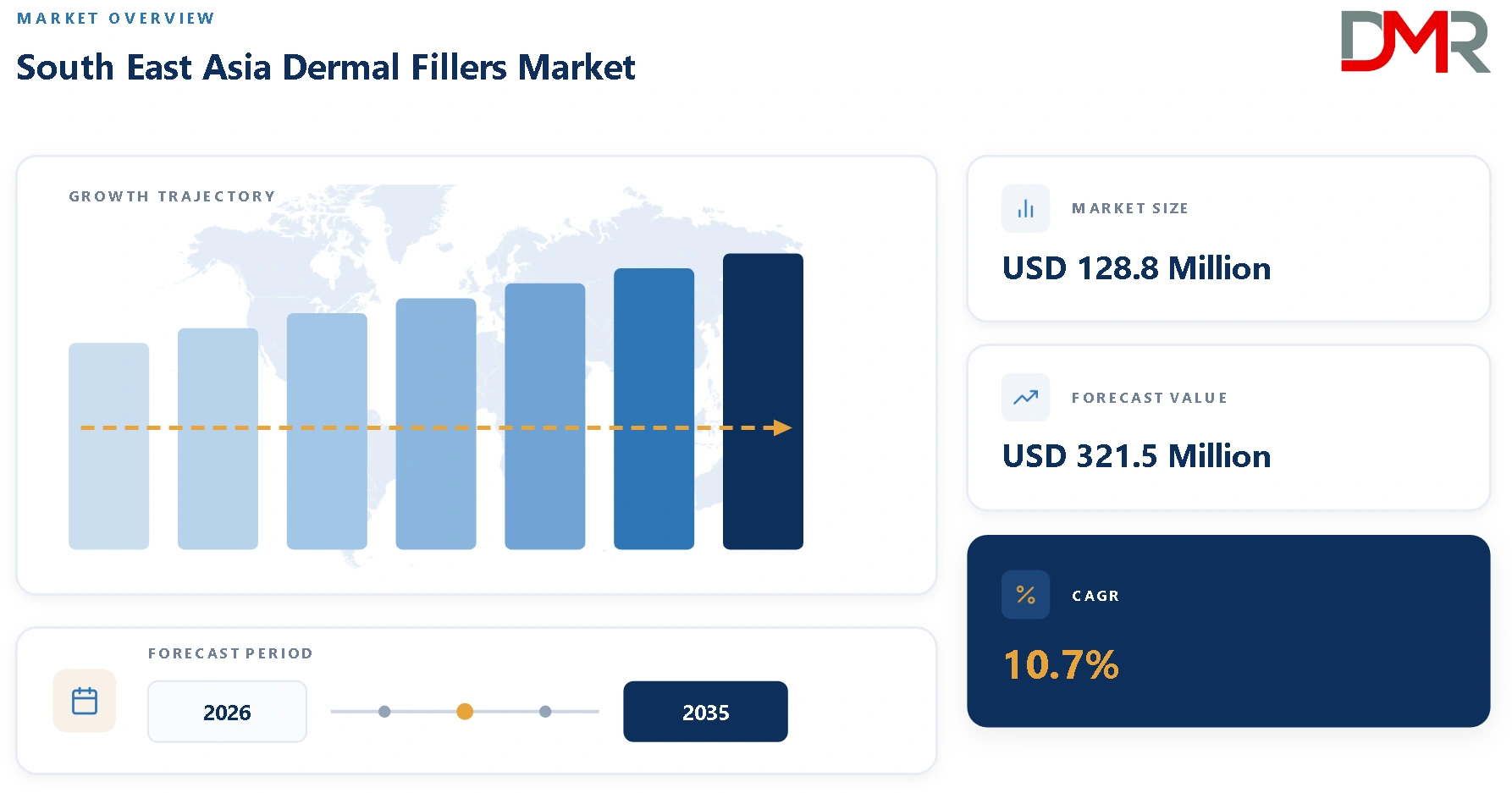
- Market Size (2026): USD 128.8 Mn
- Forecast Value (2035): USD 321.5 Mn
- CAGR (2026-2035): 10.7%
- Largest Segment by Ingredient (2026): Hyaluronic Acid, approximately 74%
- Fastest-Growing Segment: Poly-L-Lactic Acid, at a CAGR of 16.9%
- Leading End User (2026): Dermatology Clinics, around 41%
- Leading Distribution Channel (2026): Distributors, close to 38%
- Key Players: AbbVie, Galderma, Merz Pharma and others
What is South East Asia Dermal Fillers Market and its Market Size?
The South East Asia Dermal Fillers Market size is estimated to reach USD 128.8 Mn in 2026 and is further anticipated to reach USD 321.5 Mn by 2035, at a CAGR of 10.7%.
ℹ
To learn more about this report –
Download Your Free Sample Report Here
The market covers injectable products used to restore or add soft-tissue volume, soften facial lines, improve contours and support selected corrective procedures. The commercial scope centers on manufacturer and authorized distributor revenue for dermal filler products supplied into medical aesthetic settings. It does not treat the full patient bill, physician fee or clinic operating revenue as filler market revenue.
Hyaluronic acid remains the commercial anchor because it combines familiar handling, broad indication coverage and a reversible treatment pathway when appropriately managed. Calcium hydroxylapatite, poly-L-lactic acid and other biomaterials add differentiated options for patients seeking structural support, gradual collagen stimulation or specific corrective outcomes. Product choice is shaped by treatment depth, anatomical area, expected duration, injector experience and local registration status.
Demand comes mainly from dermatology clinics, aesthetic physician practices, cosmetic surgery centers, medical spas and selected hospitals. Buyers increasingly assess more than unit price. They compare formulation characteristics, evidence packages, injector education, traceability, after-sales support and the reliability of local distribution. In larger cities, treatment demand is reinforced by social visibility, medical tourism and a growing preference for procedures with limited interruption to work and daily activity.
The market is structurally changing as providers broaden treatment plans from isolated wrinkle correction toward facial balancing, contouring and skin-quality protocols. Premium products compete through formulation science and physician training, while value brands compete through distributor reach and accessible procedure economics. Regulatory enforcement is also becoming more visible, increasing the commercial value of authenticated supply, qualified injectors and disciplined post-market practices.
Use Cases
- Dermatology Clinic Rejuvenation: Dermatologists use injectable fillers to correct age-related volume loss and facial folds during outpatient consultations. The approach gives patients a treatment option that can be tailored by anatomical area and depth, while clinics can build repeat demand through staged treatment plans and follow-up assessments.
- Medical Tourism Packages: Aesthetic hospitals and specialist centers serving international patients combine facial contouring with other elective procedures. Dermal fillers add a shorter-duration injectable service to treatment packages, helping providers serve patients who want visible facial refinement without adding a major surgical recovery period.
- Post-Scar Correction: Reconstructive and dermatology teams use selected fillers for depressed scars and localized tissue deficits where restoring soft-tissue support can improve surface appearance. Treatment selection depends on scar depth, tissue quality and the clinician's ability to manage vascular and anatomical risk.
- Premium Facial Balancing: High-end aesthetic practices use fillers across the chin, cheeks, lips and jawline to create proportion rather than treating one isolated wrinkle. This multi-area model can increase product utilization per treatment plan while shifting consultations toward individualized facial assessment and longer-term maintenance.
Key Takeaways
- Market Size & Share: The market is estimated at USD 128.8 Mn in 2026 and is projected to reach USD 321.5 Mn by 2035.
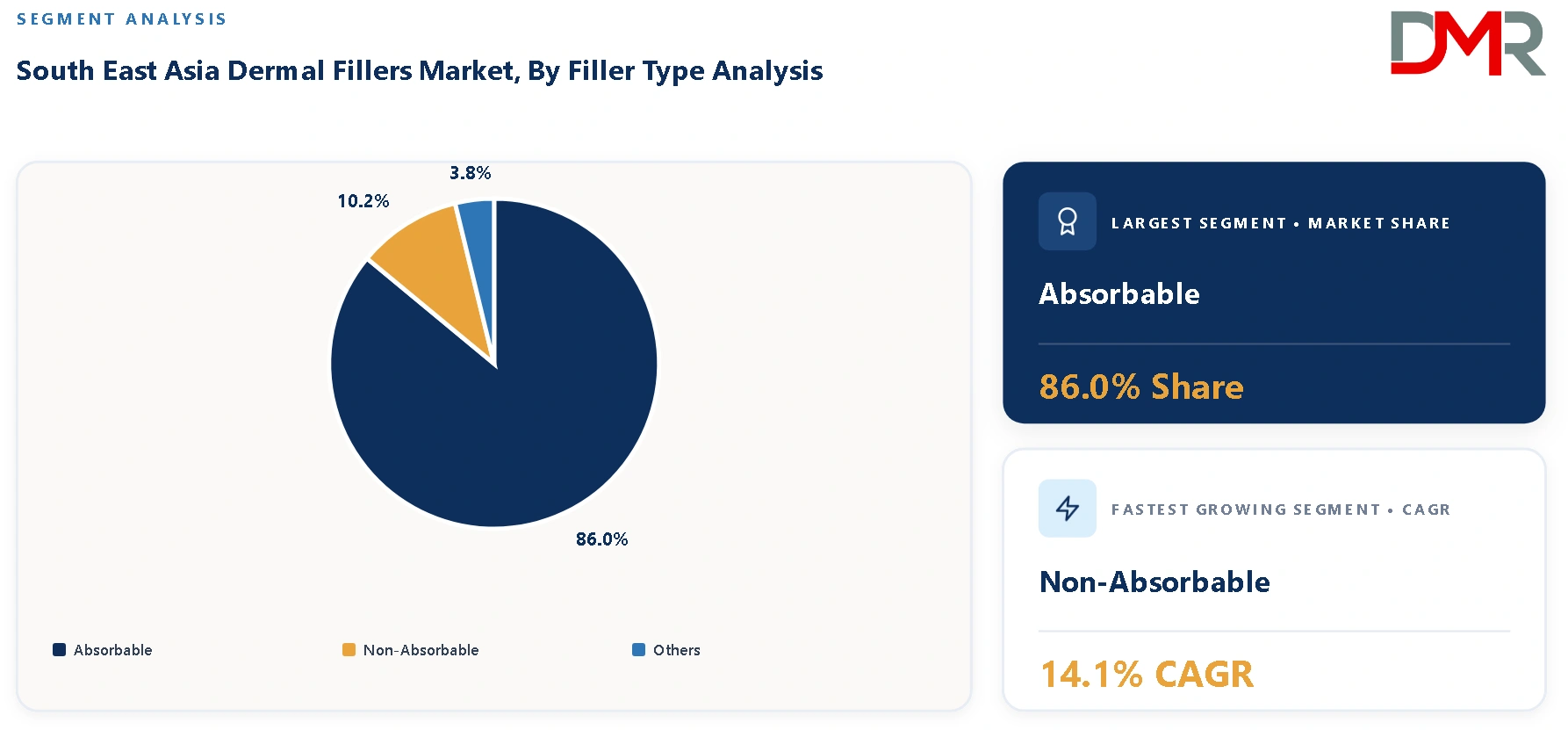
- Filler Type Analysis: Absorbable fillers are expected to account for approximately 86% of 2026 revenue, reflecting their broad clinical adoption and repeat-treatment profile.
- Demand Concentration: Dermatology clinics are projected to represent around 41% of 2026 demand, supported by specialist injector access and recurring aesthetic consultations.
- Ingredient Analysis: Hyaluronic acid is expected to hold approximately 74% of 2026 revenue, while poly-L-lactic acid is expanding at a forecast CAGR of 16.9%.
- Application Analysis: Facial rejuvenation is projected to lead application demand at about 34% in 2026, while lip enhancement is gaining faster as younger patients broaden treatment objectives.
- Channel Analysis: Distributors are expected to control close to 38% of 2026 channel revenue because registration support, inventory management and clinic coverage remain important across fragmented national markets.
How AI/Gen AI is Transforming the South East Asia Dermal Fillers Market?
AI is influencing dermal filler workflows mainly through assessment, visualization and administrative support rather than through the filler material itself. Computer vision can assist facial landmark detection and symmetry assessment, while three-dimensional imaging helps clinicians compare facial proportions before treatment. These tools can make consultations more structured by showing how changes in one anatomical area may affect overall balance.
Generative AI has a narrower but growing role. LLM document processing can organize consultation notes, consent documentation and follow-up records, while demand forecasting can help multi-site clinics plan inventory by product family and treatment season. AI does not replace injector judgment, anatomical knowledge or informed consent. Its value is highest when it reduces repetitive documentation and improves the consistency of pre-treatment assessment.
- Computer Vision: Facial landmark detection can support standardized assessment of asymmetry, folds and contour changes.
- 3D Facial Simulation: Three-dimensional models can improve patient communication by illustrating planned contour changes before injection.
- LLM Document Processing: Language models can structure consultation notes, aftercare instructions and follow-up summaries for clinician review.
- Demand Forecasting: Predictive models can estimate product consumption across clinic locations and reduce stockouts or excess inventory.
Key Drivers in the South East Asia Dermal Fillers Market
Two demand forces are reshaping the market at the same time: broader consumer acceptance of minimally invasive facial enhancement and the expansion of specialist clinic capacity across major urban centers.
- Preference for Minimally Invasive Aesthetic Care: Consumers increasingly compare injectable treatment with surgical alternatives on recovery time, treatment flexibility and the ability to make incremental changes. This expands the addressable patient pool beyond people seeking major correction. Repeat treatment also matters commercially because many absorbable products require maintenance, creating recurring product demand rather than a single purchase. As providers move toward facial balancing and combination protocols, product selection becomes more granular, supporting premium formulations with specific rheological and handling characteristics. The effect is strongest in urban private care, where patients can access trained injectors and evaluate multiple brands through clinic networks.
- Expansion of Specialist Aesthetic Capacity: New clinics, physician-led practices and medical aesthetic chains increase the number of points where regulated fillers can be prescribed, purchased and administered. A larger injector base also improves the practical reach of brands that can support training, product education and local regulatory requirements. The commercial effect is amplified by medical tourism in established hubs, where providers serve both domestic and international patients. This favors companies with dependable distributor coverage and clinical education programs, because product availability alone does not create adoption when clinicians require confidence in anatomy, injection technique and complication management.
Restraints in the South East Asia Dermal Fillers Market
Growth is constrained by clinical risk, regulatory fragmentation and uneven purchasing power across the region. These brakes influence both product selection and the pace at which new brands can build trust.
- Clinical Risk and Injector Skill Requirements: Dermal fillers are elective medical interventions, so adverse events can damage patient trust and clinic reputation even when the underlying product is properly manufactured. Vascular occlusion, infection, inflammatory reactions and poor aesthetic outcomes require trained assessment and rapid management. This raises the value of physician education but also limits how quickly inexperienced providers can safely expand procedure volume. Premium brands can justify part of their position through training and evidence, while lower-cost products face a higher burden of proof when clinics evaluate safety, traceability and practitioner support.
- Regulatory Fragmentation and Price Sensitivity: Each national market can impose different registration, import, labeling, selling and post-market requirements. Thailand, for example, requires a selling license for injectable hyaluronic acid dermal fillers, while Malaysia maintains an active medical device registration framework covering multiple filler products. These differences increase launch time and distributor costs. At the same time, mid-market clinics remain sensitive to procedure economics, encouraging promotional competition and making it harder for premium products to pass through price increases without stronger clinical differentiation.
Growth Opportunities in the South East Asia Dermal Fillers Market
White space is emerging in regenerative and biostimulatory formulations, secondary cities and distributor-led professional education. Products that can show a distinct treatment rationale beyond basic volume replacement have room to gain share, particularly where physicians want more options for gradual remodeling and skin-quality protocols.
- Biostimulator Expansion: Poly-L-lactic acid, calcium hydroxylapatite and newer polymer-based products can address patients seeking gradual collagen stimulation or structural support rather than immediate volumization alone. Their higher forecast growth gives manufacturers an opening to build differentiated portfolios around treatment sequencing.
- Secondary-City Clinic Networks: Indonesia, Vietnam, Thailand and the Philippines have large urban populations outside the primary capitals. Distributor partnerships that combine regulatory support, cold-chain or controlled logistics where required, training and digital ordering can extend access without requiring every manufacturer to build a direct sales force.
- Professional Education Models: Training programs tied to anatomy, patient selection and complication management can strengthen brand loyalty. Companies that provide structured education to clinics can compete on total account value rather than syringe price alone.
Trends in the South East Asia Dermal Fillers Market
The market is shifting toward natural-looking outcomes, combination treatment plans and product specialization. Consumers increasingly want refinement that preserves facial movement and proportion, while clinicians seek formulations matched to tissue depth and treatment objective.
- Natural-Looking Contouring: Product positioning is moving from dramatic augmentation toward controlled correction of facial proportions, including the chin, jawline, cheeks and perioral area.
- Skin Quality and Hydration: Injectable protocols increasingly overlap with skin-quality objectives, creating demand for lower-viscosity formulations, skin boosters and combination approaches rather than volume restoration alone.
- Biostimulation: PLLA, CaHA and polymer-based products are receiving more attention because they support treatment strategies based on gradual tissue remodeling and collagen production.
- Channel Professionalization: Authorized distributors are investing more heavily in traceability, practitioner training and product authentication as regulators and clinics place greater emphasis on controlled supply.
Research Scope and Analysis
Segment performance is assessed across filler type, ingredient, application, end user and distribution channel. Each axis identifies the sub-segment carrying the largest share of 2026 revenue and the one expanding fastest through 2035, with the commercial reason behind each position.
ℹ
To learn more about this report –
Download Your Free Sample Report Here
By Filler Type
Absorbable fillers are projected to hold the largest share by filler type in 2026, accounting for approximately 86% of revenue, because repeat treatment, reversibility and broad aesthetic use cases make them the default choice for many clinics. Non-absorbable products remain a narrower category because permanence increases the importance of patient selection and long-term risk management. Growth, however, is concentrated in non-absorbable and long-duration formulations, expanding at a CAGR of 14.1% between 2026 and 2035 as clinicians explore durable structural correction and selected reconstructive applications. The faster trajectory is supported by specialist demand, although regulatory scrutiny and complication management constrain the addressable provider base.
By Ingredient
Hyaluronic acid is projected to lead the ingredient axis in 2026, accounting for around 74% of revenue, because its familiarity, reversibility and broad portfolio of viscosities allow use across multiple facial areas. Calcium hydroxylapatite, PLLA and other materials occupy smaller positions but provide differentiated clinical objectives. The steeper trajectory sits with poly-L-lactic acid, expanding at a CAGR of 16.9% from 2026 to 2035 as clinics adopt more gradual collagen-stimulation protocols and patients seek longer-horizon rejuvenation. Training requirements remain higher than for routine HA use, but the product category benefits from a growing interest in regenerative aesthetics.
By Application
Facial rejuvenation is expected to remain the leading application in 2026, representing approximately 34% of revenue because it covers a broad patient population and supports repeat treatment across multiple facial areas. Wrinkle reduction and facial contouring remain important companion uses, while lip enhancement is more concentrated among younger consumers and first-time injectable users. Growth, however, is concentrated in lip enhancement, expanding at a CAGR of 15.8% through 2035 as social-media-driven aesthetic preferences increase demand for subtle shape and proportion changes. Providers are also using treatment plans that combine lips with chin and lower-face correction.
By End User
Dermatology clinics are projected to account for around 41% of 2026 revenue by end user, supported by specialist physician access, established consultation pathways and repeat treatment relationships. Cosmetic surgery centers hold a strong position where fillers are integrated into broader facial procedures and post-procedure correction. Growth, however, is concentrated in medical spas, expanding at a CAGR of 14.6% between 2026 and 2035 as physician-supervised aesthetic concepts broaden outside traditional dermatology settings. The segment remains dependent on local rules governing who may inject, product handling and clinical oversight, so its growth will vary materially across national markets.
By Distribution Channel
Distributors are expected to hold close to 38% of 2026 channel revenue because fragmented national markets make local regulatory knowledge, inventory management and clinic relationships valuable to manufacturers. Direct sales remain important for large accounts and strategic clinic chains, while medical wholesalers support smaller practices. Growth, however, is concentrated in direct manufacturer-to-clinic and digital-assisted ordering models, expanding at a CAGR of 15.2% through 2035 as established providers consolidate procurement and require stronger product traceability. Online channels remain tightly constrained by medical device rules and the need to prevent unauthorized product circulation.
The South East Asia Dermal Fillers Market Report is Segmented Based on the Following
By Filler Type
- Absorbable
- Non-Absorbable
- Others
By Ingredient
- Hyaluronic Acid
- Calcium Hydroxylapatite
- Poly-L-Lactic Acid
- Polymethyl Methacrylate
- Collagen
- Others
By Application
- Facial Rejuvenation
- Wrinkle Reduction
- Lip Enhancement
- Facial Contouring
- Scar Correction
- Volume Restoration
- Others
By End User
- Dermatology Clinics
- Cosmetic Surgery Centers
- Medical Spas
- Hospitals
- Aesthetic Physician Practices
- Others
By Distribution Channel
- Distributors
- Direct Sales
- Clinic and Hospital Pharmacies
- Medical Aesthetics Wholesalers
- Online Channels
- Others
Regulatory Landscape
Regulatory requirements remain a primary market-access variable because dermal fillers are regulated as medical devices or controlled health products in the region, with national differences in product registration, importer responsibilities, selling permissions, labeling and post-market surveillance. Thailand specifically requires permission for the sale of injectable hyaluronic acid dermal fillers, while Malaysia maintains a searchable registration system with active entries for HA and other filler products. The commercial opening is for manufacturers that pair compliant dossiers with strong local representation, traceability and practitioner education. The brake is fragmentation: a product cleared in one ASEAN market does not automatically gain access across neighboring markets, increasing launch costs and favoring distributors with multi-country regulatory capability.
Patent Analysis
Patent activity around dermal fillers is centered on formulation chemistry, crosslinking methods, particle engineering, delivery characteristics and biomaterials that stimulate tissue remodeling. The commercial shift is toward differentiated injectables that offer predictable handling, improved longevity or a distinct regenerative mechanism rather than another undifferentiated HA gel. White space exists for regional commercialization of specialized formulations that can be supported by clinical evidence and protected know-how, especially in biostimulation and combination treatment protocols. The risk is that formulation differentiation can become difficult to defend when claims rely on incremental changes to established biomaterials, while freedom-to-operate reviews and national patent enforcement add complexity for smaller entrants. This supports partnerships, licensing and distributor-led market entry.
Competitive Landscape
Competition is fragmented by product positioning, clinical evidence, brand recognition and route to market. Large injectable aesthetics companies benefit from broad portfolios and physician education, while specialists compete through formulation differentiation and focused clinical niches. Asian manufacturers increasingly add price competition and shorter regional commercialization paths. In Southeast Asia, local distributors remain strategically important because national registration, clinic access and professional training are difficult to manage through a single regional model. Premium brands therefore compete on evidence, injector confidence and product range, while value-oriented suppliers emphasize availability, account coverage and procedure economics.
Some of the Prominent Players in the South East Asia Dermal Fillers Market Are
- AbbVie
- Galderma
- Merz Pharma
- Sinclair
- Teoxane
- IBSA Institut Biochimique
- Croma-Pharma
- Prollenium Medical Technologies
- Laboratoires Vivacy
- Anika Therapeutics
- Suneva Medical
- Hugel
- Medytox
- LG Chem
- Huadong Medicine
- BioPlus
- Genoss
- Caregen
- Samyang Biopharmaceuticals
- Dexlevo
- IMEIK
- Bloomage Biotechnology
- Shanghai Haohai Biological Technology
- Huons BioPharma
- Bioxis Pharmaceuticals
- Kewpie Corporation
- Shiseido Company
- Rohto Pharmaceutical
- Hyphens Pharma
- Ardence Aesthetics
- Dermalux Asia
- Venusys Medical
- Medicell Pharmaceutical (Malaysia)
- Redo Marketing
- Medraplus
- Elogio Asia Pacific
- Steril Medic
- Dermamed
- Celeste Thailand
- Regeneris
- Other Key Players
Recent Developments
- In April 2026, Ardence Aesthetics launched Plinest in Vietnam, extending its medical aesthetics distribution platform into another Southeast Asian market and giving the brand a local commercial route for physician-led injectable treatments.
- In May 2026, Samyang Biopharmaceuticals formally launched its Rapulen polymer biostimulator in Thailand, introducing a polycaprolactone-based option and increasing competitive pressure in the region's collagen-stimulation segment.
- In June 2026, Galderma received approval for Restylane SHAYPE in Thailand for chin augmentation, adding a more targeted facial-contouring indication to its regional filler portfolio and widening the set of anatomical areas supported by the brand.
- In August 2025, Hyphens Pharma highlighted a stronger regional focus on medical aesthetics, using its ASEAN operating footprint and Ardence Aesthetics platform to broaden access to specialty aesthetic products and professional channels.
- In September 2025, Allergan Aesthetics announced the expansion of SKINVIVE by JUVÉDERM into additional markets, reinforcing the shift from conventional volume correction toward injectable skin-quality treatments and broader portfolio-based aesthetic protocols.
Report Details
| Report Characteristics |
| Market Size (2026) |
USD 128.8 Mn |
| Forecast Value (2035) |
USD 321.5 Mn |
| CAGR (2026–2035) |
10.7% |
| Historical Data |
2021 – 2025 |
| Forecast Data |
2026 – 2035 |
| Base Year |
2025 |
| Segments Covered |
By Filler Type, By Ingredient, By Application, By End User, and By Distribution Channel |
| Regional Coverage |
South East Asia - Indonesia, Malaysia, Singapore, Thailand, Vietnam, Philippines, Myanmar, Cambodia, Laos |
Frequently Asked Questions
How big is the South East Asia Dermal Fillers Market?
▾ The South East Asia Dermal Fillers Market is estimated at USD 128.8 Mn in 2026. The estimate reflects revenue from dermal filler products supplied through authorized medical and aesthetic channels within the defined Southeast Asian geography, rather than total clinic procedure revenue or physician fees. Demand is concentrated in major urban aesthetic centers, specialist clinics and established medical tourism hubs.
What is the growth rate of the South East Asia Dermal Fillers Market?
▾ The South East Asia Dermal Fillers Market is projected to expand at a CAGR of 10.7% from 2026 to 2035, reaching USD 321.5 Mn by 2035. Growth is supported by wider use of minimally invasive aesthetic treatments, clinic network expansion, broader facial-contouring applications and increasing interest in biostimulatory products. Regulatory compliance and price competition will moderate the pace.
Which country holds the largest share in the South East Asia Dermal Fillers Market?
▾ Indonesia is expected to hold the largest country-level demand position within the South East Asia Dermal Fillers Market because its population scale creates a large addressable urban consumer base, while private aesthetic clinics continue to expand in major cities. Thailand and Vietnam remain important markets because of specialist capacity, medical tourism and established consumer awareness of aesthetic procedures.
Who are the key players in the South East Asia Dermal Fillers Market?
▾ Key players include AbbVie, Galderma, Merz Pharma, Teoxane, Sinclair, Croma-Pharma and Prollenium Medical Technologies, alongside Asian manufacturers and Southeast Asian distributors. Competition depends on regulatory access, product portfolio breadth, clinical evidence, physician education, supply reliability and the ability to maintain authenticated distribution across fragmented national markets.
What is the leading ingredient in the South East Asia Dermal Fillers Market?
▾ Hyaluronic acid is expected to remain the leading ingredient, accounting for approximately 74% of 2026 revenue. Its position reflects broad application coverage, established injector familiarity, reversibility and a wide range of formulations for different tissue depths. PLLA and other biostimulatory materials are expanding faster as providers diversify beyond immediate volume restoration.
Which filler type is growing fastest?
▾ Non-absorbable and longer-duration filler formulations are expected to record the faster trajectory within the filler type axis, with a forecast CAGR of 14.1% from 2026 to 2035. Their opportunity is tied to selected structural and corrective applications where clinicians and patients value durability, although permanent or longer-duration products face higher scrutiny around patient selection and complication management.
Which end user represents the largest demand pool?
▾ Dermatology clinics are expected to represent around 41% of 2026 demand. Their advantage comes from specialist physician access, established aesthetic consultations and the ability to combine fillers with dermatology services. Medical spas and aesthetic physician practices are expanding as provider models diversify, but their addressable opportunity remains more dependent on national rules governing clinical supervision and injection practice.