Market Snapshot
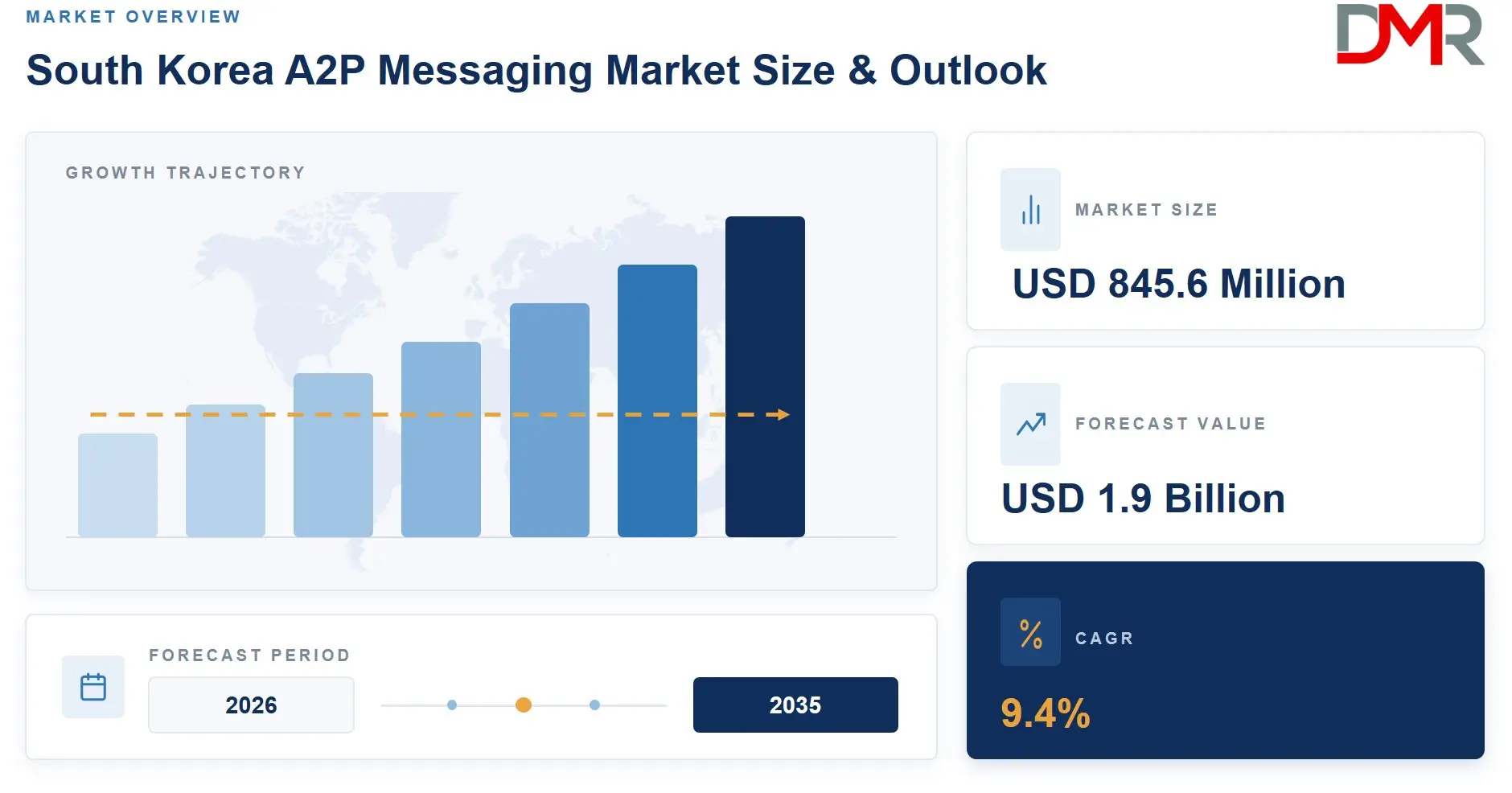
- Market Size (2026): USD 845.6 Mn
- Forecast Value (2035): USD 1.9 Bn
- CAGR (2026-2035): 9.4%
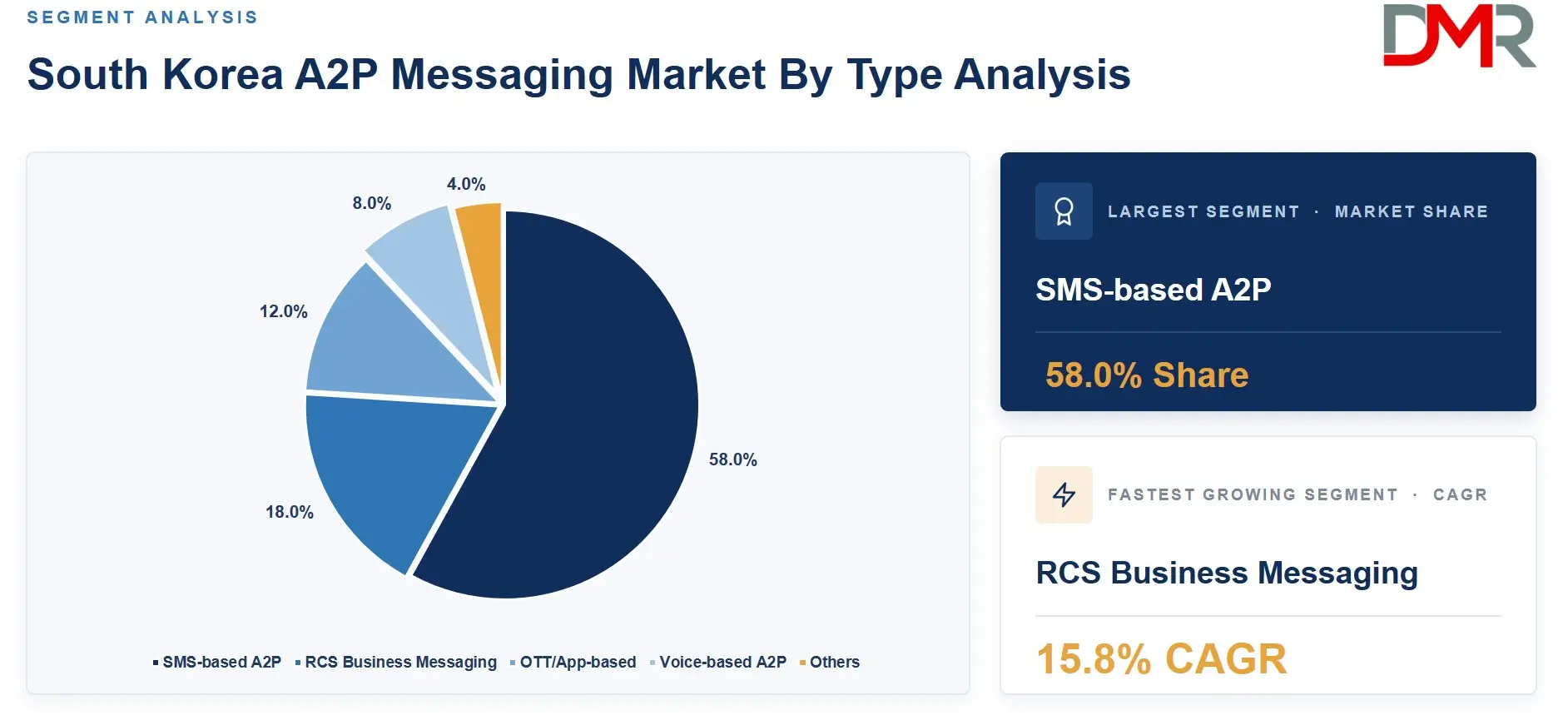
- Leading Type (2026): SMS-based A2P, around 58%
- Leading Application (2026): OTP & Authentication, close to 34%
- Key Players: SK Telecom, KT Corporation, Kakao Corp., and others
What is South Korea A2P Messaging Market and its Market Size?
The South Korea A2P Messaging Market size is estimated to reach USD 845.6 Mn in 2026 and is further anticipated to reach USD 1.9 Bn by 2035, at a CAGR of 9.4%.
ℹ
To learn more about this report –
Download Your Free Sample Report Here
Application-to-person messaging covers text, RCS and voice-originated communications that enterprises, banks, government agencies and platforms send to individual mobile subscribers in South Korea, delivered through mobile network operator gateways, SMS aggregators and cloud communication platforms. The figures in this report track domestic message volume and platform revenue generated for delivery to South Korean mobile numbers; they do not represent the worldwide billings of vendors headquartered in the country, several of which serve customers well beyond its borders. Coverage spans one-time password verification, transactional alerts, promotional campaigns and customer engagement messages routed over SMS, RCS Business Messaging, voice-based delivery and OTT-bridged channels.
Demand concentrates among card issuers, commercial banks and fintech platforms that lean on messaging to satisfy authentication rules set by financial regulators, alongside e-commerce marketplaces, delivery and logistics operators, and healthcare providers that use alerts to confirm orders, shipments and appointments. Enterprises favour the channel over app push notifications because SMS and RCS reach a subscriber regardless of whether a company's own app is installed or open, which keeps delivery certainty high for time-sensitive confirmations.
The channel mix is shifting as the country's three mobile network operators extend RCS Business Messaging beyond pilot programmes into standard commercial offerings, giving brands richer formatting, read receipts and in-message actions that plain SMS cannot carry. Consent requirements under national privacy and network-usage law are tightening at the same time, pushing volume toward verified, opt-in sending and favouring platforms that can prove compliance at scale.
Use Cases
- Banking One-Time Password Delivery: Commercial banks and card issuers send SMS and voice-based OTP codes to confirm logins, card transactions and fund transfers, meeting financial-sector authentication rules while cutting fraud losses tied to weaker verification methods used previously.
- E-commerce Order and Delivery Alerts: Online marketplaces and last-mile logistics operators trigger RCS and SMS notifications at order confirmation, dispatch and doorstep arrival, replacing courier phone calls and cutting missed-delivery repeat attempts during peak shopping periods such as Chuseok.
- Public Sector Emergency Notification: Local governments and public agencies push SMS alerts for severe weather, disease outbreaks and municipal service updates, reaching residents who have not installed a dedicated government app and who may be offline on data services.
- Healthcare Appointment and Prescription Reminders: Hospitals, clinics and pharmacy chains send automated SMS reminders for appointments, lab results and medication refills, a use case now expanding into RCS-based rich messages that let patients confirm or reschedule directly, cutting missed-appointment rates at the largest teaching hospitals.
Key Takeaways
- Market Size & Share: The market is valued at approximately USD 845.6 Mn in 2026 and is projected to reach USD 1.9 Bn by 2035.
- Type Analysis: SMS-based A2P messaging is expected to account for around 58% of 2026 revenue, anchored by carrier reliability and OTP compliance requirements.
- Application Analysis: OTP & Authentication messaging is projected to hold close to 34% of 2026 demand as financial institutions harden login and transaction verification.
- Demand Concentration: BFSI is estimated to represent nearly 29% of 2026 end-use demand, the largest of any industry vertical tracked in this report.
- Regulatory Momentum: Consent enforcement under national privacy and anti-spam rules is reshaping promotional messaging volumes toward verified opt-in lists rather than broad-based sends.
- Platform Shift: Growth is concentrated in RCS Business Messaging, forecast to expand at a CAGR of 15.8% between 2026 and 2035 as carriers scale commercial rollout.
How AI/Gen AI is Transforming the South Korea A2P Messaging Market?
Artificial intelligence is entering the messaging value chain mainly as an operational layer rather than a customer-facing novelty. Aggregators and cloud communication platforms apply machine learning models to route messages across the country's three carrier networks in real time, selecting the path with the lowest latency and highest delivery-receipt confidence for a given handset and time of day. Natural language classifiers scan outbound content before it leaves an enterprise's account to flag copy that risks violating consent or spam rules, reducing the manual review load that compliance teams previously carried.
On the buyer side, generative tools are used to draft and localise RCS message templates so that promotional and transactional copy stays within character limits while preserving the brand cards and quick-reply buttons that RCS supports. Predictive models applied to historical open and response data increasingly decide send-time and channel selection, choosing between SMS, RCS and voice fallback for a given message rather than defaulting to a single channel across an entire campaign.
- Intelligent Routing: Machine learning models pick the lowest-latency carrier path per message, lifting delivery-receipt rates during peak traffic windows.
- Compliance Screening: Natural language classifiers flag outbound copy that risks breaching consent or spam rules before a campaign is sent.
- RCS Template Generation: Generative tools draft and localise rich-card message templates, keeping brand copy within character and formatting limits.
- Predictive Channel Selection: Models choose between SMS, RCS and voice fallback per recipient based on historical response behaviour.
Key Drivers in the South Korea A2P Messaging Market
Two forces underpin sustained demand for application-to-person messaging across the country's mobile subscriber base through 2035.
- Mandatory Authentication in Financial Services: Financial regulators require strong customer authentication for online banking, card payments and brokerage logins, and SMS or voice-delivered one-time passwords remain the default second factor for the large share of subscribers who do not use biometric or hardware tokens. Every new digital banking account, buy-now-pay-later service and open banking integration adds another recurring stream of OTP traffic, and card issuers layer transaction-level alerts on top of login verification to meet fraud-monitoring obligations. Because this demand is compliance-driven rather than discretionary marketing spend, it holds up even when enterprises trim promotional budgets, giving the market a stable revenue floor.
- E-commerce and Logistics Expansion: A dense parcel-delivery network and a subscriber base that shops heavily through mobile marketplaces generate constant order, dispatch and delivery-confirmation traffic. Same-day and dawn-delivery services in particular depend on precisely timed SMS and RCS alerts to coordinate handoffs between warehouses, couriers and recipients, and each new fulfilment centre or delivery partnership adds a proportional increase in transactional message volume. As marketplaces layer loyalty and re-engagement messaging on top of core delivery alerts, the same infrastructure carries a growing share of promotional traffic as well.
Restraints in the South Korea A2P Messaging Market
Two brakes temper the pace at which enterprises can scale outbound messaging.
- Tightening Consent and Anti-Spam Enforcement: Regulators have moved from voluntary guidance to certification requirements for bulk SMS providers, with revised guides clarifying that vague consent language no longer satisfies disclosure rules for advertising messages. Enterprises must now maintain verifiable opt-in records and clearer refusal mechanisms, which raises compliance overhead and can slow campaign launch timelines for marketing teams accustomed to broader sending lists. Aggregators that cannot demonstrate certification-grade safeguards risk losing the ability to route bulk traffic at all.
- OTT Channel Substitution: A messaging app used by the overwhelming majority of the population gives enterprises a free or low-cost alternative to carrier-billed SMS for notifications and marketing to consumers who have opted into a brand's channel there. Where a business already maintains an OTT presence, incremental A2P SMS spend competes for the same customer-engagement budget line, and price-sensitive marketing teams often shift the least time-critical messages away from paid SMS first, capping the addressable spend for promotional traffic even as transactional and compliance-driven volume keeps growing.
Growth Opportunities in the South Korea A2P Messaging Market
Two areas of white space stand out for vendors positioning ahead of 2035.
- RCS Migration Services for Mid-Market Enterprises: Large financial institutions and marketplaces have already moved core traffic to RCS, but mid-sized retailers, clinics and local service businesses still send predominantly plain SMS because template registration, brand verification and channel fallback logic add integration work smaller IT teams are not staffed to handle. Platforms that package RCS onboarding, brand-home registration and automatic SMS fallback into a managed service can capture this underserved segment as carriers push adoption beyond flagship accounts.
- Vertical-Specific Compliance Tooling: Healthcare, financial services and public-sector senders each face distinct consent, retention and content rules on top of the general anti-spam framework, and few messaging platforms today offer sector-specific template libraries or audit trails tuned to a single regulator's expectations. A vendor that builds compliance workflows around a specific vertical's rules, rather than a generic opt-in checkbox, can differentiate on risk reduction rather than price alone.
Trends in the South Korea A2P Messaging Market
Two shifts are reshaping how messages are bought and delivered right now.
- Brand Verification Becomes a Buying Criterion: As smishing and impersonation scams have surged, recipients increasingly distrust messages from unverified numbers, prompting carriers and platforms to promote registered sender IDs, RCS brand-home profiles and trust marks as standard rather than optional features. Enterprises now weigh a platform's verification tooling alongside price and delivery rate when choosing a messaging partner, a criterion that barely featured in procurement decisions a few years ago.
- Consolidation Around Multi-Channel Delivery APIs: Enterprises are moving away from managing separate integrations for SMS, RCS and app-based messaging toward single APIs that select the optimal channel automatically and fall back gracefully when a preferred channel is unavailable. This consolidation is shifting purchasing power toward platforms that can guarantee cross-channel reach over point solutions tied to a single message type.
Research Scope and Analysis
Segment performance is assessed across five axes: type, application, end use industry, deployment mode and distribution channel. Each axis identifies the sub-segment carrying the largest share of 2026 revenue and the one expanding fastest through 2035, with the commercial reason behind each position.
ℹ
To learn more about this report –
Download Your Free Sample Report Here
By Type
SMS-based A2P messaging is projected to hold the largest share by type in 2026, accounting for around 58% of revenue, since carrier-grade delivery reliability and universal handset compatibility make it the default channel for regulated OTP and transactional traffic that cannot risk non-delivery. Growth, however, is concentrated in RCS Business Messaging, expanding at a CAGR of 15.8% between 2026 and 2035 as the three national carriers extend commercial rollout to iPhone users and enterprises migrate promotional and customer-engagement campaigns toward richer, branded formats that lift response rates over plain text.
By Application
OTP & Authentication is estimated to lead by application in 2026, holding close to 34% of demand, a position anchored by mandatory two-factor authentication across online banking, card payments and brokerage logins that generates recurring, non-discretionary message volume. The steeper trajectory sits with Customer Engagement & CRM messaging, projected at a CAGR of 14.1% as enterprises expand loyalty, re-engagement and post-purchase communication programmes on top of core transactional sending.
By End Use Industry
BFSI is expected to account for the largest share by end use industry in 2026, at nearly 29% of revenue, reflecting the sector's heavy reliance on messaging for authentication, fraud alerts and payment confirmations under close regulatory supervision. Growth is fastest in E-commerce & Retail, forecast at a CAGR of 13.5% as mobile-first marketplaces scale order, delivery and promotional messaging alongside continued growth in online shopping volumes.
By Deployment Mode
Public cloud platforms are projected to lead by deployment mode in 2026, capturing around 46% of revenue, as enterprises favour the lower upfront cost and faster integration of cloud-hosted messaging gateways over maintaining on-premise infrastructure. The fastest growth sits with API-based managed services, at a CAGR of 16.9%, as mid-sized enterprises increasingly outsource template management, compliance monitoring and channel routing rather than building this capability internally.
By Distribution Channel
CPaaS providers are estimated to hold the largest share by distribution channel in 2026, at close to 41% of revenue, since a single API integration lets enterprises reach SMS, RCS and voice channels without separate carrier contracts. Aggregator and hub platforms show the fastest growth, at a CAGR of 13.2%, as smaller enterprises route traffic through intermediaries that negotiate carrier terms and certification compliance on their behalf.
The South Korea A2P Messaging Market Report is Segmented Based on the Following
By Type
- SMS-based A2P
- RCS Business Messaging
- OTT/App-based
- Voice-based A2P
- Others
By Application
- OTP & Authentication
- Promotional & Marketing Messaging
- Transactional Alerts & Notifications
- Customer Engagement & CRM
- Others
By End Use Industry
- BFSI
- E-commerce & Retail
- Logistics & Transportation
- Healthcare
- IT & Telecom
- Others
By Deployment Mode
- Public Cloud Platforms
- Hybrid Cloud Platforms
- On-premise Gateways
- API-based Managed Services
- Others
By Distribution Channel
- CPaaS Providers
- Direct Operator Connect
- Aggregator/Hub Platforms
- Others
Regulatory Landscape
South Korea's anti-spam framework has shifted from voluntary industry guidance to legally enforceable certification: the national communications regulator now requires bulk SMS providers to demonstrate safeguards against illegal spamming as a condition of maintaining certification, following a self-regulatory pilot that showed uneven compliance. Regulators have also revised guidance under the network-usage law to close loopholes where vague phrases such as "benefit notifications" were used to solicit consent without clearly disclosing that a message was advertising. The direction of travel favours senders that can prove verified opt-in and registered sender identity, and disadvantages aggregators that route traffic for clients without visibility into how consent was obtained. The commercial opening sits with platforms that build certification and audit-trail tooling directly into their sending workflow, turning a compliance burden into a differentiator against lower-cost, less-verified competitors. The risk is a near-term compression of promotional message volume as enterprises pause broad campaigns to rebuild consent lists, a drag that should ease as certified sending becomes the market norm and demand concentrates with providers that cleared the bar early.
Technology Analysis
RCS Business Messaging has moved from Android-only pilots to full commercial service across all three national carriers, with iPhone support closing the last major device gap and opening up branded, interactive messaging for a subscriber base that had been reachable only through plain SMS on Apple handsets until recently. What is shifting now is enterprise willingness to invest in RCS template design and brand-home verification, since the addressable audience finally spans the full smartphone base rather than a partial one. The commercial opening favours platforms and system integrators that can handle brand registration, template certification and legacy SMS fallback as a bundled service, since few enterprise IT teams have this expertise in-house. The main risk is fragmentation: carrier-specific rollout timelines and certification processes can slow national campaigns that need uniform behaviour across all three networks, and any divergence in future protocol updates would raise integration costs for platforms that have already built to today's specification. Net effect, richer messaging formats should lift response rates and support premium pricing for RCS traffic relative to commoditised SMS.
Competitive Landscape
The market is moderately fragmented, with the three national mobile network operators controlling the underlying carrier connectivity that every other participant depends on, while a layer of aggregators, CPaaS providers and domestic messaging platforms compete on price, delivery reliability, template tooling and compliance support. Competition centres less on undercutting per-message pricing, which carriers largely set, and more on value-added services: brand verification, multi-channel routing, analytics dashboards and certification-grade consent management. Domestic platforms built around KakaoTalk-adjacent business messaging hold a structural advantage given the near-universal reach of that app, while international CPaaS vendors compete primarily for multinational enterprises that want a single contract spanning South Korea alongside other markets. Consolidation pressure is building among smaller aggregators that cannot absorb the cost of the new certification regime.
Some of the Prominent Players in the South Korea A2P Messaging Market are:
- Sinch AB
- Infobip Ltd.
- Twilio Inc.
- Vonage Holdings Corp.
- Bird (MessageBird B.V.)
- Route Mobile Limited
- Kaleyra S.p.A. (Tata Communications)
- Telesign Corporation
- Mitto AG
- Cisco Webex Connect (IMImobile)
- Tanla Platforms Limited
- Gupshup Inc.
- Karix Mobile Private Limited
- Clickatell (Pty) Ltd.
- SAP Digital Interconnect
- ValueFirst Digital Media Private Limited
- Netcore Cloud Private Limited
- Exotel Techcom Private Limited
- Plivo Inc.
- ClickSend Pty Ltd.
- SMSGlobal Pty Ltd.
- MessageMedia Pty Ltd.
- Yuboto Ltd.
- SK Telecom Co., Ltd.
- KT Corporation
- LG Uplus Corp.
- LGU+ ixi Corp.
- KT M&S Corp.
- Kakao Corp.
- Naver Cloud Corp.
- NHN Cloud Corp.
- Infobank Corp.
- Coocon Corp.
- BizM Co., Ltd.
- Aligo Co., Ltd.
- Solapi Corp.
- Samsung SDS Co., Ltd.
- LG CNS Corp.
- Amazon Web Services, Inc.
- Microsoft Corporation
- Other Key Players
Recent Developments
- In April 2026, South Korea's communications regulator approved certification rules requiring bulk SMS providers to implement safeguards against illegal spamming as a condition of keeping their operating certification, formalising a scheme that had previously run on a voluntary basis.
- In March 2026, the Korea Internet & Security Agency and the communications regulator published a revised guide to the network-usage law clarifying that vague consent language can no longer be used to solicit permission for advertising messages, requiring senders to disclose that content explicitly.
- In January 2026, SK Telecom, KT and LG Uplus moved iPhone-based RCS business messaging from beta into full commercial service, extending branded, interactive enterprise messaging to iOS users after prior support had been limited to Android devices.
- In May 2025, Kakao launched Brand Message, a new consent-based enterprise messaging product delivered through its BizMessage platform, giving advertisers a dedicated opt-in channel alongside its existing transactional messaging services.
Report Details
| Report Characteristics |
| Market Size (2026) |
USD 845.6 Mn |
| Forecast Value (2035) |
USD 1.9 Bn |
| CAGR (2026-2035) |
9.4% |
| Historical Data |
2021 - 2025 |
| Forecast Data |
2026 - 2035 |
| Base Year |
2025 |
| Segments Covered |
By Type, By Application, By End Use Industry, By Deployment Mode, and By Distribution Channel |
| Regional Coverage |
South Korea |
Frequently Asked Questions
How big is the South Korea A2P Messaging Market?
▾ The South Korea A2P Messaging Market is estimated at USD 845.6 Mn in 2026 and is projected to reach USD 1.9 Bn by 2035, reflecting steady demand for compliance-driven and transactional enterprise messaging.
What is the growth rate of the South Korea A2P Messaging Market?
▾ The market is expected to expand at a CAGR of 9.4% between 2026 and 2035, with RCS Business Messaging growing markedly faster than the overall market average.
What is driving demand in the South Korea A2P Messaging Market?
▾ Demand is driven chiefly by mandatory two-factor authentication in online banking, card payments and brokerage services, which generates recurring one-time password traffic that holds up regardless of enterprise marketing budgets, alongside high-volume e-commerce and delivery notifications.
Who are the key players in the South Korea A2P Messaging Market?
▾ Key players include Sinch AB, Infobip Ltd., Twilio Inc., Vonage Holdings Corp., SK Telecom Co., Ltd., KT Corporation, and Kakao Corp., among others operating across carrier, aggregator and platform tiers.
Which type leads the South Korea A2P Messaging Market?
▾ SMS-based A2P messaging leads by type, accounting for around 58% of 2026 revenue, owing to its universal handset compatibility and its role as the default channel for regulated authentication traffic.
Which industry accounts for the largest share of demand in the South Korea A2P Messaging Market?
▾ BFSI accounts for the largest share of demand, at nearly 29% in 2026, reflecting the sector's dependence on messaging for authentication, fraud alerts and payment confirmations under close regulatory oversight.