South Korea Display Manufacturing Automation Market Snapshot
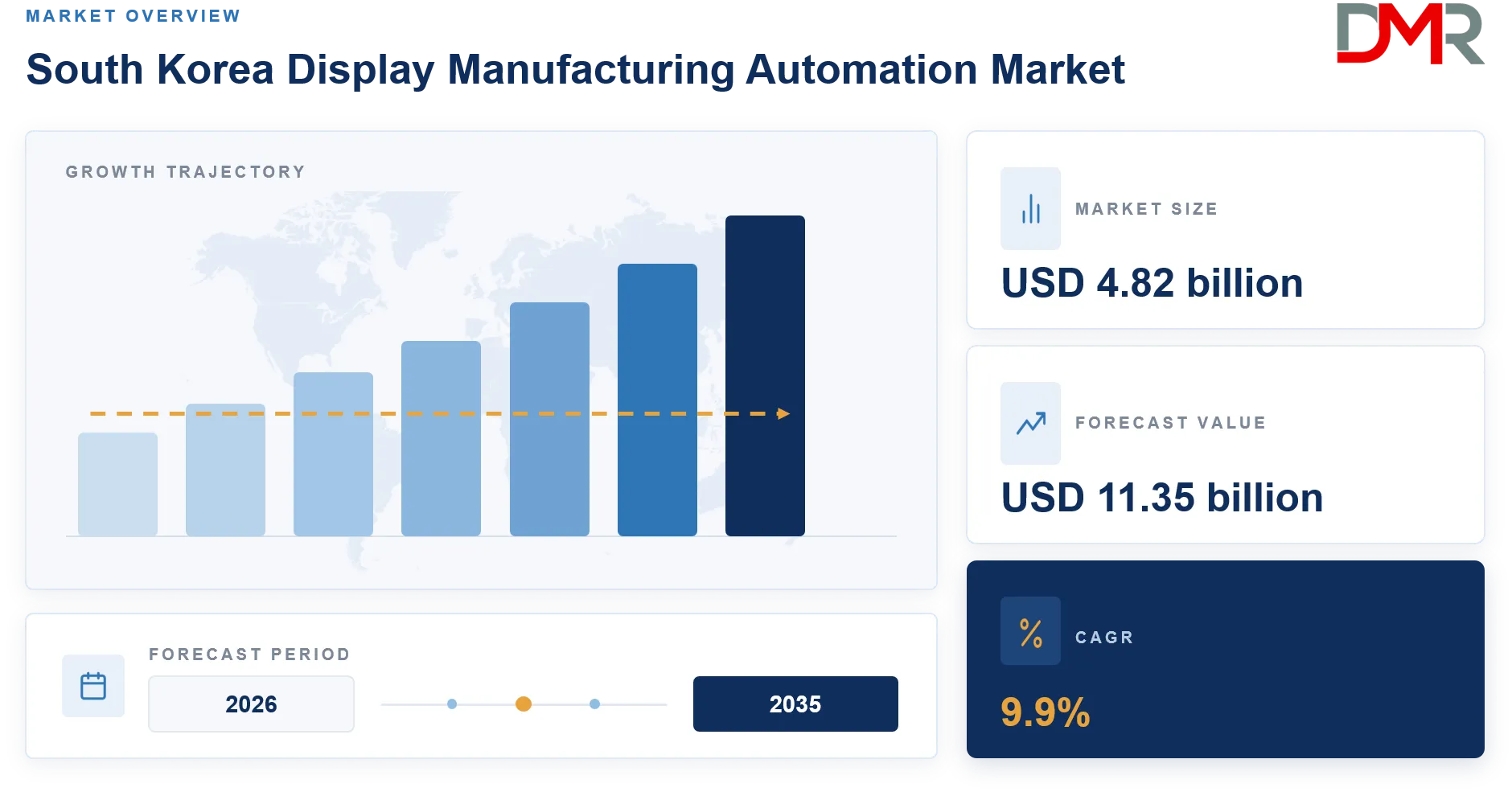
- Market Value: South Korea display manufacturing automation market size is valued at USD 4.82 billion in 2026 and is projected to reach USD 11.35 billion by 2035.
- CAGR: South Korea display manufacturing automation market is expected to grow at a CAGR of 9.9% from 2026 to 2035.
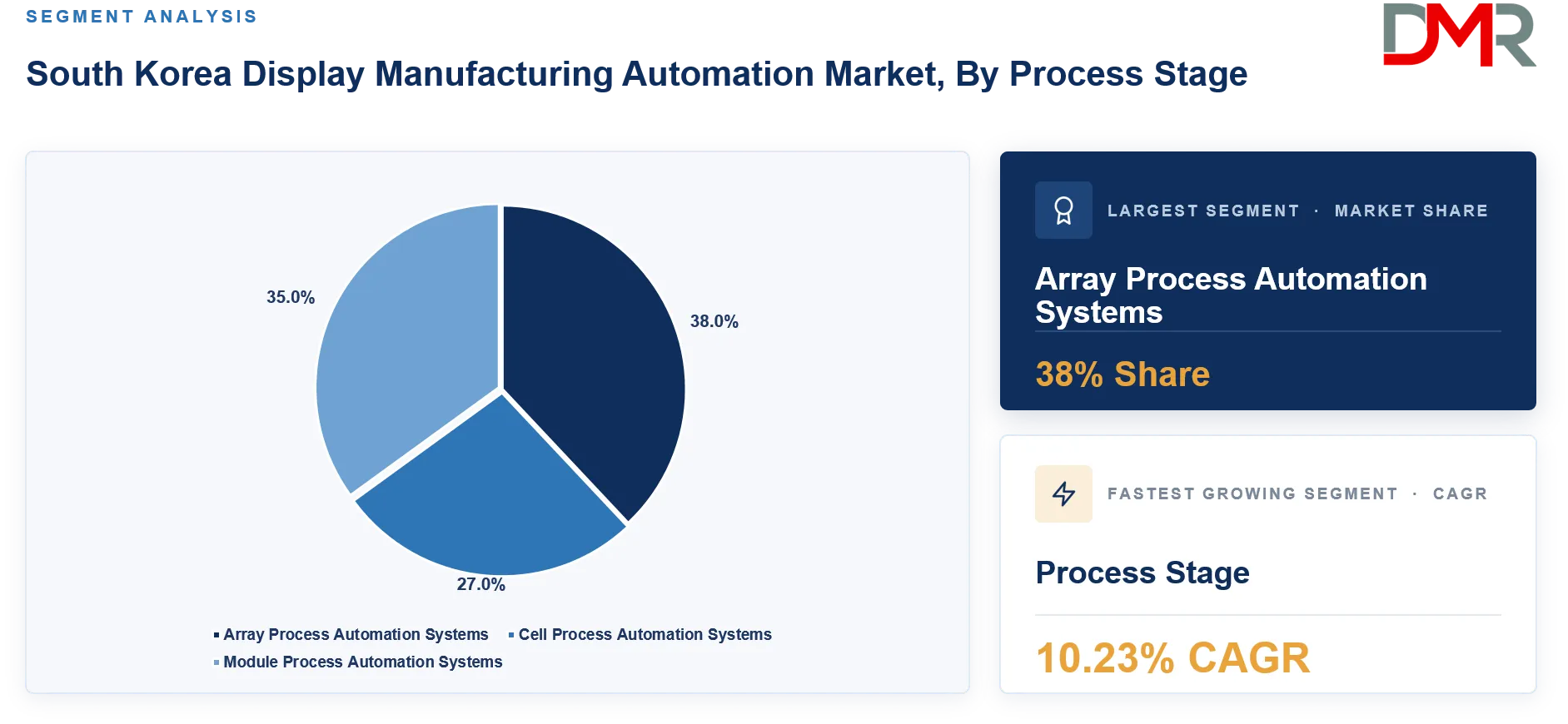
- By Process Stage Segment Analysis: Array process automation systems led the process stage segment with a 38.0% share in 2026.
- By Equipment Type Segment Analysis: Inspection equipment automation led equipment types with a 36.0% share in 2026.
- By Display Technology Segment Analysis: OLED manufacturing automation held a 64.0% share in 2026.
- Major Players: SEMES, SFA Engineering, AP Systems, Wonik IPS, Sunic System and Others.
What is the South Korea Display Manufacturing Automation Market and its Market Size?
The South Korea Display Manufacturing Automation Market size is projected to be valued at USD 4.82 billion in 2026 and is projected to reach USD 11.35 billion by 2035, expanding at a CAGR of 9.9% during the forecast period. The market covers automated equipment, robotics, inspection systems, process controls, handling solutions, deposition tools, testing platforms, and production optimization software used across array, cell, and module manufacturing. Demand is closely linked with South Korea's transition toward OLED, higher generation fabrication lines, flexible displays, IT OLED panels, automotive displays, and manufacturing processes that require tighter tolerances and higher production yields.
ℹ
To learn more about this report –
Download Your Free Sample Report Here
Automation has become critical because modern OLED production involves hundreds of closely controlled manufacturing steps. Small deviations in deposition thickness, alignment, encapsulation, particle control, or electrical performance can reduce panel yield and increase production cost. South Korean panel manufacturers are therefore investing in equipment that combines precision robotics, automated optical inspection, real-time process control, predictive maintenance, and data-driven yield management. Samsung Display's 8.6 generation IT OLED facility in Asan and LG Display's ongoing investment in next-generation OLED infrastructure in Paju illustrate how equipment intensity is rising as manufacturers move toward larger substrates and more complex display architectures.
Use Cases
- Automated OLED Array Processing: Display fabs use automated deposition, coating, photolithography, cleaning, and material handling platforms to control thin-film transistor formation. These systems improve repeatability across large substrates and reduce defects caused by manual intervention, contamination, and process variation.
- High-Speed Display Inspection: Automatic optical inspection and electrical testing platforms identify mura, particles, pixel defects, alignment errors, wiring failures, and surface abnormalities before panels move to downstream assembly. Earlier defect detection protects yield and reduces the value lost from processing defective substrates.
- Flexible Panel Handling: Precision robotic systems move thin and flexible OLED panels during bonding, lamination, encapsulation, and module assembly. Controlled force, positioning accuracy, and vibration reduction are especially important for foldable smartphones, wearables, automotive displays, and thin IT OLED products.
- Smart Process Control: Distributed control systems and supervisory platforms collect data from deposition, annealing, inspection, testing, and assembly tools. Manufacturers use this information to stabilize recipes, identify process drift, coordinate equipment, and maintain consistent output across high-volume production lines.
- Yield and Defect Optimization: Production optimization software connects inspection results with equipment and process data to identify recurring defect patterns. This supports faster root-cause analysis, improves equipment utilization, and helps fabs raise usable panel output without relying only on additional production capacity.
How AI and Gen AI are Transforming the South Korea Display Manufacturing Automation Market?
Artificial intelligence is increasingly being embedded into inspection and production optimization systems used in South Korean display fabs. Conventional inspection tools depend heavily on predefined defect rules, while newer vision systems can classify complex pixel, surface, pattern, and coating abnormalities using large image datasets. This is valuable in OLED production, where defect signatures can differ according to material, substrate, process recipe, and panel design. Equipment vendors are also linking inspection intelligence with deposition, annealing, photolithography, bonding, and electrical test data so engineers can trace defects to specific process conditions. The result is faster fault isolation, more consistent quality control, and improved yield during high-volume production.
Generative AI is beginning to support engineering workflows rather than directly replacing process control systems. Manufacturing teams can use language-based interfaces to review maintenance histories, summarize alarms, compare production lots, retrieve equipment documents, and generate explanations from factory data. Its greater commercial value is likely to emerge when combined with predictive analytics and digital manufacturing platforms. For South Korean OLED producers, this can shorten troubleshooting cycles on complex production lines and help engineers interpret large volumes of equipment information. Adoption will remain controlled because production recipes, customer specifications, yield records, and equipment settings are commercially sensitive, making secure deployment and validation important requirements.
Key Drivers in the South Korea Display Manufacturing Automation Market
Expansion of Advanced OLED Manufacturing Capacity
South Korea's shift toward high-value OLED production is increasing demand for automated display manufacturing equipment. Samsung Display has invested KRW 4.1 trillion in its 8.6 generation IT OLED line in Asan, designed to support annual production capacity of around 10 million notebook panels. Larger substrates increase the economic impact of processing errors, making automated deposition, inspection, transfer, alignment, and process control essential. LG Display is also expanding OLED technology infrastructure in Paju, strengthening long-term equipment demand across the domestic supply chain.
Growing Yield and Precision Requirements
Flexible OLED, foldable panels, high-resolution smartphone displays, and automotive displays require tighter process control than conventional commodity LCD production. Small defects can reduce the usable output of expensive substrates, organic materials, driver components, and module assemblies. Manufacturers are therefore increasing the use of automatic optical inspection, electrical testing, precision robotics, laser processing, and real-time control platforms. Automation helps improve repeatability while supporting lower defect rates, higher throughput, and more efficient use of costly manufacturing capacity.
Restraints in the South Korea Display Manufacturing Automation Market
High Capital Intensity and Long Equipment Qualification Cycles
Display automation systems require significant investment before generating production returns. Advanced deposition, inspection, lithography, bonding, laser, vacuum, and robotic systems must also pass strict customer qualification before entering mass production. Qualification can involve months of process tuning, reliability testing, and integration with existing factory systems. These requirements create barriers for smaller equipment vendors and can delay adoption of new automation technologies, particularly when panel manufacturers are managing uncertain demand or reducing capital expenditure.
Exposure to Cyclical Display Investment
Equipment suppliers remain sensitive to changes in panel makers' capital spending. Orders often rise sharply during construction or conversion of OLED fabrication lines and then normalize once major equipment installation is completed. Smartphone, television, notebook, and monitor demand can also influence fab utilization and investment timing. South Korean automation suppliers are reducing this risk by expanding into semiconductor equipment, batteries, overseas OLED projects, and service revenue, but customer concentration and project-based ordering remain important market constraints.
Growth Opportunities in the South Korea Display Manufacturing Automation Market
8.6 Generation IT OLED Manufacturing
The move toward 8.6 generation OLED production creates a substantial equipment opportunity because manufacturers need systems capable of processing larger glass substrates while maintaining high uniformity and precision. Samsung Display's Asan investment has accelerated equipment development for deposition, inspection, handling, laser processing, testing, and module production. Chinese panel makers are also building 8.6 generation OLED capacity, giving South Korean suppliers an export opportunity. SFA Engineering, HIMS, Device, HB Solution, and other Korean vendors are increasingly positioned to supply these international projects.
Automotive and Wearable OLED Applications
Automotive cockpit displays, digital clusters, passenger displays, head-up systems, and wearable devices create opportunities beyond traditional smartphone and television panels. These applications require reliability under temperature changes, vibration, prolonged operation, and demanding brightness conditions. Automation suppliers can address these requirements through precision assembly, advanced inspection, electrical testing, traceability, and process control equipment. As panel producers diversify their OLED customer base, specialized manufacturing lines and modular automation solutions can generate new equipment demand.
Trends in the South Korea Display Manufacturing Automation Market
Transition Toward Higher Generation OLED Lines
South Korea's display manufacturing ecosystem is moving from smartphone-centered small and medium OLED capacity toward larger substrates for notebooks, tablets, monitors, and other IT products. Samsung Display's 8.6 generation A6 line represents this transition and creates demand for equipment designed around 2,290 mm by 2,620 mm substrates. Larger glass improves the number of IT panels that can be produced per substrate, but it also increases handling, deposition uniformity, alignment, and inspection challenges. This is driving redesign across automation hardware and control systems.
Increasing Integration of Inspection and Process Data
Inspection equipment is evolving from standalone defect detection toward connected yield-management infrastructure. Automated optical inspection results can now be linked with equipment parameters, production batches, material information, and electrical test data. This allows manufacturers to identify relationships between defects and specific production conditions. South Korean equipment suppliers are therefore developing systems that combine high-resolution cameras, precision motion control, defect classification, statistical process monitoring, and factory software, supporting more continuous optimization of OLED manufacturing lines.
Research Scope and Analysis
The South Korea Display Manufacturing Automation Market is segmented based on Process Stage, Equipment Type, Display Technology, End-User Application, and Automation Solution Type. The study provides an in-depth analysis of key segments and sub-segments, covering their applications, industry adoption, demand patterns, production requirements, technology development, and contribution to overall market growth.
ℹ
To learn more about this report –
Download Your Free Sample Report Here
By Process Stage
Array process automation systems dominated the market with a 38.0% share in 2026. Array manufacturing includes critical thin-film transistor processes that determine electrical performance and pixel control before the display moves into cell and module production. Thin-film transistor deposition tools and photolithography coating equipment require accurate process recipes, vacuum control, film thickness management, substrate transfer, contamination prevention, and precise alignment. Because defects generated during the array stage can affect an entire downstream panel, manufacturers place strong emphasis on automated monitoring and inspection. Rising OLED resolution, larger substrates, and more demanding transistor architectures are expected to support continued investment in array process automation.
By Equipment Type
Inspection equipment automation led equipment types with a 36.0% share in 2026. Inspection is required at several production points because OLED and advanced LCD panels can develop electrical, optical, surface, bonding, and pattern-related defects. Automatic optical inspection systems use high-resolution imaging and controlled illumination to identify abnormalities, while electrical testing tools evaluate circuits, pixels, and driver performance. The economic value of inspection rises as panel complexity and substrate value increase. South Korean suppliers such as HB Solution, HIMS, and other specialized equipment companies serve an ecosystem where panel makers require faster detection, detailed defect classification, and stronger links between inspection data and manufacturing process parameters.
By Display Technology
OLED manufacturing automation held a 64.0% share in 2026, reflecting South Korea's strategic concentration on premium display technology. OLED production requires automated organic material deposition, thin-film encapsulation, laser processing, inspection, handling, bonding, and module assembly. Flexible OLED adds further complexity because thin substrates and sensitive layers require precise motion and pressure control. Samsung Display is expanding IT OLED production through its Asan facilities, while LG Display continues investment in next-generation OLED technology and domestic infrastructure. These developments support demand for both flexible OLED production lines and rigid OLED assembly systems, while LCD automation remains relevant for specialized panels and legacy manufacturing capacity.
The South Korea Display Manufacturing Automation Market Report is segmented on the basis of the following:
By Process Stage
- Array Process Automation Systems
- Thin-Film Transistor Deposition Tools
- Photolithography Coating Equipment
- Cell Process Automation Systems
- Liquid Crystal Injection Machines
- OLED Encapsulation Systems
- Module Process Automation Systems
- Flexible Panel Bonding Robots
- Display Driver IC Attach Tools
By Equipment Type
- Deposition Equipment Automation
- Chemical Vapor Deposition Systems
- Sputtering Coating Automation
- Inspection Equipment Automation
- Automatic Optical Inspection Systems
- Electrical Testing Automation Tools
- Assembly Equipment Automation
- Precision Robotic Handling Systems
- Laser Annealing Automation Units
By Display Technology
- OLED Manufacturing Automation
- Flexible OLED Production Lines
- Rigid OLED Assembly Systems
- LCD Manufacturing Automation
- TFT-LCD Array Processing Tools
- Advanced IPS Panel Automation
By End-User Application
- Smartphone Display Production
- Television Panel Manufacturing
- Automotive Display Assembly
- IT Device Display Fabrication
- Industrial Monitor Production
- Wearable Display Manufacturing
By Automation Solution Type
- Industrial Robotics Integration
- Collaborative Robot Systems
- High-Precision SCARA Robots
- Process Control Systems
- Distributed Control Architecture
- Supervisory Control Platforms
- AI-Driven Optimization Software
- Yield Enhancement Algorithms
- Defect Detection Intelligence
Competitive Landscape
The South Korea display manufacturing automation market is characterized by specialized equipment vendors that compete on process precision, customer qualification, installed base, reliability, service capability, and the ability to support new OLED production architectures. SEMES has a strong position in advanced manufacturing equipment and factory automation linked with Korea's electronics ecosystem. SFA Engineering provides logistics, handling, inspection, and smart manufacturing solutions and is positioned to benefit from both domestic and overseas display investments. AP Systems participates in laser and thermal processing technologies used in advanced display production, while Wonik IPS supplies deposition and process equipment and has been involved in Samsung Display's 8.6 generation OLED ecosystem.
Sunic System is associated with OLED deposition equipment development. Competition is expanding as panel makers demand larger substrate capability, lower defect rates, integrated inspection, automated material movement, and faster production ramp-up. Export orders from Chinese OLED projects offer additional revenue opportunities for Korean companies, while domestic investment from Samsung Display and LG Display continues to anchor technology development. Suppliers that combine equipment engineering, software, inspection intelligence, robotics, and global after-sales support are likely to strengthen their position through the 2035 forecast period.
Some of the prominent players in the South Korea Display Manufacturing Automation Industry are:
- SEMES
- SFA Engineering
- AP Systems
- Wonik IPS
- Sunic System
- Sindoh Giyeon
- Nexa Dynamics
- Selcos
- HPSP
- AVACO
- Viatron
- HB Solution
- HIMS
- Device
- YAS
- TNS Solution
- ENC Technology
- LS Electric
- Robostar
- HD Hyundai Robotics
- Others
Technology Analysis
South Korea's display manufacturing automation technology stack is increasingly centered on high-precision OLED production, where equipment performance directly affects yield, throughput, and panel consistency. Core systems include automated deposition, photolithography coating, encapsulation, laser processing, robotic handling, automatic optical inspection, electrical testing, and factory-level process control. The shift toward 8.6 generation IT OLED lines is raising requirements for larger-substrate transport, tighter film uniformity, faster defect detection, and more accurate alignment than earlier smartphone-focused fabs. Suppliers are also integrating machine vision, predictive maintenance, real-time equipment monitoring, and yield analytics into production platforms. This convergence of hardware, control software, robotics, and inspection intelligence is helping manufacturers reduce process variation and improve utilization of expensive fab assets. As flexible OLED, automotive displays, foldable panels, and high-resolution IT displays expand, automation systems that combine precision mechanics with data-driven process optimization are becoming more strategically important.
Investment and White Space Analysis
Investment in South Korea's display manufacturing automation market is being shaped by large OLED capacity programs, equipment localization, and the need to support new IT, automotive, and flexible display formats. Samsung Display's 8.6 generation IT OLED investment in Asan and LG Display's continued OLED spending in Paju are creating demand for deposition, inspection, handling, module assembly, robotics, and factory control systems. The strongest white space lies in technologies that improve yield on larger substrates, automate fragile flexible-panel handling, connect inspection data with process controls, and reduce equipment downtime through predictive maintenance. Export opportunities are also expanding as Chinese panel makers build new OLED lines and seek qualified Korean equipment vendors. Additional gaps exist in automotive display automation, advanced electrical testing, smart material logistics, and software that links defect classification with root-cause analysis. Vendors that can offer modular systems, faster qualification, local service, and cross-fab data integration are well positioned to capture underserved demand.
Recent Developments
- July 2026: HIMS secured a 11.04 billion won OLED display equipment supply contract with Guangzhou China Star Optoelectronics for mask tensioners and repair systems, marking a significant expansion in China's 8.6G OLED production line projects.
- July 2026: DeviceENG and HB Solution won major contracts totaling 50.4 billion won from TCL CSOT for its 8.6G inkjet-printed OLED line in Guangzhou, with Device supplying mask cleaning systems and HB Solution providing inspection and metrology equipment.
- January 2026: SFA Engineering signed a 90 billion won contract to supply an AI-based autonomous logistics and warehouse automation system to Asung Daiso's new Yangju hub, expanding its robotics and smart factory capabilities across display, semiconductor, and distribution sectors.
Report Details
| Report Characteristics |
| Market Size (2026) |
USD 4.82 Bn |
| Forecast Value (2035) |
USD 11.35 Bn |
| CAGR (2026-2035) |
9.9% |
| Historical Data |
2021 - 2025 |
| Forecast Data |
2027 - 2035 |
| Base Year |
2025 |
| Estimate Year |
2026 |
| Segments Covered |
By Process Stage (Array Process Automation Systems {Thin-Film Transistor Deposition Tools, Photolithography Coating Equipment}, Cell Process Automation Systems {Liquid Crystal Injection Machines, OLED Encapsulation Systems}, and Module Process Automation Systems {Flexible Panel Bonding Robots, Display Driver IC Attach Tools}), By Equipment Type (Deposition Equipment Automation {Chemical Vapor Deposition Systems, Sputtering Coating Automation}, Inspection Equipment Automation {Automatic Optical Inspection Systems, Electrical Testing Automation Tools}, and Assembly Equipment Automation {Precision Robotic Handling Systems, Laser Annealing Automation Units}), By Display Technology (OLED Manufacturing Automation {Flexible OLED Production Lines, Rigid OLED Assembly Systems}, and LCD Manufacturing Automation {TFT-LCD Array Processing Tools, Advanced IPS Panel Automation}), By End-User Application (Smartphone Display Production, Television Panel Manufacturing, Automotive Display Assembly, IT Device Display Fabrication, Industrial Monitor Production, and Wearable Display Manufacturing), By Automation Solution Type (Industrial Robotics Integration {Collaborative Robot Systems, High-Precision SCARA Robots}, Process Control Systems {Distributed Control Architecture, Supervisory Control Platforms}, and AI-Driven Optimization Software {Yield Enhancement Algorithms, Defect Detection Intelligence}) |
| Regional Coverage |
South Korea |
Frequently Asked Questions
What is the current size of the South Korea Display Manufacturing Automation Market?
▾ South Korea display manufacturing automation market size is USD 4.82 billion in 2026 and USD 11.35 billion by 2035.
What is the growth rate of the South Korea Display Manufacturing Automation Market during?
▾ South Korea display manufacturing automation market is forecast to grow at a 9.9% CAGR from 2026 to 2035.
What factors are driving the growth of the South Korea Display Manufacturing Automation Market?
▾ OLED expansion, precision inspection, robotics, and IT displays drive South Korea display automation market growth.
What are the major challenges restraining the South Korea Display Manufacturing Automation Market?
▾ High equipment costs and long qualification cycles restrain South Korea display manufacturing automation market growth.
Which segment holds the largest share of the South Korea Display Manufacturing Automation Market?
▾ Array process automation leads the South Korea display manufacturing automation market with a 38.0% share in 2026.
Who are the leading companies in the South Korea Display Manufacturing Automation Market?
▾ SEMES, SFA Engineering, AP Systems, Wonik IPS, Sunic System, Sindoh Giyeon, Nexa Dynamics, Selcos, HPSP, AVACO, Viatron, HB Solution, HIMS, Device, YAS, TNS Solution, ENC Technology, LS Electric, Robostar, HD Hyundai Robotics, and others are leading companies in the South Korea display manufacturing automation market.
How is AI influencing the South Korea Display Manufacturing Automation Market?
▾ AI improves defect detection, yield analysis, maintenance, and process control in South Korea display automation market.
What are the future opportunities and trends in the South Korea Display Manufacturing Automation Market?
▾ IT OLED, automotive displays, smart inspection, robotics, and exports support South Korea display automation growth.