South Korea Food Packaging Market Snapshot
- Market Size in 2026: USD 8.3 billion
- Market Size in 2035: USD 11.9 billion
- CAGR from 2026 to 2035: 4.1%
- Leading Material Segment in 2026: Plastics, 48% share
- Leading Type Segment in 2026: Flexible, 44% share
- Leading Application Segment in 2026: Meat, Poultry & Seafood, 22% share
- Fastest-Growing Segment: Paper & Paper-Based Packaging, approximately 6.2% CAGR
What is the South Korea Food Packaging and its Market Size?
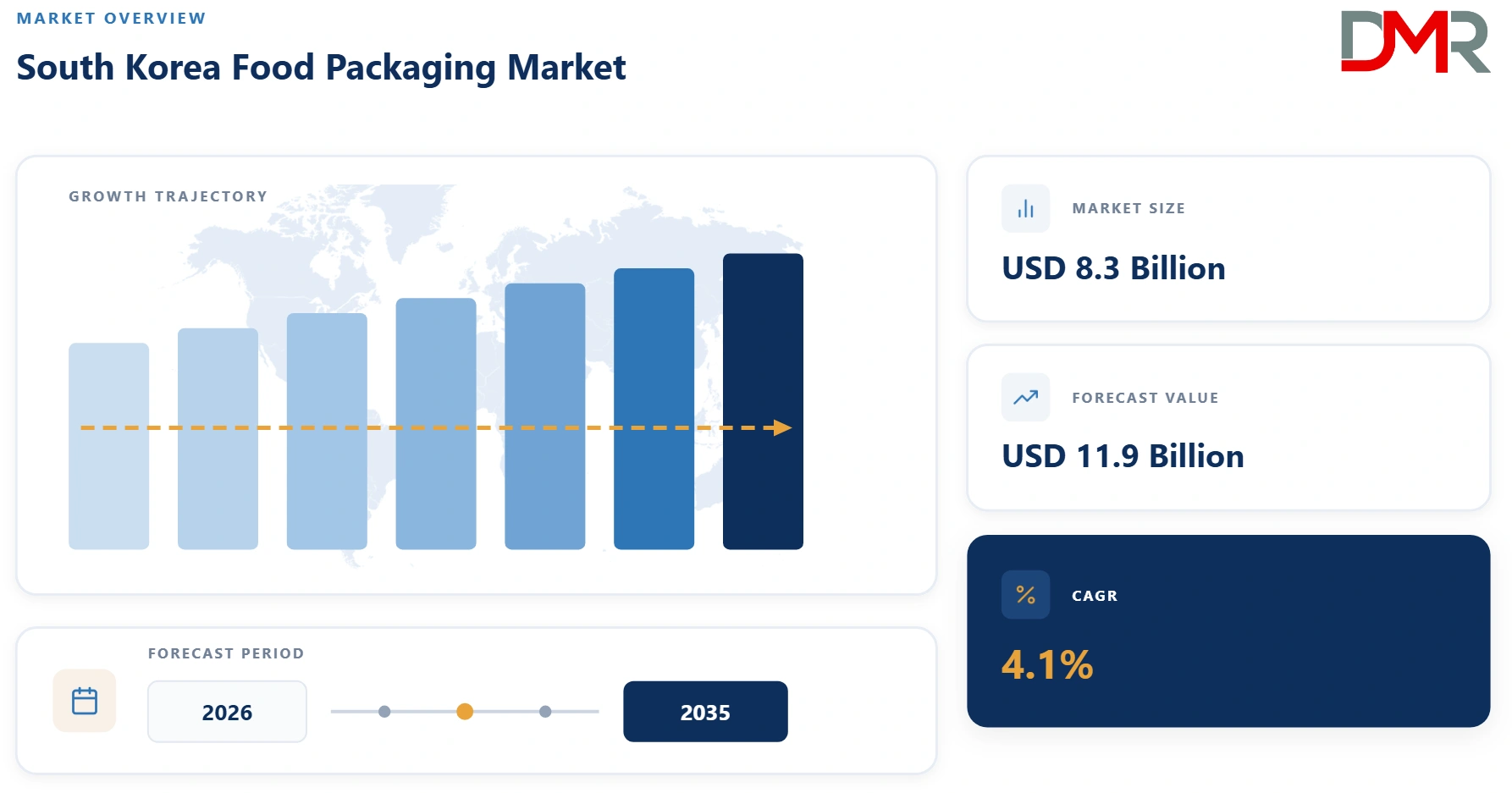
The South Korea food packaging market is estimated at USD 8.3 billion in 2026, rising to approximately USD 11.9 billion by 2035, representing a 4.1% CAGR. The forecast reflects steady food consumption, premiumization, convenience-food penetration, growth in home meal replacement products, online grocery and food delivery, and continued demand for longer shelf life.
ℹ
To learn more about this report –
Download Your Free Sample Report Here
The South Korea food packaging market comprises materials, containers, films, pouches, trays, cartons, bottles, jars, cans and other packaging formats used to protect, preserve, transport, display and dispense food products. The market covers packaging supplied to food manufacturers, processors, retailers, foodservice operators and consumers. Its core value proposition is extending shelf life while protecting food safety, product integrity and convenience. Packaging also supports portion control, branding, logistics efficiency and increasingly important sustainability objectives. The market encompasses conventional plastics, paper-based materials, glass, metals and emerging recyclable, bio-based and compostable alternatives.
Use Cases
- Convenience foods: Microwaveable trays, pouches and containers enable rapid preparation of ready-to-eat and ready-to-cook meals.
- Fresh produce: Trays, films and ventilated containers protect fruits and vegetables while extending freshness during distribution.
- Meat and seafood: High-barrier films and vacuum packaging protect against oxygen exposure, leakage, contamination and premature spoilage.
- Dairy products: Cups, bottles, cartons and multilayer structures provide protection against moisture, light and microbial contamination.
- Bakery products: Films, paperboard cartons and modified-atmosphere packaging preserve texture, appearance and freshness.
- Sauces and condiments: Flexible pouches, squeeze containers and jars improve dispensing convenience while maintaining product stability.
Key Takeaways
- Market Size and Growth: The market is estimated at USD 8.3 billion in 2026 and is projected to reach USD 11.9 billion by 2035, a 4.1% CAGR.
- Growth Drivers: Convenience food, HMR, food delivery, premiumization, shelf-life extension and sustainability requirements are central growth drivers.
- Material Dominance: Plastics remain the largest material category because of their lightweight, barrier, sealing and cost advantages.
- Type Dominance: Flexible packaging leads because pouches and films offer material efficiency, portability and strong suitability for processed and convenience foods.
- Fastest Growth: Paper and paper-based solutions are forecast to expand fastest as brands respond to recyclability requirements and consumer preference for lower-plastic formats.
- Strategic Shift: The market is moving from commodity packaging toward lightweight, recyclable, high-barrier and functionally differentiated solutions.
How AI/Gen AI is Transforming the South Korea Food Packaging Market?
AI, IoT and advanced automation are increasingly being integrated into packaging design, inspection, production and supply-chain management. Machine-vision systems identify seal defects, contamination and dimensional inconsistencies at high production speeds, while IoT sensors monitor temperature, humidity, machine condition and material usage. AI-supported design tools can optimize material thickness, barrier performance and package geometry while reducing development cycles.
The primary benefits are improved yield, lower material waste, predictive maintenance and greater consistency. Smart factories can also synchronize packaging equipment with high-speed food-processing lines, reducing labor dependency and downtime. These technologies increasingly allow packaging producers to offer customized formats without sacrificing manufacturing efficiency.
Key Drivers in the South Korea Food Packaging Market
Growth of Convenience and Ready-to-Eat Food
South Korea's highly urbanized lifestyle and strong convenience-food culture are supporting sustained demand for packaging designed around portability, quick preparation and portion control. Ready-to-eat meals, meal kits, instant foods, snacks and refrigerated or frozen prepared foods require packaging capable of preserving food quality while enabling microwave heating, resealing or easy opening. The continued expansion of convenience channels and online food purchasing further increases demand for durable primary and secondary packaging.
Food Safety and Shelf-Life Extension
Food manufacturers increasingly rely on packaging to minimize contamination, oxygen exposure, moisture migration and physical damage. High-barrier films, vacuum packaging, modified-atmosphere packaging, aseptic formats and advanced sealing systems allow processors to extend shelf life and reduce food losses. This is particularly important for meat, seafood, dairy, processed foods and products moving through longer distribution chains.
Restraints in the South Korea Food Packaging Market
Sustainability Requirements and Recycling Complexity
Increasing environmental scrutiny is creating a fundamental design challenge. Food packaging must simultaneously deliver barrier properties, heat resistance, mechanical strength, food safety and affordability while also becoming easier to recycle. Multilayer structures can provide excellent performance but may be difficult to recover when different materials are bonded together. Paper-based alternatives may also require coatings or barrier treatments that complicate recycling.
Volatile Raw-Material and Conversion Costs
Packaging producers remain exposed to fluctuations in polymer, resin, pulp, aluminum, glass, energy and transportation costs. Food manufacturers, particularly large retailers and private-label producers, exert substantial price pressure, limiting the ability of converters to pass through cost increases immediately. Sustainable materials can also carry higher procurement or qualification costs than established commodity structures.
Growth Opportunities in the South Korea Food Packaging Market
Recyclable and Mono-Material Packaging
The strongest structural opportunity lies in recyclable formats that retain the performance characteristics of conventional multilayer packaging. Mono-material PE and PP films, recyclable barrier papers, lightweight rigid containers and recycled-content solutions can capture increasing demand from food brands seeking compliance and lower environmental impact.
Premium Functional Packaging
Food packaging is increasingly becoming a product-feature platform rather than simply a protective container. Easy-open mechanisms, resealable closures, microwave compatibility, portion control, tamper evidence, high-barrier performance and smart labels create opportunities for premium pricing.
Trends in the South Korea Food Packaging Market
Lightweighting and Material Reduction
Packaging producers are increasingly reducing package thickness, eliminating unnecessary components and optimizing package dimensions without compromising performance. Lightweighting reduces material consumption, transport requirements and production costs while supporting corporate sustainability objectives.
Fiber-Based and Bio-Based Substitution
Paperboard, molded fiber, sugarcane-based materials and bio-based polymers are gaining attention as alternatives to conventional plastic packaging. The shift is strongest where food-contact performance and recycling requirements can be met without materially increasing total system cost.
Research Scope and Analysis
The market is segmented By Material, By Type and By Application. Material analysis evaluates the substrate and material technology; type analysis distinguishes packaging geometry and flexibility; application analysis examines demand generated by major food categories. Shares represent estimated 2026 market value.
ℹ
To learn more about this report –
Download Your Free Sample Report Here
By Material Analysis
Plastics are estimated to dominate the South Korea food packaging market in 2026 with approximately 48% share, supported by their lightweight characteristics, low unit cost, heat-sealing capability, barrier performance and compatibility with high-speed packaging lines. Flexible plastic films and rigid PP/PET/PE containers remain deeply embedded across processed foods, meat, seafood, snacks, dairy and sauces. Paper & Paper-Based packaging is the fastest-growing material segment, with an estimated 6.2% CAGR, driven by recyclability requirements, corporate sustainability targets and consumer preference for lower-plastic formats. Paper-based products are increasingly moving beyond secondary packaging into trays, cartons, sleeves and selected food-contact applications. Glass accounts for an estimated 15% share, retaining strength in sauces, premium foods and products where inertness and premium presentation are important. Metals represent approximately 10%, particularly in cans and shelf-stable food applications, while Others, including molded fiber, bio-based polymers and specialized materials, account for approximately 8%. The shift is therefore not a wholesale replacement of plastic but a gradual migration toward recyclable and resource-efficient structures.
By Type Analysis
Flexible packaging is estimated to lead in 2026 with approximately 44% share, reflecting widespread use of pouches, films, sachets, wraps and bags across snacks, sauces, processed foods, frozen foods and meat products. Flexible formats offer high packaging-to-product ratios, efficient logistics, strong graphics and increasingly sophisticated barrier performance. Rigid packaging holds approximately 39% share and remains critical for bottles, jars, tubs, trays and containers where structural protection, stackability and premium presentation are required. Semi-rigid packaging represents roughly 17% and is particularly relevant to trays, cups and food containers that need more structural stability than films while retaining lower material intensity than conventional rigid formats. Flexible packaging is also expected to remain the fastest-growing type at approximately 4.8% CAGR, supported by lightweighting, resealable designs and demand for convenient meal and snack formats. Continued advances in mono-material films and recyclable barrier structures should allow flexible packaging to retain its market leadership despite regulatory pressure on difficult-to-recycle multilayer films.
By Applicatiom Analysis
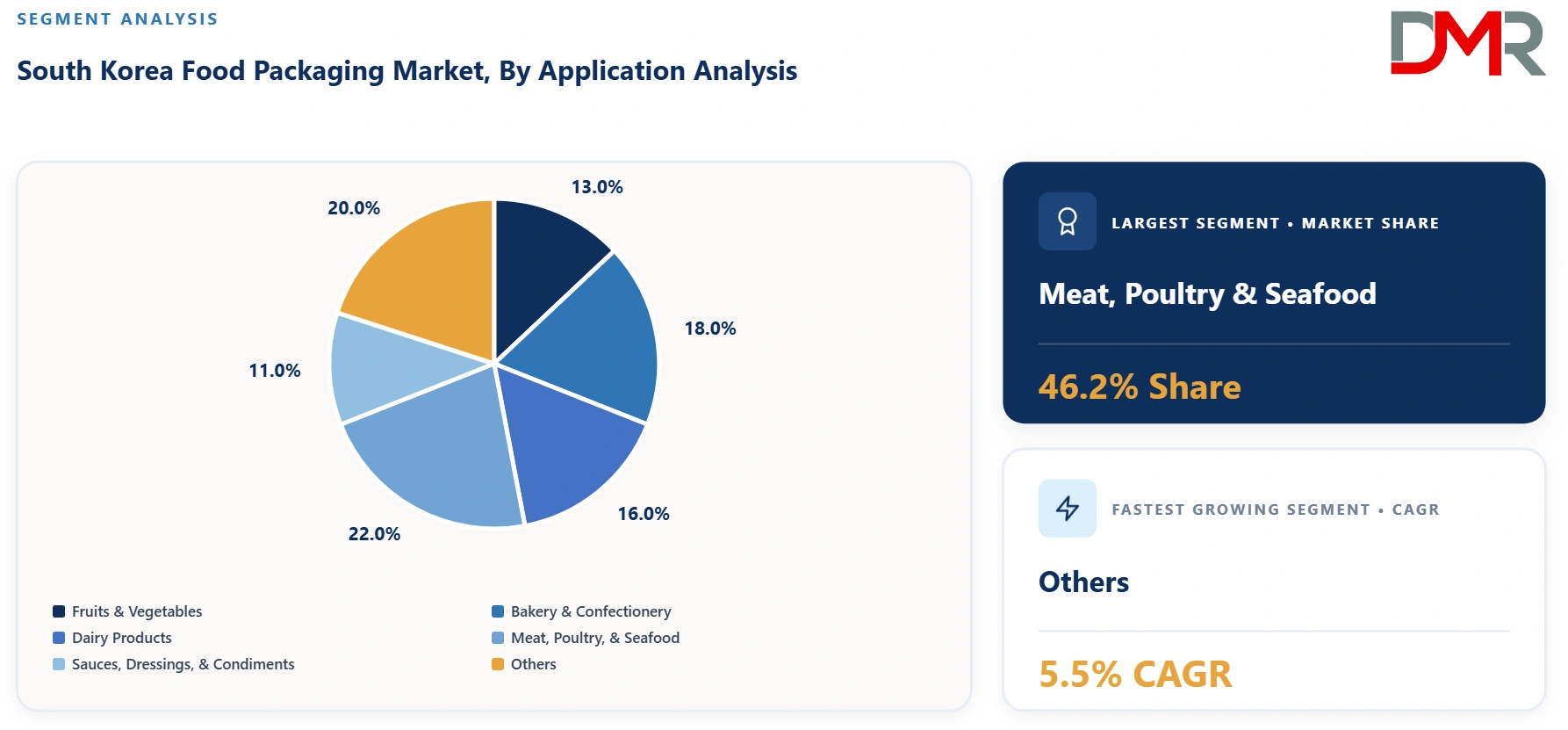
Meat, Poultry & Seafood is estimated to represent the largest application category in 2026 at approximately 22% share, reflecting intensive use of vacuum packs, barrier films, trays, modified-atmosphere packaging and high-integrity sealing. The category benefits from the strong commercial value of shelf-life extension and contamination protection. Bakery & Confectionery represents around 18%, supported by films, paperboard cartons, wrappers and premium presentation formats. Dairy Products account for approximately 16%, with cups, bottles, cartons, films and multilayer structures serving liquid and solid dairy products. Fruits & Vegetables contribute about 13%, with increasing use of ventilated trays, punnets and films designed to manage moisture and respiration. Sauces, Dressings & Condiments represent approximately 11%, supported by jars, squeeze bottles, pouches and single-use sachets. Others, including snacks, prepared foods, instant meals and specialty products, account for approximately 20%. The fastest-growing application is estimated to be ready-to-eat and convenience-oriented products within Others, at roughly 5.5% CAGR, due to meal convenience, food delivery and HMR adoption.
The South Korea Food Packaging Market Report is segmented on the basis of the following:
By Material
- Plastics
- Paper & Paper-Based
- Glass
- Metals
- Others
By Type
- Rigid
- Semi-rigid
- Flexible
By Application
- Fruits & Vegetables
- Bakery & Confectionery
- Dairy Products
- Meat, Poultry, & Seafood
- Sauces, Dressings, & Condiments
- Others
Regulatory Landscape
South Korea's food packaging industry is increasingly shaped by packaging recyclability, material-selection and waste-reduction requirements. The amended packaging material and structure standards effective October 2025 place greater emphasis on recyclability and restrict certain difficult-to-recycle structures where practical alternatives exist.
The regulatory direction creates compliance costs for converters but also expands the addressable market for mono-material films, recyclable paper, recycled-content plastics and simplified package structures. Producers must increasingly consider end-of-life performance during initial package design rather than treating recycling as a post-production issue. Regulatory compliance, food-contact safety and labeling requirements therefore become competitive differentiators.
Companies able to validate recyclability while preserving barrier and thermal performance should gain an advantage in large food-brand tenders, whereas suppliers dependent on complex unrecyclable structures face redesign and qualification risks.
Investment and White Space Analysis
The most attractive investment opportunities are concentrated in high-performance sustainable packaging rather than basic commodity conversion. White spaces include recyclable high-barrier flexible films, mono-material retort structures, paper-based moisture and grease barriers, recycled-content rigid packaging, molded-fiber food trays and packaging designed specifically for microwave and frozen-food cycles. South Korea's sophisticated food-processing ecosystem creates an attractive environment for co-development between food manufacturers, resin producers and converters. CJ CheilJedang's collaboration with Lotte Chemical demonstrates this vertically integrated model, combining food-packaging R&D with material-science capabilities.
Investment risks include technology qualification, uncertain willingness to pay for sustainable materials, raw-material volatility and potential cannibalization between competing substrates. The strongest returns are likely to come from solutions that deliver sustainability and measurable performance or cost benefits.
Competitive Landscape
The South Korea food packaging market is moderately fragmented, combining large domestic food companies, packaging converters, petrochemical/material suppliers and global packaging groups. Competition is based on material performance, price, food safety, conversion efficiency, recyclability, design capability and supply reliability. Major players increasingly pursue partnerships and vertical collaboration because next-generation packaging requires simultaneous optimization of food-processing conditions, material formulation and package engineering. Key competitive participants include CJ CheilJedang, LOTTE Packaging Solutions, LOTTE Wellfood, SPC Group, Dongwon Systems, Amcor, Mondi and Sealed Air. Domestic players benefit from close relationships with Korean food manufacturers, while multinational companies bring advanced material science, global R&D networks and broad product portfolios. Sustainability, lightweighting and functional performance are becoming increasingly important differentiators.
Some of the prominent players in the South Korea Food Packaging Market are:
- CAS Corporation
- Tae Bang Patec
- Green Packing
- Sambo Tech
- Ilshin Autoclave
- Dongwoo Packaging Machinery
- Hanmi Packaging Machinery
- Sungsim Machinery
- Daejin Machinery
- Youngsun Machinery
- Daeyoung Packaging Machinery
- Korea Packaging Machinery
- Sambo Machinery
- Kyung Han Machinery
- Kwang Dong Machinery
- Seoul Packaging Machinery
- Daehan Packaging Machinery
- Hanyang Packaging Machinery
- Jinwoo Machinery
- Sejin Packaging Machinery
- TSK Korea
- Daeyang Machinery
- Shinwoo Machinery
- Dongyang Packaging Machinery
- Hwasung Machinery
- Iljin Packaging Machinery
- Korea Vacuum Machinery
- Taeyang Packaging Machinery
- Hanil Packaging Machinery
- Kyungwon Machinery
- Doosan Bobcat Packaging Solutions
- LG Electronics
- Samsung Electronics
- CJ CheilJedang
- SPC Samlip
- Lotte Engineering & Machinery
- Nongshim Engineering
- Pulmuone
- Orion Corporation
- Ottogi
- Other Key Players
Recent Developments
- June 2026: CJ CheilJedang and Lotte Chemical signed an MOU to jointly develop high-performance food packaging materials designed to withstand extremely low-temperature frozen logistics and high-temperature microwave cooking.
- May 2026: CJ CheilJedang highlighted the application of its PHACT PHA-based materials in food-service packaging, supporting the expansion of bio-based and biodegradable packaging solutions.
- November 2025: Mondi expanded its food-packaging portfolio with additional corrugated and solid-board solutions focused on lightweighting, shelf visibility, sustainability and food-industry compliance.
- September 2025: Amcor showcased reusable cups and lids, lightweighted food containers, recycled-plastic solutions and closure innovations, emphasizing functionality alongside sustainability.
Report Details
| Report Characteristics |
| Market Size (2026) |
USD 8.3 Bn |
| Forecast Value (2035) |
USD 11.9 Bn |
| CAGR (2026–2035) |
4.1% |
| Historical Data |
2021 – 2025 |
| Forecast Data |
2026 – 2035 |
| Base Year |
2025 |
| Segments Covered |
By Material, By Type, By Application |
| Country Coverage |
South Korea |
Frequently Asked Questions
What is the South Korea Food Packaging Market size in 2026?
▾ The South Korea Food Packaging Market is estimated at USD 8.3 billion in 2026, covering major materials, packaging types, and food applications.
What will the South Korea Food Packaging Market size reach by 2035?
▾ The South Korea Food Packaging Market is projected to reach approximately USD 11.9 billion by 2035, driven by convenience foods, premiumization, and sustainable packaging.
What is the CAGR of the South Korea Food Packaging Market?
▾ The South Korea Food Packaging Market is forecast to expand at approximately 4.1% CAGR from 2026 to 2035, supported by sustained packaging demand and innovation.
Which material segment leads the South Korea Food Packaging Market?
▾ Plastics lead the South Korea Food Packaging Market, accounting for an estimated 48% share in 2026 due to cost, lightweight, barrier, and processing advantages.
Which is the fastest-growing segment in the South Korea Food Packaging Market?
▾ Paper & Paper-Based packaging is the fastest-growing segment in the South Korea Food Packaging Market, with an estimated 6.2% CAGR through 2035.
What are the key drivers of the South Korea Food Packaging Market?
▾ The South Korea Food Packaging Market is primarily driven by convenience foods, HMR, food delivery, shelf-life extension, food safety, premiumization, and recyclable packaging demand.
Who are the key players in the South Korea Food Packaging Market?
▾ Key players in the South Korea Food Packaging Market include CJ CheilJedang, LOTTE Packaging Solutions, LOTTE Wellfood, SPC Group, Dongwon Systems, Amcor, Mondi, and Sealed Air.
What are the major trends in the South Korea Food Packaging Market?
▾ Major trends in the South Korea Food Packaging Market include lightweighting, mono-material structures, recyclable packaging, fiber-based alternatives, smart manufacturing, and high-performance barrier technologies.