South Korea Food Processing Equipment Market Snapshot
- Market Size in 2026: USD 2.16 Billion
- Market Size in 2035: USD 3.28 Billion
- CAGR from 2026 to 2035: 4.8%
- Leading Equipment Type Segment in 2026: Heat Processing Equipment, 27% share
- Leading Mode of Operation Segment in 2026: Automatic, 57% share
- Leading Form of End Product Segment in 2026: Solid, 43% share
- Fastest-Growing Segment: Automatic Equipment, 6.2% CAGR
What is the South Korea Food Processing Equipment and its Market Size?
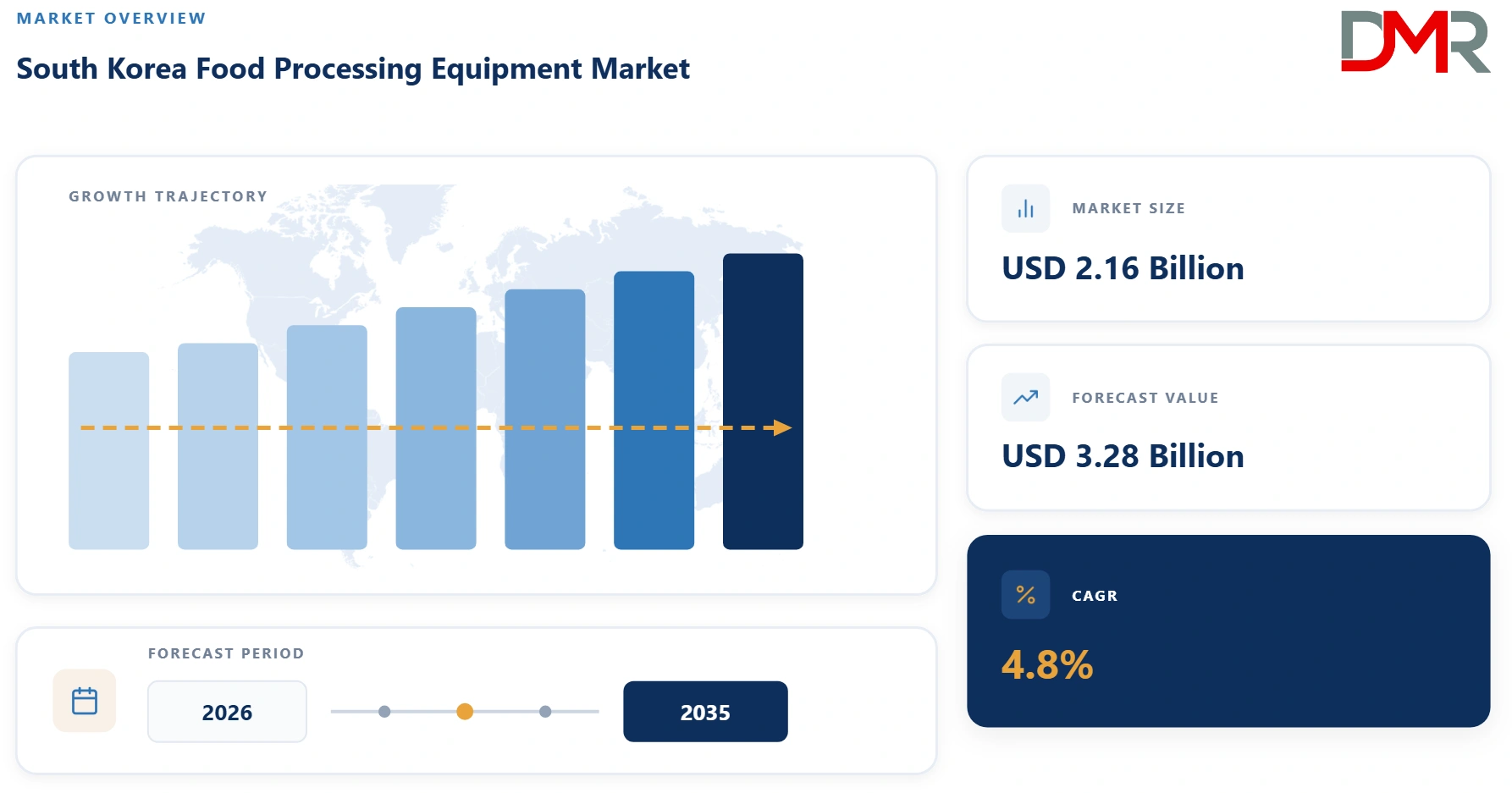
The South Korea food processing equipment market is estimated at USD 2.16 billion in 2026 and is projected to reach approximately USD 3.28 billion by 2035, representing a 4.8% CAGR.
ℹ
To learn more about this report –
Download Your Free Sample Report Here
South Korea food processing equipment comprises machinery, systems, automation platforms, and integrated production lines used to convert agricultural, animal, marine, and other food ingredients into processed, packaged, and preserved food products. The market encompasses preparation equipment such as washing, peeling and sorting systems; mechanical machinery including cutters, grinders and mixers; thermal equipment such as ovens, pasteurizers and sterilizers; preservation systems; and filling, sealing and packaging equipment.
It serves food manufacturers across dairy, bakery, meat, seafood, beverages, convenience foods, fruits and vegetables, grains, oils and emerging alternative-protein categories. The market's primary value proposition is higher throughput, consistent product quality, food safety, labor productivity, traceability, and lower operating costs.
Use Cases
- Automated meal production: Integrated lines manufacture ready-to-eat and ready-to-cook meals with consistent portioning, cooking, cooling and packaging.
- Dairy processing: Pasteurization, homogenization, separation and filling systems improve safety, shelf life and product consistency.
- Meat and poultry processing: Cutting, grinding, mixing, cooking, chilling and inspection equipment increases throughput and yield.
- Bakery production: Automated mixing, forming, proofing, baking, cooling and packaging systems support large-volume commercial production.
- Beverage manufacturing: Blending, filtration, pasteurization, filling and packaging technologies enable high-speed beverage production.
- Alternative-protein processing: Extrusion, fermentation, mixing and thermal systems support plant-based and novel-protein product development.
Key Takeaways
- Market size: The market is estimated at USD 2.16 billion in 2026, reaching USD 3.28 billion by 2035.
- Growth rate: The market is expected to expand at approximately 4.8% CAGR during 2026-2035.
- Key drivers: Labor-cost pressure, food-safety requirements, convenience-food growth, export manufacturing, automation and smart-factory investment.
- Segment dominance: Heat processing equipment leads equipment categories, while automatic machinery dominates by operating mode.
- Fastest growth: Automatic equipment is projected to grow approximately 6.2% annually, reflecting demand for integrated controls, robotics, sensors and production analytics.
- Competitive structure: The market remains relatively fragmented, with domestic machinery suppliers competing alongside major international technology providers.
How AI/Gen AI is Transforming the South Korea Food Processing Equipment Market?
AI, industrial IoT, machine vision, robotics, cloud connectivity and advanced automation are increasingly embedded in Korean food-processing equipment. Sensors collect temperature, pressure, vibration, moisture, throughput and quality information, while machine-vision systems inspect products and packaging. AI-based analytics can identify deviations, optimize process parameters and support predictive maintenance.
The principal benefits are improved equipment utilization, lower labor dependency, reduced waste, more consistent quality, faster changeovers and greater traceability. Tetra Pak's research indicates that highly automated beverage factories can achieve higher overall equipment effectiveness, lower product waste and fewer packaging-line stoppages.
Key Drivers in the South Korea Food Processing Equipment Market
Accelerating Automation and Labor Productivity
South Korea's highly developed manufacturing economy is experiencing persistent pressure to improve labor productivity, particularly in food manufacturing where repetitive activities such as sorting, filling, packing, inspection and material handling remain labor intensive. Rising wage costs, workforce aging and difficulty recruiting production workers encourage processors to replace manual operations with automated machinery, robotics and integrated production lines.
Growth of Processed, Convenience and Export-Oriented Foods
Korean consumers increasingly purchase convenience foods, ready meals, packaged beverages, processed seafood, bakery products, sauces and other value-added products. Meanwhile, Korean food manufacturers are expanding overseas, increasing the need for scalable, standardized production technology capable of meeting export-market quality and traceability requirements.
Restraints in the South Korea Food Processing Equipment Market
High Capital Cost and Long Equipment Payback
Advanced food-processing systems require substantial upfront investment, particularly where manufacturers purchase complete automated lines rather than individual machines. High-speed packaging, aseptic processing, robotic handling, machine vision and integrated digital-control platforms can require extensive engineering, installation and validation. This is particularly challenging for smaller Korean processors, which may have limited access to capital and less predictable production volumes.
Integration Complexity and Skilled-Workforce Requirements
Automation does not eliminate technical workforce requirements; it changes them. Food manufacturers need engineers and technicians capable of integrating PLCs, sensors, robotics, machine vision, MES platforms and data systems while maintaining stringent hygienic standards. Legacy equipment can also lack standardized connectivity, making integration expensive.
Growth Opportunities in the South Korea Food Processing Equipment Market
Smart Factories and AI-Enabled Production
The expansion of smart-food factories provides one of the strongest opportunities for equipment vendors. Instead of selling standalone machinery, suppliers can offer complete digital production architectures connecting preparation, processing, packaging, inspection, utilities and maintenance. AI can then optimize recipes, detect anomalies and forecast component failures.
Energy-Efficient and Sustainable Processing
Energy-intensive operations such as cooking, pasteurization, drying, refrigeration and cooling represent a major opportunity for efficiency-focused equipment suppliers. Korean food manufacturers face increasing pressure to lower energy consumption and carbon emissions while maintaining production economics.
Trends in the South Korea Food Processing Equipment Market
From Standalone Machines to Integrated Production Platforms
Food manufacturers increasingly want connected lines rather than isolated machines. Suppliers are combining processing, automation, data management, quality control and lifecycle services into integrated platforms. This trend reduces integration complexity and gives producers a single point of responsibility for plant performance.
Sustainability is Becoming a Procurement Criterion
Energy, water, waste and carbon performance are increasingly considered alongside throughput and purchase price. Food processors are seeking machinery that lowers utility consumption, shortens cleaning cycles, reduces product losses and improves resource efficiency.
Research Scope and Analysis
The South Korea food processing equipment market is segmented by Equipment Type, Mode of Operation, Form of End Product, and Application. These dimensions capture the equipment technology purchased, degree of automation, physical characteristics of processed products, and the major downstream food industries generating equipment demand.
ℹ
To learn more about this report –
Download Your Free Sample Report Here
By Equipment Type Analysis
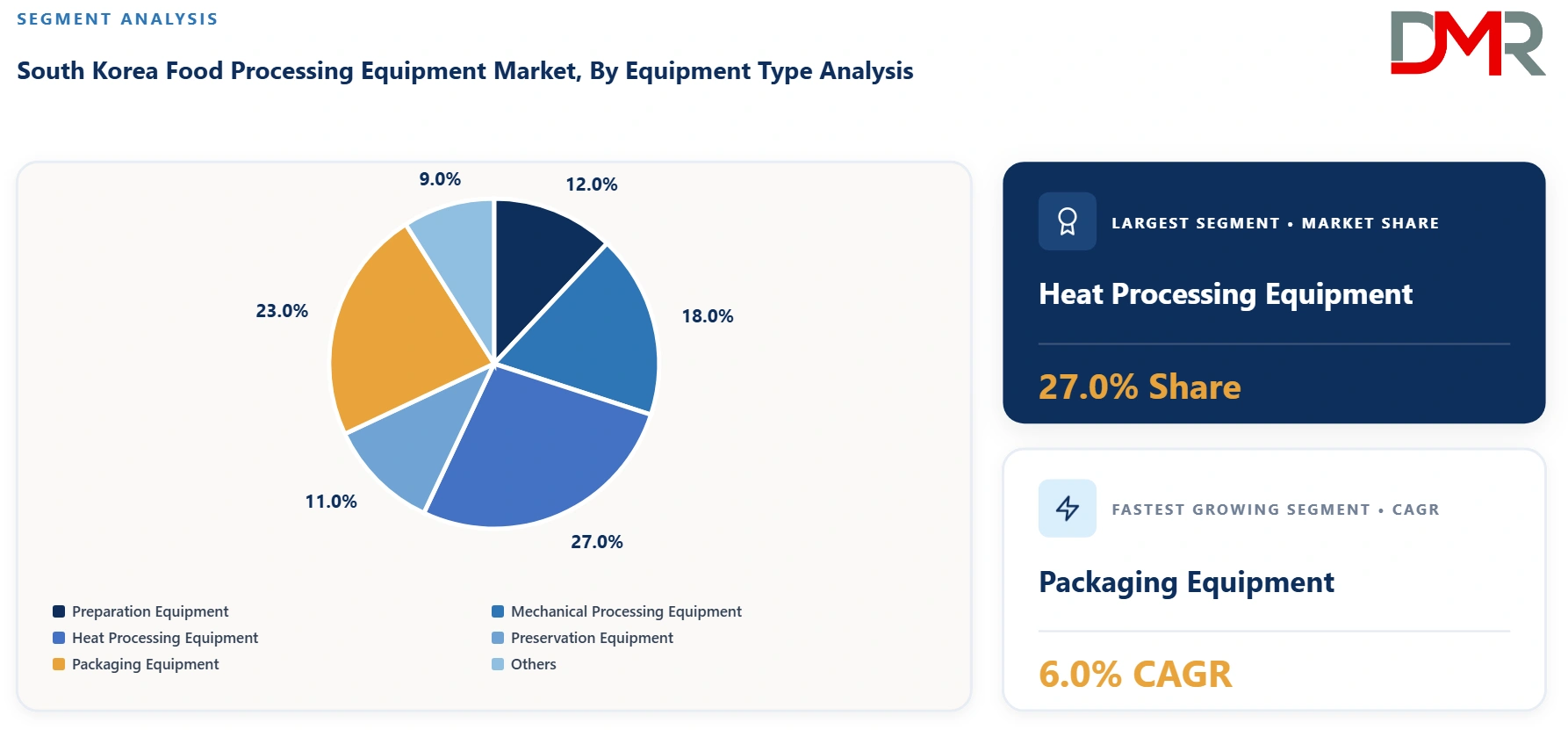
Heat Processing Equipment is estimated to be the dominant equipment category in 2026, accounting for approximately 27% of market value. The segment includes ovens, cookers, pasteurizers, sterilizers, blanchers and related thermal systems, benefiting from broad use across dairy, beverages, prepared foods, bakery, sauces and meat products. Thermal processing remains fundamental to food safety, shelf-life extension and product consistency. Packaging Equipment represents the second-largest category at approximately 23%, supported by growing ready-to-eat foods, beverages and export-oriented packaged products. Mechanical Processing Equipment accounts for about 18%, covering cutting, slicing, grinding, mixing and forming machinery. The fastest-growing equipment sub-segment is Packaging Equipment, estimated at approximately 6.0% CAGR, as processors adopt high-speed filling, inspection, MAP, aseptic and automated end-of-line systems. Preparation equipment represents around 12%, preservation equipment 11%, and other equipment approximately 9%. The opportunity is increasingly concentrated in integrated equipment packages rather than single-machine purchases.
By Mode of Operation Analysis
Automatic equipment dominates the market in 2026 with an estimated 57% share, reflecting South Korea's advanced industrial infrastructure, high labor productivity requirements and strong adoption of robotics, PLC-based controls, machine vision and connected manufacturing systems. Semi-Automatic equipment represents approximately 29%, remaining important among SMEs and processors upgrading individual production steps without committing to complete automated lines. Manual equipment accounts for roughly 14%, concentrated in smaller businesses, specialty production and applications where product variability or low volumes make automation economically less attractive. Automatic equipment is projected to be the fastest-growing sub-segment at approximately 6.2% CAGR, driven by labor shortages, smart-factory subsidies, predictive maintenance and demand for traceable production. The increasing availability of modular automation should also allow smaller processors to automate gradually rather than through large one-time investments. The market is therefore moving from basic mechanical automation toward digitally integrated, sensor-rich production systems.
By Form of End Product Analysis
Solid products lead this segment with an estimated 43% share in 2026, supported by large production volumes of bakery products, instant noodles, processed meat, seafood, frozen foods, snacks and prepared meals. Solid food processing requires extensive preparation, cutting, forming, cooking, cooling and packaging equipment, creating broad machinery demand. Liquid products hold approximately 34%, driven by beverages, dairy, sauces, soups, liquid ingredients and functional drinks. The liquid category is expected to be the fastest-growing form at approximately 5.6% CAGR, reflecting expansion of beverages, dairy alternatives, functional formulations and aseptic products. Semi-solid products represent around 23%, including sauces, spreads, pastes, yogurt, fillings and processed ingredients. Demand in this segment is increasingly influenced by high-shear mixing, homogenization, precise dosing and hygienic processing. Equipment flexibility is becoming especially important because Korean producers increasingly manufacture multiple formulations on the same line.
By Application Analysis
Ready-to-Eat & Ready-to-Cook Foods represent the largest application category, with an estimated 19% share in 2026, reflecting demand for convenience, portion-controlled meals and shelf-life-enhanced products. Dairy Products account for approximately 15%, followed by Bakery & Confectionery at 13%, Meat & Poultry at 12%, and Beverages at 12%. The fastest-growing application is estimated to be Ready-to-Eat & Ready-to-Cook Foods at approximately 6.1% CAGR, supported by convenience consumption, foodservice demand and export opportunities. Fish & Seafood contributes around 7%, Fruits & Vegetables 9%, Grains & Pulses 5%, Edible Oils 4%, and other applications 4%. Korean manufacturers increasingly require flexible equipment capable of short production runs and frequent recipe changes. Export expansion also raises demand for validated thermal processing, automated inspection and packaging systems that can deliver consistent quality across domestic and international markets.
The South Korea Food Processing Equipment Market Report is segmented on the basis of the following:
By Equipment Type
- Preparation Equipment
- Mechanical Processing Equipment
- Heat Processing Equipment
- Preservation Equipment
- Packaging Equipment
- Others
By Mode of Operation
- Automatic
- Semi-Automatic
- Manual
By Form of End Product
By Application
- Dairy Products
- Bakery & Confectionery
- Meat & Poultry
- Fish & Seafood
- Fruits & Vegetables
- Grains & Pulses
- Beverages
- Ready-to-Eat & Ready-to-Cook Foods
- Edible Oils
- Others
Regulatory Landscape
South Korea's food-processing equipment market is strongly influenced by food-safety, hygiene, labeling, traceability and manufacturing requirements overseen by authorities including the Ministry of Food and Drug Safety. The regulatory environment creates recurring demand for hygienically designed equipment, automated monitoring, cleaning-in-place systems, validated thermal processes and digital traceability.
Regulatory compliance is both a market driver and a cost consideration: equipment manufacturers must provide food-contact-compatible materials, sanitary design, documentation and reliable control systems. Future opportunities are strongest for suppliers offering compliance-ready automation rather than commodity machinery. Risks include certification delays, customization costs and changing requirements for emerging food technologies. Equipment capable of automatically recording critical process parameters should gain competitive advantage because it reduces manual documentation and supports auditable production.
Investment and White Space Analysis
Investment opportunities are concentrated in smart automation, flexible production lines, sustainable thermal processing, inspection, packaging and alternative-food processing. South Korea's government has explicitly increased support for smart food factories and food-tech R&D, while regional programs are helping food-industry SMEs deploy sensors, inspection systems and data analytics.
White space exists between sophisticated multinational systems and lower-cost conventional machinery: modular, mid-priced automation for Korean SMEs is relatively attractive. Another opportunity lies in retrofit solutions that connect legacy machines to modern factory-management systems, avoiding full-line replacement. Energy-reduction equipment also offers attractive economics as manufacturers seek lower operating costs. Key investment risks include long capital-payback periods, cyclicality of food-manufacturing capex, dependence on imported components and competition from Japanese, European and increasingly capable Chinese machinery suppliers. Suppliers combining financing, modularity, local service and measurable ROI should be best positioned to capture incremental demand.
Competitive Landscape
The South Korea food processing equipment market is fragmented, despite the presence of major multinational suppliers with strong positions in specialized technologies. Domestic suppliers compete effectively in customized machinery, price-sensitive projects and local service, while multinational companies differentiate through advanced processing technology, automation, engineering expertise and global lifecycle support. Competition is increasingly based on energy efficiency, throughput, digital connectivity, hygiene, total cost of ownership and after-sales support rather than initial machine price alone.
Some of the prominent players in the South Korea Food Processing Equipment Market are:
- Hyupjin Machinery
- Samjin Machinery
- Hanyoung Food Machinery
- Daesung Machinery
- Sung An Machinery
- Daeheung Machinery
- Seowon Machinery
- Dongyang Machinery
- Samwon Engineering
- Seoho Machinery
- SFA Engineering
- Shinyoung Mechanics
- Korea Food Machinery
- Dongbu Food Machinery
- Kukje Machinery
- Saehan Machinery
- Shinhan Machinery
- Hanil Food Machinery
- Pyeonghwa Machinery
- Daewon Food Machinery
- Samyang Corporation
- LS Mtron
- Doosan Corporation
- Hyundai Heavy Industries
- CJ CheilJedang
- Nongshim
- Ottogi
- Daesang Corporation
- Sempio Foods
- Pulmuone
- Lotte Food
- Harim
- Dongwon F&B
- SPC Samlip
- Bühler Group
- GEA Group
- Tetra Pak
- Krones
- JBT Corporation
- Marel
- Other Key Players
Recent Developments
- May 2026: Bühler introduced multiple upgrades to its Grains & Food portfolio, incorporating hygienic design, automation, digital solutions and AI, including energy-saving technologies for chocolate and bakery processing.
- November 2025: Tetra Pak launched Factory OS, a modular automation and digitalization portfolio designed to connect equipment and factory data and create AI-ready food and beverage production environments.
- September 2025: Krones presented its Ingeniq automated production-line concept and expanded process and packaging capabilities, emphasizing data connectivity, resource efficiency, automation and lifecycle performance.
- April 2025: GEA introduced its NEXUS approach for integrated heating and cooling, targeting lower energy use and carbon emissions in food, dairy and beverage processing plants.
- March 2025: GEA highlighted its collaboration with South Korean food producer Pulmuone on a modernized naengmyeon production process, demonstrating how customized extrusion technology can reduce water and electricity use while maintaining traditional product characteristics.
Report Details
| Report Characteristics |
| Market Size (2026) |
USD 2.16 Bn |
| Forecast Value (2035) |
USD 3.28 Bn |
| CAGR (2026–2035) |
4.8% |
| Historical Data |
2021 – 2025 |
| Forecast Data |
2026 – 2035 |
| Base Year |
2025 |
| Segments Covered |
By Equipment Type, By Mode of Operation, By Form of End Product, By Application |
| Country Coverage |
South Korea |
Frequently Asked Questions
What is the size of the South Korea Food Processing Equipment Market?
▾ The South Korea Food Processing Equipment Market is estimated at USD 2.16 billion in 2026 and is projected to reach approximately USD 3.28 billion by 2035.
What CAGR is expected for the South Korea Food Processing Equipment Market?
▾ The South Korea Food Processing Equipment Market is estimated to grow at approximately 4.8% CAGR from 2026 to 2035.
What are the key growth drivers for the South Korea Food Processing Equipment Market?
▾ The South Korea Food Processing Equipment Market is driven by automation, labor productivity, food-safety requirements, convenience foods, exports, equipment replacement and smart-factory investments.
Which equipment segment leads the South Korea Food Processing Equipment Market?
▾ Heat Processing Equipment leads the South Korea Food Processing Equipment Market, accounting for approximately 27% of the market in 2026, followed by packaging equipment.
Which operating mode is growing fastest in the South Korea Food Processing Equipment Market?
▾ Automatic equipment is the fastest-growing segment of the South Korea Food Processing Equipment Market, with an estimated 6.2% CAGR, supported by robotics, AI and smart manufacturing.
What are the major trends in the South Korea Food Processing Equipment Market?
▾ Major trends in the South Korea Food Processing Equipment Market include connected production lines, AI-enabled quality control, predictive maintenance, sustainable processing and digital traceability.
Who are the key players in the South Korea Food Processing Equipment Market?
▾ Key players in the South Korea Food Processing Equipment Market include Tetra Pak, GEA, Bühler, Krones, JBT Marel, Alfa Laval and SPX FLOW, alongside domestic manufacturers.
How is the South Korea Food Processing Equipment Market segmented?
▾ The South Korea Food Processing Equipment Market is segmented by Equipment Type, Mode of Operation, Form of End Product and Application, covering processing through packaging equipment.