South Korea Shipbuilding Robotics Market Snapshot
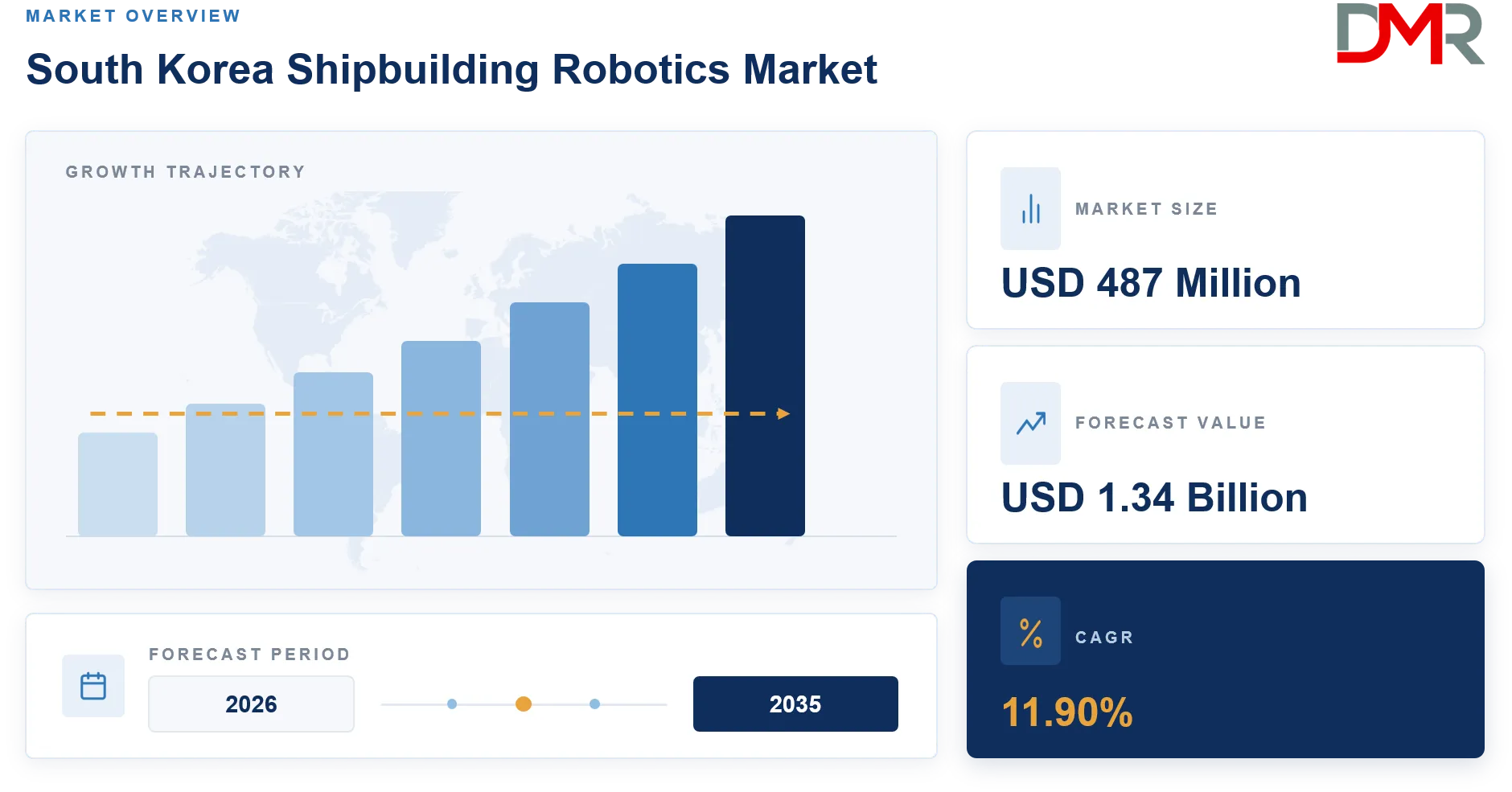
- Market Value: The South Korea shipbuilding robotics market is valued at USD 487 million in 2026 and is projected to reach USD 1.34 billion by 2035.
- CAGR: The South Korea shipbuilding robotics market is expected to grow at a CAGR of 11.9% from 2026 to 2035.
- By Robot Type Segment Analysis: Articulated robots dominated the robot type segment with a 42.0% share in 2026.
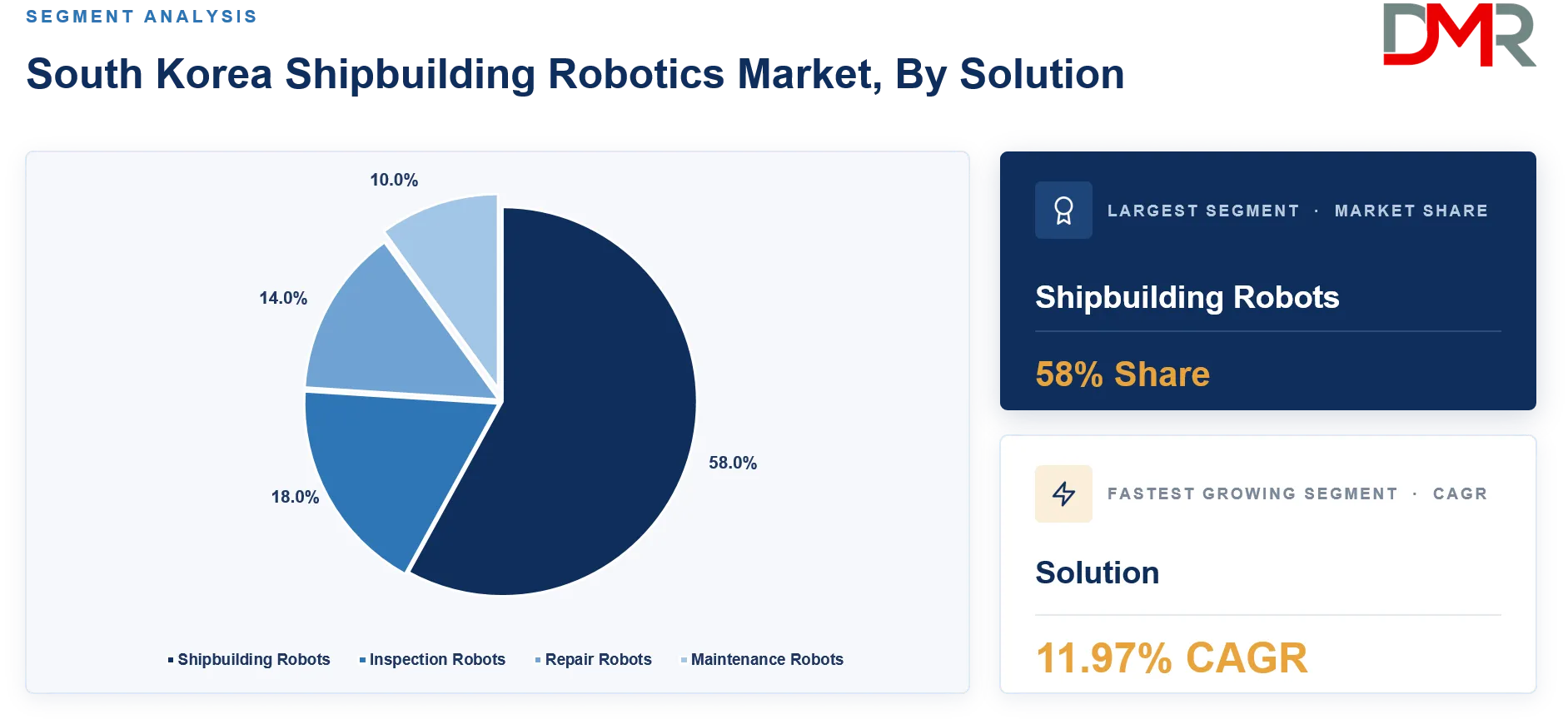
- By Solution Segment Analysis: Shipbuilding robots led the solution segment with a 58.0% share in 2026.
- By Application Segment Analysis: Welding held a 46.0% share of the South Korea shipbuilding robotics market in 2026.
- Major Players: HD Korea Shipbuilding & Offshore Engineering, HD Hyundai Heavy Industries, and Others.
What is the South Korea Shipbuilding Robotics Market and its Market Size?
The South Korea Shipbuilding Robotics Market size is projected to be valued at USD 487 million in 2026 and is projected to reach USD 1.34 billion by 2035, expanding at a CAGR of 11.9% during the forecast period. The forecast represents an increase of about USD 853 million in annual market value over nine years. Growth is being supported by automation of welding, steel processing, hull fabrication, material handling, inspection, coating, logistics, and other production tasks across large Korean shipyards.
ℹ
To learn more about this report –
Download Your Free Sample Report Here
South Korea has an unusually strong environment for shipbuilding robotics because major shipbuilders, industrial robot suppliers, system integrators, welding specialists, and smart manufacturing developers operate within the same industrial ecosystem. HD Korea Shipbuilding & Offshore Engineering, HD Hyundai Heavy Industries, HD Hyundai Samho, Samsung Heavy Industries, and Hanwha Ocean are important demand-side entities, while companies such as HD Hyundai Robotics, Rainbow Robotics, JCT, Diden Robotics, NeoArc Robotics, SP Systems, and other technology developers support the expanding automation supply chain.
In 2026, articulated robots generated an estimated USD 204.5 million based on their 42.0% market share. Shipbuilding robot solutions represented approximately USD 282.5 million, while welding applications accounted for about USD 224.0 million. South Korea's 17.5% share of Asia Pacific shipbuilding robotics revenue also indicates an implied regional market of approximately USD 2.78 billion in 2026, highlighting the country's substantial position within the wider Asian shipyard automation landscape.
Use Cases
- Automated Ship Welding: Shipyards deploy robotic welding systems for hull fabrication, panel welding, module joining, structural assembly, deck work, and pipe welding. Robots can maintain repeatable torch positioning and process parameters over long weld paths. This use case is particularly important in South Korea because welding represents 46.0% of the shipbuilding robotics market in 2026.
- Hull and Structural Fabrication: Articulated robots can support cutting, forming, positioning, joining, and finishing of large steel structures used in commercial ships, cargo vessels, naval ships, and offshore vessels. Their multi-axis movement allows shipyards to automate complex fabrication tasks while integrating robotic systems with fixtures, positioners, sensors, controllers, and laser seam tracking equipment.
- Inspection and Maintenance: Inspection robots can support visual examination, weld verification, surface monitoring, confined-space inspection, and maintenance planning. Mobile and sensor-equipped platforms can reach difficult areas while collecting production data. This creates opportunities for shipyards seeking more consistent quality control across hull blocks, engine rooms, structural assemblies, coating operations, and final inspection stages.
- Automated Material Movement: Automated guided vehicles and autonomous mobile robots are increasingly relevant for moving tools, components, steel parts, consumables, and other materials between workshops and assembly areas. Shipyards can connect mobile robots with production schedules and digital control systems, reducing unnecessary movement while supporting more predictable logistics across large and complex construction sites.
- Painting and Coating: Robotic painting and coating systems can be applied to repetitive surface preparation and coating processes where stable movement, controlled application, and worker safety are important. Shipbuilding environments contain large steel surfaces and difficult work zones, creating demand for robotic systems that can assist with coating consistency while reducing exposure to fumes, overspray, and physically demanding tasks.
How AI/Gen AI is Transforming the South Korea Shipbuilding Robotics Market?
Artificial intelligence is moving shipbuilding robotics from programmed repetition toward adaptive production. Traditional robots perform predefined movements effectively when components remain in fixed positions. Ship construction is more variable because large steel blocks, weld seams, surfaces, and assembly conditions can differ between vessels. Machine vision, sensor fusion, seam recognition, adaptive path planning, and data-based process control help robots respond to these variations. In South Korean shipyards, this is especially relevant to welding, inspection, logistics, and structural fabrication, where robots must operate around large components and changing production layouts.
Generative and data-driven systems also create opportunities to connect design information with robotic execution. Shipyards can use production data, digital models, welding specifications, inspection records, and equipment performance data to improve task planning and robot programming. Over time, these systems can reduce the engineering effort required to configure robots for low-volume, high-complexity vessels. The commercial opportunity extends beyond robot hardware to controllers, sensors, laser seam tracking systems, software, simulation tools, fleet management, quality analytics, and integrated automation platforms.
Key Drivers in the South Korea Shipbuilding Robotics Market
Pressure to Automate Labor-Intensive Shipyard Processes
Shipbuilding requires large volumes of skilled welding, cutting, assembly, coating, and inspection work. Many of these tasks are repetitive, physically demanding, or performed in difficult production environments. Robotics allows Korean shipbuilders to shift selected processes from manual execution toward repeatable automated workflows. Demand is strongest where automation can increase equipment utilization, stabilize quality, reduce physical workload, and support production capacity without relying entirely on additional skilled labor.
Expansion of Smart and Digitally Connected Shipyards
South Korea's shipbuilding robotics growth is closely connected with smart shipyard investment. Robot installations become more valuable when linked with digital design systems, production scheduling, sensors, computer vision, manufacturing software, and automated logistics. Major shipbuilders are progressively integrating these technologies across fabrication and assembly operations. This creates demand not only for robotic arms but also for software, controllers, seam tracking, mobile platforms, positioners, control systems, and system integration services.
Restraints in the South Korea Shipbuilding Robotics Market
Complexity of Automating Customized Ship Construction
Ships are large, highly engineered products built in relatively low volumes compared with automobiles or consumer electronics. Production environments change as blocks move between fabrication, assembly, outfitting, coating, and inspection stages. Variations in weld geometry, component positioning, confined spaces, and work sequences can reduce the effectiveness of fixed automation. Robot suppliers must therefore provide flexible sensing, mobility, programming, fixtures, and process controls, which raises integration complexity for shipyards and subcontractors.
High Integration and Deployment Requirements
Shipbuilding robots rarely operate as standalone machines. Effective deployment can require welding equipment, controllers, sensors, vision systems, laser seam tracking, software, fixtures, positioners, safety systems, production data interfaces, and skilled integration. The cost and engineering effort can be significant for smaller shipyards and subcontractors. Return on investment also varies by application, making careful process selection important before robotic automation is expanded across an entire construction stage.
Growth Opportunities in the South Korea Shipbuilding Robotics Market
Mobile and Flexible Robotics for Large Shipyards
Autonomous mobile robots, automated guided vehicles, collaborative robots, and mobile manipulators provide a major growth opportunity because shipbuilding work does not remain within one fixed production cell. Robots that can travel between work areas and perform welding, handling, inspection, or logistics tasks can address a wider portion of shipyard operations. Improvements in localization, navigation, machine vision, wireless connectivity, battery systems, and safety controls should expand the commercial potential of flexible automation.
Robotics for Inspection, Maintenance, and Retrofit Projects
Robotics demand is expected to extend beyond new vessel construction. Inspection, repair, maintenance, and retrofit projects create opportunities for robotic platforms equipped with cameras, sensors, scanning systems, and specialized tools. These technologies can support condition assessment, weld inspection, coating checks, repair preparation, and maintenance planning. As commercial ships and offshore assets require upgrades during their operating lives, robotic service applications can create recurring demand outside traditional shipbuilding cycles.
Trends in the South Korea Shipbuilding Robotics Market
Shift from Fixed Automation to Collaborative and Adaptive Robots
The South Korea shipbuilding robotics market is moving toward systems that can operate closer to workers and adapt to variable tasks. Collaborative robots offer easier redeployment for selected welding and assembly applications, while advanced sensing helps robots identify workpieces and adjust movement. Articulated robots continue to lead with 42.0% share in 2026, yet collaborative robots and mobile platforms are becoming strategically important where shipyards need flexibility rather than permanently installed robotic cells.
Integration of Robotics with Digital Production Systems
Robot value is increasingly determined by how effectively equipment connects with the broader production environment. Shipyards are linking automation with digital design data, manufacturing planning, sensors, inspection systems, logistics platforms, and quality monitoring. This trend increases demand for integrated robotic automation systems rather than isolated machines. Software, control systems, laser seam tracking, digital simulation, and production analytics are therefore becoming important parts of South Korea's shipbuilding automation value chain.
Research Scope and Analysis
The South Korea Shipbuilding Robotics Market is segmented based on robot type, solution, application, welding application, ship type, end user, construction stage, component, and automation level. The study provides an in-depth analysis of key segments and sub-segments, covering their applications, industry adoption, demand patterns, competitive relevance, and contribution to overall market growth.
ℹ
To learn more about this report –
Download Your Free Sample Report Here
By Robot Type
Articulated robots led the South Korea shipbuilding robotics market with a 42.0% share in 2026, equivalent to approximately USD 204.5 million. Their market position is supported by multi-axis flexibility and suitability for welding, cutting, assembly, coating, handling, and other processes requiring precise tool orientation. Ship structures contain curved surfaces, long seams, large panels, and complex joints, making articulated movement valuable. Collaborative robots are emerging for flexible work cells, while AGVs and AMRs address logistics and mobile automation across large production areas.
By Solution
Shipbuilding robots accounted for 58.0% of the market in 2026, representing approximately USD 282.5 million. The segment covers robotic systems used directly in vessel fabrication and assembly, where the volume of welding, cutting, positioning, material handling, and structural work creates a strong automation case. Inspection, repair, and maintenance robots form complementary markets that can grow as shipyards extend robotics from initial production into quality assurance and lifecycle support. This creates opportunities for specialized sensors, mobile platforms, software, and service-oriented robotic solutions.
By Application
Welding held 46.0% of the South Korea shipbuilding robotics market in 2026, equal to approximately USD 224.0 million. Welding is central to hull fabrication, structural assembly, panel production, module joining, deck construction, and piping. Robotic welding systems can combine manipulators with welding power sources, sensors, seam tracking, positioners, controllers, and process software. Cutting, painting, material handling, inspection, assembly, and logistics provide additional growth areas as shipbuilders expand automation beyond welding-intensive production lines.
The South Korea Shipbuilding Robotics Market Report is segmented on the basis of the following:
By Robot Type
- Articulated Robots
- Collaborative Robots
- Cartesian Robots
- Automated Guided Vehicles
- Autonomous Mobile Robots
- Other Robot Types
By Solution
- Shipbuilding Robots
- Inspection Robots
- Repair Robots
- Maintenance Robots
By Application
- Welding
- Cutting
- Assembly
- Painting and Coating
- Material Handling
- Inspection and Maintenance
- Logistics
- Other Applications
By Welding Application
- Hull Fabrication
- Structural Assembly
- Panel Welding
- Module Welding
- Deck Assembly
- Pipe Welding
By Ship Type
- Commercial Ships
- Cargo Ships
- Military and Naval Ships
- Offshore Vessels
- Recreational Boats
- Ferries
- Research Vessels
By End User
- Major Shipbuilders
- Shipyards
- Shipbuilding Subcontractors
- Offshore Engineering Companies
- Commercial Marine Builders
- Offshore Vessel Manufacturers
- Retrofit Projects
By Construction Stage
- Steel Processing
- Fabrication Yard Operations
- Hull Assembly
- Engine Room Installation
- Bridge Installation
- Structural Assembly
- Painting and Coating
- Final Inspection
By Component
- Robotic Systems
- Welding Equipment
- Controllers
- Control Systems
- Sensors
- Laser Seam Tracking Systems
- Software
- Fixtures and Positioners
- Other Components
By Automation Level
- Manual and Computer Numerical Control Systems
- Integrated Automation Systems
- Modular Automation Systems
- Robotic Automation Systems
Competitive Landscape
The South Korea shipbuilding robotics market combines large shipbuilding groups, industrial robot manufacturers, specialist robotics developers, system integrators, software companies, and emerging intelligent automation firms. HD Korea Shipbuilding & Offshore Engineering, HD Hyundai Heavy Industries, HD Hyundai Samho, Samsung Heavy Industries, and Hanwha Ocean influence demand through shipyard modernization and process automation.
HD Hyundai Robotics has a strategic position in industrial robot systems and shipbuilding-focused automation, while Rainbow Robotics expands the competitive landscape through collaborative and advanced mobile robotic technologies. Smaller specialists including JCT, Diden Robotics, NeoArc Robotics, SP Systems, Gore Robotics, Ucast, A-Robot, Vazil Company, and others can compete through application expertise, integration flexibility, software, sensing, autonomous platforms, or specialized welding solutions. Competitive advantage increasingly depends on complete solutions that combine hardware with welding equipment, controllers, sensors, seam tracking, software, fixtures, mobility, and production integration.
Some of the prominent players in the South Korea Shipbuilding Robotics Industry are:
- HD Korea Shipbuilding & Offshore Engineering (HD KSOE)
- HD Hyundai Heavy Industries (HD HHI)
- HD Hyundai Samho
- Samsung Heavy Industries (SHI)
- Hanwha Ocean
- J Ocean Heavy Industries
- HD Hyundai Robotics
- Rainbow Robotics
- JCT Co., Ltd.
- Diden Robotics
- NeoArc Robotics
- NC AI
- Gore Robotics
- SP Systems Co., Ltd.
- Allforland
- Ucast
- Endotlight
- A-Robot
- Persona AI
- Vazil Company
- Others
Technology Analysis
Technology development in the South Korea shipbuilding robotics market is shifting from fixed robotic cells toward flexible systems designed for large, variable shipyard environments. Articulated robots, which held 42.0% market share in 2026, remain important for welding, cutting, assembly, and coating because their multi-axis motion supports complex steel structures. Adoption is expanding around collaborative robots, autonomous mobile robots, machine vision, laser seam tracking, force sensing, digital twins, and adaptive welding controls. HD Hyundai Heavy Industries, Samsung Heavy Industries, Hanwha Ocean, and other Korean shipbuilders are advancing smart shipyard strategies that connect robotics with production data and digital manufacturing systems. The technology opportunity is also moving toward integrated platforms combining robotic systems, welding equipment, controllers, sensors, software, fixtures, and positioners. This integration can help robots recognize seam variation, optimize movement, support quality inspection, and operate across hull fabrication, panel welding, module assembly, logistics, and maintenance workflows.
Investment and White Space Analysis
Investment opportunities in the South Korea shipbuilding robotics market extend beyond conventional robotic arms as the market grows from USD 487 million in 2026 to USD 1.34 billion by 2035. Welding already represents 46.0% of market revenue, making advanced welding automation commercially attractive, while less automated processes create additional white space. Inspection robots, repair robots, maintenance platforms, autonomous mobile robots, painting systems, confined-space robotics, and retrofit solutions offer room for specialized suppliers. Opportunities are also emerging in laser seam tracking, machine vision, sensors, robot programming software, fleet management, digital simulation, fixtures, and intelligent control systems. Smaller shipyards and subcontractors create another underserved segment because they require modular automation with lower integration costs than large shipbuilders. Technology vendors can also target retrofit projects and offshore vessels, where mobile and adaptable systems may deliver greater value than fixed automation. Partnerships with major Korean shipbuilders can provide validation pathways for solutions intended for wider Asia Pacific deployment.
Recent Developments
- July 2026: Samsung Heavy Industries, SP Systems, Allforland and Gore Robotics joined a consortium to automate shipyard logistics, targeting autonomous handling and last-mile material movement through pilot projects.
- March 2026: Samsung Heavy Industries commissioned its 6,500-square-metre Pipe Robofab, an automated plant integrating AI vision, logistics, machining, measurement, alignment and welding to produce about 100,000 pipe spools annually.
- December 2025: HD Hyundai Samho and HD Hyundai Robotics signed an MOU to co-develop, validate and standardize shipbuilding-specific automation, combining robotic, machine-vision and AI technologies for smart-factory production.
Report Details
| Report Characteristics |
| Market Size (2026) |
USD 487 Mn |
| Forecast Value (2035) |
USD 1.34 Bn |
| CAGR (2026–2035) |
11.9% |
| Historical Data |
2021 – 2025 |
| Forecast Data |
2027 – 2035 |
| Base Year |
2025 |
| Estimate Year |
2026 |
| Segments Covered |
By Robot Type (Articulated Robots, Collaborative Robots, Cartesian Robots, Automated Guided Vehicles, Autonomous Mobile Robots, and Other Robot Types), By Solution (Shipbuilding Robots, Inspection Robots, Repair Robots, and Maintenance Robots), By Application (Welding, Cutting, Assembly, Painting and Coating, Material Handling, Inspection and Maintenance, Logistics, and Other Applications), By Welding Application (Hull Fabrication, Structural Assembly, Panel Welding, Module Welding, Deck Assembly, and Pipe Welding), By Ship Type (Commercial Ships, Cargo Ships, Military and Naval Ships, Offshore Vessels, Recreational Boats, Ferries, and Research Vessels), By End User (Major Shipbuilders, Shipyards, Shipbuilding Subcontractors, Offshore Engineering Companies, Commercial Marine Builders, Offshore Vessel Manufacturers, and Retrofit Projects), By Construction Stage (Steel Processing, Fabrication Yard Operations, Hull Assembly, Engine Room Installation, Bridge Installation, Structural Assembly, Painting and Coating, and Final Inspection), By Component (Robotic Systems, Welding Equipment, Controllers, Control Systems, Sensors, Laser Seam Tracking Systems, Software, Fixtures and Positioners, and Other Components), By Automation Level (Manual and Computer Numerical Control Systems, Integrated Automation Systems, Modular Automation Systems, and Robotic Automation Systems) |
| Regional Coverage |
South Korea |
Frequently Asked Questions
What is the current size of the South Korea Shipbuilding Robotics Market?
▾ The South Korea shipbuilding robotics market size is valued at USD 487 million in 2026 and may reach USD 1.34 billion by 2035.
What is the growth rate of the South Korea Shipbuilding Robotics Market during?
▾ The South Korea shipbuilding robotics market is forecast to grow at an 11.9% CAGR from 2026 through 2035.
What factors are driving the growth of the South Korea Shipbuilding Robotics Market?
▾ Smart shipyards, welding automation, labor efficiency, and digital tools drive South Korea shipbuilding robotics demand.
What are the major challenges restraining the South Korea Shipbuilding Robotics Market?
▾ High costs, custom ship designs, variable work areas, and integration needs restrain South Korea shipbuilding robotics.
Which segment holds the largest share of the South Korea Shipbuilding Robotics Market?
▾ Articulated robots lead the South Korea shipbuilding robotics market with a 42.0% share by robot type in 2026.
Who are the leading companies in the global South Korea Shipbuilding Robotics Market?
▾ HD Korea Shipbuilding & Offshore Engineering (HD KSOE), HD Hyundai Heavy Industries (HD HHI), HD Hyundai Samho, Samsung Heavy Industries (SHI), Hanwha Ocean, J Ocean Heavy Industries, HD Hyundai Robotics, Rainbow Robotics, JCT Co., Ltd., Diden Robotics, NeoArc Robotics, NC AI, Gore Robotics, SP Systems Co., Ltd., Allforland, Ucast, Endotlight, A-Robot, Persona AI, and Vazil Company are prominent companies in the South Korea shipbuilding robotics market.
How is AI influencing the South Korea Shipbuilding Robotics Market?
▾ AI advances South Korea shipbuilding robotics with machine vision, seam tracking, adaptive welding, and inspection.
What are the future opportunities and trends in the South Korea Shipbuilding Robotics Market?
▾ Mobile robots, smart welding, digital shipyards, inspection, and retrofits offer South Korea market opportunities.