Spain Oil Processing Equipment Market Snapshot
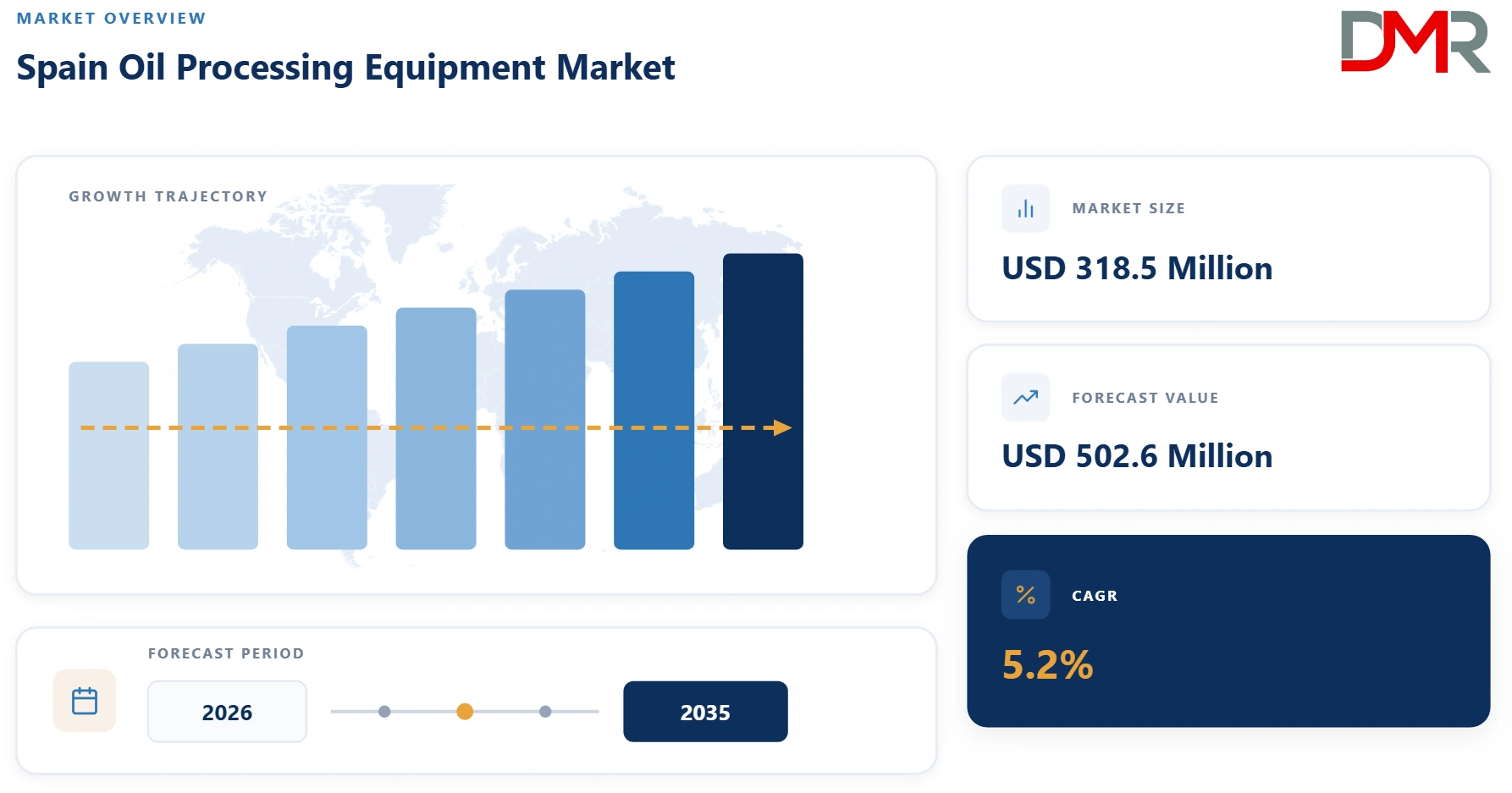
- Spain Oil Processing Equipment Market Size in 2026: USD 318.5 million
- Spain Oil Processing Equipment Market Size in 2035: USD 502.6 million
- Spain CAGR from 2026 to 2035: 5.2%
- Oil Pressing and Extraction Equipment is the leading equipment segment in 2026: 30.8%
- Olive Oil is the leading oil type segment in 2026: 72.4%
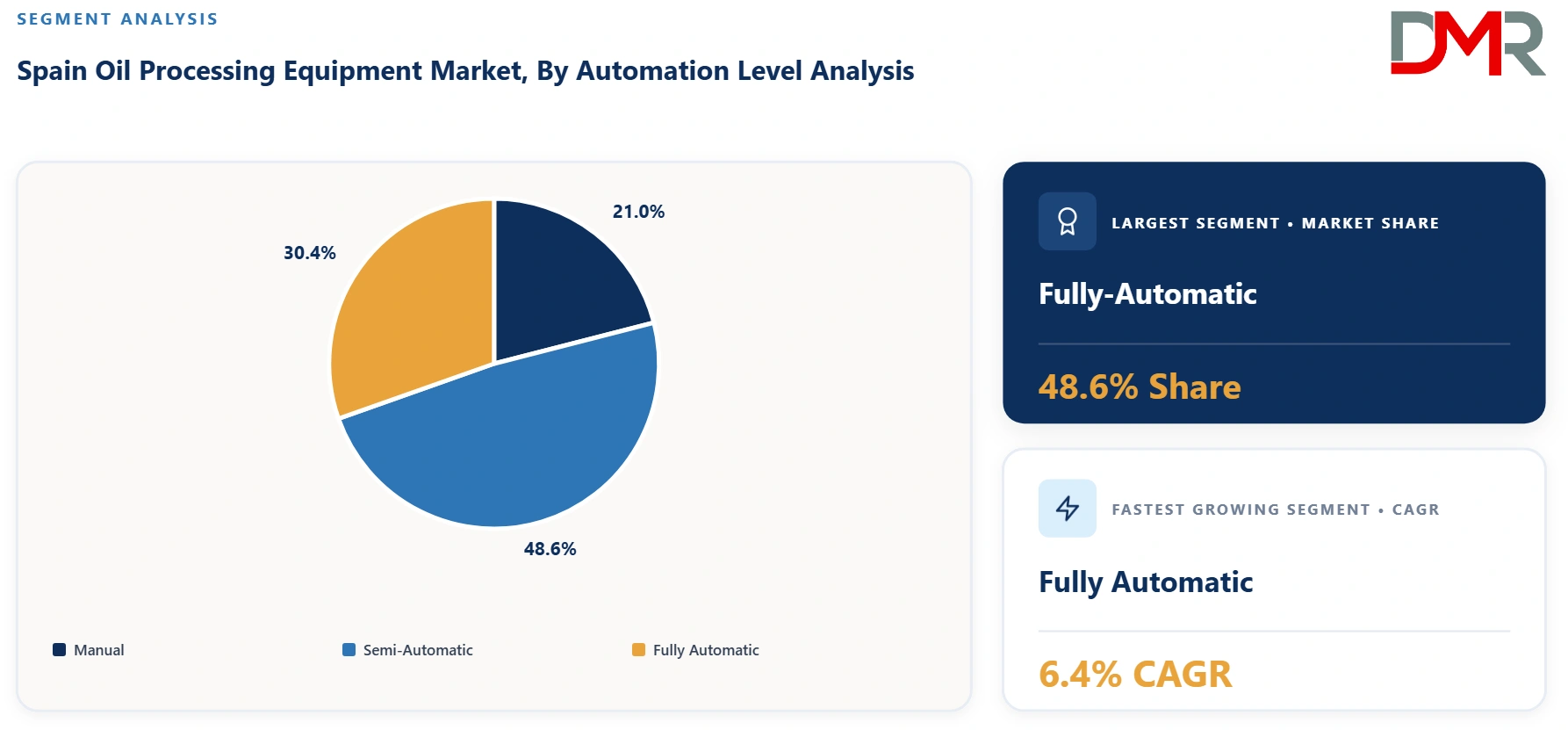
- Semi-Automatic is the leading automation level segment in 2026: 48.6%
- Olive Oil Mills is the leading end-user segment in 2026: 55.2%
What is the Spain Oil Processing Equipment Market and Its Market Size?
The Spain Oil Processing Equipment Market is projected to reach USD 318.5 million in 2026 and grow at a compound annual growth rate of 5.2% until 2035 to reach USD 502.6 million.
ℹ
To learn more about this report –
Download Your Free Sample Report Here
Oil processing equipment comprises machines and integrated production systems used for preparing raw materials, crushing, pressing, extraction, separation, centrifugation, filtration, refining, storage, filling, and packaging. Spain represents a prominent equipment market because of its globally significant olive oil industry and established sunflower, soybean, rapeseed, corn, and specialty oil processing activities. Demand is supported by mill modernization, automation, quality improvement, resource efficiency, and processing-capacity expansion.
Use Cases
- Olive Oil Extraction: Spanish olive oil mills use cleaning systems, crushers, malaxers, decanter centrifuges, vertical separators, filtration units, and storage systems to convert harvested olives into virgin and extra virgin olive oil. Modern extraction lines improve yield, control processing temperature, reduce water consumption, preserve phenolic content, support traceability, and maintain product quality during intensive seasonal production periods.
- Edible Oil Refining: Industrial edible oil manufacturers deploy degumming, neutralization, bleaching, deodorization, winterization, filtration, and vacuum-processing equipment to improve the quality of crude sunflower, soybean, rapeseed, palm, and corn oils. These systems remove impurities, undesirable odors, pigments, waxes, and free fatty acids while helping processors achieve food-safety, consistency, shelf-life, and regulatory requirements.
- Specialty and Organic Oil Production: Small and medium-sized processors use compact presses, batch extraction equipment, low-temperature filtration systems, and semi-automatic filling lines to produce organic olive oil, avocado oil, nut oils, seed oils, and other premium products. Flexible systems allow producers to process smaller batches, preserve nutritional characteristics, maintain product identity, and serve premium retail, foodservice, cosmetic, and export markets.
- Oil Filling and Packaging: Oil producers use automated rinsing, filling, capping, labeling, inspection, case-packing, and palletizing equipment for glass bottles, plastic containers, metal cans, and bag-in-box formats. Integrated packaging lines reduce product losses, improve filling accuracy, support rapid format changes, increase throughput, strengthen traceability, and help Spanish manufacturers respond efficiently to domestic retail and international export requirements.
Key Takeaways
- Market Size: The Spain Oil Processing Equipment Market is anticipated to be valued at USD 318.5 million in 2026 and is forecast to reach USD 502.6 million by 2035, expanding at a CAGR of 5.2%.
- Growth Outlook: Market growth is supported by the modernization of olive mills, expanding use of continuous extraction systems, rising demand for premium oils, automation of seasonal processing, export-oriented production, energy-efficiency improvements, equipment replacement, stricter quality standards, and investment in advanced filtration, separation, refining, and packaging technologies.
- Primary Growth Drivers: Spain’s large olive oil processing industry, increasing production efficiency requirements, adoption of automated centrifugation, rising labor costs, growing organic oil production, sustainability targets, water conservation, digital monitoring, predictive maintenance, improved process control, and demand for higher extraction yields are accelerating equipment investment.
- By Equipment Type Analysis: Oil Pressing and Extraction Equipment is projected to lead with a 30.8% share in 2026, supported by extensive demand for crushers, malaxers, presses, decanters, and continuous extraction lines. Filtration Equipment is expected to record the highest CAGR of approximately 5.8% through 2035.
- By Oil Type Analysis: Olive Oil is anticipated to dominate with a 72.4% share in 2026, reflecting Spain’s leading position in global olive oil production. Other Specialty Oils are expected to grow at the highest CAGR of approximately 6.1%, supported by premium, organic, cold-pressed, nut, seed, and functional oil products.
- By Automation Level Analysis: Semi-Automatic equipment is projected to hold the largest share of 48.6% in 2026, owing to its balance of production efficiency, investment cost, flexibility, and suitability for cooperatives and medium-sized mills. Fully Automatic equipment is expected to register the highest CAGR of approximately 6.4%.
- By End User Analysis: Olive Oil Mills are anticipated to lead with a 55.2% share in 2026 because of Spain’s extensive olive-processing infrastructure. Specialty and Organic Oil Producers are projected to record the highest CAGR of approximately 6.0%, driven by premiumization and increasing demand for differentiated oils.
How AI and GenAI Are Transforming the Spain Oil Processing Equipment Market?
Artificial intelligence is improving extraction control, quality inspection, predictive maintenance, production scheduling, and energy management across Spanish oil mills. AI-enabled systems analyze temperature, moisture, olive maturity, paste consistency, flow rates, centrifuge performance, and oil quality to recommend operating adjustments. Machine vision identifies defective raw materials and packaging irregularities, while predictive analytics reduces unexpected equipment downtime during short harvesting seasons. Generative AI can assist operators with maintenance instructions, troubleshooting, production reports, and equipment configuration. Digital twins further enable processors to simulate throughput, energy consumption, yield, and production-line changes before implementing physical modifications.
Key Drivers in the Spain Oil Processing Equipment Market
Spain’s Large Olive Oil Production Base
Spain’s globally significant olive oil sector creates recurring demand for extraction, centrifugation, filtration, storage, and packaging equipment. The International Olive Council estimated Spanish olive oil production at approximately 1.419 million tonnes during the 2024–2025 crop year, representing an increase of around 66% from the preceding season. This production scale requires mills to maintain high throughput during concentrated harvesting periods while protecting oil quality. Equipment upgrades are therefore focused on faster processing, reduced oxidation, controlled temperatures, improved separation, and higher recovery. Large cooperatives and industrial mills are also investing in continuous systems to manage fluctuating harvest volumes and strengthen export competitiveness.
Need for Higher Yield and Resource Efficiency
Rising energy, water, maintenance, and labor costs are encouraging Spanish processors to replace aging machinery with efficient integrated lines. Advanced crushers, malaxers, decanters, separators, heat exchangers, and filtration systems can improve oil recovery while reducing wastewater and product losses. Alfa Laval reported that its vacuum-based Olive Oil Booster installation at Spain’s Coselva cooperative increased premium extra virgin olive oil extraction by 10% and polyphenol content by 20%. These measurable productivity and quality gains strengthen the business case for modern equipment. Processors are increasingly evaluating machinery based on lifetime operating costs, water consumption, cleaning requirements, energy intensity, maintenance intervals, and the ability to recover valuable oil from by-products.
Restraints in the Spain Oil Processing Equipment Market
High Initial Investment and Seasonal Utilization
Advanced extraction lines, industrial decanters, automatic separators, refining plants, and integrated packaging systems require substantial capital expenditure. This creates adoption barriers for small mills, family-owned processors, and agricultural cooperatives with restricted financing capacity. Olive processing is also highly seasonal, meaning expensive machinery may remain underutilized outside the harvesting period. Returns can be affected by fluctuating crop volumes, weather conditions, olive prices, energy costs, and export demand. Smaller processors frequently extend the operating life of existing equipment or purchase individual machines instead of complete production lines. Financing support, equipment leasing, modular systems, retrofitting services, and shared processing facilities are therefore important for expanding adoption.
Technical Complexity and Skilled Workforce Shortages
Modern oil processing lines combine mechanical extraction, automation software, sensors, programmable controllers, quality-monitoring systems, and connected maintenance platforms. Operating these systems requires knowledge of oil chemistry, process engineering, electrical controls, data interpretation, food safety, and equipment maintenance. Small and rural mills may face difficulties recruiting technicians with these combined capabilities. Integration challenges are also common when new centrifuges, filtration systems, or digital controls must operate alongside older crushers, pumps, tanks, and filling equipment. Improper configuration can reduce yield or negatively affect oil quality. Equipment suppliers must consequently provide training, remote support, commissioning, spare parts, and dependable maintenance services throughout the harvesting season.
Growth Opportunities in the Spain Oil Processing Equipment Market
Modernization of Small and Cooperative Olive Mills
Spain has a broad base of cooperatives and independent olive mills that creates a sizable opportunity for modular modernization. Suppliers can offer scalable equipment packages covering washing, crushing, malaxation, extraction, filtration, storage, and filling without requiring complete facility replacement. Retrofit sensors, automated dosing systems, variable-speed drives, energy-monitoring platforms, and connected maintenance solutions can improve existing lines at comparatively manageable costs. Compact two-phase decanters and flexible batch-processing equipment are particularly relevant for cooperatives processing multiple olive varieties. Vendors that combine machinery with financing, operator training, seasonal maintenance, remote diagnostics, and performance guarantees can access customers that may otherwise postpone major capital investments.
Expansion of Premium, Organic, and Specialty Oils
Increasing interest in organic extra virgin olive oil, cold-pressed oils, avocado oil, nut oils, seed oils, and functional blends is creating opportunities for flexible processing equipment. Specialty producers require gentle crushing, low-temperature extraction, batch segregation, fine filtration, inert-gas storage, and precise filling systems that protect aroma, nutrients, and product identity. These applications generally involve smaller production volumes but higher product value, supporting investment in compact and adaptable machinery. Export-oriented producers also need traceability, quality inspection, tamper-evident packaging, and rapid format changes. Equipment manufacturers can develop modular lines for multiple raw materials and offer hygienic designs that reduce cross-contamination and cleaning time between production batches.
Trends in the Spain Oil Processing Equipment Market
Continuous Extraction and Advanced Centrifugation
Spanish mills are increasingly replacing traditional pressing and older three-phase systems with continuous two-phase extraction technologies. Modern decanters provide higher throughput, improved separation, reduced process-water requirements, lower wastewater generation, and better control over oil quality. Equipment designs are also being optimized for Spain’s large mills, where high seasonal processing capacity and continuous operation are essential. Flottweg’s Z6E Oleum Max 350, for example, is designed for very-high-capacity olive oil production and can process up to 350 tonnes per day. Suppliers are also developing flexible decanters capable of managing first extraction and pomace recovery, enabling mills to improve asset utilization and capture additional value from processing residues.
Connected, Automated, and Sustainable Processing Lines
Automation is expanding from individual machines to integrated oil-processing environments. Sensors continuously monitor temperature, flow, vibration, torque, moisture, pressure, and energy use, allowing operators to adjust production and detect developing equipment problems. Cloud-connected service platforms support remote diagnostics and predictive maintenance, which are valuable during time-sensitive harvest campaigns. Suppliers are also improving hygienic design, clean-in-place systems, heat recovery, variable-speed drives, water recycling, and by-product utilization. Fully automatic lines reduce dependence on manual labor while generating traceable production data. Demand is therefore shifting toward equipment that simultaneously improves yield, quality, uptime, energy efficiency, environmental performance, and regulatory compliance.
Research Scope and Analysis
This report analyzes Spain oil processing equipment market across cleaning and preparation, crushing and grinding, pressing and extraction, separation and centrifugation, filtration, refining, filling and packaging, oil categories, automation levels, olive oil mills, edible oil manufacturers, oilseed crushers, food producers, cooperatives, specialty processors, market dynamics, competition, technology, regulation, trade, investment, opportunities, trends, forecasts, through 2035, outlook.
ℹ
To learn more about this report –
Download Your Free Sample Report Here
By Equipment Type Analysis
Oil Pressing and Extraction Equipment is projected to dominate with a 30.8% market share in 2026, driven by extensive installation of presses, malaxers, and decanter-based extraction systems. Filtration Equipment is expected to register the highest CAGR of approximately 5.8%. Growth is supported by premium oil production, improved clarity requirements, and greater adoption of membrane and automated filtration technologies.
By Oil Type Analysis
Olive Oil is expected to lead the market with a 72.4% share in 2026, supported by Spain’s extensive olive cultivation, processing infrastructure, cooperatives, and export-oriented production. Other Specialty Oils are projected to grow at the highest CAGR of approximately 6.1%. Growth is driven by demand for cold-pressed, organic, seed, nut, avocado, and functional oils.
By Automation Level Analysis
Semi-Automatic equipment is anticipated to account for the largest share of 48.6% in 2026, owing to its affordability, operational flexibility, and suitability for medium-sized processors and cooperatives. Fully Automatic equipment is expected to record the highest CAGR of approximately 6.4%. Labor constraints, digital monitoring, process consistency, and predictive maintenance are accelerating adoption.
By End User Analysis
Olive Oil Mills are projected to dominate the market with a 55.2% share in 2026, reflecting Spain’s large olive-processing base and recurring equipment replacement requirements. Specialty and Organic Oil Producers are expected to register the highest CAGR of approximately 6.0%. Premiumization, product differentiation, organic certification, and export opportunities are supporting investment among specialized processors.
The Spain Oil Processing Equipment Market Report Is Segmented Based on the Following
By Equipment Type
- Cleaning and Preparation Equipment
- Crushing and Grinding Equipment
- Oil Pressing and Extraction Equipment
- Separation and Centrifugation Equipment
- Filtration Equipment
- Refining Equipment
- Filling and Packaging Equipment
- Others
By Oil Type
- Olive Oil
- Sunflower Oil
- Soybean Oil
- Rapeseed Oil
- Palm Oil
- Corn Oil
- Other Specialty Oils
By Automation Level
- Manual
- Semi-Automatic
- Fully Automatic
By End User
- Olive Oil Mills
- Edible Oil Manufacturers
- Oilseed Crushing Companies
- Food and Beverage Manufacturers
- Agricultural Cooperatives
- Specialty and Organic Oil Producers
- Others
Technology Analysis
Technology development in Spain’s oil processing equipment market centers on two-phase extraction, high-capacity decanters, automated separators, vacuum-assisted malaxation, membrane filtration, digital process control, and connected maintenance. These technologies improve extraction yield, preserve polyphenols, reduce oxidation, and lower water and energy consumption. Opportunities exist in retrofitting existing mills with sensors, variable-speed drives, intelligent controls, and cloud-based monitoring. However, integrating advanced equipment with older production lines can create interoperability and workforce-training risks. Technology adoption will gradually shift competition from basic machinery pricing toward measurable performance, lifecycle efficiency, product quality, remote service availability, and the ability to process different olive varieties and specialty oil raw materials.
Regulatory Landscape
Spain’s equipment market is influenced by European Union food hygiene, machinery safety, food-contact material, environmental, traceability, and packaging requirements. Equipment must support sanitary processing, effective cleaning, contamination prevention, temperature control, worker protection, and accurate production records. EU environmental policies are also encouraging reduced water consumption, improved energy efficiency, waste minimization, recyclable packaging, and productive use of olive pomace and wastewater. These requirements create opportunities for hygienic machinery, clean-in-place systems, resource-monitoring software, energy-efficient drives, and by-product recovery equipment. However, compliance increases engineering, certification, installation, and documentation costs. Suppliers offering validated equipment, regulatory guidance, operator training, and traceability integration can strengthen their competitive position among Spanish processors.
Competitive Landscape
The Spain Oil Processing Equipment Market includes global process-technology groups, specialist olive-oil machinery manufacturers, Spanish engineering companies, packaging-line suppliers, and filtration providers. Competition is based on extraction yield, throughput, oil quality, energy and water efficiency, automation, customization, equipment reliability, and after-sales support. Alfa Laval, GEA, Pieralisi, Flottweg, Amenduni Nicola, and HAUS compete strongly in extraction and separation. Local engineering and packaging suppliers address cooperative and medium-sized processors. Vendors are expanding digital monitoring, predictive maintenance, modular equipment, turnkey integration, operator training, and rapid seasonal service capabilities.
Some of the Prominent Players in the Spain Oil Processing Equipment Market Are
- Alfa Laval AB
- GEA Group AG
- Pieralisi Group
- Flottweg SE
- Amenduni Nicola S.p.A.
- HAUS Centrifuge Technologies
- Calderería Manzano S.A.
- Mori-Tem S.r.l.
- TEM S.p.A.
- Rapanelli Fioravante S.p.A.
- Vitone Eco S.r.l.
- Andreotti Impianti S.p.A.
- Technoilogy S.r.l.
- Desmet
- Crown Iron Works
- Anderson International Corp.
- French Oil Mill Machinery Company
- CPM Holdings Inc.
- Bühler Group
- C.M. Bernardini International S.p.A.
- MIA Food Tech
- PALL Corporation
- Eaton Corporation
- SPX FLOW Inc.
- Pentair plc
- Krones AG
- KHS Group
- Sidel Group
- Serac Group
- Tetra Pak
- SACMI
- OCME S.r.l.
- CFT Group
- Bertoli S.r.l.
- AROL S.p.A.
- Robino & Galandrino S.p.A.
- Zambelli Packaging
- Pamasol Willi Mäder AG
- Inoxpa S.A.U.
- ProMinent GmbH
- Other Key Players
Recent Developments
- May 2025 – Alfa Laval: Alfa Laval presented its large-capacity olive oil extraction technologies at Expoliva 2025 in Jaén, including the Olive Oil Booster, Foodec Sigma decanter, and UVPX413 separator. The company reported that its Spanish Coselva installation improved premium extra virgin olive oil extraction by 10% and polyphenol content by 20%.
- May 2025 – Pieralisi: Pieralisi participated in Expoliva 2025 in Jaén and presented its latest olive oil extraction technologies, including a newly unveiled machine. The company also highlighted research involving its multiblade crusher, reinforcing its focus on improving extraction yields and olive oil quality.
- September 2025 – Alfa Laval: A cooperative olive mill reported quadrupling its production capacity after installing an Alfa Laval two-phase decanter. The development demonstrated the growing role of high-capacity, user-friendly centrifugal extraction systems in helping established mills respond to greater processing demand.
- 2025 – Flottweg: Flottweg expanded its focus on high-capacity olive oil processing through the Z6E Oleum Max 350, designed specifically for major mills and Spanish operating conditions. The two-phase decanter provides processing capacity of up to 350 tonnes per day and supports continuous seasonal production.
Report Details
| Report Characteristics |
| Market Size (2026) |
USD 318.5 Mn |
| Forecast Value (2035) |
USD 502.6 Mn |
| CAGR (2026–2035) |
5.2% |
| Historical Data |
2021 – 2025 |
| Forecast Data |
2026 – 2035 |
| Base Year |
2025 |
| Segments Covered |
By Equipment Type, By Oil Type, By Automation Level, By End User |
Frequently Asked Questions
How big is the Spain Oil Processing Equipment Market?
▾ The Spain Oil Processing Equipment Market is estimated at USD 318.5 million in 2026 and is forecast to reach USD 502.6 million by 2035.
What is the CAGR of the Spain Oil Processing Equipment Market from 2026 to 2035?
▾ The Spain Oil Processing Equipment Market is projected to expand at a CAGR of 5.2% during the forecast period from 2026 to 2035.
What factors are driving the growth of the Spain Oil Processing Equipment Market?
▾ Growth is driven by olive mill modernization, increasing automation, demand for higher extraction yields, energy and water efficiency, expanding premium oil production, export-oriented processing, equipment replacement, and adoption of advanced centrifugation and filtration technologies.
What are the major trends in the Spain Oil Processing Equipment Market?
▾ Major trends include continuous two-phase extraction, high-capacity decanters, vacuum-assisted processing, automated filtration, predictive maintenance, digital monitoring, energy-efficient equipment, by-product recovery, flexible production lines, and integrated filling and packaging systems.
Which equipment type holds the largest market share?
▾ Oil Pressing and Extraction Equipment is expected to hold the largest share of 30.8% in 2026, supported by strong demand for crushers, presses, malaxers, decanters, and integrated extraction lines.
Which oil type dominates the Spain Oil Processing Equipment Market?
▾ Olive Oil is projected to dominate with a 72.4% market share in 2026, reflecting Spain’s extensive olive cultivation, large processing capacity, strong cooperative structure, and export-oriented olive oil industry.
Who are the key players in the Spain Oil Processing Equipment Market?
▾ Key players include Alfa Laval, GEA Group, Pieralisi, Flottweg, Amenduni Nicola, HAUS Centrifuge Technologies, Calderería Manzano, Mori-Tem, Rapanelli, Vitone Eco, Desmet, Crown Iron Works, and Bühler Group.
How is the Spain Oil Processing Equipment Market segmented?
▾ The market is segmented by Equipment Type, Oil Type, Automation Level, and End User. Major categories include extraction and pressing equipment, olive and seed oils, manual to fully automatic systems, olive mills, edible oil manufacturers, cooperatives, and specialty oil producers.