What is the Spain Personal Cloud Market Size?
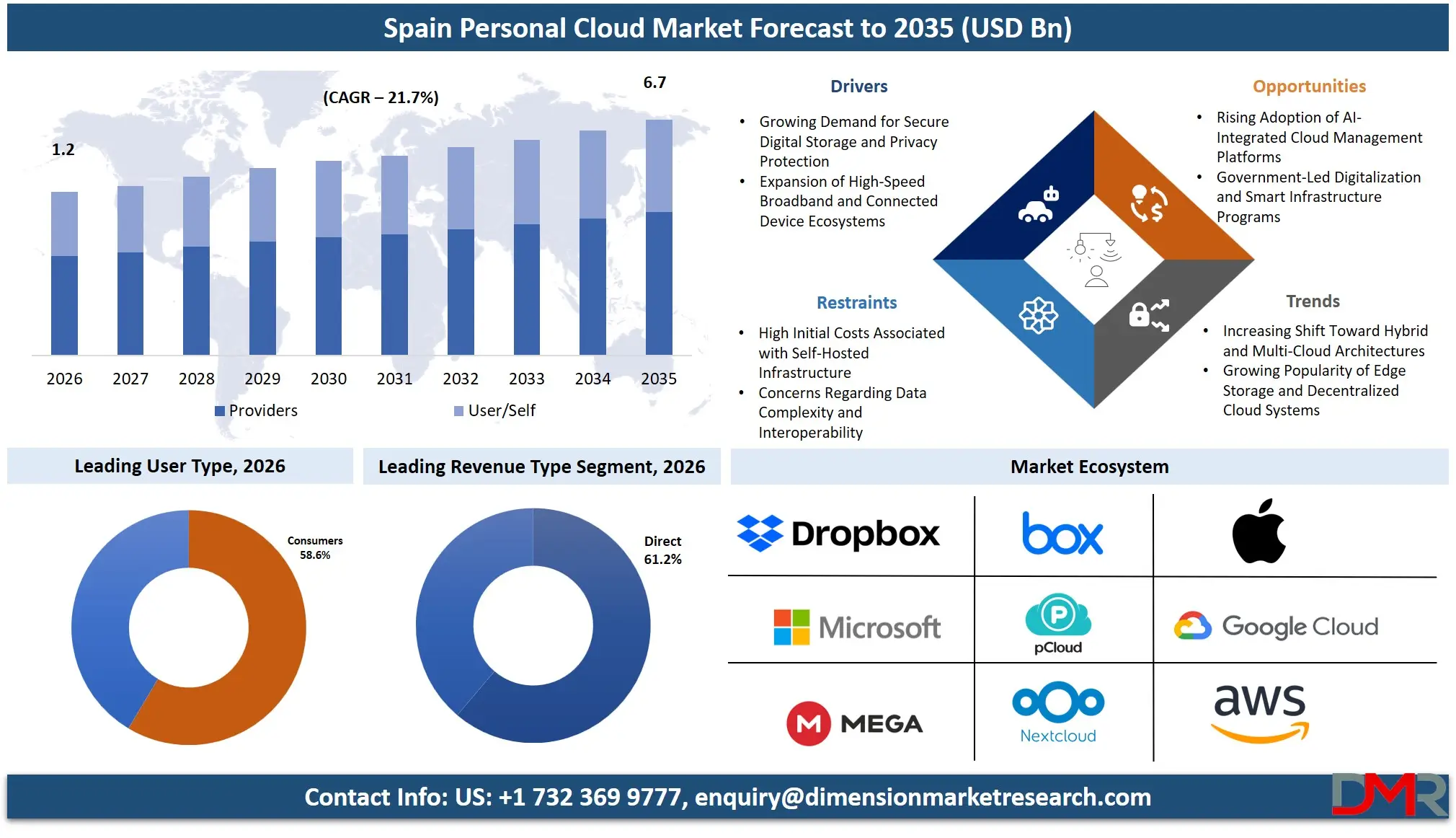
The Spain Personal Cloud Market size is expected to be USD 1.2 billion in 2026 and increase at a compound annual growth rate of 21.7% to USD 6.7 billion in 2035 due to heightened sense of security threats, risks associated with ransomware, and third-party access without consent.
ℹ
To learn more about this report –
Download Your Free Sample Report Here
Spain Personal Cloud Market represents the collection of cloud storage services as well as self-hosted cloud services available in Spain which helps both individuals and businesses to store their digital information safely and effectively using different devices. This market includes cloud storage platforms, Network Attached Storage, and other forms of hybrid cloud services. Digitalization, internet presence in Spain, and data privacy have been the major factors for adoption, while advancements such as artificial intelligence and edge computing improve the efficiency of cloud storage services.
ℹ
To learn more about this report –
Download Your Free Sample Report Here
Key Takeaways
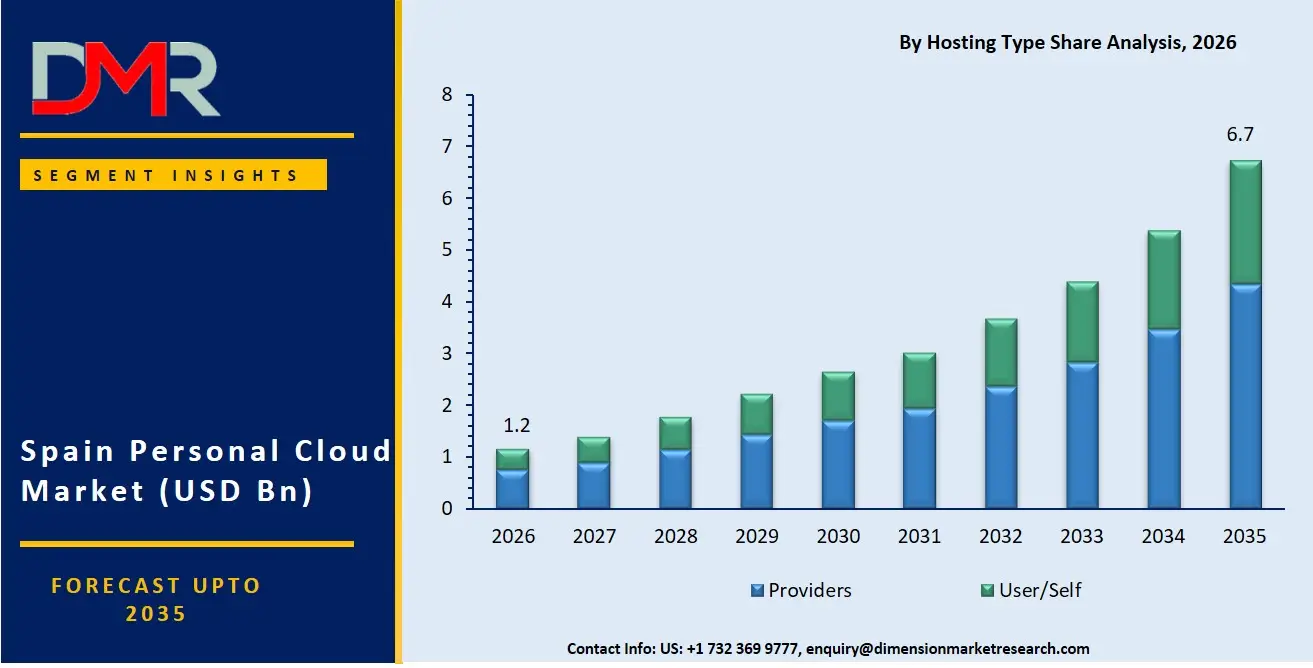
- Market Size & Forecast: The Spain Personal Cloud Market size is projected to reach USD 1.2 billion in 2026 and is anticipated to have a value of USD 6.7 billion in 2035.
- Growth Rate & Outlook: The Spain Personal Cloud Market size is set to grow at a compound annual growth rate of 21.7% during the forecast period of 2026 to 2035.
- Primary Growth Drivers: Some of the major growth drivers in the market are Increasing demand for Security, Privacy, and Data Management, and more.
- Key Market Trends: Some of the major trends in the market are Growth in Adoption of Hybrid/Multi-Cloud Solutions, and more.
- By Hosting Type: Provider segment is anticipated to get the majority share of the Spain Personal Cloud Market in 2026.
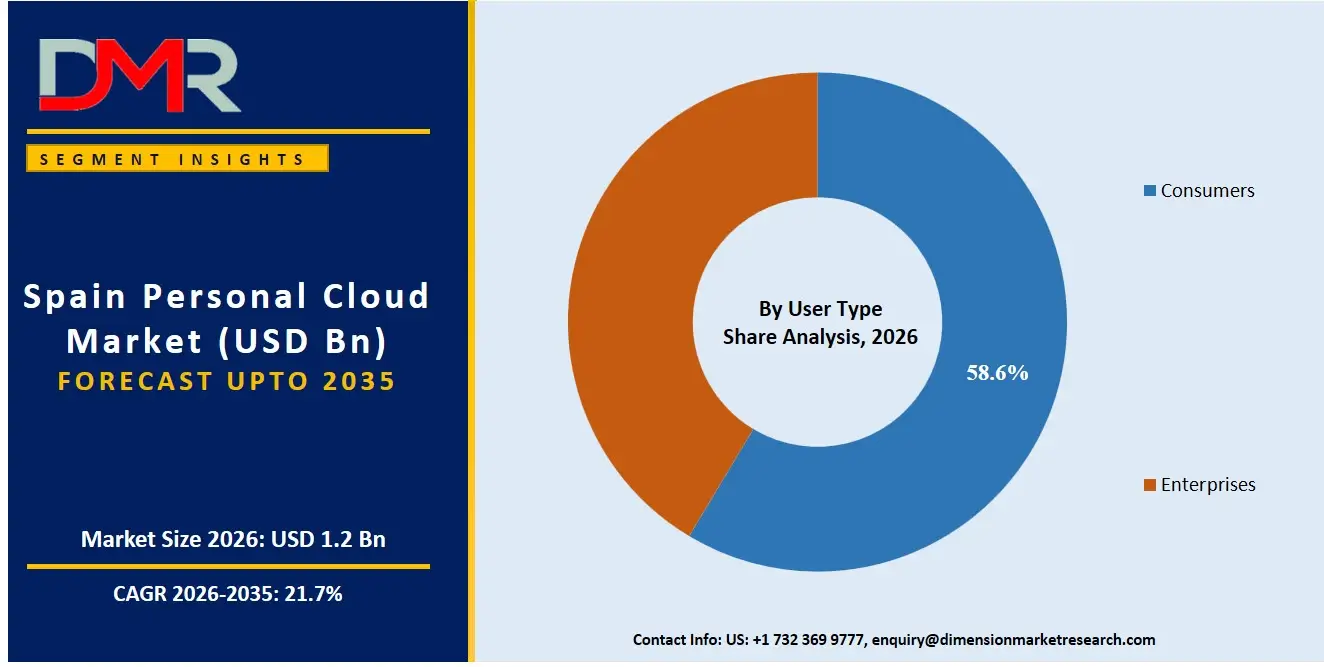
- By User Type: Consumer is expected to get the largest revenue share in 2026 in the Spain Personal Cloud Market.
- By Revenue Type: Direct segment is expected to get the largest revenue share in 2026 in the Spain Personal Cloud Market.
What is the Personal Cloud?
A personal cloud can be defined as a cloud-based digital content management and storage system that allows users and organizations to manage their data in such a way that it gets stored, synced, accessed, and shared across different connected devices using internet-based or private networking infrastructure. A personal cloud ecosystem is characterized by the presence of cloud platforms on the web, NAS storage solutions, private clouds based on servers, self-hosted personal cloud services, mobile device sync software, and data backup solutions.
Use Cases
- Collaboration among Remote Workers: Many remote workers and SMEs in Spain adopt personal cloud applications to share documents, edit files together, collaborate simultaneously, and manage virtual workspaces safely. Enterprises opt to install encrypted personal clouds to ensure business continuity and increased availability.
- Backup and File Synchronization on Smart Devices: Personal cloud technologies are employed by consumers to back up mobile phones, tablets, laptops, and multimedia devices such as video cameras and digital cameras. Such services allow automatic synchronization of media files, contacts, videos, and music.
- Media Streaming Services: Personal cloud architecture supports media streaming from the users' own cloud storage service, which is growing due to demand for personalized media content and broadband internet speed in Spain.
- Data Archiving Services for SMEs: Personal clouds hosted on NAS appliances and self-hosting services help SMEs archive their sensitive data and manage compliance and disasters effectively.
How AI Is Transforming the Spain Personal Cloud Market
Artificial intelligence technology is playing a key role in the efficiency and user satisfaction in the Spain personal cloud sector. The use of artificial intelligence in file sorting, photo identification, elimination of duplications, and predictive storage is making it easier for users to handle increasing digital files. Artificial intelligence-based cyber security systems also provide better protection by detecting malicious activities and blocking any attempt at intrusion.
Customer personalization services like automatic backup settings, vocal commands for file searches, and smart device synchronization are some other benefits provided by artificial intelligence in the Spain personal cloud space. Companies have started incorporating artificial intelligence in their personal clouds to increase workflow automation, better utilize the storage capacity, and facilitate business continuity planning.
Market Dynamic
Driving Factors in the Spain Personal Cloud Market
Increasing Demand for Security, Privacy, and Data Management
The heightened sense of security threats, risks associated with ransomware, and third-party access without consent is largely fueling the demand in Spain's personal cloud solutions market. It can be observed that there is a high preference for encrypted cloud solutions that are under individual control in order to gain more control over the digital files. The rising trend of a remote workforce in Spain and the increasing use of hybrid working models have made the need for secure file sharing and disaster recovery imperative.
Restraints in the Spain Personal Cloud Market
Higher Setup Expenses Involving Self-Managed Cloud System
Despite the growing popularity, the industry is hindered by the higher setup expenses related to NAS, servers, and backup system setup. For instance, small businesses and end users tend to experience difficulties when creating more complex self-managed cloud solutions that include data security measures and sufficient storage capacity. Regular maintenance activities, upgrades, power consumption, and technical skills result in increased expenses. Such aspects deter cost-conscious customers from switching from more affordable public cloud computing provided via paid subscriptions by commercial vendors.
Opportunities in the Spain Personal Cloud Market
Higher Setup Expenses Involving Self-Managed Cloud System
Despite the growing popularity, the industry is hindered by the higher setup expenses related to NAS, servers, and backup system setup. For instance, small businesses and end users tend to experience difficulties when creating more complex self-managed cloud solutions that include data security measures and sufficient storage capacity. Regular maintenance activities, upgrades, power consumption, and technical skills result in increased expenses. Such aspects deter cost-conscious customers from switching from more affordable public cloud computing provided via paid subscriptions by commercial vendors.
Trends in the Spain Personal Cloud Market
Growth in Adoption of Hybrid/Multi-Cloud Solutions
Firms and individuals in Spain have been favoring hybrid cloud solutions, combining benefits of the cloud's convenience with private data storage. Hybrid clouds allow the use of public cloud technology for scalability and collaboration, while keeping confidential information stored on-premises. It results in growing requirements for integrated storage technologies, efficient synchronization services, and backup capabilities. Multi-cloud approaches are also widely used by businesses, providing cost optimization, decreased dependence on single vendors, and increased flexibility, thus revolutionizing competitive forces in Spain's personal cloud industry.
Research Scope and Analysis
The Spain Personal Cloud Market report is segmented on the basis of cloud type, hosting type, user type, business model, company size, and verticals. The coverage includes the identification of dominant segments and fast-growing segments, usage trends, and revenue generation from different categories. In addition, it also covers market driving factors like digitization, remote working, and need for data security.
ℹ
To learn more about this report –
Download Your Free Sample Report Here
By Cloud Type Analysis
Online Cloud is predicted to account for the largest share of about 41.8% in 2026 due to growing consumer preference for subscription storage, minimal requirement for infrastructure, and easy synchronization between devices. Online clouds are becoming preferred options for households and SMEs in Spain since they offer convenience in terms of avoiding hardware maintenance duties and scalability. Increasing use of smartphones, digital content consumption, and remote working are driving growing demand. However, NAS (Network Attached Storage) Cloud is forecasted to be the most rapidly expanding sector driven by data privacy and ownership security fears, as well as rising cyber security concerns. Enterprises and tech-savvy households are adopting NAS Clouds in increasing numbers in an effort to control storage operations from a local perspective, secure their backups, and stream high-speed media content. Server Device Clouds are another category that businesses with stringent infrastructure needs are adopting.
By Hosting Type Analysis
Provider Hosting is set to become the most dominant segment in the personal cloud market of Spain and hold a share of around 64.3% by 2026 owing to its simplicity, scalability, and ease of use. Enterprises and individuals favor provider hosted environments as they ensure auto-updates, cybersecurity solutions, cloud access from anywhere, and low initial investment. Digital transformation and increased reliance on collaboration services among small businesses have fueled demand for provider hosting. On the other hand, User/Self Hosting is expected to experience the highest growth rate in the assessment period driven by mounting issues regarding data sovereignty. Self-hosted personal cloud systems ensure improved privacy levels, allow individuals complete control over the structure of their data centers, and decrease reliance on third parties. People with good technological skills are using NAS systems and local server systems to ensure the safety of multimedia content and personal information.
By User Type Analysis
The Consumers segment will capture about 58.6% market share in the Spain personal cloud industry by 2026 owing to the increasing use of smartphones, growing content creation activities, and growing needs for automatic backup tools. The growing consumer preference for personal cloud service providers to facilitate photo storage, media streaming, device-to-device syncs, and personal data retrieval drives market growth. Besides, the presence of budget-friendly subscription plans for cloud services boosts their uptake. However, the Enterprises segment is the fastest-growing due to increasing use of remote infrastructure and the need for enhanced security measures. The large enterprises are still investing in scalable private clouds to enable collaboration and document management processes. At the same time, small and medium-sized enterprises are increasingly adopting affordable personal clouds to boost operational agility and remote data storage.
By Revenue Type Analysis
Direct Revenue will capture the biggest share of almost 61.2% in 2026, owing largely to increasing usage of the subscription storage service both by organizations and consumers. The sources of direct income include subscription charges and the premium storage package, which continue to be major income streams given the increased need for high-capacity storage and high levels of security as well as cross-platform functionality. Organizations are more interested in paying for the service with advanced collaborative tools and compliance-focused data encryption features. On the other hand, there will be a marked growth in the use of Indirect Revenue model in the industry, as advertisers offer their users storage capacity in return for using storage services supported by advertisements.
By Vertical Analysis
The IT & ITeS category is predicted to dominate around 22.9% share of the Spain personal cloud market by 2026 owing to the significant use of cloud technology in collaboration, software development, and management of cloud-based infrastructure. Companies in the field need to invest in scalable cloud storage to facilitate efficient coding processes and management of digital assets. With more companies opting for SaaS solutions and flexible working models, the segment is likely to maintain its leadership position. The Healthcare & Life Sciences category is forecasted to show the most rapid growth with the adoption of secured personal cloud by hospitals and healthcare organizations to manage patient data, medical imaging data, and telemedicine services. BFSI companies have also invested heavily in encryption technologies in their cloud storage solutions to comply with data protection regulations.
The Spain Personal Cloud Market Report is segmented on the basis of the following:
By Cloud Type
- Online Cloud
- NAS (Network Attached Storage) Cloud
- Server Device Cloud
- Home-Made Cloud
By Hosting Type
- User/Self Hosting
- Provider Hosting
By User Type
By Revenue Type
- Direct Revenue
- Subscription fees
- Premium storage plans
- Indirect Revenue
- Advertising
- Bundled telecom or device services
- Freemium upgrades
By Vertical
- BFSI
- IT & ITeS
- Telecommunications
- Retail & E-commerce
- Government & Public Sector
- Manufacturing
- Healthcare & Life Sciences
- Energy & Utilities
- Media & Entertainment
- Others
Competitive Landscape
The Spanish market for personal clouds involves highly stiff competition resulting from innovations, services differentiation, and strategies aimed at boosting cybersecurity. Market players are increasingly relying on the use of AI-powered storage management services, hybrid deployment options, security encryption methods, and optimized subscription charges as part of their strategies. Partnerships with telecommunications companies, device makers, and enterprise software providers are also being embraced to increase customer base and offer bundles of services. The high barriers of entry in terms of infrastructure and technology make it hard for new entrants to compete.
Some of the prominent players in the Spain Personal Cloud are:
- Google Cloud
- Microsoft
- Apple
- Dropbox
- Amazon Web Services (AWS)
- Box
- pCloud
- MEGA
- Nextcloud
- ownCloud
- Sync.com
- Tresorit
- Proton Drive
- IDrive
- SpiderOak
- Acronis
- Seafile
- OVHcloud
- IBM Cloud
- Oracle Cloud Infrastructure
- Other Key Players
Recent Developments
- In April 2026, OpenText has joined forces with S3NS, the collaboration between Thales and Google Cloud, offering a trusted cloud platform in France to support businesses in Europe. This partnership will offer a hybrid sovereign cloud model that ensures any sensitive workload stays within a localized governance setting while being able to utilize hyperscale cloud technology safely.
- In March 2026, Amazon Web Services (AWS) is planning to make an investment of EUR 33.7 billion (USD 39.2 billion) in Spain in order to improve its data center infrastructure and enhance its artificial intelligence and cloud computing capacities throughout Europe. This latest investment in AWS Europe (Spain) Region located in Aragón will help in boosting Spain's economy up until 2035 while employing thousands of people in the process.
- In February 2026, Nokia has been chosen by Telefónica to provide networking capabilities at 17 new Edge data center locations within Spain. The network infrastructure has been built to enable the provision of AI, B2B, and telecom cloud services. These services will provide high-speed and low-latency connectivity for residential, business, and public sector customers. It is part of efforts to enhance the digital infrastructure in Spain and provide advanced services.
Report Details
| Report Characteristics |
| Market Size (2026) |
USD 1.2 Bn |
| Forecast Value (2035) |
USD 6.7 Bn |
| CAGR (2026–2035) |
21.7% |
| Historical Period |
2021 – 2025 |
| Forecast Period |
2027 – 2035 |
| Base Year |
2025 |
| Estimate Year |
2026 |
| Segments Covered |
By Cloud Type, By Hosting Type, By User Type, By Revenue Type, By Vertical |
| Country Coverage |
Spain |
Frequently Asked Questions
How big is the Spain Personal Cloud Market?
▾ The Spain Personal Cloud Market size is expected to reach USD 1.2 billion by 2026 and is projected to reach USD 6.7 billion by the end of 2035.
What is the CAGR of the Spain Personal Cloud Market from 2026 to 2035?
▾ The market is growing at a CAGR of 21.7 percent over the forecasted period.
What factors are driving the growth of the Spain Personal Cloud Market?
▾ Increasing Demand for Security, Privacy, and Data Management, and more are the factors driving the growth of the Spain Personal Cloud Market.
What are the major trends in the Spain Personal Cloud Market?
▾ Growth in Adoption of Hybrid/Multi-Cloud Solutions, and more are some of the major trends in the market.
Who are the key players in the Spain Personal Cloud Market?
▾ Some of the key players in the Spain Personal Cloud Market include Apple, Google, Microsoft, and more
How is the Spain Personal Cloud Market segmented?
▾ The Spain Personal Cloud Market is segmented by cloud type, hosting type, user type, revenue type, vertical.