Spain Seafood Processing Market Snapshot
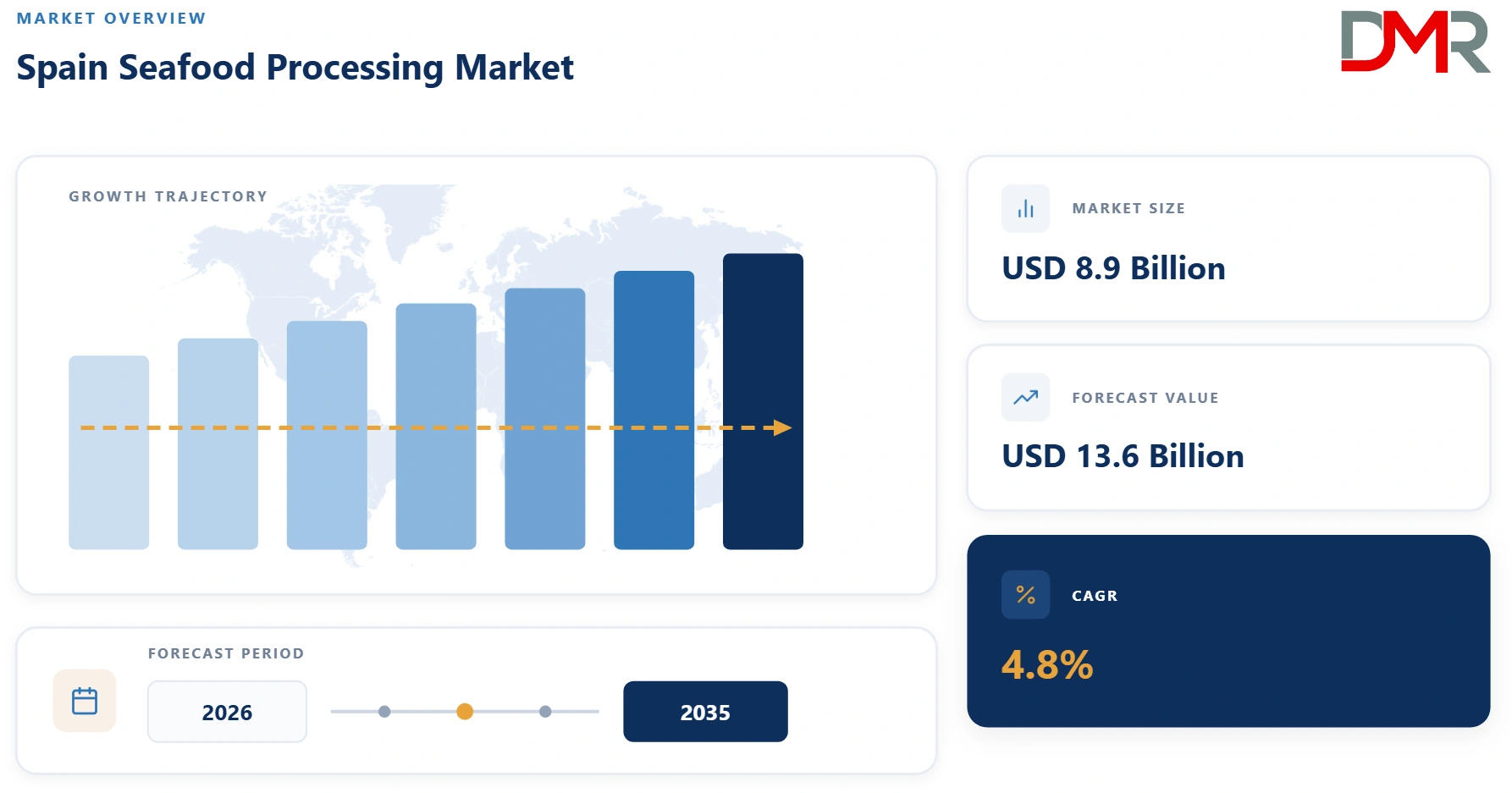
- Spain Seafood Processing Market Size in 2026: USD 8.9 Billion
- Spain Seafood Processing Market Size in 2035: USD 13.6 Billion
- Spain CAGR from 2026 to 2035: 4.8%
- Canned and Preserved Seafood Processing is the leading processing type segment in 2026: 34.6%
- Tuna is the leading species type segment in 2026: 27.3%
- Retail and Grocery Chains is the leading distribution channel segment in 2026: 41.8%
- Export/International Trade is the leading end user segment in 2026: 53.7%
What is the Spain Seafood Processing Market and its Market Size?
The Spain Seafood Processing Market is projected to be valued at USD 8.9 Billion in 2026 and is projected to reach USD 13.6 Billion by 2035, expanding at a CAGR of 4.8% during the forecast period.
ℹ
To learn more about this report –
Download Your Free Sample Report Here
Growth is being propelled by Spain's position as one of Europe's largest seafood processing and consumption nations, deeply rooted culinary tradition around canned and preserved seafood products such as tuna, sardines, and anchovies, and Spain's extensive fishing fleet and port infrastructure supporting both domestic processing and substantial seafood import and re-export trade. The maturing of value-added and convenience-oriented seafood product lines including surimi-based products, ready-to-eat seafood meals, and premium canned seafood positioned for gourmet and export markets, growing processor investment in traceability and sustainability certification to meet European Union and international buyer requirements, and continued strength of Spain's canned seafood export brands in international markets are reshaping the market from a traditionally commodity- and tradition-oriented processing sector into a more diversified, quality- and sustainability-differentiated industry. Investment is accelerating as Spanish seafood processors navigate fluctuating raw material availability tied to global fishing quotas while pursuing premiumization and export market expansion strategies.
Use Cases
- Canned Tuna and Sardine Production for Domestic and Export Markets: Spanish seafood processors produce canned tuna, sardines, and anchovies for both strong domestic consumption, reflecting deep-rooted Spanish culinary tradition, and substantial export demand across European and international markets where Spanish canned seafood brands hold established reputation for quality.
- Frozen Seafood Processing for Retail and Foodservice Distribution: Processors handle frozen fish fillets, shellfish, and cephalopods such as squid and octopus for distribution across Spanish retail grocery chains and foodservice operators, supporting both everyday consumption and Spain's prominent seafood-centered restaurant and tapas culture.
- Surimi and Value-Added Seafood Product Manufacturing: Manufacturers produce surimi-based products and other value-added, convenience-oriented seafood items to meet growing consumer demand for easy-to-prepare seafood options, leveraging Spain's established seafood processing technical expertise.
- Premium and Gourmet Canned Seafood for International Export: Specialty processors produce premium, artisanally positioned canned seafood products, including high-grade tuna belly and specialty preserved shellfish, targeting gourmet retail and export markets willing to pay premium pricing for authentic Spanish seafood craftsmanship.
Key Takeaways
- Market Size: The Spain Seafood Processing Market is anticipated to be valued at USD 8.9 Billion in 2026 and is forecast to reach USD 13.6 Billion by 2035, expanding at a CAGR of 4.8%.
- Growth Outlook: Market expansion is sustained by Spain's deep culinary tradition around processed seafood, extensive fishing fleet and port infrastructure supporting both domestic processing and international trade, and continued strength of Spanish canned seafood brands in export markets.
- Primary Growth Drivers: Spain's established position as one of Europe's leading seafood processing and consumption nations, sustained international demand for Spanish canned seafood brands, growing consumer preference for convenient and value-added seafood products, and rising investment in traceability and sustainability certification are accelerating market growth.
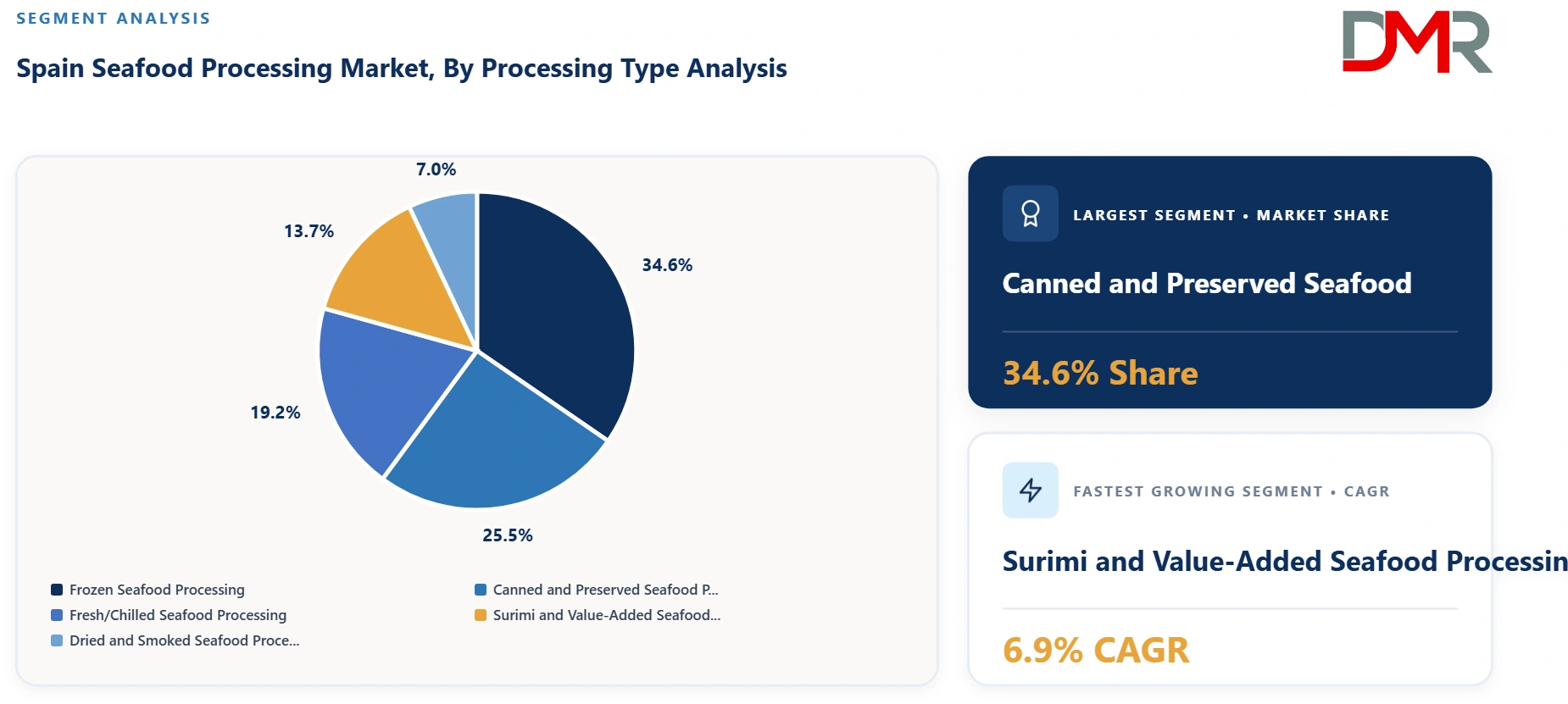
- By Processing Type Analysis: Canned and Preserved Seafood Processing is projected to lead the processing type segment with a 34.6% share in 2026, reflecting deep-rooted Spanish culinary tradition and strong export brand positioning. Surimi and Value-Added Seafood Processing is the fastest-growing processing type segment at 6.9% CAGR, driven by rising consumer demand for convenient, ready-to-prepare seafood products.
- By Species Type Analysis: Tuna is expected to dominate with a 27.3% share in 2026, supported by Spain's globally significant tuna canning industry. Squid and Octopus is the fastest-growing species type segment at 6.4% CAGR, driven by rising domestic and export demand for cephalopod products central to Spanish cuisine.
- By Distribution Channel Analysis: Retail and Grocery Chains is poised to lead with a 41.8% share in 2026, reflecting strong domestic consumer demand for processed seafood products. Export Markets is the fastest-growing distribution channel segment at 6.1% CAGR, driven by sustained international demand for Spanish canned and premium seafood products.
- By End User Analysis: Export/International Trade is projected to dominate with a 53.7% share in 2026, reflecting Spain's position as a major net seafood processing and trading hub within Europe. Domestic Consumption is also a substantial and stable segment, underpinned by Spain's high per-capita seafood consumption relative to broader European averages.
Key Drivers in the Spain Seafood Processing Market
Deep-Rooted Culinary Tradition and High Per-Capita Seafood Consumption
Spain maintains one of the highest per-capita seafood consumption rates in Europe, reflecting deep-rooted culinary tradition spanning canned tuna and sardines, fresh and frozen fish, and a wide variety of shellfish and cephalopod dishes central to Spanish regional cuisines. This sustained, culturally embedded domestic demand provides a stable foundation for the Spanish seafood processing industry, distinguishing it from markets where seafood processing growth depends more heavily on shifting consumer trends. This structural demand base supports continued investment in both traditional and value-added seafood processing capacity across the country.
Established Global Reputation of Spanish Canned Seafood Export Brands
Spain has developed several internationally recognized canned seafood brands, particularly in tuna and sardine categories, that command strong reputation and export demand across European and international markets. This established brand equity, built over decades of processing tradition and quality consistency, provides Spanish seafood processors with a durable competitive advantage in international markets relative to processors in regions lacking comparable brand recognition. Continued export demand for these established brands supports sustained processing capacity utilization and reinforces incentive for continued quality and traceability investment to protect this valuable brand positioning.
Restraints in the Spain Seafood Processing Market
Raw Material Supply Volatility Tied to Global Fishing Quotas and Environmental Conditions
Fluctuations in raw seafood material availability, driven by international fishing quota regulations, environmental conditions affecting fish stocks, and geopolitical factors affecting access to key fishing grounds, represent a significant restraint on the Spain Seafood Processing Market. Spanish processors, particularly those reliant on internationally sourced tuna and other migratory species, must navigate quota-related supply constraints and price volatility that can complicate production planning and squeeze processor margins. These supply chain uncertainties can also affect processors' ability to maintain consistent product availability for both domestic and export customers.
Growth Opportunities in the Spain Seafood Processing Market
Sustainability Certification and Traceable Seafood Sourcing
Growing international buyer and consumer demand for sustainably sourced, traceable seafood products presents a significant opportunity for Spanish processors to differentiate through Marine Stewardship Council and other recognized sustainability certifications. Processors capable of demonstrating verified sustainable sourcing practices, particularly for tuna and other species subject to sustainability scrutiny, can capture premium positioning and strengthen relationships with international retail and foodservice buyers increasingly requiring such certification as a condition of supply agreements.
Premium and Gourmet Product Line Development for Export Markets
Rising international demand for premium, artisanally positioned seafood products presents an opportunity for Spanish processors to develop higher-margin gourmet product lines that capitalize on Spain's strong reputation for seafood quality and culinary craftsmanship. Processors investing in premium packaging, higher-grade raw material sourcing, and artisanal production positioning can capture growing international gourmet food market demand, differentiating from lower-margin commodity canned seafood competition from other global processing regions.
Trends in the Spain Seafood Processing Market
Growing Investment in Value-Added and Convenience-Oriented Seafood Products
Spanish seafood processors are increasingly investing in value-added and convenience-oriented product development, including ready-to-eat seafood meals, pre-marinated and pre-seasoned products, and surimi-based convenience items, responding to evolving consumer lifestyle preferences even within a market with strong traditional seafood consumption patterns. This trend reflects processors' efforts to capture incremental value beyond traditional commodity processing while addressing younger consumer segments seeking convenience alongside traditional seafood quality expectations.
Consolidation Among Spanish Seafood Processing and Export Companies
The Spain Seafood Processing Market is experiencing continued consolidation as larger Spanish seafood companies acquire smaller regional processors and complementary businesses to build more comprehensive, vertically integrated seafood processing and export operations. Consolidation allows combined entities to achieve greater raw material sourcing scale, broader product portfolio breadth spanning multiple species and processing types, and stronger negotiating position with both raw material suppliers and major international retail and foodservice buyers.
Research Scope and Analysis
The Spain Seafood Processing Market is segmented by processing type, species type, distribution channel, and end user, covering frozen, canned, fresh, surimi, and dried/smoked seafood processing, tuna, sardines, shellfish, and cephalopod species, and domestic and export distribution channels.
ℹ
To learn more about this report –
Download Your Free Sample Report Here
By Processing Type Analysis
Canned and Preserved Seafood Processing is projected to dominate the Spain Seafood Processing Market with approximately 34.6% share in 2026, reflecting deep-rooted Spanish culinary tradition around canned tuna, sardines, and anchovies and strong established export brand positioning in this category. Surimi and Value-Added Seafood Processing is expected to register the highest CAGR of 6.9% during 2026-2035, driven by rising consumer demand for convenient, ready-to-prepare seafood products that complement traditional Spanish seafood consumption patterns.
By Species Type Analysis
Tuna is anticipated to dominate the Spain Seafood Processing Market by species type, accounting for approximately 27.3% share in 2026, supported by Spain's globally significant tuna canning industry and strong international brand recognition in this category. Squid and Octopus is projected to register the highest CAGR of 6.4% between 2026 and 2035, driven by rising domestic and export demand for cephalopod products that hold central importance in traditional Spanish regional cuisines.
By Distribution Channel Analysis
Retail and Grocery Chains is projected to lead the Spain Seafood Processing Market with an estimated 41.8% share in 2026, reflecting strong and consistent domestic consumer demand for canned, frozen, and fresh processed seafood products across Spanish grocery retail. Export Markets is expected to register the fastest CAGR of 6.1% through 2035, driven by sustained international demand for Spanish canned seafood brands and growing premium seafood product export opportunities.
By End User Analysis
Export/International Trade is projected to dominate the Spain Seafood Processing Market with approximately 53.7% share in 2026, reflecting Spain's position as a major seafood processing, import, and re-export hub within the broader European seafood trade network. Domestic Consumption remains a substantial and stable segment underpinned by Spain's high per-capita seafood consumption, among the highest in Europe, supporting consistent baseline demand independent of export market fluctuations.
The Spain Seafood Processing Market Report is segmented based on the following:
By Processing Type
- Frozen Seafood Processing
- Canned and Preserved Seafood Processing
- Fresh/Chilled Seafood Processing
- Surimi and Value-Added Seafood Processing
- Dried and Smoked Seafood Processing
By Species Type
- Tuna
- Sardines and Anchovies
- Mussels and Shellfish
- Squid and Octopus
- Hake and Whitefish
- Others
By Distribution Channel
- Retail and Grocery Chains
- Foodservice and HoReCa
- Export Markets
- Direct-to-Consumer
By End User
- Domestic Consumption
- Export/International Trade
Technology Analysis
Technology investment is increasingly shaping competitiveness in the Spain Seafood Processing Market as processors adopt automated filleting, sorting, and canning equipment to improve throughput and consistency while managing labor availability challenges common across the broader European food processing sector. Growing use of blockchain and digital traceability platforms is supporting the sustainability certification and origin verification increasingly demanded by international retail and foodservice buyers, particularly for tuna and other species subject to sustainability scrutiny. Opportunities are expanding for processors investing in cold chain and freezing technology that preserves product quality across Spain's substantial seafood import and re-export trade, as well as automated quality inspection systems for value-added and premium product lines. However, the capital intensity of advanced automation and traceability technology can create adoption barriers for smaller, traditionally family-owned Spanish seafood processing operations.
Investment and White Space Analysis
Investment opportunities in the Spain Seafood Processing Market are expanding alongside sustained domestic seafood consumption, continued strength of Spanish canned seafood export brands, and growing international demand for sustainably certified and premium seafood products. Significant white space exists in sustainability certification and traceability technology investment, premium and gourmet product line development for export markets, and value-added convenience seafood products addressing evolving consumer lifestyle preferences. Processors with strong established export brand equity, sustainability certification credentials, and diversified species and product portfolios are positioned to capture premium, longer-duration contracts with international retail and foodservice buyers. However, raw material supply volatility tied to fishing quotas, environmental conditions affecting fish stocks, and consolidation-driven competitive pressure can constrain margins for smaller, less diversified processors.
Competitive Landscape
The Spain Seafood Processing Market is moderately consolidated and competitive, comprising large diversified Spanish seafood processing and export companies, regional and family-owned processors specializing in traditional products, and international seafood companies with Spanish processing operations. Competition centers on established brand equity, particularly in canned tuna and sardine categories, raw material sourcing scale and diversification, sustainability certification credentials, and export market development capability. Large diversified Spanish companies benefit from established international brand recognition and broad product portfolio breadth, while regional and family-owned processors compete on traditional product authenticity and specialized regional market relationships. Companies increasingly differentiate through sustainability certification, premium product positioning, and value-added convenience product innovation rather than commodity processing scale alone.
Some of the prominent players in the Spain Seafood Processing Market are:
- Angulas Aguinaga
- Nueva Pescanova
- Nauterra
- JEALSA
- Frinsa del Noroeste
- Ubago Group Mare
- Bolton Food
- Grupo Consorcio
- Vensy España
- Cabomar Congelados
- Gambastar
- Pereira Productos del Mar
- Clavo Food Factory
- Ángel López Soto
- Frime
- Iberconsa
- Gedesco
- Jomesco Food
- Seirokbat
- Hijos de Carlos Albo
- Ignacio González Montes
- Escuris
- Calvo Conservas
- Industrias Cerdeimar
- Frigoríficos Ros
- Frigomar Burela
- Armadora Pereira
- Balfegó & Balfegó
- Albacora
- Albacor Industria del Mar
- Conservas Pescamar
- Hijos de José Serrats
- Hijos de Emilio Ramírez
- Bacalaos Eguillor
- Bacalaos Santymar
- Anxoves de L'Escala
- Anchoas de Santoña
- Aquanaria
- Stolt Sea Farm
- Mascato
- Other Key Players
Recent Developments
- May 2026: Grupo Profand agreed to acquire Unión Martín Group, expanding its seafood processing and distribution footprint across the Canary Islands and mainland Spain.
- April 2026: Stolt Sea Farm reported higher revenue and profit for Q1 2026, supported by improved pricing and continued demand for its premium flatfish products.
- February 2026: Nueva Pescanova Group was ranked sixth globally for sustainable ocean and coastal ecosystem management and as the leading Spanish company in the assessment.
- January 2026: Nauterra promoted its premium seafood and gourmet product innovations at Gulfood 2026, highlighting quality, sustainability, and international market development.
Report Details
| Report Characteristics |
| Market Size (2026) |
USD 8.9 Bn |
| Forecast Value (2035) |
USD 13.6 Bn |
| CAGR (2026–2035) |
4.8% |
| Historical Data |
2021 – 2025 |
| Forecast Data |
2026 – 2035 |
| Base Year |
2025 |
| Segments Covered |
By Processing Type, By Species Type, By Distribution Channel, By End User |
| Country Coverage |
Spain |
Frequently Asked Questions
How big is the Spain Seafood Processing Market?
▾ The Spain Seafood Processing Market is valued at USD 8.9 Billion in 2026 and is projected to reach USD 13.6 Billion by 2035, reflecting sustained domestic consumption and strong international export demand for Spanish canned and processed seafood products.
What is the CAGR of the Spain Seafood Processing Market from 2026 to 2035?
▾ The market is projected to expand at a compound annual growth rate (CAGR) of 4.8% between 2026 and 2035, supported by Spain's established seafood processing tradition, sustained export brand strength, and growing demand for value-added and sustainably certified seafood products.
What factors are driving the growth of the Spain Seafood Processing Market?
▾ Growth is driven by Spain's established position as one of Europe's leading seafood processing and consumption nations, sustained international demand for Spanish canned seafood brands, growing consumer preference for convenient and value-added seafood products, and rising investment in traceability and sustainability certification.
What are the major trends in the Spain Seafood Processing Market?
▾ Major trends include growing investment in value-added and convenience-oriented seafood products, continued consolidation among Spanish seafood processing and export companies, and rising adoption of sustainability certification and digital traceability technology.
Who are the key players in the Spain Seafood Processing Market?
▾ Key market participants include Grupo Calvo, Conservas Garavilla (Isabel), Grupo Nueva Pescanova, Frinsa del Noroeste, and Jealsa Rianxeira, among other major Spanish seafood processing and export companies.
How is the Spain Seafood Processing Market segmented?
▾ The market is segmented by processing type, species type, distribution channel, and end user, with demand analysis concentrated across Galicia, the Basque Country, Andalusia, and Catalonia.