Market Overview
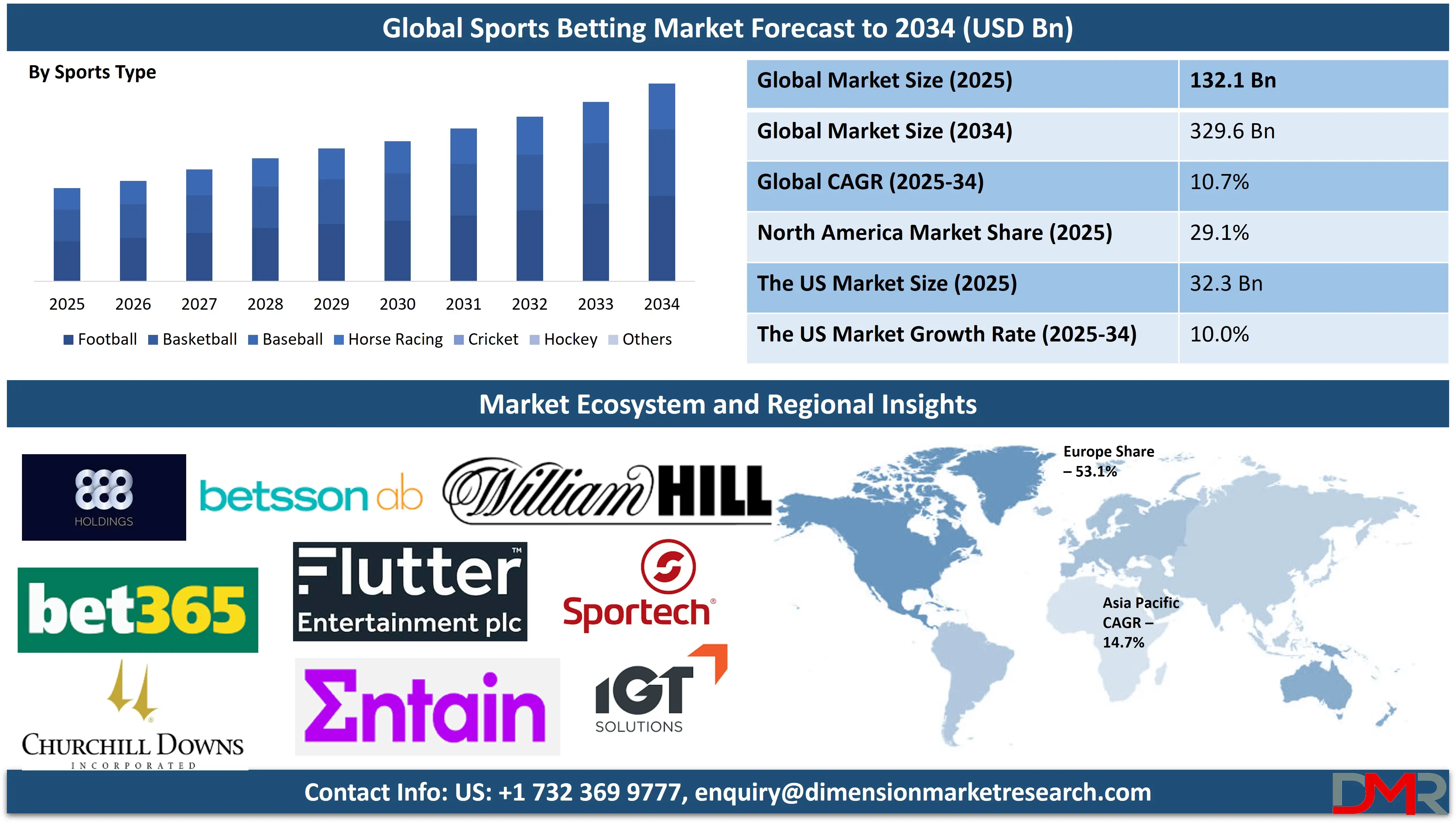
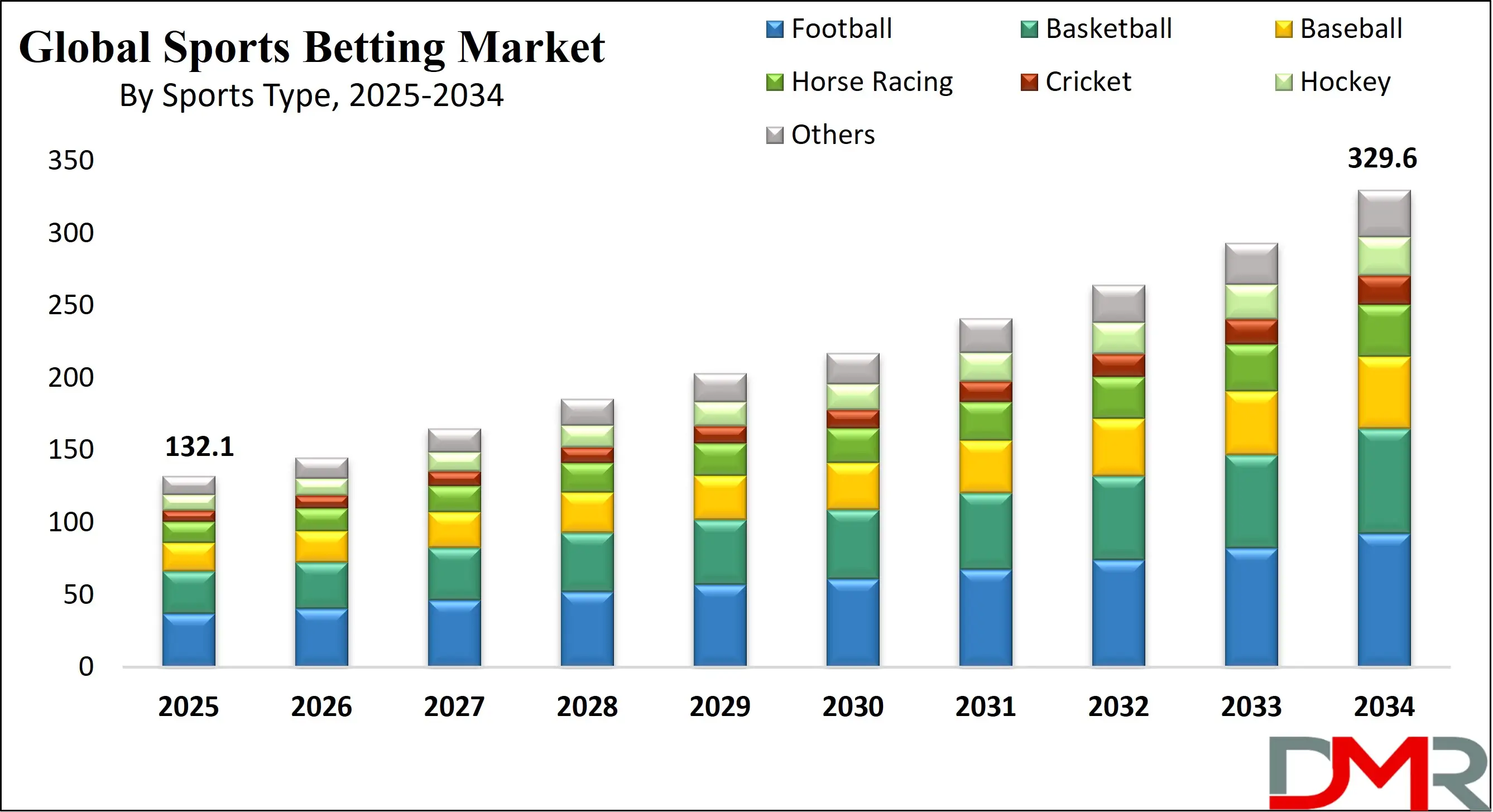
The global Sports Betting Market is estimated at USD 132.1 billion in 2025 and is projected to reach USD 329.6 billion by 2034, expanding at a CAGR of 10.7%.
ℹ
To learn more about this report –
Download Your Free Sample Report Here
Sports betting involves predicting the outcome of sports events and placing wagers on those predictions. Bettors can choose from various markets, including point spreads, money lines, totals, and futures. It's popular in various sports such as football, basketball, baseball, and horse racing. The legality of sports betting varies by region, with some areas offering regulated betting markets, while others prohibit it. Many bettors use strategies, statistics, and analysis to increase their chances of winning, though sports betting remains inherently risky. Online platforms and mobile apps have made sports betting more accessible, with both recreational and professional bettors participating globally.
The demand for sports betting is fueled by several factors, including significant changes in the regulatory framework of the global gambling industry, the widespread use of connected devices, and the growing digital infrastructure. Online sports betting saw a surge in popularity during the pandemic, driven by the rise of eSports and other forms of digital betting. Moreover, the increased use of smartphones has made sports betting more accessible, contributing to the expansion of the global market.
ℹ
To learn more about this report –
Download Your Free Sample Report Here
The US Sports Betting Market
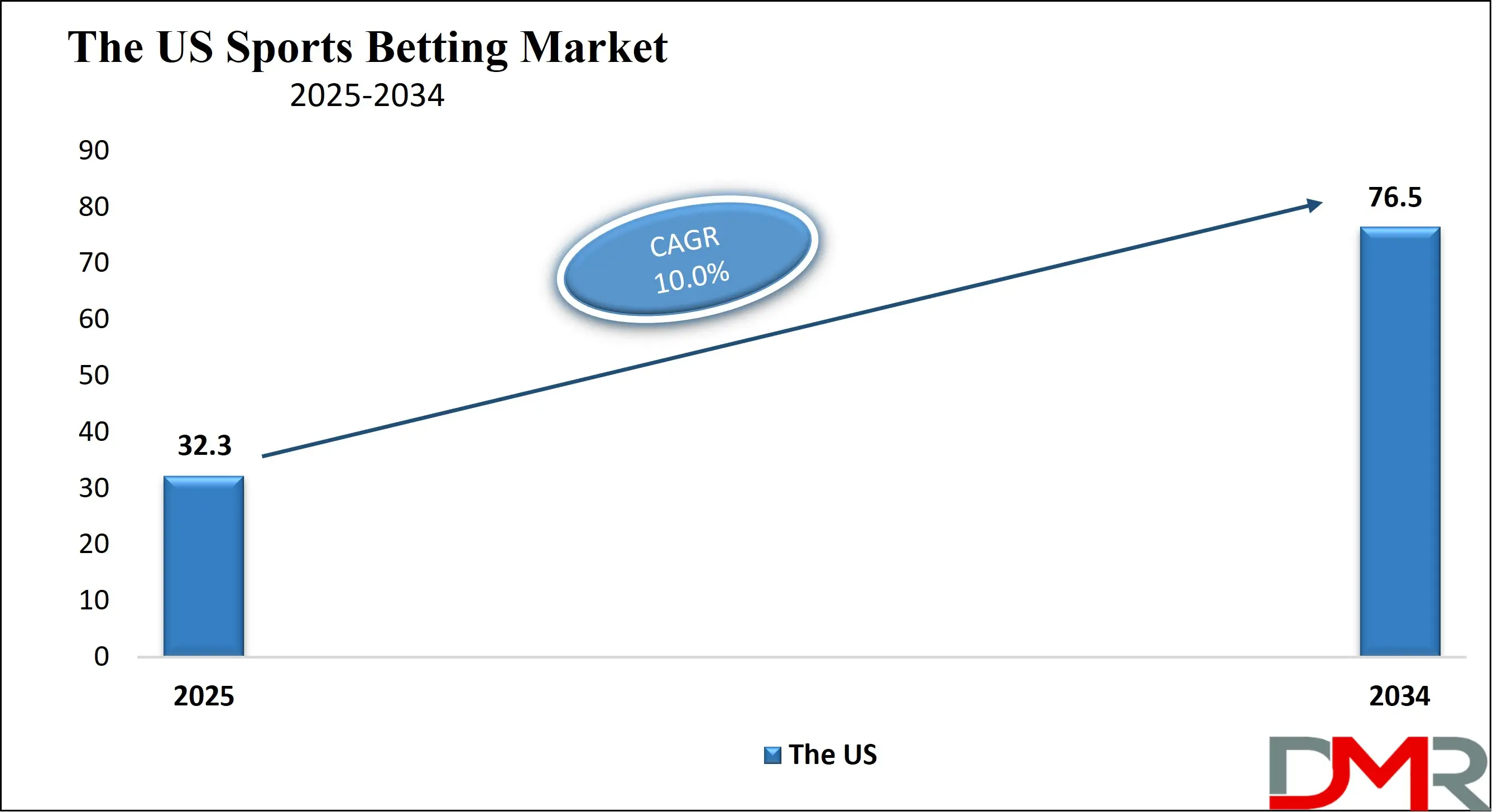
The US Sports Betting market is projected to be valued at USD 32.3 billion in 2025. It is expected to witness subsequent growth in the upcoming period as it holds USD 76.5 billion in 2034 at a CAGR of 10.0%.
The growth of the U.S. sports betting market is supported by state-level legalization, increasing consumer participation, and continued expansion of mobile wagering platforms. As of 2026, legal sports betting is live in 39 states and the District of Columbia, with Missouri becoming the latest state to launch regulated sports wagering on December 1, 2025.
ℹ
To learn more about this report –
Download Your Free Sample Report Here
Live in-game betting is becoming more popular, allowing bettors to wager on real-time events, enhancing engagement. There's also a growing emphasis on data analytics and AI, helping sportsbooks personalize offerings and set more accurate odds. Collaborations between sportsbooks and sports leagues are increasing, fostering legitimacy and mainstream acceptance.
Key Takeaways
- Market Growth: The global Sports Betting Market is projected to expand by approximately USD 197.5 billion, increasing from USD 132.1 billion in 2025 to USD 329.6 billion by 2034, at a CAGR of 10.7%.
- Betting Type Analysis: Fixed odds wagering is predicted to dominate the global market with a revenue share of 51.4% based on product by the end of 2025.
- Sports Type Analysis: Football is expected to dominate the global Sports Betting Market in 2025, supported by its worldwide fan base, extensive league and tournament calendar, and high betting activity across major competitions such as the English Premier League, UEFA competitions, and FIFA tournaments.
- Platform Analysis: Online platforms are projected to dominate the global market with the highest revenue share by 2025.
- Regional Analysis: Europe is projected to dominate the global Sports Betting market, holding a market share of 53.1% by 2025.
Stats & Facts
- H2 Gambling Capital data cited by the International Betting Integrity Association estimated the global land-based and online sports betting market, excluding horse and dog racing, at approximately USD 94.3 billion in GGR in 2024.
- Online channels represented approximately 65% of global sports betting GGR in 2024, generating around USD 61 billion, according to H2 Gambling Capital estimates.
- Legal sports betting is currently live in 39 U.S. states and the District of Columbia, following Missouri's regulated market launch on December 1, 2025.
- The American Gaming Association estimated that Americans would legally wager approximately USD 30 billion on the 2025 NFL season, up 8.5% from its revised estimate for the previous season.
- Missouri officially launched regulated retail and mobile sports wagering on December 1, 2025, becoming the latest U.S. state to begin legal sports betting operations.
Use Cases
- Online Sportsbook Platforms: Sports betting markets enable users to place wagers on various sports events via online platforms, offering odds on outcomes like match results or player performance.
- Fantasy Sports Leagues: Sports betting markets integrate with fantasy sports, allowing users to wager on athlete performance in fantasy leagues, enhancing fan engagement.
- In-Game Betting: Live or in-game betting allows users to place wagers during a match, predicting outcomes like the next goal or score, with dynamic odds.
- Sponsorship and Partnerships: Betting companies partner with sports teams or events for sponsorship, promoting their brands through advertisements and exclusive betting opportunities.
Market Dynamics
Key Drivers in Sports Betting Market
Expanded Sports Leagues and Events
An ever-expanding pool of sporting leagues and events worldwide plays an instrumental role in fuelling the expansion of the sports betting market. Leagues bring teams, nations, and individuals together in competition for trophies or championships attracting vast audiences and creating enthusiasm among fans. Their scheduled nature ensures regular participation and viewership thus creating frequent betting activities and opportunities. New professional sports leagues across different regions provide bettors with more betting options to diversify their wagers, not only increasing engagement but also helping drive global expansion and popularity of the sports betting industry.
Global Digital Infrastructure Growth
Global digital infrastructure's fast expansion plays an essential role in expanding sports betting markets worldwide. Improved internet connectivity and smartphone ownership enable users to conveniently access betting platforms at any time or place. This digital transformation has simplified placing bets, drawing a wider demographic of participants. Technological developments such as live streaming, in-app features, and secure payment systems have made online sports betting increasingly desirable and accessible to users. Digital technologies continue to develop cutting-edge solutions that enhance user experiences; creating the conditions necessary for sustained expansion in this sector of betting.
Restraints in Sports Betting Market
Regulative and Legal Challenges
Strict regulations surrounding sports betting could restrict market growth over the forecast period. While regulations designed to ensure fairness and combat fraud may serve their intended purpose of keeping competition fair, expanding into new regions or offering services may create significant legal and operational hurdles that inhibit growth in certain regions or limit opportunities available to legitimate sports betting operators - the combination of regulatory obstacles and legal risks may limit potential market growth potentials in general.
Public Perception and Social Impact
Sports betting market growth could also be limited by concerns over potential negative social impacts associated with gambling and public perception of it, including addiction issues and its influence on young audiences. Negative attitudes regarding betting could prompt governments and advocacy groups to implement more stringent regulations or even ban certain betting activities altogether such action would limit market expansion while impeding adoption amongst members of society as a whole.
Opportunities in Sports Betting Market
Diversifying Betting
Bettors now have more betting opportunities to bolster their wagering portfolios with new professional sports leagues emerging across various regions. Because these leagues encompass such an expansive spectrum of sports and competition formats, bettors have access to an unparalleled selection of events on which to place bets ranging from traditional sports competitions to niche competitions. Diversifying betting opportunities helps maintain consistent participation as bettors can explore a wide variety of new options and strategies, which cater to bettors with varied preferences and boost engagement as a whole.
Soaring Interest in Sports Betting among Millennial and Older Generations
Millennials, widely known for their affinity toward tech and entertainment, engage with online platforms and innovative betting formats actively. Older generations are also increasing their engagement in sports betting as an enjoyable recreation, driven by digital accessibility and tailored offerings. This convergence of interests among different age groups fosters inclusivity within the market as operators develop formats and promotions tailored specifically for individual preferences, broadening the appeal and accessibility of sports betting while guaranteeing long-term growth with expanded market reach.
Trends in Sports Betting Market
Integrating Machine Learning Technologies
Machine learning technologies continue to take root as more sportsbooks embrace them as key strategies in improving player selections and betting odds. Machine learning tools have transformed the betting landscape by enabling the creation of predictive algorithms capable of analyzing vast quantities of historical data and trends. These tools assist bettors with informed decisions by accurately predicting likely game and event outcomes with increasing accuracy. As they look for strategies to increase their odds of success, machine learning gives them the insight they need to optimize their approach.
Diversifying Distribution Channels
The sports betting market is experiencing rapid expansion of distribution channels due to technological innovations like video streaming and instant messaging services. These developments allow bettors to engage in real-time betting, enriching user experiences by offering immediate access to game updates and odds. Video streaming services enable bettors to watch games live while placing bets, increasing engagement and providing an immersive betting experience. Coupled with AI, blockchain, and 5G networks these distribution channels open new opportunities for sports betting platforms by expanding their reach and reaching more bettors than ever.
Research Scope and Analysis
By Betting Type
Fixed Odds Wagering is expected to dominate the Sports Betting Market with approximately 51.4% of market revenue in 2025, due to its simplicity, predictability, and accessibility. Bettors find comfort in its straightforward nature where payout potentials are known before placing bets, providing clarity and providing peace of mind for betting decisions.
Betting on sports and events with bookmakers has long been available across various sports and regions and is widely popular with both newcomers to gambling as well as experienced wagerers alike. Regulation plays a pivotal role, with fixed odds wagering often the dominant form in emerging and established markets alike. Furthermore, its prevalence enables sports books to manage risk effectively and secure its dominance further.
Live/in-play betting, the second most prominent segment, has seen immense growth due to its dynamic and interactive nature. As opposed to fixed odds betting, live in-play allows wagers to be placed during events for an engaging experience that appeals to bettors seeking real-time thrills and spills.
Due to advancements in mobile technology and live streaming, this format has become more readily accessible, providing various betting opportunities such as predicting goals or minute-by-minute outcomes. Operators benefit from high turnover and flexible odds adjusting based on live events while fixed odds and in-play betting dominate the market by satisfying various bettor preferences while offering reliability as well as thrill and immersion.
By Sports Type
Football is expected to dominate the Sports Betting Market, accounting for approximately 35.3% of the market in 2025, supported by its global audience, extensive league and tournament calendar, and high wagering activity across major competitions such as the English Premier League, UEFA competitions, La Liga, Serie A, and FIFA tournaments. Football's dominance can be traced to its international appeal and support by various leagues and tournaments like the NFL, EPL, and FIFA World Cup which attract millions of followers and bettors worldwide. Football remains at the core of the sports betting market with regular matches and extensive fan engagement driving revenue and market adoption trends for football betting.
Its steady rise indicates its impactful effect on market adoption as more bettors gravitate to it as their sport of choice. Horse Racing is predicted to be the second-largest segment of the sports betting market and is projected to experience a high CAGR throughout its forecast period. Horse racing draws fans due to its historical relevance, global appeal, and thrill it provides bettors. Popular events like the Kentucky Derby and Royal Ascot increase its appeal further while drawing high stakes and wide participation.
By Platform
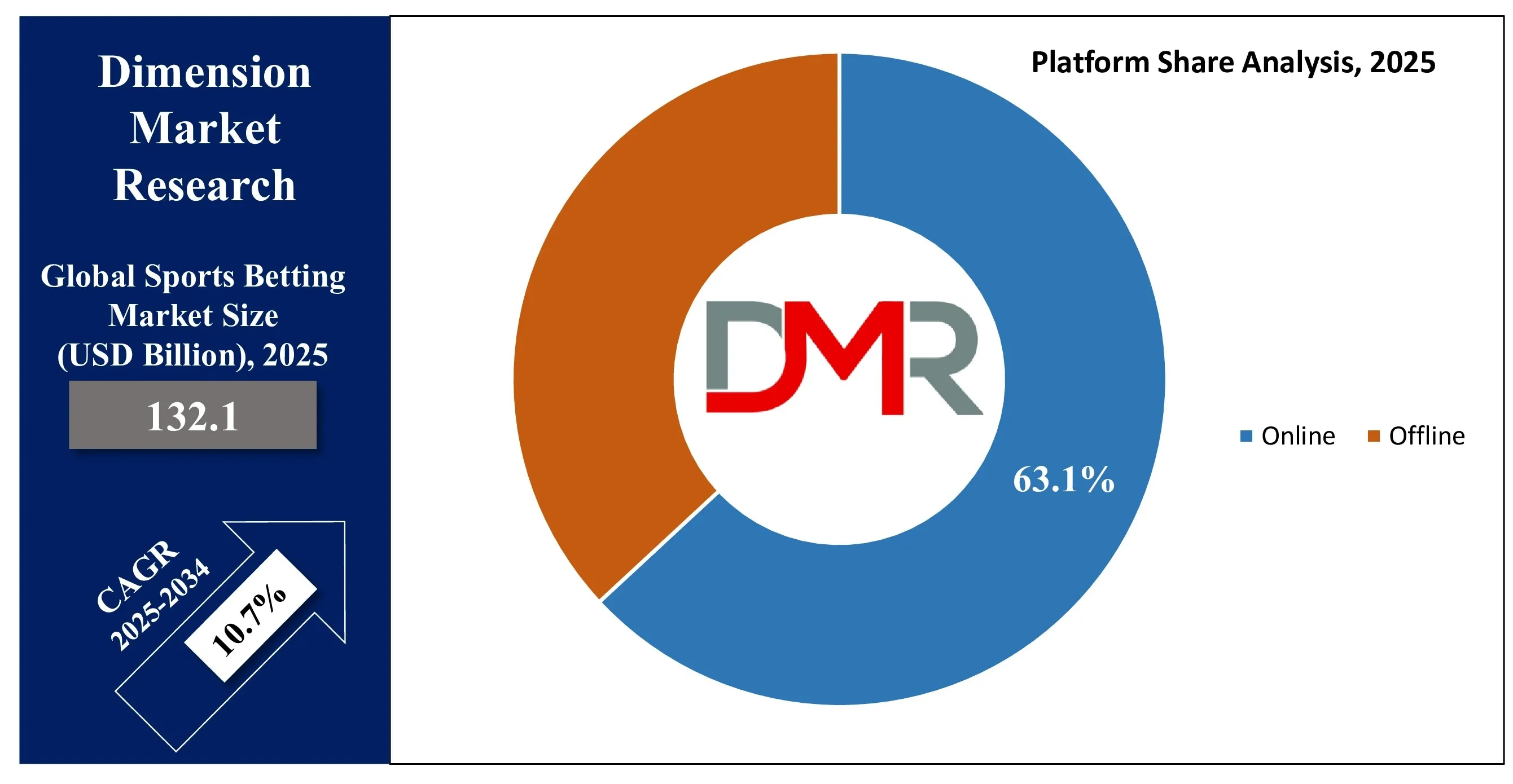
Online platforms are expected to dominate the Sports Betting Market with approximately 63.1% of the market share in 2025, driven by increasing smartphone penetration, mobile sportsbook adoption, digital payment availability, live and in-play betting, and improvements in online betting infrastructure. These innovations have revolutionized consumer lifestyles by making online betting more accessible and convenient.
Factors including rising financial development, higher living standards and an increase in discretionary income have all played an instrumental role in creating this trend of more people engaging with online betting platforms. User-friendly interfaces, live betting options, secure transactions, and mobile app accessibility further boost its appeal and cement its place as the leader segment.
ℹ
To learn more about this report –
Download Your Free Sample Report Here
Offline betting remains the second-leading segment, serving traditional bettors who prefer in-person experiences. Gambling thrives through social engagement. Physical locations like casinos and betting shops enable users to interact socially while placing bets - creating a community-like setting in which users can join together in placing bets and enjoy themselves in this fun activity. Even as online platforms gain in popularity, offline betting still retains some appeal in areas with limited internet connectivity or for those who prefer tactile interactions over digital experiences.
The Sports Betting Market Report is segmented based on the following:
By Betting Type
- Fixed Odds Wagering
- Exchange Betting
- Live/In-Play Betting
- eSports Betting
- Others
By Sports Type
- Football
- Basketball
- Baseball
- Horse Racing
- Cricket
- Hockey
- Others
By Platform
Regional Analysis
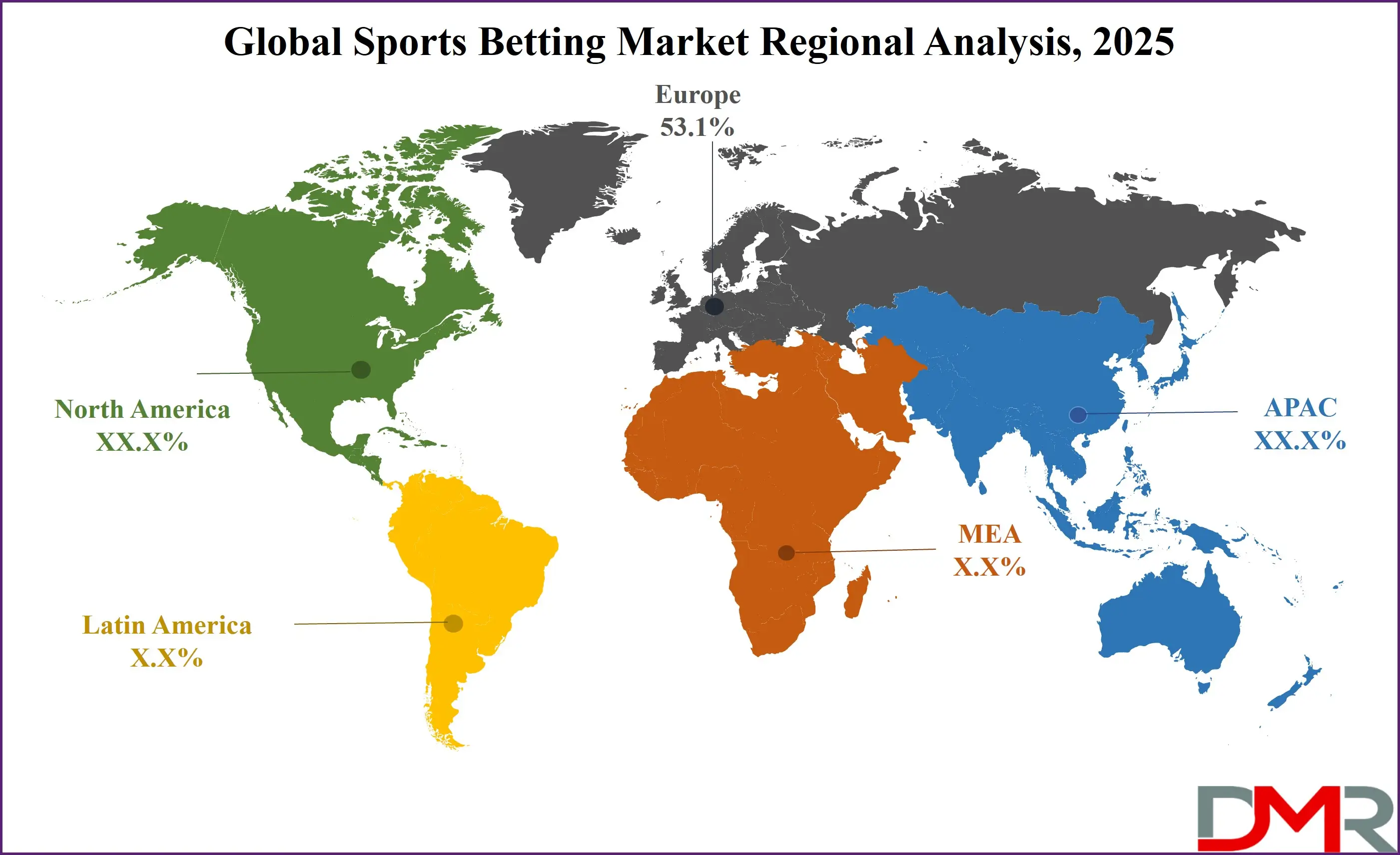
Europe is predicted to dominate the sports betting market with revenue share of 53.1% by the end of 2025, due to a combination of favorable regulations, established legal frameworks, and a strong cultural affinity for sports. This region benefits from some of the most advanced, and transparent laws as sports betting is legalized in European countries which creates a secure environment for both operators and bettors. These strict regulations have significantly reduced fraud, bolstering trust, and driving market expansion. The popularity of sports such as football, rugby, motor racing, and tennis, which have large, passionate fan bases, further fuels the growth of the betting industry.
ℹ
To learn more about this report –
Download Your Free Sample Report Here
Additionally, the rise of online sports betting has played a crucial role in Europe's market dominance. The combination of a sizable customer base, robust infrastructure, and continuous technological advancements ensures Europe's continued dominance in the sports betting market, making it a hub for both local and international operators.
Asia-Pacific represents an important and expanding market for sports betting, supported by a large population, rising smartphone penetration, increasing digital payment adoption, growing interest in international and domestic sporting events, and evolving regulatory frameworks across several countries.
Sports such as cricket, football, basketball, horse racing, and eSports generate significant betting interest across the region. Expansion of mobile betting platforms and improvements in digital infrastructure are also supporting market development. However, regulatory conditions vary substantially by country, resulting in different levels of legal market penetration and operator participation across Asia-Pacific.
By Region
North America
Europe
- Germany
- The U.K.
- France
- Italy
- Russia
- Spain
- Benelux
- Nordic
- Rest of Europe
Asia-Pacific
- China
- Japan
- South Korea
- India
- ANZ
- ASEAN
- Rest of Asia-Pacific
Latin America
- Brazil
- Mexico
- Argentina
- Colombia
- Rest of Latin America
Middle East & Africa
- Saudi Arabia
- UAE
- South Africa
- Israel
- Egypt
- Rest of MEA
Competitive Landscape
Leading companies in the sports betting industry are concentrating on developing engaging, user-friendly websites and introducing exclusive promotions to maintain a competitive edge in the market. They are increasingly integrating advanced technologies, such as APIs, to improve functionality and create a more seamless user experience.
This approach helps in attracting and retaining a larger customer base by simplifying interactions and enhancing the overall platform efficiency. Furthermore, these market players are actively pursuing collaborations and partnerships to drive innovation, improve product offerings, and open new revenue streams. Such strategic initiatives are reshaping the industry and fostering sustained growth in the competitive landscape.
Some of the prominent players in the global sports betting industry are:
- Flutter Entertainment plc
- DraftKings Inc.
- bet365
- Entain plc
- BetMGM
- Kaizen Gaming/Betano
- evoke plc
- FDJ UNITED
- Fanatics Betting & Gaming
- PENN Entertainment/theScore Bet
- Caesars Entertainment
- Betsson AB
- Churchill Downs Incorporated
- IGT
- Other Key Players
Recent Developments
- June 2026: Flutter Entertainment highlighted the scale of betting activity expected around the 2026 FIFA World Cup, citing H2 Gambling Capital's estimate of approximately USD 60 billion in legal sportsbook wagering globally during the tournament.
- December 2025: Missouri officially launched regulated sports wagering, allowing licensed operators to provide retail and statewide mobile sports betting.
- December 2025: DraftKings became the Official Sportsbook and Odds Provider of ESPN under a multi-year agreement, with sportsbook integrations beginning across ESPN's ecosystem.
- December 2025: PENN Entertainment transitioned its U.S. online sportsbook from ESPN BET to theScore Bet following the early termination of its partnership with ESPN.
- October 2024: FDJ completed its acquisition of Kindred Group, after obtaining more than 90% of Kindred's share capital through its tender offer.
- May 2024: 888 Holdings plc rebranded as evoke plc, bringing its corporate identity under a new name while retaining consumer brands including William Hill, 888, and Mr Green.
Report Details
| Report Characteristics |
| Market Size (2025) |
USD 132.1 Bn |
| Forecast Value (2034) |
USD 329.6 Bn |
| CAGR (2025–2034) |
10.7% |
| Historical Data |
2019 – 2024 |
| The US Market Size (2025) |
USD 32.3 Bn |
| Forecast Data |
2025 – 2034 |
| Base Year |
2024 |
| Estimate Year |
2025 |
| Report Coverage |
Market Revenue Estimation, Market Dynamics, Competitive Landscape, Growth Factors, etc. |
| Segments Covered |
By Betting Type (Fixed Odds Wagering, Exchange Betting, Live/In-Play Betting, eSports Betting, and Others), By Sports Type (Football, Basketball, Baseball, Horse Racing, Cricket, Hockey, and Others), By Platform (Online, and Offline) |
| Regional Coverage |
North America – US, Canada; Europe – Germany, UK, France, Russia, Spain, Italy, Benelux, Nordic, Rest of Europe; Asia-Pacific – China, Japan, South Korea, India, ANZ, ASEAN, Rest of APAC; Latin America – Brazil, Mexico, Argentina, Colombia, Rest of Latin America; Middle East & Africa – Saudi Arabia, UAE, South Africa, Turkey, Egypt, Israel, Rest of MEA |
| Prominent Players |
Flutter Entertainment plc, DraftKings Inc., bet365, Entain plc, BetMGM, Kaizen Gaming/Betano, evoke plc, FDJ UNITED, Fanatics Betting & Gaming, PENN Entertainment/theScore Bet, Caesars Entertainment, Betsson AB, Churchill Downs Incorporated, IGT, and Other Key Players. |
Frequently Asked Questions
How big is the Global Sports Betting Market?
▾ The Global Sports Betting Market is estimated at USD 132.1 billion in 2025 and is expected to reach USD 329.6 billion by 2034.
Which region accounted for the largest Global Sports Betting Market?
▾ Europe is expected to account for the largest share of the Global Sports Betting Market, with approximately 53.1% in 2025.
Who are the key players in the Global Sports Betting Market?
▾ Some of the major key players in the Global Sports Betting Market are Bet365, Flutter Entertainment Plc., William Hill Plc. and many others.
What is the growth rate in the Global Sports Betting Market?
▾ The Global Sports Betting Market is projected to grow at a CAGR of 10.7% from 2025 to 2034.
How big is the US Sports Betting Market?
▾ The U.S. Sports Betting Market is projected to reach USD 32.3 billion in 2025 and is expected to increase to USD 76.5 billion by 2034, expanding at a CAGR of 10.0%.