Market Snapshot
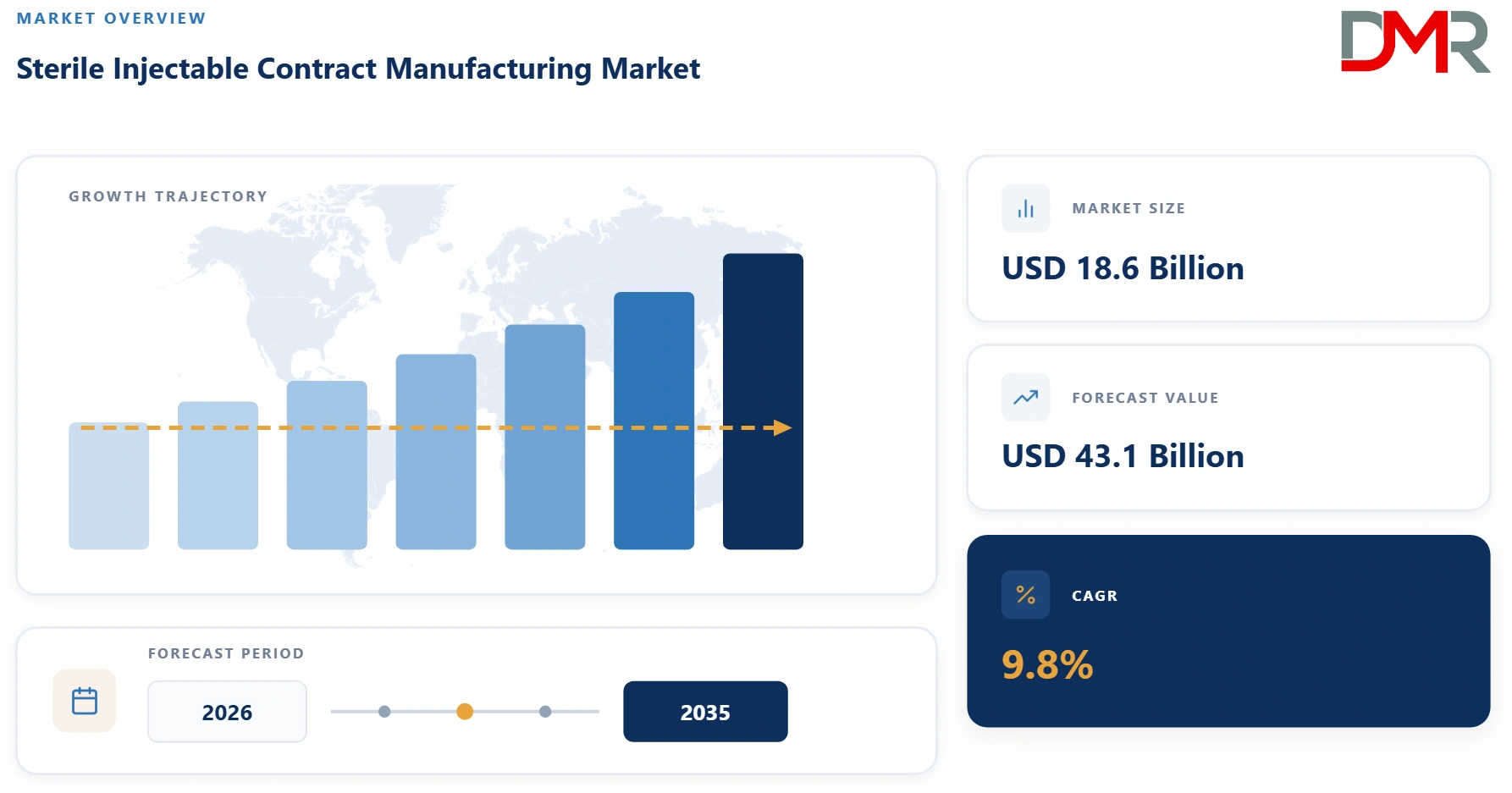
- Market Size (2026): USD 18.6 Bn
- Forecast Value (2035): USD 43.1 Bn
- CAGR (2026-2035): 9.8%
- Largest Region (2026): Asia-Pacific, approximately 30.5%
- Fastest-Growing Region: Asia-Pacific
- Leading Service Type (2026): Clinical and Commercial Manufacturing, around 31.4%
- Leading Molecule Type (2026): Small Molecules, close to 43.2%
- Key Players: Lonza, Catalent, Vetter Pharma, and Others
What is Sterile Injectable Contract Manufacturing Market and its Market Size?
Global Sterile Injectable Contract Manufacturing Market size is estimated to reach USD 18.6 Bn in 2026 and is further anticipated to reach USD 43.1 Bn by 2035, at a CAGR of 9.8%.
ℹ
To learn more about this report –
Download Your Free Sample Report Here
Sterile injectable contract manufacturing covers outsourced development, aseptic processing, fill-finish, inspection, packaging, testing, and related supply services for parenteral medicines. The scope includes small molecules, biologics, vaccines, peptides, and other injectable formats manufactured under validated contamination-control systems. It excludes active pharmaceutical ingredient production unless bundled with an injectable manufacturing program.
Demand is shaped by the technical difficulty of aseptic operations, the rising number of biologic and specialty therapies, and the need for sponsors to access compliant capacity without building complete facilities. Procurement decisions typically weigh regulatory history, container-closure expertise, batch flexibility, cold-chain capability, technology transfer performance, and the ability to support both clinical and commercial volumes.
The market also benefits from portfolio outsourcing by established pharmaceutical companies and virtual biotechnology firms. Capacity planning remains complex because injectable programs require long validation cycles, specialized equipment, and controlled scheduling. Providers that combine formulation development, analytical services, fill-finish, packaging, and lifecycle support can capture more value per program.
Use Cases
- Biologic Launch Support: Biotechnology companies use specialized CDMOs for aseptic filling, inspection, and packaging when internal facilities cannot meet launch timelines. External capacity reduces capital requirements while supporting clinical-to-commercial scale-up, validated processes, and controlled cold-chain distribution.
- Clinical Trial Supply: Drug developers outsource small and medium batches to obtain randomized, labeled injectable supplies across multiple trial phases. Flexible lines help manage changing forecasts, reduce underutilized equipment, and coordinate stability programs with regulatory submissions.
- Legacy Product Transfer: Pharmaceutical companies transfer established injectable products to secondary manufacturers to improve supply resilience or add regional capacity. Qualified sites can provide technology transfer, comparability testing, packaging changes, and dual-source production without disrupting market availability.
- High-Value Specialty Medicines: Specialty drug sponsors use contract manufacturers for low-volume, high-complexity products such as peptides, oncology injectables, and lyophilized formulations. Expertise in containment, freeze-drying, and visual inspection improves batch reliability and reduces technical execution risk.
Key Takeaways
- Market Size & Share: The market is estimated at USD 18.6 Bn in 2026, with Asia-Pacific representing approximately 30.5% of revenue.
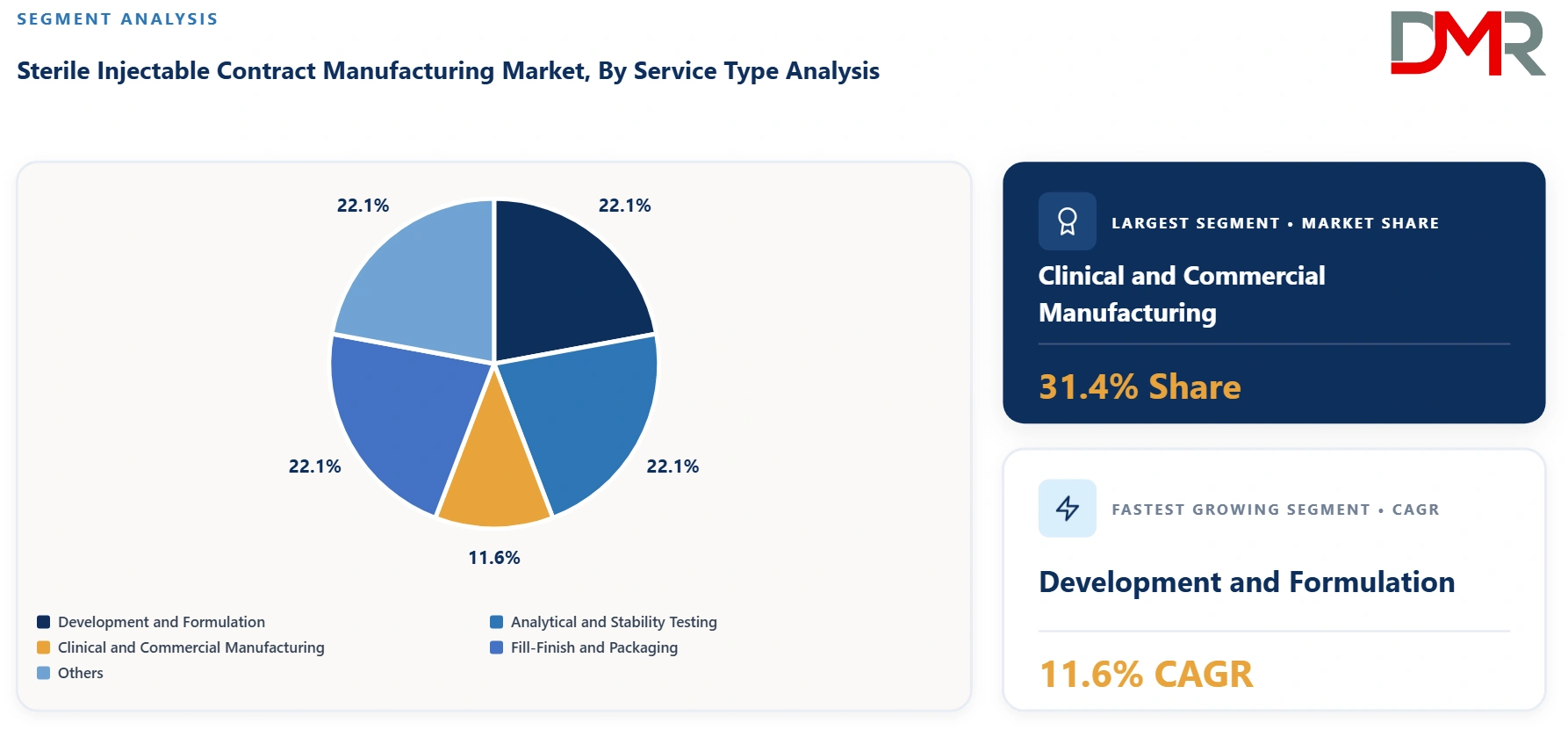
- Service Type Analysis: Clinical and commercial manufacturing leads, while development and formulation is projected to expand at 11.6% CAGR.
- Molecule Type Analysis: Small molecules account for approximately 43.2% of 2026 revenue, while biologics show faster outsourcing growth.
- Regional Analysis: North America and Europe remain major procurement centers, while Asia-Pacific contributes about 30.5% of demand.
- Commercial Catalyst: Biologic pipelines and injectable drug shortages are increasing demand for qualified external fill-finish capacity.
- Competitive Dynamics: Competition centers on regulatory performance, capacity availability, container technologies, technical transfer, and integrated services.
How AI/Gen AI is Transforming the Sterile Injectable Contract Manufacturing Market?
AI is being applied across sterile manufacturing to identify process deviations, improve batch-record review, predict equipment maintenance needs, and prioritize investigations. Computer-vision systems can support container inspection by flagging particulate matter, cosmetic defects, fill-volume anomalies, and labeling errors for human review. Predictive models can also connect environmental monitoring, machine parameters, and historical batch outcomes to identify conditions associated with contamination risk or yield loss.
Generative AI is increasingly useful for technical documentation and knowledge retrieval, although regulated decisions still require validated workflows and human approval. Systems can draft deviation summaries, compare change-control records, map customer requirements to manufacturing procedures, and assist with training content. Adoption depends on data integrity, model validation, cybersecurity, audit trails, and clear separation between advisory outputs and release decisions.
- Visual Inspection Analytics: Classification models help detect defects and route uncertain units for operator assessment.
- Predictive Maintenance: Time-series models forecast failures in filling, lyophilization, isolator, and inspection equipment.
- Document Intelligence: Retrieval and generation tools accelerate review of batch records, deviations, CAPAs, and technology-transfer packages.
Key Drivers in the Global Sterile Injectable Contract Manufacturing Market
Growth of Biologic and Specialty Pipelines
Biologics, peptides, oncology therapies, and other specialty medicines require controlled aseptic processing, specialized formulation, and container-closure expertise. Many sponsors lack sufficient internal capacity or prefer to preserve capital for discovery and commercialization. Contract manufacturers provide access to validated suites, trained operators, analytical laboratories, and established quality systems. Demand is especially strong when products move from clinical batches to commercial supply, because sponsors need scalable processes without repeating development work. Providers with flexible lines, high-containment capabilities, and integrated testing can capture programs across multiple lifecycle stages.
Need for Flexible Capacity and Supply Resilience
Injectable supply chains face long qualification cycles, constrained sterile capacity, and high consequences from production interruptions. Pharmaceutical companies increasingly use external manufacturers to add geographic redundancy, manage demand peaks, and reduce dependence on single sites. CDMOs that offer multiple vial sizes, prefilled syringe capabilities, lyophilization, and rapid changeover can serve a wider product mix. Outsourcing also helps sponsors respond to short launch windows and public procurement requirements. The commercial value of reliable capacity supports multi-year agreements and encourages investment in new isolators, filling lines, inspection systems, and cold-chain infrastructure.
Restraints in the Global Sterile Injectable Contract Manufacturing Market
High Validation and Compliance Burden
Sterile manufacturing requires extensive qualification of facilities, utilities, personnel, processes, cleaning, environmental monitoring, and container-closure systems. Each technology transfer can require substantial documentation and engineering work before routine production begins. Regulatory observations or failed media fills can delay launches and raise costs for both the sponsor and provider. Smaller CDMOs may struggle to fund upgrades or maintain specialist teams, while large providers must balance compliance investments across multiple sites. These requirements lengthen sales cycles and make switching suppliers difficult once a product is validated.
Capacity Constraints and Technology Transfer Risk
Demand for injectable capacity can exceed available slots, especially for biologics, lyophilized products, and prefilled systems. Sponsors may face long lead times, minimum-batch requirements, or limited access to late-stage commercial suites. Transfers also create technical risk because differences in equipment geometry, process controls, materials, and operator practices can affect product quality. Delays in analytical method transfer or component qualification can extend timelines. Providers therefore need disciplined project management and transparent capacity planning, while sponsors must allocate adequate time and resources for comparability and validation.
Growth Opportunities in the Global Sterile Injectable Contract Manufacturing Market
Expansion of Prefilled and Self-Administration Formats
Prefilled syringes, cartridges, and autoinjector-compatible presentations can improve dosing convenience and reduce preparation steps in clinical and home-care settings. Their adoption creates opportunities for CDMOs with expertise in device compatibility, siliconization, plunger systems, container-closure integrity, assembly, and combination-product documentation. Sponsors increasingly seek partners that can coordinate drug product manufacturing with primary packaging and device operations. Investment in flexible syringe lines and automated inspection can help manufacturers serve biologics, vaccines, and specialty therapies while supporting differentiated presentations and lifecycle extensions.
Regionalized Capacity and Integrated Development Services
Sponsors are seeking regional supply options to reduce logistics exposure and improve responsiveness to local regulatory and market requirements. CDMOs can expand by pairing formulation, analytical development, clinical supply, fill-finish, and commercial packaging in a single network. Integrated services reduce handoffs and create stronger customer retention. Additional white space exists in emerging markets where sterile capacity is growing but advanced isolator systems, lyophilization, high-potency handling, and biologics expertise remain limited. Partnerships, site acquisitions, and technology licensing can accelerate capability development without building every function organically.
Trends in the Global Sterile Injectable Contract Manufacturing Market
Shift Toward Isolator-Based Aseptic Processing
Isolators and restricted access barrier systems are gaining attention because they reduce direct operator interaction with critical processing zones and can support stronger contamination-control strategies. Adoption is accompanied by investment in automated decontamination, glove integrity testing, rapid transfer systems, and environmental monitoring. The trend is particularly relevant for high-value products where batch loss is costly. CDMOs are differentiating through validated barrier technologies, flexible line configurations, and the ability to manage varied container formats without excessive changeover time.
Greater Integration of Digital Quality and Manufacturing Data
Sterile facilities are connecting equipment, environmental monitoring, electronic batch records, laboratory systems, and quality-management platforms. Better data integration supports faster review, improved traceability, and earlier identification of recurring deviations. Customers increasingly expect transparent access to program status, stability results, investigations, and release milestones. Digitalization does not remove validation obligations, but it can reduce manual transcription and improve consistency. Providers that demonstrate strong data governance, cybersecurity, and audit-ready records are better positioned for complex multinational programs.
Research Scope and Analysis
The study evaluates sterile injectable contract manufacturing across service type, molecule type, container type, scale, and end user. Growth is assessed through outsourcing intensity, pipeline complexity, regulatory expectations, capacity investment, and demand for flexible commercial supply.
ℹ
To learn more about this report –
Download Your Free Sample Report Here
By Service Type
Clinical and Commercial Manufacturing is estimated to hold around 31.4% of 2026 revenue because sponsors require qualified capacity for repeatable production and validated release testing. Growth, however, is concentrated in Development and Formulation, projected to expand at a CAGR of 11.6% between 2026 and 2035 as complex pipelines, smaller batches, and differentiated delivery formats increase outsourcing requirements.
By Molecule Type
Small Molecules is estimated to hold around 43.2% of 2026 revenue because sponsors require qualified capacity for repeatable production and validated release testing. Growth, however, is concentrated in Biologics, projected to expand at a CAGR of 12.4% between 2026 and 2035 as complex pipelines, smaller batches, and differentiated delivery formats increase outsourcing requirements.
By Container Type
Vials is estimated to hold around 47.1% of 2026 revenue because sponsors require qualified capacity for repeatable production and validated release testing. Growth, however, is concentrated in Prefilled Syringes, projected to expand at a CAGR of 10.9% between 2026 and 2035 as complex pipelines, smaller batches, and differentiated delivery formats increase outsourcing requirements.
By Scale
Large-Scale Commercial is estimated to hold around 38.5% of 2026 revenue because sponsors require qualified capacity for repeatable production and validated release testing. Growth, however, is concentrated in Clinical Scale, projected to expand at a CAGR of 11.8% between 2026 and 2035 as complex pipelines, smaller batches, and differentiated delivery formats increase outsourcing requirements.
By End User
Pharmaceutical Companies is estimated to hold around 46.0% of 2026 revenue because sponsors require qualified capacity for repeatable production and validated release testing. Growth, however, is concentrated in Biotechnology Companies, projected to expand at a CAGR of 12.1% between 2026 and 2035 as complex pipelines, smaller batches, and differentiated delivery formats increase outsourcing requirements.
The Global Sterile Injectable Contract Manufacturing Market Report is Segmented Based on the Following
By Service Type
- Development and Formulation
- Analytical and Stability Testing
- Clinical and Commercial Manufacturing
- Fill-Finish and Packaging
- Others
By Molecule Type
- Small Molecules
- Biologics
- Vaccines
- Peptides and Oligonucleotides
- Others
By Container Type
- Vials
- Prefilled Syringes
- Ampoules
- Cartridges
- Others
By Scale
- Clinical Scale
- Small-Batch Commercial
- Large-Scale Commercial
- Specialized High-Potency Scale
- Others
By End User
- Pharmaceutical Companies
- Biotechnology Companies
- Generic Drug Manufacturers
- Specialty and Orphan Drug Developers
- Others
Regional Analysis
Sterile injectable outsourcing demand is distributed across established pharmaceutical hubs and expanding manufacturing centers. Regional differences reflect drug-development intensity, regulatory maturity, labor availability, installed fill-finish capacity, and access to specialized packaging and cold-chain infrastructure.
Region with the Largest Revenue Share
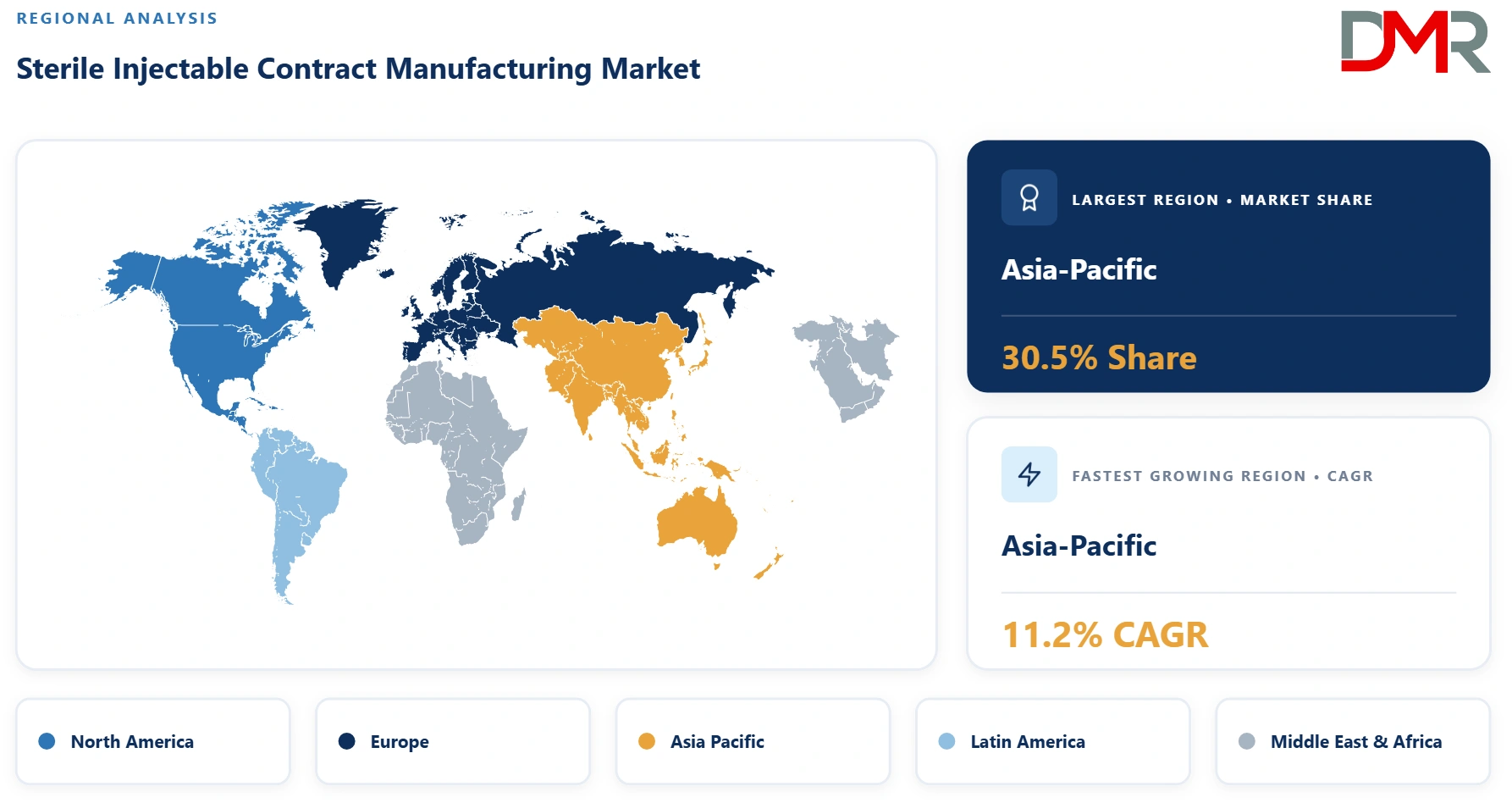
Asia-Pacific is estimated to represent approximately 30.5% of 2026 revenue. The region combines large pharmaceutical production bases, expanding biotechnology activity, competitive manufacturing economics, and growing investment in sterile facilities. China, Japan, India, South Korea, and Australia contribute through different models, ranging from domestic supply and generic injectables to biosimilars, vaccines, and outsourced clinical manufacturing. Demand is also supported by regional efforts to strengthen medicine security and reduce dependence on distant supply chains. Providers with internationally recognized quality systems and strong technology-transfer capabilities can serve both local sponsors and multinational programs.
ℹ
To learn more about this report –
Download Your Free Sample Report Here
Region with the Highest CAGR
Asia-Pacific is projected to record the highest regional growth at approximately 11.2% between 2026 and 2035. Expansion is supported by biologics investment, vaccine and injectable capacity additions, clinical-trial activity, and increasing use of external manufacturing by emerging biotechnology companies. The opportunity is strongest for suppliers that can demonstrate regulatory readiness, consistent aseptic performance, and reliable export logistics. Partnerships with global pharmaceutical companies can further accelerate site qualification and improve utilization of new lines.
By Region
- North America: The US, Canada
- Europe: Germany, France, The UK, Italy, Spain, Rest of Europe
- Asia-Pacific: China, Japan, India, Australia, South Korea, Rest of APAC
- Latin America: Mexico, Brazil, Colombia, Argentina, Rest of LATAM
- Middle East & Africa: Saudi Arabia, The UAE, South Africa, Rest of MEA
Regulatory Landscape
Sterile injectable contract manufacturing is governed by requirements covering aseptic processing, contamination control, process validation, environmental monitoring, data integrity, personnel qualification, container-closure integrity, and batch release. Sponsors assess inspection history, deviation management, media-fill performance, analytical validation, and change-control discipline when selecting a provider. Regulatory expectations increasingly emphasize science-based contamination-control strategies and documented risk management. Cross-border programs must also align site procedures with local agency expectations, pharmacopoeial methods, serialization rules, and import controls. These requirements favor providers with mature quality systems, experienced regulatory teams, and facilities capable of supporting inspections and remediation without interrupting supply.
Investment and White Space Analysis
Investment is concentrating in isolator-based filling, prefilled syringe and cartridge lines, lyophilization, high-potency containment, biologics formulation, and digital quality systems. White space remains in flexible clinical-to-commercial capacity, regional secondary sourcing, and integrated services for smaller biotechnology companies. New capacity can generate attractive returns when anchored by long-term customer commitments, but utilization ramp-up and qualification timelines must be managed carefully. Investors should assess site history, workforce depth, utility redundancy, technology-transfer performance, customer concentration, and the ability to convert clinical programs into durable commercial revenue. Partnerships and network-based manufacturing models can reduce execution risk.
Competitive Landscape
The market includes diversified pharmaceutical service companies, specialist fill-finish providers, biologics CDMOs, and regional manufacturers. Competition is based on regulatory performance, available capacity, technical breadth, speed of technology transfer, container formats, batch-size flexibility, geographic reach, and total program economics. Larger providers benefit from multi-site networks and integrated analytics, while specialists can compete through focused expertise, responsiveness, and niche containment or delivery capabilities. Consolidation and capacity investment remain important strategic themes as sponsors seek fewer handoffs and stronger supply resilience. Customer qualification requirements create switching costs after validation, making quality consistency and delivery reliability central to retention.
Some of the Prominent Players in the Global Sterile Injectable Contract Manufacturing Market Are:
- Baxter BioPharma Solutions
- Catalent
- CDMO Pharma
- CordenPharma
- Cytovance Biologics
- Evonik Health Care
- Fujifilm Diosynth Biotechnologies
- Grifols
- Jubilant HollisterStier
- KBI Biopharma
- Kindeva Drug Delivery
- Lonza
- MabPlex
- Merck KGaA
- Novartis Pharma Services
- PCI Pharma Services
- Pfizer CentreOne
- Piramal Pharma Solutions
- Recipharm
- Rentschler Biopharma
- Samsung Biologics
- Sanofi Contract Manufacturing
- Siegfried
- Simtra BioPharma Solutions
- SK pharmteco
- Sterling Pharma Solutions
- Vetter Pharma
- Wockhardt Bio AG
- WuXi Biologics
- WuXi STA
- Ajinomoto Bio-Pharma Services
- Almac Group
- Aenova Group
- BioVectra
- Boehringer Ingelheim BioXcellence
- Cambrex
- Curia Global
- Delpharm
- Nitto Avecia Pharma Services
- Aptar Pharma
- Other Key Players
Recent Developments
- In 2026, CDMO operators continued investing in sterile fill-finish, isolator, lyophilization, and prefilled syringe capacity to address biologic and specialty-drug demand.
- In 2025, pharmaceutical service providers expanded integrated offerings that combine development, analytical testing, clinical supply, commercial manufacturing, and packaging.
- In 2025, manufacturers increased adoption of electronic batch records, automated inspection, and data-integrated environmental monitoring across sterile facilities.
- In 2025, sponsors continued pursuing dual sourcing and regional manufacturing strategies after disruptions exposed dependence on single production sites.
Report Details
| Report Characteristics |
| Market Size (2026) |
USD 18.6 Bn |
| Market Size (2035) |
USD 43.1 Bn |
| CAGR |
9.8% |
| Historical Year |
2021–2025 |
| Forecast Year |
2026–2035 |
| Base Year |
2025 |
| Segments Covered |
By Service Type, By Molecule Type, By Container Type, By Scale, By End User |
| Regional Coverage |
North America, Europe, Asia-Pacific, Latin America, Middle East & Africa |
Frequently Asked Questions
How big is the Global Sterile Injectable Contract Manufacturing Market?
▾ Global Sterile Injectable Contract Manufacturing Market size is estimated to reach USD 18.6 Bn in 2026 and is projected to reach USD 43.1 Bn by 2035, growing at a CAGR of 9.8%.
What is the growth rate of the Global Sterile Injectable Contract Manufacturing Market?
▾ The market is expanding at an estimated CAGR of 9.8% from 2026 to 2035, supported by biologic pipelines, specialty medicines, and demand for qualified sterile capacity.
Which region holds the largest share in the Global Sterile Injectable Contract Manufacturing Market?
▾ Asia-Pacific leads the market, holding approximately 30.5% of global revenue in 2026.
Who are the key players in the Global Sterile Injectable Contract Manufacturing Market?
▾ Prominent operating companies include Lonza, Catalent, Vetter Pharma, and Samsung Biologics.
Which segment is leading the Global Sterile Injectable Contract Manufacturing Market?
▾ The Clinical and Commercial Manufacturing segment commands the highest service-type share, accounting for roughly 31.4% in 2026.
Which segment is expanding fastest in the Global Sterile Injectable Contract Manufacturing Market?
▾ The Development and Formulation service segment is projected to record strong growth, registering an estimated CAGR of 11.6% through 2035.
What are the major growth drivers in the Global Sterile Injectable Contract Manufacturing Market?
▾ Market expansion is primarily propelled by biologic and specialty-drug pipeline growth and the need for flexible, validated sterile capacity and supply resilience.