Global Subscription Economy Market Snapshot
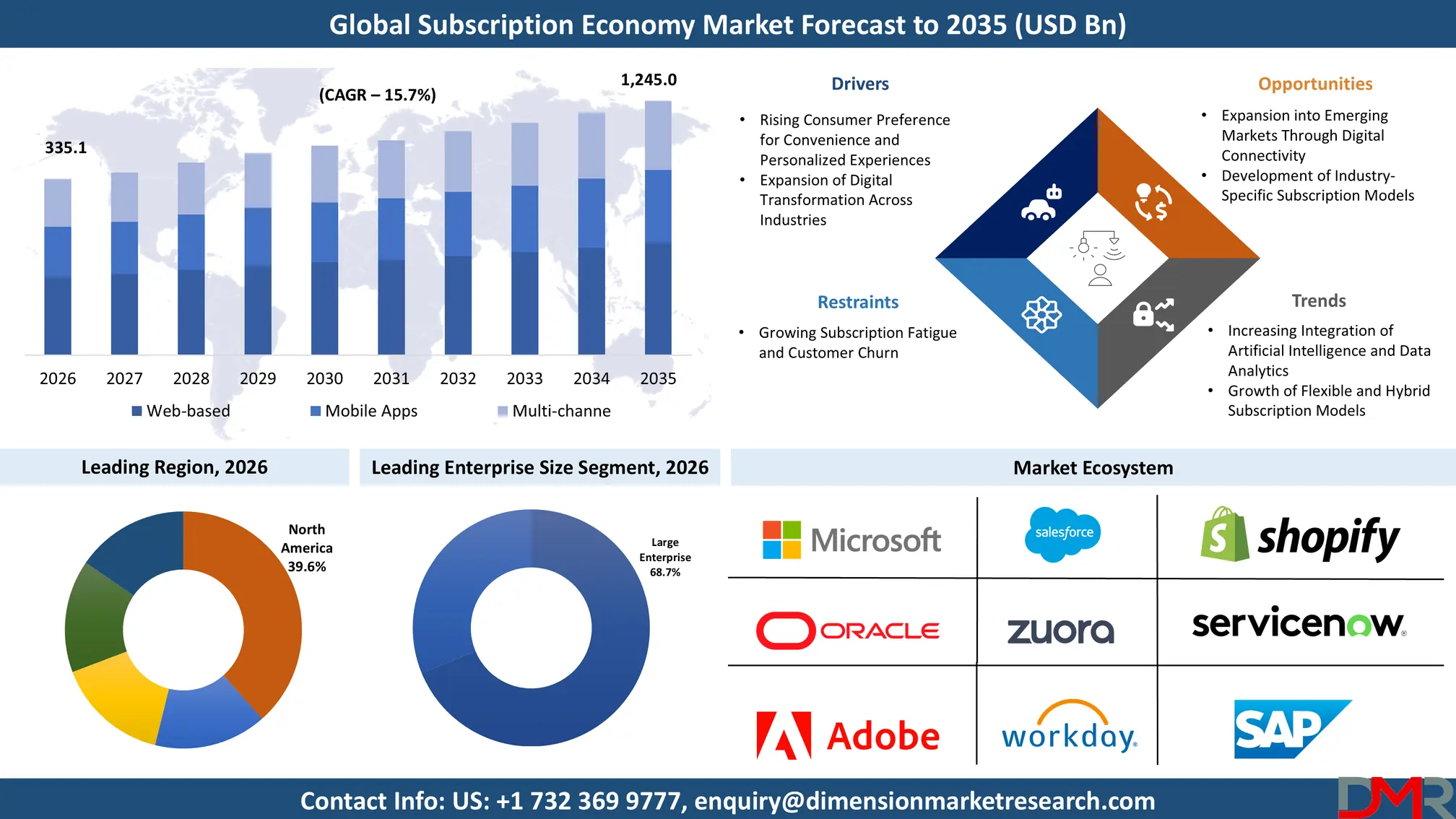
- Global Subscription Economy Market Size in 2026: USD 335.1 Billion
- Global Subscription Economy Market Size in 2035: USD 1,245.0 Billion
- Global CAGR from 2026 to 2035: 15.7%
- Access Subscription is the leading Type of Subscription segment in 2026: 36.4%
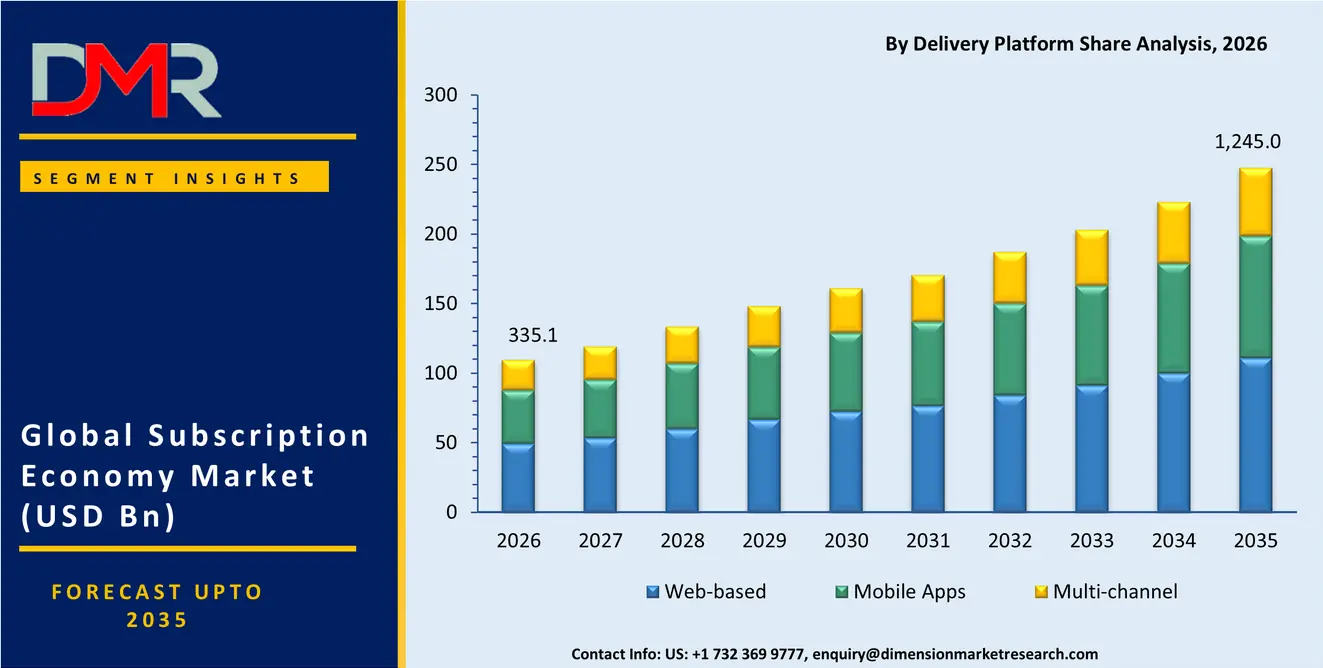
- Mobile Apps is the leading Delivery Platform segment in 2026: 46.8%
- B2C is the leading Business Model segment in 2026: 61.5%
- Fixed Recurring Fee is the leading Revenue Model segment in 2026: 51.2%
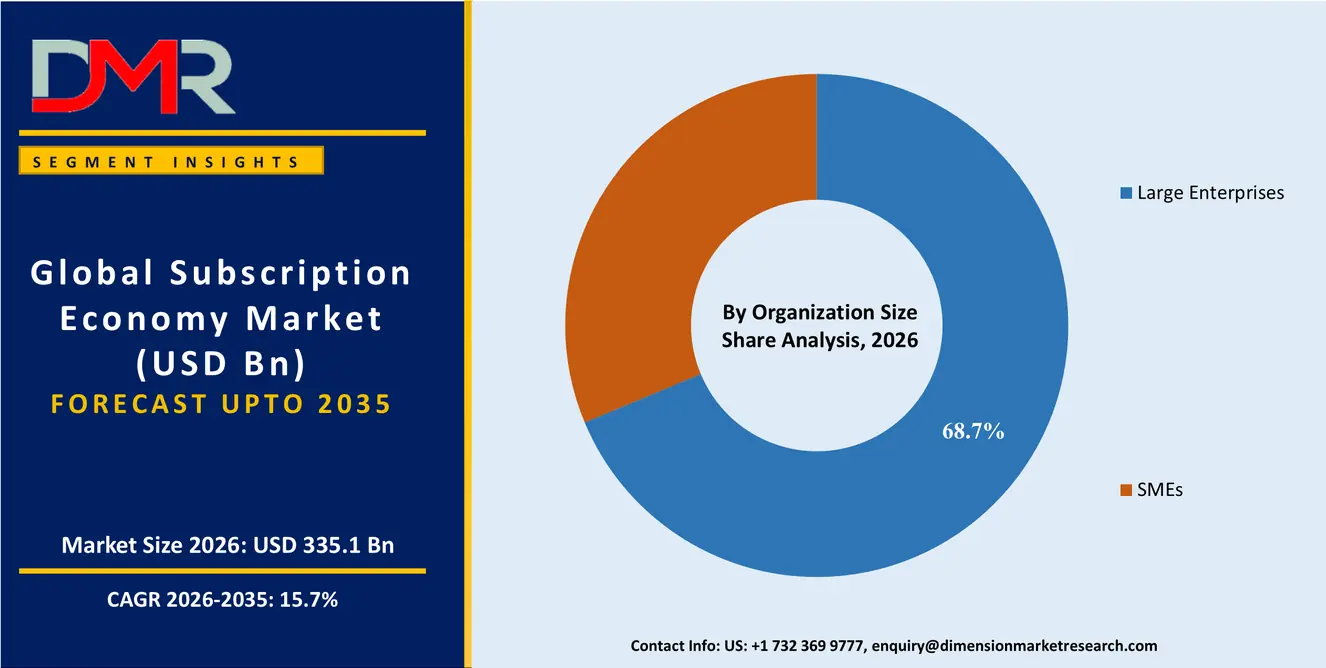
- Large Enterprises is the leading Organization Size segment in 2026: 68.7%
- Software & SaaS is the leading Industry Vertical segment in 2026: 25.6%
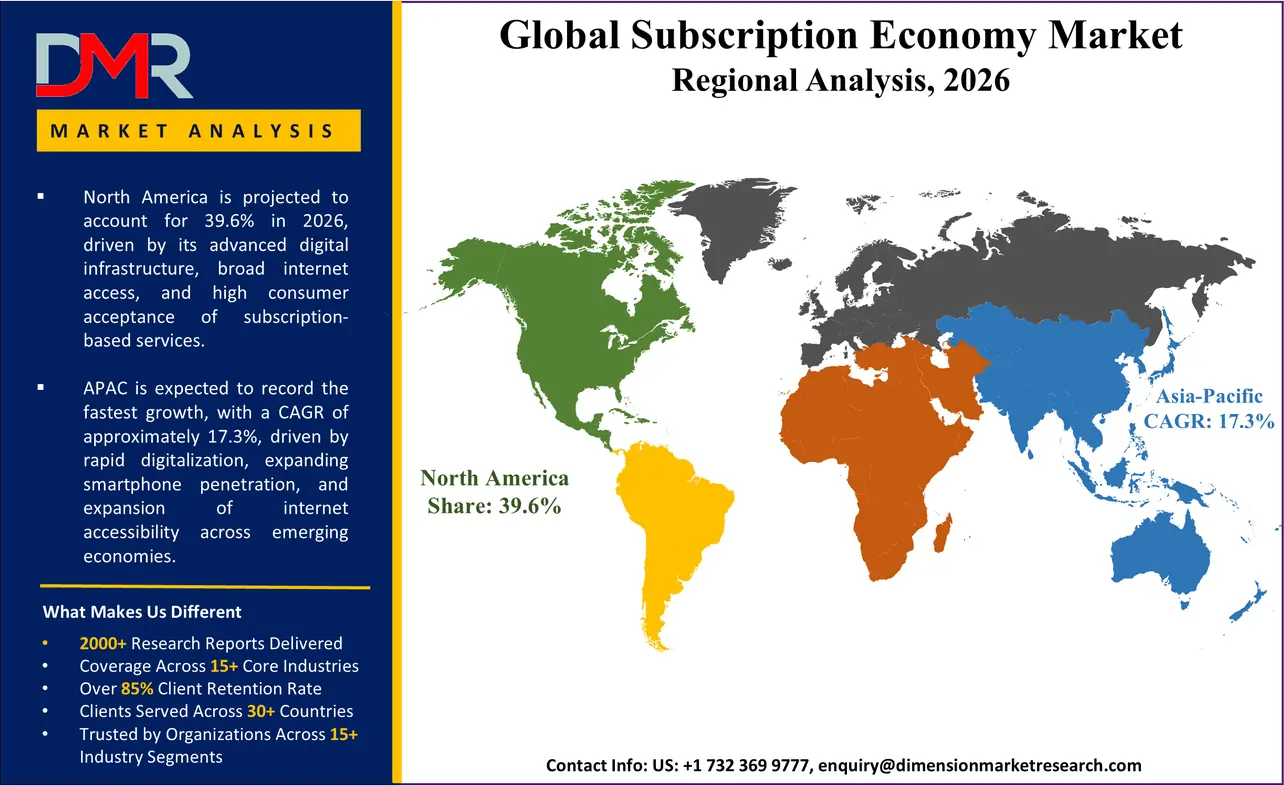
- North America is the leading Region in 2026: 39.6%
What is the Global Subscription Economy and its Market Size?
The Global Subscription Economy Market is projected to reach USD 335.1 billion in 2026 and grow at a compound annual growth rate of 15.7% from there until 2035 to reach a value of USD 1,245.0 billion.
ℹ
To learn more about this report –
Download Your Free Sample Report Here
The Subscription Economy Market represents revenue generated through recurring subscription-based business models in which customers pay periodically for continued access to digital services, software, physical products, memberships, mobility services, healthcare offerings, education, and other recurring-use products or services. The market covers B2C, B2B, and B2B2C subscription businesses across multiple industry verticals.
The scope primarily measures revenues generated from subscription-based offerings rather than the total revenue of companies providing billing infrastructure, hardware, or unrelated products. Subscription management and payment technology providers are considered part of the supporting ecosystem when their services directly enable recurring-revenue business models.
Use Cases
- Digital Media & Entertainment: Subscription models are widely used by video and audio streaming platforms such as Netflix and Amazon Prime, enabling customers to pay recurring fees for continuous access to on-demand content.
- Software & Cloud Services: Subscription models enable software and cloud providers to offer applications, data storage, communication tools, and other digital services through recurring monthly or annual fees.
- Physical Goods & E-commerce: Subscription models allow brands to ship curated products periodically or provide replenishment services for frequently purchased household and consumer goods at regular intervals.
- Mobility & Hospitality: Subscription models are used for vehicle-sharing, rental memberships, food delivery benefits, hospitality programs, and other services that provide recurring access or benefits for a fixed periodic fee.
Key Takeaways
- Market Size: The Global Subscription Economy Market is valued at USD 335.1 Billion in 2026 and is expected to reach USD 1,245.0 Billion by 2035.
- Growth Rate and Outlook: The market is projected to grow at a CAGR of 15.7% from 2026 to 2035, driven by increasing adoption of subscription-based business models and digital services.
- Primary Growth Drivers: Key growth factors include rising consumer preference for convenience, expansion of digital transformation, increasing adoption of SaaS platforms, and AI-powered personalization.
- Type of Subscription Analysis: Access Subscription is the leading type of subscription segment, supported by growing demand for continuous access to software, streaming, cloud services, and membership platforms.
- Delivery Platform Analysis: Mobile Apps is the leading delivery platform segment, driven by smartphone penetration, mobile connectivity, and demand for seamless subscription management.
- Business Model Analysis: B2C (Business-to-Consumer) is the leading business model segment, owing to widespread adoption of subscription services across media, e-commerce, software, and consumer applications.
- Regional Leadership: North America is the leading region, supported by advanced digital infrastructure, strong technology adoption, and the presence of major subscription-based companies.
How AI/Gen AI is Transforming the Subscription Economy Market?
Generative AI is transforming the subscription economy by enabling businesses to personalize customer experiences, automate engagement, predict churn, and optimize pricing and subscription plans. AI systems can analyze user behavior in real time to personalize onboarding, trial experiences, recommendations, retention offers, and customer communications. Machine learning and large language models also support proactive churn management by identifying at-risk subscribers and triggering targeted retention actions. At the same time, AI-intensive services are encouraging companies to move beyond traditional flat-rate subscriptions toward hybrid, usage-based, and consumption-based pricing models that better reflect computing costs and customer usage patterns.
Key Drivers in the Global Subscription Economy Market
Rising Consumer Preference for Convenience and Personalized Experiences
Consumers mainly prefer subscription-based services because they provide convenience, flexibility, and personalized experiences. Instead of making repeated purchasing decisions, subscribers receive constant access to products or services through automated billing and regular deliveries. Companies use customer data, artificial intelligence, and predictive analytics to recommend customized content, products, and pricing plans that improve user satisfaction and retention. The growth in adoption of digital platforms, smartphones, and high-speed internet has further accelerated subscription usage across industries such as media, software, e-commerce, food delivery, and healthcare, which continues to strengthen demand for subscription-based business models worldwide.
Expansion of Digital Transformation Across Industries
Rapid digital transformation is promoting businesses across multiple sectors to adopt subscription-based revenue models. Organizations are moving away from one-time sales toward recurring revenue streams that enhance financial stability, customer engagement, and long-term profitability. Cloud computing, Software-as-a-Service (SaaS), connected devices, and digital payment infrastructure have made subscription management easier and more scalable. Businesses also benefit from constant customer insights, allowing regular product improvements and targeted marketing campaigns. As industries including education, automotive, fitness, entertainment, and manufacturing increasingly digitize their offerings, subscription models are becoming an essential strategy for delivering ongoing services while maintaining predictable income and stronger customer relationships.
Restraints in the Global Subscription Economy Market
Growing Subscription Fatigue and Customer Churn
As consumers subscribe to numerous digital services, media platforms, software solutions, and membership programs, subscription fatigue has become a major market restraint. The increase in monthly expenses makes customers reassess their spending, resulting in frequent cancellations or switching between competing providers. Businesses must constantly invest in new features, exclusive content, personalized experiences, and customer support to maintain subscriber loyalty. High churn rates increase customer acquisition costs and minimize profitability, mainly for smaller companies with limited marketing budgets. Economic uncertainty and inflation further influence discretionary spending, making customer retention increasingly challenging for subscription-based businesses operating in highly competitive global markets.
Growth Opportunities in the Global Subscription Economy Market
Expansion into Emerging Markets Through Digital Connectivity
Emerging economies provide substantial growth opportunities for subscription-based businesses owing to expanding internet access, smartphone adoption, and digital payment ecosystems. The growth of middle-class populations and increasing digital literacy are encouraging consumers to explore subscription services across entertainment, education, healthcare, and e-commerce sectors. Companies can launch affordable pricing models, localized content, regional language support, and flexible payment options to attract new customer segments. Strategic partnerships with telecom operators, financial institutions, and local technology providers further improve market penetration. As digital infrastructure continues to develop, emerging markets are expected to become major contributors to the long-term expansion of the global subscription economy.
Development of Industry-Specific Subscription Models
Businesses are largely creating specialized subscription offerings personalized to distinctive industry requirements, opening new avenues for market growth. Sectors like healthcare, automotive, industrial equipment, agriculture, beauty, and professional services are adopting recurring revenue models that provide constant access to products, maintenance, analytics, and support. These customized subscriptions enhance customer loyalty while generating predictable income for service providers. The integration of Internet of Things (IoT), artificial intelligence, and data analytics enables businesses to deliver proactive maintenance, personalized recommendations, and performance monitoring. Such value-added services strengthen customer relationships and encourage wider adoption of subscription-based business models across diverse industries.
Trends in the Global Subscription Economy Market
Increasing Integration of Artificial Intelligence and Data Analytics
Artificial intelligence and advanced data analytics are becoming important to the evolution of subscription-based businesses. Companies use AI to analyze customer behavior, predict churn, optimize pricing, recommend customized products, and automate customer support. Machine learning algorithms help identify subscriber preferences, allowing businesses to deliver highly customized experiences that improve engagement and retention. Predictive analytics also supports inventory planning, demand forecasting, and targeted promotional campaigns. As organizations constantly invest in intelligent technologies, AI-driven subscription management is set to enhance operational efficiency while creating more personalized and valuable customer experiences across multiple industry sectors.
Growth of Flexible and Hybrid Subscription Models
Businesses are mostly adopting flexible subscription structures that allow customers to customize plans according to their preferences and usage patterns. Hybrid models integrating subscriptions with pay-per-use, freemium, or one-time purchase options are gaining popularity because they accommodate diverse consumer needs. This flexibility reduces barriers to adoption while improving customer satisfaction and retention. Companies also introduce tiered memberships with premium features, exclusive content, loyalty rewards, and bundled services to increase perceived value. As competition intensifies, adaptable subscription models are becoming an important trend that enables businesses to attract broader customer segments while maximizing recurring revenue potential.
Research Scope and Analysis
The Subscription Economy market research examines business models, recurring revenue strategies, consumer adoption, digital platforms, pricing trends, and competitive dynamics across industries. It evaluates market drivers, challenges, technological innovations, regulatory influences, and growth opportunities, providing actionable insights into evolving subscription-based business ecosystems and long-term market potential.
ℹ
To learn more about this report –
Download Your Free Sample Report Here
By Type of Subscription Analysis
The Access Subscription segment is set to account for a 36.4% share of the global subscription economy market in 2026, establishing itself as the dominant subscription type due to its ability to provide continuous access to digital services, software, streaming platforms, cloud applications, and membership-based offerings through recurring payments. Its large adoption is supported by growth in consumer demand for convenience, seamless user experiences, and predictable service delivery, while businesses benefit from stable recurring revenue, stronger customer retention, and valuable usage insights for personalized offerings. Meanwhile, the Hybrid Subscription segment is projected to expand at the fastest CAGR of 19.4% during the forecast period, driven by rising demand for flexible pricing models that combine recurring subscriptions with pay-per-use, freemium, or one-time purchase options. This approach also allows businesses to attract diverse customer segments, minimize adoption barriers, improve conversion rates, and maximize customer lifetime value, making hybrid subscriptions a highly preferred strategy across industries such as software, digital media, e-commerce, mobility, healthcare, and professional services.
By Delivery Platform Analysis
The Mobile Apps segment will hold the largest 46.8% share of the global subscription economy market, due to the widespread adoption of smartphones, better mobile internet connectivity, and growing consumer preference for convenient, on-the-go access to subscription services.
ℹ
To learn more about this report –
Download Your Free Sample Report Here
Mobile applications allow ease of subscription management, personalized recommendations, secure digital payments, and real-time engagement, making them the preferred delivery platform across streaming, software, fitness, e-commerce, education, and financial services. In addition, the Multi-Channel segment is expected to register the fastest CAGR of 17.9% during the forecast period, owing to the increase in demand for integrated customer experiences across mobile apps, websites, smart TVs, desktops, and connected devices. Businesses are adopting omnichannel delivery strategies to provide consistent access, enhance customer engagement, improve retention, and maximize subscription revenue by allowing users to seamlessly switch between platforms without disrupting their experience.
By Business Model Analysis
The B2C (Business-to-Consumer) segment is expected to account for the largest 61.5% share of the global subscription economy market in 2026, driven by the rapid adoption of subscription-based services across streaming media, software, e-commerce, digital news, fitness, gaming, and online education. The model allows businesses to establish direct customer relationships, generate predictable recurring revenue, and enhance customer loyalty through personalized offerings, flexible pricing, and seamless digital experiences. Meanwhile, the B2B2C (Business-to-Business-to-Consumer) segment is projected to register the fastest CAGR of 19.1% during the forecast period, assisted by growing partnerships between service providers, enterprises, telecom operators, retailers, financial institutions, and digital platforms. This model expands customer reach, reduces acquisition costs, and enables businesses to deliver value-added subscription services through established partner ecosystems, accelerating market penetration and long-term revenue growth.
By Revenue Model Analysis
The Fixed Recurring Fee segment accounts for the largest 51.2% share of the global subscription economy market in 2026, driven by its ability to provide predictable revenue streams for businesses and transparent, consistent pricing for customers. This model is largely adopted across Software-as-a-Service (SaaS), streaming platforms, digital media, online education, and membership services because it simplifies billing, improves financial planning, and strengthens long-term customer relationships. Meanwhile, the Usage-Based/Pay-as-you-go segment is projected to register the fastest CAGR of 18.9% during the forecast period, due to the growing demand for flexible pricing models that align costs with actual consumption. Businesses are majorly adopting this model in cloud computing, telecommunications, utilities, and enterprise software to attract cost-conscious customers, enhance scalability, reduce entry barriers, and support evolving consumption patterns while maximizing revenue opportunities.
By Organization Size Analysis
The Large Enterprises segment is estimated to account for the largest 68.7% share of the global subscription economy market in 2026, driven by their strong financial resources, advanced digital infrastructure, and ability to invest in sophisticated subscription management platforms, customer analytics, and personalized service offerings. Large organizations majorly leverage subscription models across software, cloud services, media, manufacturing, and professional services to generate predictable recurring revenue, improve customer retention, and enhance operational efficiency. On the other hand, the SMEs segment is projected to register the fastest CAGR of 18.8% during the forecast period, supported by growing access to affordable cloud-based subscription platforms, digital payment solutions, and scalable Software-as-a-Service (SaaS) applications. These solutions enable small and medium-sized enterprises to adopt recurring revenue models with lower upfront investment, expand their customer base, improve cash flow stability, and compete more effectively in increasingly digital and subscription-driven markets.
By Industry Vertical Analysis
The Software & SaaS segment is set to attain the largest 25.6% share of the global subscription economy market in 2026, driven by the widespread adoption of cloud-based solutions, Software-as-a-Service platforms, and enterprise digital transformation initiatives. Businesses across industries are increasingly shifting from traditional software ownership models to subscription-based solutions that provide continuous updates, scalability, lower upfront costs, and improved operational flexibility. Meanwhile, the Automotive & Mobility segment is projected to register the fastest CAGR of 19.6% during the forecast period, supported by the growing adoption of connected vehicles, vehicle-as-a-service models, mobility subscriptions, and digital automotive solutions. Automakers and mobility providers are increasingly integrating subscription offerings for features such as infotainment, autonomous driving capabilities, maintenance services, and flexible vehicle access. This trend is creating new revenue streams, enhancing customer experiences, and accelerating the expansion of subscription models within the automotive ecosystem.
The Global Subscription Economy Market Report is segmented on the basis of the following:
By Type of Subscription
- Access Subscription
- Replenishment Subscription
- Curation Subscription
- Membership/ Club-based
- Hybrid
By Delivery Platform
- Web-based
- Mobile Apps
- Multi-channel
By Business Model
- B2C (Business-to-Consumer)
- B2B (Business-to-Business)
- B2B2C (Business-to-Business-to-Consumer)
By Revenue Model
- Fixed Recurring Fee
- Usage-Based/Pay-as-you-go
- Freemium + Premium Upgrade
- Tiered Subscription
By Organization Size
By Industry Vertical
- Media & Entertainment
- Software & SaaS
- E-commerce & Retail
- Telecom
- Healthcare & Wellness
- Education & E-learning
- Automotive & Mobility
- Financial Services & Insurance
- Others
Regional Analysis
North America is the Leading Region in the Global Subscription Economy Market
North America is set to hold the largest share of the global subscription economy market, with a share of 39.6% in 2026, supported by its advanced digital infrastructure, broad internet access, and high consumer acceptance of subscription-based services. The region is home to a large number of leading technology, streaming, software, and e-commerce companies that have successfully adopted recurring revenue business models. Strong demand for Software-as-a-Service (SaaS), video streaming, digital media, subscription commerce, and membership programs continues to drive market expansion. Businesses increasingly utilize artificial intelligence, cloud computing, and data analytics to personalize customer experiences and improve retention. Additionally, well-established digital payment systems, high disposable incomes, and continuous innovation further strengthen North America's leadership in the global subscription economy market.
ℹ
To learn more about this report –
Download Your Free Sample Report Here
Asia Pacific is the Fastest-Growing Region in the Global Subscription Economy Market
Asia Pacific is the fastest-growing region in the global subscription economy market, which is anticipated to grow at a CAGR of 17.3% during the forecast period, driven by rapid digitalization, expanding smartphone penetration, and expansion of internet accessibility across emerging economies. The growth of middle-class populations, growing digital payment adoption, and an increase in demand for online entertainment, education, software, and e-commerce subscriptions are accelerating market growth. Countries like China, India, Japan, South Korea, and Southeast Asian nations are experiencing strong consumer adoption of recurring service models. Businesses are introducing affordable pricing, localized content, and flexible subscription plans to attract diverse customer segments. Government support for digital transformation and expanding cloud infrastructure further contribute to sustained regional market growth.
The Europe Subscription Economy Market
The Europe Subscription Economy Market is estimated at USD 87.4 billion in 2026 and is projected to reach USD 295.8 billion by 2035, registering a CAGR of 14.5% during the forecast period. Market growth is driven by increasing adoption of subscription-based digital services, cloud software, streaming platforms, e-commerce memberships, and recurring-service models across major European economies.
Businesses are increasingly focusing on customer retention through personalized experiences, flexible pricing, bundled offerings, and value-added services. Strong digital infrastructure, widespread adoption of cashless payments, and continued enterprise digital transformation are expected to support long-term market expansion across the region.
Latin America Subscription Economy Market
The Latin America Subscription Economy Market is experiencing steady growth, supported by increasing internet penetration, expanding smartphone usage, and rising consumer demand for digital services. Subscription models are gaining popularity across streaming media, software, online education, and e-commerce sectors as businesses seek predictable recurring revenue. Improvements in digital payment infrastructure and fintech innovation are making subscription services more accessible to consumers. Companies are also offering localized content, affordable pricing, and flexible payment options to strengthen customer engagement. Continued digital transformation and growing online consumption are expected to support sustained market development across the region.
MEA Subscription Economy Market
The Middle East and Africa (MEA) Subscription Economy Market is witnessing gradual growth, driven by increasing digital adoption, expanding broadband connectivity, and rising demand for subscription-based digital services. Growth in this region is supported by government initiatives promoting digital economies, cloud computing, and smart city development, particularly across Gulf countries. Consumers are increasingly subscribing to streaming platforms, software solutions, online education, and digital fitness services. Businesses are investing in localized offerings, flexible payment methods, and mobile-first subscription models to improve customer reach. As digital infrastructure continues to advance, the MEA region is expected to present promising opportunities for subscription-based business expansion.
Major Countries Analysis
United States Subscription Economy Market
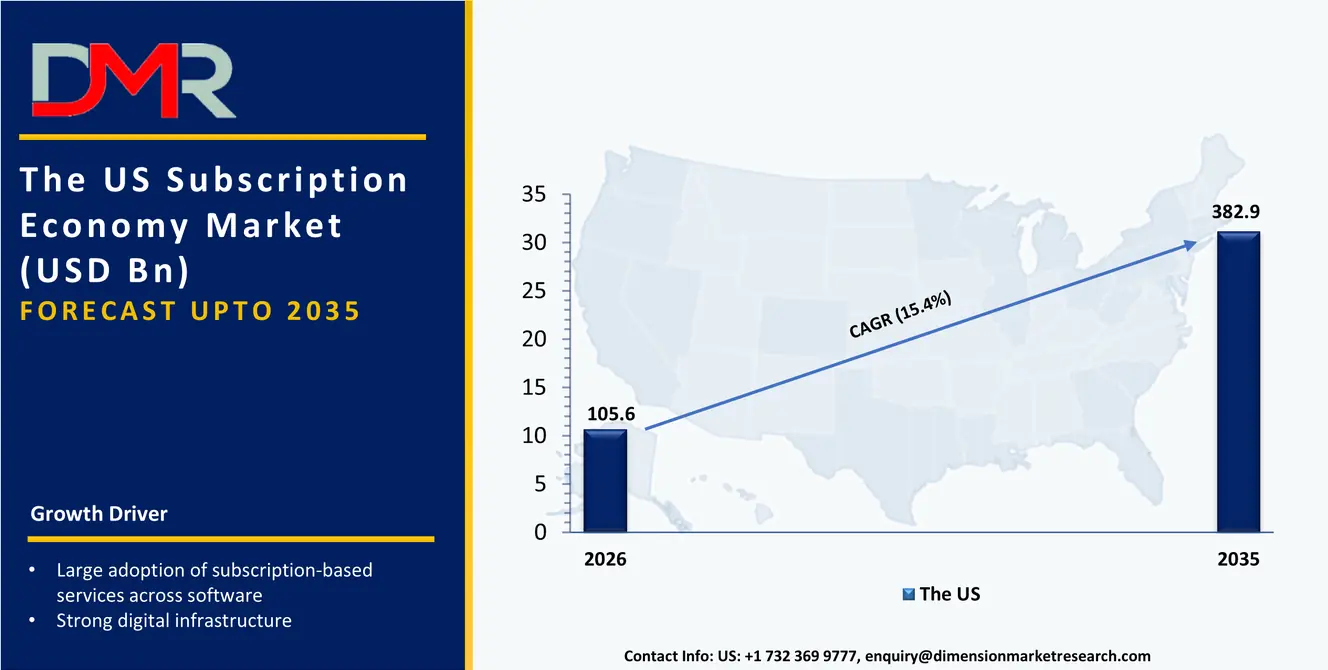
The United States Subscription Economy Market is valued at USD 105.6 billion in 2026 and is expected to reach USD 382.9 billion by 2035, registering a CAGR of approximately 15.4% during 2026–2035. Market growth is supported by widespread adoption of SaaS, streaming services, digital memberships, e-commerce subscriptions, cloud platforms, and recurring-service business models. Strong digital infrastructure, high consumer adoption of online services, advanced payment systems, and the presence of major technology and media companies continue to support subscription-based revenue growth across the country.
ℹ
To learn more about this report –
Download Your Free Sample Report Here
Japan Subscription Economy Market
The Japan Subscription Economy Market is valued at USD 15.4 billion in 2026 and is projected to reach USD 58.6 billion by 2035, expanding at a CAGR of approximately 16.0% during the 2026–2035 forecast period. Market growth is supported by continued digitalization, rising adoption of streaming and software subscriptions, increasing cashless payments, and consumer demand for convenient and personalized recurring services. Businesses are introducing flexible membership plans, localized digital offerings, bundled services, and personalized experiences to strengthen customer retention and expand recurring revenue opportunities.
Saudi Arabia Subscription Economy Market
The Saudi Arabia Subscription Economy Market is valued at USD 4.4 billion in 2026 and is forecast to reach USD 18.6 billion by 2035, expanding at a CAGR of approximately 17.4% between 2026 and 2035. In Saudi Arabia, the market expansion is driven by rapid digital transformation, increasing internet penetration, and strong government initiatives supporting the digital economy under Vision 2030. The growth in demand for streaming platforms, cloud-based software, online education, and subscription commerce, along with growing digital payment adoption, continues to accelerate the country's subscription economy.
Technology Analysis
Technology is the backbone of the Subscription Economy market, with cloud-native platforms, artificial intelligence, machine learning, predictive analytics, API integrations, and automated billing systems enabling seamless subscription management. Businesses increasingly leverage AI for customer personalization, churn prediction, dynamic recommendations, and demand forecasting, improving retention and lifetime value.
Integration with digital payment gateways, CRM platforms, ERP systems, and customer success tools further enhances operational efficiency. Growing adoption of usage-based billing and embedded subscription capabilities across industries is creating new revenue opportunities.
However, cybersecurity threats, data privacy concerns, integration complexity, and platform scalability challenges remain key risks. Continuous technological innovation is strengthening customer experiences, supporting recurring revenue models, and accelerating market expansion across diverse industry verticals.
Pricing Analysis
Pricing strategies are a critical competitive factor in the Subscription Economy market, with businesses increasingly adopting tiered, freemium, usage-based, hybrid, and personalized subscription models to maximize customer acquisition and retention.
AI-driven pricing optimization helps companies analyze customer behavior, willingness to pay, and consumption patterns, enabling flexible monetization approaches. Bundled offerings, loyalty incentives, and value-added services are becoming common to reduce churn and enhance customer lifetime value.
However, increasing subscription fatigue, pricing transparency requirements, inflationary pressures, and intense competition challenge providers to balance affordability with profitability. Effective pricing innovation improves recurring revenue stability, strengthens customer loyalty, enhances market competitiveness, and supports sustainable long-term business growth.
By Region
North America
Europe
- Germany
- France
- The U.K.
- Italy
- Spain
- Rest of Europe
Asia-Pacific
- China
- Japan
- India
- Australia
- South Korea
- Rest of APAC
Latin America
- Mexico
- Brazil
- Rest of LATAM
Middle East & Africa
- Saudi Arabia
- The UAE
- South Africa
- Rest of MEA
Competitive Landscape
The Subscription Economy Market is highly competitive, with specialized subscription platform providers, technology companies, and service providers offering subscription-based solutions across multiple industry verticals. Companies are investing in personalization capabilities, advanced customer acquisition technologies, scalable service delivery platforms, and retention optimization systems to provide compelling subscription experiences that enhance customer lifetime value and market penetration. Strategic partnerships, content licensing, and technology integration are vital to strengthening subscription portfolios and competitive positioning. Further, major subscription service providers maintain comprehensive platform capabilities and large customer bases that allow revenue growth and market expansion across global markets with diverse service offerings.
Some of the prominent players in the Global Subscription Economy Market are:
- Zuora
- Salesforce
- Adobe
- Microsoft
- Oracle
- SAP
- ServiceNow
- Workday
- Shopify
- Stripe
- Chargebee
- Recurly
- Paddle
- Maxio
- ChargeOver
- FastSpring
- Netflix
- Spotify
- Amazon
- Disney
- Warner Bros. Discovery
- Paramount Skydance Corporation
- Apple
- Peloton Interactive
- HelloFresh
- Hello Bello
- Stitch Fix, Inc
- The Honest Company
- Bark
- FabFitFun
- Chewy
- Rent the Runway
- Ipsy
- Patreon
- Cisco
- Autodesk
- Intuit
- Atlassian
- HubSpot
- Other Key Players
Recent Developments
- In August 2026, GridCars introduced a new EV driver subscription programme that connects home charging with public charging, giving EV owners a chance to earn rewards every time they charge at home. Under this programme, customers earn R1 in public-charging rewards for every verified 1 kWh charged at home. The planned standard subscription price is R299 a month. As part of the launch offer, however, customers who register in August will pay a minimum of R99 per month for the first six subscription months, with the first subscription month beginning in September.
- In June 2026, ING introduced a subscription-based retail banking model designed to simplify everyday banking and expand fee-based services. The model includes four plans, ING Go, ING More, ING Extra, and ING Max, combining core banking services with additional financial and lifestyle benefits. The offerings are being tailored to individual markets and are expected to support ING's broader strategy of increasing recurring fee income across its retail banking operations.
- In March 2026, Visa launched an Enhanced Subscription Manager solution, a new value‑added service within its Digital Issuer Solutions business. As the number of subscriptions worldwide is projected to reach 12 billion by 2030, consumers are looking for simple, transparent ways to track and manage recurring charges. In support of this, Visa is collaborating with Pinwheel, a leading provider of in‑app bill management capabilities. Further, the solution helps issuers respond to consumer demand by providing a consolidated, easy-to-integrate offering that elevates the user experience. Issuers can give cardholders greater subscription visibility, easy payment switching methods, and cancellation capabilities, all without leaving their banking app.
- In October 2025, Recurly expanded its subscription management platform with new AI-powered capabilities focused on subscriber retention, lifecycle management, and revenue optimization. The release included enhancements to Recurly Compass, subscriber engagement tools, commerce capabilities, and support for additional payment methods, enabling businesses to automate subscription management and improve customer lifecycle decisions.
Report Details
| Report Characteristics |
| Market Size (2026) |
USD 335.1 Bn |
| Forecast Value (2035) |
USD 1,245.0 Bn |
| CAGR (2026–2035) |
15.7% |
| Historical Period |
2021 – 2025 |
| Forecast Period |
2026 – 2035 |
| Base Year |
2025 |
| Estimate Year |
2026 |
| Segments Covered |
By Type of Subscription, By Delivery Platform, By Business Model, By Revenue Model, By Organization Size, By Industry Vertical |
| Regional Coverage |
North America – The US and Canada; Europe – Germany, The UK, France, Spain, Italy, & Rest of Europe; Asia-Pacific – China, Japan, South Korea, India, Australia, Rest of APAC; Latin America – Mexico, Brazil, Rest of LATAM; Middle East & Africa – Saudi Arabia, The UAE, South Africa, & Rest of MEA |
Frequently Asked Questions
How big is the Subscription Economy Market?
▾ The Global Subscription Economy Market is valued at USD 335.1 billion in 2026 and is expected to reach USD 1,245.0 billion by 2035.
What is the CAGR of the Subscription Economy Market from 2026 to 2035?
▾ The market is projected to grow at a CAGR of 15.7% during 2026-2035.
What factors are driving the growth of the Subscription Economy Market?
▾ Growth is driven by increasing digital transformation, rising adoption of SaaS platforms, consumer preference for convenience, expansion of digital payments, and demand for personalized services.
What are the major trends in the Subscription Economy Market?
▾ Major trends include AI-powered personalization, flexible subscription models, usage-based pricing, hybrid revenue models, and omnichannel subscription experiences.
Which region held the largest share of the Subscription Economy Market in 2026?
▾ North America held the leading position in 2026 due to strong digital infrastructure, technology adoption, and presence of major subscription-based companies.
Which region is expected to grow the fastest in the Subscription Economy Market?
▾ Asia Pacific is expected to be the fastest-growing region due to rapid digitalization, expanding internet connectivity, smartphone adoption, and increasing digital payments.
Who are the key players in the Subscription Economy Market?
▾ Key players include Zuora, Salesforce, Adobe, Microsoft, Oracle, SAP, ServiceNow, Shopify, Stripe, Chargebee, Netflix, Spotify, Amazon, Apple, and other leading subscription service providers.
How is the Subscription Economy Market segmented?
▾ The market is segmented by Type of Subscription, Delivery Platform, Business Model, Revenue Model, Organization Size, Industry Vertical, and Region.