What is the Global Supply Chain Consulting Service Market Size?
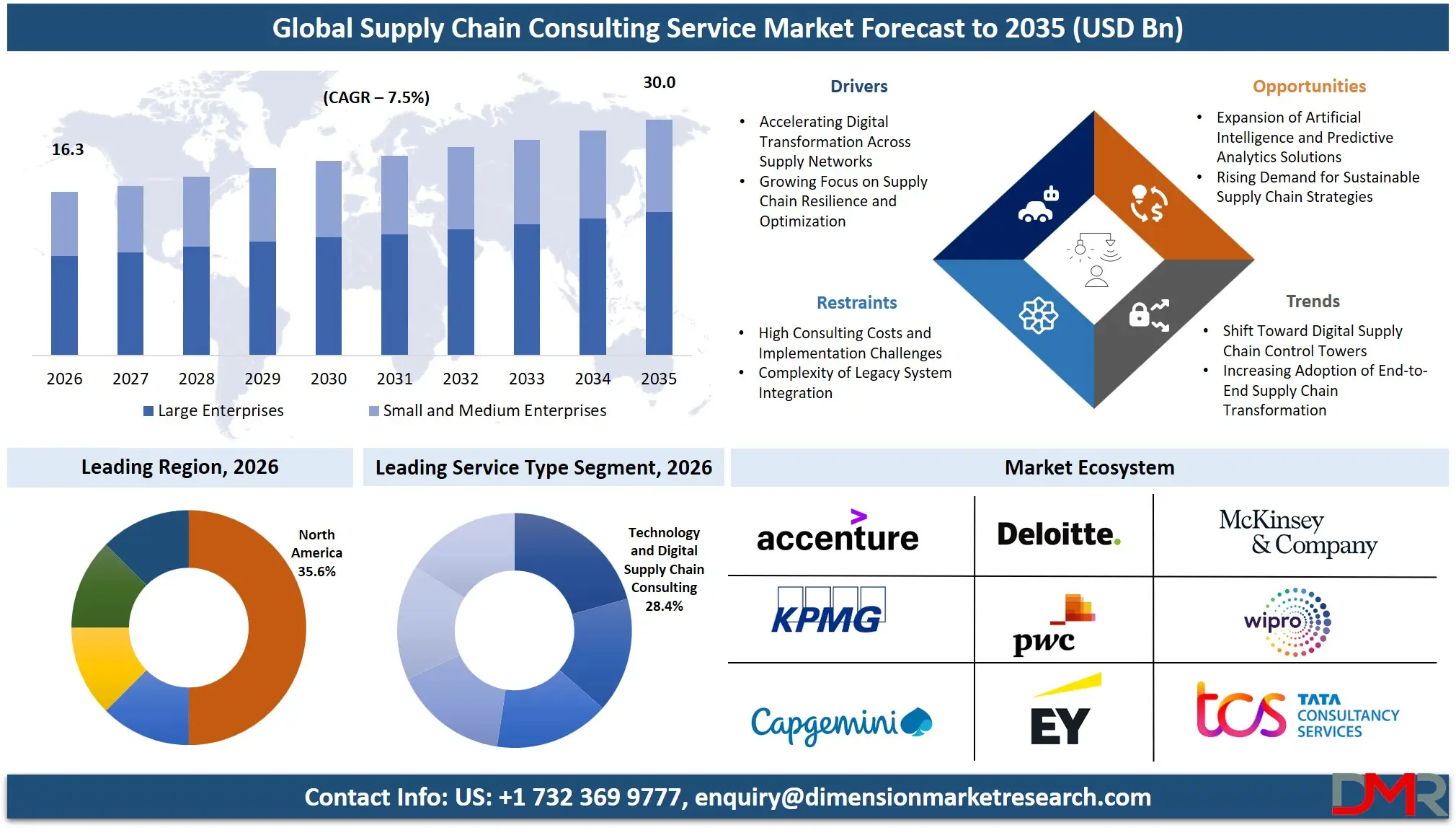
The Global Supply Chain Consulting Service Market is valued at USD 16.3 billion in 2026 and is anticipated to reach USD 30.0 billion by 2035, expanding at a CAGR of approximately 7.5% during 2026 to 2035.
ℹ
To learn more about this report –
Download Your Free Sample Report Here
The market is witnessing significant growth as organizations increasingly prioritize supply chain resilience, digital transformation, operational efficiency, and cost optimization. Growing adoption of artificial intelligence, advanced analytics, automation, cloud-based supply chain platforms, and real-time visibility solutions is driving demand for specialized consulting services. Businesses across manufacturing, retail, healthcare, automotive, and technology sectors are leveraging supply chain consultants to redesign networks, enhance inventory management, optimize logistics operations, and mitigate supply chain risks. Increasing global trade complexity, sustainability requirements, and the need for agile and technology-driven supply networks are further accelerating market expansion.
United States Supply Chain Consulting Service Market
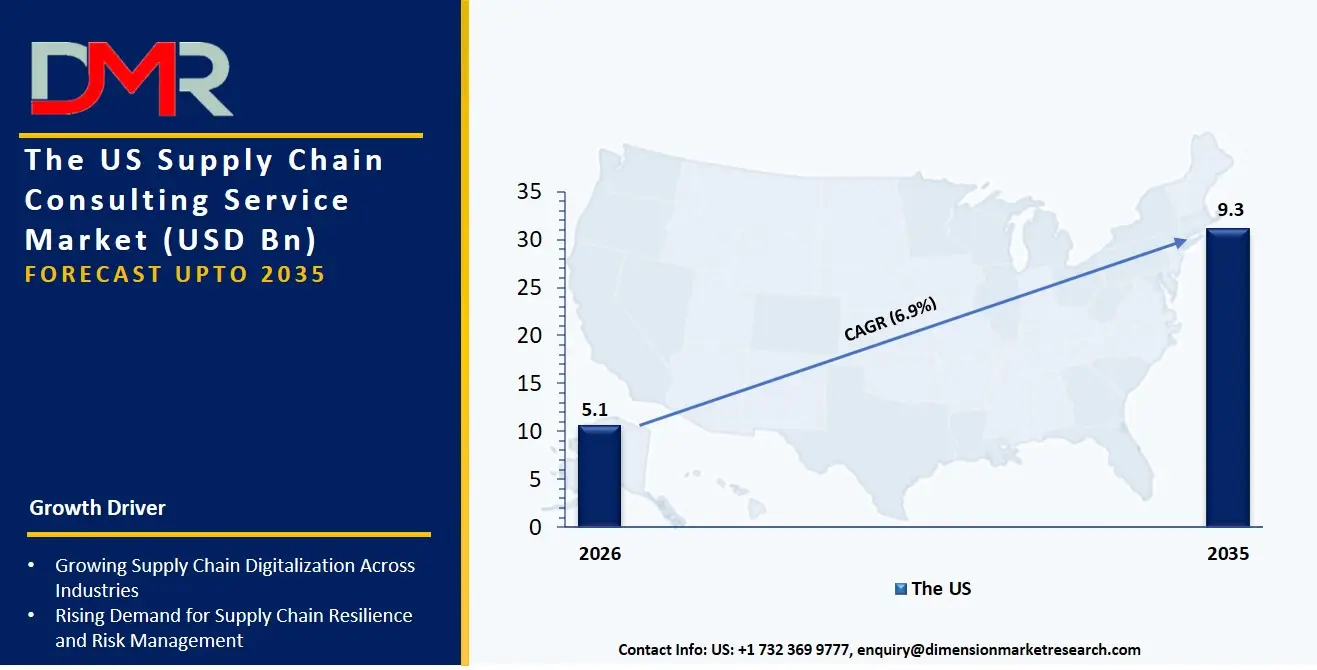
The United States Supply Chain Consulting Service Market is valued at USD 5.1 billion in 2026 and is expected to reach USD 9.3 billion by 2035, registering a CAGR of approximately 6.9% from 2026 to 2035.
ℹ
To learn more about this report –
Download Your Free Sample Report Here
The market growth is driven by increasing investments in digital supply chain transformation, automation, predictive analytics, and advanced operational strategies. Enterprises across manufacturing, electronic commerce, healthcare, aerospace, automotive, and technology industries are adopting consulting services to improve supply chain visibility, strengthen supplier relationships, and enhance logistics efficiency. Rising demand for artificial intelligence-based forecasting, cloud-enabled supply chain management platforms, and advanced planning solutions is further supporting market growth. Additionally, growing emphasis on supply chain resilience, inventory optimization, risk management, and cost reduction is encouraging organizations to collaborate with consulting providers to achieve sustainable business performance.
Europe Supply Chain Consulting Service Market
The Europe Supply Chain Consulting Service Market is valued at USD 4.6 billion in 2026 and is projected to reach USD 8.5 billion by 2035, growing at a CAGR of approximately 7.1% during 2026–2035. The market is expanding due to increasing focus on sustainable supply chain practices, regulatory compliance, digital transformation, and operational resilience across various industries. Companies operating in automotive, pharmaceuticals, manufacturing, retail, and electronics sectors are investing in consulting solutions to optimize supply networks, improve supplier performance, enhance inventory control, and streamline transportation operations. The growing adoption of Industry 4.0 technologies, artificial intelligence, automation, and advanced analytics is creating strong opportunities for consulting service providers. Furthermore, increasing emphasis on sustainable sourcing, carbon reduction initiatives, circular economy models, and supply chain risk mitigation is strengthening market demand across Europe.
Japan Supply Chain Consulting Service Market
The Japan Supply Chain Consulting Service Market is valued at USD 660.0 million in 2026 and is forecast to reach USD 1,200.0 million by 2035, expanding at a CAGR of approximately 6.8% between 2026 and 2035.The market is supported by increasing demand for supply chain digitalization, automation, operational improvement, and resilience enhancement among Japanese enterprises. Manufacturing industries, including automotive, electronics, and industrial equipment, are major contributors due to their focus on lean operations, supplier collaboration, production optimization, and logistics efficiency. Growing adoption of artificial intelligence, robotics, advanced analytics, and cloud-based supply chain platforms is accelerating demand for consulting expertise. Additionally, Japan's emphasis on sustainability, business continuity planning, and risk management strategies is encouraging organizations to implement advanced supply chain solutions to maintain competitiveness in the evolving global marketplace.
Key Takeaways
- Market Size: The Global Supply Chain Consulting Service Market is valued at USD 16.3 billion in 2026 and is projected to reach USD 30.0 billion by 2035, expanding at a CAGR of approximately 7.5% during 2026 to 2035, driven by increasing demand for supply chain optimization, digital transformation, and resilience-focused consulting solutions.
- Growth Rate and Outlook: The market is expected to witness steady growth throughout the forecast period, supported by rising adoption of artificial intelligence, advanced analytics, automation, cloud-based supply chain platforms, sustainability initiatives, and increasing complexity in global supply networks.
- Primary Growth Drivers: Key factors driving market expansion include the need for supply chain resilience, growing digitalization of logistics operations, demand for real-time visibility, supplier risk management, inventory optimization, sustainable sourcing practices, and increasing investments in supply chain transformation programs.
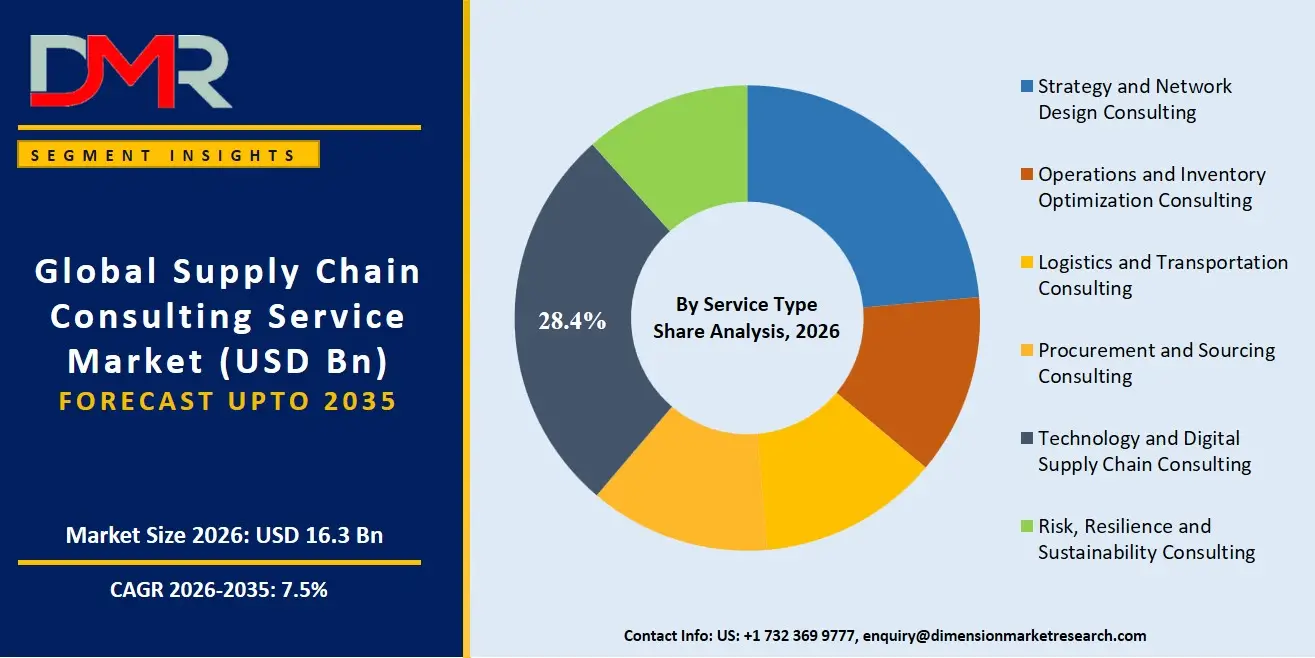
- By Service Type Analysis: Technology and Digital Supply Chain Consulting is projected to dominate the service type segment, accounting for 28.4% market share in 2026, driven by enterprise adoption of artificial intelligence, analytics, digital platforms, and enterprise resource planning modernization. Risk, Resilience and Sustainability Consulting is expected to record the highest CAGR of 9.8% through 2035.
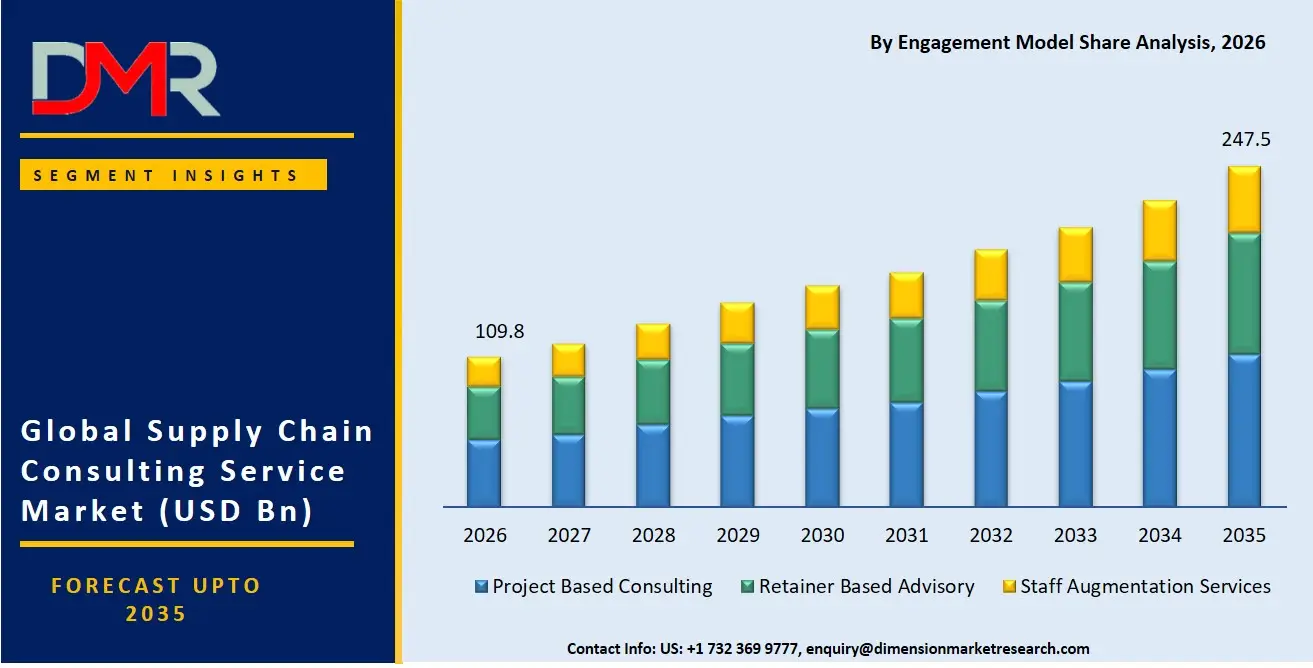
- By Engagement Model Analysis: Project Based Consulting is anticipated to lead the engagement model segment with a 58.3% market share in 2026, supported by demand for transformation, implementation, and strategy projects. Retainer Based Advisory is projected to achieve the fastest growth with a CAGR of 8.6%, driven by increasing demand for continuous consulting support.
- By End Use Industry Analysis: Manufacturing is expected to remain the leading end use industry segment, capturing 24.8% market share in 2026, due to complex production networks and increasing operational efficiency requirements. Healthcare and Pharmaceuticals is projected to register the highest CAGR of 9.5% through 2035.
- Regional Leadership: North America, led by the United States, represents a major regional market due to strong adoption of digital supply chain solutions and consulting services. The United States market is valued at USD 5.1 billion in 2026, followed by Europe at USD 4.6 billion, while Japan contributes significantly through advanced manufacturing, automation, and supply chain modernization initiatives.
What is the Supply Chain Consulting Service?
Supply Chain Consulting Service refers to professional advisory solutions that help organizations design, optimize, transform, and manage their end-to-end supply chain operations. These services assist businesses in improving procurement strategies, supplier management, inventory planning, logistics efficiency, warehouse operations, demand forecasting, and distribution networks. Supply chain consultants analyze existing processes, identify operational gaps, and develop customized strategies to enhance efficiency, reduce costs, increase resilience, and support sustainable growth.
With the growing adoption of digital technologies, modern supply chain consulting increasingly includes artificial intelligence, advanced analytics, cloud-based platforms, automation, enterprise resource planning integration, and real-time visibility solutions. Organizations across manufacturing, retail, healthcare, automotive, and other industries rely on consulting expertise to navigate disruptions, improve agility, and build competitive, future-ready supply chain ecosystems.
Use Cases
- Supply Chain Optimization: Organizations use supply chain consulting services to analyze operations, improve network design, optimize inventory levels, enhance logistics performance, reduce operational costs, and develop efficient supply chain strategies aligned with changing business requirements.
- Digital Supply Chain Transformation: Businesses leverage consulting expertise to implement artificial intelligence, advanced analytics, cloud platforms, automation, and enterprise resource planning solutions that improve visibility, decision-making capabilities, forecasting accuracy, and overall supply chain efficiency.
- Supply Chain Risk Management: Companies utilize consulting services to identify vulnerabilities, strengthen supplier networks, improve business continuity planning, manage disruptions, and develop resilient supply chain frameworks capable of addressing geopolitical, environmental, and operational challenges.
- Sustainable Supply Chain Development: Organizations adopt consulting solutions to implement sustainable sourcing practices, reduce environmental impact, achieve regulatory compliance, improve resource efficiency, and integrate environmental, social, and governance principles throughout supply chain operations.
How AI is Transforming the Supply Chain Consulting Service Market?
Artificial intelligence is transforming the Supply Chain Consulting Service Market by enabling organizations to achieve greater visibility, accuracy, and efficiency across complex supply networks. AI-powered analytics help consultants analyze large volumes of operational data, improve demand forecasting, optimize inventory levels, and identify potential disruptions before they impact business performance. Machine learning algorithms support predictive maintenance, supplier risk assessment, route optimization, and automated decision-making, allowing companies to build more agile and resilient supply chains. AI integration with cloud-based supply chain platforms and enterprise resource planning systems is also enhancing real-time monitoring and strategic planning capabilities. As businesses increasingly focus on digital transformation, cost optimization, and operational resilience, supply chain consulting providers are leveraging AI-driven solutions to deliver customized strategies, improve performance outcomes, and support future-ready supply chain ecosystems
Market Dynamics
Key Drivers in the Global Supply Chain Consulting Service Market
Accelerating Digital Transformation Across Supply Networks
The increasing adoption of digital technologies is a major growth driver for the global Supply Chain Consulting Service Market. Enterprises are investing in artificial intelligence, advanced analytics, cloud-based platforms, Internet of Things integration, and supply chain management solutions to enhance visibility, automation, and decision-making. Consulting providers play a critical role in technology selection, implementation planning, process redesign, and digital transformation strategies. As businesses seek connected and data-driven supply ecosystems, demand for specialized consulting expertise continues to rise across manufacturing, retail, healthcare, and logistics sectors, supporting improved operational efficiency and supply chain agility.
Growing Focus on Supply Chain Resilience and Optimization
Increasing supply chain disruptions, supplier uncertainties, transportation challenges, and changing market dynamics are encouraging organizations to strengthen operational resilience. Companies are engaging supply chain consultants to optimize inventory management, redesign distribution networks, improve sourcing strategies, and develop risk mitigation frameworks. Consulting services help enterprises create flexible supply chain models capable of responding to demand fluctuations and external disruptions. The growing emphasis on cost optimization, operational efficiency, and sustainable supply chain practices is further accelerating the adoption of consulting solutions across industries seeking improved performance and long-term competitiveness.
Restraints in the Global Supply Chain Consulting Service Market
High Consulting Costs and Implementation Challenges
The cost associated with professional consulting services, technology integration, and large-scale transformation initiatives can limit adoption, particularly among small and medium enterprises. Supply chain consulting projects often require investments in digital platforms, process restructuring, employee training, and ongoing support. Organizations may hesitate to allocate significant budgets without clear short-term returns. Additionally, complex implementation requirements and the need for coordination across multiple business functions can delay project execution. These financial and operational challenges may restrict market growth among cost-sensitive companies despite the long-term benefits associated with improved efficiency, visibility, and supply chain performance.
Complexity of Legacy System Integration
The presence of outdated supply chain infrastructure and fragmented enterprise systems creates challenges for organizations implementing modern consulting solutions. Many businesses operate with disconnected platforms that require extensive customization and integration before adopting advanced digital supply chain technologies. Consultants must address data quality issues, system compatibility concerns, cybersecurity requirements, and organizational resistance during transformation projects. These complexities can increase implementation timelines and operational disruptions. Effective change management, technology assessment, and phased implementation strategies are essential for overcoming integration barriers and enabling successful adoption of advanced supply chain consulting services.
Growth Opportunities in the Global Supply Chain Consulting Service Market
Expansion of Artificial Intelligence and Predictive Analytics Solutions
The growing use of artificial intelligence, machine learning, and predictive analytics is creating significant opportunities for supply chain consulting providers. Businesses are increasingly seeking expert guidance to implement intelligent forecasting models, automated planning systems, demand prediction tools, and real-time decision-making platforms. Consultants help organizations identify suitable technologies, optimize data utilization, and develop analytics-driven supply chain strategies. As companies focus on improving accuracy, reducing operational costs, and enhancing responsiveness, demand for technology-focused consulting services is expected to expand across industries, creating new opportunities for specialized advisory firms.
Rising Demand for Sustainable Supply Chain Strategies
Increasing focus on environmental responsibility, regulatory compliance, and sustainable business practices is creating new opportunities in supply chain consulting. Organizations are seeking expertise in sustainable sourcing, carbon reduction strategies, supplier assessment, and environmental, social and governance initiatives. Consultants support businesses in developing transparent and responsible supply chain frameworks while balancing operational efficiency with sustainability objectives. Growing pressure from regulators, investors, and consumers is encouraging enterprises to integrate sustainability into supply chain planning, creating increased demand for specialized consulting services focused on resilience, compliance, and long-term value creation.
Trends in the Global Supply Chain Consulting Service Market
Shift Toward Digital Supply Chain Control Towers
The adoption of digital supply chain control towers is becoming an important trend as organizations seek enhanced visibility across procurement, inventory, logistics, and distribution operations. These platforms enable real-time monitoring, predictive insights, and faster response to supply chain disruptions. Consulting providers are increasingly helping enterprises design and implement integrated control tower solutions that connect multiple stakeholders and improve operational coordination. The growing need for transparency, agility, and data-driven decision-making is encouraging businesses across industries to invest in advanced visibility platforms as part of broader supply chain modernization strategies.
Increasing Adoption of End-to-End Supply Chain Transformation
Organizations are increasingly moving from isolated improvement projects toward comprehensive end-to-end supply chain transformation initiatives. Businesses are seeking consulting support to redesign supply networks, improve operational processes, implement automation, and develop flexible operating models. This trend is driven by evolving customer expectations, globalization challenges, digital disruption, and the need for greater resilience. Supply chain consultants are increasingly providing integrated solutions that combine strategy, technology, analytics, and sustainability expertise. As enterprises prioritize long-term efficiency and adaptability, transformation-focused consulting engagements are becoming a key component of modern supply chain management strategies.
Research Scope and Analysis
The Global Supply Chain Consulting Service Market is segmented based on Service Type, Engagement Model, Organization Size, and End Use Industry. The Service Type segment covers major consulting solutions across supply chain strategy, operations, logistics, procurement, digital transformation, and risk management. The market is further categorized by engagement approach, enterprise size, and industry application to analyze growth opportunities and market dynamics.
ℹ
To learn more about this report –
Download Your Free Sample Report Here
By Service Type Analysis
Technology and Digital Supply Chain Consulting is projected to dominate the service type segment in the global Supply Chain Consulting Service Market, accounting for 28.4% of the market share in 2026. The segment leadership is driven by increasing enterprise adoption of artificial intelligence, advanced analytics, digital supply chain platforms, enterprise resource planning modernization, and real-time visibility solutions. Risk, Resilience and Sustainability Consulting is expected to register the highest CAGR of 9.8% through 2035, supported by rising supply chain disruptions, sustainability regulations, geopolitical risks, and demand for resilient operating frameworks. Strategy and Network Design Consulting represents the second-largest segment with a 24.6% market share, driven by network optimization, supply chain transformation, strategic planning, and regional supply chain redesign initiatives.
By Engagement Model Analysis
Project Based Consulting is anticipated to dominate the engagement model in the global Supply Chain Consulting Service Market with a 58.3% market share in 2026, supported by strong demand for transformation projects, implementation programs, strategic initiatives, and operational improvement engagements.
ℹ
To learn more about this report –
Download Your Free Sample Report Here
Retainer Based Advisory is projected to achieve the highest CAGR of 8.6% through 2035, driven by increasing demand for continuous consulting support, executive advisory services, performance monitoring, and long-term supply chain improvement programs. Retainer Based Advisory is also the second-largest engagement model, accounting for 26.7% of the market share, as organizations increasingly prefer ongoing partnerships to address evolving supply chain challenges, enhance operational efficiency, and maintain competitive advantage.
By Organization Size Analysis
Large Enterprises is expected to represent the dominant segment in the global Supply Chain Consulting Service Market, capturing 67.5% of the market share in 2026. The segment growth is attributed to extensive global operations, complex supplier ecosystems, higher consulting investments, and continuous adoption of digital transformation and supply chain resilience strategies. Small and Medium Enterprises are expected to record the highest CAGR of 9.2% through 2035, supported by increasing technology adoption, growing awareness of consulting benefits, and the need for scalable operational improvements. Small and Medium Enterprises represent the second-largest segment with a 32.5% share, as businesses increasingly utilize external expertise to optimize procurement, logistics, inventory management, and supply chain performance.
By End Use Industry Analysis
Manufacturing is projected to dominate the global Supply Chain Consulting Service Market with a 24.8% market share in 2026, driven by complex production networks, supplier management requirements, inventory optimization needs, and increasing investments in operational efficiency. Healthcare and Pharmaceuticals is projected to experience the highest CAGR of 9.5% through 2035 due to rising regulatory compliance needs, pharmaceutical supply chain modernization, healthcare logistics advancement, and increasing demand for transparent and resilient supply networks. Retail and Electronic Commerce is the second-largest industry segment, accounting for 18.3% of the market share, supported by rapid e-commerce expansion, omnichannel fulfillment strategies, customer experience improvement initiatives, and growing demand for logistics optimization and efficient last-mile delivery solutions.
The Global Supply Chain Consulting Service Market Report is segmented on the basis of the following:
By Service Type
- Strategy and Network Design Consulting
- Supply Chain Strategy
- Network Design
- Supply Chain Transformation
- Sales and Operations Planning
- Operations and Inventory Optimization Consulting
- Process Optimization
- Inventory Optimization
- Warehouse Optimization
- Distribution Optimization
- Logistics and Transportation Consulting
- Transportation Management
- Freight Optimization
- Route Optimization
- Last Mile Delivery
- Carrier Management
- Procurement and Sourcing Consulting
- Strategic Sourcing
- Category Management
- Supplier Risk Management
- Supplier Performance Management
- Technology and Digital Supply Chain Consulting
- Enterprise Resource Planning Advisory
- Supply Chain Management Platform Advisory
- Artificial Intelligence and Advanced Analytics
- Control Tower Solutions
- Blockchain Integration
- Internet of Things Integration
- Risk, Resilience and Sustainability Consulting
- Supply Chain Risk Management
- Business Continuity Planning
- Trade Compliance
- Sustainable Sourcing
- Environmental, Social and Governance Advisory
By Engagement Model
- Project Based Consulting
- Strategy Projects
- Transformation Projects
- Implementation Projects
- Retainer Based Advisory
- Continuous Advisory
- Executive Advisory
- Performance Improvement
- Staff Augmentation Services
- Functional Specialists
- Technology Specialists
- Program Management Support
By Organization Size
- Large Enterprises
- Small and Medium Enterprises
By End Use Industry
- Manufacturing
- Industrial Manufacturing
- Discrete Manufacturing
- Process Manufacturing
- Retail and Electronic Commerce
- Brick and Mortar Retail
- Electronic Commerce
- Fast Moving Consumer Goods
- Consumer Packaged Goods
- Food Processing
- Beverage Manufacturing
- Healthcare and Pharmaceuticals
- Healthcare Providers
- Pharmaceutical Manufacturers
- Medical Devices
- Automotive
- Original Equipment Manufacturers
- Automotive Components
- Aerospace and Defense
- Commercial Aerospace
- Defense
- Electronics and High Technology
- Consumer Electronics
- Semiconductors
- Information Technology Hardware
- Others
Regional Analysis
Leading Region by Market Share
ℹ
To learn more about this report –
Download Your Free Sample Report Here
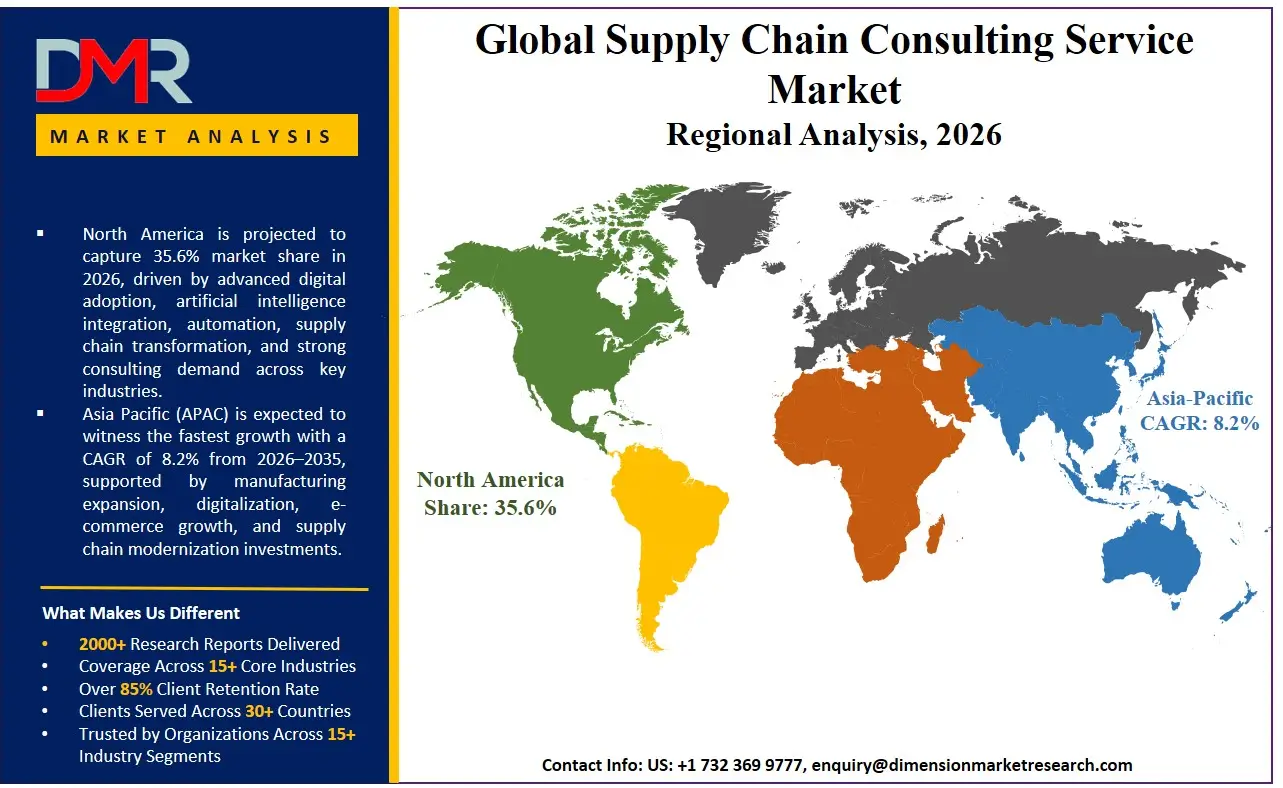
North America is expected to maintain its leading position in the Global Supply Chain Consulting Service Market, accounting for 35.6% market share in 2026. The region's dominance is attributed to strong enterprise adoption of digital supply chain transformation, advanced analytics, artificial intelligence, automation, and cloud-based supply chain platforms. Major industries, including manufacturing, healthcare, automotive, retail, and technology, are increasingly investing in consulting services to enhance operational efficiency, improve supply chain visibility, and strengthen resilience. The presence of established consulting providers and high technology adoption among enterprises further supports North America's market leadership.
Fastest-Growing Regional Market
Asia Pacific is projected to be the fastest-growing regional market for supply chain consulting services, registering a CAGR of 8.2% during 2026–2035. Growth is driven by rapid industrial expansion, increasing manufacturing activities, e-commerce development, digital transformation initiatives, and rising investments in logistics infrastructure. Countries such as China, India, Japan, and South Korea are adopting advanced supply chain technologies, including artificial intelligence, automation, analytics, and cloud platforms, to improve efficiency and resilience. Growing focus on supplier optimization, regional supply chain redesign, sustainability practices, and risk management is creating significant opportunities for consulting service providers across the Asia Pacific region.
By Region
North America
Europe
- Germany
- The U.K.
- France
- Italy
- Russia
- Spain
- Benelux
- Nordic
- Rest of Europe
Asia-Pacific
- China
- Japan
- South Korea
- India
- ANZ
- ASEAN
- Rest of Asia-Pacific
Latin America
- Brazil
- Mexico
- Argentina
- Colombia
- Rest of Latin America
Middle East & Africa
- Saudi Arabia
- UAE
- South Africa
- Israel
- Egypt
- Rest of MEA
Competitive Landscape
The Global Supply Chain Consulting Service Market is characterized by the presence of global consulting firms, technology providers, and specialized supply chain advisory companies competing through digital capabilities, industry expertise, and customized transformation solutions. Leading players focus on strengthening their service portfolios by integrating artificial intelligence, advanced analytics, cloud-based platforms, automation, and supply chain visibility solutions. Companies are increasingly adopting strategic partnerships, technology collaborations, mergers and acquisitions, and innovation-driven approaches to expand market presence and address evolving client requirements. Competitive differentiation is driven by expertise in supply chain strategy, network optimization, risk management, sustainability consulting, and digital transformation. As organizations prioritize resilient and agile supply networks, market participants continue to enhance consulting capabilities to support complex global supply chain challenges.
Some of the prominent players in the Global Supply Chain Consulting Service Market are:
- Accenture
- Deloitte
- McKinsey & Company
- Boston Consulting Group (BCG)
- Bain & Company
- KPMG
- PwC
- Ernst & Young (EY)
- IBM Consulting
- Capgemini
- Tata Consultancy Services (TCS)
- Infosys Consulting
- Wipro Consulting
- Gartner
- Bain Supply Chain Practice
- Oliver Wyman
- Roland Berger
- AlixPartners
- GEP Worldwide
- Llamasoft
- Other Key Players
Recent Developments
- In April 2026, Wipro agreed to acquire Mindsprint, a Singapore-based technology and business services firm, from Olam Group for USD 375 million, alongside an eight-year strategic transformation deal in which Olam committed USD 100 million a year in spend, expanding Wipro's consulting capabilities in food and agribusiness supply chain operations.
- In March 2026, Argon and Co, a Paris-based supply chain and operations consulting firm, acquired Scott Sheldon, a US supply chain planning and consulting firm with offices across the US, UK, and India, to expand its systems integration and technology implementation capabilities in North America.
- In January 2026, Körber, the international technology group, signed a binding agreement to acquire a majority stake in Stellium, a Houston-based SAP supply chain management consulting firm, to expand its supply chain consulting capabilities alongside its existing software business.
Report Details
| Report Characteristics |
| Market Size (2026) |
USD 16.3 Bn |
| Forecast Value (2035) |
USD 30.0 Bn |
| CAGR (2026–2035) |
7.5% |
| The US Market Size (2026) |
USD 5.1 Bn |
| Historical Data |
2021 – 2025 |
| Forecast Data |
2027 – 2035 |
| Base Year |
2025 |
| Estimate Year |
2026 |
| Segments Covered |
By Service Type, By Engagement Model, By Organization Size, By End Use Industry |
| Regional Coverage |
North America – The US and Canada; Europe – Germany, The UK, France, Russia, Spain, Italy, Benelux, Nordic, & Rest of Europe; Asia-Pacific – China, Japan, South Korea, India, ANZ, ASEAN, Rest of APAC; Latin America – Brazil, Mexico, Argentina, Colombia, Rest of Latin America; Middle East & Africa – Saudi Arabia, UAE, South Africa, Turkey, Egypt, Israel, & Rest of MEA |
Frequently Asked Questions
How big is the Supply Chain Consulting Service Market?
▾ The Global Supply Chain Consulting Service Market is valued at USD 16.3 billion in 2026 and is projected to reach USD 30.0 billion by 2035, supported by increasing demand for supply chain optimization, digital transformation, resilience planning, and advanced consulting solutions.
What is the CAGR of the Supply Chain Consulting Service Market from 2026 to 2035?
▾ The Supply Chain Consulting Service Market is expected to expand at a CAGR of approximately 7.5% from 2026 to 2035, driven by rising adoption of artificial intelligence, automation, analytics, cloud platforms, and sustainable supply chain strategies.
What factors are driving the growth of the Supply Chain Consulting Service Market?
▾ Key growth drivers include increasing supply chain complexity, demand for operational efficiency, digital transformation initiatives, artificial intelligence adoption, inventory optimization requirements, supplier risk management, sustainability regulations, and the need for resilient and agile supply chain networks.
What are the major trends in the Supply Chain Consulting Service Market?
▾ Major trends include AI-driven supply chain optimization, real-time visibility platforms, predictive analytics, cloud-based supply chain management solutions, automation, digital twins, sustainable sourcing practices, control tower solutions, and increasing focus on supply chain resilience.
Which region held the largest share of the Supply Chain Consulting Service Market in 2026?
▾ North America held the largest share of the Supply Chain Consulting Service Market in 2026, accounting for 35.6% market share, supported by strong enterprise adoption of digital transformation, advanced analytics, automation, and supply chain consulting solutions.
Which region is expected to grow the fastest in the Supply Chain Consulting Service Market?
▾ Asia Pacific (APAC) is expected to be the fastest-growing regional market, registering a CAGR of 8.2% from 2026 to 2035 due to expanding manufacturing activities, e-commerce growth, technology adoption, and supply chain modernization initiatives.
Who are the key players in the Supply Chain Consulting Service Market?
▾ Key players include Accenture, Deloitte, McKinsey & Company, Boston Consulting Group, Bain & Company, KPMG, PwC, Ernst & Young, IBM Consulting, Capgemini, Tata Consultancy Services, Infosys Consulting, Wipro Consulting, Gartner, Oliver Wyman, Roland Berger, AlixPartners, GEP Worldwide, and Coupa Supply Chain Optimization.
How is the Supply Chain Consulting Service Market segmented?
▾ The Supply Chain Consulting Service Market is segmented based on Service Type, Engagement Model, Organization Size, and End Use Industry. Service Type includes supply chain strategy, operations optimization, logistics consulting, procurement consulting, digital supply chain consulting, and risk and sustainability consulting. The market is further analyzed across different engagement approaches, enterprise sizes, and industry applications.