Market Overview
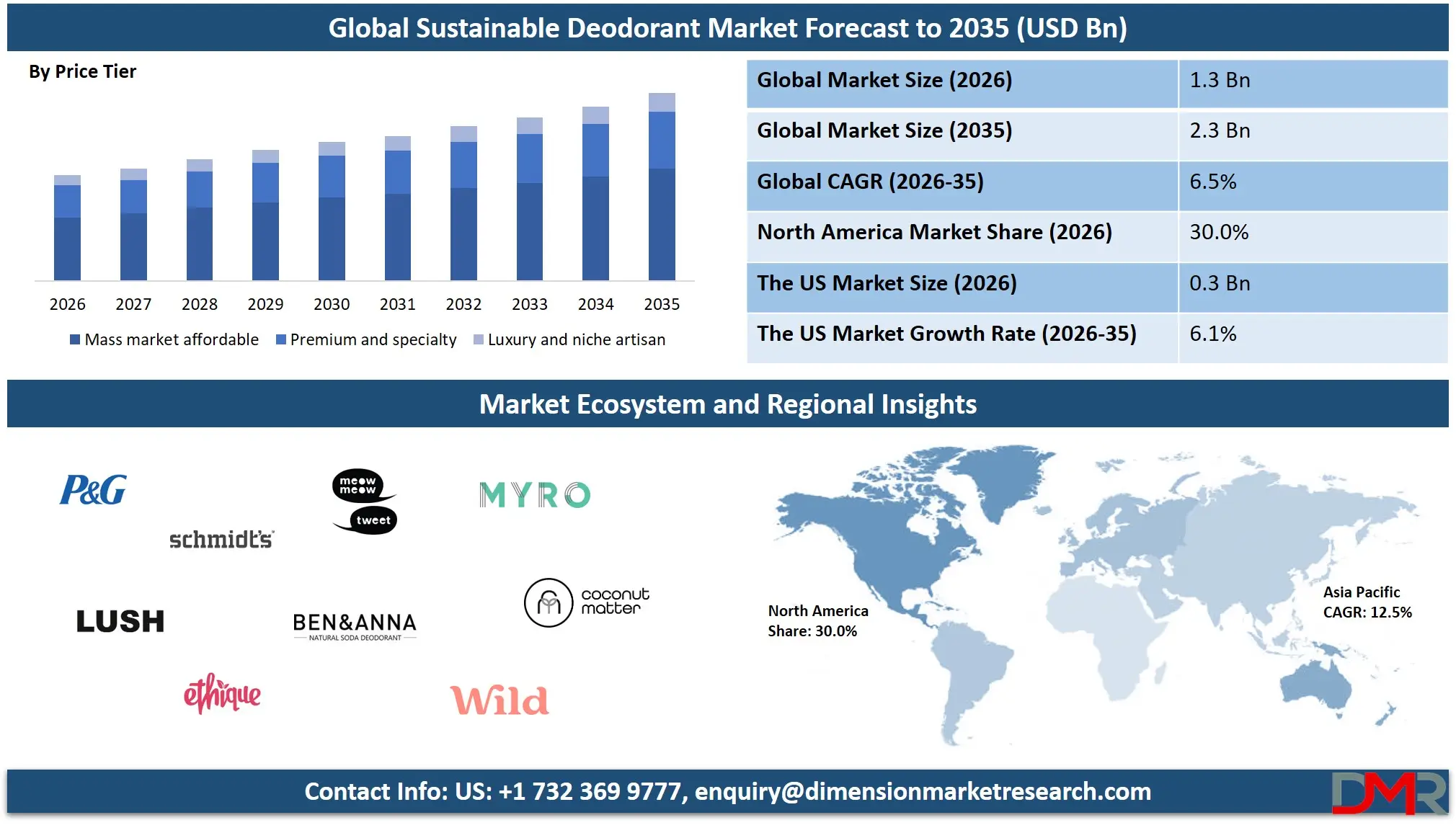
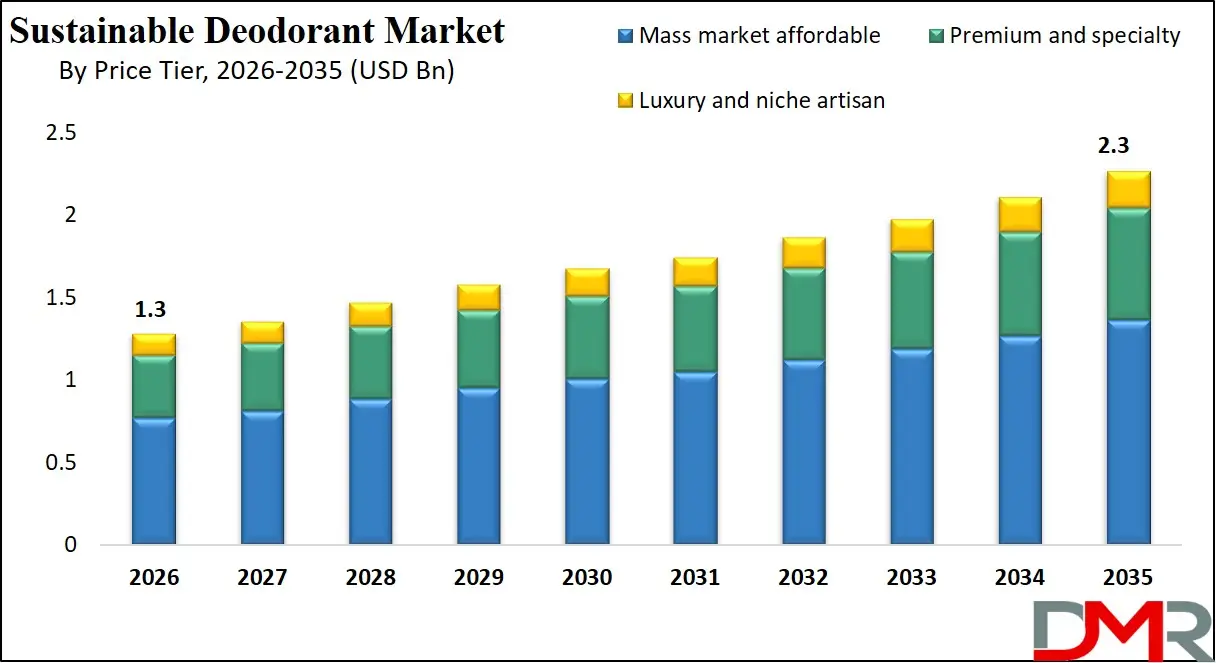
The global sustainable deodorant market is estimated at USD 1.3 billion in 2026 and is expected to expand at a CAGR of 6.5% through 2035, reaching USD 2.3 billion. Growth is driven by rising demand for eco-friendly personal care products, natural and chemical-free deodorants, biodegradable packaging, and increased consumer preference for cruelty-free and organic skincare solutions.
ℹ
To learn more about this report –
Download Your Free Sample Report Here
Sustainable deodorant is a type of personal care product designed to control body odor while minimizing environmental impact and promoting health-conscious formulations. These deodorants are typically made from natural, plant-based, or biodegradable ingredients, avoiding harmful chemicals such as aluminum, parabens, and synthetic fragrances. They often come in eco-friendly packaging, including recyclable containers, compostable sticks, or refillable designs. Sustainable deodorants prioritize cruelty-free testing, reduced carbon footprint, and the use of responsibly sourced raw materials, catering to consumers who seek products that are both effective and environmentally responsible. The growing awareness of sustainability, wellness, and conscious consumption has driven the adoption of these products across multiple demographics globally.
The global sustainable deodorant market refers to the worldwide industry involved in the production, distribution, and consumption of deodorants formulated with eco-friendly ingredients and packaging. It encompasses a wide range of product types including bio-enzyme formulations, plant-based botanicals, activated carbon absorbents, probiotic deodorants, and solid or waterless formats. This market includes offerings from multinational personal care corporations as well as niche brands specializing in natural and organic solutions. Distribution channels span from supermarkets, drug stores, and beauty retailers to online platforms that cater to consumers seeking convenient access to eco-conscious personal care products.
ℹ
To learn more about this report –
Download Your Free Sample Report Here
The market is witnessing growth driven by increasing consumer demand for natural, chemical-free personal care products, rising environmental awareness, and the preference for cruelty-free and ethically produced items. Asia-Pacific, North America, and Europe are the primary regions contributing to the market, with Asia-Pacific emerging as the fastest-growing region due to expanding urban populations, rising disposable income, and increasing penetration of e-commerce. The global sustainable deodorant market not only reflects changing consumer lifestyles but also the strategic innovations by companies in terms of ingredient transparency, packaging sustainability, and brand positioning in the natural and organic personal care segment.
The US Sustainable Deodorant Market
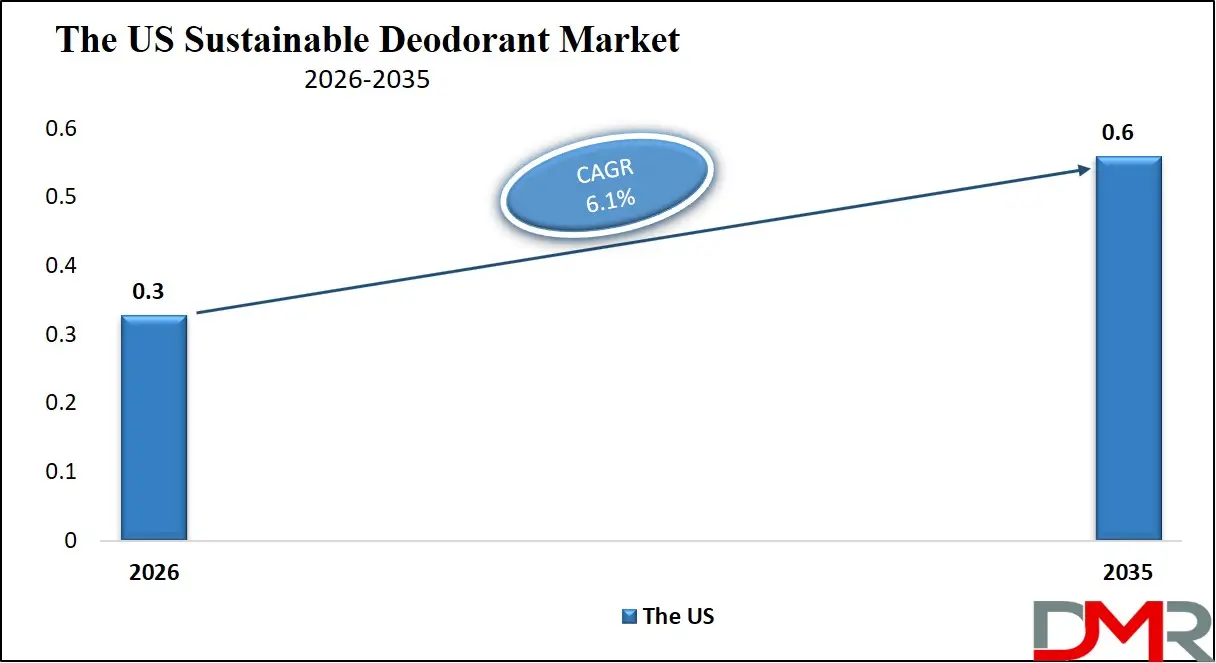
The U.S. Sustainable Deodorant Market size is expected to reach at USD 0.3 billion in 2026. It is further expected to witness subsequent growth in the upcoming period, holding USD 0.6 billion in 2035 at a CAGR of 6.1%.
ℹ
To learn more about this report –
Download Your Free Sample Report Here
The U.S. sustainable deodorant market is growing steadily as consumers increasingly prioritize eco-conscious personal care and clean beauty solutions. Rising awareness of chemical-free formulations has driven demand for products made with natural ingredients, plant-based botanicals, and organic compounds that avoid aluminum, parabens, and synthetic fragrances. Both men and women are adopting cruelty-free deodorants packaged in biodegradable, recyclable, or refillable containers. Retailers and online platforms are expanding offerings to meet evolving preferences, while brands innovate with waterless, solid, and probiotic-based deodorants to combine effectiveness with sustainability and health-conscious appeal.
Growth in the U.S. market is fueled by the clean beauty movement and environmentally aware consumer behavior. Millennials and Gen Z are key drivers, favoring transparency in labeling and ethical sourcing of ingredients. Packaging innovation, including zero-waste sticks and compostable containers, is enhancing market appeal, while premium and mass-market brands alike invest in marketing natural deodorants. The trend toward wellness and holistic health encourages wider adoption of sustainable deodorants, creating opportunities for both established brands and emerging players focused on organic, plant-based, and eco-friendly product lines.
The Europe Sustainable Deodorant Market
The European sustainable deodorant market is projected to reach approximately USD 325 million in 2026, reflecting steady growth driven by increasing consumer awareness of clean beauty and eco-conscious personal care products. Consumers in countries such as Germany, France, and the United Kingdom are actively seeking chemical-free, plant-based, and organic deodorants that provide effective odor control while being gentle on the skin. The demand is supported by both mass-market and premium segments, with a focus on biodegradable packaging, refillable formats, and cruelty-free certifications that resonate with environmentally aware buyers.
Growth in the European market is underpinned by expanding retail distribution, including supermarkets, specialty beauty stores, and e-commerce platforms that make sustainable deodorants more accessible to urban and suburban consumers. Rising disposable incomes, combined with increased emphasis on health, wellness, and environmental responsibility, are encouraging adoption of natural and chemical-free deodorants. Manufacturers are responding with innovative formulations, including bio-enzyme, activated carbon, and botanical-based products, strengthening the region's position in the global sustainable deodorant landscape while maintaining a CAGR of 5.8%.
The Japan Sustainable Deodorant Market
The Japanese sustainable deodorant market is projected to reach around USD 130 million in 2026, driven by growing consumer preference for natural, chemical-free, and eco-friendly personal care products. Consumers in Japan increasingly seek plant-based, organic, and aluminum-free deodorants that provide effective odor control while being gentle on the skin. The popularity of sustainable packaging, such as recyclable, compostable, and refillable containers, is also supporting market growth. Rising awareness of clean beauty and health-conscious personal care is encouraging adoption across both urban and affluent consumer segments.
The market in Japan is expected to grow at a robust CAGR of 7.2%, reflecting strong demand for innovative formulations that combine performance with sustainability. E-commerce channels and specialty retail stores are expanding availability, making it easier for consumers to access natural deodorants. Premium and niche brands offering botanical extracts, essential oils, and zero-waste packaging are particularly appealing to environmentally conscious and wellness-focused buyers. This combination of health awareness, sustainability trends, and innovative products is driving Japan's position as one of the fastest-growing markets in the global sustainable deodorant industry.
Global Sustainable Deodorant Market: Key Takeaways
- Steady Market Expansion: The global sustainable deodorant market is projected to reach USD 1.3 billion in 2026 and expand to USD 2.3 billion by 2035, reflecting a CAGR of 6.5%, supported by increasing demand for natural deodorants, eco-friendly personal care products, and biodegradable packaging solutions.
- Asia-Pacific Leading Market Share: Asia-Pacific accounts for approximately 39.0% of the global market revenue in 2026, making it the largest regional contributor due to strong consumer demand, rising disposable income, and rapid adoption of clean beauty and organic personal care products.
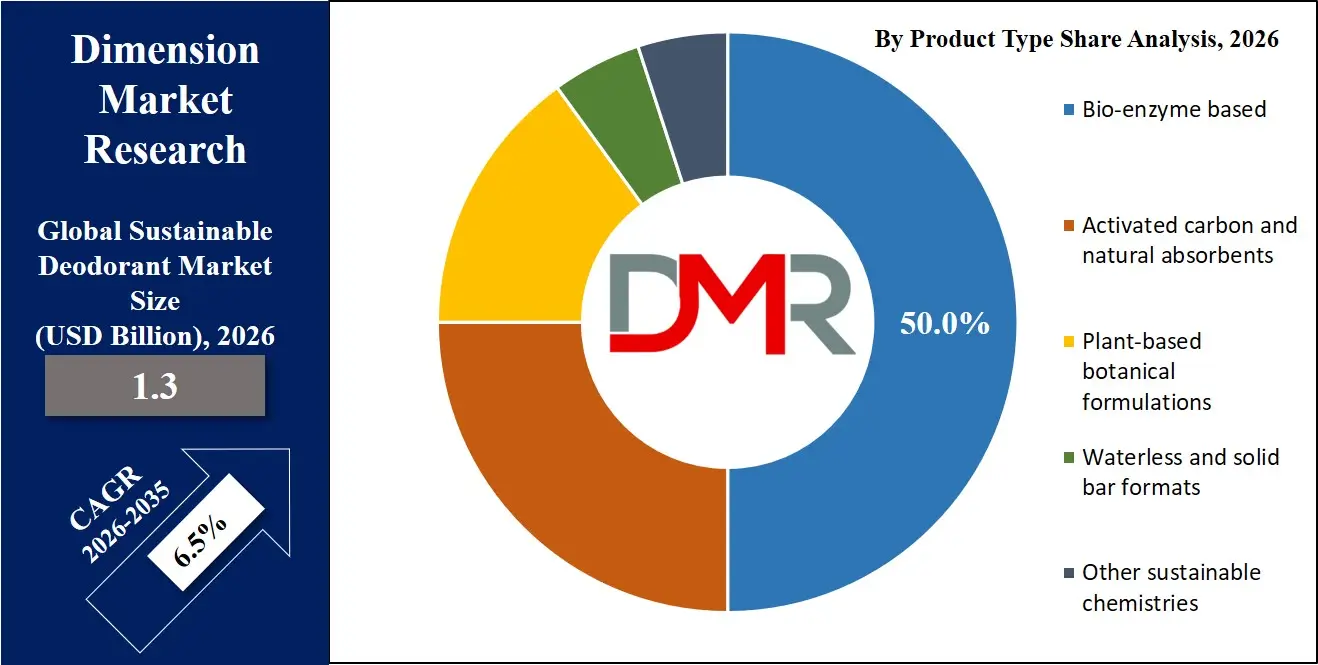
- Dominance of Bio-Enzyme Formulations: Bio-enzyme based deodorants hold nearly 50.0% of the product type segment in 2026, driven by their ability to neutralize odor naturally while avoiding aluminum, parabens, and synthetic chemicals.
- Mass Market Products Drive Volume Sales: Mass market affordable deodorants capture around 60.0% of the price tier segment in 2026, reflecting strong consumer demand for accessible, natural, and environmentally responsible personal care products.
- Retail Stores Remain the Primary Sales Channel: Supermarkets and hypermarkets contribute approximately 43.0% of global distribution in 2026, benefiting from strong retail visibility, broad product availability, and competitive pricing for sustainable deodorant brands.
Global Sustainable Deodorant Market: Use Cases
- Everyday Personal Care: Sustainable deodorants are widely used in daily hygiene routines by consumers seeking chemical-free and natural odor protection. Plant-based and organic formulations provide long-lasting freshness without aluminum or parabens, appealing to health-conscious individuals. Biodegradable packaging and cruelty-free testing enhance the eco-friendly value, allowing users to maintain personal care standards while supporting environmentally responsible products.
- Fitness and Sports: Active consumers prefer sustainable deodorants for their gentle yet effective odor control during workouts or outdoor activities. Natural absorbents and bio-enzyme ingredients manage sweat and odor without synthetic chemicals. Eco-conscious athletes often choose waterless or solid formats to reduce plastic waste, combining performance with sustainability in personal care.
- Travel and On-the-Go: Portable and compact sustainable deodorant sticks or creams cater to frequent travelers who want eco-friendly hygiene solutions. Refillable and recyclable packaging allows convenient use without generating excess waste. Chemical-free, lightweight formulas ensure skin safety and freshness during long journeys, aligning with the growing demand for natural personal care products worldwide.
- Premium and Gifting Segment: Sustainable deodorants are increasingly purchased as premium gifts for eco-conscious consumers. Luxury formulations with essential oils, natural fragrances, and biodegradable packaging appeal to environmentally aware buyers. This segment leverages clean beauty and organic branding to offer thoughtful, health-focused gifts that reflect sustainability values.
Global Sustainable Deodorant Market: Stats & Facts
- ZipDo Education Reports (2025)
- Around 70% of global consumers prefer eco-friendly packaging for personal care products.
- Approximately 60% of adults worldwide use skincare or personal care products daily.
- About 45% of North American consumers seek out cruelty-free personal care products.
- 40% of consumers are willing to pay a premium for eco-friendly personal care brands.
- 65% of beauty product buyers are influenced by social media reviews.
- WifiTalents Personal Care Industry (2025)
- 40% of consumers prefer natural and organic personal care products.
- Sustainability concerns influence 70% of personal care purchasing decisions.
- In 2023, 65% of consumers believe brands with eco-friendly initiatives are more trustworthy.
- WifiTalents Sustainability in Cosmetics (2025)
- 74% of consumers are willing to pay more for sustainable beauty products.
- 68% of millennials prefer buying from brands committed to sustainability.
- 80% of consumers select brands based on environmental impact.
- 65% of consumers prefer biodegradable or recyclable packaging for personal care products.
- 85% of consumers say ingredient transparency influences purchasing decisions.
Global Sustainable Deodorant Market: Market Dynamic
Driving Factors in the Global Sustainable Deodorant Market
Rising Consumer Preference for Clean Beauty and Natural Ingredients
Increasing awareness about chemical-free personal care products has led consumers to choose sustainable deodorants made from plant-based botanicals, organic compounds, and bio-enzyme formulations. Health-conscious buyers actively seek aluminum-free, paraben-free, and cruelty-free deodorants that deliver long-lasting odor protection while being gentle on the skin. This shift towards natural and eco-friendly personal care is fueling demand across both premium and mass-market segments worldwide.
Growing Environmental Awareness and Eco-Friendly Packaging Adoption
The global push for environmental sustainability has encouraged brands to adopt recyclable, compostable, and refillable packaging for deodorants. Consumers are increasingly considering the carbon footprint, biodegradable packaging, and zero-waste formats when making purchase decisions. Eco-conscious shoppers favor products that combine effective odor control with minimal environmental impact, supporting market growth for sustainable personal care solutions.
Restraints in the Global Sustainable Deodorant Market
Higher Price Points Compared to Conventional Deodorants
Sustainable deodorants often cost more due to the use of organic ingredients, eco-friendly packaging, and ethical production processes. This price difference can limit adoption among cost-sensitive consumers, particularly in emerging markets where affordability remains a key factor.
Limited Awareness and Availability in Certain Regions
Although adoption is growing, some regions still lack awareness about the benefits of sustainable deodorants or have limited access to natural personal care products. Low penetration in rural or semi-urban areas and limited distribution channels can constrain market expansion.
Opportunities in the Global Sustainable Deodorant Market
Expansion through E-Commerce and Online Retail Platforms
The rise of digital commerce provides an opportunity to reach eco-conscious consumers globally. Online platforms allow brands to showcase natural ingredients, cruelty-free certifications, and sustainable packaging, creating a direct connection with buyers. Subscription models for refillable or solid deodorants can also boost recurring sales.
Innovation in Formulations and Product Formats
Emerging technologies and ingredient innovation, such as probiotic deodorants, waterless formulations, and solid sticks with biodegradable packaging, offer significant growth potential. Brands can differentiate by creating chemical-free, organic, and skin-friendly options that meet both performance and sustainability expectations.
Trends in the Global Sustainable Deodorant Market
Rise of Zero-Waste and Plastic-Free Deodorants
Consumers are increasingly adopting zero-waste personal care solutions, driving demand for solid bars, refillable sticks, and compostable packaging. The trend aligns with broader sustainability goals and supports environmentally responsible consumption habits.
Popularity of Premium and Customized Natural Deodorants
Personalization and premium eco-friendly offerings are gaining traction. Consumers prefer natural fragrances, essential oils, and customizable deodorant options that cater to sensitive skin and lifestyle preferences. This trend is fostering brand differentiation and attracting niche markets focused on clean beauty and holistic wellness.
Global Sustainable Deodorant Market: Research Scope and Analysis
By Product Type Analysis
In the sustainable deodorant market, bio-enzyme based products are expected to lead the product type segment, capturing around 50.0% of the total market share in 2026. These deodorants utilize naturally derived enzymes to neutralize body odor effectively, offering chemical-free solutions that appeal to health-conscious and environmentally aware consumers. Their formulation avoids harmful substances such as aluminum and parabens while providing long-lasting freshness. The popularity of bio-enzyme deodorants is further driven by their compatibility with sensitive skin, cruelty-free testing, and alignment with the growing demand for clean beauty and organic personal care products globally.
ℹ
To learn more about this report –
Download Your Free Sample Report Here
Activated carbon and natural absorbents also hold a significant position in this market segment, offering around a quarter of the market share. These products are designed to trap moisture and absorb odor naturally, relying on ingredients such as charcoal, clay, or mineral powders. Consumers are increasingly choosing these deodorants for their toxin-free formulations and environmental benefits, including reduced chemical load and biodegradable or recyclable packaging. The demand for activated carbon and natural absorbent deodorants is fueled by the preference for plant-based and sustainable personal care solutions that combine effective odor control with minimal environmental impact.
By Price Tier Analysis
In the sustainable deodorant market, mass market affordable products are expected to dominate the price tier segment, capturing approximately 60.0% of the total market share in 2026. These deodorants are priced competitively to appeal to a wide consumer base, making chemical-free, natural, and eco-friendly formulations accessible to everyday users. Their popularity is driven by growing awareness of sustainable personal care and the increasing availability of natural deodorants in supermarkets, drug stores, and online platforms. Mass market products balance effectiveness, affordability, and environmentally responsible packaging, enabling broader adoption across diverse demographics.
Premium and specialty deodorants focus on high-quality, natural, and organic ingredients, often incorporating essential oils, plant-based botanicals, and innovative bio-enzyme or probiotic formulations. The packaging is frequently recyclable, refillable, or biodegradable, emphasizing sustainability and luxury appeal. These products cater to consumers seeking enhanced fragrance, sensitive skin compatibility, and exclusive clean beauty experiences, creating differentiation in the market and supporting the growth of eco-conscious lifestyle choices.
By Distribution Channel Analysis
In the sustainable deodorant market, supermarkets and hypermarkets are expected to dominate the distribution channel segment, capturing around 43.0% of the total market share in 2026. These retail outlets provide wide accessibility and visibility for eco-friendly personal care products, making chemical-free, plant-based, and biodegradable deodorants easily available to a large consumer base. The presence of multiple brands, competitive pricing, and in-store promotions further attract everyday buyers, while the convenience of one-stop shopping encourages frequent purchases, supporting mass adoption of sustainable deodorants across diverse demographics.
Pharmacies and drug stores play a significant role in this market segment by offering health-oriented and natural personal care products. Consumers often prefer these channels for their perceived credibility, curated selections, and availability of chemical-free, sensitive skin-friendly deodorants. Brands leverage pharmacies and drug stores to highlight product safety, cruelty-free certifications, and natural formulations, appealing to health-conscious and wellness-focused buyers. These channels also provide opportunities for targeted marketing, professional recommendations, and accessibility in urban and semi-urban regions, strengthening the reach of sustainable deodorant offerings.
By End-User Analysis
In the sustainable deodorant market, men are expected to dominate the end-user segment, capturing approximately 58.0% of the total market share in 2026. Male consumers are increasingly adopting chemical-free and natural deodorants that offer effective odor control while being gentle on the skin. Products with plant-based botanicals, bio-enzyme formulations, and eco-friendly packaging appeal to men who are health-conscious and environmentally aware. The growing focus on personal hygiene, active lifestyles, and wellness trends drives higher usage among male consumers across urban and suburban regions.
Women represent an important segment in the sustainable deodorant market, showing rising adoption of eco-friendly and clean beauty personal care products. Female consumers often prefer natural ingredients, sensitive skin formulations, and botanical or essential oil-based deodorants that are aluminum-free and paraben-free. The demand is supported by increasing awareness of chemical-free options, fragrance variety, and environmentally responsible packaging. Women are also key drivers for niche and premium products, with a preference for cruelty-free and refillable solutions that align with sustainable lifestyle choices.
The Global Sustainable Deodorant Market Report is segmented on the basis of the following:
By Product Type
- Bio-enzyme based
- Activated carbon and natural absorbents
- Plant-based botanical formulations
- Herbal extracts
- Essential oils
- Waterless and solid bar formats
- Stick bars
- Cream and paste bars
- Other sustainable chemistries
By Price Tier
- Mass market affordable
- Premium and specialty
- Luxury and niche artisan
By Distribution Channel
- Supermarkets and Hypermarkets
- Pharmacies and Drug Stores
- Online and e-commerce
- Specialty and Beauty Retailers
By End-User
- Men
- Women
- Unisex and others
Impact of Artificial Intelligence in the Global Sustainable Deodorant Market
The impact of artificial intelligence in the global sustainable deodorant market is becoming increasingly significant as brands and manufacturers adopt AI‑driven tools to optimize production, marketing, and consumer engagement. AI technologies are enabling companies to analyze large datasets from consumer behavior, ingredient performance, and sustainability metrics to identify trends, forecast demand, and personalize product offerings. By leveraging machine learning algorithms, firms can accelerate formulation development for chemical‑free and natural deodorants, testing combinations of plant‑based ingredients or bio‑enzyme technologies more efficiently than traditional research methods. AI also supports quality control by monitoring supply chains and production processes to ensure consistency with eco‑friendly and clean beauty standards while minimizing waste.
In marketing and retail, artificial intelligence is enhancing how sustainable deodorant products reach consumers and how brands communicate their value propositions. AI‑powered recommendation engines on e‑commerce platforms suggest natural deodorants tailored to individual preferences, such as fragrance type, skin sensitivity, or packaging sustainability, increasing conversion rates and customer satisfaction. Chatbots and virtual assistants offer real‑time support, guiding buyers through sustainability attributes like recyclable packaging and cruelty‑free certifications. Predictive analytics help brands optimize inventory levels and distribution strategies across supermarkets, drug stores, and online channels. Overall, AI accelerates innovation, improves operational efficiency, and elevates the consumer experience, strengthening competitive positioning in the sustainable deodorant segment.
Global Sustainable Deodorant Market: Regional Analysis
Region with the Largest Revenue Share
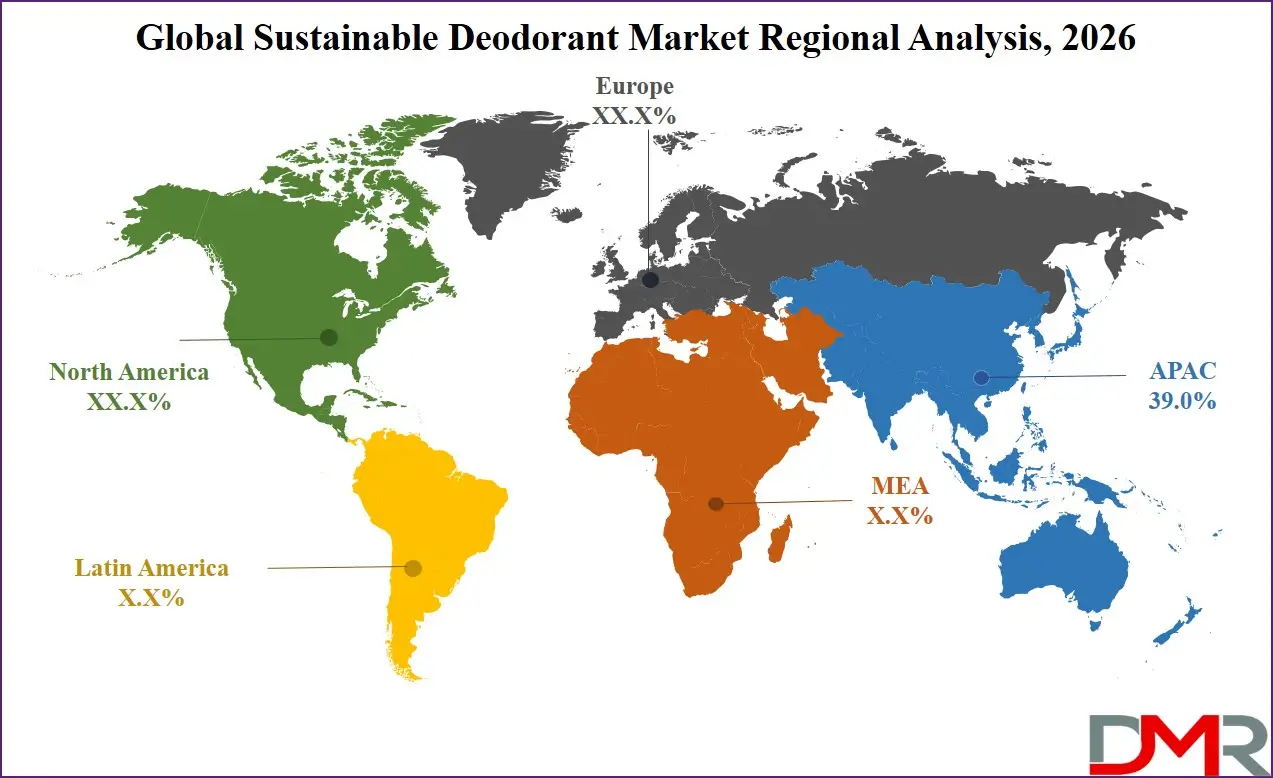
Asia-Pacific is expected to lead the global sustainable deodorant market, accounting for approximately 39.0% of total market revenue in 2026. The region's growth is driven by rising environmental awareness, increasing adoption of clean beauty and chemical-free personal care products, and a growing urban population with higher disposable incomes. Consumers in countries like China, India, Japan, and South Korea are increasingly choosing plant-based, organic, and biodegradable deodorants. Expanding e-commerce penetration, the availability of international and local sustainable brands, and a strong preference for eco-friendly packaging further contribute to the region's dominant position in the global market.
ℹ
To learn more about this report –
Download Your Free Sample Report Here
Region with the Highest CAGR
The Asia-Pacific region is projected to register the highest compound annual growth rate in the global sustainable deodorant market. Rapid urbanization, rising disposable incomes, and increasing awareness of health and environmental sustainability are driving consumer demand for chemical-free, natural, and eco-friendly personal care products. The growing preference for plant-based formulations, biodegradable packaging, and cruelty-free options, combined with expanding e-commerce and retail penetration, is accelerating market adoption. Countries such as China, India, Japan, and South Korea are emerging as key growth hubs, positioning Asia-Pacific as the fastest-growing region in the market.
By Region
North America
Europe
- Germany
- The U.K.
- France
- Italy
- Russia
- Spain
- Benelux
- Nordic
- Rest of Europe
Asia-Pacific
- China
- Japan
- South Korea
- India
- ANZ
- ASEAN
- Rest of Asia-Pacific
Latin America
- Brazil
- Mexico
- Argentina
- Colombia
- Rest of Latin America
Middle East & Africa
- Saudi Arabia
- UAE
- South Africa
- Israel
- Egypt
- Rest of MEA
Global Sustainable Deodorant Market: Competitive Landscape
The global sustainable deodorant market is highly competitive, characterized by the presence of numerous players focusing on innovation, product differentiation, and sustainability initiatives. Companies are investing in research and development to create chemical-free, plant-based, and biodegradable formulations while enhancing packaging to meet eco-conscious consumer demands. Competitive strategies include expanding distribution through e-commerce and retail channels, introducing premium and customizable products, and leveraging marketing campaigns that emphasize clean beauty, cruelty-free practices, and environmental responsibility. This dynamic landscape drives continuous innovation and intensifies efforts to capture consumer loyalty in the growing sustainable personal care segment.
Some of the prominent players in the Global Sustainable Deodorant Market are:
- Native (Procter & Gamble brand)
- Schmidt's Naturals (Unilever brand)
- Lush Cosmetics
- Ethique
- Meow Meow Tweet
- Ben & Anna
- Wild Cosmetics
- Myro
- Coconut Matter
- Earth Conscious
- We Love The Planet
- Nuud
- Soapwalla
- Primal Life Organics
- Each & Every
- Bubble and Bee Organic
- Lavanila Laboratories
- EO Products
- Green Tidings
- The Natural Deodorant Co
- Other Key Players
Recent Developments in the Global Sustainable Deodorant Market
- Dec 2025: Wild expanded its eco-friendly personal care lineup by launching a refillable roll-on deodorant in the UK featuring a reusable metal case combined with bio-based, compostable refills, reinforcing innovation in natural scent options and low-waste formats.
- Oct 2025: Lifelong unveiled its refillable deodorant 2.0 on Kickstarter, a sustainable personal care product made from 100% ocean-bound recycled plastic with customizable scents and compostable pouch refills, aiming to reduce single-use plastic waste.
- Jun 2025: Unilever completed its acquisition of a UK-based sustainable personal care brand known for refillable, plant-based products, significantly strengthening its presence in the eco-friendly deodorant and personal care segment.
- Apr 2025: Wild's co-founders received a substantial payout from the sale of their natural deodorant company to a global consumer goods giant, marking a notable merger that supports expansion of refillable personal care offerings.
Report Details
| Report Characteristics |
| Market Size (2026) |
USD 1.3 Bn |
| Forecast Value (2035) |
USD 2.3 Bn |
| CAGR (2026–2035) |
6.5% |
| The US Market Size (2026) |
USD 0.3 Bn |
| Historical Data |
2021 – 2025 |
| Forecast Data |
2027 – 2035 |
| Base Year |
2025 |
| Estimate Year |
2026 |
| Report Coverage |
Market Revenue Estimation, Market Dynamics, Competitive Landscape, Growth Factors and etc. |
| Segments Covered |
By Product Type (Bio-enzyme based, Activated carbon and natural absorbents, Plant-based botanical formulations, Waterless and solid bar formats, Other sustainable chemistries), By Price Tier (Mass market affordable, Premium and specialty, Luxury and niche artisan), By Distribution Channel (Supermarkets and Hypermarkets, Pharmacies and Drug Stores, Online and e-commerce, Specialty and Beauty Retailers), and By End-User (Men, Women, Unisex and others) |
| Regional Coverage |
North America – The US and Canada; Europe – Germany, The UK, France, Russia, Spain, Italy, Benelux, Nordic, & Rest of Europe; Asia-Pacific – China, Japan, South Korea, India, ANZ, ASEAN, Rest of APAC; Latin America – Brazil, Mexico, Argentina, Colombia, Rest of Latin America; Middle East & Africa – Saudi Arabia, UAE, South Africa, Turkey, Egypt, Israel, & Rest of MEA |
| Prominent Players |
Native (Procter & Gamble brand), Schmidt’s Naturals (Unilever brand), Lush Cosmetics, Ethique, Meow Meow Tweet, Ben & Anna, Wild Cosmetics, Myro, Coconut Matter, Earth Conscious, and many others. |
| Purchase Options |
We have three licenses to opt for: Single User License (Limited to 1 user), Multi-User License (Up to 5 Users) and Corporate Use License (Unlimited User) along with free report customization equivalent to 0 analyst working days, 3 analysts working days and 5 analysts working days respectively. |
Frequently Asked Questions
How big is the Global Sustainable Deodorant Market?
▾ The Global Sustainable Deodorant Market size is estimated to have a value of USD 1.3 billion in 2026 and is expected to reach USD 2.3 billion by the end of 2035.
What is the growth rate in the Global Sustainable Deodorant Market in 2026?
▾ The market is growing at a CAGR of 6.5% over the forecasted period of 2026.
What is the size of the US Sustainable Deodorant Market?
▾ The US Sustainable Deodorant market is projected to be valued at USD 0.3 billion in 2026. It is expected to witness subsequent growth in the upcoming period as it holds USD 0.6 billion in 2035 at a CAGR of 6.1%.
Which region accounted for the largest Global Sustainable Deodorant Market?
▾ Asia Pacific is expected to have the largest market share in the Global Sustainable Deodorant Market with a share of about 39.0% in 2026.
Who are the key players in the Global Sustainable Deodorant Market?
▾ Some of the major key players in the Global Sustainable Deodorant Market are Native (Procter & Gamble brand), Schmidt’s Naturals (Unilever brand), Lush Cosmetics, Ethique, Meow Meow Tweet, Ben & Anna, Wild Cosmetics, Myro, Coconut Matter, Earth Conscious, and many others.