Switzerland Nutraceutical Ingredients Market Snapshot
- Switzerland Nutraceutical Ingredients Market Size in 2026: USD 920 Million
- Switzerland Nutraceutical Ingredients Market Size in 2035: USD 1,580 Million
- Switzerland CAGR from 2026 to 2035: 6.2%
- Vitamins are the leading ingredient type segment in 2026: 24.5%
- Dry is the leading form segment in 2026: 72.8%
- Additional Supplements is the leading function segment in 2026: 48.3%
- Dietary Supplements is the leading application segment in 2026: 46.8%
What is the Switzerland Nutraceutical Ingredients Market and its Market Size?
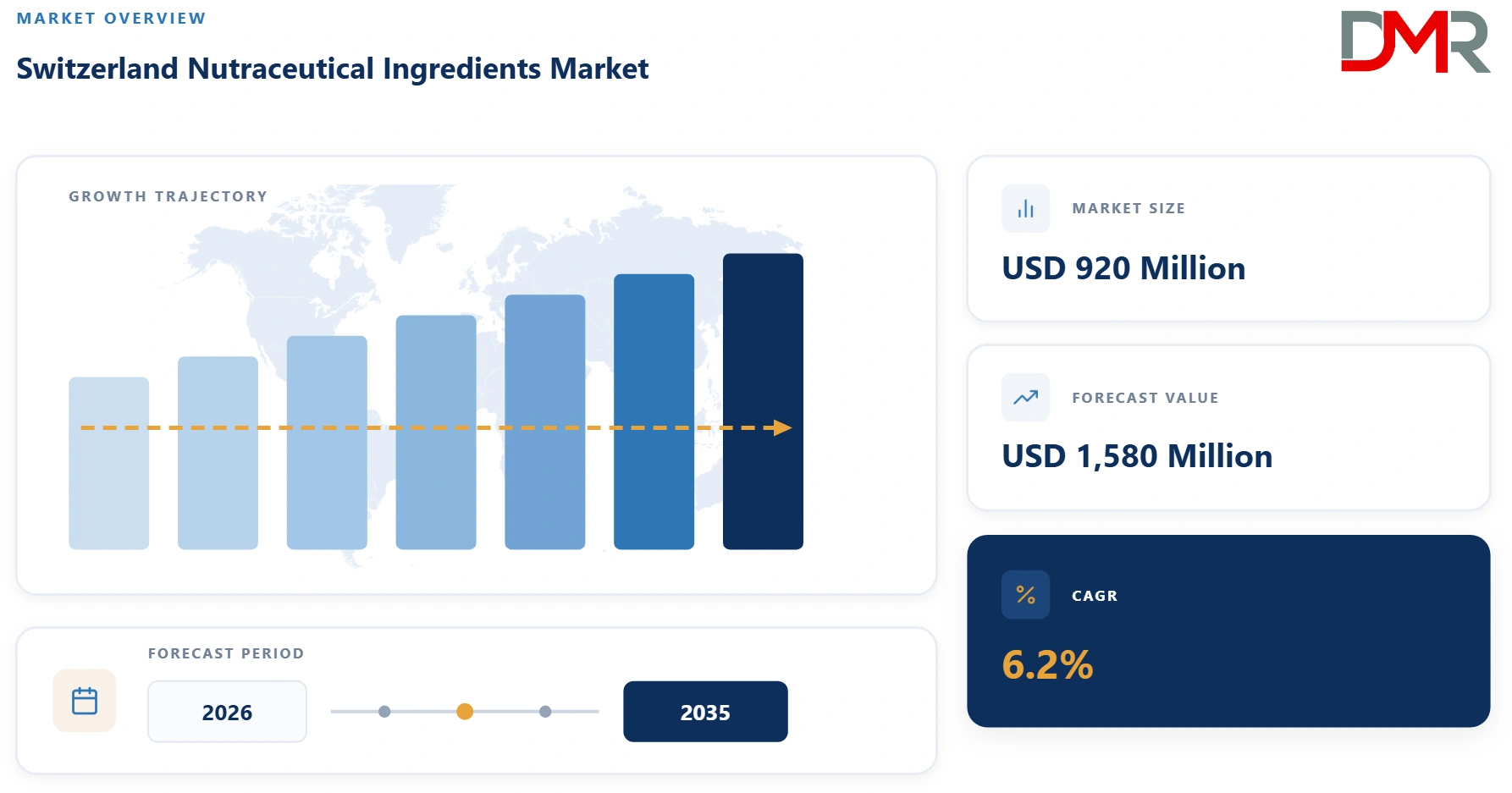
The Switzerland Nutraceutical Ingredients Market is projected to reach USD 920 million in 2026 and grow at a compound annual growth rate of 6.2% from there until 2035 to reach a value of USD 1,580 million.
ℹ
To learn more about this report –
Download Your Free Sample Report Here
Nutraceutical ingredients are biologically active substances incorporated into dietary supplements, functional foods, beverages, sports nutrition products, animal nutrition, and medical nutrition formulations. Switzerland presents an attractive market due to its affluent and health-conscious population, ageing demographics, advanced pharmaceutical and food industries, strong research capabilities, and presence of globally established nutrition companies. Demand increasingly favors clinically supported, traceable, sustainable, plant-based, and personalized ingredients addressing immunity, digestive health, active ageing, cognition, metabolic wellness, and sports performance.
Use Cases
- Preventive Health and Daily Supplementation: Vitamins, minerals, amino acids, probiotics, prebiotics, and plant extracts are incorporated into tablets, capsules, powders, and gummies intended to support immunity, energy metabolism, bone health, digestive function, and general wellness. Switzerland’s ageing and health-conscious population encourages manufacturers to formulate scientifically supported products for everyday preventive nutrition and the management of nutritional deficiencies.
- Sports Performance and Recovery: Proteins, amino acids, functional carbohydrates, electrolytes, vitamins, and botanical ingredients are used in sports powders, nutrition bars, beverages, and recovery supplements. These formulations support muscle development, endurance, hydration, energy production, and post-exercise recovery. Expanding participation in fitness, outdoor sports, cycling, skiing, and active lifestyles is strengthening demand for convenient and personalized sports nutrition products.
- Functional Food and Beverage Fortification: Food and beverage manufacturers use fibers, probiotics, vitamins, minerals, proteins, functional fats, and plant extracts to enhance the nutritional profile of dairy products, cereals, snacks, beverages, and meal replacements. These ingredients allow companies to introduce products targeting digestive wellness, immunity, healthy ageing, energy, cognition, and cardiovascular health while meeting consumer demand for convenient nutrition.
- Medical and Specialized Nutrition: Nutraceutical ingredients are incorporated into food for special medical purposes and products for older adults, patients, and individuals with specific dietary requirements. Proteins, amino acids, functional lipids, vitamins, minerals, and specialty carbohydrates support nutritional management, muscle preservation, recovery, and healthy ageing. Switzerland’s sophisticated healthcare ecosystem provides opportunities for clinically validated and healthcare-professional-supported formulations.
Key Takeaways
- Market Size: The Switzerland Nutraceutical Ingredients Market is anticipated to be valued at USD 920 million in 2026 and is forecast to reach USD 1,580 million by 2035, expanding at a CAGR of 6.2%.
- Growth Outlook: Market expansion is supported by increasing preventive healthcare awareness, population ageing, demand for functional nutrition, premium supplement consumption, sports participation, personalized wellness, scientific ingredient validation, and product innovation across dietary supplements, functional foods, beverages, animal nutrition, and medical nutrition.
- Primary Growth Drivers: High purchasing power, growing awareness of nutritional deficiencies, consumer interest in healthy ageing, demand for natural and plant-based products, strong pharmaceutical and biotechnology capabilities, and the presence of major nutrition companies are encouraging investment in high-value nutraceutical ingredients.
- By Ingredient Type Analysis: Vitamins are projected to lead the ingredient type segment with a 24.5% share in 2026, supported by their extensive application in daily supplements, functional foods, beverages, immunity products, and medical nutrition. Probiotics are expected to record the fastest CAGR of approximately 7.4% through 2035.
- By Form Analysis: Dry ingredients are expected to dominate with a 72.8% share in 2026 due to their longer shelf life, formulation flexibility, transportation efficiency, dosage accuracy, and suitability for tablets, capsules, powders, sachets, and food premixes. Liquid ingredients are projected to expand at a CAGR of approximately 6.8%.
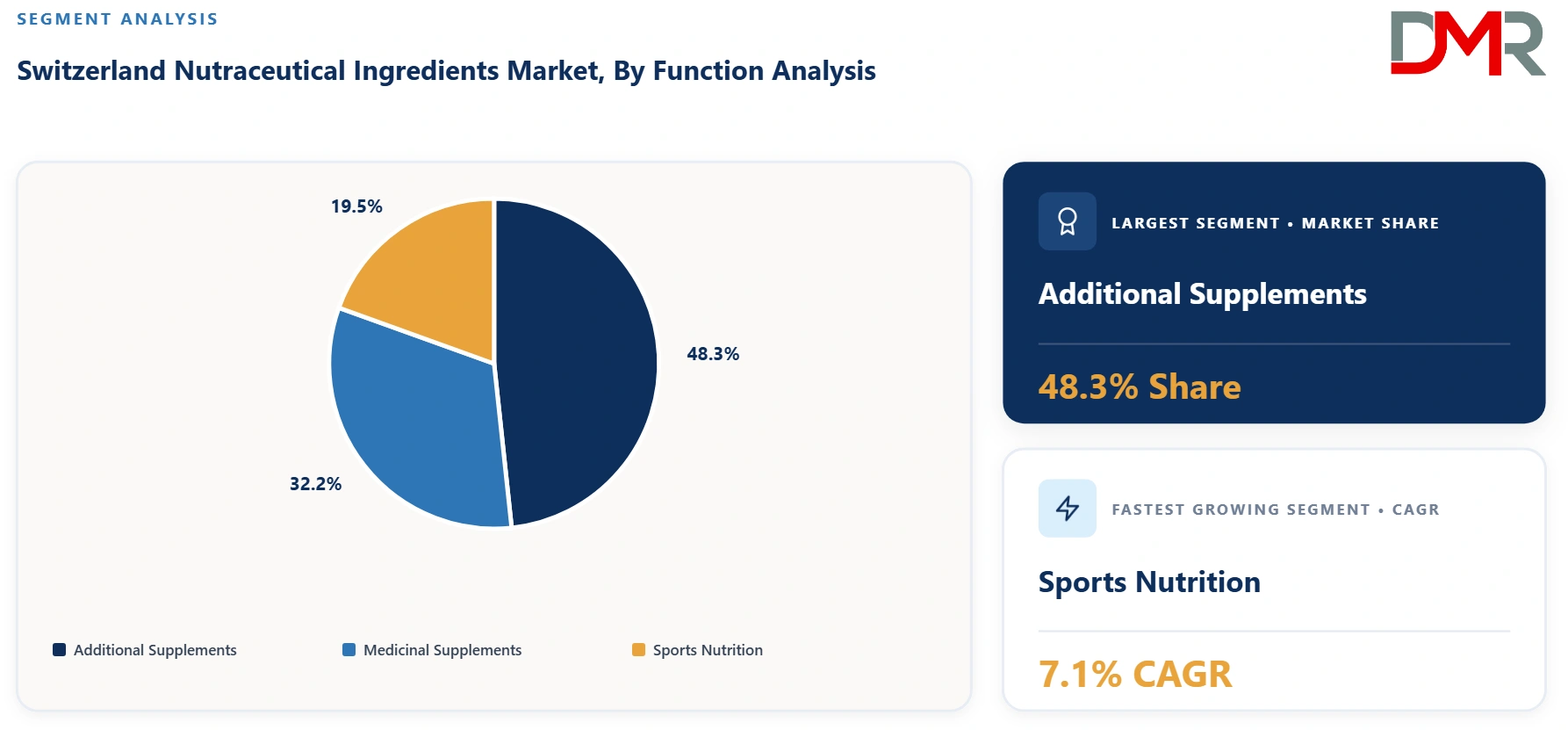
- By Function Analysis: Additional Supplements are anticipated to account for 48.3% of market revenue in 2026, driven by routine consumption of vitamins, minerals, probiotics, and botanical supplements. Sports Nutrition is expected to grow fastest at a CAGR of approximately 7.1% through 2035.
- By Application Analysis: Dietary Supplements are projected to lead with a 46.8% share in 2026, supported by demand for preventive health, immunity, healthy ageing, and digestive wellness products. Functional Beverages are expected to register the fastest CAGR of approximately 7.3% during the forecast period.
How AI and Generative AI Are Transforming the Switzerland Nutraceutical Ingredients Market?
Artificial intelligence is accelerating ingredient discovery, formulation development, clinical evidence assessment, and personalized nutrition across Switzerland’s nutraceutical ecosystem. Machine-learning models analyze biochemical, genomic, microbiome, and consumer data to identify promising bioactive compounds and predict their health effects. Generative AI supports rapid formulation concepts, claim documentation, scientific literature reviews, and product positioning. Manufacturers can optimize ingredient combinations, stability, taste, dosage, and bioavailability before physical testing. AI-enabled quality systems also identify production deviations, forecast ingredient demand, improve traceability, and reduce waste. However, reliable datasets, human scientific oversight, regulatory compliance, privacy protection, and validation remain essential for responsible adoption.
Key Drivers in the Switzerland Nutraceutical Ingredients Market
Ageing Population and Growing Preventive Healthcare Awareness
Switzerland’s demographic ageing is increasing demand for ingredients supporting bone health, muscle maintenance, cognition, cardiovascular wellness, immunity, and digestive function. The country’s permanent population exceeded 9.1 million in 2025, while people aged 65 and above outnumbered those below 20 for the first time. The proportion aged 65 or older is projected to rise from 19.3% in 2023 to 25.5% by 2055. These demographic changes are encouraging consumers to adopt vitamins, minerals, proteins, omega fatty acids, probiotics, and botanical extracts as part of healthy-ageing routines and are stimulating innovation in specialized and medical nutrition products.
Strong Nutrition Research and Premium Product Demand
Switzerland has an advanced life-sciences ecosystem, internationally active nutrition companies, research universities, biotechnology capabilities, and affluent consumers willing to purchase differentiated health products. Ingredient developers benefit from expertise in clinical nutrition, food science, fermentation, pharmaceutical manufacturing, encapsulation, and precision delivery. Consumers increasingly seek science-backed, traceable, clean-label, and sustainably sourced ingredients rather than basic commodity formulations. Demand is particularly strong for premium probiotics, branded plant extracts, high-purity vitamins, specialty proteins, omega fatty acids, and ingredients supported by clinical evidence. This combination of scientific infrastructure and premium consumption supports higher-value product development and strengthens Switzerland’s role in nutritional innovation.
Restraints in the Switzerland Nutraceutical Ingredients Market
Strict Claims, Composition, and Novel-Food Requirements
Switzerland permits food supplements without routine premarket authorization, but manufacturers, importers, and distributors remain responsible for product safety and legal compliance. Maximum levels apply to various vitamins and minerals, while health claims must be listed under applicable Swiss regulations or authorized by the Federal Food Safety and Veterinary Office. Novel foods, genetically modified ingredients, and previously unlisted health claims can require additional evaluation or approval. Products must also remain clearly differentiated from therapeutic products and cannot claim to prevent, treat, or cure diseases. These requirements increase documentation, testing, legal-review, and reformulation costs, particularly for smaller companies introducing innovative bioactive ingredients.
High Production Costs and Dependence on Imported Inputs
Switzerland’s high labor, energy, manufacturing, compliance, and facility expenses can limit domestic production of commodity nutraceutical ingredients. Manufacturers frequently depend on international suppliers for botanical extracts, plant proteins, amino acids, vitamins, minerals, and functional oils. This exposes companies to currency movements, transportation disruptions, geopolitical risks, agricultural variability, and fluctuations in raw-material prices. Maintaining traceability and consistent purity across complex global supply chains adds further cost. Premium positioning can absorb part of this burden, but price-sensitive consumers may select lower-priced imported products. Smaller formulators also face difficulty meeting minimum order quantities and financing advanced testing, certification, and specialized production infrastructure.
Growth Opportunities in the Switzerland Nutraceutical Ingredients Market
Personalized Nutrition and Healthy-Ageing Formulations
Personalized nutrition creates substantial opportunities for ingredient companies capable of combining diagnostic information, lifestyle data, age, activity, and dietary preferences into targeted formulations. Switzerland’s strong healthcare, pharmaceutical, digital-health, and research infrastructure provides a supportive environment for products addressing healthy longevity, women’s health, metabolic wellness, cognition, mobility, sleep, and immune function. Opportunities exist for clinically validated combinations of proteins, vitamins, minerals, probiotics, omega fatty acids, and plant bioactives. Ingredient suppliers can collaborate with healthcare professionals, laboratories, pharmacies, supplement brands, and digital platforms to develop premium programs incorporating individualized recommendations, subscription models, biomarkers, and measurable wellness outcomes.
Plant-Based, Sustainable, and Clinically Validated Ingredients
Growing attention to sustainability and ingredient transparency is creating opportunities for plant proteins, algae-derived oils, fermentation-based nutrients, upcycled botanical extracts, natural carotenoids, and low-impact functional ingredients. Swiss consumers increasingly evaluate sourcing, environmental footprints, animal welfare, formulation simplicity, and scientific credibility. Suppliers that document bioavailability, efficacy, safety, traceability, and environmental performance can differentiate themselves from commodity competitors. Opportunities also exist in vegan capsules, allergen-conscious products, clean-label stabilizers, and ingredients produced through precision fermentation. Partnerships between ingredient manufacturers, universities, biotechnology companies, and food businesses can shorten commercialization timelines and create intellectual property around premium, sustainable nutritional solutions.
Trends in the Switzerland Nutraceutical Ingredients Market
Gut Health, Microbiome, and Biotics-Based Products
Demand is shifting beyond conventional digestive supplements toward products addressing the relationship between the microbiome, immunity, metabolism, mood, skin health, and healthy ageing. This is increasing interest in strain-specific probiotics, prebiotic fibers, postbiotics, synbiotics, and targeted combinations supported by human studies. Manufacturers are focusing on improved stability, controlled release, survivability, shelf life, and compatibility with beverages and foods. Swiss companies and research institutions can leverage biotechnology and clinical expertise to develop high-value microbiome solutions. Transparent strain identification and validated claims will become increasingly important as consumers and healthcare professionals expect evidence distinguishing specialized products from general digestive-health supplements.
Clean-Label Delivery Formats and Functional Beverages
Consumers are increasingly seeking convenient formats that fit daily routines, including gummies, sachets, effervescent tablets, ready-to-drink beverages, liquid shots, and single-serve powders. Functional beverages are benefiting from demand for hydration, energy, immunity, relaxation, focus, digestive wellness, and exercise recovery. This trend increases requirements for water-dispersible vitamins, stable probiotics, soluble fibers, natural plant extracts, minerals with improved taste profiles, and oxidation-resistant functional oils. Clean labels, reduced sugar, natural flavors, recognizable ingredients, vegan suitability, and sustainable packaging influence product development. Delivery technologies that preserve ingredient activity while controlling bitterness, color, odor, and interaction will become increasingly valuable.
Research Scope and Analysis
The research covers Switzerland nutraceutical ingredients across proteins, amino acids, fibers, specialty carbohydrates, probiotics, prebiotics, phytochemicals, plant extracts, functional fats, oils, vitamins, minerals, carotenoids, other ingredients, dry, liquid, other forms, additional supplements, medicinal supplements, sports nutrition, dietary supplements, functional foods, functional beverages, animal nutrition, and food for special medical purposes applications.
ℹ
To learn more about this report –
Download Your Free Sample Report Here
By Ingredient Type Analysis
Vitamins are projected to dominate the ingredient type segment with a 24.5% share in 2026, supported by widespread use in supplements, fortified foods, beverages, and medical nutrition. Their established health functions and formulation versatility sustain demand. Probiotics are expected to record the fastest CAGR of approximately 7.4%, above the overall market CAGR, driven by expanding microbiome and digestive-health applications.
By Form Analysis
Dry ingredients are anticipated to lead the form segment with a 72.8% share in 2026, reflecting their stability, longer shelf life, precise dosing, and suitability for tablets, capsules, powders, premixes, and sachets. Liquid ingredients are projected to register the fastest CAGR of approximately 6.8, as demand grows for shots, beverages, drops, and liquid-filled capsules.
By Function Analysis
Additional Supplements are expected to dominate the function segment with a 48.3% share in 2026, supported by regular consumer use of vitamins, minerals, probiotics, functional oils, and plant-based formulations. Sports Nutrition is forecast to record the fastest CAGR of approximately 7.1%, due to fitness participation, active lifestyles, and performance-focused consumption.
By Application Analysis
Dietary Supplements are projected to lead the application segment with a 46.8% share in 2026, driven by strong preventive-health awareness and demand for convenient concentrated nutrition. Functional Beverages are anticipated to achieve the fastest CAGR of approximately 7.3%, surpassing overall market growth as consumers adopt fortified drinks for energy, hydration, digestion, immunity, cognition, and exercise recovery.
The Switzerland Nutraceutical Ingredients Market Report is Segmented Based on the Following
By Ingredient Type
- Proteins
- Amino Acids
- Fibers & Specialty Carbohydrates
- Probiotics
- Prebiotics
- Phytochemicals & Plant Extracts
- Functional Fats & Oils
- Vitamins
- Minerals
- Carotenoids
- Others
By Form
By Function
- Additional Supplements
- Medicinal Supplements
- Sports Nutrition
By Application
- Dietary Supplements
- Functional Food
- Functional Beverages
- Animal Nutrition
- Food for Special Medical Purposes (FSMP)
Regulatory Landscape
Switzerland regulates nutraceutical ingredients through food legislation administered primarily by the Federal Food Safety and Veterinary Office and cantonal enforcement authorities. Standard food supplements generally do not require authorization, but businesses must ensure safety, quality, labeling, composition, and legal compliance through self-supervision. Maximum levels govern selected vitamins and minerals, while approved conditions determine permissible nutrition and health claims. Novel foods, genetically modified ingredients, and unlisted health claims may require authorization. Companies must prevent therapeutic positioning because supplements cannot claim to diagnose, prevent, treat, or cure diseases. These rules protect consumers but increase compliance costs, scientific documentation needs, formulation complexity, and commercialization timelines for innovative ingredients.
Technology Analysis
Technology development is improving the efficacy, stability, sensory performance, and personalization of nutraceutical ingredients. Microencapsulation, liposomal delivery, controlled-release systems, nanoemulsions, spray drying, fermentation, and advanced extraction enhance bioavailability and protect sensitive compounds against heat, oxygen, moisture, and digestive degradation. Precision fermentation supports sustainable production of proteins, vitamins, and bioactive compounds, while strain-selection platforms improve probiotic specificity. Artificial intelligence and high-throughput screening accelerate discovery and formulation optimization. Digital traceability technologies strengthen supply-chain transparency and quality assurance. However, commercialization requires careful safety assessment, scalable manufacturing, consumer acceptance, and regulatory validation, particularly when advanced processes produce ingredients classified as novel foods.
Competitive Landscape
The Switzerland Nutraceutical Ingredients Market combines major Swiss life-science and nutrition groups with international ingredient manufacturers, specialty distributors, biotechnology businesses, and formulation partners. Competition centers on clinical evidence, ingredient purity, bioavailability, traceability, regulatory support, sustainability, delivery technology, and customized formulation. DSM-Firmenich, Nestlé Health Science, and Lonza provide strong domestic industry capabilities, while global suppliers compete across proteins, vitamins, minerals, probiotics, botanicals, fibers, carotenoids, and functional lipids. Partnerships with universities, healthcare organizations, food manufacturers, and supplement brands are increasingly important for differentiation and commercialization.
Some of the Prominent Players in the Switzerland Nutraceutical Ingredients Market Are
- DSM-Firmenich
- Nestlé Health Science
- Lonza Group
- BASF SE
- ADM
- Cargill Incorporated
- Kerry Group
- International Flavors & Fragrances
- Glanbia plc
- Ingredion Incorporated
- Tate & Lyle PLC
- Roquette Frères
- Givaudan
- Symrise AG
- Evonik Industries
- Lallemand Inc.
- Chr. Hansen
- Novonesis
- AAK AB
- Beneo
- Balchem Corporation
- Kemin Industries
- Sabinsa Corporation
- Prinova Group
- Arla Foods Ingredients
- FrieslandCampina Ingredients
- Fonterra Co-operative Group
- Gelita AG
- Rousselot
- BioGaia AB
- Probi AB
- SFI Health
- Gnosis by Lesaffre
- Lycored
- Nutraceutix
- AstaReal
- Kaneka Corporation
- Döhler Group
- Azelis
- Barentz
- Other Key Players
Recent Developments
- February 2026: Nestlé introduced its Vital nutritional drink range for consumers in midlife and beyond, using patented nutrient combinations designed to support energy, strength, sleep, and focus while strengthening the company’s healthy-longevity portfolio.
- January 2026: Lonza reported that its Capsules & Health Ingredients business recorded, while its core EBITDA margin improved by 1.6 percentage points to 25.9%.
- November 2025: Nestlé expanded open innovation partnerships with universities to accelerate nutrition and health research focused on women’s health, healthy longevity, and weight management.
- July 2025: Nestlé scientists developed and commercialized Muscle Repair+, a bioactive supplement containing vitamin B-related nutrients nicotinamide and pyridoxine to support muscle-cell repair and recovery after exercise.
Report Details
| Report Characteristics |
| Market Size (2026) |
USD 920 Mn |
| Forecast Value (2035) |
USD 1,580 Mn |
| CAGR (2026–2035) |
6.2% |
| Historical Data |
2021 – 2025 |
| Forecast Data |
2026 – 2035 |
| Base Year |
2025 |
| Segments Covered |
By Ingredient Type, By Form, By Function, By Application |
Frequently Asked Questions
How big is the Switzerland Nutraceutical Ingredients Market?
▾ The Switzerland Nutraceutical Ingredients Market is valued at USD 920 million in 2026 and is projected to reach USD 1,580 million by 2035.
What is the CAGR of the Switzerland Nutraceutical Ingredients Market from 2026 to 2035?
▾ The market is expected to expand at a compound annual growth rate of 6.2% during the forecast period from 2026 to 2035.
What factors are driving the growth of the Switzerland Nutraceutical Ingredients Market?
▾ Growth is driven by population ageing, preventive healthcare awareness, high purchasing power, demand for functional foods, personalized nutrition, active lifestyles, and strong domestic nutrition and life-science capabilities.
What are the major trends in the Switzerland Nutraceutical Ingredients Market?
▾ Major trends include microbiome-focused formulations, personalized nutrition, healthy-ageing products, plant-based ingredients, functional beverages, clean-label formulations, clinical validation, advanced delivery systems, and sustainable sourcing.
Which ingredient type holds the largest market share?
▾ Vitamins are projected to lead the ingredient type segment with a 24.5% market share in 2026, supported by broad application across supplements, fortified foods, beverages, and specialized nutrition.
Which application holds the largest market share?
▾ Dietary Supplements are expected to dominate the application segment with a 46.8% share in 2026, driven by preventive-health consumption and demand for convenient concentrated nutrition.
Who are the key players in the Switzerland Nutraceutical Ingredients Market?
▾ Key players include DSM-Firmenich, Nestlé Health Science, Lonza, BASF, ADM, Cargill, Kerry Group, Givaudan, Novonesis, Glanbia, Roquette, and International Flavors & Fragrances.
How is the Switzerland Nutraceutical Ingredients Market segmented?
▾ The market is segmented by ingredient type, form, function, and application. Major categories include vitamins, proteins, probiotics, dry and liquid forms, additional and sports supplements, dietary supplements, functional foods, beverages, animal nutrition, and FSMP products.