What is the Tag Management System Market Size?
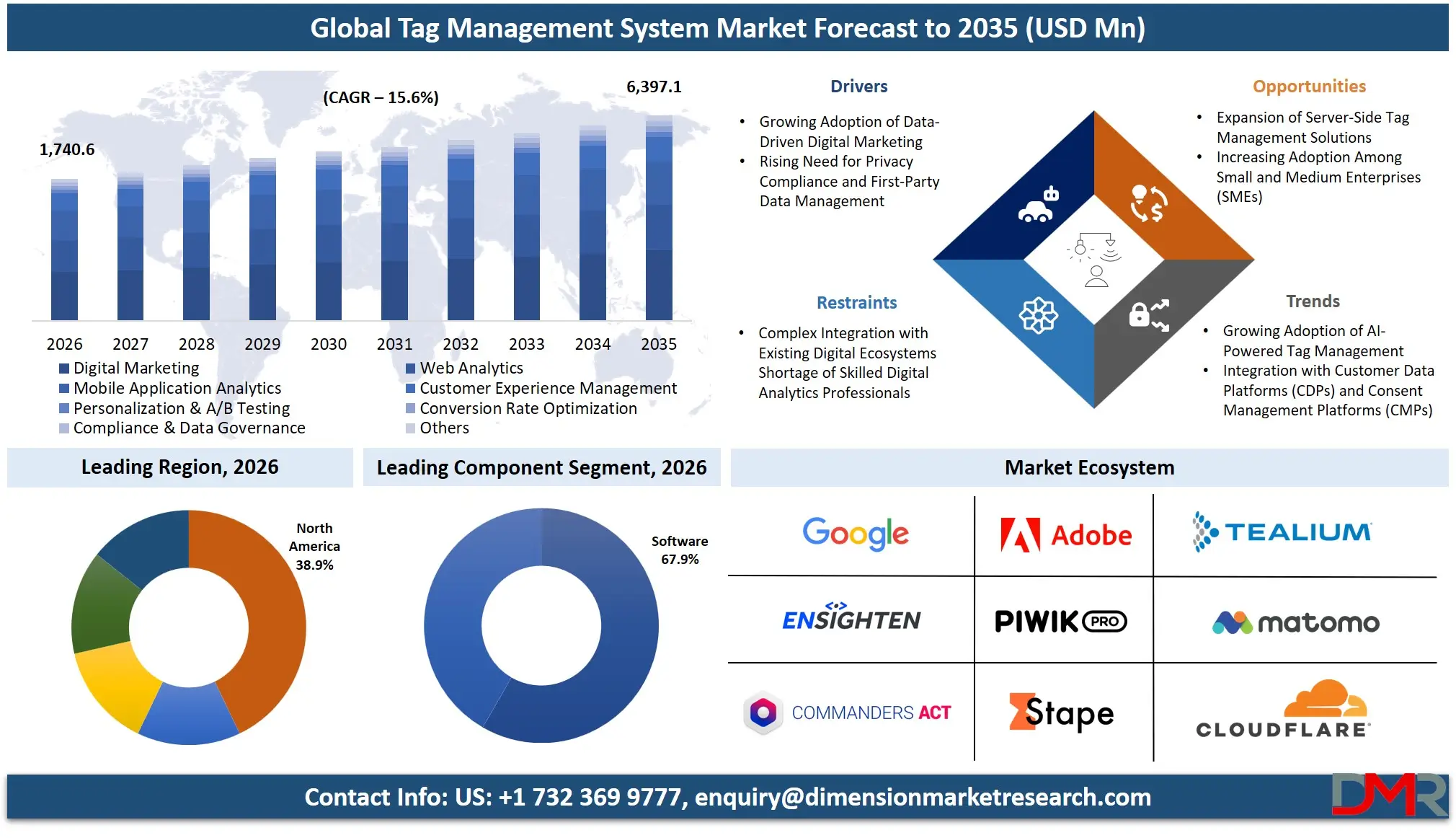
The Global Tag Management System Market is expected to reach a value of USD 1,740.6 million in 2026, and it is further anticipated to reach USD 6,397.1 million by 2035, growing at a CAGR of 15.6% during the forecast period.
ℹ
To learn more about this report –
Download Your Free Sample Report Here
The tag management system market has been growing at an accelerated rate as enterprises pivot to first-party data strategies and navigate the deprecation of third-party cookies. The market consists of software and services that enable organizations to deploy, unify, and govern digital tags JavaScript snippets for analytics, marketing, and advertising across web, mobile, and server-side environments without heavy IT dependency. The increasing demand to implement consent-driven data collection, real-time customer journey orchestration, and privacy-compliant personalization is driving the necessity of specialized tag management solutions. Enterprises are the most frequent adopters, with cloud-based deployments remaining the most popular because of their scalability and seamless integration with martech stacks. The retail & e-commerce, BFSI, and media & entertainment industries are key players as they need agile, secure, and high-performance digital data layers to power advanced analytics and hyper-personalized campaigns.
The US Tag Management System Market
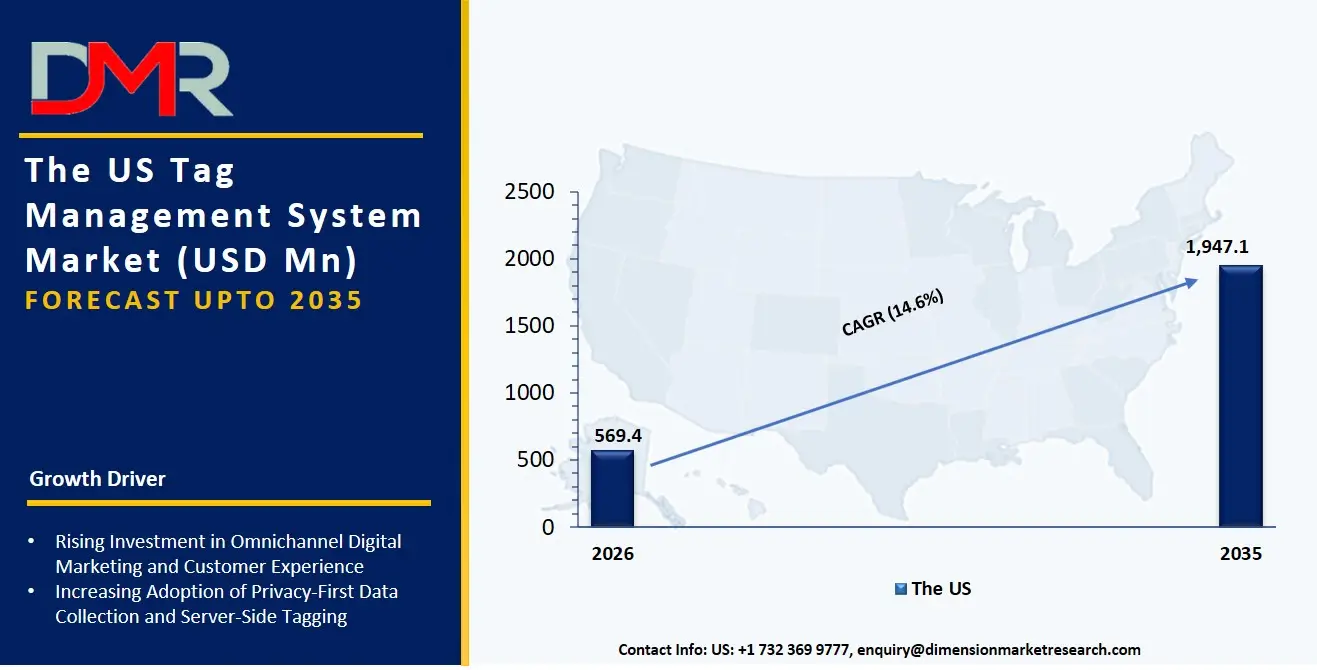
The US Tag Management System Market is projected to reach USD 569.4 million in 2026 at a compound annual growth rate of 14.6% over its forecast period, culminating in a value of USD 1,947.1 million by 2035.
ℹ
To learn more about this report –
Download Your Free Sample Report Here
The US continues to be the largest and most sophisticated market for tag management systems, fueled by stringent state-level privacy legislation and the aggressive digital experience initiatives of Fortune 500 companies. The market has been typified by high demand for server-side tag management, whereby organizations are aiming to shift data processing from the client-side browser to a controlled cloud environment to enhance site performance and data security. Besides, the proliferation of Customer Data Platforms (CDPs) is producing a parallel need for API & event tag management services to unify data streams and enforce governance frameworks across digital properties.
The Europe Tag Management System Market
The Europe Tag Management System Market is estimated to be valued at USD 487.4 million in 2026 and is further anticipated to reach USD 1,759.3 million by 2035 at a CAGR of 15.3%. The regulatory frameworks including GDPR and the evolving ePrivacy Regulation have a profound impact on the European market and drive the critical need for consent & privacy management solutions. Accelerated growth of server-side and hybrid deployment services is also being experienced in the region as publishers and advertisers in the UK and Germany seek to build resilient, first-party data collection architectures. In addition, industry bodies such as the IAB Europe are challenging solution providers to create dedicated implementation & integration services that ensure strict data residency and seamless interoperability with local European Consent Management Platforms (CMPs), pushing the market toward sovereign, privacy-centric tag governance frameworks.
The Japan Tag Management System Market
The Japan Tag Management System Market is projected to be valued at USD 113.1 million in 2026 and is further expected to witness robust growth, reaching USD 362.8 million by 2035 at a CAGR of 13.8%. The Japanese market is unique, with a corporate drive to digital experience personalization in response to a hyper-connected, mobile-first consumer base and the urgent modernization of legacy, siloed marketing stacks. Marketing tag management and performance monitoring services make up a large part of the spending as large conglomerates (Keiretsu) deploy and manage complex analytics, CRM, and advertising pixels across sprawling digital ecosystems and super-app platforms. There is also a strong need to integrate deeply with local mar-tech platforms like LINE and Yahoo! Japan, bridging gaps between traditional on-premise CRM systems and modern customer data collection & tracking frameworks, which forms a specialized niche in API-driven integration and custom workflow automation by domestic system integrators.
Key Takeaways
- Market Size & Forecast: The Global Tag Management System market is projected to reach USD 1,740.6 million in 2026, expanding dramatically to USD 6,397.1 million by 2035, fueled by the dual drivers of cookieless advertising imperatives and the universal need for real-time, governed customer data collection.
- Growth Rate & Outlook: Global market growth is expected at a CAGR of 15.6%, driven by a critical need for marketing agility and the escalating complexity of managing dozens of cross-channel vendor pixels without degrading website performance.
- Primary Growth Drivers: Key forces include the widespread shift from browser-reliant third-party cookies to server-side first-party data control, the need for privacy-centric consulting to avoid costly non-compliance penalties, and the integration of unified data layers requiring specialized implementation & integration skills.
- Key Market Trends: Major trends include the rise of server-side tag management as a default architecture, the use of AI-powered scanning tools within performance monitoring services to auto-detect rogue or unconsented tags, and the shift toward consent & privacy management as boards prioritize zero-party data ethics.
- By Deployment Mode Analysis: Cloud-based models are expected to dominate enterprise discussions due to agility and total cost of ownership. However, professional services are increasingly required to build seamless API & event tag management layers that connect on-premise legacy databases with cloud-based marketing activation tools.
- By Application Analysis: Digital marketing and web analytics are the most mature applications due to the need for accurate multi-touch attribution. Conversion rate optimization is a fast-growing area as A/B testing tools require precise and governed tag deployment to ensure statistically valid results.
- Regional Leadership: North America is poised to dominate this market with 38.9% of the market share in 2026 due to its concentration of ad-tech pioneers and a rigorous regulatory environment that utilizes these solutions to their fullest and makes it a leader in this market.
What is the Tag Management System?
Tag Management Systems (TMS) are the centralized software and service hubs that are offered by third-party vendors to assist organizations in governing the entire lifecycle of digital tags. These services, unlike the data collection itself, are related to the how of tag deployment. This involves software to control tag logic and data routing, as well as services like consulting to establish a strategic data taxonomy and business case for unification, implementation & integration to migrate from hard-coded tags seamlessly, and training & support to ensure marketing teams can self-manage without breaking site performance. With enterprises operating an average of 15-20 different vendor tags, a TMS is needed to achieve data accuracy, site speed governance, and regulatory compliance, making marketing investments translate into tangible customer insights, as opposed to technical debt.
Use Cases
- Real-Time Personalization in E-Commerce: Retail giants hire implementation & integration services to deploy sophisticated customer data collection and tracking tags. This powers real-time personalization engines that curate product recommendations based on in-session browsing behavior, orchestrated through a unified data layer.
- PHI-Safe Analytics in Healthcare: Hospital networks use server-side tag management and consent & privacy management consulting to de-identify and collect patient portal interaction data in a HIPAA-compliant manner, enabling digital experience optimization without risking Protected Health Information (PHI) exposure.
- Cross-Platform Attribution in BFSI: Banks use API & event tag management to connect mobile app events with web analytics tags, creating a unified, privacy-safe view of the customer journey. This fuels accurate multi-touch attribution models for mortgage and credit card campaigns.
- Consent-Driven Ad Monetization in Media: Global media publishers use consent & privacy management functions integrated with a TMS to dynamically load or suppress ad-serving tags based on user consent signals, ensuring GDPR/CCPA compliance while maximizing ad revenue.
How AI is Transforming the Tag Management System Market?
AI is fundamentally changing tag management by automating the governance of digital data collection and enhancing marketing operational efficiency. In customer data collection & tracking, AI-based anomaly detection tools have the potential to automatically flag when tags fire with incorrect data types or on unintended pages, greatly minimizing data contamination and manual debugging time, and reducing analytical project risk. Meanwhile, AI-powered features in performance monitoring allow businesses to simulate the load-time impact of each vendor tag, predicting and suggesting consolidation actions to improve Core Web Vitals and SEO rankings.
Consent and personalization projects are also revolving around AI. In the area of consulting services, intelligent compliance-monitoring agents are used to continuously scan websites and identify unconsented cookie drops, configuration flaws, and privacy policy breaches to keep organizations in line with frameworks like GDPR and CCPA. Moreover, generative AI assistants are complementing training & support by simulating tag configuration logic, allowing new marketing users to ask a bot to generate the exact code needed for a custom event trigger, thereby reducing the learning curve for non-technical teams.
Market Dynamics
Key Drivers in the Global Tag Management System Market
Growing Adoption of Data-Driven Digital Marketing
The increasing dependence on digital marketing is a major driver for the Tag Management System (TMS) market. Organizations rely on customer behavior insights to optimize campaigns, improve conversion rates, and personalize user experiences across websites and mobile applications. Tag management platforms simplify the deployment and maintenance of tracking codes without requiring constant developer support, enabling marketing teams to respond quickly to changing campaign requirements. As businesses invest more in omnichannel marketing, customer journey analytics, and performance measurement, demand for centralized tag management solutions continues to grow, improving operational efficiency while supporting faster and more accurate data collection across digital channels.
Rising Need for Privacy Compliance and First-Party Data Management
Global privacy regulations and the gradual decline of third-party cookies are encouraging organizations to strengthen first-party data collection strategies. Tag management systems help businesses maintain compliance by providing centralized control over tracking technologies, consent management integration, and accurate data governance. Companies increasingly require solutions that ensure transparency in data collection while minimizing compliance risks associated with evolving regulations. Server-side tagging, consent-based tracking, and privacy-focused analytics have become essential capabilities. As enterprises prioritize secure and compliant digital operations, investments in advanced tag management platforms continue to increase across industries seeking trustworthy and sustainable customer data management.
Restraints in the Global Tag Management System Market
Complex Integration with Existing Digital Ecosystems
Many organizations operate multiple marketing, analytics, CRM, and enterprise software platforms, making integration of tag management systems technically challenging. Legacy infrastructure, inconsistent data structures, and fragmented digital environments often increase implementation time and deployment costs. Businesses may require specialized expertise to configure tracking rules, maintain data quality, and ensure compatibility across applications. These integration complexities can delay project implementation and reduce expected efficiency gains, particularly for organizations undergoing digital transformation. Consequently, integration challenges remain a significant barrier for companies seeking seamless deployment of enterprise-wide tag management solutions across diverse technology environments.
Shortage of Skilled Digital Analytics Professionals
Successful implementation of tag management platforms requires expertise in digital analytics, web technologies, data governance, and marketing automation. Many organizations face shortages of professionals capable of configuring advanced tracking frameworks, troubleshooting implementation issues, and maintaining data accuracy across evolving digital channels. Smaller businesses often lack dedicated analytics teams, limiting their ability to fully utilize advanced platform capabilities. Inadequate technical knowledge can result in incorrect tagging, inconsistent reporting, and reduced return on investment. This talent gap slows adoption, increases reliance on external consultants, and creates operational challenges for organizations implementing sophisticated tag management solutions.
Growth Opportunities in the Global Tag Management System Market
Expansion of Server-Side Tag Management Solutions
Server-side tagging is emerging as a major growth opportunity because it enhances website performance, strengthens data privacy, and improves the reliability of customer data collection. Unlike traditional browser-based tagging, server-side implementations reduce page load times while offering greater control over data transmission and security. Businesses adopting privacy-first digital strategies increasingly view server-side architectures as critical for maintaining marketing effectiveness despite evolving browser restrictions. As organizations seek improved analytics accuracy, reduced dependency on third-party cookies, and stronger compliance capabilities, demand for advanced server-side tag management platforms is expected to expand significantly across global markets.
Increasing Adoption Among Small and Medium Enterprises
Small and medium enterprises are rapidly expanding their digital presence through e-commerce, digital advertising, and online customer engagement, creating significant growth opportunities for tag management vendors. Affordable cloud-based platforms, simplified implementation, and subscription-based pricing models make advanced tag management accessible to businesses with limited IT resources. SMEs increasingly recognize the importance of measuring marketing performance, understanding customer behavior, and optimizing digital investments through reliable analytics. As digital transformation accelerates among smaller organizations worldwide, vendors offering user-friendly, scalable, and cost-effective tag management solutions are expected to experience substantial market growth.
Trends in the Global Tag Management System Market
Growing Adoption of AI-Powered Tag Management
Artificial intelligence is increasingly being integrated into tag management platforms to automate tag deployment, detect implementation errors, optimize data collection, and improve analytics accuracy. AI-driven capabilities reduce manual configuration efforts while providing intelligent recommendations for marketing optimization and data governance. Organizations benefit from faster troubleshooting, predictive insights, and automated quality assurance across complex digital environments. As businesses continue expanding digital operations, AI-powered tag management solutions are becoming essential for improving operational efficiency, reducing implementation errors, and enabling more intelligent management of marketing technologies and customer data collection processes.
Integration with Customer Data Platforms and Consent Management
Modern tag management systems are increasingly integrated with customer data platforms (CDPs), consent management platforms (CMPs), and marketing automation solutions to create unified digital ecosystems. This integration enables organizations to collect, govern, and activate first-party customer data while maintaining compliance with evolving privacy regulations. Businesses gain improved customer profile accuracy, enhanced personalization capabilities, and consistent data governance across multiple digital channels. The growing emphasis on privacy-first marketing, omnichannel customer engagement, and centralized data management continues to accelerate demand for integrated tag management solutions that support both compliance and advanced marketing intelligence.
Research Scope and Analysis
The Global Tag Management System Market is segmented by Component into Software and Services, Deployment Mode into Cloud-Based and On-Premise, Organization Size into Large Enterprises and Small and Medium Enterprises, Function, Application, and End User, covering industries such as Retail and E-commerce, Banking Financial Services and Insurance, IT and Telecommunications, Healthcare and Life Sciences, Manufacturing, Travel and Hospitality, Government and Public Sector, Education, and Others.
ℹ
To learn more about this report –
Download Your Free Sample Report Here
By Component Analysis
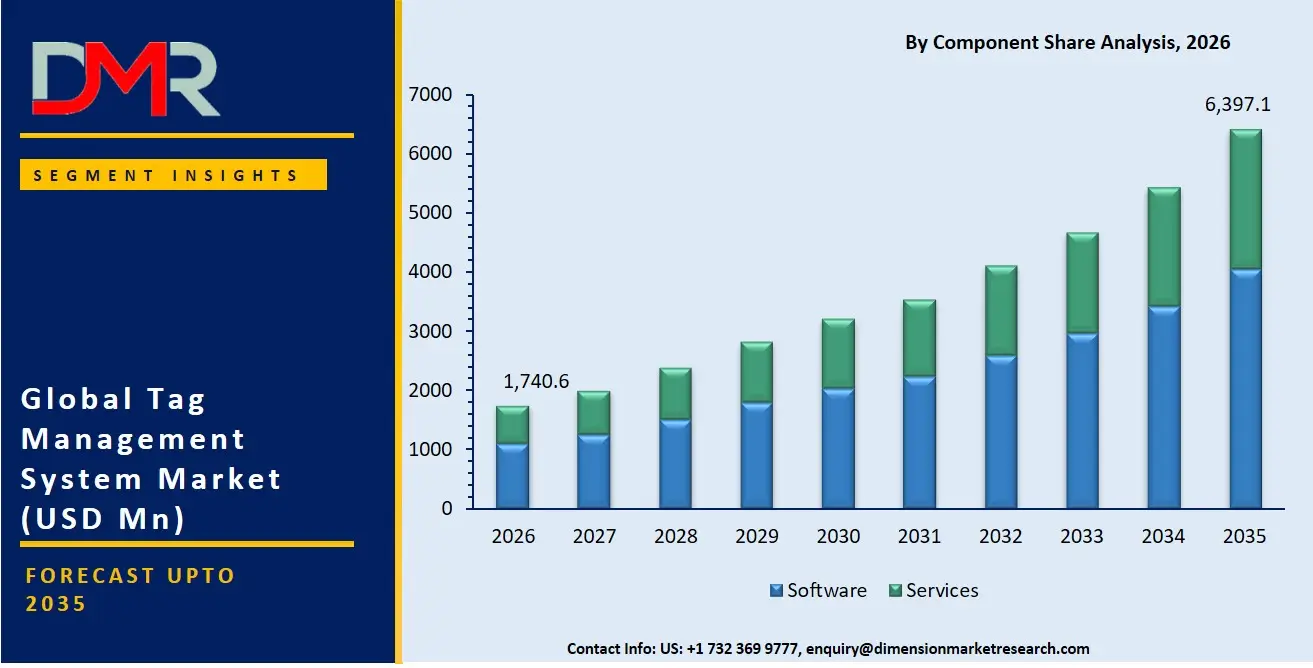
Software is projected to dominate the Global Tag Management System Market because organizations increasingly require centralized platforms to deploy, manage, and update tracking tags without relying heavily on IT teams. Modern software solutions streamline website and mobile application analytics, improve marketing campaign execution, reduce page loading times, and ensure compliance with evolving privacy regulations.
ℹ
To learn more about this report –
Download Your Free Sample Report Here
Enterprises prefer software-based tag management due to its scalability, real-time deployment capabilities, and seamless integration with analytics, advertising, customer data platforms, and content management systems. The growing adoption of digital marketing, omnichannel customer engagement, and first-party data strategies further strengthens software demand, making it the leading component across industries globally.
By Deployment Mode Analysis
Cloud-based deployment is anticipated to dominate the market because it provides flexibility, scalability, rapid implementation, and lower infrastructure costs compared to on-premise solutions. Organizations can manage tags across multiple digital properties from a centralized platform while benefiting from automatic software updates, enhanced security, and simplified maintenance. Cloud deployment also supports remote collaboration, real-time analytics integration, and seamless compatibility with marketing technology ecosystems. As businesses continue expanding digital operations and adopting SaaS-based marketing tools, cloud-based tag management has become the preferred deployment model for enterprises seeking agility, cost efficiency, and faster innovation without significant capital investment.
By Organization Size Analysis
Large enterprises are expected to dominate the Tag Management System Market due to their extensive digital ecosystems, multiple websites, mobile applications, and large-scale marketing campaigns requiring sophisticated tag governance. These organizations generate significant customer data and require centralized management to improve analytics accuracy, optimize advertising performance, and ensure compliance with global privacy regulations. Large enterprises also possess greater IT budgets, enabling investments in advanced tag management platforms integrated with customer data platforms, CRM systems, and business intelligence tools. Their strong focus on personalized customer experiences, digital transformation, and data-driven decision-making continues to drive substantial adoption of enterprise-grade tag management solutions.
By Function Analysis
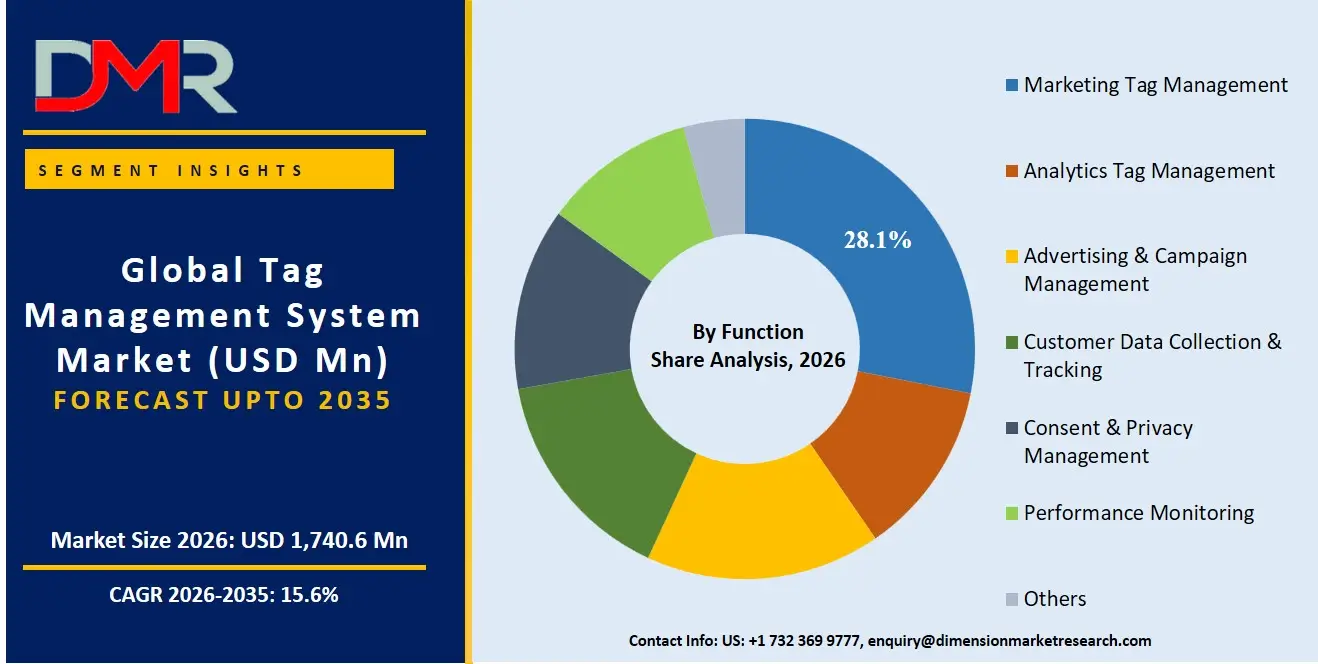
Marketing tag management is projected to dominate because digital marketing remains the primary use case for tag management systems. Businesses depend on marketing tags to measure campaign effectiveness, track customer interactions, optimize advertising spend, and improve conversion rates across digital channels. Centralized management enables marketers to deploy and modify tags quickly without extensive developer involvement, accelerating campaign launches and reducing operational complexity. As organizations increasingly invest in omnichannel marketing, customer journey analytics, and personalized advertising, marketing tag management continues to be the most widely adopted function, delivering measurable improvements in campaign performance, customer engagement, and return on marketing investment.
By Application Analysis
Digital marketing is poised to dominate the application segment because tag management systems are essential for measuring customer behavior, campaign performance, website engagement, and advertising effectiveness. Organizations use these platforms to rapidly deploy tracking codes across multiple channels while maintaining data accuracy and regulatory compliance. The expansion of social media marketing, programmatic advertising, search engine marketing, and personalized customer engagement has significantly increased the need for efficient tag management. Businesses prioritize digital marketing investments to improve customer acquisition, optimize advertising budgets, and maximize conversion rates, making this application the largest contributor to overall market demand.
By End User Analysis
Retail and e-commerce is expected to dominate the Tag Management System Market because digital retailers rely extensively on customer behavior tracking, personalized recommendations, campaign optimization, and conversion analytics. Tag management platforms enable retailers to collect accurate first-party customer data, monitor shopping journeys, evaluate marketing effectiveness, and improve website performance across multiple devices. The rapid growth of online shopping, omnichannel retail strategies, loyalty programs, and personalized digital experiences has further accelerated adoption within this sector. Retailers continuously invest in advanced analytics and marketing technologies to enhance customer engagement, increase sales conversions, reduce cart abandonment, and improve overall digital commerce performance.
The Global Tag Management System Market Report is segmented on the basis of the following:
By Component
- Software
- Web Tag Management
- Mobile Tag Management
- Server-Side Tag Management
- API & Event Tag Management
- Services
- Consulting
- Implementation & Integration
- Training & Support
- Managed Services
By Deployment Mode
By Organization Size
- Large Enterprises
- Small & Medium Enterprises (SMEs)
By Function
- Marketing Tag Management
- Analytics Tag Management
- Advertising & Campaign Management
- Customer Data Collection & Tracking
- Consent & Privacy Management
- Performance Monitoring
- Others
By Application
- Digital Marketing
- Web Analytics
- Mobile Application Analytics
- Customer Experience Management
- Personalization & A/B Testing
- Conversion Rate Optimization
- Compliance & Data Governance
- Others
By End User
- Retail & E-commerce
- Banking, Financial Services & Insurance (BFSI)
- IT & Telecommunications
- Media & Entertainment
- Healthcare & Life Sciences
- Manufacturing
- Travel & Hospitality
- Government & Public Sector
- Education
- Others
Regional Analysis
Leading Region by Market Share
ℹ
To learn more about this report –
Download Your Free Sample Report Here
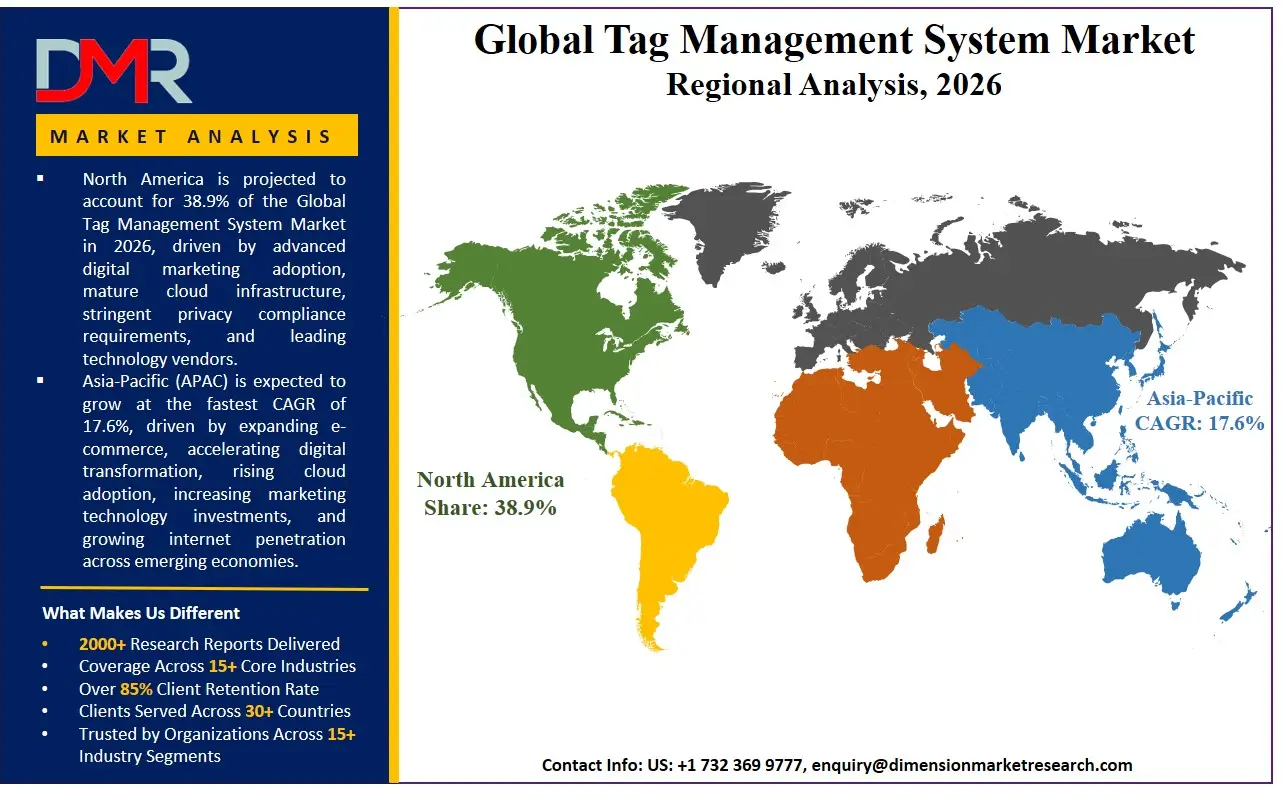
North America is poised to dominate the global tag management system market as it is projected to hold 38.9% of the market share by the end of 2026. The United States, which dominates North America, has the highest share in the TMS market because of the unmatched concentration of martech innovators and the aggressive data-driven marketing agendas of Fortune 500 companies. The area has an established ecosystem of global system integrators, specialized boutique tag governance firms, and a rich pool of talent in data layer architecture and privacy law. Enterprise investment in retail media networks, advanced multi-touch attribution, and the complete overhaul of cookie-based targeting contribute to the sustained demand for server-side tag management and API event forwarding, along with continuous performance monitoring. Moreover, an optimistic venture capital climate persistently finances upcoming D2C (Direct-to-Consumer) enterprises that need expert managed services to achieve rapid scale and privacy compliance.
Fastest-Growing Regional Market
Asia-Pacific is expected to be the most rapidly expanding tag management system market, driven by the government-led sweeping digital economy initiatives in India, China, Japan, and Southeast Asia. The fast-paced growth of smartphone penetration, the rise of a middle-income digital consumer base, and the dynamic expansion of super-app ecosystems are compelling established conglomerates and digital-native brands to discard inefficient, hard-coded tracking for unified TMS platforms. Consulting and implementation & integration services are in high demand to help these large organizations move toward server-side architectures and orchestrate complex consent mechanisms. There is also a severe lack of qualified TMS and data privacy talent in the region, making it necessary to outsource managed services and training & support to cover the skills gap and enable faster investments in personalization and conversion rate optimization.
By Region
North America
Europe
- Germany
- The U.K.
- France
- Italy
- Russia
- Spain
- Benelux
- Nordic
- Rest of Europe
Asia-Pacific
- China
- Japan
- South Korea
- India
- ANZ
- ASEAN
- Rest of Asia-Pacific
Latin America
- Brazil
- Mexico
- Argentina
- Colombia
- Rest of Latin America
Middle East & Africa
- Saudi Arabia
- UAE
- South Africa
- Israel
- Egypt
- Rest of MEA
Competitive Landscape
The competitive environment of the global tag management system market has become highly dynamic with a heterogeneous array of multinational software vendors, professional service divisions of the large advertising holding companies, and niche pure-play server-side consultancies. The key to success will be profound strategic alliances with major digital experience platforms (DXPs) and CDPs, because they will open the necessary co-selling opportunities and early access to new API integration capabilities. The movement towards market consolidation is rapidly progressing with traditional marketing analytics companies acquiring privacy-tech and AI engineering specialized boutiques to stay afloat. Proprietary intellectual property, including automated tag audit crawlers, consent connector frameworks, and industry-specific data layer templates, is becoming a more important basis of competitive differentiation than just basic tag-wrapping or generic technical support.
Some of the prominent players in the Global Tag Management System Market are:
- Google LLC
- Adobe Inc.
- Tealium Inc.
- Ensighten Inc.
- Commanders Act
- Piwik PRO
- Cloudflare, Inc.
- Stape Inc.
- Matomo
- Qubit (Coveo)
- ObservePoint
- HubSpot, Inc.
- Oracle Corporation
- Salesforce, Inc.
- Microsoft Corporation
- IBM Corporation
- SAS Institute Inc.
- Acoustic, L.P.
- BlueConic
- Snowplow Analytics Ltd.
- Other Key Players
Recent Developments
- May 2026: Tealium introduced new AI capabilities, including AI at the Edge, AI Decisioning, and enhanced integrations to strengthen real-time, privacy-first customer data orchestration and server-side activation.
- January 2026: Adobe released new Adobe Experience Platform capabilities, including Agent Orchestrator, enhanced Real-Time Customer Profile features, schema updates, and segmentation improvements to strengthen enterprise data activation and marketing workflows.
- January 2026: Tealium expanded its platform with Databricks Cloud Data Source general availability, enabling organizations to activate customer data directly from Databricks while supporting privacy regulations such as GDPR and CCPA.
Report Details
| Report Characteristics |
| Market Size (2026) |
USD 1,740.6 Mn |
| Forecast Value (2035) |
USD 6,397.1 Mn |
| CAGR (2026–2035) |
15.6% |
| The US Market Size (2026) |
USD 569.4 Mn |
| Historical Data |
2021 – 2025 |
| Forecast Data |
2027 – 2035 |
| Base Year |
2025 |
| Estimate Year |
2026 |
| Segments Covered |
By Component, By Deployment Mode, By Organization Size, By Function, By Application, and By End User |
| Regional Coverage |
North America – The US and Canada; Europe – Germany, The UK, France, Russia, Spain, Italy, Benelux, Nordic, & Rest of Europe; Asia-Pacific – China, Japan, South Korea, India, ANZ, ASEAN, Rest of APAC; Latin America – Brazil, Mexico, Argentina, Colombia, Rest of Latin America; Middle East & Africa – Saudi Arabia, UAE, South Africa, Turkey, Egypt, Israel, & Rest of MEA |
Frequently Asked Questions
How big is the Global Tag Management System Market?
▾ The Global Tag Management System market is poised to be valued at USD 1,740.6 million in 2026 and is projected to reach USD 6,397.1 million by 2035, driven by the universal need for specialized software and services to govern digital tags, ensure data privacy, and optimize marketing performance.
What is the CAGR of the Global Tag Management System Market from 2026 to 2035?
▾ The market is expected to grow at a CAGR of 15.6% from 2026 to 2035, reflecting the accelerating complexity of digital marketing stacks and the permanent shift to a cookieless, consent-first advertising ecosystem.
What factors are driving the growth of the Global Tag Management System Market?
▾ Key drivers include the critical need for marketing agility without IT dependency, the imperative to move data processing server-side for security and speed, the management complexity of 20+ vendor tags, and the surge in demand for Consent & Privacy Management consulting amid evolving global data sovereignty laws.
Which region held the largest share of the Tag Management System Market in 2026?
▾ North America is projected to hole 38.9% of the market share in 2026, driven by a dense ecosystem of martech pioneers and aggressive enterprise investment in unified data layers and server-side event forwarding.
Which region is expected to grow the fastest in the Tag Management System Market?
▾ The Asia-Pacific region is expected to grow the fastest, fueled by rapid digital commerce adoption in China, India, and Japan, where Implementation & Integration and Managed Services are critical for transitioning large consumer conglomerates to sophisticated personalization and mobile analytics.
What are the major trends in the Global Tag Management System Market?
▾ Major trends include the definitive shift to server-side architecture, the integration of AI into tag auditing and anomaly detection, the rise of Green Tagging for sustainability, the demand for data layer engineering, and the focus on Performance Monitoring to optimize Core Web Vitals.
Who are the key players in the Global Tag Management System Market?
▾ Key players include pure-play TMS providers like Tealium and Commanders Act, martech cloud leaders like Adobe and Google, privacy-focused platforms like Piwik PRO and Cookiebot, and the specialized TMS professional services divisions of global digital agencies.
How is the Global Tag Management System Market segmented?
▾ The market is segmented by Component, Deployment Mode, Organization Size, Function, Application, and End User.