Market Snapshot
- The Global Tech-Savvy Hotel Chains Market was valued at USD 117.41 Billion in 2025 and is forecast to reach USD 275.46 Billion by 2035, at a CAGR of 8.9%.
- Business Travelers led the End-User segment with a 56.23% share in 2025.
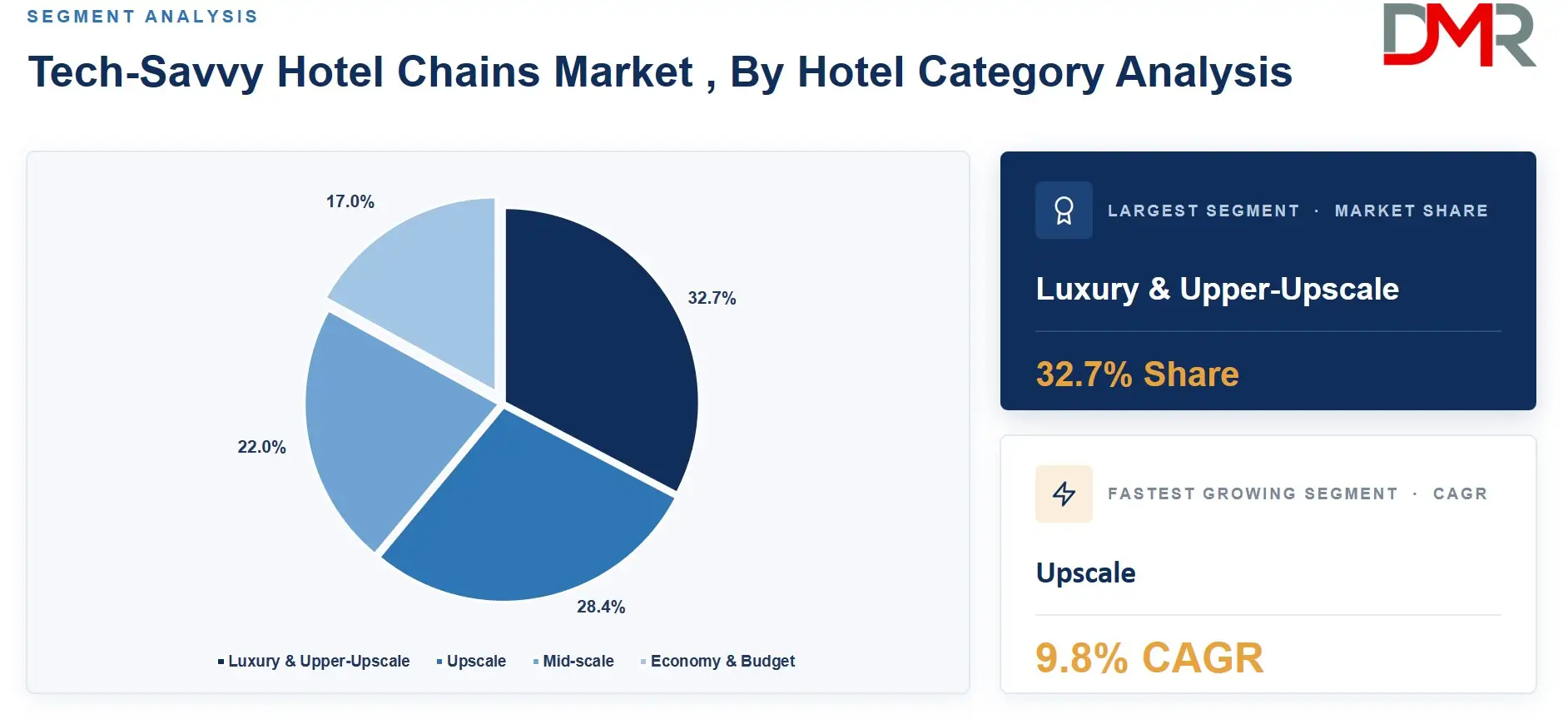
- Luxury & Upper-Upscale hotels held a 32.7% share of the Hotel Category segment in 2025.
- Hotel chains with Greater Than 500 properties captured a 54.75% share of the Hotel-Chain Tier segment in 2025.
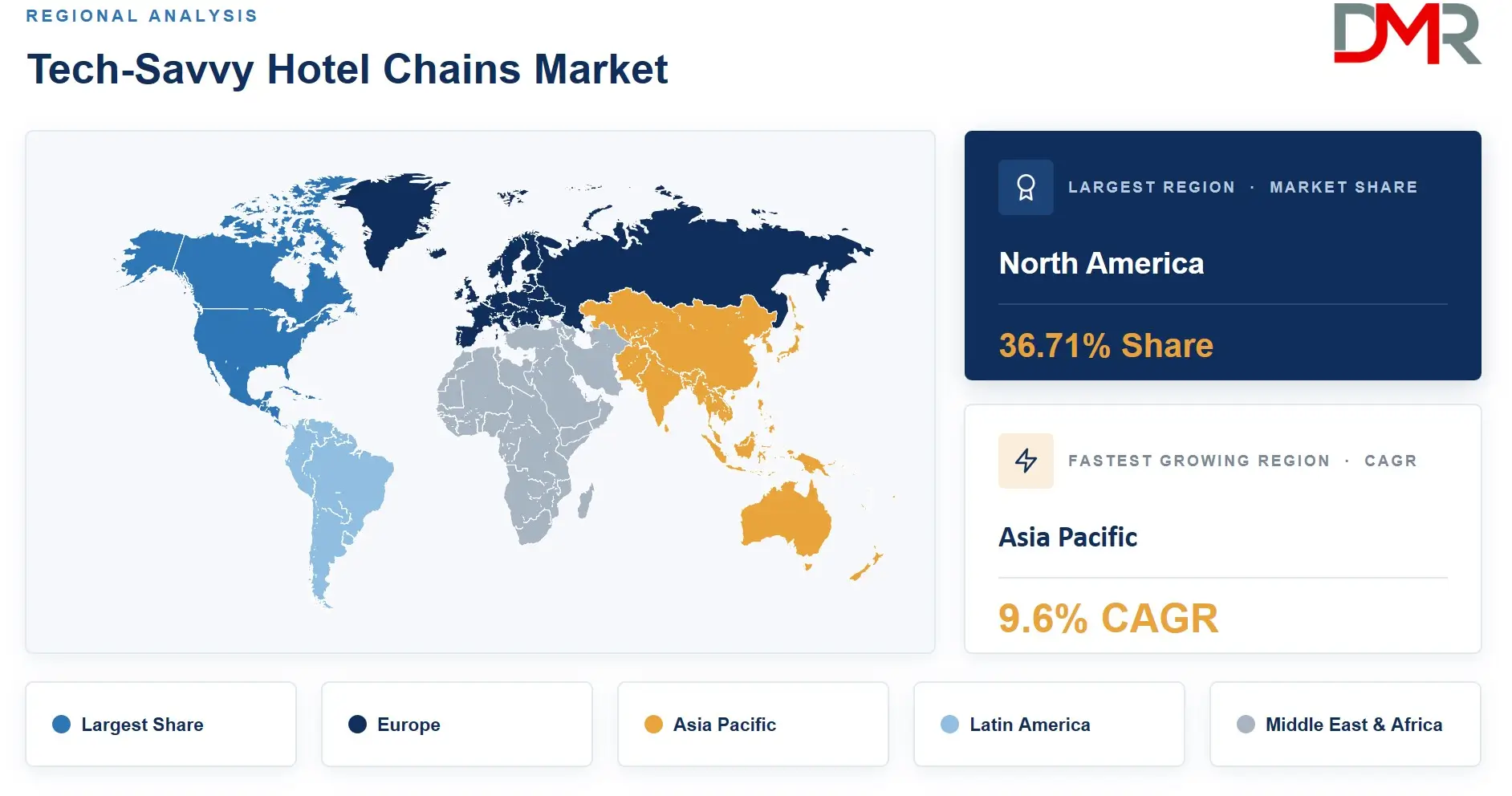
- North America held the largest regional share at 36.71% in 2025.
- Asia Pacific is the fastest-growing region in the forecast period.
Market Overview
The tech-savvy hotel chains market covers branded hospitality operators that deploy integrated digital infrastructure across their property portfolios. Qualifying deployments include cloud property management systems, IoT-enabled room controls, mobile guest applications, AI-driven revenue management, and contactless service channels. Pure lodging operators that rely on legacy on-premises systems are excluded, as are independent properties without brand affiliation or scaled technology rollout programs.
Hotels occupy a critical node in the broader travel and hospitality ecosystem. Technology investment now determines competitive position, guest retention rates, and cost structures more directly than property count or location alone. As reported by Oracle's "Hospitality in 2025" data cited in a 2025 implementation guide, 54% of hotel executives want mobile check-in and keyless room entry kept permanently across their properties. That majority preference signals a structural, not cyclical, shift in how chains define baseline guest experience.
Generative AI, cloud-native platforms, and sensor networks are compressing the cycle between guest preference data and service delivery. Operators that connect these systems across departments gain granular visibility into occupancy patterns, energy consumption, and loyalty behavior simultaneously. Chains that fail to integrate across functions face rising cost disadvantages as competitors automate both guest-facing and back-office operations at scale.
Market Size and Forecast
The Global Tech-Savvy Hotel Chains Market size is estimated at USD 127.87 Billion in 2026 from USD 117.41 Billion in 2025, and is projected to reach USD 275.46 Billion by 2035, exhibiting a CAGR of 8.9% during the forecast period.
Historical growth between 2020 and 2024 reflected recovery from pandemic-era demand disruption combined with accelerated capital reallocation toward technology infrastructure. Hotel groups used reduced occupancy periods to overhaul property management systems and pilot AI pricing tools without disrupting peak-season operations. Figures from CareerTrainer AI confirm that by 2026, 75% of hotel chains were exploring or implementing AI for revenue management and dynamic pricing, indicating that technology adoption had crossed from early-mover advantage into mainstream chain strategy.
.webp)
ℹ
To learn more about this report –
Download Your Free Sample Report Here
Forecast assumptions rest on sustained enterprise spending on smart hospitality infrastructure, continued 5G rollout across key urban and resort markets, and growing guest willingness to share behavioral data in exchange for personalized service. A downside scenario would emerge if capital costs for legacy-property retrofits deter mid-tier operators from committing to full digital overhauls, compressing growth among economy and midscale tiers. The upside scenario depends on data monetization partnerships maturing into reliable revenue streams for multi-property groups, adding a secondary income layer beyond room yield.
Hotel Category Analysis
Luxury & Upper-Upscale hotels accounted for 32.7% of Hotel Category demand in 2026, the highest of any category.
Luxury and upper-upscale operators set the technology investment benchmark for the entire market. These properties deploy the most complete digital stacks, combining AI concierge systems, biometric access, and IoT comfort controls to justify premium rate positioning. An IoT-enabled energy management platform deployed across a lodging portfolio delivered 65% general energy savings and £376,911 in cost reductions within 12 months, as documented in a 2025 Spacewell case study. Luxury operators are primary adopters of such platforms because the ROI calculation is clearest where room rates are highest.
ℹ
To learn more about this report –
Download Your Free Sample Report Here
Upscale properties are the fastest-growing category, closing the technology gap with luxury operators by adopting white-label smart hospitality tools at lower implementation costs. Mid-scale and economy segments present a structural lag. Capital constraints in budget tiers mean operators in those categories tend to prioritize point solutions, such as mobile check-in or automated housekeeping scheduling, over end-to-end platform integration. Vendors targeting mid-scale chains with modular, subscription-based deployment models hold the clearest growth path in underserved categories.
End-User Analysis
With a 56.23% share in 2026, Business Travelers outpaced all other End-User categories.
Business travelers generate the majority of demand because their itineraries prioritize frictionless digital service, reliable connectivity, and speed of check-in over price sensitivity. Corporations increasingly mandate tech-enabled properties for duty-of-care compliance and expense management integration. That buyer behavior creates a self-reinforcing cycle: hotel chains with stronger digital infrastructure win corporate accounts, generating revenue that funds further technology investment.
Leisure travelers represent the second segment and are narrowing the gap. Post-pandemic leisure spending elevated expectations for contactless service, app-controlled room environments, and in-stay personalization among non-business guests. Properties that built business-traveler digital capability now find the same infrastructure generating loyalty among leisure guests, particularly in urban and resort markets where mid-to-upscale brands compete for repeat bookings.
Hotel-Chain Tier Analysis
Greater Than 500 properties chains captured 54.75% of the Hotel-Chain Tier segment in 2026, ahead of all rivals.
Scale is the primary competitive variable in technology deployment. Chains operating more than 500 properties spread infrastructure investment across a larger revenue base, reducing per-property cost and accelerating payback periods. Central procurement of cloud PMS licenses, AI pricing engines, and IoT sensor networks at group level gives large-tier operators cost and integration advantages that smaller operators cannot easily replicate.
The 101 to 500 property tier is gaining ground by adopting managed service models, outsourcing technology operations to third-party hospitality tech providers rather than building internal capability. Chains with fewer than 100 properties face the steepest barriers. Vendors offering scalable SaaS platforms with low minimum deployment thresholds are the most likely partners to unlock revenue from this fragmented tier.
Key Market Segments
By Hotel Category
- Luxury & Upper-Upscale
- Upscale
- Mid-scale
- Economy & Budget
By End-User
- Business Travelers
- Leisure Travelers
By Hotel-Chain Tier
- Greater Than 500 properties
- 101–500 properties
- Less Than 100 properties
Regional Analysis
North America led all regions with a 36.71% share of the Tech-Savvy Hotel Chains Market in 2026, equivalent to approximately USD 43.09 Billion.
North America's dominance reflects the concentration of global hotel chain headquarters, the maturity of enterprise hospitality technology vendors, and high corporate travel volumes that reward digital infrastructure investment. US-based chains completed cloud PMS migrations and AI revenue management deployments ahead of peers in other regions, creating a compounding advantage as data volumes from those systems now inform more accurate pricing and guest segmentation. Based on research by Nurix AI in 2025, AI customer-service deployments in chain hotels reduced wait times by 30% while supporting guests in 20 languages, a capability profile that North American operators were first to operationalize at scale.
Asia Pacific is the fastest-growing region, where a combination of urban construction pipelines, rising domestic travel demand, and government smart-city investment is pulling hotel technology spend forward. China, Japan, and South Korea lead within the region on contactless payment integration and in-room automation. Europe holds a steady share, supported by business travel corridors between major financial centers and sustainability regulations that align with smart energy management investments. Latin America and the Middle East and Africa remain early-stage but are attracting vendor attention as branded chain expansion accelerates in Gulf cities and secondary Brazilian markets.
ℹ
To learn more about this report –
Download Your Free Sample Report Here
Key Regions and Countries
North America
Europe
- Germany
- France
- The UK
- Spain
- Italy
- Rest of Europe
Asia Pacific
- China
- Japan
- South Korea
- India
- Australia
- Rest of APAC
Latin America
- Brazil
- Mexico
- Rest of Latin America
Middle East & Africa
- GCC
- South Africa
- Rest of MEA
Market Dynamics
AI and Connected Infrastructure Redefine Revenue and Guest Service Economics
AI-driven revenue management systems are generating measurable financial returns that now justify enterprise-scale deployment budgets. Hotels using these systems in 2025 reported an estimated 17% increase in total revenue compared with non-adopters, as reported by Hotel Technology News based on aggregated live deployment data. That revenue gap creates a competitive imperative: operators without AI pricing engines face structural yield disadvantage against chains that have already embedded the capability.
Alongside revenue gains, AI-based optimization reduced manual pricing work by approximately 30% in revenue management teams, as reported by Hotel Technology News in 2025. Those freed staff hours migrate toward strategic analysis, loyalty program development, and cross-property revenue coordination. In October 2025, Treebo Hospitality Ventures launched its "Hotel Superhero" SaaS AI management system, deploying voice and chat-based automation across more than 750 properties, demonstrating that the productivity shift is already scaling beyond flagship chains into regional operators.
Smart thermostats with occupancy sensors deliver approximately 20–40% energy savings per room by cutting heating and cooling in unoccupied spaces, as documented by NZero in 2025. For large chains running thousands of rooms nightly, that reduction translates into material cost improvements at portfolio level, compounding the ROI case for full smart-building integration.
Legacy Infrastructure Slows Full-Scale Digital Conversion
Older hotel assets present the primary structural brake on market-wide adoption. Legacy property management systems and fragmented back-office stacks require expensive middleware or full replacement before smart hospitality tools can operate at their designed capability. Robot leasing for hotels typically costs $1,000–$2,000 per month, while purchasing units ranges from $15,000–$25,000 with a 5 to 7 year operational lifespan, as reported by RoboZaps in 2026. For economy and mid-scale operators with compressed margins, those acquisition costs extend payback timelines beyond typical investment approval horizons.
Executive hesitation on full-scale digital overhauls is a documented pattern, particularly among ownership groups that manage properties under management contracts where technology investment responsibility is disputed between owner and operator. Until industry contracts more clearly allocate technology capex obligations, fragmented decision-making will continue to slow retrofit timelines in the mid-tier.
Mid-Scale Conversion and Automation Partnerships Open Untapped Revenue Pools
Mid-scale regional chains in second-tier cities represent the clearest white space in Tech-Savvy Hotel Chains Market . Occupancy data from those properties shows tech-oriented business traveler demand that is currently served by undifferentiated supply. Vendors capable of delivering end-to-end smart hotel conversion packages at manageable capital thresholds can capture a segment that global chains have not yet fully penetrated.
Operational automation presents a parallel opportunity. A single delivery robot operating 24/7 saves approximately $45,000–$70,000 annually in wages and benefits, with payback periods of 6 to 18 months, as reported by RoboZaps in 2026. At Iberostar Hotels in 2025, a focused smart energy project reduced HVAC demand by 25% and total energy costs by 15%, per SENER Group reporting. Replicating those results across a 200-property portfolio would generate savings that fund the next cycle of technology investment without external capital.
Market Trends
Cloud-Native Stacks and AI Guest Interfaces Become Competitive Baseline
Contactless check-in, mobile key access, and digital payments have shifted from differentiators to baseline expectations among guests at technology-forward properties. A 2026 AI and hospitality report from CareerTrainer AI found that 68% of hotels globally were piloting or deploying AI chatbots for guest communication and concierge-style assistance. Cloud-native hospitality technology stacks are replacing on-premises systems across major chains, enabling faster feature deployment and real-time data sharing across distributed networks. Operators that complete the migration earliest will enter the next pricing cycle with lower IT maintenance costs and higher service agility than peers still running hybrid architectures.
Market Competition Overview
The tech-savvy hotel chains market is moderately consolidated at the top tier, where a handful of global multi-brand operators control the largest share of technology-enabled room supply. These leading groups leverage centralized procurement and shared platform infrastructure to drive down per-property technology costs, a structural advantage that widens as their portfolios grow. Figures from NZero in 2025 show that LED fixture upgrades alone reduce lighting energy use by up to 75% in hotel properties. Large operators that have completed portfolio-wide LED and sensor rollouts have already extracted cost savings that smaller rivals are still approaching.
The competitive boundary is shifting from brand count to data capability. Operators with the richest cross-property guest datasets can train more accurate AI pricing and personalization models, compounding their yield advantage each booking cycle. Mid-tier players are responding by forming technology consortia and adopting shared SaaS platforms. New entrants from the hospitality technology vendor side are also acquiring smaller boutique chains to test proprietary platforms at scale before licensing to larger groups.
Company Profiles
Canary Technologies has built its competitive position by embedding AI across the full guest journey, from pre-arrival messaging through checkout. In June 2025, the company raised $80 million in Series D funding led by Brighton Park Capital, extending its platform reach across thousands of properties globally. A documented case study at Trapp Family Lodge and Resort confirmed that the Canary AI guest engagement platform reduced average response times to 30 seconds while cutting call volume by 30%, as reported by Canary Technologies in 2025. That performance profile positions the company as a strong partner for mid-to-large chains targeting labor cost reduction without sacrificing service quality.
Marriott International operates the market's most visible technology transformation at scale. The group's strategy combines portfolio expansion through acquisition with platform-level AI investment. Marriott's focus on generative AI use cases and cloud-native systems across its global network signals that technology is now a primary rather than supporting pillar of its brand architecture. Competitors without equivalent data infrastructure face increasing difficulty matching Marriott's ability to personalize pricing and service offers across diverse traveler profiles.
Key Players
- Meliá Hotels International
- Louvre Hotels Group
- Marriott International
- Whitbread plc (Premier Inn)
- Shangri-La Group
- Four Seasons Hotels & Resorts
- Mandarin Oriental Hotel Group
- Hilton Worldwide
- Accor Hotels
- InterContinental Hotels Group (IHG)
- Jin Jiang International
- Hyatt Hotels Corp.
- citizenM Hotels
- OYO Hotels & Homes
- Sonder Holdings
- Red Lion Hotels Corp.
- Wyndham Hotels & Resorts
- Choice Hotels International
- Radisson Hotel Group
- Minor Hotels
Recent Developments
- April 2025 Marriott International completed its acquisition of citizenM for approximately $355 million, adding 37 tech-enabled lifestyle hotels with mobile-first, smart-room guest experience features to its portfolio.
- September 2025 Marriott International expanded its AI transformation strategy by prioritizing generative AI use cases and deploying cloud-native systems across its global hotel network.
- March 2026 Hilton rolled out its AI Planner, a generative AI tool embedded in its booking platform to enable conversational trip planning across its 9,100-property network.
Report Details
| Report Characteristics |
| Market Value (2025) |
USD 117.41 Billion |
| Market Value (2026) |
USD 127.87 Billion |
| Forecast Revenue (2035) |
USD 275.46 Billion |
| CAGR (2026–2035) |
8.9% |
| Base Year for Estimation |
2025 |
| Historic Period |
2020 – 2024 |
| Forecast Period |
2026 – 2035 |
| Report Coverage |
Revenue Forecast, Market Dynamics, Competitive Landscape, Recent Developments |
| Segments Covered |
By Hotel Category (Luxury & Upper-Upscale, Upscale, Mid-scale, Economy & Budget), By End-User (Business Travelers, Leisure Travelers), By Hotel-Chain Tier (Greater Than 500 properties, 101–500 properties, Less Than 100 properties) |
| Regional Analysis |
North America – US and Canada; Europe – Germany, France, The UK, Spain, Italy, and Rest of Europe; Asia Pacific – China, Japan, South Korea, India, Australia, and Rest of APAC; Latin America – Brazil, Mexico, and Rest of Latin America; Middle East & Africa – GCC, South Africa, and Rest of MEA |
| Competitive Landscape |
Meliá Hotels International, Louvre Hotels Group, Marriott International, Whitbread plc (Premier Inn), Shangri-La Group, Four Seasons Hotels & Resorts, Mandarin Oriental Hotel Group, Hilton Worldwide, Accor Hotels, InterContinental Hotels Group (IHG), Jin Jiang International, Hyatt Hotels Corp., citizenM Hotels, OYO Hotels & Homes, Sonder Holdings, Red Lion Hotels Corp., Wyndham Hotels & Resorts, Choice Hotels International, Radisson Hotel Group, Minor Hotels |
| Customization Scope |
Customization for segments and region or country level will be provided. Additional customization can be done based on requirements. |
| Purchase Options |
Three license options: Single User License, Multi-User License (Up to 5 Users), Corporate Use License (Unlimited Users and Printable PDF) |
Frequently Asked Questions
What is the biggest investment opportunity in Tech-Savvy Hotel Chains Market ?
▾ End-to-end smart hotel conversions for mid-scale regional chains in second-tier cities represent the largest underserved opportunity. Business traveler demand in those markets is currently served by properties with minimal digital infrastructure. Vendors offering modular, subscription-based deployment at accessible capital thresholds hold the clearest path to capturing this segment.
Who are the top companies in Tech- Hotel Savvy Chains Market ?
▾ Marriott International, Hilton Worldwide, and InterContinental Hotels Group rank among the largest operators by technology-enabled room supply and platform investment. Canary Technologies leads among hospitality technology vendors serving chain operators globally. Accor Hotels, Hyatt Hotels Corp., and Wyndham Hotels & Resorts are also primary players across multiple tiers and regions.
Which segment is growing fastest in Tech- Hotel Savvy Chains Market and why?
▾ The Upscale hotel category is the fastest-growing segment within Hotel Category. Upscale operators are closing the technology gap with luxury chains by adopting white-label smart hospitality tools at lower implementation costs. Business traveler demand for frictionless digital service in that tier is pulling capital allocation toward platform upgrades at a faster rate than economy categories.
Which region is growing fastest in Tech- Hotel Savvy Chains Market and why?
▾ Asia Pacific is the fastest-growing region, driven by new urban hotel construction, rising domestic travel, and government smart-city investment programs across China, Japan, South Korea, and India. Those conditions create greenfield deployment opportunities where technology can be built into properties from the ground up rather than retrofitted into legacy assets.
What is the biggest challenge holding Tech-Savvy Hotel Chains Market back?
▾ Legacy property management systems and fragmented back-office stacks are the primary barrier to full-scale digital adoption. Capital-intensive retrofits for older hotel assets create extended ROI timelines that slow executive commitment, particularly in ownership structures where technology investment responsibility between owner and operator is ambiguous.